Autonomous Self-Assembly in Bioprinting: Harnessing Developmental Biology to Build Functional Tissues
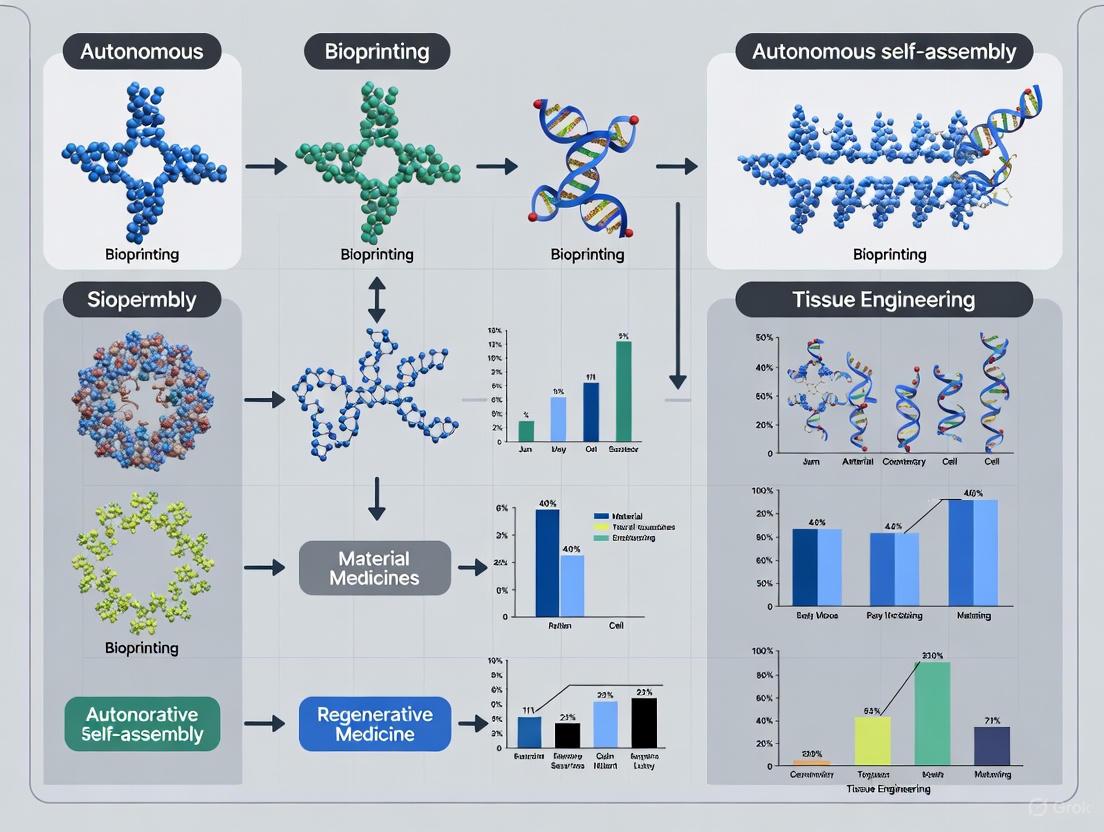
This article explores autonomous self-assembly, a scaffold-free biofabrication strategy that mimics embryonic development to create complex, functional tissues.
Autonomous Self-Assembly in Bioprinting: Harnessing Developmental Biology to Build Functional Tissues
Abstract
This article explores autonomous self-assembly, a scaffold-free biofabrication strategy that mimics embryonic development to create complex, functional tissues. Targeting researchers, scientists, and drug development professionals, we examine the foundational principles of self-assembly and cell sorting, detail innovative methodologies like tissue strands and 4D bioprinting, and address key challenges in vascularization and process control. The content further discusses optimization through machine learning and advanced materials, validates approaches with in vivo testing and mathematical modeling, and compares self-assembly against traditional scaffold-based methods. By synthesizing current research and future directions, this review underscores the transformative potential of autonomous self-assembly for generating biologically accurate tissue models and clinical grafts.
The Principles of Self-Assembly: From Embryonic Development to Scaffold-Free Biofabrication
Defining Autonomous Self-Assembly and Self-Organization in Biological Systems
In the realm of biology and regenerative medicine, the processes of autonomous self-assembly and self-organization represent fundamental principles through which disordered components spontaneously form organized structures and patterns. These processes are pivotal for embryonic development, tissue maintenance, and the emerging field of bioprinting. Autonomous self-assembly is defined as a process where a disordered system of pre-existing components forms an organized structure or pattern as a consequence of specific, local interactions among the components themselves, without external direction [1]. When the constitutive components are molecules, the process is more specifically termed molecular self-assembly [1]. This process is characterized by its spontaneity and reversibility, with the responsible interactions acting on a strictly local level [1].
In contrast, self-organization refers to the emergence of an overall order in time and space of a given system that results from the collective interactions of its individual components [2] [3]. A critical distinction lies in their thermodynamic behavior: self-assembly typically occurs in equilibrium or near-equilibrium conditions, while self-organization requires a constant input of energy to maintain order, occurring in non-equilibrium or dissipative systems [3]. This energy dependence makes self-organization a hallmark of living systems, which constantly consume energy to maintain their organized state [3]. Despite these distinctions, the terms are often used interchangeably in scientific literature, particularly when describing biological phenomena where both processes frequently operate in concert [2].
Table 1: Fundamental Characteristics of Self-Assembly and Self-Organization
| Characteristic | Self-Assembly | Self-Organization |
|---|---|---|
| Energy Requirement | Typically occurs at or near equilibrium | Requires constant energy input (dissipative systems) |
| Thermodynamic State | Equilibrium states | Far-from-equilibrium states |
| Temporal Dynamics | Often static once formed | Dynamic, ongoing processes |
| Biological Examples | Protein folding, lipid bilayer formation | Cellular oscillations, cortical waves, morphogenetic patterning |
| Role in Bioprinting | Scaffold formation, bioink design | Tissue maturation, vascular network formation |
Theoretical Foundations and Key Distinctions
The theoretical underpinnings of self-assembly and self-organization reveal why these processes are so pervasive in biological systems. Self-assembly in microscopic systems typically follows a sequence beginning with diffusion, followed by nucleation of seeds, subsequent growth of these seeds, and ending at Ostwald ripening [1]. The thermodynamic driving free energy can be either enthalpic or entropic, with the latter being particularly counter-intuitive as entropy is conventionally associated with disorder [1]. Despite this association, under suitable conditions, entropy maximization can indeed drive nano-scale objects to self-assemble into target structures in a controllable way [1].
Self-organization relies on four basic ingredients: (1) strong dynamical non-linearity, often involving positive and negative feedback; (2) balance of exploitation and exploration; (3) multiple interactions among components; and (4) availability of energy to overcome the natural tendency toward entropy [2]. The principle of "order from noise" formulated by Heinz von Foerster notes that self-organization is facilitated by random perturbations that let the system explore a variety of states in its state space [2]. This increases the chance that the system will arrive into the basin of a "strong" or "deep" attractor.
Three distinctive features make self-assembly a unique concept beyond ordinary chemical reactions. First, the self-assembled structure must have a higher order than the isolated components. Second, weak interactions (e.g., Van der Waals, capillary, π-π interactions, hydrogen bonds) take a prominent role rather than strong covalent bonds. Third, the building blocks span a wide range of nano- and mesoscopic structures with different chemical compositions, functionalities, and shapes—not just atoms and molecules [1]. These features enable the sophisticated structural and functional complexity observed in biological systems while maintaining the flexibility and reversibility necessary for adaptive responses.
Methodologies for Studying Self-Assembly and Self-Organization
Experimental Approaches and Technical Protocols
Investigating self-assembly and self-organization in biological systems requires specialized methodologies that can capture their dynamic, multi-scale nature. For studying protein self-assembly systems like the Min system in bacteria, which defines the position for cell division, researchers employ both reverse engineering of the natural biological situation and forward engineering through reconstitution approaches [3]. The Min protein system, where proteins shuttle between cytoplasmic and membrane-bound states through self-organization, is typically analyzed through fluorescence microscopy to visualize oscillation patterns, combined with genetic manipulation to determine functional dependencies [3].
The experimental workflow for scaffold-free tissue engineering exemplifies how these principles are applied in bioprinting research. This methodology utilizes self-assembling multicellular units as building blocks, employing early developmental morphogenetic principles such as cell sorting and tissue fusion [4]. The protocol begins with (1) preparation of multicellular spheroids as bioink particles, (2) printing these spheroids into defined architectures using rapid prototyping technologies, (3) incubation under conditions that promote tissue fusion, and (4) maturation in bioreactors that provide appropriate mechanical and biochemical cues [4]. This approach leverages the innate self-organizing capacity of cells to form functional tissue structures without exogenous scaffolds.
Table 2: Key Reagents and Materials for Studying Self-Assembly and Self-Organization
| Reagent/Material | Composition/Type | Function in Research |
|---|---|---|
| Bioinks | Natural polymers (alginate, gelatin, HA, collagen), synthetic polymers (PEG, PCL, Pluronics) | Provide 3D environment for cell encapsulation and tissue formation [5] [6] |
| Multicellular Spheroids | Cell aggregates (100-500 μm diameter) | Serve as self-assembling building blocks for scaffold-free tissue engineering [4] |
| Hydrogels | Crosslinked networks with high water content | Mimic natural extracellular matrix for 3D cell culture [5] [6] |
| Min Protein System Components | MinD, MinE, MinC proteins | Model system for studying protein self-organization and pattern formation [3] |
| Lipid Assemblies | Phospholipids, cholesterol, sphingolipids | Study membrane domain formation and cellular compartmentalization [7] |
Analytical and Computational Methods
Quantitative analysis of self-organization often employs reaction-diffusion systems, which since Turing's seminal work have been recognized as fundamental descriptions for pattern formation and self-organization in biology [3]. These systems are mathematically modeled using partial differential equations that describe how the concentration of one or more substances distributed in space changes under the influence of two processes: local chemical reactions in which the substances are converted into each other, and diffusion which causes the substances to spread out in space [3].
For molecular self-assembly, kinetic analysis typically follows Langmuir adsorption models where the absorption/adsorption rate in diffusion-controlled concentrations can be estimated by Fick's laws of diffusion [1]. The desorption rate is determined by the bond strength of the surface molecules/atoms with a thermal activation energy barrier, while the growth rate represents the competition between these two processes [1]. Advanced microscopy techniques including cryo-electron microscopy and fluorescence recovery after photobleaching (FRAP) provide crucial experimental data on assembly dynamics and molecular mobility within organized structures [7].
Applications in Bioprinting and Tissue Engineering
The principles of self-assembly and self-organization are revolutionizing approaches to tissue engineering and regenerative medicine, particularly through bioprinting technologies. In bioprinting, autonomous self-assembly mimics the organ development process seen in embryos, facilitating tissue growth under laboratory conditions by leveraging cellular components to organize tissue through the production of extracellular matrix components and signaling molecules [5]. This approach represents a paradigm shift from traditional scaffold-based methods toward more biologically driven fabrication strategies.
A key application involves using multicellular spheroids as self-assembling building blocks that undergo tissue fusion to form larger, more complex structures [4]. When placed in close proximity, these spheroids fuse similarly to liquid droplets, a process driven by the minimization of free surface energy and cellular motility [4]. This scaffold-free approach harnesses the innate developmental capacity of cells, potentially overcoming limitations associated with synthetic biomaterials such as immunogenicity, inflammatory responses, and mechanical mismatch with native tissues [4].
Three-dimensional bioprinting implements these principles through three primary approaches: biomimicry, autonomous self-assembly, and mini-tissue building blocks [5]. The success of these bioprinting techniques heavily relies on the careful selection of bioinks—specialized materials that enable the printing of living cells and biomolecules while ensuring their proper transport and organization during the 3D printing process [5]. These bioinks must create environments that promote cell adhesion, proliferation, and optimal functionality, with both natural and synthetic polymers being widely used [5].
Table 3: Quantitative Parameters for Self-Assembly in Bioprinting Applications
| Parameter | Typical Range/Values | Impact on Tissue Formation |
|---|---|---|
| Cell Viability Post-Printing | >80% target [8] | Determines functional potential of printed construct |
| Spheroid Diameter | 100-500 μm [4] | Affects diffusion limits and fusion kinetics |
| Tissue Fusion Time | Hours to days [4] | Influences structural integrity and organization |
| Pore Size in Assembled Structures | 50-200 μm [1] | Affects nutrient diffusion and vascular invasion |
| Bioink Viscosity | 10-1000 Pa·s [5] | Impacts printability and cell viability during extrusion |
Current Challenges and Future Perspectives
Despite significant advances, several challenges remain in fully harnessing self-assembly and self-organization for bioprinting applications. The most significant hurdle is vascularization—creating functional blood vessel networks within engineered tissues [8]. While small tissue patches can survive through diffusion, larger structures require perfusable vascular networks to deliver oxygen and nutrients while removing waste products [8]. Current research focuses on creating vascular networks with endothelial cells to ensure tissue viability and integration [8].
Future directions include the development of 4D bioprinting using "smart" materials that change shape or function after printing in response to physiological triggers like body temperature or specific molecular signals [8]. This approach would enable the creation of constructs that dynamically self-organize after implantation, better mimicking natural developmental processes. Additionally, organ-on-a-chip systems represent another promising application where self-organizing principles are used to create more physiologically relevant models for drug screening and disease modeling [6].
The convergence of guided self-organization concepts with bioprinting technologies offers particular promise for addressing current limitations in tissue fabrication. This approach aims to regulate self-organization for specific purposes by constraining self-organizing processes within complex systems through restrictions on local interactions rather than explicit external control mechanisms [2]. By combining task-independent global objectives with task-dependent constraints on local interactions, researchers can steer self-organizing processes toward desired outcomes such as increased internal structure and functionality [2]. As these technologies mature, they hold potential to ultimately fulfill the promise of generating fully functional, transplantable organs through biologically inspired fabrication approaches.
Embryonic morphogenesis is the complex biological process through which a developing embryo forms its distinct shapes and structures. This process is orchestrated by autonomous cellular self-assembly, a principle that tissue engineers are now harnessing to create functional biological structures. Self-assembly is defined as the autonomous organization of components, from an initial state into a final pattern or structure without external intervention [4]. Living organisms, particularly the developing embryo, are quintessential self-organizing systems where histogenesis and organogenesis occur through intricate cell-cell and cell-extracellular matrix (ECM) interactions [4].
The growing interest in applying these developmental principles to bioprinting research stems from limitations in traditional scaffold-based tissue engineering approaches. Such limitations include immunogenicity, inflammatory responses to biodegradation products, mechanical mismatch with native tissues, and difficulties in creating complex, multi-cellular architectures [4] [9]. In contrast, scaffold-free, self-assembly-based approaches utilize the innate regenerative capabilities of cells and tissues, relying on developmental processes like cell sorting and tissue fusion to form biologically relevant structures [4] [10]. This whitepaper details the core mechanisms of embryonic morphogenesis and their application as revolutionary tools in advanced biomanufacturing.
Core Mechanisms of Morphogenesis
Cell Sorting: The Pursuit of Energetic Equilibrium
Cell sorting is a fundamental morphogenetic process wherein cells self-organize into structured tissues based on differential adhesion properties. The Differential Adhesion Hypothesis (DAH) provides a theoretical framework, proposing that cells move within a cellular collective to maximize adhesion and minimize free interfacial energy, much like the separation of immiscible liquids [9]. This results in populations of cells rearranging so that more cohesive (strongly adhesive) cells become internalized, while less cohesive (weakly adhesive) cells envelop them [4].
This phenomenon is governed by the distinct expression of cell adhesion molecules (CAMs), such as cadherins, which act as biological adhesives. The resulting surface and interfacial tensions between different cell populations drive the reorganization. The process can be modeled computationally, for instance, using the cellular Potts model, which simulates cell behavior based on energy minimization principles [9]. In a practical demonstration, when mixtures of cells from different tissue types (e.g., liver and heart) are placed in culture, they will spontaneously sort and segregate into distinct, spatially organized domains that recapitulate embryonic tissue organization [4].
Tissue Fusion: The Merging of Cellular Building Blocks
Tissue fusion is the process by which two or more contiguous, cell-dense structures merge into a single, larger tissue entity. This is a critical process in embryonic development, evident in events such as neural tube formation and palatal fusion [4]. From a biophysical perspective, tissue fusion is driven by the same thermodynamic principles as cell sorting—the pursuit of a configuration that minimizes surface free energy [9].
The kinetics of this process are influenced by several factors:
- Tension at the tissue surface: Generated by actomyosin cortices, this tension acts like a "surface tension" in liquid droplets, promoting rounding and fusion.
- Cell mobility and proliferation: These enable the remodeling required for the merging of structures.
- ECM deposition and remodeling: Newly synthesized matrix components help stabilize the fused structure.
In biofabrication, tissue fusion enables the creation of larger, scalable tissues from smaller building blocks like spheroids or strands [10]. These units, when placed in close proximity, will fuse over time to form a continuous, cohesive tissue, as demonstrated in the fabrication of vascular-like structures [4].
Biological Machinery: Molecules and Forces Driving Morphogenesis
The mechanisms of cell sorting and tissue fusion are powered by a conserved set of biological components.
Table 1: Key Molecular and Physical Drivers of Morphogenesis
| Driver Category | Key Examples | Primary Function in Morphogenesis |
|---|---|---|
| Cell Adhesion Molecules | Cadherins (e.g., E-cadherin, N-cadherin), Integrins | Mediate selective cell-cell and cell-ECM adhesion; generate mechanical forces for rearrangement [9]. |
| Cytoskeletal Elements | Actin, Myosin, Microtubules | Generate contractile forces and enable cell shape changes and motility [9]. |
| Extracellular Matrix (ECM) | Collagen, Laminin, Fibronectin | Provides structural scaffold and biochemical cues for cell migration, adhesion, and differentiation [4] [9]. |
The interplay of these components is regulated by various signaling pathways. The following diagram illustrates the core logical relationship and workflow of how these mechanisms are integrated into a bioprinting strategy.
Application in Bioprinting: From Spheroids to Scaffold-Free Organs
The Scalable Bioink: Tissue Strands
A significant advancement in scaffold-free bioprinting is the development of tissue strands as a novel bioink. This approach involves fabricating near 8 cm-long, scaffold-free living strands of cells that possess innate self-assembly capabilities [10]. The fabrication process involves:
- Coaxial Extrusion: A coaxial nozzle system is used to print very long, semi-permeable tubular alginate capsules, which serve as a molding reservoir [10].
- Cell Microinjection: A high-density cell pellet (e.g., chondrocytes) is microinjected into the lumen of these tubular capsules [10].
- Tissue Maturation: Within the capsule, cells spontaneously aggregate and form a cohesive, cylindrical neotissue—the "tissue strand." The capsule is subsequently dissolved to release the living strand [10].
These tissue strands exhibit rapid fusion and self-assemble capabilities, enabling the robotic-assisted bioprinting of scale-up tissues in solid form without requiring a liquid delivery medium or supporting molds [10]. The quantitative characteristics of engineered cartilage tissue strands demonstrate their suitability as a bioink.
Table 2: Quantitative Characterization of Engineered Cartilage Tissue Strands [10]
| Property | Day 3 | Day 10 | Day 14 | Week 3 |
|---|---|---|---|---|
| Diameter (μm) | 639 ± 47 | 507 ± 18 | 508 ± 21 | Not Reported |
| Cell Viability | 75 ± 0.5% | Not Reported | Not Reported | 87 ± 3% |
| Ultimate Strength (kPa) | Not Reported | Not Reported | Not Reported | 3,371 ± 465 |
| Young's Modulus (kPa) | Not Reported | Not Reported | Not Reported | 5,316 ± 488 |
Experimental Workflow for Bioprinting with Tissue Strands
The following diagram outlines the end-to-end experimental protocol for fabricating and bioprinting with self-assembling tissue strands.
The Scientist's Toolkit: Essential Research Reagents and Materials
Table 3: Key Reagents and Materials for Scaffold-Free Bioprinting Experiments
| Item | Function/Application | Specific Example |
|---|---|---|
| Alginate (Sodium Alginate) | Biopolymer used to fabricate sacrificial tubular capsules for tissue strand formation; inert to cell adhesion, forcing cell-cell self-assembly [10]. | N/A |
| Chondrocytes | Primary cartilage cells used as a model cell type for engineering cartilage tissue strands and validating the biofabrication process [10]. | N/A |
| Coaxial Nozzle System | Extrusion apparatus for fabricating continuous, hollow tubular alginate capsules with controlled luminal and outer diameters [10]. | Custom-built system |
| Gas-Tight Microsyringe | Precision instrument for microinjecting high-density cell pellets into the lumen of tubular capsules with minimal cell loss [10]. | N/A |
| Chondrogenic Media | Cell culture medium supplemented with factors (e.g., TGF-β) to promote cartilage-specific ECM production and tissue maturation [10]. | DMEM supplemented with TGF-β3, dexamethasone, ascorbate |
| CAD/CAM Bioprinting Software | Software for designing the 3D blueprint and toolpaths for robotic-assisted deposition of tissue strands [9]. | N/A |
The mechanisms of embryonic morphogenesis—cell sorting and tissue fusion—represent a foundational biological blueprint for the next generation of bioprinting technologies. By leveraging these autonomous self-assembly processes, researchers can move beyond the limitations of scaffold-dependent strategies. The development of advanced bioinks, such as self-assembling tissue strands, provides a viable path for the scaffold-free fabrication of scaled-up, functional tissues with native-like biological properties. This biomimetic approach, firmly rooted in the principles of developmental biology, holds immense promise for creating clinically relevant tissue constructs for regenerative medicine, drug screening, and disease modeling.
Tissue engineering has traditionally relied on the use of scaffolds as foundational structures for tissue regeneration. These scaffolds, constructed from natural or synthetic biomaterials, serve as temporary templates that support cell attachment, proliferation, and eventual tissue formation. However, this scaffold-based approach faces significant challenges, including inflammatory responses, potential toxicity from degradation products, and inadequate replication of native tissue microstructure [11] [4]. In response to these limitations, the scaffold-free paradigm has emerged as a transformative strategy that harnesses the innate capacity of cells to self-organize into functional tissues without exogenous material support.
The scaffold-free approach represents more than a technical innovation; it embodies a fundamental shift in philosophical approach that aligns with the principles of developmental biology. By leveraging cellular self-assembly and self-organization processes, this methodology recapitulates embryonic tissue formation, where cells autonomously organize into complex structures through cell-cell and cell-matrix interactions [4] [12]. This paradigm capitalizes on the sophisticated biological machinery of cells, which remains unparalleled by human-made devices, to create tissue constructs with superior biomimicry and functionality [11].
This technical guide examines the scaffold-free paradigm within the broader context of autonomous self-assembly in bioprinting research, providing researchers and drug development professionals with a comprehensive framework for understanding and implementing these advanced tissue engineering strategies.
Core Principles and Definitions
Fundamental Concepts in Scaffold-Free Tissue Engineering
Scaffold-free tissue engineering is founded upon the principle that cells possess an intrinsic capacity to create tissues with efficiency and sophistication that remains unmatched by synthetic approaches [11]. This capability is driven by two interconnected biological processes: self-assembly and self-organization, which must be distinctly understood.
Self-assembly refers to the autonomous organization of cellular components into aggregates through physical forces and chemical interactions without external guidance. This process is mediated by cell adhesion molecules (CAMs) such as N-Cadherin and N-CAM, which facilitate cell-cell binding and the formation of multicellular structures [12]. The initial aggregation represents a crucial stage in tissue development but does not fully encompass the complexity of organogenesis.
Self-organization represents a more advanced phenomenon wherein cells spontaneously form organized structures through coordinated migration, differentiation, and patterning in response to biochemical and biophysical cues [12]. This process involves cellular response to signaling gradients that direct phenotypic alterations and tissue patterning, more closely mimicking native developmental processes.
Comparative Analysis: Scaffold-Based vs. Scaffold-Free Approaches
The distinctions between scaffold-based and scaffold-free tissue engineering strategies extend beyond the mere presence or absence of supporting materials. These differences fundamentally influence the biological fidelity, regulatory pathway, and clinical applicability of the resulting tissue constructs.
Table 1: Fundamental Comparison Between Scaffold-Based and Scaffold-Free Approaches
| Parameter | Scaffold-Based Approach | Scaffold-Free Approach |
|---|---|---|
| Structural Foundation | Synthetic or natural biomaterials | Cell-secreted extracellular matrix (ECM) |
| Cell Density | Low to moderate initial seeding | High initial cell density |
| Cell-Matrix Interactions | Primarily cell-scaffold interactions | Native cell-ECM interactions |
| Biocompatibility | Risk of foreign body response | Superior biocompatibility |
| Degradation Concerns | Required; potential toxic byproducts | Not applicable; native ECM |
| Regulatory Considerations | Complex (combination product) | Simplified (biological product) |
| Diffusion Limitations | Can be engineered | Constrained by cellular metabolism |
| Mechanical Properties | Dependent on scaffold material | Evolving with tissue maturation |
The scaffold-free approach offers distinct advantages in preserving native tissue biology. By eliminating exogenous materials, these constructs mitigate risks of immune reactions, foreign body responses, and complications associated with scaffold degradation [11] [12]. Furthermore, the densely cellular microenvironment enhances cell-cell communication and promotes the deposition of tissue-specific ECM components, ultimately yielding constructs that more closely recapitulate native tissue architecture and function [4] [13].
Key Scaffold-Free Technology Platforms
Cell Sheet Engineering
Cell sheet engineering represents a sophisticated scaffold-free technology that utilizes temperature-responsive culture surfaces to harvest intact cellular monolayers with preserved cell-cell junctions and deposited extracellular matrix. Typically, these systems employ temperature-responsive polymers such as poly(N-isopropylacrylamide) (pNIPAM) that undergo reversible hydration changes in response to temperature variations [11]. At standard culture temperatures (37°C), the surface is hydrophobic and facilitates cell adhesion and growth. When temperature is reduced below 32°C, the polymer becomes hydrophilic, prompting spontaneous detachment of an intact cell sheet without enzymatic digestion [11].
The preservation of native ECM and cell adhesion proteins enables these sheets to be manipulated, stacked, and transplanted into lesion sites, where they exert therapeutic effects through paracrine mechanisms and direct integration [13]. This technology has demonstrated clinical success in multiple applications, including Epicel for burn treatment, HeartSheet for cardiac repair, and Holoclar for corneal regeneration [11]. The methodology for generating cell sheets typically involves:
- Surface Preparation: Culture vessels are grafted with temperature-responsive polymers using electron beam or plasma polymerization
- Cell Culture: Target cells are seeded and cultured to confluence, during which they deposit native ECM components
- Sheet Harvesting: Temperature is reduced to trigger spontaneous detachment, preserving intracellular connections and matrix proteins
- Stacking/Transplantation: Multiple sheets can be layered to create 3D structures or directly applied to damaged tissues
Spheroid-Based Technologies
Tissue spheroids represent three-dimensional multicellular aggregates that serve as building blocks for scaffold-free tissue engineering. These structures form through the inherent tendency of cells to self-assemble when placed in non-adherent environments, a process governed by the Differential Adhesion Hypothesis (DAH) which explains reaggregative behavior through minimization of surface free energy [14]. The liquid-like properties of cellular aggregates drive them to coalesce into single, larger spheroids through a process termed "spheroid fusion" [14].
Spheroid formation techniques include:
- Hanging Drop Method: Cells are suspended in droplets where gravity facilitates aggregation
- Non-Adherent Microwells: Patterned surfaces constrain cell movement to promote aggregation
- Agitation-Based Methods: Rotary culture systems prevent attachment while promoting cell-cell contacts
- Magnetic Levitation: Nanoparticles and magnetic fields position cells to form aggregates
Spheroids offer significant advantages for tissue engineering, including high cell density, enhanced cell-cell interactions, and native-like ECM deposition [14] [12]. These characteristics promote differentiated cellular functions and tissue-specific phenotypes that more closely mimic in vivo conditions compared to monolayer cultures.
Tissue Strands as Bioprinting Building Blocks
Tissue strands represent an advanced scaffold-free bioink material that addresses limitations of spheroid-based approaches, particularly for scale-up tissue fabrication. These structures are typically generated by microinjecting high-density cell suspensions into semi-permeable tubular alginate capsules that serve as maturation chambers [10]. Within these confines, cells spontaneously self-assemble into continuous, cylindrical tissue units with substantial mechanical integrity.
The process for tissue strand fabrication involves:
- Capsule Fabrication: Tubular alginate capsules are extruded using coaxial nozzle systems with uniform diameter (typically 700μm-1.2mm luminal diameter)
- Cell Microinjection: Cell pellets are injected using gas-tight microsyringes with minimal cellular damage
- Tissue Maturation: Strands mature in culture for 7-14 days, during which radial contraction occurs (approximately 20-30% diameter reduction)
- Capsule Dissolution: Alginate capsules are dissolved to release intact tissue strands
The mechanical properties of tissue strands evolve significantly during maturation, with ultimate tensile strength increasing from 283.1 ± 70.36 kPa at one week to 3,371 ± 465.0 kPa at three weeks, and Young's modulus increasing from 1,050 ± 248.6 kPa to 5,316 ± 487.8 kPa over the same period [10]. This enhanced integrity enables bioprinting without supportive hydrogels or delivery media, facilitating direct fabrication of scale-up tissues.
Diagram 1: Tissue strand fabrication workflow for scaffold-free bioprinting
Quantitative Advantages of Scaffold-Free Systems
Cellular Viability and Retention Metrics
A primary advantage of scaffold-free systems lies in their enhanced cellular viability and retention compared to both traditional cell delivery methods and scaffold-based approaches. Studies quantifying cell survival post-transplantation reveal striking differences: while direct injection of cell suspensions results in less than 5% cell retention at the target site within the first days after transplantation, scaffold-free constructs maintain significantly higher cellular density and viability [11].
Specific quantitative comparisons demonstrate:
- Tissue Strand Viability: Scaffold-free tissue strands maintain 87 ± 3% viability after 7 days in culture, recovering from initial reduction due to processing (75 ± 0.5%) [10]
- Spheroid Functionality: MSC spheroids demonstrate enhanced secretory profiles, with 2-3 fold increases in VEGF, HGF, FGF2, and immunomodulatory factors compared to 2D cultures [13]
- Cell Sheet Integrity: Harvested cell sheets retain >95% of native ECM proteins and cell-cell junctions compared to enzymatically harvested cells [11] [13]
Mechanical and Structural Properties
The mechanical properties of scaffold-free constructs evolve dynamically during maturation, progressively approaching those of native tissues. Unlike scaffold-based systems where mechanical behavior is primarily determined by the biomaterial properties, scaffold-free constructs develop tissue-specific mechanical characteristics through native ECM deposition and organization.
Table 2: Mechanical Properties of Scaffold-Free Constructs During Maturation
| Time Point | Ultimate Tensile Strength (kPa) | Young's Modulus (kPa) | Failure Strain (%) | Key Biological Processes |
|---|---|---|---|---|
| Week 1 | 283.1 ± 70.36 | 1,050 ± 248.6 | 62.93 ± 12.83 | Initial cell-cell adhesion, minimal ECM deposition |
| Week 2 | 1,202 ± 56.28 | 1,517 ± 438.1 | 83.93 ± 22.03 | Collagen deposition, matrix organization |
| Week 3 | 3,371 ± 465.0 | 5,316 ± 487.8 | 91.46 ± 3.85 | Mature ECM cross-linking, tissue consolidation |
Data derived from tensile testing of cartilage tissue strands shows progressive strengthening over a three-week chondrogenic culture period [10]. This temporal evolution of mechanical properties correlates with key biological processes including collagen deposition, matrix organization, and tissue consolidation, demonstrating the dynamic self-assembly capabilities of scaffold-free systems.
Experimental Protocols for Scaffold-Free Tissue Engineering
Spheroid Formation and Fusion Assay
The generation of consistent, reproducible spheroids is fundamental to scaffold-free tissue engineering. The following protocol details a standardized approach for spheroid formation and quantitative fusion assessment:
Materials and Equipment:
- Microtissues 3D Petri Dish molds or equivalent non-adherent microwell system
- Cell types of interest (e.g., HUVECs, AoSMCs, NHDFs)
- Appropriate culture media supplemented with serum or growth factors
- Agarose for mold fabrication (2% w/v in MilliQ water)
- Time-lapse imaging system with environmental control
Procedure:
- Prepare non-adherent molds by allowing molten agarose to harden around desired shapes within culture dishes
- Equilibrate molds in culture media at 37°C, 5% CO2 for 24 hours prior to use
- Harvest and count cells using standard trypsinization procedures
- Prepare cell suspension at appropriate density (e.g., 8,000 cells/spheroid in 30μL media for hanging drop method)
- Seed cells into non-adherent systems and culture for 24-48 hours to form spheroids
- For fusion assays, transfer multiple spheroids into single wells or hanging drops
- Image continuously using time-lapse microscopy (e.g., every 10 minutes for 72 hours)
- Analyze fusion kinetics by measuring reduction in interfacial angles between spheroids over time [14]
Technical Notes:
- Optimal cell numbers vary by cell type; pilot studies are recommended
- Fusion rates are influenced by cytoskeletal tension; ROCK inhibitor Y-27632 (10μM) can modulate fusion dynamics
- Spheroid compactness can be quantified by diameter measurements over time
Scaffold-Free Bioprinting Using Tissue Strands
Bioprinting with tissue strands represents an advanced scaffold-free methodology that enables fabrication of scale-up tissue constructs. The following protocol describes the process from strand generation to bioprinting:
Materials and Equipment:
- Coaxial nozzle extrusion system for alginate tube fabrication
- Alginate solution (1-3% w/v in PBS) for capsule formation
- Calcium chloride solution (100mM) for crosslinking
- Gas-tight microsyringe for cell injection
- Bioprinter with temperature-controlled printing stage
- Sterile dissection tools for strand manipulation
Procedure:
- Fabricate alginate capsules using coaxial extrusion into calcium chloride bath
- Transfer capsules to culture media and equilibrate overnight
- Prepare cell pellet by centrifugation (200 million cells for 130mm capsule)
- Microinject cell suspension into alginate capsules using gas-tight syringe
- Culture for 7-10 days, monitoring radial contraction and tissue maturation
- Dissolve alginate capsules using citrate buffer or EDTA solution
- Harvest tissue strands and load into bioprinting cartridge
- Bioprint onto hydrated agarose-coated surfaces to prevent adhesion
- Culture bioprinted constructs under appropriate conditions for tissue maturation [10]
Technical Notes:
- Strand diameter stabilization typically occurs by day 10-14
- Printing parameters must be optimized for strand mechanical properties
- Perfusion culture enhances viability for thick constructs (>1mm)
The Scientist's Toolkit: Essential Reagents and Materials
Successful implementation of scaffold-free tissue engineering methodologies requires specific reagents and specialized materials that enable cellular self-assembly while preventing unintended adhesion.
Table 3: Essential Research Reagents for Scaffold-Free Tissue Engineering
| Reagent/Material | Function/Application | Example Specifications |
|---|---|---|
| Temperature-Responsive Polymers | Cell sheet harvest via thermal transition | pNIPAM-grafted surfaces, LCST ~32°C |
| Non-Adherent Mold Materials | Spheroid formation by preventing cell attachment | 2% agarose in MilliQ water |
| ROCK Inhibitor | Modulates cytoskeletal tension, enhances cell viability | Y-27632, 10μM working concentration |
| Alginate Solutions | Tubular capsule fabrication for tissue strands | 1-3% w/v in PBS, medical grade |
| Calcium Chloride Solution | Ionic crosslinking of alginate capsules | 100mM in deionized water |
| Hanging Drop Platforms | Gravity-assisted spheroid formation | 30μL drops on petri dish lids |
| Microsyringe Systems | Cell injection for tissue strand formation | Gas-tight, sterilizable |
| Coaxial Nozzle Systems | Fabrication of hollow tubular capsules | Customizable diameter ratios |
These specialized tools facilitate the fundamental processes of scaffold-free tissue engineering by providing controlled environments for cellular self-assembly while minimizing external interference with native biological processes.
Molecular Mechanisms and Signaling Pathways
The successful implementation of scaffold-free strategies depends on understanding the molecular mechanisms governing cellular self-assembly and tissue fusion. These processes are orchestrated by complex signaling networks that direct cytoskeletal reorganization, cell adhesion, and matrix remodeling.
The self-assembly process initiates through cadherin-mediated cell-cell adhesion, which triggers intracellular signaling cascades including the Rho/ROCK pathway that regulates actin cytoskeleton dynamics and cellular tension [14]. Subsequent tissue maturation involves hypoxia-inducible factors (HIF-1α) that promote cell survival under avascular conditions and stimulate production of angiogenic factors like VEGF [13]. The ERK and AKT pathways are activated through E-cadherin engagement in MSC spheroids, leading to enhanced secretion of trophic factors and ECM components [13].
Diagram 2: Signaling pathways in scaffold-free tissue self-assembly
Clinical Translation and Commercial Landscape
The scaffold-free approach has transitioned from experimental methodology to clinically implemented therapy, with several products achieving regulatory approval and commercial success. These advancements demonstrate the translational potential of scaffold-free paradigms across diverse medical applications.
Approved Scaffold-Free Products
The clinical translation of scaffold-free technologies has yielded several commercially available products that address unmet needs in regenerative medicine:
- Epicel (Vericel Corporation): Autologous epidermal keratinocyte sheets for burn treatment
- Holoclar (Chiesi Farmaceutici): Autologous epithelial corneal cell sheets for limbal stem cell deficiency
- HeartSheet (Terumo): Autologous skeletal myoblast sheets for severe heart failure
- Chondrosphere (CO.DON AG): Autologous 3D chondrocyte spheroids for knee articular cartilage injuries
- LifeLine (Cytograft): Autologous fibroblast tubular constructs as shunts for haemodialysis [11]
Clinical Advantages and Outcomes
Scaffold-free constructs demonstrate superior clinical performance compared to traditional approaches in several key areas:
- Enhanced Integration: The absence of synthetic materials facilitates seamless integration with host tissues through native biological mechanisms
- Reduced Immunogenicity: Autologous cell sources combined with scaffold-free methodology minimize immune recognition and rejection
- Functional Tissue Restoration: Clinical outcomes demonstrate functional restoration rather than mere repair, particularly in articular cartilage and ocular applications
- Predictable remodeling: Scaffold-free tissues undergo physiological remodeling rather than foreign body responses
The scaffold-free paradigm represents a fundamental shift in tissue engineering methodology, aligning more closely with developmental biology principles than traditional biomaterial-centric approaches. By harnessing the innate capacity of cells to self-organize into functional tissues, this strategy surmounts many limitations associated with scaffold-based systems, including foreign body responses, inflammatory reactions, and inadequate biomimicry.
The future of scaffold-free tissue engineering will likely focus on addressing remaining challenges, particularly the incorporation of vascular networks to overcome diffusion limitations in thick tissues and the development of standardized quality control metrics for clinical translation. Emerging technologies such as 4D bioprinting with stimuli-responsive tissues and integration of organ-on-a-chip methodologies with scaffold-free constructs will further expand applications in drug screening and disease modeling.
As the field progresses, the synergy between scaffold-based and scaffold-free approaches may offer the most promising path forward, leveraging the advantages of each system to address the complex challenges of functional tissue engineering. The continued elucidation of self-assembly mechanisms and their application through increasingly sophisticated biofabrication technologies will undoubtedly advance the field toward its ultimate goal: the faithful recreation of functional human tissues for therapeutic applications.
Three-dimensional (3D) bioprinting is revolutionizing biomedical science by enabling the fabrication of complex, functional tissues. A pivotal concept within this field is autonomous self-assembly, a biofabrication approach that mimics embryonic development by using cellular building blocks capable of organizing into sophisticated tissue architectures with minimal external guidance [15]. This whitepaper examines the three primary building blocks—spheroids, organoids, and tissue strands—that serve as the foundational "bioinks" for this paradigm. These constructs leverage innate biological processes to fuse and self-organize, facilitating the creation of tissues with native-like cell densities and microenvironments that are unattainable with traditional single-cell bioinks [16] [17] [6]. By harnessing the self-assembling potential of these building blocks, researchers are overcoming long-standing challenges in achieving physiologically relevant cell densities (100-500 million cells/mL) and complex tissue functions, thereby accelerating progress in regenerative medicine, disease modeling, and drug development [16] [18].
Characterizing the Cellular Building Blocks
The efficacy of autonomous self-assembly hinges on selecting the appropriate cellular building block. Spheroids, organoids, and tissue strands each possess distinct characteristics, preparation methods, and applications, making them suited for different research and clinical objectives.
Table 1: Comparative Analysis of Cellular Building Blocks for Autonomous Self-Assembly
| Feature | Spheroids | Organoids | Tissue Strands |
|---|---|---|---|
| Definition & Cell Source | Simple, spherical cell aggregates formed from primary cells, cell lines, or a multicellular mix [19] [20]. | Complex, self-organizing 3D structures derived from adult/embryonic stem cells or induced pluripotent stem cells (iPSCs) that recapitulate organ complexity [19] [18]. | Elongated, cylindrical cellular aggregates, typically formed from cell lines like beta TC3 mouse insulinoma cells, with a defined diameter [17]. |
| Architecture & Self-Assembly Capacity | Uniform spherical structure formed via cell-cell adhesion; lacks inherent polarity and complex tissue organization [19]. | Self-organizes into complex, organ-specific morphology with multiple cell types and structural domains [19] [20]. | A simplified, strand-like geometry that readily fuses with adjacent strands, often within 24 hours [17]. |
| Key Applications | Drug screening, tumor microenvironment modeling, and biomarker discovery [19] [20]. | Disease modeling (e.g., cancer), organ development studies, personalized medicine, and drug efficiency evaluation [19] [18]. | Serves as a "bioink" for scale-up organ printing, particularly for creating miniature tissue analogs like pancreatic tissue [17]. |
| Culture Timeline | Relatively short (approximately 2-3 days) [19]. | Extended culture period (21-28 days or longer) to achieve full complexity [19]. | Formation achieved within 4 days post-fabrication [17]. |
| Technical Considerations | Simple culture, lower cost, but limited biological complexity and can develop a necrotic core at larger sizes [19] [20]. | High biological relevance but requires specialized extracellular matrix (ECM) and growth factors; can exhibit heterogeneity [19] [18]. | Fabricated using printable alginate micro-conduits as semi-permeable capsules, providing reasonable mechanical strength [17]. |
The following diagram illustrates the logical relationship between the core concept of autonomous self-assembly and the three primary building blocks, highlighting their key characteristics and applications.
Advanced Bioprinting Technologies for Building Blocks
The unique properties of spheroids, organoids, and tissue strands demand specialized bioprinting technologies that can handle their size and complexity while preserving viability and function. The table below summarizes the primary bioprinting techniques used for these cellular building blocks, highlighting their relevance to self-assembly strategies.
Table 2: Bioprinting Technologies for Cellular Building Blocks
| Bioprinting Technology | Principle | Advantages for Self-Assembly | Limitations |
|---|---|---|---|
| Extrusion-Based Bioprinting | Bioink is dispensed continuously as a strand via pneumatic or mechanical pressure [21]. | Compatible with a wide range of viscosities and high cell densities; suitable for printing tissue strands and spheroid-laden bioinks [16] [21]. | Lower resolution (~200 μm); shear stress can reduce cell viability [21]. |
| Aspiration-Assisted Bioprinting (AAB) | Uses aspiration force to pick and place individual biologics like spheroids into a gel substrate [16]. | High positional precision (~11% of spheroid size) and minimal cellular damage (>90% viability) [16]. | Low throughput as it prints one spheroid at a time (~20 sec/spheroid) [16]. |
| High-Throughput Bioprinting (HITS-Bio) | A multi-nozzle array (DCNA) positions multiple spheroids simultaneously using digitally controlled aspiration [16]. | Unprecedented speed (10x faster than AAB); maintains high cell viability (>90%); enables scalable fabrication [16]. | Platform complexity requires integrated cameras and software for real-time verification [16]. |
| Inkjet-Based Bioprinting | Droplets of bioink are ejected using thermal, piezoelectric, or acoustic forces [18] [21]. | High resolution (~5 μm) and high print speeds; high cell viability [18]. | Restricted to low-viscosity bioinks; risk of nozzle clogging [18] [21]. |
| Volumetric Bioprinting (VBP) | A nozzle-less photo-curing technique that creates entire 3D structures within seconds via photopolymerization [18]. | Extremely fast printing; high fidelity and cellular resolution; creates organ-like structures [18]. | Limited to photocrosslinkable materials; potential phototoxic risks [18]. |
Experimental Protocols for Fabrication and Bioprinting
This section provides detailed methodologies for the fabrication of cellular building blocks and their subsequent processing via advanced bioprinting technologies.
Protocol 1: Fabrication of Tissue Strands for Scale-Up Printing
This protocol, adapted from the literature, details the creation of tissue strands using alginate micro-conduits [17].
- Fabrication of Alginate Micro-Conduits: Create semi-permeable capsules using a bioprinting or microfluidic system to form alginate-based micro-conduits with an internal diameter scale of 500-700 μm.
- Cell Seeding: Seed mouse insulinoma beta TC3 cells (or other relevant cell lines) into the alginate micro-conduits.
- Culture and Formation: Culture the seeded constructs for 4 days. During this time, the cells will aggregate and form a cohesive tissue strand within the conduit.
- Harvesting: After 4 days, the tissue strands will have formed with reasonable mechanical strength and high cell viability (close to 90%). They can be harvested for subsequent bioprinting.
- Bioprinting and Fusion: Deposit the tissue strands alongside other bioinks, such as human umbilical vein smooth muscle cell (HUVSMC) vascular conduits, to fabricate miniature tissue analogs. Fusion between adjacent strands is typically observed within 24 hours.
Protocol 2: High-Throughput Bioprinting of Spheroids (HITS-Bio)
This protocol describes the operation of the HITS-Bio platform for the rapid, parallel deposition of spheroids [16].
- System Setup: Assemble the HITS-Bio platform inside a biosafety hood. The system consists of a digitally-controlled nozzle array (DCNA), a high-precision XYZ linear stage, and an extrusion head for depositing a hydrogel substrate.
- Spheroid Aspiration:
- Move the DCNA to a Petri dish containing spheroids suspended in culture medium.
- Apply aspiration pressure to selectively open nozzles within the DCNA, picking up multiple spheroids simultaneously.
- Confirm successful aspiration using an integrated bottom-view camera.
- Gently lift the DCNA with the attached spheroids from the chamber.
- Substrate Deposition: Using the extrusion head, deposit a layer of hydrogel bioink (e.g., a blend of alginate and carboxymethyl cellulose) onto the printing bed. This bioink acts as a supportive "cement" for the spheroid "bricks."
- Spheroid Deposition:
- Transfer the DCNA loaded with spheroids over the deposited substrate.
- Lower the array until the spheroids contact the substrate.
- Cut off the aspiration pressure to release the spheroids onto the substrate with high spatial precision.
- Encapsulation and Cross-linking: Deposit a second layer of bioink over the bioprinted spheroids to envelop them. Cross-link the entire construct using a 405 nm light-emitting diode (LED) light source for 1 minute (for photo-crosslinkable bioinks) or by immersing in a calcium chloride solution (for ionic cross-linking of alginate).
The following workflow diagram visualizes the key stages of the HITS-Bio process.
Protocol 3: Design and Evaluation of a Hydrogel-Based Support Bioink
This general protocol provides a framework for developing and characterizing hydrogel-based bioinks that act as supportive matrices for cellular building blocks, balancing printability, stability, and biocompatibility [22].
- Bioink Formulation: Prepare a composite bioink, such as one containing 4% (w/v) alginate (Alg), 10% (w/v) carboxymethyl cellulose (CMC), and varying concentrations (e.g., 8%, 12%, 16%) of gelatin methacrylate (GelMA). The alginate provides shear-thinning properties, CMC enhances structural strength, and GelMA offers thermo-responsiveness and cell-adhesion motifs [22].
- Rheological Characterization:
- Shear Thinning: Perform a flow sweep test on a rotational rheometer to confirm viscosity decreases with increasing shear rate, facilitating extrusion.
- Viscoelasticity: Conduct an amplitude sweep to determine the linear visco-elastic (LVE) range and yield stress. Perform a frequency sweep to measure storage (G′) and loss (G′′) moduli, indicating solid-like (G′ > G′′) or liquid-like (G′′ > G′) behavior.
- Thixotropy: Perform a thixotropy test by applying alternating low and high shear strains to evaluate the bioink's self-recovery capability after extrusion.
- Printability Assessment: Extrude the bioink using a pneumatic or mechanical extrusion system. Qualitatively and quantitatively assess the printability by evaluating fiber diameter consistency, shape fidelity, and the ability to form multi-layered, stable 3D structures.
- Post-Printing Stability and Biocompatibility:
- Cross-linking: Employ a dual-cross-linking strategy: ionic cross-linking by immersing the construct in 100 mM CaCl₂ for 10 minutes, followed by photo-cross-linking with UV light to cure the GelMA component.
- Long-term Stability: Incubate the cross-linked scaffolds in cell culture media for up to 21 days, monitoring for structural integrity and degradation.
- Biocompatibility: Encapsulate cells (e.g., human adipose-derived stem cells) within the bioink and print constructs. Assess cell viability, proliferation, and morphology over time using live/dead assays and immunostaining.
The Scientist's Toolkit: Essential Research Reagents and Materials
Successful research in autonomous self-assembly requires a specific toolkit. The following table catalogues key reagents, materials, and equipment essential for working with spheroids, organoids, and tissue strands.
Table 3: Essential Research Reagents and Materials for Self-Assembly Biofabrication
| Item | Function/Application | Examples/Specifications |
|---|---|---|
| Extracellular Matrix (ECM) Scaffolds | Provides a biologically active 3D environment to support complex organoid growth and self-organization. | Corning Matrigel matrix, Cultrex UltiMatrix RGF Basement Membrane Extract, collagen-based hydrogels [19] [20]. |
| Low-Attachment Cultureware | Promotes the self-aggregation of cells into spheroids by preventing adhesion to the vessel surface. | Ultra-low attachment (ULA) plates, plates with hydrophilic hydrogel coatings [20]. |
| Hydrogel Polymers | Serve as the base material for bioinks, providing structural support, printability, and a hydrated microenvironment. | Sodium Alginate (3-4% w/v), Carboxymethyl Cellulose (CMC, 9-10% w/v), Gelatin Methacryloyl (GelMA, 8-16% w/v) [23] [22]. |
| Cross-Linking Agents | Stabilize printed hydrogel constructs, providing mechanical integrity and long-term stability. | Calcium Chloride (CaCl₂, 100 mM solution for alginate), Photo-initiators (e.g., LAP for UV cross-linking of GelMA) [23] [22]. |
| Specialized Growth Media | Contains specific growth factors and supplements to direct stem cell differentiation and maintain organoid culture. | Media formulations tailored to the organoid type (e.g., for brain, liver, intestine), often including Wnt agonists, R-spondin, Noggin, etc. [19]. |
| Hanging Drop Platforms | A scaffold-free method to generate uniform spheroids through gravity-driven cell aggregation. | Commercial hanging drop plates or manual systems using inverted culture dish lids [20]. |
| Bioprinting Platforms | Automated systems for the precise spatial deposition of cellular building blocks and bioinks. | Extrusion-based bioprinters, aspiration-assisted bioprinters (AAB), high-throughput systems (HITS-Bio) [16] [21]. |
Spheroids, organoids, and tissue strands represent a powerful toolkit for advancing the frontier of autonomous self-assembly in bioprinting. By leveraging their innate biological capacity to fuse and self-organize, these building blocks facilitate the fabrication of tissue constructs with remarkable architectural and functional complexity. Continued refinement of bioprinting technologies like HITS-Bio, coupled with the rational design of supportive bioinks, is rapidly addressing historical challenges in throughput, scalability, and viability. As these technologies converge, the vision of engineering scalable, patient-specific tissues for regenerative medicine and highly predictive drug screening models is steadily transitioning from a promising concept to a tangible reality. The future of the field lies in the intelligent integration of these cellular building blocks with increasingly sophisticated biofabrication strategies.
The Role of Extracellular Matrix and Cell-Cell Communication in Guiding Self-Assembly
The pursuit of autonomous self-assembly in bioprinting research represents a paradigm shift from simply positioning cells to programming them to form complex, functional tissues independently. This process mirrors embryonic development, where tissues emerge through sophisticated cell-matrix and cell-cell interactions without external guidance. The extracellular matrix (ECM) and direct cell communication pathways serve as the fundamental guides for this four-dimensional process (three spatial dimensions plus time), enabling the transition from printed constructs to living, functional tissues. Within bioprinting, this means creating systems where the initial design—comprising cells, biomaterials, and biochemical cues—orchestrates its own maturation into a tissue structure that recapitulates native biology. This technical guide explores the mechanisms by which the ECM and cell-cell communication direct this self-organization, providing a framework for researchers aiming to leverage these principles for advanced tissue models, drug screening platforms, and regenerative medicine applications [24] [25].
The challenge in conventional bioprinting lies in surpassing the millimeter scale and achieving macroscopic tissue features while maintaining cell viability and function. Autonomous self-assembly addresses this by leveraging the innate ability of cells to organize, a process limited in traditional top-down approaches. Furthermore, self-assembly can reduce the batch-to-batch variability often plaguing organoid cultures. By synthetically programming communication pathways and designing matrix environments that provide precise physical and biochemical signals, researchers can guide morphogenesis across physiologically relevant size scales, paving the way for vascularized and functionally complex tissues [24] [25] [26].
The Extracellular Matrix as an Instructive Scaffold
Composition and Mechanical Properties of the ECM
The ECM is not a passive scaffold but a dynamic, instructive environment. Its composition—a complex network of fibrous proteins (e.g., collagens), glycoproteins (e.g., fibronectin, laminin), and glycosaminoglycans—varies by tissue and provides specific mechanical and biochemical support to cells. In bioprinting, bioinks are designed to mimic this native ECM, serving as an engineered extracellular matrix (eECM) that guides cell fate [24] [27].
A critical property of the eECM is its mechanical stiffness, which cells sense through mechanotransduction pathways. The matrix's stiffness influences fundamental cellular processes, including spreading, differentiation, migration, and proliferation. For instance, in bone tissue engineering, stiffer matrices are often employed to promote osteogenic differentiation, reflecting the mechanical properties of native bone tissue [24] [28]. Furthermore, the ECM's nanoscale architecture and ligand presentation are crucial. The spatial organization of adhesive peptides (e.g., RGD sequences) within the matrix influences how cells bind and cluster integrins, activating intracellular signaling cascades that dictate survival, proliferation, and differentiation outcomes [24].
Quantifying ECM Mechanics and Cell-Generated Forces
Understanding the mechanical interplay between cells and their surrounding ECM is essential for predicting the behavior of bioprinted constructs. Research on 3D-bioprinted cell-ECM microbeams has quantified how cell-generated forces lead to structural deformations such as buckling, axial contraction, and failure.
Table 1: Mechanical Behaviors of 3D Bioprinted Cell-ECM Microbeams
| Parameter Varied | Observed Mechanical Behavior | Key Quantitative Relationship |
|---|---|---|
| Beam Radius ((R)) | Buckling wavelength ((\lambda)) scales with beam radius | (\lambda = 2\pi(EI/G')^{1/4}) |
| Elastic Modulus ((E)) of Beam | Stiffer beams increase buckling resistance | ( \sigma_b \approx \sqrt{EG'/\pi} ) (Critical buckling stress) |
| Shear Modulus ((G')) of Surrounding Medium | Softer media permit buckling; stiffer media suppress it, potentially leading to beam failure | ( F_b \approx R^2\sqrt{\pi E G'} ) (Critical buckling force) |
| Cell Density | Higher cell density increases internal compressive forces, promoting buckling | Behavior modeled via cell-generated stress ((\sigma_b)) in Euler-Bernoulli beam theory |
In these experiments, microbeams made of cells (e.g., fibroblasts, glioblastoma, or pancreatic cancer cells) within a collagen-I matrix were printed into a jammed microgel support bath. The resulting buckling wavelength ((\lambda)) was accurately predicted by Euler-Bernoulli beam theory for an elastic beam within an elastic continuum, demonstrating that cell-generated tension is the driving force. This quantitative framework allows researchers to predict and program the mechanical evolution of bioprinted structures by tuning ECM properties and cell density [29].
Experimental Protocol: Evaluating Tumor Spheroid Invasion in Tunable ECM
The following protocol outlines a method to study how ECM properties, specifically polymer network density, influence cancer cell invasion, a key aspect of self-organization in disease models.
- Objective: To assess the influence of GelMA hydrogel polymer network density on the invasive behavior of soft-tissue sarcoma (STS) spheroids.
- Materials:
- Cell Line: Human fibrosarcoma cell line (HT1080).
- Bioink: Gelatin methacryloyl (GelMA) with varying degrees of polymer density (modulated by methacrylation degree and UV crosslinking intensity).
- Culture Vessels: Non-adherent round-bottom 96-well plates (e.g., Corning ULA plates).
- Microfluidic Device: A perfusable hydrogel-based chip.
- Methodology:
- Spheroid Formation: Seed HT1080 cells at a density of (1 \times 10^4) cells/well in 200 µL of suspension into a ULA plate. Centrifuge the plate at 2500 rpm for 5 minutes to promote spheroid aggregation. Culture for 3 days, quantifying spheroid diameter and roundness using image analysis software (e.g., ImageJ).
- 3D Bioprinting and Encapsulation: Load the tunable GelMA bioink into a syringe. Using a bioprinter, extrude the bioink into a pre-designed microfluidic chip, simultaneously encapsulating the pre-formed spheroids within the hydrogel structure. Crosslink the GelMA via UV light exposure according to the predefined parameters for each network density.
- Perfusion Culture: Place the bioprinted chip in a perfusion system to maintain a dynamic nutrient supply and remove waste products.
- Analysis:
- Cell Tracking and Staining: Monitor spheroid invasion over time via live-cell imaging. Perform immunostaining for focal adhesion markers (e.g., vinculin) and actin cytoskeleton (e.g., phalloidin) to assess cell-matrix interactions.
- Gene Expression: Use RT-qPCR to measure the expression of genes associated with invasion (e.g.,
MMP2), hypoxia (e.g.,HIF-1α), and stemness (e.g.,CD44).
- Expected Outcome: Spheroids in lower-density GelMA networks, characterized by larger pore sizes and lower stiffness, will exhibit higher invasiveness, proliferation, and increased expression of
HIF-1α,CD44, andMMP2genes, demonstrating the critical role of ECM density in guiding cell behavior [30].
Engineering Cell-Cell Communication for Spatial Patterning
Synthetic Programming of Cell Adhesion and Signaling
While the ECM provides critical environmental cues, precise spatial patterning of multiple cell types requires direct cell-cell communication. "Top-down" bioprinting offers control but can lack single-cell precision, whereas "bottom-up" self-organization of organoids is often stochastic. Synthetic developmental biology bridges this gap by engineering natural communication pathways to program self-organizing behavior with cellular resolution [25] [26].
A primary mechanism for creating sharp spatial boundaries is engineered cell adhesion. Differential adhesion, where cells with similar surface adhesiveness sort to maximize contact with like neighbors, can be harnessed to form distinct tissue domains. A key tool is the engineering of cadherin expression profiles.
Table 2: Engineered Pathways for Autonomous Cellular Patterning
| Patterning Module | Molecular Mechanism | Engineering Application in Bioprinting |
|---|---|---|
| Differential Adhesion | Engineered expression of specific cadherins (e.g., E-cadherin, P-cadherin) to control homotypic vs. heterotypic adhesion. | Cells engineered with P-cadherin self-sort when mixed with E-cadherin-expressing cells, creating a single, localized signaling center to pattern an embryoid [25] [26]. |
| Morphogen Signaling | Engineering sender cells to secrete morphogens (e.g., Wnt, Hedgehog) and receiver cells with synthetic response circuits. | Enables the creation of controlled, long-range spatial gradients of signaling ligands that direct different cell fates within a 3D construct based on concentration [25]. |
| Synthetic Notch (synNotch) | Custom receptor-ligand pairs that, upon binding, trigger intracellular cleavage and release of a transcription factor to activate user-defined genes. | Used to create synthetic multicellular feedback loops. A first signal can induce both a fate change and a change in cadherin expression, driving self-organization into complex, stable patterns with single-cell resolution [25] [26]. |
For example, in embryoid models, the precise formation of a single primitive streak (a key developmental structure) requires a localized source of Wnt signaling. When unsorted Wnt-secreting HEK cells are mixed with embryonic stem cells (ESCs), multiple streaks form stochaneously. However, if the HEK cells are engineered to express P-cadherin and the ESCs express E-cadherin, the two cell types spontaneously sort into adjacent domains, consolidating the Wnt signal into a single, defined location and leading to robust and consistent patterning [25] [26].
Experimental Protocol: Patterning via Engineered Cadherin Expression
This protocol details how to employ engineered adhesion to achieve spatially organized co-cultures in 3D aggregates.
- Objective: To generate an embryoid with a single, localized Wnt signaling center by leveraging cadherin-mediated cell sorting.
- Materials:
- Cell Lines: HEK 293 cells engineered to secrete Wnt ligands and express P-cadherin; Mouse Embryonic Stem Cells (mESCs) expressing E-cadherin.
- Culture Vessel: Low-attachment plates for 3D aggregate formation.
- Methodology:
- Cell Preparation: Culture and expand the two engineered cell lines separately. Harvest cells using standard trypsinization.
- Aggregate Formation: Mix the HEK and mESC populations at a predetermined ratio (e.g., 1:20). Resuspend the mixed cell pellet in a suitable medium and plate the suspension in low-attachment plates to allow for 3D aggregate formation.
- Culture and Monitoring: Culture the aggregates for several days, monitoring their morphology daily.
- Analysis:
- Imaging: Use confocal microscopy to visualize the spatial distribution of the two cell types within the aggregate, using fluorescent labels specific to each population.
- Gene Expression Analysis: Perform in-situ hybridization or immunohistochemistry for markers of primitive streak formation (e.g., Brachyury) to confirm the presence and number of signaling centers.
- Expected Outcome: Aggregates containing P-cadherin-expressing HEK cells will show a single, compact cluster of HEK cells adjacent to the mESC mass and a single region of primitive streak marker expression. Control aggregates with unmodified HEK cells will show dispersed HEK cells and multiple, erratic streaks [25] [26].
Integrated Systems and Advanced Applications
Tissue-Specific ECM for Directed Differentiation
The ultimate power in guiding self-assembly comes from integrating tailored ECM with patterned cell communication. A prominent example is the use of decellularized ECM (dECM) from specific tissues to drive stem cell differentiation toward a lineage matching the ECM source. This approach leverages the tissue-specific biochemical composition of the native ECM.
Research has demonstrated that using porcine brain ECM (BMX) as a component of a bioink can direct the differentiation of mouse embryonic stem cells (mESCs) toward neural lineages, even in the absence of specific exogenous differentiation factors. In one study, mESCs were bioprinted in hydrogels containing BMX mixed with Geltrex. These cells spontaneously formed neural structures and, when transplanted in vivo, continued to develop into neural outgrowths. In contrast, control cells printed in Geltrex alone failed to form these structures or formed teratomas. This underscores the inherent, instructive capacity of tissue-specific ECM in guiding self-assembly and cell fate determination autonomously [31].
Similarly, in cartilage tissue engineering, combining gellan gum with cartilage-derived dECM creates a bioink that synergistically enhances both printability and bioactivity. The gellan gum provides the structural integrity and shear-thinning properties necessary for printing, while the incorporated dECM supplies crucial cartilage-specific cues (e.g., GAGs, collagens) that promote chondrogenic differentiation and the deposition of cartilage-like matrix, as evidenced by Alcian blue staining for proteoglycans [32].
The Scientist's Toolkit: Essential Reagents for Self-Assembly Research
Table 3: Key Research Reagent Solutions for Investigating Self-Assembly
| Reagent / Material | Function in Self-Assembly Research | Example Application |
|---|---|---|
| Gelatin Methacryloyl (GelMA) | A tunable, photocrosslinkable hydrogel that serves as an engineered ECM; stiffness and permeability are controlled by the degree of methacrylation and UV crosslinking. | Used as a bioink to study tumor spheroid invasion [30] and for general tissue engineering applications [28]. |
| Decellularized ECM (dECM) | Provides a tissue-specific biochemical milieu of structural proteins, GAGs, and growth factors to direct cell fate and organization. | Brain ECM directs neural differentiation [31]; cartilage dECM promotes chondrogenesis [32]. |
| Recombinant Cadherins | Engineered cell surface proteins to control homotypic and heterotypic cell adhesion strength, enabling cell sorting into defined spatial domains. | Used to pattern embryoids by causing P-cadherin-expressing sender cells to sort from E-cadherin-expressing host cells [25] [26]. |
| synNotch Ligand/Receptor Pairs | Genetically encoded, orthogonal signaling systems that allow programmed activation of specific genes (e.g., transcription factors, cadherins) upon cell-cell contact. | Creates synthetic multicellular circuits that self-organize into complex, pre-determined patterns with single-cell resolution [25] [26]. |
| Jammed Microgel Support Bath | A yield-stress fluid used as a support medium for free-form 3D bioprinting; it fluidizes under shear stress from the print nozzle and solidifies to hold the printed structure in place. | Enables the printing and mechanical study of delicate cell-ECM microbeams without collapse [24] [29]. |
Visualizing the Self-Assembly Control System
The following diagrams illustrate the core logical relationships and pathways that govern autonomous self-assembly in bioprinted constructs.
ECM and Communication Pathways
Diagram 1: Control Logic of Self-Assembly. This diagram illustrates the bidirectional feedback loops between cells and their microenvironment. The ECM provides mechanical and biochemical cues to the cell (Cell1), which responds by remodeling the ECM. Cell1 also communicates with a neighboring cell (Cell2) through secreted morphogens and direct adhesion, which in turn influences how Cell2 interacts with the matrix. This continuous cycle drives autonomous tissue patterning.
Engineered Adhesion Patterning
Diagram 2: Adhesion-Based Patterning Workflow. A simplified workflow for creating spatial patterns using engineered adhesion. Starting from a randomly mixed population of cells, the induction of differential adhesion molecules (e.g., expressing P-cadherin in one subpopulation) drives a self-organization process that results in the sorting of cells into distinct, spatially segregated domains.
The convergence of advanced biomaterials and synthetic biology is ushering in a new era of autonomous self-assembly in bioprinting. By designing engineered extracellular matrices that replicate the mechanical and biochemical complexity of native tissues and by programming cells with synthetic communication pathways, researchers can guide the formation of intricate, functional tissue structures from within. The quantitative frameworks, experimental protocols, and reagent tools outlined in this guide provide a foundation for leveraging these principles. The future of bioprinting lies not only in the precision of the printer but also in the programmed intelligence of the cellular building blocks and their microenvironment, enabling the creation of tissues that truly self-organize, mature, and function like their native counterparts. This approach holds immense potential for developing more predictive disease models, more effective drug screening platforms, and ultimately, functional engineered tissues for regenerative medicine.
Methodologies and Real-World Applications: Building Functional Tissues with Self-Assembly
The pursuit of engineering functional tissues has historically followed a "top-down" paradigm, where cells are seeded onto prefabricated, often exogenous, biomaterial scaffolds. However, this approach faces inherent challenges, including limited cell density, uneven cell distribution, and potential immunogenic reactions to the scaffold materials [33] [4]. In response, the field has witnessed a significant paradigm shift towards "bottom-up" strategies that leverage principles of autonomous self-assembly. This approach utilizes living, self-assembling multicellular units—tissue spheroids and strands—as fundamental building blocks, or bioinks, for fabricating complex biological structures [4] [34]. This strategy mirrors the quintessential self-organizing processes observed in embryonic development, where cells undergo histogenesis and organogenesis through autonomous organization and cell-cell interactions without external intervention [4] [9]. By harnessing these innate developmental mechanisms, scaffold-free bioprinting aims to create tissues that more faithfully recapitulate the native cellular density, extracellular matrix (ECM) composition, and functional complexity of living organs, presenting a transformative path for regenerative medicine and drug discovery [33] [4].
Building Blocks of Life: Characterizing Spheroids and Strands
The efficacy of scaffold-free bioprinting hinges on the precise fabrication and characterization of its core components: spheroids and tissue strands. These building blocks are not mere clusters of cells; they are sophisticated microtissues that replicate critical features of the native cellular microenvironment.
- Tissue Spheroids are three-dimensional spherical aggregates of cells. Their key advantage lies in their ability to achieve a native-like, high cell density and to promote robust cell-cell and cell-ECM interactions. Cells within a spheroid secrete their own ECM, creating a physiologically relevant microenvironment that enhances tissue-specific functions and supports the preservation of stem cell pluripotency [33] [16]. The self-assembly process, often driven by differential adhesion and molecular recognition, guides the cells to organize into a cohesive unit that pragmatically imitates the functional complexity of natural tissues [33] [9].
- Tissue Strands represent a cylindrical morphology of cellular aggregates. They offer a distinct advantage for extrusion-based bioprinting, as their shape is inherently compatible with the printing process, serving as both the bioink and the fabricated structure [33]. This format can facilitate rapid tissue fusion along a linear axis and is particularly useful for creating vascular-like networks or muscle fibers.
Table 1: Comparative Analysis of Self-Assembling Building Blocks
| Feature | Spheroids | Tissue Strands |
|---|---|---|
| Morphology | Spherical or ellipsoidal aggregates [33] | Cylindrical, filamentous structures [33] |
| Key Advantage | Native-like cell density & strong ECM secretion [33] [16] | Native shape for extrusion-based bioprinting [33] |
| Typical Size Range | 100 - 500 μm in diameter [16] | 100 - 500 μm in diameter [33] |
| Fusion Dynamics | Isotropic fusion from all contact points [9] | Anisotropic, primarily along the long axis [33] |
| Ideal Applications | Volumetric tissue fabrication (e.g., liver, cartilage) [33] [16] | Elongated tissues (e.g., blood vessels, muscle fibers) [33] |
The process of tissue fusion is a critical post-printing phenomenon where individual spheroids or strands coalesce into a continuous, cohesive tissue. This process is governed by the same principles of cellular self-assembly that power embryonic development [4]. Cells within adjacent spheroids actively rearrange to minimize free energy and surface tension, leading to the merging of discrete units into a single, continuous structure. Successful fusion is dependent on several factors, including the spheroid's sphericity, culture time, and the specific cell types involved [33].
Diagram 1: Spheroid Self-Assembly Pathway
Advanced Bioprinting Techniques for Building Blocks
The translation of self-assembling building blocks into structured tissues requires specialized bioprinting technologies capable of handling these delicate, living units with high precision and minimal damage. While several techniques exist, they vary significantly in throughput, precision, and applicability.
- Aspiration-Assisted Bioprinting (AAB): This technique uses a hollow nozzle to apply a controlled aspiration force to pick up a single spheroid and then deposit it at a predefined location with high positional precision (approximately 11% of the spheroid size) and high cell viability (>90%) [16]. The primary limitation of conventional AAB is its low throughput, as it processes only one spheroid at a time.
- High-Throughput Integrated Tissue Fabrication System (HITS-Bio): A significant advancement, HITS-Bio addresses the throughput limitation by employing a digitally-controlled nozzle array (DCNA) to pick and place multiple spheroids simultaneously [16]. This system can achieve a bioprinting speed an order of magnitude faster than single-nozzle techniques while maintaining cell viability above 90%, making it suitable for fabricating scalable tissues (e.g., a 1 cm³ cartilage construct with ~600 spheroids in under 40 minutes) [16].
- Extrusion-Based Bioprinting: This method involves loading spheroids into a cartridge and extruding them, often embedded within a supportive hydrogel bioink, to form larger structures. While it offers high throughput, it provides less control over the precise placement of individual spheroids and exposes cells to higher shear stress, which can impact viability [16].
- Kenzan Method: This scaffold-free technique uses a needle array to hold spheroids in a predetermined 3D configuration, allowing them to fuse over time. However, it is a low-throughput process as it assembles spheroids one at a time, and the physical penetration of needles can cause damage to the cellular aggregates [16].
Table 2: Technical Comparison of Spheroid Bioprinting Modalities
| Bioprinting Technique | Throughput | Precision | Key Advantage | Primary Limitation |
|---|---|---|---|---|
| HITS-Bio | Very High (parallel transfer) | High (simultaneous multi-spheroid placement) [16] | Unprecedented speed for scalable tissue fabrication [16] | System complexity |
| Aspiration-Assisted (AAB) | Low (one at a time) | Very High (~11% of spheroid size) [16] | High viability (>90%) and precision with delicate spheroids [16] | Low throughput limits scalability [16] |
| Extrusion-Based | High | Low (random placement in bioink) [16] | Ability to create large, voluminous constructs | High shear stress, low placement precision [16] |
| Kenzan Method | Low | Medium (predefined needle array) | True scaffold-free fabrication | Needle penetration causes damage; low throughput [16] |
Diagram 2: HITS-Bio Multi-Spheroid Bioprinting Workflow
The Scientist's Toolkit: Reagents and Experimental Protocols
Research Reagent Solutions
Table 3: Essential Reagents and Materials for Spheroid Bioprinting
| Reagent/Material | Function/Description | Example Use Case |
|---|---|---|
| hASCs (Human Adipose-Derived Stem Cells) | A versatile adult stem cell source for generating spheroids capable of osteogenic and chondrogenic differentiation [16]. | Calvarial bone regeneration and cartilage tissue fabrication [16]. |
| Induced Pluripotent Stem Cells (iPSCs) | Patient-specific pluripotent cells differentiated into various lineages; form embryonic bodies as building blocks [33]. | Fabrication of patient-specific neural, cardiac, or liver tissue models [33] [35]. |
| GelMA (Gelatin Methacryloyl) | A photopolymerizable hydrogel derived from ECM components; serves as a printable bioink substrate for embedding spheroids [16] [34]. | Used as a support bath or embedding matrix to provide a conducive microenvironment for spheroid fusion and maturation. |
| MicroRNAs (e.g., miR-148b) | Non-coding RNAs that regulate gene expression; used to genetically manipulate spheroids to enhance differentiation [16]. | Transfected into hASC spheroids to promote robust osteogenic commitment for bone repair [16]. |
| Sacrificial Bioinks | Temporary materials used to create channels or spaces; removed after printing to leave behind perfusable vascular networks [33]. | Creating vascular conduits within bioprinted constructs to enhance nutrient and oxygen diffusion. |
Detailed Experimental Protocol: Intraoperative Bioprinting for Bone Regeneration
The following protocol, adapted from a recent high-impact study, details the use of HITS-Bio for the repair of calvarial bone defects in a rat model, showcasing a direct application of spheroid bioprinting [16].
Step 1: Spheroid Fabrication and Differentiation
- Culture: Culture human Adipose-Derived Stem Cells (hASCs) in standard expansion medium until sufficient cell numbers are achieved.
- Transfection: Transfect the hASCs with a combination of microRNAs (e.g., miR-148b) to direct their commitment toward the osteogenic lineage.
- Aggregation: Seed the transfected hASCs into non-adherent, U-bottom 96-well plates or use an agitated suspension culture system to promote self-assembly. Culture for 3-7 days to form mature, spherical spheroids with high cell density.
Step 2: HITS-Bio Bioprinting Process
- Setup: Sterilize the HITS-Bio platform and install the digitally-controlled nozzle array (DCNA). Prepare a sterile GelMA bioink solution.
- Aspiration: Transfer the spheroid suspension into a spheroid chamber. Using the DCNA, apply controlled aspiration pressure to selectively pick up multiple spheroids simultaneously. The number of spheroids picked up is determined by the number of nozzles activated.
- Deposition: In the surgical site (or in vitro substrate), deposit a thin layer of GelMA bioink. Position the DCNA loaded with spheroids over the bioink and release the aspiration pressure to deposit the spheroids in the desired spatial pattern. Repeat the process to build multi-spheroid layers.
- Cross-linking: After deposition, expose the construct to 405 nm LED light for approximately 60 seconds to photopolymerize the GelMA and stabilize the structure.
Step 3: Implantation and Analysis
- Implantation: In the rat calvarial defect model, the bioprinted construct is implanted directly into the critical-sized defect.
- Assessment: Monitor bone regeneration over 3 to 6 weeks using micro-Computed Tomography (μCT) and histological staining. The expected outcome is near-complete defect closure, with bone coverage areas reaching ~91% at 3 weeks and ~96% at 6 weeks, demonstrating successful tissue fusion and functional regeneration [16].
Applications and Future Outlook
The application of spheroid and strand-based bioprinting is rapidly expanding across tissue engineering. Prominent examples include the fabrication of scalable cartilage constructs for repairing volumetric defects and calvarial bone regeneration through intraoperative bioprinting, which significantly reduces surgery time by enabling on-demand tissue fabrication at the defect site [16]. Furthermore, the technology is being leveraged to create cancer models and microphysiological systems for drug screening, where the high cell density and native-like microenvironment of spheroids provide a more predictive platform for evaluating drug efficacy and toxicity [15] [36].
Despite the considerable progress, several challenges remain on the path to clinical translation. A primary hurdle is achieving vascularization in thick tissues to prevent core necrosis [33]. Future research is focused on integrating vascular spheroids or using sacrificial bioinks to create perfusable channels within the constructs. Furthermore, ensuring shape fidelity of soft bioinks during and post-bioprinting is critical for reproducing the anatomical accuracy of target tissues [33]. The field is also beginning to embrace computational modeling and machine learning to predict and optimize the complex self-assembly and fusion dynamics of multicellular structures, thereby reducing experimental iterations and accelerating design [37] [9] [36]. As bioprinting technologies like HITS-Bio continue to advance in speed and precision, the vision of fabricating fully functional, complex organs using self-assembling building blocks moves closer to reality.
The pursuit of creating biologically functional tissues in vitro has catalyzed the emergence of sophisticated biofabrication technologies capable of generating complex, volumetric structures. Among these, diffusion-based printing and coaxial printing represent two advanced modalities that transcend the capabilities of conventional bioprinting by leveraging fundamental physical and chemical principles to create tubular architectures essential for vascularization, ductal systems, and organ mimics. These techniques align with the broader research objective of achieving autonomous self-assembly in bioprinting, wherein printed constructs possess the innate capacity to evolve into higher-order structures with minimal external intervention [38] [39]. The shift from static 3D printing to dynamic, self-forming structures—sometimes termed 4D bioprinting—relies on the intelligent design of materials and processes that harness diffusion-driven phenomena and spontaneous geometric transformations post-printing [39].
This technical guide elucidates the core mechanisms, applications, and methodological protocols for these two transformative approaches. It frames them not as isolated techniques, but as complementary strategies within a unified framework aimed at overcoming one of the most significant challenges in tissue engineering: the fabrication of hierarchical, perfusable, and living tubular networks.
Diffusion-Based Bioprinting: Principles and Applications
Fundamental Mechanisms
Diffusion-based bioprinting is an emerging paradigm that strategically utilizes the mass transfer of functional molecules to modulate the properties and geometry of printed constructs during or immediately after the fabrication process [38]. This represents a significant departure from traditional methods, where diffusion is primarily considered a design parameter for nutrient supply. Instead, diffusion is leveraged as an active fabrication tool. The strategies can be categorized based on the direction of molecular flux:
- Inward Diffusion: This involves the diffusion of specialized molecules from the external environment into the printed bioink. The most common application is in situ gelation, where crosslinkers (e.g., Ca²⁺ for alginate) diffuse from a surrounding coagulation bath, support bath, or air into an extruded filament, inducing stabilization and solidification [40] [38]. For instance, in the Freeform Reversible Embedding of Suspended Hydrogels (FRESH) method, bioinks are extruded into support baths supplemented with crosslinking ions, which diffuse into the bioink to solidify it while the support bath itself is later removed [38].
- Outward Diffusion: This strategy employs the diffusion of molecules, such as viscosity-modifying agents or solvents, out of the printed ink and into the surroundings. This can be used to engineer time-dependent properties, such as increasing porosity or triggering secondary structural changes as components leave the construct [38].
- Diffusion Within the Construct: This refers to the establishment of localized chemical or biomolecular gradients from one zone of a construct to another. This is crucial for creating microenvironmental niches that direct cell fate and organization, mimicking the natural gradients found in native tissues [38].
Application Scope and Advantages
The primary applications of diffusion-based strategies are the fabrication of multi-material tissue constructs and perfusable networks [38]. By controlling the diffusion of crosslinkers or other functional agents at the interface of different bioinks, seamless zonal transitions with distinct mechanical or biochemical properties can be achieved. This is essential for engineering interfaces like the osteochondral junction or muscle-tendon units.
Furthermore, these strategies are indispensable for creating perfusable vascular-like channels. A common method involves printing a sacrificial filament into a hydrogel matrix. Through a combination of outward diffusion and other processes, the sacrificial material is removed, leaving behind a hollow channel that can be endothelialized to form a blood vessel mimic [38] [41]. The major advantage of diffusion-based approaches is their ability to create complex internal architectures and property gradients without the need for complex multi-printhead systems or extensive post-processing, thereby simplifying the fabrication of intricate tissue mimics.
Table 1: Key Characteristics of Diffusion-Based Bioprinting Strategies
| Strategy | Functional Molecules | Primary Mechanism | Resulting Construct Feature |
|---|---|---|---|
| Inward Diffusion | Crosslinkers (e.g., CaCl₂), Catalysts | Molecules diffuse into bioink from bath or air | In situ gelation; enhanced construct stability and shape fidelity [38] |
| Outward Diffusion | Solvents, Viscosity Modifiers | Molecules diffuse out of bioink into surroundings | Time-dependent property changes; increased porosity [38] |
| Internal Diffusion | Growth Factors, Chemoattractants | Molecules diffuse within bioink to establish concentration differences | Localized biochemical gradients for directed cell migration and differentiation [38] |
Coaxial Bioprinting for Tubular Structures
Core Technology and Instrumentation
Coaxial bioprinting is an advanced form of extrusion-based bioprinting (EBB) that utilizes a concentric nozzle assembly to simultaneously extrude two or more bioinks, typically forming a core-shell structure in a single step [40] [41]. This technology significantly enlarges the application scope of EBB, particularly for the fabrication of tubular tissues. The instrumentation consists of a nozzle with inner and outer channels, through which different materials are independently fed and controlled, often by separate pneumatic or mechanical extrusion systems [40] [41]. The configuration can be adapted to produce different outcomes:
- Solid Fibers: Achieved by extruding the cell-laden bioink through the core nozzle while a crosslinking solution is extruded through the shell nozzle. The crosslinker diffuses into the core, solidifying the fiber from the outside-in [40].
- Hollow (Tubular) Fibers: Formed by extruding the crosslinkable bioink (e.g., sodium alginate) through the outer nozzle and a crosslinking solution (e.g., CaCl₂) or a sacrificial material through the inner nozzle. The immediate crosslinking at the interface creates a stable, hollow tube upon deposition [40] [42]. This is a direct and efficient method for generating vascular conduits.
A key design aspect is the nozzle geometry. The inner nozzle is often designed to be longer, which helps prevent the crosslinker flowing in the outer channel from clogging the nozzle tip [40]. The diameters of the nozzles are critical; smaller diameters improve resolution but increase shear stress, which can be detrimental to cell viability. A lower limit around 210 μm for the inner nozzle diameter has been demonstrated for printing human umbilical vein endothelial cells (HUVECs) [40].
Achievements in Tissue Engineering
Coaxial bioprinting has been a cornerstone achievement in the quest for vascularized tissue constructs. Since one of its first demonstrations for vascularized tissue in 2013, it has been extensively used to create vessel-like structures with living cells [41]. Researchers have fabricated tri-layered hollow fibers containing concentric layers of HUVECs and fibroblasts, mimicking the compartmentalization of native blood vessels [40]. Furthermore, the technology has been successfully combined with sacrificial materials to create sophisticated, perfusable networks. For example, Pluronic F127 or gelatin have been used as a sacrificial core material, providing mechanical support to the soft shell bioink during printing. The core is later removed, leaving a hollow lumen that can be seeded with endothelial cells to form a functional vessel [41].
Beyond vascular tissue, coaxial printing finds applications in creating other tubular structures (e.g., for neural guides) and in drug delivery systems, where concentric layers can be designed for controlled release of therapeutic agents [40].
Experimental Protocols for Core Techniques
Protocol 1: Fabricating Hollow Tubes via Coaxial Bioprinting
This protocol outlines the key steps for creating cell-laden hollow tubular structures using a coaxial nozzle system with a sodium alginate-based bioink, a widely adopted model system [42].
Materials and Reagents:
- Sodium Alginate (SA): A natural polysaccharide used as the primary bioink material due to its rapid ionic crosslinking, biocompatibility, and low toxicity [42].
- Calcium Chloride (CaCl₂): Acts as the crosslinking agent; Ca²⁺ ions diffuse into the alginate solution, forming a stable gel (calcium alginate) [42].
- Cell Culture: Human Umbilical Vein Endothelial Cells (HUVECs) or other relevant cell types.
- Culture Medium: Dulbecco's Modified Eagle Medium (DMEM) supplemented with 10% Fetal Bovine Serum (FBS) and 1% Penicillin-Streptomycin [41].
Procedure:
- Bioink Preparation: Dissolve sodium alginate particles in deionized water using a constant-temperature magnetic stirrer to ensure complete dissolution. Sterilize the solution (e.g., by autoclaving or filtration) [42].
- Cell Preparation: Culture HUVECs to a desired confluence. Detach and centrifuge the cells to form a pellet.
- Cell-Laden Bioink Formulation: Gently resuspend the HUVEC pellet in the sterile sodium alginate solution to achieve a homogenous cell suspension. Keep the final bioink at room temperature before printing to maintain viscosity consistency [42].
- Crosslinker Preparation: Dissolve calcium chloride in deionized water to the desired concentration (e.g., 1-5% w/v) [42].
- Bioprinting Process:
- Load the cell-laden alginate bioink into the syringe connected to the outer channel of the coaxial nozzle.
- Load the calcium chloride solution into the syringe connected to the inner channel.
- Set the flow rates for the core (Qcore) and shell (Qshell) fluids using the bioprinter's software. These parameters are critical for controlling the wall thickness and overall diameter of the tube. A higher shell flow rate typically results in a thicker tube wall [40] [41].
- Initiate printing. The alginate extruded from the outer channel immediately interfaces with the CaCl₂ from the inner channel, causing gelation at the interface and forming a hollow, tubular filament.
- Deposit the tubular filament into a culture dish or a support bath according to the designed path.
- Post-Printing Culture: Transfer the bioprinted tubular construct to a cell culture incubator (37°C, 5% CO₂) with appropriate culture medium to maintain cell viability and promote proliferation [42].
Protocol 2: Generating Perfusable Networks via Sacrificial Diffusion-Based Printing
This protocol describes a method to create complex, branched vascular networks within a bulk hydrogel matrix using a sacrificial material that is removed via diffusion.
Materials and Reagents:
- Sacrificial Bioink: A material that can be printed and then liquefied or removed. Gelatin or Pluronic F127 are commonly used. Gelatin is solid at room temperature but liquefies at 37°C, while Pluronic F127 exhibits reverse thermal gelation [41].
- Matrix Hydrogel: A bulk, cell-laden hydrogel that will form the tissue construct. Collagen, fibrin, or methacrylated gelatin (GelMA) are suitable options [41].
- Crosslinking Agents: Depending on the matrix hydrogel (e.g., thrombin for fibrin, UV light for GelMA).
Procedure:
- Preparation of Sacrificial Ink: Prepare a high-concentration gelatin or Pluronic F127 solution. For gelatin, heat to dissolve fully and then load into a printing cartridge while warm and liquid.
- Embedded Printing: Extrude the sacrificial ink into a pre-cooled deposition chamber (for gelatin) or onto a substrate, forming the desired vascular network pattern.
- Matrix Encapsulation: After printing the sacrificial network, prepare the matrix hydrogel precursor solution and mix it with the desired cell type (e.g., fibroblasts). Gently pour or pipette the cell-laden matrix solution over the sacrificial structure, ensuring complete embedding. Then, crosslink the matrix hydrogel using its specific mechanism (e.g., incubating at 37°C for collagen, applying UV light for GelMA) [41].
- Sacrificial Removal (Diffusion Phase): Place the encapsulated construct in a cell culture incubator at 37°C. The gelatin sacrificial network will melt. To facilitate its removal by diffusion, perfuse the culture medium through the construct or place it in a large volume of medium. The liquefied gelatin will diffuse out of the matrix, leaving behind patent, hollow channels that replicate the printed sacrificial pattern [41].
- Endothelialization: Perfuse a suspension of endothelial cells (e.g., HUVECs) through the newly formed channels. The cells will attach to the inner surface of the channels and proliferate, forming a confluent endothelium that mimics a natural blood vessel [41].
The Scientist's Toolkit: Essential Research Reagents
Table 2: Key Research Reagent Solutions for Advanced Bioprinting
| Reagent/Material | Function/Application | Brief Rationale |
|---|---|---|
| Sodium Alginate | Primary bioink for coaxial and diffusion-based printing [42] | Rapid ionic crosslinking with Ca²⁺; good biocompatibility and tunable viscosity [40] [42] |
| Calcium Chloride (CaCl₂) | Crosslinking agent for alginate-based bioinks [42] | Provides Ca²⁺ ions that form ionic bonds between guluronic acid residues in alginate, leading to gelation [40] |
| Methacrylated Gelatin (GelMA) | Photocrosslinkable bioink for structural support [41] | Combines the biocompatibility of gelatin with the controllable crosslinking of methacrylate groups under UV light [41] |
| Gelatin | Sacrificial material for creating perfusable channels [41] | Melts at 37°C, allowing for gentle removal via diffusion to create hollow lumens without harsh chemicals [41] |
| Pluronic F127 | Sacrificial material for support and channel creation [41] | Exhibits reverse thermal gelation (liquid when cold, gel at room temp), useful as a temporary support that can be washed away [41] |
| Silk-based Bioinks (e.g., SilMA) | Bioink for 4D bioprinting of self-forming tubes [39] | Offers excellent mechanical strength, biocompatibility, and allows for visible-light crosslinking; can be engineered to exhibit dynamic shape-changing behavior [39] |
| Decellularized ECM (dECM) | Bioink component to enhance biological relevance [43] | Retains native tissue-specific biochemical cues, promoting improved cell differentiation and function, though it can exhibit batch-to-batch variability [43] |
Integration with Autonomous Self-Assembly and 4D Bioprinting
The true potential of diffusion-based and coaxial techniques is realized when they are viewed as pathways toward autonomous self-assembly—a core objective in next-generation biofabrication. These techniques provide the initial, guided structure and conditions, but the final, functional tissue architecture is achieved through the biological and physical responses of the construct itself.
4D Bioprinting is a direct manifestation of this principle, where the fourth dimension is time-dependent shape transformation. A groundbreaking example is the 4D bioprinting of self-forming tubular structures using functionally modified silk (SilMA) and its composites [39]. In this process, flat, bioprinted lattice structures are designed with specific aspect ratios and material compositions. When exposed to an aqueous environment (the external stimulus), they autonomously curl and fuse into hollow tubes driven by differential swelling stresses across the structure [39]. This transformation, which can occur within minutes, is a form of self-assembly inspired by natural phenomena like curling leaves.
The following diagram illustrates the conceptual workflow and decision-making process for selecting and applying these advanced bioprinting techniques toward the goal of creating self-assembling tubular structures.
Quantitative Process Optimization and Modeling
The successful implementation of these advanced bioprinting techniques relies heavily on the precise control of process parameters. Computational modeling, particularly Computational Fluid Dynamics (CFD), has emerged as an effective tool to optimize these parameters, saving time and reducing costly experimental iterations [41].
For coaxial bioprinting, key parameters include the flow rates of the core (Qcore) and shell (Qshell) fluids, which directly determine the wall thickness and diameter of the resulting tube. Bioinks like alginate are typically non-Newtonian, shear-thinning fluids, meaning their viscosity decreases under shear stress (e.g., during extrusion). Their behavior can be described by the Power Law fluid model [41] [42]:
μ_AV = K * γ^(n-1)
where μ_AV is the apparent viscosity, K is the viscosity coefficient, γ is the shear rate, and n is the power law exponent (n < 1 for shear-thinning fluids) [42]. Analytical and CFD models using this relationship can predict critical flow parameters like shear stress within the nozzle, which is directly linked to cell viability [41].
Table 3: Key Quantitative Parameters for Coaxial Bioprinting Optimization
| Parameter | Impact on Printing Outcome | Optimization Consideration |
|---|---|---|
| Shell Flow Rate (Q_shell) | Directly influences the outer diameter and wall thickness of the tubular fiber [40] [41] | Higher flow rates produce thicker fibers; must be balanced against shear stress. |
| Core Flow Rate (Q_core) | Affects the inner diameter and stability of the lumen [40] [41] | Must be optimized with Q_shell to achieve a concentric, stable core-shell jet. |
| Bioink Concentration | Determines solution viscosity and final mechanical strength of the tube [42] | Higher concentration increases viscosity and strength but may require higher extrusion pressure, increasing cell shear stress. |
| Crosslinker Concentration | Controls the speed and degree of gelation at the core-shell interface [42] | Higher concentration leads to faster gelation and better shape fidelity, but can be cytotoxic if too high. |
| Nozzle Diameter | Determines printing resolution and shear stress on cells [40] | Smaller diameters improve resolution but increase shear stress; a lower limit of ~210 μm has been suggested for cell viability [40]. |
| Printing Speed | Affects filament deposition and structural stability [41] | Must be synchronized with material flow rates to ensure continuous extrusion and good adhesion between layers. |
Diffusion-based and coaxial bioprinting techniques represent a significant leap forward in the biofabrication of complex, tubular tissue constructs. By harnessing physical and chemical principles like molecular diffusion and interfacial gelation, they provide unparalleled capabilities for creating the perfusable vascular networks essential for sustaining thick, functional engineered tissues. The integration of these techniques with the concepts of 4D bioprinting and autonomous self-assembly, facilitated by smart materials like SilMA, points toward a future where bioprinted constructs can dynamically evolve and mature into sophisticated tissues. As computational modeling continues to refine process parameters and material science expands the library of advanced bioinks, the clinical translation of fully vascularized, functional organ replacements moves from a distant vision to an attainable horizon.
Four-dimensional (4D) bioprinting represents a paradigm shift in biofabrication, introducing dynamic capabilities to tissue engineering. This technology leverages stimuli-responsive biomaterials and sophisticated design principles to create cell-laden constructs that evolve their shape or functionality over time in response to specific environmental cues. Framed within the context of autonomous self-assembly research, 4D bioprinting moves beyond static scaffolds, enabling the creation of structures that can morph, self-fold, or adapt post-printing. This whitepaper provides an in-depth technical examination of the mechanisms, materials, and methodologies underpinning 4D bioprinting. It details experimental protocols for fabricating dynamic tissues, presents quantitative data on material performance, and visualizes core concepts through specialized diagrams. Aimed at researchers and drug development professionals, this guide serves as a comprehensive resource for advancing the application of 4D bioprinting in regenerative medicine and autonomous tissue fabrication.
The evolution of additive manufacturing in biomedicine has progressed from creating static 3D scaffolds to the frontier of dynamic 4D bioprinting. While 3D bioprinting allows for the precise spatial deposition of cells and biomaterials to create complex structures, the resulting constructs are largely static and cannot replicate the dynamic morphological changes inherent in native tissue development and function [44] [45]. The concept of 4D printing, first introduced by Professor Tibbits in 2013, is succinctly defined as "3D printing + time" [44] [46]. In the context of bioprinting, this translates to the creation of living, 3D structures that undergo predetermined and functional transformations over time in response to internal or external stimuli [47] [45].
This capability for post-printing self-assembly is a cornerstone of autonomous systems in bioprinting research. It addresses a significant challenge in tissue engineering: the fabrication of complex, often hollow, 3D structures like blood vessels, which are prone to collapse if printed directly [44]. By printing a 2D or temporary 3D precursor that autonomously morphs into the final, more complex 3D structure after printing, 4D bioprinting opens new pathways for creating biologically relevant tissues [45]. This transformation is primarily driven by two factors: the use of smart materials that react to environmental cues, and the harnessing of inherent cell traction forces [47] [48]. The following sections will provide a detailed technical guide to the mechanisms, materials, and experimental practices that enable this transformative technology.
Core Mechanisms of 4D Bioprinting
The dynamic behavior of 4D-bioprinted constructs is governed by a set of core mechanisms that enable programmable shape morphing and functional transformation. Understanding these principles is essential for designing autonomous self-assembling systems.
Shape Morphing via Stimuli-Responsive Materials
The most prevalent mechanism in 4D bioprinting involves stimuli-responsive biomaterials, often termed "smart materials." These materials are engineered to undergo predictable changes in their physical or chemical properties—such as swelling, shrinking, or bending—when exposed to a specific trigger [44] [49]. The transformation is typically programmed during the printing process through smart design, which involves strategically distributing different materials or creating internal stresses within a single material [45].
A common design strategy is to create a bilayer structure, where one layer responds to a stimulus more dramatically than the other. For instance, a humidity-responsive hydrogel layer printed alongside a passive polymer will cause the entire structure to bend or curl as the hydrogel swells upon hydration [47]. The resulting deformation is not random; it is predetermined by the geometry of the printed layers and the anisotropic properties of the composite material, leading to complex shape-shifting from a simple 2D precursor [45].
Autonomous Self-Assembly via Cell Traction Forces
Beyond material-driven morphing, 4D bioprinting can harness biological forces for autonomous transformation. Cell traction forces (CTFs) are physical forces generated by cells as they interact with and pull on their surrounding extracellular matrix (ECM) [48]. This mechanism is the basis of techniques like cell origami, where the contractile forces generated by cells are used to fold 2D microplates into predetermined 3D structures [48].
In a seminal experiment, researchers cultured fibroblasts (NIH/3T3) on micropatterned structures with a sacrificial alginate layer. The CTFs generated by the cells as they spread and migrated caused the thin film to gradually self-fold into a complex 3D dodecahedron. This process could be controlled by enzymatically degrading the alginate layer to initiate folding, effectively using living cells as micro-actuators [48]. This bio-driven approach exemplifies autonomous self-assembly, enabling the creation of sophisticated, cell-laden microtissues that closely mimic natural tissue organization.
The diagram below illustrates the core decision-making workflow for selecting an appropriate 4D bioprinting mechanism based on the target application and material properties.
Stimuli-Responsive Materials for 4D Bioprinting
The choice of material is critical to the success of any 4D bioprinting application. Smart biomaterials must be both printable and biocompatible, while also exhibiting a robust response to a specific stimulus. The table below summarizes the primary categories of stimuli-responsive materials used in 4D bioprinting.
Table 1: Categories of Stimuli-Responsive Materials for 4D Bioprinting
| Stimulus Type | Material Examples | Mechanism of Action | Key Applications |
|---|---|---|---|
| Physical | |||
| Temperature | Poly(N-isopropylacrylamide) (PNIPAM), PEO-PPO-PEO triblock copolymers [47] [48] | Phase transition (e.g., swelling/shrinking) at a specific Lower Critical Solution Temperature (LCST) [47]. | Shape-memory scaffolds, minimally invasive implants [48]. |
| Humidity/Moisture | Cellulose fibrils in acrylamide matrix, Poly(ethylene glycol) (PEG) hydrogels [47] [48] | Anisotropic swelling of hydrogel components upon water uptake [47]. | Self-folding 3D structures from 2D prints [47]. |
| Light | Photosensitive resins (e.g., Ceramo-polysaccharides) [49] | Photocrosslinking or photodegradation upon light exposure, enabling precise spatial control [49]. | High-resolution 4D structures, real-time monitoring of curing [50]. |
| Chemical | |||
| pH | Alginate-based hydrogels, polymers with carboxyl or amine groups [47] | Protonation/deprotonation of ionic groups causes swelling or deswelling [47]. | Drug delivery to specific gastrointestinal tract regions [47]. |
| Ions | Alginate, chitosan [44] | Crosslinking or disruption of polymer chains in presence of specific ions (e.g., Ca²⁺) [44]. | Stabilization of printed structures, triggered degradation [44]. |
| Biological | Enzymes (e.g., Alginate lyase) [48] | Enzymatic degradation of a sacrificial material layer or crosslinks. | Controlled self-assembly via cell origami [48]. |
Material Composites and Bioink Requirements
To achieve complex shape transformations, researchers often use multi-material composites rather than single-component bioinks. A prominent example is the composite hydrogel of cellulose fibrils embedded in an acrylamide matrix. The alignment of the stiff cellulose fibrils during printing restricts swelling in specific directions, leading to predictable, anisotropic shape changes when the hydrogel absorbs water [47].
Bioinks for 4D bioprinting must satisfy stringent requirements beyond stimulus responsiveness. Key properties include [44] [49]:
- Rheological Properties: Must be extrudable and exhibit shear-thinning behavior for extrusion-based printing, yet rapidly recover viscosity to maintain structural integrity after deposition.
- Mechanical Properties: Must possess sufficient strength and elasticity to withstand the transformation process and support cell growth.
- Biocompatibility: Must provide a supportive microenvironment for cell viability, proliferation, and function, mimicking the native extracellular matrix (ECM).
Experimental Protocols and Methodologies
This section provides detailed methodologies for key 4D bioprinting experiments, serving as a practical guide for researchers.
Protocol 1: Fabrication of a Self-Folding Bilayer Construct
Objective: To create a 2D-bioprinted structure that autonomously folds into a 3D tube in response to hydration.
Materials:
- Bioink A (Active Layer): A humidity-responsive hydrogel (e.g., 2% w/v alginate, 3% w/v gelatin, reinforced with 1% w/v aligned cellulose fibrils).
- Bioink B (Passive Layer): A non-swelling polymer (e.g., 15% w/v Polycaprolactone (PCL)).
- Crosslinking Solution: 100 mM Calcium Chloride (CaCl₂).
- Equipment: Dual-head extrusion bioprinter.
Procedure:
- Design and Slicing: Design a 2D rectangular structure (e.g., 20 mm x 5 mm). Assign the active layer material to the central 80% of the rectangle's width and the passive layer to the two outer edges.
- Bioink Preparation: Prepare Bioink A and load it into one syringe. Melt Bioink B (PCL) and load it into a high-temperature syringe on the second printhead.
- Bioprinting: Simultaneously print the designed bilayer structure onto a sterile build plate.
- Post-Printing Crosslinking: Immediately after printing, immerse the construct in the CaCl₂ solution for 5 minutes to ionically crosslink the alginate in Bioink A.
- Induction of Self-Folding: Rinse the construct with deionized water and transfer to a cell culture medium or a humid environment at 37°C.
- Observation and Analysis: Monitor the shape transformation over 30-60 minutes. The active layer will swell upon hydration, while the passive layer remains dimensionally stable, causing the entire structure to bend inward and form a tubular construct. Document the process with time-lapse imaging and quantify the bending angle.
Protocol 2: 4D Bioprinting via Cell Traction Forces (Cell Origami)
Objective: To leverage cell-generated forces to self-fold a 2D microstructure into a 3D cell-laden construct.
Materials:
- Sacrificial Bioink: 3% w/v Alginate.
- Cell-laden Bioink: Fibroblast (NIH/3T3) suspension in a collagen or fibrin hydrogel.
- Enzyme Solution: 5 U/mL Alginate lyase in culture medium.
- Materials for Micropatterning: Photomask and UV source for soft lithography.
Procedure:
- Fabricate Micropatterned Substrate: Create a substrate with defined, 2D microplates (e.g., 100 µm x 100 µm squares) using soft lithography techniques.
- Deposit Sacrificial Layer: Print or cast a thin layer of the sacrificial alginate bioink over the micropatterned substrate.
- Seed Cell-laden Bioink: Seed the fibroblast-laden collagen bioink onto the microplates. Allow the collagen to gel at 37°C.
- Initiate Self-Folding: Add the alginate lyase solution to enzymatically degrade the sacrificial alginate layer. This gradual degradation releases the internal stress, allowing the CTFs from the spreading fibroblasts to pull and fold the microplates.
- Culture and Validation: Culture the resulting 3D structures. Validate cell viability using a Live/Dead assay (e.g., staining with Calcein-AM and Propidium Iodide) over 1-6 days and image the 3D structure using confocal microscopy [48].
The Scientist's Toolkit: Essential Research Reagents
Successful 4D bioprinting requires a carefully selected toolkit of materials and reagents. The following table details essential components and their functions in a typical 4D bioprinting workflow.
Table 2: Research Reagent Solutions for 4D Bioprinting
| Reagent/Material | Function in 4D Bioprinting | Example Formulation/Note |
|---|---|---|
| Alginate | A versatile ionic-crosslinking polymer; used as a swelling component in bilayers or as a sacrificial material for cell origami. [47] [48] | 2-4% w/v in aqueous solution; crosslinked with CaCl₂. |
| Poly(N-isopropylacrylamide) (PNIPAM) | A thermoresponsive polymer that undergoes a volume phase transition near 32°C. [47] [48] | Used for creating temperature-activated shape-memory constructs. |
| Cellulose Fibrils | Provides mechanical reinforcement and anisotropic swelling properties to composite hydrogels. [47] | 0.5-1.5% w/v, aligned during the extrusion printing process. |
| Gelatin / GelMA | Provides cell-adhesive motifs (RGD sequences); mimics natural ECM. Methacrylated form (GelMA) is photopolymerizable. [44] | Used as a component in cell-laden bioinks to support cell viability and function. |
| Polycaprolactone (PCL) | A biodegradable, non-swelling thermoplastic polymer used as a passive, stiff layer in bilayer systems. [45] | Printed at a high temperature (e.g., 80-100°C) from a separate printhead. |
| Alginate Lyase | An enzyme that degrades alginate by cleaving glycosidic bonds; used to trigger self-folding in cell origami. [48] | Typically used at 1-5 U/mL in culture medium to initiate folding. |
| Calcium Chloride (CaCl₂) | A crosslinking agent for anionic polymers like alginate, providing structural integrity to printed hydrogels. [44] | Common concentration for crosslinking is 50-200 mM. |
Applications and Quantitative Analysis
The applications of 4D bioprinting are vast and transformative, particularly in regenerative medicine and drug development. Key applications include:
- Vascular Tissue Engineering: Creating self-forming tubular structures that mimic blood vessels [44] [45].
- Minimally Invasive Surgery: Fabricating constructs that can be implanted in a temporary, compact shape and then expand to their final form in situ [44].
- Drug Screening and Disease Modeling: Developing dynamic tissue models that more accurately simulate the behavior of native tissues under physiological or pathological conditions [45] [48].
The performance of 4D-bioprinted constructs is validated through rigorous testing. The table below summarizes key evaluation metrics and typical results from recent research.
Table 3: Quantitative Analysis of 4D Bioprinted Construct Performance
| Evaluation Metric | Methodology | Exemplary Data from Literature |
|---|---|---|
| Shape Transformation Rate | Time-lapse imaging to measure bending angle or curvature over time. | A cellulose fibril-alginate bilayer reached a final bending angle of 180° (full tube closure) within 30 minutes of hydration [47]. |
| Cell Viability Post-Printing Live/Dead assay (e.g., Calcein-AM/Propidium Iodide staining) and confocal microscopy. | Viability >85% reported in alginate-GelMA based 4D constructs after 7 days of culture [44]. In cell origami, most cells remained viable within self-folded dodecahedrons for 3-6 days [48]. | |
| Shape Memory Recovery | Cyclic thermo-mechanical testing for thermoresponsive polymers. | Certain shape-memory polymers (SMPs) demonstrate shape recovery ratios exceeding 95% upon heating to their transition temperature [44]. |
| Mathematical Modeling | Finite Element Analysis (FEA) to predict swelling-induced deformations. | Models successfully predict final 3D configuration from 2D printed patterns, accounting for hydrogel swelling kinetics and composite stiffness [44] [47]. |
4D bioprinting stands as a powerful embodiment of autonomous self-assembly in bioprinting research. By integrating time and stimuli-responsive materials, it enables the creation of dynamic, living constructs that can evolve and adapt post-printing, closely mirroring the complexities of native biology. While challenges remain—including the need for more biocompatible smart materials, faster printing speeds, and more accurate predictive models—the trajectory of 4D bioprinting is unequivocally toward greater biological fidelity and functional autonomy.
Future advancements will likely involve more sophisticated multi-material printing systems and the integration of machine learning to optimize print parameters and predict shape evolution [48]. Furthermore, the exploration of 5D printing, which involves printing on non-planar or rotating surfaces, is already emerging as a next frontier to create constructs with enhanced mechanical strength and biological functionality [44]. As these technologies mature, 4D bioprinting is poised to fundamentally transform regenerative medicine, drug discovery, and our understanding of tissue morphogenesis.
The field of tissue engineering stands at the precipice of a paradigm shift, moving from static, scaffold-based approaches toward dynamic, biologically driven processes of autonomous self-assembly. This transition is largely propelled by advancements in 3D bioprinting, an additive manufacturing technology that enables the precise spatial deposition of cells, biomaterials, and biochemicals to create complex, living constructs [51]. Within the context of autonomous self-assembly, bioprinting does not merely seek to create a static tissue replica; rather, it aims to initiate and guide a biologically autonomous process where printed cells and components self-organize into functional tissue structures that recapitulate native physiology [51]. This in-depth technical guide explores the application of 3D bioprinting for fabricating cartilage, vascular networks, and neural tissues, framing the discussion within the broader thesis of autonomous self-assembly in bioprinting research.
The limitations of conventional two-dimensional (2D) cell culture and animal models in replicating authentic human physiology are well-documented. These models struggle to reconstruct the critical three-dimensional (3D) cell-cell interactions and cell-extracellular matrix (ECM) crosstalk that define living tissue [51]. Organoids, 3D culture systems derived from stem or progenitor cells, have emerged as a promising solution, forming miniature tissue analogs that partially recapitulate native organ structure and function. However, the traditional methods for creating organoids often lack spatial control and reproducibility. 3D bioprinting addresses this gap by providing the high precision, automation, and scalability required to construct organoids with enhanced structural fidelity and reproducibility, thereby accelerating their application in disease modeling, drug screening, and regenerative medicine [51]. For complex tissues like cartilage, vascular networks, and neural tissues, which require intricate architectures and multiple cell types, the synergy between bioprinting's guided assembly and the innate self-organizing capabilities of cells is paramount.
Technical Foundation of 3D Bioprinting
Predominant Bioprinting Techniques
The choice of bioprinting technique is critical and depends on the desired structural complexity, cell viability, and material requirements of the target tissue. The following techniques are most prevalent in tissue engineering applications.
Table 1: Comparison of Predominant 3D Bioprinting Techniques
| Technique | Mechanism | Advantages | Limitations | Suitability for Self-Assembling Tissues |
|---|---|---|---|---|
| Microextrusion | Pneumatic or mechanical dispensing of continuous bioink filaments [52] [53]. | High throughput, wide range of material viscosities, ability to create high-density cell constructs [52]. | Lower resolution (>100 µm), potential for high shear stress affecting cell viability [52]. | Ideal for depositing large volumes of stem-laden hydrogels that subsequently self-organize, such as in bone/cartilage organoids [51]. |
| Inkjet | Thermal or acoustic forces to generate discrete droplets of bioink [52]. | High speed, low cost, good cell viability [52]. | Limited bioink viscosity range, nozzle clogging, difficulty in forming cohesive 3D structures. | Suitable for incorporating bioactive factors or secondary cell types to stimulate self-assembly in pre-formed structures. |
| Laser-Assisted | Laser energy to transfer bioink from a donor layer to a substrate [52]. | Nozzle-free, high resolution (~10-20 µm), high cell viability [52] [53]. | Low throughput, complex setup, high cost. | Excellent for high-precision patterning of vascular and neural networks that guide subsequent self-organization. |
| Stereolithography | UV light to crosslink photosensitive bioinks in a layer-by-layer fashion [52]. | High resolution and accuracy, smooth surface finish, fast printing times. | Potential cytotoxicity of photoinitiators, limited to photosensitive materials. | Useful for creating intricate, cell-laden scaffolds that provide a guiding architecture for autonomous cell maturation. |
Essential Bioinks and Biomaterials
Bioinks are composite materials comprising living cells, hydrogel carriers, and bioactive factors. They are the foundational material for bioprinting and are designed to mimic the native extracellular matrix (ECM), providing not just printability but also biochemical and mechanical cues that drive autonomous self-assembly [51].
- Natural Hydrogels: Materials like alginate, collagen, fibrin, and hyaluronic acid are widely used due to their inherent biocompatibility, biodegradability, and presence of cell-adhesion motifs. They provide an excellent microenvironment that supports cell viability, proliferation, and self-organization [51] [53].
- Synthetic & Hybrid Bioinks: Synthetic polymers like PEG (polyethylene glycol) offer greater tunability of mechanical properties and printability but lack innate bioactivity. Hybrid bioinks, which combine natural and synthetic materials, are increasingly popular to balance the benefits of both—providing a controllable, printable structure while presenting biological cues to guide autonomous tissue formation [52].
Fabrication of Specific Tissues
Cartilage Tissue Engineering
Articular cartilage, a avascular and aneural tissue with limited self-repair capacity, is a prime candidate for bioprinting strategies that leverage self-assembly. The goal is to create constructs that replicate the complex zonal architecture and mechanical integrity of native cartilage.
- Seed Cells: Mesenchymal Stem Cells (MSCs) are the primary cell source due to their robust chondrogenic differentiation potential. MSCs can be derived from bone marrow (BMSCs), adipose tissue (AD-MSCs), or umbilical cord (UC-MSCs) [51]. Induced Pluripotent Stem Cells (iPSCs) offer a powerful alternative for creating patient-specific cartilage models [51].
- Bioink Formulation: Bioinks for cartilage typically consist of a hydrogel base like gelatin-methacryloyl (GelMA) or hyaluronic acid-methacrylate (HAMA) blended with chondrogenic factors such as TGF-β3 (Transforming Growth Factor Beta 3). The hydrogel provides a chondroconductive environment that supports the autonomous condensation and differentiation of MSCs into chondrocytes, mimicking the natural process of chondrogenesis [51].
- Experimental Protocol for Bioprinting a Cartilage Construct:
- Pre-bioprinting: Isolate and expand human MSCs (e.g., BMSCs) in culture over 2-3 weeks. Prepare a bioink by suspending 20 million cells/mL in 3% (w/v) GelMA hydrogel supplemented with 10 ng/mL TGF-β3. Design a 3D model (e.g., a meniscus shape) using CAD software.
- Bioprinting: Using a microextrusion bioprinter fitted with a 22G nozzle, print the bioink at 18°C with a pressure of 25-30 kPa and a printing speed of 5 mm/s. The printed construct is then photo-crosslinked with UV light (365 nm, 5 mW/cm²) for 60 seconds to stabilize the structure.
- Post-bioprinting & Maturation: Culture the construct in a chondrogenic medium (DMEM high glucose, 1% ITS, 50 µg/mL ascorbate-2-phosphate, 40 µg/mL L-proline, 100 nM dexamethasone, and 10 ng/mL TGF-β3) for 4-6 weeks. Medium should be changed every 2-3 days. The autonomous self-assembly process occurs during this phase, with the MSCs differentiating and secreting a cartilage-specific ECM rich in collagen type II and aggrecan, ultimately leading to a functional tissue construct.
Diagram 1: Workflow for 3D Bioprinting of Cartilage Tissue.
Fabricating Vascular Networks
The creation of perfusable, hierarchical vascular networks is one of the most significant challenges in tissue engineering. Without vascularization, thick tissues cannot survive due to diffusion limits. Bioprinting strategies for vasculature often combine direct writing of channels with the autonomous self-assembly of endothelial cells into capillary networks.
- Seed Cells: Human Umbilical Vein Endothelial Cells (HUVECs) are the workhorse for forming the vessel lining. Mesenchymal Stem Cells (MSCs) or pericytes are co-printed to provide stabilization and maturation signals, mimicking the autonomous interactions in native vasculogenesis [51].
- Bioink and Strategy: A common approach involves a multi-material bioprinting strategy. A fugitive bioink, such as Pluronic F-127, is printed to create a sacrificial template of the desired vascular architecture. This template is then encapsulated within a primary tissue-specific hydrogel (e.g., fibrin or collagen) containing parenchymal cells and supporting cells like MSCs. Upon cooling, the fugitive ink liquefies and is evacuated, leaving behind a patent microchannel. The inner surface of this channel is then seeded with HUVECs, which autonomously self-organize into a confluent endothelium. Furthermore, the supporting MSCs within the surrounding matrix can differentiate into pericytes, stabilizing the newly formed vessel [51].
- Key Experiment Methodology:
- Design: Design a branching channel network (diameter: 500 µm - 1 mm) as a sacrificial template.
- Printing: Use a dual-printhead system. Printhead 1 deposits the fugitive Pluronic F-127 ink. Printhead 2 simultaneously prints a primary bioink (e.g., fibrinogen with 10T1/2 fibroblast cells acting as pericyte progenitors) to encapsulate the sacrificial structure.
- Crosslinking & Removal: Induce fibrin gelation with thrombin. Cool the construct to 4°C and gently aspirate the liquefied Pluronic F-127 to create open channels.
- Endothelialization: Perfuse the channels with a suspension of HUVECs (5-10 million cells/mL) and allow them to adhere under static conditions for 4-6 hours. Apply subsequent perfusion culture to promote endothelial maturation and barrier function.
Engineering Neural Tissues
Bioprinting neural tissues involves replicating the complex architecture of the central and peripheral nervous systems, requiring precise cell patterning and the creation of guidance cues for axon extension.
- Seed Cells: Neural Stem Cells (NSCs) are ideal due to their ability to self-renew and differentiate into neurons, astrocytes, and oligodendrocytes. Induced Pluripotent Stem Cell (iPSC)-derived neural progenitors enable the creation of patient-specific disease models [51]. Differentiated motor neurons or Schwann cells may also be used for specific applications.
- Bioink Considerations: Bioinks for neural tissue must be soft to mimic the native brain ECM and often incorporate peptide motifs like IKVAV (from laminin) to promote neuronal adhesion and neurite outgrowth. Fibrin-based hydrogels and hyaluronic acid derivatives are commonly used for their biocompatibility and ability to support neural network formation through autonomous self-assembly [51].
- Protocol for a Simplified Neural Construct:
- Bioink Preparation: Create a bioink by mixing iPSC-derived neural progenitors at a density of 15 million cells/mL with a 1:1 blend of fibrinogen (5 mg/mL) and hyaluronic acid. Add aprotinin (100 KIU/mL) to prevent premature fibrin degradation.
- Bioprinting: Using a microextrusion bioprinter, print linear strands of the bioink onto a substrate. Gelation is initiated by immersing the structure in a thrombin solution (2 U/mL).
- Differentiation and Maturation: Culture the constructs in neural differentiation media (e.g., DMEM/F12 supplemented with N2 and B27, 1 µM retinoic acid, and 500 µM db-cAMP) for 3-5 weeks. During this period, the neural progenitors autonomously differentiate and extend axons along the printed guidance cues, forming interconnected neural networks that exhibit spontaneous electrical activity.
The Scientist's Toolkit: Essential Research Reagents
Table 2: Key Research Reagents for Bioprinting Self-Assembling Tissues
| Reagent / Material | Function | Example Use Case |
|---|---|---|
| Mesenchymal Stem Cells (MSCs) | Multipotent stromal cells with tri-lineage differentiation potential; key drivers of self-assembly and tissue maturation [51]. | Primary cell source for cartilage and bone organoids; supportive cells for vascular stabilization. |
| Induced Pluripotent Stem Cells (iPSCs) | Patient-specific pluripotent cells that can be differentiated into any cell type; enable personalized disease modeling and therapy [51]. | Source for patient-specific neural progenitors, chondrocytes, or endothelial cells. |
| Gelatin-Methacryloyl (GelMA) | A photocrosslinkable hydrogel derived from gelatin; provides excellent cell-adhesion motifs and tunable mechanical properties [51]. | Primary bioink material for cartilage, liver, and cardiac tissue engineering. |
| Fibrin Hydrogel | A natural hydrogel formed from fibrinogen and thrombin; highly bioactive and promotes cell migration and angiogenesis [51]. | Matrix for vascular network formation and as a component in neural tissue bioinks. |
| Transforming Growth Factor-Beta 3 (TGF-β3) | A key morphogen that induces and maintains chondrogenesis in MSCs [51]. | Essential supplement in the culture medium for bioprinted cartilage constructs. |
| Pluronic F-127 | A thermoreversible polymer used as a sacrificial bioink; solidifies at room temperature and liquefies upon cooling [51]. | Creating perfusable vascular channels within bulk tissue constructs. |
| IKVAV Peptide | A laminin-derived peptide sequence that promotes neuronal adhesion and neurite outgrowth [51]. | Functionalization of bioinks to enhance neural network formation in bioprinted neural tissues. |
Quantitative Data and Market Context
The growing investment and market expansion in 3D bioprinting underscore its technological and commercial importance. The following table synthesizes key quantitative data from recent market analyses.
Table 3: Global 3D Bioprinting Market Quantitative Data and Forecasts
| Metric | Value / Forecast | Source & Context |
|---|---|---|
| Market Value (2024) | USD 1.3 billion | Market stood at USD 1.3 billion in 2024 [52] [53]. |
| Projected Market Value (2029/2030) | USD 2.4 billion to USD 2.8 billion | Projected to reach USD 2.4 billion by 2029 [53] or USD 2.8 billion by 2030 [52]. |
| Compound Annual Growth Rate (CAGR) | 12.7% to 13.6% | Expected to grow at a CAGR of 12.7% (2024-2029) [53] or 13.6% (2025-2030) [52]. |
| Dominant Regional Market | North America (~40% share) | Holds nearly 40% share of the global market, driven by strong R&D and key market players [52] [53]. |
| Leading Component Segment | 3D Bioprinters (~45% share) | The 3D Bioprinters segment dominates with roughly 45% of the market share [52]. |
| Key Driver | Adoption in Pharmaceutical & Cosmetic Industries | Used for drug testing, disease modeling, and safety evaluation of skincare products, reducing reliance on animal models [53]. |
| Primary Opportunity | Rising Demand for Organ Transplantation | With over 103,000 people on the US national transplant waiting list, bioprinting offers potential solutions to the organ shortage [53]. |
The integration of 3D bioprinting with the principles of autonomous self-assembly represents a transformative approach to tissue engineering. By providing initial architectural guidance and the correct cellular and biochemical milieu, bioprinting sets the stage for complex biological processes to unfold, leading to the formation of functional tissues like cartilage, vascular networks, and neural tissues. This synergy enables the creation of highly biomimetic organoids and constructs that are superior to traditional models for disease research, drug screening, and regenerative therapies.
Future research will focus on overcoming remaining challenges, including improving the resolution and speed of bioprinting to create more complex microstructures, developing advanced bioinks that dynamically respond to environmental cues, and achieving the integration of multiple tissue types within a single construct. As these technical hurdles are addressed, the vision of bioprinting fully functional, transplantable organs through guided autonomous self-assembly moves closer to reality, promising to redefine the future of medicine.
The convergence of autonomous self-assembly and 3D bioprinting is forging a new paradigm in biomedical research, moving beyond regenerative medicine to revolutionize disease modeling and therapeutic screening. This approach leverages the innate ability of cells to self-organize into complex, functional tissues, providing in vitro models that recapitulate the native cellular milieu and pathophysiological conditions with high fidelity. This whitepaper details the core principles of self-assembling tissues, provides validated experimental protocols, and presents quantitative data demonstrating their application in modeling skeletal diseases and screening Adenosine (A2A) receptor agonists. By integrating developmental morphogenetic principles with advanced biofabrication, scaffold-free self-assembly offers a transformative platform for accelerating drug discovery and developing personalized therapeutic strategies.
Core Principles of Autonomous Self-Assembly in Bioprinting
Autonomous self-assembly is the process by which cells and biological components spontaneously organize into structured tissues without external guidance, mimicking the quintessential processes of embryonic development [4]. In the context of bioprinting, this principle is harnessed to create highly biomimetic tissue constructs.
- Developmental Biology Foundations: Self-assembly in biofabrication relies on early developmental morphogenetic principles, such as cell sorting and tissue fusion. These processes are driven by cellular self-organization and the differential adhesion hypothesis, where cells move to maximize adhesive contacts with similar cells, leading to the spontaneous formation of distinct tissue layers and patterns [4].
- Scaffold-Free Fabrication: Unlike classical scaffold-based tissue engineering, which faces challenges such as immunogenicity, inflammatory response, and mechanical mismatch, scaffold-free approaches use self-assembling multicellular units (e.g., spheroids) as building blocks. These "bioink particles" secrete their own extracellular matrix (ECM), creating a natural, physiologically relevant microenvironment [4] [54].
- Overcoming Communication Limits: Biological self-organization often results in periodic patterns (e.g., segments, stripes). A key functional advantage of this patterning is that it overcomes the physical limits of biochemical communication. By partitioning tissues into small, repeating units, cells can efficiently interact via diffusible morphogens and direct contact, ensuring robust coordination across the entire tissue structure [55].
The following diagram illustrates the core workflow and logical relationships in a scaffold-free, self-assembly based bioprinting process.
Experimental Validation: Disease Modeling and Drug Screening with Skeletal Organoids
A pivotal study demonstrated the practical application of self-assembling human skeletal organoids for disease modeling and drug testing [56]. The research successfully generated "mini joint" cultures to model inflammatory disease and test therapeutic compounds.
Quantitative Outcomes of Skeletal Organoid Drug Testing
The table below summarizes the key quantitative results from the study, which validated the organoids' functionality and response to a therapeutic agent.
Table 1: Quantitative outcomes from self-assembling skeletal organoid drug testing study [56].
| Organoid Type | Key Characteristics Demonstrated | Drug Tested | Outcome and Significance |
|---|---|---|---|
| Bone Organoid | Osteogenesis, micro vessel formation [56] | Adenosine (A2A) receptor agonists | Successful testing of a therapeutic agent for inflammatory joint disease [56]. |
| Cartilage Organoid | Cartilage development and maturation [56] | Not specified | Modeled cartilage development and maturation processes [56]. |
| Hybrid "Mini-Joint" | Spontaneous polarization of bone and cartilage components, modeling of inflammatory disease [56] | Adenosine (A2A) receptor agonists | Used to model inflammatory disease and test efficacy of A2A receptor agonists as a therapeutic intervention [56]. |
Detailed Experimental Protocol
This protocol outlines the methodology for creating and utilizing self-assembling skeletal organoids, based on the cited research [56].
Step 1: Cell Sourcing and Preparation
- Cell Source: Use human mesenchymal stem cells (hMSCs) derived from bone marrow or other sources such as adipose tissue, dental pulp, or joint synovium [4]. The use of patient-specific induced pluripotent stem cells (iPS) is recommended for personalized disease modeling.
- Cell Conditioning: Culture and expand the chosen stem cells in a standard 3D culture setting. Employ biophysical stimulation in the bioreactor to promote stabilization and maturation towards the osteogenic or chondrogenic lineages [4].
Step 2: Generation of Self-Assembling Building Blocks
- Spheroid Formation: Create multicellular spheroids using non-adhesive hydrogel wells or through the hanging drop method. This process leverages the self-assembling properties of cells and the differential adhesion hypothesis [4].
- Bioink Preparation: Use these spheroids as the primary bioink particles for scaffold-free bioprinting. The spheroids should possess inherent self-organizing capabilities [4].
Step 3: Scaffold-Free Bioprinting and Maturation
- Bioprinting: Employ a robotic bioprinter or a micro-needle array (e.g., the 'Kenzan' method) to position the spheroids into a topologically defined structure, such as a miniature joint construct [54].
- Culture and Fusion: Transfer the bioprinted structure into a bioreactor. The spheroids will undergo biological self-assembly through tissue fusion to form a larger, continuous tissue. Culture the construct under conditions that promote osteogenesis and chondrogenesis.
- Maturation: Maintain the culture for several weeks to allow for extracellular matrix (ECM) production, tissue maturation, and spontaneous polarization into cartilaginous and bone components, forming a "mini-joint" [56].
Step 4: Disease Modeling and Drug Testing
- Induction of Disease Phenotype: Introduce an inflammatory stimulus (e.g., a cytokine cocktail) to the mature organoid to model conditions like rheumatoid arthritis.
- Drug Application: Apply the drug candidate, such as an Adenosine (A2A) receptor agonist, to the diseased organoid.
- Outcome Assessment: Evaluate therapeutic efficacy by quantifying changes in inflammatory markers, assessing tissue viability, and analyzing the structural integrity of the bone and cartilage components [56].
The Scientist's Toolkit: Essential Reagents and Materials
Successful implementation of self-assembly protocols requires specific, high-quality reagents. The following table catalogues essential solutions for this research domain.
Table 2: Key research reagent solutions for self-assembling tissue experiments.
| Reagent/Material | Function and Application | Specific Examples and Notes |
|---|---|---|
| Cell Sources | Provide the living components for tissue formation. | Human Mesenchymal Stem Cells (hMSCs) [4], induced Pluripotent Stem Cells (iPS) [4]. |
| Basal Bioink Polymers | Serve as temporary carriers or hydrogels for 3D culture and printing. | Hyaluronic Acid (HA) [5], Gelatin Methacryloyl (GelMA) [5], Fibrin [54], Decellularized Extracellular Matrix (dECM) [54]. |
| Signaling Molecules | Direct cell differentiation and pattern formation during self-assembly. | WNT Agonists/Inhibitors (e.g., DKK4) [55], Endothelin-3 [55], Bone Morphogenetic Proteins (BMPs). |
| Bioreactor Systems | Provide microenvironmental control (molecular, structural, physical) for tissue maturation. | Systems enabling mechanical stimulation (e.g., cyclic strain) and perfusion [4] [57]. |
Signaling Pathways Governing Self-Organization and Patterning
The emergence of complex patterns in self-assembled tissues is governed by conserved signaling pathways that operate on principles of reaction-diffusion and cellular automata. Understanding these pathways is crucial for engineering sophisticated tissue models.
A key mechanism is the Turing-type pattern formation system, which involves short-range activators and long-range inhibitors. For instance, in skin patterning, WNT ligands act as local activators, while DKK molecules serve as long-range inhibitors. Their interaction spontaneously generates periodic patterns of thick and thin epithelial regions, which pre-pattern the tissue for subsequent organ formation, such as hair follicles [55]. Furthermore, cell-cell communication via direct contact and protrusions, as seen in zebrafish pigment cell patterning, can also implement Turing principles without the need for freely diffusible morphogens [55].
The diagram below outlines the core logic of a Turing-type patterning system, a fundamental circuit for self-organization.
The integration of autonomous self-assembly with bioprinting technologies marks a significant leap forward in creating physiologically relevant human tissue models. By harnessing the innate morphogenetic capabilities of cells, researchers can generate complex, patterned organoids that faithfully mimic in vivo conditions, thereby bridging the critical gap between conventional 2D cell cultures and human clinical trials. The successful application of skeletal organoids for inflammatory disease modeling and drug testing underscores the immediate potential of this technology to enhance the efficiency and predictive power of preclinical research. As the field advances, the focus will increasingly shift toward engineering multi-tissue assembloids and integrating vascular networks, further solidifying the role of self-assembled tissues as indispensable tools in the future of drug development and personalized medicine.
Overcoming Technical Hurdles: Optimization Strategies for Scalability and Function
The development of perfusable microvascular networks represents the foremost challenge in advancing tissue engineering and regenerative medicine. Without an integrated vascular system, the viability of engineered tissues is severely limited by diffusion, confining cells to within 100–200 μm of a nutrient source [58] [59]. This diffusion limit constrains engineered constructs to thin, simplistic tissues incapable of fulfilling clinical needs for organ replacement or complex disease modeling. Autonomous self-assembly, one of the three primary approaches in bioprinting alongside biomimicry and mini-tissue building blocks, mimics embryonic organ development by leveraging cellular components to spontaneously organize into tissue through the production of extracellular matrix (ECM) components and signaling molecules [5]. This review examines current strategies for creating perfusable microvascular networks within the context of autonomous self-assembly, providing technical guidance and methodological details to support research in this critical area.
Biological Foundations of Vascular Formation
A deep understanding of the biological processes underlying blood vessel formation is essential for replicating these phenomena in engineered tissues. Two primary mechanisms govern blood vessel development: vasculogenesis and angiogenesis [58] [60].
Vasculogenesis involves the de novo formation of blood vessels from endothelial progenitor cells or angioblasts. This process begins with mesodermal stem cell differentiation into endothelial progenitor cells driven by biomolecules such as vascular endothelial growth factor (VEGF). These progenitor cells migrate to specific locations, form separate blood islands, and subsequently coalesce into a vascular plexus and endothelial cells (ECs). The ECs then arrange into tubular structures, forming primitive capillaries that mature as layers of smooth muscle cells and fibroblasts organize around them [58].
Angiogenesis, in contrast, involves the formation of new blood vessels through the sprouting of ECs from existing vessels. This process is triggered by metabolic signals such as oxygen or nutrient deficiency, prompting endothelial cells to break from their stable position and branch toward the affected site. This remodeling depends on interactions with growth factors including VEGF, basic fibroblast growth factor (bFGF), and platelet-derived growth factor (PDGF), which stimulate endothelial cell proliferation, migration, and differentiation [60].
The following diagram illustrates the key biological processes and signaling pathways involved in vascular formation:
Figure 1: Biological Pathways of Vasculogenesis and Angiogenesis. VEGF = Vascular Endothelial Growth Factor; PDGF = Platelet-Derived Growth Factor; bFGF = basic Fibroblast Growth Factor; EPC = Endothelial Progenitor Cell; EC = Endothelial Cell.
Bioprinting Strategies for Vascularization
Sacrificial Bioprinting
Sacrificial bioprinting involves printing a fugitive material that defines the vascular network architecture, which is subsequently encapsulated within a cell-laden hydrogel. After crosslinking the surrounding matrix, the sacrificial material is removed, leaving behind perfusable channels. This approach effectively creates hierarchical vascular networks that can be endothelialized to form biological vessels.
Key Materials and Methods:
- Sacrificial Inks: Pluronic F-127 is commonly used at concentrations of 30-50% (w/v), with 40% demonstrating optimal stability for printing vertical pillars [61]. Carbohydrate glass and gelatin are also employed as fugitive materials.
- Experimental Protocol:
- Prepare sacrificial ink (e.g., 40% Pluronic F-127 in cold 1× PBS) and maintain at 4°C until printing
- Print the sacrificial network into a support bath or directly onto a substrate
- Encapsulate the printed structure with cell-laden hydrogel (e.g., 8% GelMA)
- Crosslink the hydrogel (e.g., UV photopolymerization for GelMA)
- Liquefy and remove sacrificial material by cooling (for Pluronic) or dissolution
- Seed endothelial cells (HUVECs) into the channels at density of 5-10×10⁶ cells/mL
- Connect to perfusion system and culture for 10-14 days to form mature endothelium
This method has successfully created vascular channels with diameters ranging from 100 μm to 1 mm, supporting endothelialization and perfusion for over 3 weeks in culture [61].
Coaxial Extrusion Bioprinting
Coaxial extrusion utilizes concentric nozzles to simultaneously print both the core and shell materials, enabling direct fabrication of tubular structures in a single step. This technique allows for precise control over vessel diameter and wall thickness.
Technical Implementation:
- Nozzle Configuration: Inner nozzle for core material (typically sacrificial or support hydrogel), outer nozzle for cell-laden bioink
- Crosslinking Mechanism: Immediate ionic or photo-crosslinking of the shell material as it exits the nozzle
- Cell Sources: HUVECs combined with supporting cells (MSCs or fibroblasts) in the shell material at densities of 1-10×10⁶ cells/mL
This approach has demonstrated the creation of vessel-like structures with diameters as small as 150 μm, exhibiting excellent cell viability and the formation of endothelial monolayers with appropriate barrier function [59].
Autonomous Self-Assembly Approaches
Autonomous self-assembly leverages the innate ability of cells to organize into complex structures without predefined patterning. This approach closely mimics embryonic development by utilizing cellular components to produce ECM and signaling molecules that guide tissue formation [5].
Implementation Strategy:
- Formulate bioinks containing endothelial cells and supporting stromal cells (e.g., MSCs or fibroblasts) at ratios between 1:1 and 1:3
- Incorporate angiogenic factors (VEGF, bFGF) within the bioink for controlled release
- Print 3D constructs with basic geometries that provide initial spatial guidance
- Culture under conditions that support cellular self-organization (typically in perfusion bioreactors)
- Monitor network formation over 7-21 days using microscopy and immunohistochemistry
This method results in the spontaneous formation of capillary-like networks with diameters of 10-50 μm, demonstrating natural branching morphology and connectivity [58].
Quantitative Analysis of Vascularization Strategies
The table below provides a comparative analysis of the key vascularization strategies, including their respective capabilities and limitations:
Table 1: Comparative Analysis of Vascularization Strategies in Bioprinting
| Strategy | Minimum Channel Diameter | Cell Viability | Printing Speed | Structural Complexity | Key Applications |
|---|---|---|---|---|---|
| Sacrificial Bioprinting | 50-100 μm [59] | >80% [61] | Medium | High (3D branching networks) | Organ-scale tissues, Tumor models [61] |
| Coaxial Extrusion | 150-500 μm [59] | 75-85% [59] | Fast | Medium (Individual vessels) | Vascular grafts, Tubular structures |
| Autonomous Self-Assembly | 10-50 μm [58] | >90% [5] | Slow (requires maturation) | High (natural capillary networks) | Microvasculature, Capillary beds |
| Embedded Printing (FRESH) | 20 μm [59] | 80-90% [59] | Slow | Very High (complex geometries) | Cardiac patches, Anatomical models |
The selection of an appropriate bioink is critical to the success of any vascularization strategy. The following table summarizes key bioink formulations and their properties relevant to vascularization:
Table 2: Bioink Formulations for Vascularized Tissue Engineering
| Bioink Composition | Mechanical Properties | Gelation Method | Printability | Cell Compatibility | Vascular Application |
|---|---|---|---|---|---|
| GelMA (8% w/v) [61] | Storage modulus ~1 kPa | UV crosslinking | High (Pr ≈ 0.9) [61] | HUVECs, MSCs, NB cells | Sacrificial bioprinting, Self-assembly |
| Collagen Type I [5] | Weak (requires reinforcement) | Thermal (37°C) | Low (slow gelation) | High (native ECM) | Angiogenesis assays, Microfluidic models |
| Hyaluronic Acid (HA) [5] | Tunable via modification | Ionic/UV crosslinking | Medium | Chondrocytes, MSCs | Cartilage tissue engineering |
| Pluronic F-127 (40%) [61] | Thermoresponsive (shear-thinning) | Thermal (4-20°C) | High | Sacrificial (no cells) | Sacrificial template for channels |
| dECM-based Bioinks [59] | Tissue-specific mechanics | Thermal/Enzymatic | Medium | High (tissue-specific cells) | Organ-specific models |
Experimental Protocols for Vascularization Assessment
Protocol for Perfusable Vascularized Tumor Model
This detailed protocol outlines the methodology for creating a vascularized tumor model using sacrificial bioprinting, based on established work with neuroblastoma models [61]:
Bioink Preparation:
- GelMA Synthesis:
- Dissolve type A gelatin (∼300 bloom) in 0.25 M carbonate-bicarbonate buffer (pH 9.2-9.4) at 40°C with stirring (800 rpm)
- Add methacrylic anhydride (50 μL per gram gelatin) dropwise and react for 2 hours at 40°C
- Quench reaction with HCl to pH 7.4, dialyze for 5 days against milli-Q water, and lyophilize
Cell-Laden Bioink:
- Prepare 8% (w/v) GelMA with 0.5% (w/v) Irgacure 2959 photoinitiator in 1× PBS
- Mix with cell suspension (e.g., neuroblastoma cells, MSCs) at final density of 5-20×10⁶ cells/mL
- Centrifuge at 3,500 rpm for 5 minutes to remove air bubbles
Sacrificial Ink:
- Prepare 40% (w/v) Pluronic F-127 in cold 1× PBS (4°C)
- Mix intermittently until clear solution forms
Bioprinting Process:
- Utilize a multi-material bioprinter with temperature-controlled printheads
- Maintain Pluronic ink at 4-10°C during printing
- Print Pluronic sacrificial network first using 22-27G nozzles at pressures of 20-40 kPa
- Encapsulate with cell-laden GelMA using 20-25G nozzles at pressures of 15-30 kPa
- Photocrosslink GelMA with UV light (365 nm, 5-10 mW/cm²) for 30-60 seconds per layer
Post-Printing Processing:
- Culture constructs in perfusion bioreactors with flow rates gradually increasing from 0.1 to 1 mL/min over 7 days
- Maintain culture for 14-21 days with medium changes every 2-3 days
- Assess endothelialization at days 7, 14, and 21 using immunofluorescence for CD31 and VE-cadherin
Protocol for Assessing Vascular Network Functionality
Perfusion Analysis:
- Connect bioprinted vascular network to perfusion system with fluorescent tracers (e.g., FITC-dextran of varying molecular weights)
- Image using confocal microscopy or micro-CT to assess network connectivity and permeability
- Calculate diffusion coefficients using Fluorescence Recovery After Photobleaching (FRAP) assays:
- Equation: D = (2r²)/τ₁/₂, where r is ROI radius and τ₁/₂ is half recovery time [61]
Immunohistochemical Characterization:
- Fix constructs in 4% paraformaldehyde for 2 hours at 4°C
- Section using cryostat or vibratome (100-200 μm thickness)
- Stain for endothelial markers:
- CD31 (PECAM-1) for endothelial cells
- α-SMA for pericyte coverage
- ZO-1 for tight junctions
- Quantify vessel density, diameter, and branching points using image analysis software
Barrier Function Assessment:
- Measure transendothelial electrical resistance (TEER) using specialized electrodes
- Perform permeability assays with fluorescent dextrans of varying molecular weights
- Assess molecular transfer rates across the endothelial barrier
The Scientist's Toolkit: Essential Research Reagents
Table 3: Essential Research Reagents for Vascularization Studies
| Reagent/Category | Specific Examples | Function/Application | Key Considerations |
|---|---|---|---|
| Bioink Polymers | GelMA, Collagen, Hyaluronic Acid, Fibrin | Provides structural support and biochemical cues | Biocompatibility, degradation rate, mechanical properties [5] [61] |
| Sacrificial Materials | Pluronic F-127, Carbohydrate Glass, Gelatin | Creates temporary vascular channels | Removal mechanism, resolution, compatibility with cells [59] [61] |
| Cells for Vasculature | HUVECs, iPSC-ECs, EPCs, MSCs | Forms endothelial lining and supportive cells | Source, expansion capacity, functionality [58] [60] |
| Angiogenic Factors | VEGF, bFGF, S1P, Angiopoietin-1 | Stimulates vessel formation and maturation | Concentration, release kinetics, combination effects [58] [60] |
| Perfusion Media | EGM-2, Vasculife, Custom formulations | Supports endothelial cell growth and function | Growth factor composition, serum content, additives |
| Characterization Reagents | CD31, VE-cadherin, vWF antibodies; FITC-dextran | Assesses network formation and function | Specificity, compatibility with 3D imaging |
Integration with Autonomous Self-Assembly in Bioprinting Research
Within the broader thesis of autonomous self-assembly in bioprinting research, vascularization strategies represent a critical test case for balancing directed fabrication with emergent biological behavior. The most successful approaches hybridize engineered precision with biological self-organization—creating initial vascular templates through bioprinting that subsequently mature and remodel through autonomous cellular processes [5].
This synergy between engineering and biology is exemplified in strategies that combine printed macrovessels with self-assembled microvascular networks. The following diagram illustrates this integrated workflow:
Figure 2: Integrated Workflow Combining Engineering and Autonomous Self-Assembly Approaches for Vascularization.
This conceptual framework highlights how autonomous self-assembly principles complete the vascularization process initiated by precision bioprinting. The engineered structures provide the initial architecture and mechanical cues, while self-assembly processes enable the formation of biologically complex, functional networks capable of integration with host vasculature upon implantation.
Future directions in this field include the development of 4D-bioprinted systems using stimuli-responsive biomaterials that dynamically remodel in response to environmental cues, further blurring the distinction between engineered fabrication and biological self-organization [59]. These advanced systems promise to ultimately overcome the vascularization challenge, enabling the creation of thick, complex tissues for both therapeutic applications and advanced disease modeling.
The convergence of machine learning (ML), real-time monitoring, and 3D bioprinting is catalyzing a paradigm shift from manual, iterative optimization toward intelligent, autonomous systems capable of self-correction and adaptive fabrication. This evolution is critical for achieving the reliable production of complex, functional tissues, a cornerstone of advanced regenerative medicine and pharmacological research [62]. Within the broader thesis of autonomous self-assembly in bioprinting research, robust process control represents the necessary nervous system—a framework that perceives the manufacturing environment, learns from multi-modal data, and executes precise commands to ensure the faithful reproduction of designed biological constructs [63]. Defect detection, the focus of this technical guide, is not merely a final quality check but an integral, continuous process that enables this autonomous functionality. By integrating real-time sensor data with predictive ML models, bioprinting systems can transition from static tools to dynamic partners in research, capable of preempting failures, ensuring reproducibility, and accelerating the path to clinical translation [64] [65].
Machine Learning Foundations for Bioprinting Optimization
Machine learning provides the computational backbone for interpreting the complex, multi-parameter space of bioprinting. Its application moves beyond traditional trial-and-error, enabling data-driven prediction and control.
Machine Learning Paradigms and Algorithms
The selection of an ML algorithm is dictated by the nature of the available data and the specific prediction task. The three primary paradigms—supervised, unsupervised, and reinforcement learning—each offer distinct advantages [66] [62].
- Supervised Learning is most prevalent for defect prediction and parameter optimization. It utilizes labeled datasets (e.g., printing parameters linked to measured droplet sizes or filament qualities) to train models for forecasting outcomes or classifying defects. Commonly used algorithms include Decision Trees, which offer high interpretability and fast computation; Multilayer Perceptrons (MLP), a type of neural network known for high prediction accuracy; and Support Vector Machines (SVM), effective for classification tasks [66] [67].
- Deep Learning (DL), a subset of ML, leverages complex artificial neural networks to autonomously learn patterns from raw, high-dimensional data, such as images or complex sensor streams. Convolutional Neural Networks (CNNs) are particularly powerful for analyzing real-time imaging data for defect detection, while Long Short-Term Memory (LSTM) networks can model time-dependent processes in bioprinting [62] [67].
- Ensemble Learning methods, such as Random Forest and Gradient Boosting, combine multiple models to improve predictive performance and robustness, often outperforming single models in tasks like predicting the surface roughness or geometric fidelity of printed structures [67] [68].
Table 1: Machine Learning Algorithms for Defect Detection and Process Control in Bioprinting
| Algorithm | Type | Primary Application in Bioprinting | Reported Performance |
|---|---|---|---|
| Multilayer Perceptron (MLP) | Supervised Learning | Predicting cellular droplet size from printing parameters [66] | Highest prediction accuracy among tested models [66] |
| Decision Tree | Supervised Learning | Optimization of printing parameters; fast computational forecasting [66] | Fastest computation time [66] |
| Convolutional Neural Network (CNN) | Deep Learning | Real-time visual defect detection from layer-by-layer images [67] [64] | Used for online defect detection in additive manufacturing [67] |
| Random Forest | Ensemble Learning | Predicting print roughness; detecting geometric faults [67] | One of the best-performing algorithms for geometric fault detection [67] |
| Support Vector Machine (SVM) | Supervised Learning | Classifying process anomalies from acoustic and sensor data [67] | Combined with imaging for defect detection [67] |
Key Bioprinting Parameters for ML Modeling
The effectiveness of ML models hinges on the selection of relevant input parameters. These factors can be categorized as follows:
- Bioink Properties: Rheological properties such as viscosity, storage modulus, and yield stress are core factors determining printability. The bioink composition (e.g., concentrations of polymers like GelMA and alginate) and cell concentration also critically influence the outcome [66] [68].
- Process Parameters: These are the controllable settings of the bioprinter. They include printing pressure, nozzle diameter, printing speed, printing temperature, and for light-based systems, crosslinking intensity and duration [66] [68] [69].
- Construct Design: The geometric complexity of the target structure, including features like porosity and overhang angles, interacts with material and process parameters to affect printability and the likelihood of defects [68].
Real-Time Monitoring Technologies
Real-time monitoring provides the critical data stream for ML-driven control, shifting quality assessment from a destructive, post-production activity to an integrated, non-destructive process [63].
Sensor Modalities and Data Acquisition
A multi-sensor approach is essential for comprehensive process monitoring. The following table details key sensing technologies and their applications.
Table 2: Real-Time Monitoring Technologies for Bioprinting Process Control
| Sensor Modality | Measured Parameters | Function in Defect Detection | Integration in Workflow |
|---|---|---|---|
| High-Resolution Imaging | Visual morphology, filament width, layer alignment, droplet formation [66] [63] | Tracks print accuracy, detects misalignments, and monitors droplet uniformity. | Integrated cameras capture each layer; software performs automated image analysis [66]. |
| Acoustic Emission Sensors | High-frequency sounds from the printing process [67] [64] | Identifies anomalies like nozzle clogging or inconsistent material flow based on sound signatures. | Microphones stream data to an edge node for real-time analysis [64]. |
| Vibration Sensors | Mechanical oscillations of the printer head and platform [64] | Detects irregularities in printer mechanics that could lead to layer shifting or defects. | Data is fused with other sensor streams for anomaly detection. |
| Thermal Cameras | Temperature distribution of the bioink and print bed [64] | Ensures consistent thermal conditions, critical for temperature-sensitive bioinks. | Provides a thermal map for feedback control of heating/cooling systems. |
Data Integration and Edge Computing
The high-volume, high-velocity data from these sensors necessitates robust computational architecture. An edge-intelligent IoT framework is often employed, where data from thermal cameras, vibration sensors, and acoustic microphones is streamed to an edge node (e.g., an NVIDIA Jetson module) [64]. This node performs on-device deep learning inference, enabling sub-50 ms response latency for real-time defect detection and mitigation. Condensed feature data can then be forwarded to the cloud for longer-term analytics and model refinement [64].
Integrated Experimental Protocols for Defect Detection
This section provides detailed methodologies for key experiments that establish an ML-enhanced, real-time monitoring pipeline.
Protocol: High-Throughput Data Generation for ML Model Training
Objective: To generate a large, labeled dataset linking bioprinting parameters to outcomes for training supervised ML models [66].
- Experimental Setup: Utilize a high-throughput bioprinting platform capable of printing arrays of 50 or more cellular droplets or constructs simultaneously.
- Parameter Variation: Systematically vary key parameters in a pre-defined design-of-experiments (DoE) matrix. This includes:
- Automated Image Acquisition and Analysis: For each printed droplet or filament, automatically capture high-resolution images. Use custom software to analyze these images and extract quantitative output variables, such as droplet diameter, filament width, and circularity/uniformity [66].
- Dataset Curation: Assemble a final dataset where each entry consists of the input parameters and the corresponding measured output. This dataset serves as the training and validation set for ML models like MLP and Decision Trees.
Protocol: Real-Time Defect Detection and Classification
Objective: To implement a closed-loop system that detects and classifies defects during the printing process using real-time sensor data and ML [67] [64].
- Sensor Fusion: Integrate multiple sensors (e.g., HD camera, acoustic emission sensor) with the bioprinter to stream data synchronously during printing.
- Data Labeling and Model Training:
- For image-based detection, collect layer-by-layer images of both successful prints and prints with known defects (e.g., stringing, layer shifting, under-extrusion). Annotate these images to label the defects.
- Train a Convolutional Neural Network (CNN) model on this labeled image dataset to recognize defect patterns [67].
- For acoustic-based detection, use techniques like k-means clustering to label acoustic emission data, then train a classifier (e.g., SVM or Gaussian Mixture Model) to identify acoustic signatures of failures like nozzle clogs [67].
- Edge Deployment and Inference: Deploy the trained models to an edge computing device connected to the bioprinter. The device runs the model inference in real-time on the incoming sensor data streams.
- Closed-Loop Feedback: Program the system to trigger actions upon defect detection. This can range from pausing the printer and alerting an operator to making autonomous adjustments to printing parameters (e.g., slightly increasing pressure to clear a minor clog) to correct the process.
Quantitative Performance of ML and Monitoring Systems
The integration of ML and real-time monitoring yields quantifiable improvements in bioprinting reliability and efficiency. The following table summarizes documented performance metrics.
Table 3: Quantitative Performance of Integrated ML and Monitoring Systems
| System Function | Technology/Method Used | Reported Performance Metric | Outcome/Impact |
|---|---|---|---|
| Failure Detection | IoT sensor fusion (thermal, acoustic, vibration) with on-device deep learning [64] | 92.4% detection rate | Identifies process anomalies before they cause print failures. |
| System Responsiveness | Edge computing pipeline (NVIDIA Jetson Orin) [64] | <50 ms response latency | Enables real-time intervention and correction. |
| Material Efficiency | Predictive analytics and real-time defect mitigation [64] | Up to 78% reduction in material waste | Significantly lowers printing costs, crucial for expensive bioinks. |
| Droplet Size Prediction | Multilayer Perceptron (MLP) model [66] | Highest prediction accuracy among five evaluated algorithms | Enables precise pre-print parameter tuning for desired construct dimensions. |
| Computational Speed | Decision Tree model [66] | Fastest computation time | Suitable for applications requiring rapid, iterative parameter exploration. |
The Scientist's Toolkit: Essential Research Reagents and Materials
Successful implementation of an ML-driven bioprinting workflow requires specific materials and technologies. The following toolkit details key components.
Table 4: Essential Research Reagent Solutions for ML-Optimized Bioprinting
| Item | Function/Explanation | Example Applications |
|---|---|---|
| GelMA-Alginate Bioinks | A common bioink formulation where GelMA provides cell-adhesive motifs and photocrosslinkability, while alginate modulates viscosity and rheology [66]. | Serves as a model bioink for high-throughput printing and ML dataset generation; used for creating organoids and tissue constructs [66]. |
| Edge Computing Device (e.g., NVIDIA Jetson) | A compact, powerful computer that performs ML inference directly on the data from the bioprinter's sensors, enabling low-latency, real-time decision-making [64]. | The core of an IoT-driven monitoring framework, used for running CNN models for visual defect detection [64]. |
| Multi-Modal Sensor Suite | A package of integrated sensors (HD camera, acoustic emission microphone, vibration sensor, thermal camera) to provide comprehensive process monitoring [64] [63]. | Provides the heterogeneous data stream required for robust ML-based anomaly detection and classification. |
| High-Throughput Bioprinting Platform | A bioprinter designed to print dozens to hundreds of constructs in a single session, essential for generating the large datasets needed to train accurate ML models [66]. | Accelerates data acquisition for ML training by printing entire parameter matrices in a single run rather than sequentially [66]. |
Visualizing the Integrated Workflow
The following diagram illustrates the logical flow and integration of machine learning and real-time monitoring within an autonomous bioprinting system.
Autonomous Bioprinting Control Workflow - This diagram outlines the integrated, cyclic process of an ML-augmented bioprinting system, showcasing the flow from pre-print planning to continuous learning.
The integration of machine learning and real-time monitoring is transforming 3D bioprinting from a craft into a data-driven science. This technical guide has detailed the algorithms, sensor technologies, experimental protocols, and performance metrics that underpin this transformation. By implementing these integrated systems, researchers can move decisively toward the goal of autonomous self-assembly, where bioprinters not only follow pre-programmed instructions but also perceive, learn, and adapt to ensure the consistent and reproducible fabrication of high-quality, functional biological constructs. This enhanced process control is indispensable for fulfilling the promise of bioprinting in regenerative medicine, personalized drug screening, and fundamental biological research.
The advancement of autonomous self-assembly in bioprinting research is fundamentally constrained by a critical, inherent trade-off: the conflict between the mechanical integrity required for precise, stable fabrication and the biological functionality necessary to support living cells and promote tissue maturation [70]. Autonomous self-assembly strategies mimic embryonic organ development by leveraging cellular components to spontaneously organize into tissue structures, producing their own extracellular matrix (ECM) and signaling molecules [5]. However, the success of this biomimetic approach is entirely dependent on the properties of the bioink, which must simultaneously act as a temporary, processable scaffold and a provisional, bioactive ECM analog [6] [71].
This review provides an in-depth technical analysis of this central conflict, framing it within the pursuit of autonomous self-assembly. We will dissect the rheological, structural, and biological parameters that govern this balance, present quantitative data and standardized methodologies for bioink characterization, and explore emerging material and computational strategies designed to reconcile these competing demands. The ultimate goal is to provide researchers and drug development professionals with a framework for designing bioinks that are not merely passive cell carriers but active, enabling environments for self-organizing tissue constructs.
Fundamental Trade-Offs: Rheology, Structure, and Biology
The Rheological-Biological Dilemma
The rheological properties of a bioink are the primary determinants of its printability—the ease of processing and fidelity of the printed construct. However, optimizing these physical properties often directly opposes the requirements for maintaining cell viability and function [70] [72].
Viscosity and Shear-Thinning: Viscosity, a fluid's internal resistance to flow, must be carefully balanced. A high-viscosity bioink provides superior shape fidelity and structural integrity post-deposition but requires high extrusion pressure, subjecting encapsulated cells to potentially lethal shear stresses [70] [72]. Conversely, a low-viscosity bioink flows easily but leads to poor resolution, filament collapse, and an inability to form stable 3D structures [70] [73]. A key desirable behavior is shear-thinning, where the bioink's viscosity decreases under the shear stress of extrusion, facilitating smooth flow through the nozzle, and rapidly recovers once deposited, stabilizing the printed structure [70].
Gelation Kinetics: The transition from a liquid-like (extrudable) state to a solid-like (stable) gel must be rapid and controllable. Slow gelation can cause filament spreading and loss of resolution, while overly rapid gelation can lead to nozzle clogging. Rheopectic behavior, where viscosity increases with sustained shear stress, can be particularly detrimental [70].
The mechanical stress experienced by cells during extrusion is a direct function of bioink rheology and process parameters. As illustrated in Table 1, viability decreases predictably with increasing shear stress, a relationship governed by a critical strain-based model that incorporates process parameters, bioink rheology, and cell mechanical properties [72]. This model predicts that cell viability decreases with increasing flow rate, bioink viscosity, nozzle length, or decreasing nozzle radius [72].
Table 1: Impact of Process Parameters and Bioink Properties on Cell Viability
| Parameter | Impact on Shear Stress & Cell Viability | Quantitative Effect on Viability | Key Influencing Factors |
|---|---|---|---|
| Nozzle Diameter | ↓ Diameter → ↑ Shear Stress → ↓ Viability [72] | Viability can drop significantly with sub-200μm nozzles [72] | Cell type, bioink shear-thinning index [72] |
| Extrusion Pressure/Flow Rate | ↑ Pressure/Flow Rate → ↑ Shear Stress → ↓ Viability [72] | Viability decreases ~10-40% with high pressure vs. low pressure [72] | Bioink viscosity, nozzle geometry [72] |
| Bioink Viscosity | ↑ Viscosity → ↑ Shear Stress → ↓ Viability [70] [72] | High-viscosity inks can reduce viability by >20% vs. low-viscosity [72] | Polymer concentration, crosslink density, composition [70] |
| Cell Mechanical Properties | Softer cells (e.g., stem cells) → ↑ Deformation → ↑ Damage Risk [72] | Viability varies by >30% between resilient and sensitive cell types [72] | Cytoskeletal structure, cell type, differentiation state [72] |
Structural Fidelity versus Biological Performance
Beyond the immediate act of printing, a second trade-off exists between the long-term structural stability of the bioprinted construct and its capacity to support cell proliferation, migration, and tissue maturation.
Polymer Concentration and Crosslinking: Increasing the polymer concentration or crosslinking density enhances mechanical strength and degradation resistance but reduces porosity. This impedes nutrient diffusion and metabolic waste removal, leading to necrotic cores in larger constructs [70] [74]. It can also physically restrict cell spreading, proliferation, and the cell-cell interactions vital for autonomous self-assembly [70].
Bioactive Motifs vs. Rheology: Incorporating bioactive components like cell-adhesion peptides (e.g., RGD) or growth factors is essential for guiding self-assembly and differentiation. However, these additions can alter the bioink's rheological profile, complicating printability [70]. Furthermore, a densely crosslinked, mechanically robust network may sterically hide these bioactive sites, reducing their accessibility to cells [71].
Table 2 summarizes the properties of common biomaterials used in bioinks, highlighting their respective advantages and limitations in navigating this balance.
Table 2: Characteristics of Common Bioink Biomaterials for Self-Assembly Applications
| Biomaterial | Key Advantages | Key Limitations | Impact on Self-Assembly |
|---|---|---|---|
| Alginate | Rapid ionic crosslinking, high tunability, biocompatibility [75] | Lack of cell-adhesion motifs, slow degradation [75] | Inert; requires modification (e.g., RGD) to support cell-guided organization [75] |
| Gelatin/ GelMA | Innate RGD motifs, enzymatically degradable, thermo-responsive [5] | Low mechanical stiffness, thermal sensitivity can challenge printing [5] | Excellent; provides bioactive cues and allows cell remodeling [71] [5] |
| Hyaluronic Acid (HA) | Native ECM component, supports mesenchymal condensation [5] | Fast degradation, low mechanical strength [5] | High; a key component of native ECM, influences cell signaling [5] |
| Fibrin | Excellent biocompatibility, inherent role in wound healing [6] | Very low mechanical strength, fast degradation [6] | Very high; allows robust cell-matrix interaction and tissue genesis [6] |
| Decellularized ECM (dECM) | Full spectrum of native ECM bioactivity and composition [6] | Complex rheology, variable batch-to-batch composition [6] | Ideal; provides the most biomimetic microenvironment for self-organization [6] |
Experimental Protocols for Bioink Characterization
To systematically navigate the trade-offs, standardized experimental protocols for characterizing bioink properties are essential. The following methodologies provide a framework for quantitative assessment.
Protocol 1: Rheological Assessment for Printability
Objective: To quantitatively measure the key rheological properties—viscosity, shear-thinning behavior, yield stress, and viscoelasticity (G', G'')—that predict bioink printability [70].
Materials:
- Rheometer (cone-plate or parallel-plate geometry)
- Temperature control unit
- Bioink sample (≥ 500 μL)
Method:
- Loading: Load the bioink sample onto the rheometer plate, ensuring no air bubbles are trapped.
- Flow Sweep Test:
- Set a constant temperature relevant to printing (e.g., 20-25°C).
- Apply a logarithmic shear rate sweep (e.g., 0.1 to 100 s⁻¹).
- Record the resulting viscosity (η).
- Fit the data to the Power-Law model (η = K * γ^(n-1)) to determine the consistency index (K) and flow behavior index (n). A value of n < 1 confirms shear-thinning [70] [72].
- Oscillatory Amplitude Sweep:
- Set a constant frequency (e.g., 1 Hz).
- Apply an increasing shear strain (γ) and monitor the storage (G') and loss (G'') moduli.
- The point where G' drops below G'' is the yield stress, indicating the transition from solid-like to liquid-like behavior [70].
- Gelation Kinetics:
- For stimuli-responsive bioinks (e.g., photo-, thermo-), initiate crosslinking (e.g., expose to UV light, change temperature) while monitoring G' and G'' over time at a fixed frequency and strain. The time to gelation (G' = G'') is a critical parameter [70].
Protocol 2: Assessing Cell Viability and Function Post-Printing
Objective: To evaluate the biological impact of the bioprinting process on encapsulated cells, assessing both immediate viability and long-term function.
Materials:
- Live/Dead Viability/Cytotoxicity Kit (e.g., Calcein-AM/Ethidium homodimer-1)
- Cell-laden bioprinted construct
- Confocal microscope
- Cell culture reagents
Method:
- Bioprinting: Fabricate a standard 3D construct (e.g., a grid structure) using the optimized parameters.
- Post-Printing Culture: Culture the printed constructs in standard conditions for 1 and 7 days.
- Live/Dead Staining (at Day 1 and 7):
- Functional Assessment (at Day 7):
- Metabolic Activity: Use an AlamarBlue or MTT assay to track metabolic activity over time, indicating cell recovery and proliferation [73].
- Cell Morphology: Use phalloidin (for F-actin) and DAPI (for nuclei) staining to visualize cell spreading and cytoskeletal organization within the bioink, which indicates biocompatibility and support for self-assembly [73].
Protocol 3: Quantitative Shape Fidelity Analysis
Objective: To provide a quantitative metric (Printability Index, Pr) for the accuracy of the printed structure compared to its digital model [73].
Materials:
- Bioprinted construct (e.g., a single-layer grid)
- High-resolution flatbed scanner or camera
- Image analysis software (e.g., ImageJ)
Method:
- Printing: Bioprint a single-layer grid structure with defined filament spacing (e.g., 4 mm) and length.
- Imaging: Scan the printed grid from a top-down view under consistent lighting.
- Image Analysis:
- Binarize the image and measure the following parameters:
d: Average diameter of the printed filament.L: Total length of the filament in the design.A: Total area of the printed grid structure.n: Number of pores in the grid.
- Binarize the image and measure the following parameters:
- Calculation:
- Calculate the Printability Index using the formula:
Pr = (π * d² / 4) / (A / (n * L))[73]. - An
Prvalue closer to 1 indicates high fidelity, where the printed filament diameter matches the theoretical value derived from the area and design. Values significantly >1 indicate spreading, while <1 indicate contraction.
- Calculate the Printability Index using the formula:
Emerging Strategies and The Scientist's Toolkit
Advanced Material Strategies
- Self-Healing Hydrogels: These materials recover their structure and properties after damage through dynamic, reversible crosslinks (e.g., hydrogen bonding, host-guest interactions, Schiff bases) [71]. They allow easy cell loading, protect cells during extrusion due to their shear-thinning properties, and enable long-term durability, making them ideal for supporting dynamic self-assembly processes [71].
- Composite and Hybrid Bioinks: Combining natural polymers (for bioactivity) with synthetic polymers or nanofillers (for mechanical reinforcement) creates synergistic effects. For example, alginate-gelatin blends or incorporating cellulose nanofibrils can improve both printability and biological performance [73] [74].
- Support Bath Bioprinting (FRESH): The Freeform Reversible Embedding of Suspended Hydrogels (FRESH) technique uses a yield-stress support bath (e.g., gelatin slurry) to hold soft, low-viscosity bioinks in place during printing [73]. This allows the use of very soft, biologically favorable materials like collagen or fibrin at high resolutions without structural collapse, directly addressing the fidelity-biology trade-off [73].
The AI and Machine Learning Revolution
Artificial Intelligence (AI) and Machine Learning (ML) are emerging as powerful tools to navigate the complex, multi-parameter optimization landscape of bioprinting. These approaches can significantly reduce the traditional trial-and-error experimentation, saving time and valuable resources [66] [76].
- Predictive Modeling: ML models, such as multilayer perceptrons or decision trees, can be trained on large datasets to predict critical outcomes like droplet size in inkjet printing or cell viability based on input parameters like bioink viscosity, nozzle size, pressure, and cell concentration [66].
- Material Discovery: AI can screen vast chemical spaces to design novel eco-friendly hydrogels or bioink formulations with targeted properties, predicting molecular interactions and structural outcomes before synthesis [76].
- Intelligent Printing: AI-assisted control systems can dynamically adjust printing parameters in real-time to improve fidelity and reduce waste, moving towards autonomous and sustainable bioprinting workflows [76].
The diagram below illustrates the workflow of an ML-enhanced bioprinting optimization platform.
The Scientist's Toolkit: Essential Research Reagents and Materials
Table 3: Key Research Reagent Solutions for Bioink Development and Evaluation
| Reagent/Material | Function/Application | Key Characteristics |
|---|---|---|
| Gelatin Methacryloyl (GelMA) | Versatile photocrosslinkable bioink base [66] [5] | Combines biocompatibility of gelatin with tunable mechanical properties via UV crosslinking. |
| Alginate | Ionicly crosslinkable bioink polymer; often used in blends [73] [75] | Rapid gelation with CaCl₂, high tunability, but lacks cell adhesion without modification. |
| Hyaluronic Acid (HA) | Bioink for cartilage and soft tissue regeneration [5] | Native ECM component, biodegradable, biocompatible, supports mesenchymal condensation. |
| Carboxymethyl Cellulose (CMC) | Rheology modifier for low-viscosity bioinks [73] | Enhances printability and provides a microfibrillar structure without crosslinking. |
| LAP Photoinitiator | Initiator for UV-mediated crosslinking of bioinks like GelMA [66] | Cytocompatible at appropriate concentrations, enables rapid gelation under light. |
| Calcium Chloride (CaCl₂) | Crosslinking agent for alginate-based bioinks [73] | Divalent cations form ionic bridges between guluronate blocks, creating a stable gel. |
| FRESH Support Bath | A yield-stress gel for printing low-viscosity inks [73] | Typically a gelatin slurry; provides temporary support for complex, soft structures. |
| Live/Dead Viability Kit | Standard assay for quantifying cell viability post-printing [72] [73] | Uses Calcein-AM (live, green) and Ethidium Homodimer-1 (dead, red) fluorescent stains. |
The pursuit of autonomous self-assembly in bioprinting places the fundamental trade-off between mechanical integrity and cell viability/function into sharp relief. Success in this endeavor requires a holistic, multi-faceted approach. Researchers must move beyond viewing bioinks as simple cell-laden hydrogels and instead design them as dynamic, biomimetic microenvironments that are both printable and instructive. The integration of advanced material strategies like self-healing chemistry, innovative fabrication techniques like FRESH printing, and data-driven optimization through AI and ML represents the most promising path forward. By systematically applying the characterization protocols and leveraging the emerging tools outlined in this guide, the field can overcome existing bottlenecks and unlock the full potential of bioprinting for creating functional, self-organizing tissues for regenerative medicine and drug development.
The pursuit of creating biologically functional, mature tissues through 3D bioprinting is a central challenge in regenerative medicine. While autonomous self-assembly provides a blueprint for generating complex structures reminiscent of native tissues, the journey from a nascent bioprinted construct to a stable, mature tissue requires sustained and controlled conditioning. This whitepaper delineates the synergistic roles of bioreactor systems and synthetic co-culture strategies in guiding this critical maturation phase. We explore how bioreactors provide essential physiomechanical cues to direct cellular organization and extracellular matrix (ECM) development, and how co-culture systems recapitulate the multicellular interactions inherent in living organs. Furthermore, this guide provides a detailed technical framework, including standardized experimental protocols and analytical methods, to implement these technologies effectively within a research paradigm focused on autonomous self-assembly, thereby accelerating the development of robust, long-lasting tissue constructs for therapeutic and drug development applications.
Autonomous self-assembly is a pioneering approach in 3D bioprinting that leverages nature's intrinsic mechanisms to form complex, functional tissue architectures. This process utilizes cells as the primary drivers of histogenesis, where they spontaneously organize and fuse into predefined structures based on inherent biological instructions [15]. Inspired by developmental biology, this strategy aims to create mini-tissues as fundamental building blocks for constructing larger, more anatomically correct organs.
However, a significant translational gap exists between the initial self-assembly of a bioprinted construct and its development into a fully functional, adult-grade tissue. The nascent, pre-mature constructs often lack the mechanical integrity and metabolic sophistication required for long-term stability and physiological function. The post-printing phase is, therefore, not a passive incubation period but a critical window for "directed maturation." It is during this phase that bioreactors and co-culture systems transition from supportive technologies to essential drivers of tissue evolution. Bioreactors provide the dynamic physiomechanical environment that guides ECM remodeling and tissue strengthening, while co-culture systems establish the multicellular signaling networks necessary for coordinated development and homeostasis. Together, they provide the external control system that ensures the internal self-assembly process reaches a stable, functional endpoint.
The Role of Bioreactors in Guiding Maturation
Bioreactors are engineered systems that simulate in vivo physiological conditions to support and accelerate the maturation of bioprinted tissues. They achieve this by providing controlled mechanical stimuli, enhancing mass transport, and enabling real-time monitoring of the construct's development.
Mechanical Conditioning for Enhanced Maturation
Mechanical forces are critical regulators of cellular behavior and tissue development. Different bioreactors apply specific forces to guide tissue maturation along desired pathways.
Table 1: Bioreactor Types for Mechanical Conditioning of Bioprinted Constructs
| Bioreactor Type | Mechanical Force Applied | Primary Tissue Target | Key Maturation Outcomes |
|---|---|---|---|
| Perfusion Bioreactor | Fluid-induced shear stress | Vascular networks, Bone, Liver | Enhanced nutrient/waste exchange; promotes endothelialization and angiogenesis; improves matrix deposition. |
| Compression Bioreactor | Dynamic or static compression | Cartilage, Bone | Stimulates production of collagen and proteoglycans in cartilage; promotes mineralized matrix in bone. |
| Stretch Bioreactor | Cyclic tensile strain | Cardiac muscle, Blood vessels, Ligaments | Induces alignment of cardiomyocytes and smooth muscle cells; improves contractile function and collagen fiber organization. |
Experimental Protocol: Perfusion Bioreactor Conditioning for Vascularized Constructs
Objective: To enhance the maturation, endothelialization, and long-term stability of a bioprinted, prevascularized tissue construct.
Materials:
- Bioprinted construct (e.g., in a GelMA-based bioink containing Human Umbilical Vein Endothelial Cells (HUVECs) and Mesenchymal Stem Cells (MSCs)).
- Sterile, closed-loop perfusion bioreactor system with a chamber designed to hold the construct.
- Perfusion medium: Endothelial Cell Growth Medium-2 (EGM-2), supplemented with 50 µg/mL ascorbic acid.
- Peristaltic pump with calibrated flow rate control.
- Gas exchange system (O₂/CO₂).
- In-line sensors for pH and dissolved oxygen (DO).
Methodology:
- Post-Printing Stabilization: After bioprinting, crosslink the construct and transfer it to a static culture for 24 hours in EGM-2 to allow initial cell recovery.
- Bioreactor Setup: Aseptically mount the construct into the perfusion bioreactor chamber. Ensure a snug fit to prevent channeling of fluid around, rather than through, the construct's microchannels.
- Initial Perfusion Parameters:
- Flow Rate: Initiate at a low shear stress of 0.5 dyne/cm².
- Medium Volume: 150 mL of EGM-2 with ascorbic acid.
- Environment: Maintain at 37°C, 5% CO₂.
- Flow Regime: Continuous, unidirectional flow.
- Conditioning Protocol: Culture the construct for 14 days.
- Days 1-3: Maintain initial flow rate.
- Days 4-14: Gradually increase the flow rate every 48 hours to ramp up the shear stress to a maximum of 5 dyne/cm², mimicking the increasing hemodynamic forces experienced during vascular development.
- Medium Change: Replace 50% of the culture medium every 3 days.
- Monitoring and Analysis:
- Monitor pH and DO daily.
- At endpoints (e.g., Day 7 and 14), assess viability (Live/Dead assay), endothelial network formation (CD31 immunofluorescence), and ECM deposition (collagen type I/IV immunohistochemistry).
The following workflow visualizes this experimental pipeline for perfusion-based maturation.
Engineering Stability Through Co-Culture Systems
Co-culture systems, the practice of growing multiple distinct cell populations together, are fundamental to replicating the multicellular complexity of native tissues. By establishing controlled cell-cell interactions, these systems are powerful tools for enhancing the biological functionality and structural stability of bioprinted constructs.
Principles of Stable Artificial Co-Cultures
Inspired by natural symbiosis, artificial co-cultures divide labor between different cell types, reducing the metabolic burden on any single population and enabling more complex functions [77]. The core challenge is maintaining a stable population ratio over time, as uncontrolled competitive or antagonistic interactions can lead to system collapse [77] [78]. Two primary strategies to achieve this are:
- Reducing Competition: Allocating distinct, non-overlapping nutritional resources to different species. For example, engineering one strain of E. coli to preferentially consume xylose while a partner Pseudomonas putida consumes glucose minimizes direct competition for a single carbon source, stabilizing the consortium [77].
- Establishing Cross-Feeding Interactions: Creating mutualistic dependencies where each cell type provides essential metabolites to the other. This shifts the relationship toward a stable mutualism. Examples include engineering one population to secrete B-group vitamins (e.g., riboflavin, folate) that are required by a second, vitamin-deficient population [77].
Experimental Protocol: Establishing a Cross-Feeding Co-Culture for Osteogenic Maturation
Objective: To create a stable co-culture of osteoblasts and endothelial cells where metabolic cross-feeding enhances vascularized bone tissue maturation.
Rationale: Endothelial cells support osteogenesis by secreting angiogenic factors like VEGF, while osteoblasts provide a structural niche and likely other supportive signals. This mutualistic interaction promotes the formation of a vascularized bone-like tissue.
Materials:
- Cell Types: Human Osteoblast Precursor Cells (HOPs) and Human Umbilical Vein Endothelial Cells (HUVECs).
- Basal Medium: DMEM/F-12.
- Supplements: Fetal Bovine Serum (FBS), Penicillin-Streptomycin, L-Ascorbic Acid 2-phosphate, β-Glycerophosphate.
- Bioink: A composite bioink of GelMA (for printability and HUVEC support) and nano-hydroxyapatite (nHA) (for osteoconductivity).
Methodology:
- Bioink Preparation and Bioprinting:
- Prepare two bioinks: Bioink A containing HOPs (20 million cells/mL) in GelMA-nHA, and Bioink B containing HUVECs (15 million cells/mL) in pure GelMA.
- Use a coaxial nozzle bioprinter to fabricate a core-shell filament: Core: Bioink A (Osteogenic), Shell: Bioink B (Angiogenic). This spatial patterning encourages direct paracrine signaling.
- Co-Culture Regimen:
- Culture the bioprinted structure in osteogenic medium (DMEM/F-12, 10% FBS, 50 µg/mL ascorbic acid, 10 mM β-glycerophosphate) for up to 28 days.
- Maintain in a perfusion bioreactor (as per Section 2.2) to simultaneously provide mechanical cues and enhance metabolite exchange.
- Monitoring and Stability Assessment:
- Population Dynamics: Use flow cytometry at Days 7, 14, 21, and 28 to quantify the HOP/HUVEC ratio using cell-specific markers (e.g., Alkaline Phosphatase for HOPs, CD31 for HUVECs).
- Functional Output:
- Osteogenesis: Quantify alkaline phosphatase (ALP) activity (Day 14) and calcium deposition via Alizarin Red S staining (Day 28).
- Angiogenesis: Image and quantify the formation of CD31-positive endothelial networks within the construct.
Table 2: Researcher's Toolkit for Co-Culture and Maturation Experiments
| Reagent/Material | Function/Description | Example Application |
|---|---|---|
| Gelatin Methacryloyl (GelMA) | A photo-crosslinkable, tunable hydrogel derived from gelatin; provides cell-adhesive motifs (RGD). | Serves as the primary bioink component for encapsulating cells; supports a wide range of cell types. |
| Nano-Hydroxyapatite (nHA) | A synthetic calcium phosphate ceramic that mimics the mineral component of bone. | Added to bioinks to enhance osteoconductivity and mechanical stiffness for bone tissue engineering. |
| L-Ascorbic Acid 2-Phosphate | A stable form of Vitamin C that acts as a cofactor for prolyl hydroxylase, essential for collagen synthesis. | Standard supplement in osteogenic media to promote collagenous ECM deposition by osteoblasts. |
| β-Glycerophosphate | A source of organic phosphate ions. | Used in osteogenic media to provide the phosphate required for mineralization of the bone matrix. |
| Recombinant VEGF | Vascular Endothelial Growth Factor; a key signaling protein that stimulates angiogenesis. | Can be supplemented in media or loaded into bioinks to specifically promote endothelial cell survival and tubulogenesis. |
The signaling pathways activated in this co-culture system are complex. The following diagram summarizes the key molecular crosstalk that drives the maturation process.
Integrated Workflow and Analytical Methods for Maturation
Successfully guiding a bioprinted construct to maturity requires an integrated workflow that combines self-assembly, co-culture, and bioreactor conditioning, followed by rigorous, multi-faceted analysis.
Comprehensive Maturation Workflow
The journey from a digital design to a mature, analyzable tissue construct involves a seamless integration of multiple advanced technologies, as illustrated below.
Analytical Toolkit for Assessing Maturation and Stability
Moving beyond simple viability assays is crucial for evaluating true maturation. The following table outlines key methods for a comprehensive assessment.
Table 3: Analytical Methods for Assessing Tissue Maturation and Stability
| Analytical Category | Specific Method | Measured Parameters | Significance for Maturation/Stability |
|---|---|---|---|
| Structural & Morphological | Confocal Microscopy | 3D cell organization, cytoskeleton (F-actin), live/dead distribution, specific protein localization (via IF). | Assesses spatial organization, cell-cell contacts, and viability in 3D; reveals micro-architecture. |
| Scanning Electron Microscopy (SEM) | Surface and internal ultrastructure, ECM fiber organization, and porosity. | Provides high-resolution details on ECM deposition and matrix organization. | |
| Molecular & Metabolic | Immunofluorescence (IF) / Immunohistochemistry (IHC) | Presence and distribution of specific proteins (e.g., Collagen I, Osteocalcin, CD31). | Confirms phenotype commitment (differentiation) and tissue-specific protein production. |
| Fluorescent Lifetime Imaging Microscopy (FLIM) | Metabolic state via autofluorescence of NAD(P)H and FAD. | Reports on cellular metabolic activity and heterogeneity within the 3D construct [36]. | |
| qPCR / RNA-Seq | Gene expression profiles of differentiation and maturation markers. | Provides molecular-level evidence of phenotype and functional maturation. | |
| Functional & Mechanical | Biochemical Assays (e.g., DMMB for GAGs, Alizarin Red for Calcium) | Quantification of specific ECM components. | Offers quantitative data on tissue-specific matrix production and mineralization. |
| Unconfined Compression / Tensile Testing | Elastic modulus (Young's Modulus), ultimate tensile strength. | Quantifies the development of mechanical properties, a key indicator of functional maturity. |
The vision of creating clinically relevant, self-assembled human tissues is within reach, but its realization is contingent upon mastering the post-printing maturation process. As detailed in this whitepaper, this cannot be achieved through a single technology but requires the synergistic integration of advanced co-culture strategies with dynamic bioreactor conditioning. Co-culture systems establish the biological dialogue necessary for complex tissue function, while bioreactors provide the physical language of mechanical forces and efficient transport that guides structural development. The experimental protocols and analytical frameworks provided herein offer a tangible pathway for researchers to implement these technologies. By adopting this integrated approach, the field can bridge the critical gap between initial bioprinting and long-term tissue stability, ultimately fulfilling the promise of regenerative medicine and revolutionizing preclinical drug development.
Autonomous self-assembly represents a transformative frontier in bioprinting research, shifting the paradigm from static, pre-fabricated constructs to dynamic, biologically inspired systems that organize themselves into functional tissues. This process mimics embryonic development, where cellular components spontaneously form complex tissues through the production of extracellular matrix (ECM) components and signaling molecules without external guidance [6] [5]. Smart biomaterials and hydrogels serve as the foundational enablers of this technology, providing the structural intelligence and responsive behavior necessary to guide cellular organization through pre-programmed physicochemical cues [79] [80].
The core principle of guided self-assembly leverages nature's own engineering strategies, utilizing weak, reversible non-covalent interactions—hydrogen bonding, π-π interactions, electrostatic forces, van der Waals forces, and hydrophobic assembly—to create complex, hierarchical structures from simple building blocks [81] [79]. These dynamic interactions enable the formation of robust supramolecular networks that can respond to environmental stimuli, adapt to physiological changes, and direct tissue formation in four dimensions (3D space + time) [80] [48]. As the field advances toward clinical translation, understanding and harnessing these material systems becomes paramount for addressing the complexities of critical-sized tissue regeneration and moving beyond the limitations of traditional static scaffolds [81].
Fundamental Mechanisms of Molecular Self-Assembly
Driving Forces and Molecular Interactions
The self-assembly process is governed by a delicate balance of intermolecular forces that act cooperatively to form stable, organized structures from discrete molecular components. While individual non-covalent interactions are weak and reversible, their collective action forms robust self-assembling structures capable of withstanding physiological conditions [81] [79]. The table below systematizes these fundamental interactions and their roles in biomaterial assembly.
Table 1: Fundamental Non-Covalent Interactions in Molecular Self-Assembly
| Interaction Type | Energy Range (kJ/mol) | Role in Self-Assembly | Representative Materials |
|---|---|---|---|
| Hydrogen Bonding | 4-60 | Forms directional bonds between electron donors and acceptors; critical for secondary structure formation in peptides | Polyvinyl alcohol (PVA), DNA hydrogels, Poly(N-isopropylacrylamide) [82] |
| Electrostatic/Ionic | 20-350 | Creates strong attractions between oppositely charged species; enables pH responsiveness | Alginate-Ca²⁺, Chitosan, Hyaluronic acid [79] [82] |
| π-π Stacking | 0-50 | Facilitates aromatic ring interactions; enables precise stacking of planar molecules | Peptides with aromatic residues (Fmoc, F), conductive polymers [81] |
| Hydrophobic Effect | Variable | Drives assembly of non-polar regions in aqueous environments; temperature-responsive | Pluronic (PEO-PPO-PEO), PEG-PLGA-PEG triblock copolymers [82] |
| Host-Guest | 5-100 | Provides highly specific molecular recognition with defined stoichiometry | Cyclodextrin-adamantane, Cucurbituril-viologen complexes [82] |
| Van der Waals | 0.5-5 | Creates weak, non-specific attractions between electron clouds; contributes to cohesion | All molecular systems, especially in cooperative assembly [81] |
Hierarchical Organization Pathways
The transition from molecular building blocks to macroscopic functional materials occurs through precisely orchestrated hierarchical pathways. This process typically begins with the formation of primary structures like nanofibers or protofibrils through molecular self-assembly, which subsequently entangle or organize into higher-order networks that encapsulate water and cause gelation [81]. In peptide-based systems, secondary structural elements such as β-sheets and coiled coils provide the fundamental framework for this organization, with researchers actively investigating methods to control these configurations by modifying peptide sequences or connecting synthetic molecules to existing self-assembling peptides [81].
Diagram: Hierarchical Self-Assembly Pathway from Molecules to Functional Scaffolds
Classification and Design of Smart Self-Assembling Biomaterials
Material Composition and Origin
Self-assembling biomaterials can be systematically categorized based on their chemical composition and biological origin, each offering distinct advantages for specific applications in guided tissue engineering. This classification provides a framework for selecting appropriate material systems based on the requirements of the target tissue.
Table 2: Classification of Self-Assembling Biomaterials by Composition and Origin
| Material Class | Key Examples | Structural Features | Advantages | Limitations |
|---|---|---|---|---|
| Peptide-Based | RADA16, EAK16, Fmoc-dipeptides | β-sheet nanofibers, helical bundles | High bioactivity, precise molecular design, modularity | Limited mechanical strength, potential immunogenicity |
| DNA-Based | DNA origami, tile-based assemblies | Programmable base pairing, precise nanostructures | Nanoscale precision, molecular recognition | Nuclease sensitivity, high cost, limited scalability |
| Natural Polymers | Collagen, Gelatin, Hyaluronic Acid, Chitosan | Fibrillar networks, random coils | Innate bioactivity, biodegradability, biocompatibility | Batch variability, limited tunability |
| Synthetic Polymers | PEG, Pluronics, PNIPAM, PVA | Customizable backbone, controlled architecture | Reproducibility, tunable properties, functionalization | Lack of bioactivity, potential cytotoxicity |
| Hybrid Systems | Peptide-polymer conjugates, DNA-functionalized polymers | Combined structural elements | Tailored properties, multifunctionality | Complex synthesis, characterization challenges |
Stimuli-Responsive Mechanisms for Guided Assembly
Smart biomaterials exhibit controlled transformations in response to specific environmental triggers, enabling spatiotemporal control over the self-assembly process. These responsive behaviors can be programmed into the material design to create dynamic systems that adapt to physiological conditions or external interventions.
Physically Responsive Systems utilize temperature, light, or magnetic fields as triggers. Temperature-responsive materials like poly(N-isopropylacrylamide) (PNIPAM) undergo conformational changes at specific thermal thresholds, facilitating gelation upon injection into the body [48]. Light-sensitive polymers, including those with azobenzene or spiropyran groups, enable precise spatial and temporal control over assembly using specific light wavelengths, allowing non-invasive patterning of complex structures [80].
Chemically Responsive Systems react to changes in pH, ionic strength, or redox potential. pH-sensitive polymers containing ionizable groups (e.g., carboxylic acids or amines) swell or contract in response to local pH variations, particularly valuable for targeted drug delivery in pathological environments like tumor microenvironments or sites of inflammation [80]. Similarly, materials with disulfide bonds or other redox-active motifs respond to changes in oxidative stress, enabling degradation in specific intracellular compartments [79].
Biologically Responsive Systems are activated by enzyme activity or specific biomolecular recognition. Enzyme-responsive peptides or polymers incorporate cleavage sites for tissue-specific enzymes (e.g., matrix metalloproteinases), allowing the material to remodel in response to cellular activity [79]. Supramolecular host-guest systems utilizing cyclodextrin-adamantane or similar pairs provide highly specific molecular recognition capabilities that can be programmed for controlled drug release or cell recruitment [82].
Experimental Protocols for Guided Self-Assembly Systems
Protocol 1: Fabrication of Peptide-Based Self-Assembling Hydrogels
This protocol details the synthesis and characterization of β-sheet forming peptide hydrogels, a representative class of self-assembling biomaterials with versatile biological applications.
Materials and Reagents:
- Solid-phase peptide synthesis reagents (Fmoc-protected amino acids, resin, coupling agents)
- Self-assembling peptide sequence (e.g., RADA16: AcN-RADARADARADARADA-CONH₂)
- High-purity water (Milli-Q or equivalent)
- Phosphate buffered saline (PBS, 10× concentration)
- Sterile tissue culture reagents for biological assessment
- Atomic force microscopy (AFM) supplies (mica substrates, cantilevers)
- Rheometry equipment (parallel plate geometry)
Methodology:
- Peptide Synthesis and Purification
- Synthesize peptide sequence using standard Fmoc solid-phase chemistry
- Cleave from resin and deprotect using trifluoroacetic acid-based cocktail
- Purify via reverse-phase HPLC, confirm molecular weight by mass spectrometry
- Lyophilize and store at -20°C until use
Hydrogel Self-Assembly Induction
- Prepare peptide solution at 2× final concentration (typically 0.5-1% w/v) in sterile water
- Mix rapidly with equal volume of 2× PBS or cell culture medium
- Incubate at 37°C for 30 minutes to initiate gelation
- Confirm gel formation via vial inversion test
Structural Characterization
- For AFM imaging: dilute peptide solution to 0.01% in water, deposit on freshly cleaved mica
- Allow 5 minutes for adsorption, gently rinse with water, air dry
- Image in tapping mode to visualize nanofiber morphology
- For rheology: perform time sweep at 1 Hz frequency to monitor storage (G') and loss (G") moduli
Biological Functionalization
- Incorporate bioactive motifs (e.g., RGD, IKVAV) during synthesis or via mixing
- Sterilize hydrogel by UV exposure (15-30 minutes) or filtration of precursor solutions
- Seed cells at appropriate density (e.g., 1-5×10⁶ cells/mL for 3D culture)
Troubleshooting:
- Incomplete gelation: Check ionic strength, adjust peptide concentration
- Poor nanofiber formation: Verify peptide purity, assembly conditions
- Cell viability issues: Ensure complete salt balance, minimize sterilization damage
Protocol 2: 4D Bioprinting with Shape-Transforming Hydrogels
This advanced protocol integrates self-assembling hydrogels with 4D bioprinting technology to create dynamic constructs that evolve their structure post-fabrication.
Materials and Reagents:
- Smart bioink components: GelMA, hyaluronic acid methacrylate (HAMA), or PEGDA
- Photoinitiators: Lithium phenyl-2,4,6-trimethylbenzoylphosphinate (LAP) or Irgacure 2959
- Shape-memory polymers (if applicable): Poly(ε-caprolactone) or polyurethane-based resins
- Digital Light Processing (DLP) bioprinter or extrusion-based system with UV crosslinking
- Stimulus application setup: temperature-controlled chamber, light source, or pH adjustment system
- Cell tracking dyes (e.g., Calcein-AM, CellTracker) for dynamic monitoring
Methodology:
- Bioink Formulation Optimization
- Prepare base polymer solution at predetermined concentration (e.g., 5-15% w/v GelMA)
- Add photoinitiator (0.05-0.25% w/v LAP) under low light conditions
- Incorporate cells if needed at high viability density (1-20×10⁶ cells/mL)
- Characterize rheological properties: yield stress, viscosity, shear recovery
4D Printing and Programming
- Design 2D precursor structure with programmed weak points or stress patterns
- Print using DLP for high resolution (25-100 μm layer thickness) or extrusion for larger scale
- Apply primary crosslinking: UV light (365 nm, 5-20 mW/cm² for 10-60 seconds)
- For shape-memory systems: deform to temporary shape, fix with secondary crosslinking
Shape Transformation Activation
- Apply stimulus: temperature change (25-37°C), hydration, pH adjustment, or specific wavelength
- Monitor transformation kinetics using time-lapse imaging
- Quantify geometric changes: curvature, folding angles, dimensional changes
Post-Transformation Analysis
- Assess cell viability throughout transformation (live/dead staining)
- Evaluate mechanical properties post-transformation (compressive modulus, stress relaxation)
- Characterize structural features: pore size, fiber alignment, surface topography
Critical Parameters:
- Bioink viscosity and crosslinking kinetics must match printing technology
- Transformation rate should be compatible with cell viability requirements
- Mechanical properties of temporary and permanent states must suit target tissue
Diagram: 4D Bioprinting Workflow for Programmed Self-Assembly
The Scientist's Toolkit: Essential Research Reagents
Successful implementation of guided self-assembly strategies requires careful selection of materials and characterization tools. The following table catalogs essential research reagents and their specific functions in developing and analyzing self-assembling biomaterial systems.
Table 3: Essential Research Reagents for Self-Assembling Biomaterial Research
| Category/Reagent | Supplier Examples | Specific Function | Application Notes |
|---|---|---|---|
| Peptide Building Blocks | Bachem, Genscript, CEM | Form core β-sheet nanofibers | HPLC purification ≥95%, molecular confirmation required |
| Photopolymerizable Polymers | Cellink, Advanced BioMatrix | Enable DLP/digital light processing | GelMA degree of substitution critical for properties |
| Biologically-Derived Polymers | Sigma-Aldrich, Merck, Lifecore | Provide natural bioactivity | Alginate G-content affects gelation & stability |
| Photoinitiators | Sigma-Aldrich, BASF | Radical generation for crosslinking | LAP offers superior cytocompatibility over Irgacure 2959 |
| Crosslinking Ions | Sigma-Aldrich, Thermo Fisher | Ionic gelation of polysaccharides | Ca²⁺ for alginate, SO₄²⁻ for chitosan |
| Cell Adhesion Ligands | Peptides International | Promote cell-material interaction | RGD, IKVAV, YIGSR sequences most common |
| Degradation Enzymes | Worthington, Roche | Assess matrix remodeling | Collagenase, hyaluronidase for degradation studies |
| Viability/Cytotoxicity Assays | Thermo Fisher, Abcam | Quantify cell survival & function | PrestoBlue, Live/Dead most compatible with hydrogels |
| Mechanical Test Systems | TA Instruments, Anton Paar | Characterize viscoelastic properties | Rheometry for G'/G", DMA for fatigue testing |
| Advanced Microscopy | Bruker, Zeiss, Olympus | Nanostructural characterization | AFM for fiber morphology, SEM for 3D architecture |
Applications in Tissue Engineering and Regenerative Medicine
Bone and Cartilage Regeneration
Self-assembling biomaterials have demonstrated exceptional potential in orthopaedic applications, particularly for regenerating critical-sized bone defects and osteochondral interfaces. Peptide-based hydrogels designed for bone regeneration stimulate osteogenic differentiation and facilitate hydroxyapatite binding through presentation of specific mineral-binding motifs [79]. These systems can be engineered for controlled release of osteogenic factors like bone morphogenetic protein-2 (BMP-2) in a spatiotemporally controlled manner, addressing the limitation of conventional delivery systems that often exhibit burst release and poor retention [81]. For cartilage regeneration, 4D-printed shape-memory hydrogels can be programmed to adapt to complex joint geometries, providing mechanical support while promoting chondrogenesis. These systems successfully replicate the zonal organization of native articular cartilage through layer-specific material properties and biochemical cues [83] [71].
Neural and Soft Tissue Engineering
In neural regeneration, self-assembling peptide nanofibers have shown remarkable efficacy in supporting axonal growth and functional recovery in spinal cord and peripheral nerve injuries [79]. These materials can be designed to present neurotrophic factors and cell adhesion motifs in a controlled manner, creating permissive microenvironments for nerve regeneration. Similarly, in cardiac tissue engineering, self-assembling conductive hydrogels can bridge electrical signaling across myocardial infarcts while providing mechanical support to the damaged tissue [71]. The dynamic nature of these materials allows them to accommodate the cyclic mechanical strains of the cardiac cycle while maintaining electrical integration with host tissue.
Current Challenges and Future Perspectives
Despite significant advances, several challenges remain in the clinical translation of guided self-assembling systems. Precise control over degradation kinetics to match tissue regeneration rates continues to present difficulties, particularly in maintaining bioactivity while achieving desired mechanical properties [81]. Vascularization induction in thick constructs remains a fundamental limitation, though emerging approaches incorporating angiogenic factors and microchannel designs show promise [5]. The scalability of manufacturing processes for clinical-grade materials requires further development, as many self-assembling systems are currently limited to laboratory-scale production [48].
Future research directions will likely focus on multi-material systems that combine complementary properties, such as structural polymers with conductive or bioactive components [83]. The integration of artificial intelligence and machine learning approaches for predicting assembly behavior and optimizing material formulations represents another promising frontier [83] [48]. Additionally, the development of increasingly sophisticated feedback systems that respond to multiple environmental cues will enhance the biological integration of these materials, moving closer to truly autonomous tissue regeneration systems that dynamically adapt to the changing needs of the healing process [80] [82].
As the field progresses, the convergence of materials science, biology, and engineering will continue to push the boundaries of what is possible with guided self-assembly, ultimately enabling the creation of complex, functional tissues that restore form and function in ways that traditional approaches cannot achieve.
Validation, Comparison, and Future Outlook: Assessing Efficacy and Clinical Potential
Benchmarking Self-Assembly Against Scaffold-Based and Other Biofabrication Approaches
The evolution of biofabrication has been marked by the emergence of distinct strategies for constructing biological tissues. Among these, autonomous self-assembly represents a paradigm inspired by embryonic development, where cells spontaneously organize into complex structures with minimal external guidance. This approach stands in contrast to the more directive, engineer-driven scaffold-based methods, which provide a pre-defined structural template for tissue formation. This whitepaper provides a technical benchmark of these competing approaches, analyzing their underlying principles, experimental outputs, and suitability for specific applications within regenerative medicine and drug development. The drive for this analysis stems from the growing need for physiologically relevant tissue models, accelerated by regulatory shifts like the U.S. FDA Modernization Act 3.0 (2024), which officially approved the use of microphysiological systems (MPS) in preclinical testing [84]. Achieving the structural and functional complexity of native tissues remains a central challenge, positioning the comparison between self-directing and externally guided biofabrication as a critical research frontier.
Core Biofabrication Approaches: Principles and Comparisons
Biofabrication strategies can be broadly categorized into top-down (scaffold-based) and bottom-up (including self-assembly) approaches. Understanding their fundamental mechanisms is key to benchmarking their capabilities.
- Scaffold-Based Approaches: These are quintessential top-down strategies. They involve the initial fabrication of a 3D porous structure—the scaffold—from biomaterials, which is subsequently seeded with cells. The scaffold provides mechanical support and biochemical cues to guide cell behavior and tissue development. Common techniques include extrusion-based bioprinting, electrospinning, and light-based printing such as Digital Light Processing (DLP) [84] [85].
- Autonomous Self-Assembly: This is a bottom-up strategy that mimics embryonic morphogenesis. It relies on cells as the primary drivers of histogenesis, leveraging their innate ability to produce and remodel their own extracellular matrix (ECM) and to self-organize into functional tissue structures based on cell-cell signaling and minimal pre-patterning [15] [86]. The role of engineering is to create initial conditions conducive to this self-organization, often using technologies like the Kenzan method or bioprinting-assisted tissue emergence [86].
- Biomimicry & Mini-Tissue Building Blocks: Often discussed alongside self-assembly, biomimicry aims to precisely replicate the native tissue's microstructure and microenvironment through external fabrication. Mini-tissue building blocks involve fabricating smaller, functional tissue units (e.g., spheroids, organoids) that are then assembled into larger constructs, combining elements of both top-down and bottom-up philosophies [15].
Table 1: High-Level Comparison of Biofabrication Philosophies.
| Feature | Scaffold-Based Approaches | Autonomous Self-Assembly |
|---|---|---|
| Core Philosophy | Top-down; Engineer-driven control of structure. | Bottom-up; Cell-driven morphogenesis. |
| Key Driver | Scaffold properties (mechanics, geometry, chemistry). | Cell-cell interactions and endogenous ECM production. |
| Structural Fidelity | High control over macroscopic shape and architecture. | High biological fidelity; excels at replicating micro-scale tissue organization. |
| Complexity of Workflow | Can be high, involving scaffold synthesis, printing, and seeding. | Conceptually simple but requires precise control over initial cell conditions. |
| Vascularization Potential | Requires deliberate design (e.g., coaxial printing, sacrificial inks). | Can spontaneously form microvascular networks under right conditions. |
Quantitative Benchmarking of Fabrication Strategies
A critical evaluation of performance metrics reveals the distinct advantages and trade-offs of each approach. The data below, synthesized from recent literature, allows for a direct, quantitative comparison.
Table 2: Benchmarking Performance Metrics Across Biofabrication Strategies.
| Metric | Scaffold-Based (Extrusion) | Scaffold-Based (Hybrid) | Self-Assembly / Scaffold-Free | Scaffold-Guided In Vivo Self-Assembly |
|---|---|---|---|---|
| Fabrication Timeline | Days (printing + maturation) [87] | Days (printing + maturation) [87] | Several months [88] | ~14 days [88] |
| Typical Cell Viability | Can be reduced due to shear stress [84] [87] | High (>90%) with soft hydrogels [87] | High (minimal external stress) [86] | High (host cell infiltration) [88] |
| Mechanical Strength | High (can use robust polymers like PCL) [87] | Anatomically precise, mechanically robust [87] | Often low, requires maturation [88] | Highly analogous to native tissue [88] |
| Feature Resolution | 100 µm - 1 mm [84] [89] | ~50 µm (fiber level) [87] | Cell-dense, micro-tissue level [86] | Defined by scaffold (e.g., 25 µm layers) [88] |
| Key Advantage | Structural control & scalability. | Combines strength & cell function. | High biological fidelity. | Rapid, in vivo fabrication. |
| Key Limitation | Potential compromise between printability and cell health. | Integration of dissimilar materials. | Long fabrication time; low mechanical strength. | Requires surgical implantation and retrieval. |
Detailed Experimental Protocols
To ensure reproducibility, this section outlines standardized protocols for key methodologies representing the benchmarked strategies.
Protocol 1: Scaffold-Based Neural Tissue Engineering via Microfluidic Bioprinting
This protocol details the use of a self-assembling peptide (SAP) bioink for fabricating neural tissues, a method that combines scaffold-based printing with bioactive, biomimetic materials [90].
- Bioink Formulation: Prepare a blend of linear and functionalized self-assembling peptides (SAPs). A representative bioink is composed of 1% (w/v) linear SAP and a blend of linear, branched, and RGD-functionalized SAPs in a sterile cell culture medium to promote cell adhesion and differentiation.
- Cell Preparation: Isolate and expand murine neural stem cells (NSCs) in appropriate growth media. Prior to printing, create a single-cell suspension at a high density (e.g., 10-20 million cells/mL).
- Bioprinting Process:
- Printer Setup: Use a microfluidic bioprinter (e.g., RX1) equipped with a coaxial printhead. The internal channel is for the cell-laden bioink, and the outer channel is for a crosslinking solution (e.g., CaCl₂ for ionic crosslinking).
- Loading Strategy: Employ one of two methods:
- Strategy 1: Load the SAP bioink and cell suspension separately into the printing system, allowing them to mix within the microfluidic printhead immediately before deposition.
- Strategy 2: Pre-mix the SAP bioink and NSCs thoroughly in a sterile tube before loading the mixture into the printer.
- Printing Parameters: Maintain a printing temperature of 18-22°C. Use pneumatic pressure controls optimized to achieve a stable flow rate (e.g., 100-500 µL/min) that minimizes shear stress on the cells. Print directly into a cell culture media bath or onto a substrate coated with a support hydrogel.
- Post-Printing Culture: Crosslink the printed constructs fully by immersing in a crosslinking solution for 10-15 minutes. Transfer the constructs to a bioreactor or multi-well plate with neural differentiation media. Refresh the media every 2-3 days.
- Analysis: Assess cell viability using a Live/Dead assay at 1, 3, and 7 days post-printing. Characterize neural differentiation via immunocytochemistry for markers of neurons (β-III-tubulin), astrocytes (GFAP), and oligodendrocytes (O4) after 7-14 days in culture. Confirm scaffold nanostructure using Scanning Electron Microscopy (SEM) [90].
Protocol 2: In Vivo Self-Assembly of Tubular Vascular Grafts
This protocol describes a scaffold-guided self-assembly strategy, which leverages the host's biological environment to rapidly generate functional tissues, bridging scaffold-based and self-assembly concepts [88].
- Scaffold Fabrication:
- Design: Use CAD software (e.g., SolidWorks) to design a cylindrical scaffold with an inner diameter of 2 mm, a wall thickness of 0.5 mm, and a grid-like porous structure.
- 3D Printing: Employ a DLP-based 3D printer (e.g., M-dental U60) with a 405 nm light source. Use a clinically approved, bio-based polylactic acid (PLA) resin (e.g., eResin-PLA Pro).
- Printing Parameters: Set the layer thickness to 25 µm and the exposure time per layer to 8-10 seconds. Post-print, cure the scaffolds under UV light and sterilize using ethylene oxide or gamma irradiation.
- Surgical Implantation:
- Animal Model: Use an SD rat model. Anesthetize the animal and shave/disinfect the dorsal skin.
- Pocket Creation: Make a small midline incision on the dorsum. Using blunt dissection, create subcutaneous pockets on both flanks.
- Scaffold Implantation: Insert one sterile 3D-printed PLA scaffold into each subcutaneous pocket. Ensure the pocket is large enough to avoid tension on the wound. Close the incision with sutures or surgical clips.
- Tissue Harvesting: After 14 days, euthanize the animal and surgically retrieve the scaffolds. The resulting Bioengineered Tubular Constructs (BTCs) will be rich in host cells and ECM.
- Analysis:
- Histology: Process BTCs for H&E staining (general morphology), Masson's Trichrome (collagen), and Sirius Red (collagen typing).
- Immunohistochemistry: Stain for endothelial markers (CD31, VE-cadherin), smooth muscle markers (SM-MHC), and proliferative cells (Ki67).
- Mechanical Testing: Perform uniaxial tensile testing to measure the ultimate tensile strength and compliance of the BTCs, comparing them to native abdominal aorta.
- In Vivo Functionality: Implant the BTC as an interpositional graft in the rat abdominal aorta and monitor patency and blood flow velocity via ultrasound Doppler over 24 weeks [88].
Visualization of Strategic and Experimental Pathways
The following diagrams illustrate the conceptual and experimental workflows central to understanding and implementing these biofabrication strategies.
Diagram 1: A decision-flow diagram illustrating the three core biofabrication pathways: Top-Down (Scaffold-Based), Bottom-Up (Self-Assembly), and the hybrid Scaffold-Guided In Vivo Self-Assembly. The pathways diverge based on the primary driver of tissue formation and converge on the generation of a functional tissue construct.
Diagram 2: A simplified signaling pathway for neural stem cell differentiation within a self-assembling peptide (SAP) hydrogel, a key process in scaffold-based and self-assembling constructs. The SAP provides essential biochemical cues (e.g., RGD motifs) that trigger integrin-mediated adhesion signaling, leading to cell proliferation and subsequent differentiation into major neural lineages.
The Scientist's Toolkit: Essential Research Reagents and Materials
Successful execution of the protocols above requires specific materials. The following table catalogs key reagents and their functions.
Table 3: Essential Research Reagent Solutions for Featured Experiments.
| Reagent/Material | Function/Application | Example from Protocol |
|---|---|---|
| Self-Assembling Peptides (SAPs) | Forms nanofibrous hydrogels that mimic the native extracellular matrix; can be functionalized with cell-adhesion motifs (e.g., RGD). | Bioink for 3D bioprinting of neural tissue; promotes stem cell adhesion and differentiation [90]. |
| Polylactic Acid (PLA) Resin | A biodegradable, biocompatible polymer used for high-precision 3D printing of sacrificial or guiding scaffolds. | Material for printing the tubular scaffold that guides in vivo self-assembly of vascular grafts [88]. |
| Polycaprolactone (PCL) | A synthetic polymer known for its mechanical strength, flexibility, and slow degradation rate; used for electrospinning or melt electrowriting. | Used in autopilot 3D electrospinning (AJ-3D ES) to create reinforcing scaffolds for hybrid constructs [87]. |
| Gelatin Methacryloyl (GelMA) | A photopolymerizable hydrogel derived from gelatin; offers tunable mechanical properties and inherent cell-binding sites. | Bioink for dip-coating PCL scaffolds and for co-culture studies (e.g., HepG2 and HUVECs) [87]. |
| Sodium Alginate | A natural polysaccharide that undergoes rapid ionic crosslinking (e.g., with Ca²⁺); used for its excellent printability and biocompatibility. | Bioink for coaxial bioprinting and dip-coating of 3D fiber scaffolds [90] [87]. |
| CD31 / VE-Cadherin Antibodies | Immunohistochemistry markers for identifying endothelial cells and confirming the formation of vascular structures. | Used to characterize the endothelial lining in bioengineered vascular constructs (BTCs) [88]. |
| β-III-Tubulin / GFAP Antibodies | Immunohistochemistry markers for identifying differentiated neurons (β-III-tubulin) and astrocytes (GFAP). | Used to assess neural differentiation in 3D bioprinted SAP constructs [90]. |
The benchmark analysis presented herein demonstrates that no single biofabrication strategy holds universal superiority. Scaffold-based approaches offer unparalleled control over macro-architecture and are currently more amenable to scalability, making them ideal for applications requiring specific mechanical properties or defined shapes. In contrast, autonomous self-assembly excels in creating tissues with high biological fidelity, as it leverages the innate morphogenetic capabilities of cells to form complex microstructures, including microvascular networks. The emergence of hybrid strategies, such as scaffold-guided in vivo self-assembly, represents a promising frontier. These methods successfully mitigate the primary weaknesses of the pure approaches—specifically, the slow maturation of self-assembled tissues and the biological limitations of synthetic scaffolds. The future of biofabrication lies in the convergent application of these philosophies. Researchers are encouraged to select their approach based on the specific tissue target: scaffold-based methods for structural tissues, self-assembly for parenchymal organ models, and hybrid techniques for applications requiring rapid fabrication of functional, implantable grafts. This nuanced understanding will accelerate the development of robust tissue models for drug development and advance the translational pathway of regenerative medicine.
In Vivo Testing and Functional Validation of Self-Assembled Tissue Constructs
The paradigm of autonomous self-assembly is redefining the frontiers of bioprinting research, shifting the focus from external scaffold-based fabrication to strategies that harness the innate morphogenetic capabilities of cells and tissues. This approach mimics embryonic developmental processes, where cells spontaneously organize into complex, functional structures through cell-cell and cell-extracellular matrix (ECM) interactions [4]. In the context of a broader thesis on autonomous self-assembly, this whitepaper details the critical subsequent phase: the rigorous in vivo testing and functional validation of these self-assembled constructs. The transition from in vitro formation to in vivo integration and function represents the most significant hurdle for clinical translation, necessitating standardized, in-depth evaluation protocols to assess survival, functionality, and therapeutic efficacy within a living organism [88] [91].
The core advantage of self-assembled constructs—whether scaffold-free tissue strands, organoid-tissue modules, or scaffold-guided neo-tissues—is their high initial cell density and abundant native ECM, which promise enhanced biological fidelity and faster integration with host tissues [10]. However, these same features present unique challenges for in vivo validation, including the need to establish vascularization, ensure mechanical stability under physiological loads, and demonstrate long-term functional performance. This document provides a technical guide for researchers and drug development professionals, outlining detailed methodologies for implanting, tracking, and quantitatively evaluating these advanced therapeutic products in preclinical models.
Fabrication and Pre-Implantation Characterization of Self-Assembled Constructs
Key Fabrication Paradigms
Self-assembled constructs for in vivo testing are typically generated via several prominent, scaffold-free or scaffold-guided methodologies. The chosen fabrication strategy directly influences the design of the validation pipeline.
- Scalable Tissue Strands: This approach involves micro-injecting high-density cell pellets into long, tubular alginate capsules that serve as a temporary reservoir. The cells spontaneously aggregate and form a cohesive, cylindrical "tissue strand" within days. The alginate is subsequently dissolved, releasing a scaffold-free, bioprintable neotissue that can be several centimeters long [10]. These strands are characterized by their dense cellularity and self-assembly capabilities, fusing rapidly post-printing to form larger tissue structures.
- Organoid-Tissue Modules (Organoid-TMs): Developed as a platform for scalable organoid engineering, Organoid-TMs are generated by controlling the size, number, and spatial distribution of mesenchymal stem cell (MSC) spheroids (MiBs). These MiBs undergo self-organization through fusion and condensation, forming larger, millimeter-sized architectures. The process is designed to enhance oxygen and nutrient exchange, thereby supporting the viability of larger tissue constructs without a necrotic core [91].
- Scaffold-Guided In Vivo Self-Assembly: This hybrid strategy uses 3D-printed, biodegradable scaffolds implanted subcutaneously to guide the host's own cells and ECM components to form a bioengineered tubular construct (BTC) around the scaffold. The scaffold, made from clinically approved materials like polylactic acid (PLA), provides an instructive environment and degrades over time, leaving behind a fully natural, host-derived tissue [88].
Essential Pre-Validation Characterization
Prior to in vivo implantation, constructs must undergo rigorous in vitro characterization to establish a baseline and ensure they meet minimum thresholds for survival and handling. Key quantitative assessments are summarized in the table below.
Table 1: Key Pre-Implantation Characterization Metrics for Self-Assembled Constructs
| Parameter | Measurement Technique | Target Value / Example | Significance |
|---|---|---|---|
| Viability | Live/Dead assay, Metabolic activity assay | >85% viability (recovering from ~75% post-fabrication) [10] | Ensures sufficient living cells for post-implantation integration and function. |
| Mechanical Strength | Uniaxial tensile test | Ultimate strength: 283.1 kPa (Week 1) to 3,371 kPa (Week 3) [10] | Determines if the construct can withstand surgical handling and in vivo hemodynamic forces. |
| Biochemical Composition | Biochemical assays (sGAG, DNA, hydroxyproline) | Active sGAG production over time [10] | Confirms deposition of tissue-specific ECM components. |
| Morphology & Microstructure | Scanning Electron Microscopy (SEM) | Observation of tight cell-cell adhesion and longitudinal ECM fiber deposition [10] | Assesses ultra-structural organization and cell-ECM integration. |
In Vivo Testing: Experimental Models and Implantation Protocols
Animal Model and Surgical Implantation
The choice of animal model and implantation site is critical and depends on the target tissue for the construct.
- Model: Sprague-Dawley (SD) rats are commonly used for initial in vivo validation studies [88].
- Implantation Site:
- Subcutaneous: Used for scaffold-guided self-assembly and for preliminary assessment of construct viability, vascularization, and tissue formation in a non-load-bearing environment [88].
- Orthotopic: The construct is implanted in the anatomically correct location to test function under physiological cues and mechanical loads. For example, a bioengineered vascular graft is implanted as an interpositional graft in the abdominal aorta using microsurgical anastomosis techniques [88]. For cartilage constructs, implantation into an ex vivo or in vivo osteochondral defect model is performed [91] [10].
Detailed Surgical Protocol for Abdominal Aortic Interpositional Grafting
The following methodology, adapted from the scaffold-guided BTC study, exemplifies a high-precision orthotopic implantation protocol [88].
- Preoperative Preparation: Anesthetize the SD rat using an approved injectable or inhalant anesthetic (e.g., ketamine/xylazine or isoflurane). Adminiate perioperative analgesia (e.g., buprenorphine) and apply ophthalmic ointment. Shave and aseptically prepare the abdominal surgical site.
- Surgical Exposure: Perform a midline laparotomy incision. Gently displace the intestines to the side, wrapped in a saline-soaked gauze, to expose the retroperitoneum and the abdominal aorta.
- Vascular Control: Carefully dissect the infrarenal abdominal aorta from the surrounding tissue and vena cava. Place microvascular clamps proximally and distally to isolate a segment of the aorta.
- Anastomosis: Administer systemic heparinization. Excise the isolated aortic segment. Anastomose the bioengineered tubular construct (BTC) end-to-end to the native aorta using interrupted or running 10-0 nylon sutures under a surgical microscope. Ensure patency and check for leaks before release.
- Closure: Release the clamps sequentially to restore blood flow. Observe the graft for hemostasis and pulsatility. Close the abdominal wall and skin in layers with absorbable sutures.
- Postoperative Care: Keep the animal on a warming pad until fully recovered from anesthesia. Continue analgesia for a minimum of 48 hours. Monitor daily for signs of pain, distress, or infection.
Functional Validation and Analysis Methodologies
Following implantation and a designated survival period, a multi-faceted analysis is required to validate the construct's function and integration.
Longitudinal Patency and Hemodynamic Assessment
For vascular grafts, patency is the primary functional metric. This is assessed using Doppler ultrasonography, which provides non-invasive, longitudinal data on blood flow velocity, vessel diameter, and the presence of any stenosis or thrombosis [88]. Contrast-enhanced imaging using agents like Iohexol can further elucidate 3D graft architecture and patency [88].
Explant Analysis: Histological and Immunohistochemical Evaluation
After euthanasia, explanted constructs are subjected to a battery of histological stains to evaluate tissue maturity, architecture, and composition.
Table 2: Standard Histological and Immunohistochemical Stains for Validating Self-Assembled Constructs
| Stain / Assay | Target | Function in Validation |
|---|---|---|
| Hematoxylin & Eosin (H&E) | Cell nuclei (blue/purple), Cytoplasm & ECM (pink) | General histoarchitecture, cell distribution, and overall tissue morphology. |
| Masson's Trichrome (MTC) | Collagen (blue), Nuclei (black), Muscle/Cytoplasm (red) | Visualizes collagen deposition and organization, critical for mechanical integrity. |
| Sirius Red | Collagen (red/orange under polarized light) | Specific for collagen, and can differentiate between collagen types (I vs. III) under polarized light. |
| Alcian Blue | Glycosaminoglycans (GAGs) (blue) | Identifies sulfated GAGs, essential for cartilage ECM and tissue hydration. |
| Immunohistochemistry (IHC) | Specific proteins (e.g., CD31, SM-MHC, Collagen II) | Detects presence and localization of specific cell types (endothelial, smooth muscle) and ECM proteins. |
Mechanical and Functional Testing of Explants
The biomechanical properties of explanted constructs must be compared to native tissue to confirm functional equivalence.
- Burst Pressure Measurement: For vascular grafts, this test determines the pressure at which the vessel fails, indicating its ability to withstand physiological blood pressure [88].
- Compliance Testing: Measures the graft's ability to expand and contract with pulsatile flow, a key property for preventing intimal hyperplasia [88].
- Uniaxial Tensile Testing: Determines the ultimate tensile strength and Young's modulus of the tissue, confirming that ECM maturation in vivo has produced mechanically robust tissue [10].
The following table consolidates key quantitative outcomes from successful in vivo studies of self-assembled constructs, providing benchmarks for the field.
Table 3: Summary of Key In Vivo Validation Metrics from Preclinical Studies
| Validation Metric | Construct Type | Result | Duration | Reference |
|---|---|---|---|---|
| Graft Patency Rate | Scaffold-guided BTC | 100% | 24 weeks | [88] |
| Mechanical Strength | Tissue Strand (Cartilage) | Ultimate Strength: 3,371 kPa | 3 weeks (in vitro maturation) | [10] |
| Blood Flow Velocity | Scaffold-guided BTC | Comparable to native abdominal aorta | 24 weeks | [88] |
| Tissue Formation Time | Scaffold-guided BTC | 2 weeks | N/A (pre-implantation) | [88] |
| Viability Post-Fabrication | Tissue Strand | 87% | 7 days (in vitro) | [10] |
The Scientist's Toolkit: Essential Reagents and Materials
The successful in vivo validation of self-assembled constructs relies on a suite of specialized reagents, materials, and equipment.
Table 4: Research Reagent Solutions for In Vivo Validation
| Category / Item | Specific Examples | Function / Application |
|---|---|---|
| Bioinks & Scaffold Materials | ||
| eResin-PLA Pro | PH100 (eSUN) [88] | 3D-printing material for biodegradable scaffolds; chosen for biocompatibility and FDA-approval potential. |
| Alginate (for capsules) | N/A [10] | Forms temporary, dissolvable tubular capsules for the fabrication of scaffold-free tissue strands. |
| Matrigel | EHS murine tumor-derived extract [92] | Used as a 3D cell culture substrate for in vitro differentiation studies and organoid formation. |
| Cells & Culture | ||
| Adipose-Derived MSCs (ADMSCs) | Human-derived [91] | A primary cell source for self-assembly due to accessibility, high growth rate, and multi-lineage potential. |
| Chondrocytes | Articular cartilage-derived [10] | Primary functional cells for engineering cartilage tissue strands and constructs. |
| Key Antibodies for IHC | ||
| Anti-CD31 | Mouse monoclonal (ab9498) [88] | Marker for vascular endothelial cells, validating graft endothelialization. |
| Anti-SM-MHC | Rabbit monoclonal (ab133567) [88] | Marker for smooth muscle myosin heavy chain, indicating mature vascular smooth muscle cells. |
| Anti-CD73 / CD105 | Mouse monoclonal (ab257311) / Rabbit polyclonal (PA5-46971) [88] | Mesenchymal stem cell surface markers. |
| Histological Stains | ||
| Trichrome Stains | Masson's Trichrome (G1006) [88] | Differentiates collagen (blue) from muscle (red) in ECM. |
| Sirius Red | (G1078) [88] | Specific stain for collagen, with birefringence under polarized light identifying type. |
| Imaging & Analysis | ||
| Doppler Ultrasound System | Preclinical systems (e.g., Vevo) | Non-invasive, longitudinal monitoring of blood flow and graft patency in vascular models. |
| Iohexol | Hanson Pharmaceutical (2023B02025) [88] | X-ray contrast agent for high-resolution imaging of graft structure and lumen. |
| Surgical Supplies | ||
| Microsurgical Sutures | 10-0 Nylon | For performing end-to-end anastomoses in rodent vascular graft models. |
| Microvascular Clamps | To isolate blood vessels during microsurgical procedures. |
The functional validation of self-assembled tissue constructs through comprehensive in vivo testing is a non-negotiable step in the trajectory of autonomous bioprinting from a laboratory concept to a clinical reality. The methodologies outlined herein—from precise surgical implantation and longitudinal functional monitoring to exhaustive explant analysis—provide a foundational framework for this critical phase. The quantitative benchmarks, such as 100% patency at 24 weeks for vascular grafts, demonstrate the immense potential of self-assembly strategies [88]. As the field progresses, the integration of more sophisticated real-time monitoring, such as AI-driven process control in bioprinting and advanced molecular imaging, will further refine these validation pipelines [93]. By adhering to rigorous, standardized testing protocols, researchers can robustly demonstrate the safety and efficacy of these promising technologies, ultimately accelerating their translation into transformative therapies for tissue repair and regeneration.
Mathematical Modeling and Finite Element Analysis for Predicting Self-Assembly Outcomes
Autonomous self-assembly is a fundamental process in bioprinting, enabling the construction of complex, functional biological structures from discrete components without external guidance. This process is ubiquitous in nature, underlying the formation of everything from cytoskeletal structures to viral capsids [94]. In the context of bioprinting research, harnessing self-assembly principles is crucial for advancing from static 3D constructs to dynamic, functional tissues. However, the pathway space for self-assembly reactions grows exponentially with complex size, creating a combinatorial explosion that challenges conventional modeling approaches [94]. The emergence of 4D bioprinting, where printed structures evolve over time in response to stimuli, further amplifies the need for predictive computational frameworks [48].
Mathematical modeling and Finite Element Analysis (FEA) provide powerful methodologies to overcome these challenges. They enable researchers to simulate the dynamic interplay of physical forces, molecular interactions, and environmental stimuli that govern self-assembly processes. This technical guide explores the integration of these computational approaches within autonomous self-assembly research for bioprinting applications, providing researchers with methodologies to predict and optimize outcomes before costly experimental trials.
Mathematical Modeling Approaches for Self-Assembly
Self-assembly modeling requires specialized approaches to handle its unique characteristics. The extremely large space of possible pathways accessible to intermediate species presents exceptional challenges to standard simulation methods [94].
Fundamental Modeling Challenges
The primary challenge in self-assembly modeling stems from the combinatorial explosion of possible reaction trajectories. The number of pathways by which free monomers assemble into a complex grows exponentially with complex size, creating astronomical numbers for clinically relevant structures like virus capsids or cytoskeletal networks [94]. This complexity creates problems for the most popular modeling methods:
- Mass action differential equation (DE) models require either extensive simplifications or enormous numbers of equations to account for many possible intermediates [94].
- Brownian dynamics (BD) models struggle with the large numbers of reactants and long timescales typical of self-assembly systems, requiring great simplifications that limit quantitative accuracy [94].
- Gillespie's stochastic simulation algorithm (SSA) offers a balance between DE and BD but faces challenges because the underlying reaction networks are too large to model explicitly [94].
Key Mathematical Frameworks
Table 1: Mathematical Modeling Approaches for Self-Assembly
| Model Type | Key Mechanism | Advantages | Limitations | Representative Applications |
|---|---|---|---|---|
| Continuum Models | Differential equations describing population dynamics | Computational efficiency for simple systems; Well-established numerical methods | Cannot capture stochasticity or individual molecular interactions; Simplifies pathway complexity | Early-stage assembly kinetics; Large-scale system behavior [94] |
| Stochastic Models | Probabilistic treatment of molecular interactions | Captures intrinsic noise and rare events; More biologically realistic for small systems | Computationally intensive; Parameter estimation challenges | Viral capsid formation; Amyloid aggregation [94] |
| Hybrid Multi-scale Models | Combines different resolution levels across scales | Balances computational efficiency with mechanistic detail; Captures essential features across scales | Implementation complexity; Validation challenges | Cytoskeletal assembly; Multi-component cellular machinery [94] |
| Agent-Based Models | Autonomous decision-making by individual components | Natural representation of self-organizing systems; Flexible rule incorporation | Computational cost for large systems; Emergent behavior may be unpredictable | Cell origami; Tissue-level self-organization [48] |
Incorporating Physical Forces
In 4D bioprinting contexts, cell traction forces (CTFs) play a crucial role in shape transformation. These forces arise from actomyosin interactions and actin polymerization, contributing to tissue organization, cell shape maintenance, ECM rearrangement, and tissue migration [48]. The "cell origami" technique leverages these forces as active agents for folding, allowing two-dimensional elements to self-assemble into predetermined three-dimensional structures [48].
Mathematically, CTFs can be modeled using reaction-diffusion equations coupled with mechanical models:
Where C represents cellular concentrations, D is diffusion tensor, R(C) describes biochemical reactions, and F(C) represents traction forces dependent on cell density.
Finite Element Analysis Implementation
Finite Element Analysis provides a computational framework for simulating the physical behavior of self-assembling systems across spatial and temporal domains, essential for predicting 4D bioprinting outcomes.
FEA for Stimuli-Responsive Materials
4D bioprinting utilizes smart materials that respond to environmental stimuli such as temperature, pH, light, and magnetic fields [48]. FEA simulates how these materials evolve under various conditions:
- Temperature-responsive materials: PNIPAM-based polymers and PEO-PPO-PEO triblock copolymers change properties with temperature fluctuations [48].
- Hydrogels: Materials like poly(ethylene glycol) (PEG) alter properties based on humidity, enabling controlled swelling and deformation [48].
FEA incorporates coupled field analyses to model the interaction between different physical phenomena:
Multi-Scale Modeling Framework
Self-assembly spans multiple spatial and temporal scales, requiring specialized FEA approaches:
- Molecular scale: Modeling molecular interactions and binding kinetics
- Microscale: Simulating the formation of structural elements
- Mesoscale: Analyzing tissue-level organization and pattern formation
- Macroscale: Predicting overall construct behavior and functionality
Table 2: FEA Formulations for Self-Assembly Processes
| Analysis Type | Governing Equations | Physical Quantities | Application in Self-Assembly |
|---|---|---|---|
| Chemical Transport | ∂c/∂t = ∇·(D∇c) + R(c) | Concentration (c),Diffusion coefficient (D),Reaction rate (R) | Nutrient diffusion,Morphogen gradient formation,Signaling molecule spread [94] |
| Thermo-Mechanical | ρ(∂²u/∂t²) = ∇·σ + FρCₚ(∂T/∂t) = ∇·(k∇T) + Q | Displacement (u),Stress (σ),Temperature (T) | Shape-memory polymer activation,Thermo-responsive folding,Stress-induced patterning [48] |
| Electro-Chemical | i = -FΣzᵢDᵢ∇cᵢ - F²Σzᵢ²(cᵢ/RT)∇Φ | Current density (i),Ionic concentration (cᵢ),Electric potential (Φ) | Electro-active polymer actuation,Ion-sensitive hydrogel swelling,Bioelectric pattern formation |
| Fluid-Structure Interaction | ρ(∂v/∂t + v·∇v) = -∇p + μ∇²v + f | Velocity (v),Pressure (p),Viscosity (μ) | Hydrogel swelling dynamics,Cell migration in scaffolds,Nutrient transport in constructs [48] |
Experimental Protocols and Methodologies
Protocol 1: Characterizing Biomolecular Self-Assembly Pathways
This protocol outlines methodology for experimental characterization of self-assembly kinetics, providing validation data for mathematical models.
Materials and Reagents:
- Purified monomeric proteins/peptides (≥95% purity)
- Assembly buffer (appropriate ionic strength and pH)
- Fluorescent dyes for visualization (e.g., Thioflavin T for amyloid formation)
- Stopped-flow apparatus for rapid mixing
- Atomic force microscopy (AFM) or transmission electron microscopy (TEM) supplies
Procedure:
- Sample Preparation: Prepare monomer solution in assembly buffer at desired concentration (typically 1-100 μM). Centrifuge at 100,000 × g for 30 minutes to remove pre-existing aggregates.
- Initiation: Rapidly initiate assembly using stopped-flow mixer or manual pipetting while maintaining constant temperature (±0.1°C).
- Kinetic Monitoring: Collect time-course data using:
- Fluorescence spectroscopy (measure every 30 seconds for 24 hours)
- Light scattering (measure every minute for 8 hours)
- AFM/TEM sampling (collect at t=0, 1, 2, 4, 8, 24 hours)
- Data Collection: Record assembly progress until equilibrium is reached (no significant change for ≥3 consecutive timepoints).
Data Analysis:
- Fit kinetic traces to appropriate models (nucleated growth model, Finke-Watzky two-step model)
- Extract kinetic parameters (nucleation rate, elongation rate, critical concentration)
- Correlate structural data from microscopy with kinetic phases
Protocol 2: Validating Computational Predictions of 4D Shape Transformation
This protocol describes experimental validation of computed predictions for 4D bioprinted structures.
Materials and Reagents:
- Stimuli-responsive bioink (e.g., temperature-sensitive PNIPAM-based polymer)
- Crosslinking agents (if required)
- Cell culture media (for cell-laden constructs)
- Staining solutions for viability assessment (calcein-AM/propidium iodide)
- Environmental chamber with controlled stimulus application
Procedure:
- Construct Fabrication: Print 2D or simple 3D structures using optimized printing parameters.
- Stimulus Application: Apply predetermined stimulus (temperature change, pH adjustment, light exposure) according to computational predictions.
- Time-Lapse Imaging: Capture images every 30 seconds for 24 hours using brightfield and fluorescence microscopy.
- Shape Analysis: Quantify geometric parameters (curvature, folding angles, surface area) throughout transformation.
- Cell Viability Assessment: For cell-laden constructs, assess viability at endpoint using live/dead staining.
Validation Metrics:
- Compare experimental vs. predicted final geometry using shape similarity index
- Quantify transformation kinetics (time to 50% completion, rate constant)
- Assess structural fidelity at intermediate timepoints
The Scientist's Toolkit: Research Reagent Solutions
Table 3: Essential Research Reagents for Self-Assembly Studies
| Reagent/Category | Function | Specific Examples | Technical Considerations |
|---|---|---|---|
| Stimuli-Responsive Polymers | Enable 4D transformation in response to environmental cues | PNIPAM-based polymers (temperature), PEO-PPO-PEO triblock copolymers (temperature), PEG-based hydrogels (humidity) [48] | Biocompatibility assessment required; Response kinetics dependent on molecular weight and crosslinking density |
| Crosslinking Agents | Provide structural integrity and control mechanical properties | Ionic crosslinkers (Ca²⁺ for alginate), photo-initiators (Irgacure 2959), enzymatic crosslinkers (microbial transglutaminase) | Crosslinking kinetics affect printability; Potential cytotoxicity must be evaluated |
| Bioactive Signals | Direct cell behavior and tissue maturation | Growth factors (TGF-β, VEGF), adhesion peptides (RGD), proteolytic sequences (MMP-sensitive) | Short half-life requires stabilization strategies; Spatiotemporal presentation affects efficacy |
| Molecular Probes | Visualize and quantify assembly processes | Thioflavin T (amyloid), Congo Red (fibrillar structures), fluorescently-labeled monomers | Potential interference with assembly process; Photobleaching limits long-term imaging |
| Characterization Tools | Analyze structural and mechanical properties | Atomic force microscopy (nanomechanics), scanning electron microscopy (morphology), rheometry (bulk mechanical properties) | Sample preparation artifacts; Resolution vs. field of view trade-offs |
Integrated Computational-Experimental Workflow
Successful prediction of self-assembly outcomes requires tight integration between modeling and experimentation. The following diagram illustrates the iterative framework for combining computational and experimental approaches:
This iterative framework enables continuous refinement of computational models based on experimental feedback, progressively enhancing predictive accuracy for autonomous self-assembly outcomes in bioprinting applications.
Mathematical modeling and Finite Element Analysis provide indispensable tools for predicting and optimizing self-assembly outcomes in bioprinting research. As the field advances toward increasingly complex 4D bioprinting applications, these computational approaches will play a crucial role in understanding the fundamental principles governing autonomous self-assembly and harnessing them for regenerative medicine and drug development. The integration of computational prediction with experimental validation creates a powerful paradigm for accelerating research and developing robust, functional engineered tissues.
Within the advancing field of bioprinting, the paradigm of autonomous self-assembly is gaining prominence as a strategy to recapitulate the complexity of native tissues. This approach mimics embryonic morphogenesis by leveraging the innate ability of cellular components to organize into structured tissues without the need for external scaffolding [95] [96]. The success of this scaffold-free methodology, however, hinges on a critical factor: the biological fidelity of the resulting constructs. This technical guide provides an in-depth evaluation of the core metrics—Extracellular Matrix (ECM) Deposition, Phenotypic Stability, and Functional Marker expression—essential for validating self-assembled tissues. It aims to equip researchers with robust, quantitative frameworks to bridge the gap between structural mimicry and genuine biological function, thereby accelerating the translation of these constructs from bench to bedside in regenerative medicine and drug development.
Core Principles of Autonomous Self-Assembly
Autonomous self-assembly is a scaffold-free biofabrication approach that leverages principles of developmental biology to create functional tissues [95]. Unlike traditional bioprinting that relies on precise external placement of cells, self-assembly utilizes the inherent capacity of cells to organize into complex, pre-programmed structures. This process involves embedding developmental cues into bioinks that guide cellular organization through morphogenetic processes similar to embryonic development [95] [96].
This approach offers significant advantages for biological fidelity. By mobilizing developmental-morphogenetic processes, it enables creation of more complex and realistic tissue structures while reducing cell damage associated with external manipulation [95]. The self-assembly process facilitates native-like scale-up tissues through rapid fusion and self-assembly capabilities, as demonstrated by the fabrication of near 8 cm-long tissue strands that maintain perfect cylindrical morphology [96].
The transition from discrete bioink units to functional structures represents a crucial phase where post-printing structure formation occurs as an autonomous process governed by fundamental biological organizing principles [97]. This process depends on both the initial deposition of bioink units and their subsequent ability to self-assemble into desired architectures, requiring sophisticated computational models like Cellular Particle Dynamics (CPD) to predict outcomes [97].
Quantitative Metrics for Evaluating Biological Fidelity
Extracellular Matrix (ECM) Deposition and Composition
The ECM provides structural and biochemical support essential for tissue development and function. In native tissues, the ECM is a complex network of multidomain macromolecules organized in a cell/tissue-specific manner, with composition and properties varying significantly across different tissue types [27]. Evaluating ECM deposition involves assessing both the quantity and quality of matrix components.
Quantitative analysis of ECM components can be performed through biochemical assays. For cartilage tissue engineering, sulfated glycosaminoglycan (sGAG) production serves as a key indicator of functional maturation, with active production demonstrating successful ECM deposition in cartilage strands [96]. Furthermore, collagen orientation and organization can be characterized using scanning electron microscopy (SEM), revealing longitudinal orientation of ECM components that enhance structural integrity over time [96].
Table 1: Quantitative Timeline of ECM Deposition and Mechanical Maturation in Scaffold-Free Cartilage Strands
| Time Point | sGAG Deposition | Collagen Organization | Ultimate Tensile Strength | Young's Modulus |
|---|---|---|---|---|
| Day 7 | Active production | Fibrous ECM deposition begins | 283.1 ± 70.36 kPa | 1,050 ± 248.6 kPa |
| Day 14 | Significant increase | Increased compaction | 1,202 ± 56.28 kPa | 1,517 ± 438.1 kPa |
| Day 21 | Heavy deposition throughout | Dense, aligned fibers | 3,371 ± 465.0 kPa | 5,316 ± 487.8 kPa |
ECM-based bioinks play a crucial role in enhancing biological fidelity. Bioinks containing natural ECM components like collagen methacrylate, laminin-111, and fibronectin have demonstrated the ability to support the formation of functional human luminal muscle pumps, important for studying cardiac function and remodeling [27]. Similarly, decellularized kidney ECM (DKECM)-based bioink has shown exceptional capability in recreating key features of the renal microenvironment while sustaining extracellular vesicle delivery over two weeks [98].
Phenotypic Stability Assessment
Phenotypic stability refers to the ability of cells within bioprinted constructs to maintain their specific characteristics and functions over time. This is particularly crucial for stem cell populations and specialized cells like chondrocytes, where dedifferentiation can compromise tissue functionality.
In cartilage strands, phenotypic stability has been demonstrated through significant expression of cartilage-specific markers at both transcription and protein levels throughout maturation [96]. Immunohistochemistry examination confirms that chondrocytes maintain their phenotype and functionality long-term in scaffold-free environments, with active proliferation and functional ECM production over cultivation periods exceeding three weeks [96].
The encapsulating matrix properties significantly influence phenotypic stability. Parameters such as matrix stiffness, viscoelasticity, and susceptibility to degradation directly impact cellular sensing and integration of perceived signals during mechanotransduction [28]. For osteogenic differentiation, the maturity, source, and concentration of cell types interact with these biophysical cues to determine the final phenotypic outcome [28].
Table 2: Experimental Protocols for Assessing Phenotypic Stability
| Assessment Method | Protocol Details | Key Outcome Measures |
|---|---|---|
| Immunohistochemistry | Tissue fixation, sectioning, antibody staining for tissue-specific markers | Qualitative and semi-quantitative analysis of marker protein expression and distribution |
| Gene Expression Analysis | RNA extraction, cDNA synthesis, qPCR with tissue-specific primers | Fold-change in expression of phenotypic markers (e.g., Collagen II, Aggrecan for cartilage) |
| Metabolic Activity Assay | AlamarBlue, MTT, or PrestoBlue assays at predetermined time points | Cell viability, proliferation rates, and metabolic activity maintenance |
| Mechanical Characterization | Uniaxial tensile/compressive testing, rheological measurements | Tissue maturity and functional ECM development through evolving mechanical properties |
Advanced imaging technologies integrated into modern bioprinting systems can monitor phenotypic stability in real-time. Techniques like light-sheet microscopy enable non-invasive, rapid 3D mapping of the printing volume to extract positional, morphometric, and spectral information from embedded cells, allowing for dynamic assessment of phenotypic maintenance [99].
Functional Marker Expression and Tissue Maturation
Functional markers serve as critical indicators of tissue maturation beyond basic structural formation. These markers validate that bioprinted constructs not only resemble native tissues morphologically but also replicate essential biological functions.
In bone tissue engineering, successful constructs demonstrate osteogenic differentiation capacity through expression of specific markers. The stage of differentiation dictates which cues should be presented; during initial cell attachment, parameters like ligand chemistry, bound peptides, growth factors, and extracellular vesicles are crucial, while later stages require appropriate matrix stiffness and viscoelasticity [28]. Natural polymer hydrogel matrices successfully target osteogenesis when they present the appropriate biophysical and biochemical cues [28].
For vascularized tissues, functionality is demonstrated through perfusability of vascular-like channel networks. Recent advances using GRACE (Generative, Adaptive, Context-Aware 3D Printing) have enabled automated generation of 3D models that create vessel-like channel networks (diameter 450 ± 20 μm) capable of precisely reaching cells, cell clusters, and organoids of interest, resulting in improved functionality of bioprinted cells [99]. These structures demonstrate conditional geometry generation based on feature size and type, with the entire process from scanning to completed printing requiring approximately 4 minutes per spectral channel [99].
The self-assembly and fusion kinetics of bioink units serve as additional functional markers. Research has shown that cylindrical bioink units enable considerably faster fabrication of tubular organ structures like vascular grafts compared to spherical units [97]. Furthermore, fusion of cartilage strands begins as soon as 12 hours post-printing and is nearly completed by Day 7, demonstrating their potential for scale-up tissue fabrication [96].
Advanced Assessment Technologies
Computational and Imaging Approaches
The quantitative assessment of biological fidelity increasingly relies on advanced computational and imaging technologies that provide non-invasive, real-time monitoring capabilities.
Cellular Particle Dynamics (CPD) has emerged as an effective computational method for predicting bioprinting outcomes, particularly for post-deposition bioink self-assembly [97]. This approach has been generalized to practical cases like tubular grafts printed with cylindrical bioink units, accounting for realistic experimental conditions where cylinder length and volume decrease post-printing [97]. These simulations provide instructions for efficient biofabrication without need for complex control experiments, significantly accelerating process optimization.
Volumetric imaging techniques integrated with bioprinting systems enable unprecedented quality control. The GRACE workflow combines 3D imaging, computer vision, and parametric modeling to create tailored, context-aware geometries using volumetric additive manufacturing [99]. This system employs light-sheet microscopy to rapidly map the printing volume in 3D, extracting positional, morphometric, and spectral information from contents of the vial [99]. The data then undergoes density-based spatial clustering (DBSCAN) for feature isolation and cluster detection, enabling automatic generation of geometries targeted around scanned features [99].
These technologies also address common bioprinting challenges like shadowing artefacts from light-absorbing features. By mapping opaque features, GRACE counters shadowing effects and improves printing quality when overprinting complex, heterogeneous samples [99]. This capability is particularly valuable for creating multicomponent constructs with precise spatial relationships between different tissue types.
The Scientist's Toolkit: Essential Research Reagents
Table 3: Research Reagent Solutions for Self-Assembly Bioprinting
| Reagent Category | Specific Examples | Function in Self-Assembly |
|---|---|---|
| ECM-Based Bioinks | Decellularized ECM (dECM), Collagen Methacrylate, GelMA, Laminin-111, Fibronectin [27] [98] [28] | Provides biomimetic microenvironment with tissue-specific biochemical cues and structural support |
| Photosensitive Bioinks | GelMA with LAP photoinitiator [99] | Enables rapid crosslinking under visible light for structural integrity while maintaining bioactivity |
| Crosslinking Agents | Enzymatic crosslinkers, Small molecule crosslinkers, UV initiators [28] | Provides network stability through chain-growth or step-growth mechanisms with tunable properties |
| Cell Culture Supplements | Chondrogenic factors, Osteogenic inductors, Angiogenic growth factors [96] [28] | Directs cellular differentiation and functional maturation along specific lineages |
| Functional Assessment Tools | AlamarBlue, Antibodies for IHC, PCR primers, Mechanical testing systems [96] | Enables quantitative evaluation of viability, marker expression, and functional properties |
The comprehensive evaluation of ECM deposition, phenotypic stability, and functional markers provides an essential framework for advancing autonomous self-assembly in bioprinting research. Through quantitative assessment of these parameters, researchers can move beyond structural mimicry to genuine functional replication of native tissues. The integration of advanced computational models, real-time imaging technologies, and biomimetic bioinks creates a powerful toolkit for validating biological fidelity. As these assessment methodologies continue to evolve, they will undoubtedly accelerate the translation of self-assembled constructs into clinically relevant applications for regenerative medicine and physiologically accurate platforms for drug development. The future of the field lies in the continued refinement of these evaluation metrics, enabling increasingly complex tissue constructs that truly recapitulate the form and function of native human tissues.
Autonomous self-assembly, one of the three fundamental approaches in 3D bioprinting, mimics embryonic organogenesis by leveraging cellular components to spontaneously organize into functional tissues through the production of extracellular matrix (ECM) components and signaling molecules [5]. This bioinspired approach represents a paradigm shift in regenerative medicine, potentially enabling the creation of more biologically authentic tissues. However, the very nature of self-assembling systems—with their complex, dynamic, and often patient-specific characteristics—presents unique challenges for regulatory approval and scalable manufacturing.
The pathway to clinical translation requires navigating evolving regulatory frameworks while addressing critical scalability constraints. Recent regulatory innovations, including the U.S. Food and Drug Administration's (FDA) "Plausible Mechanism Pathway" and Rare Disease Evidence Principles (RDEP), aim to address the evidence generation challenges inherent to bespoke therapies and very small patient populations [100]. Simultaneously, technical bottlenecks in vascularization, biomaterial properties, and quality control must be overcome to enable clinical-scale production. This whitepaper provides a comprehensive analysis of the regulatory and scalability landscape for autonomous self-assembly technologies, offering strategic guidance for researchers and drug development professionals working at the frontier of bioprinting research.
Technical Foundations of Autonomous Self-Assembly
Core Principles and Mechanisms
Autonomous self-assembly in bioprinting leverages the innate capacity of cells to organize into complex structures without external guidance. This process is governed by several key mechanisms:
- Cell-Cell Signaling and Communication: Direct interaction between cells through gap junctions, tight junctions, and adherents junctions enables coordinated behavior and spatial organization [5]
- ECM-Mediated Topographical Cues: Cells sense and respond to nanoscale features in their environment, influencing attachment, cytoskeletal organization, and ultimately, tissue architecture [5]
- Morphogen Gradient Formation: The spontaneous generation of concentration gradients of signaling molecules (e.g., growth factors, cytokines) guides pattern formation and regional specialization [5]
- Mechanotransduction: Cells convert mechanical stimuli into biochemical signals, creating feedback loops that refine tissue structure and functional properties [6]
These principles are harnessed through specific self-assembly strategies in bioprinting, including tissue spheroids, organoids, and cell-laden hydrogels with precisely defined physicochemical properties.
Experimental Workflow for Autonomous Self-Assembly
The following diagram illustrates the core experimental workflow for developing autonomous self-assembly constructs, highlighting critical decision points and validation milestones:
Figure 1: Experimental workflow for autonomous self-assembly construct development
Research Reagent Solutions for Self-Assembly Platforms
The following table details essential materials and their functions in autonomous self-assembly research:
| Research Reagent | Function in Self-Assembly | Key Characteristics |
|---|---|---|
| Gelatin Methacryloyl (GelMA) | ECM-mimetic hydrogel scaffold | Bioadhesive, tunable mechanical properties, photocrosslinkable [5] |
| Hyaluronic Acid (HA) | Viscoelastic matrix component | Biocompatible, non-immunogenic, enhances chondrogenic differentiation [5] |
| Decellularized ECM (dECM) | Tissue-specific bioactive scaffold | Preserves native tissue biochemical cues and composition [6] |
| Collagen Type I | Structural ECM protein | Promotes cell adhesion, migration; requires optimization of gelation kinetics [5] |
| Poly(ethylene glycol) (PEG) | Synthetic hydrogel base | Bioinert, highly tunable, minimal batch-to-batch variation [5] |
| Stimuli-responsive polymers | 4D bioprinting components | Change properties in response to temperature, pH, or light [101] |
Regulatory Pathways for Clinical Translation
Evolving Regulatory Framework for Advanced Bioprinting
The regulatory landscape for bioprinted tissues utilizing autonomous self-assembly is rapidly evolving to address the unique challenges of these complex products. The FDA has recognized that traditional drug development approaches are often ill-suited for bespoke therapies and very small patient populations [100]. Recent initiatives reflect a strategic shift toward more flexible, evidence-based pathways that can accommodate the distinctive characteristics of self-assembling systems.
A significant challenge in regulating autonomous self-assembly technologies is their classification at the intersection of multiple product categories—combining elements of biologics, medical devices, and cellular therapies. This regulatory ambiguity necessitates early and frequent engagement with regulatory agencies to establish appropriate approval pathways. The 21st Century Cures Act provision for Drug Development Tools (DDTs) offers a mechanism to qualify biomarkers, clinical outcome assessments, and other tools that can support the evaluation of self-assembling products [102].
Comparative Analysis of Expedited Regulatory Pathways
The table below summarizes key regulatory pathways relevant to bioprinted products utilizing autonomous self-assembly:
| Regulatory Pathway | Key Features | Applicability to Self-Assembly | Evidence Requirements |
|---|---|---|---|
| Plausible Mechanism Pathway (Nov 2025) | For bespoke therapies; leverages single-patient INDs; requires known molecular abnormality [100] | High applicability for patient-specific constructs | Five core elements: target identification, biological rationale, natural history, target engagement, clinical improvement [100] |
| Rare Disease Evidence Principles (Sep 2025) | For genetic diseases with <1,000 US patients; progressive deterioration; no alternatives [100] | Moderate applicability for rare tissue defects | Single adequate well-controlled trial with robust confirmatory evidence; natural history studies accepted [100] |
| Accelerated Approval | Surrogate endpoints; serious conditions; unmet need; postmarket confirmation [103] | Moderate applicability | Surrogate endpoint reasonably likely to predict clinical benefit; commitment to verify clinical benefit [103] |
| Breakthrough Therapy | Intensive FDA guidance; serious conditions; preliminary clinical evidence [103] | Low applicability for early-stage technologies | Preliminary clinical evidence of substantial improvement over available therapies [103] |
| Regenerative Medicine Advanced Therapy (RMAT) | Expedited review for regenerative medicine products [103] | High applicability for tissue constructs | Preliminary clinical evidence; potential to address unmet medical needs [103] |
Strategic Implementation of the Plausible Mechanism Pathway
The newly proposed Plausible Mechanism Pathway represents a particularly promising avenue for autonomous self-assembly technologies targeting ultra-rare conditions. This pathway operationalizes a framework for leveraging successful single-patient outcomes as an evidentiary foundation for marketing applications [100]. Implementation requires strict adherence to five core elements:
- Identification of Specific Molecular Abnormality: The disease must have a known biologic cause, not merely a constellation of clinical findings [100]
- Product Targets Underlying Biological Alterations: The therapeutic must directly address the proximate biological defect [100]
- Well-Characterized Natural History: Comprehensive understanding of disease progression in untreated populations is essential [100]
- Confirmation of Target Engagement: Demonstration that the target was successfully modulated [100]
- Improvement in Clinical Outcomes: Documented change in disease course or clinical parameters [100]
The diagram below illustrates the decision logic and evidence requirements for navigating this pathway:
Figure 2: Decision logic for Plausible Mechanism Pathway eligibility
For autonomous self-assembly technologies, successful navigation of this pathway requires meticulous documentation of the self-assembly process, quantitative metrics of tissue organization and function, and rigorous comparison to well-characterized natural history data. Postmarket evidence generation must include preservation of efficacy, absence of off-target effects, impact on developmental milestones (for pediatric applications), and ongoing safety surveillance [100].
Scalability Challenges and Manufacturing Considerations
Technical Bottlenecks in Scaling Autonomous Self-Assembly
The transition from laboratory-scale self-assembling constructs to clinically relevant volumes presents significant technical challenges that must be addressed through innovative engineering solutions:
- Vascularization Limitations: Establishing functional vascular networks remains a primary constraint. Current self-assembly approaches typically support diffusion-limited thicknesses of 100-200μm, insufficient for clinically relevant tissue dimensions [101]. Emerging solutions include sacrificial printing of vascular templates, integration of endothelial cells and pericytes into bioinks, and microfluidic perfusion systems [101]
- Biomaterial Sourcing and Quality Control: Natural polymers essential for self-assembly (e.g., collagen, gelatin) exhibit batch-to-batch variability that complicates manufacturing standardization [104]. Synthetic alternatives offer improved consistency but may lack necessary bioactivity
- Scalability-Function Tradeoffs: Processes that enhance manufacturing efficiency (e.g., higher printing speeds, simplified bioinks) often compromise the biological complexity essential for autonomous self-assembly. Strategic balance must be maintained through quality-by-design approaches [104]
- 4D Bioprinting Integration: The incorporation of time as a fourth dimension through stimuli-responsive materials enables post-printing self-assembly and functional maturation [101]. This approach shows particular promise for creating vascularized bone structures that establish a bionic microenvironment and enhance stem cell differentiation after printing [101]
Process Optimization and Quality Control Framework
A systematic approach to manufacturing scale-up requires comprehensive process characterization and quality metrics specifically tailored to autonomous self-assembly systems:
- Critical Process Parameters (CPPs): Cell density, bioink viscosity, crosslinking kinetics, maturation duration, and biochemical stimulation regimes [104]
- Critical Quality Attributes (CQAs): Cell viability post-assembly, structural organization metrics (e.g., porosity, fiber alignment), biochemical secretion profiles, mechanical properties, and functional performance in validated assays [104]
- Real-Time Monitoring: Integration of non-destructive monitoring technologies (e.g., optical coherence tomography, impedance spectroscopy) to track self-assembly progression without compromising sterility [6]
- Accelerated Stability Studies: Assessment of shelf-life and transport stability under anticipated storage conditions, with particular attention to preserving cell viability and bioactivity in self-assembling constructs [104]
Integrated Development Strategy
Strategic Framework for Translation
Successful clinical translation of autonomous self-assembly technologies requires an integrated approach that simultaneously addresses technical, regulatory, and manufacturing considerations from the earliest stages of development. The following strategic framework provides a roadmap for researchers and development professionals:
- Regulatory-First Design: Engage regulatory agencies during preclinical development to establish agreement on critical quality attributes, potency assays, and appropriate clinical endpoints [100] [102]
- Modular Platform Approach: Develop standardized, well-characterized self-assembly modules that can be adapted for multiple indications, thereby distributing development costs and streamlining regulatory review [100]
- Advanced Analytical Methods: Implement quality-by-design principles with artificial intelligence-driven optimization of bioprinting parameters and prediction of cellular behavior [105] [101]
- Phased Clinical Development: Begin with highly characterized niche indications to establish proof-of-concept before expanding to broader applications [103]
Postmarket Evidence Generation
For autonomous self-assembly technologies approved via expedited pathways, robust postmarket evidence generation is not merely regulatory compliance but a strategic imperative. This should include:
- Registry Development: Establishment of disease-specific or product-specific registries to capture long-term outcomes and rare adverse events [100]
- Advanced Analytics: Application of machine learning to real-world data to identify subtle efficacy signals and safety concerns [105]
- Structured Benefit-Risk Assessment: Implementation of formal frameworks for ongoing evaluation of the product's benefit-risk profile across diverse patient populations [103]
The clinical translation of autonomous self-assembly technologies in bioprinting represents one of the most promising yet challenging frontiers in regenerative medicine. Navigating this complex landscape requires deep understanding of both the biological principles governing self-organization and the evolving regulatory frameworks designed to accommodate innovative therapeutic paradigms. The recent introduction of the Plausible Mechanism Pathway and related regulatory innovations signals a recognition that traditional development approaches are inadequate for bespoke therapies and very small patient populations.
Success will depend on interdisciplinary collaboration among biologists, engineers, and regulatory specialists to address the dual challenges of demonstrating clinical benefit and establishing scalable, cost-effective manufacturing processes. By adopting the integrated development strategy outlined in this whitepaper—with particular emphasis on early regulatory engagement, modular platform design, and robust postmarket evidence generation—researchers can accelerate the translation of autonomous self-assembly technologies from laboratory breakthroughs to clinically impactful therapies. The coming decade will likely witness significant advances in this field, potentially revolutionizing treatment paradigms for conditions ranging from rare genetic disorders to more common degenerative diseases.
Conclusion
Autonomous self-assembly represents a paradigm shift in bioprinting, moving from static, scaffold-dependent constructs to dynamic, biologically driven tissue fabrication. By harnessing the innate morphogenetic capabilities of cells, this approach produces tissues with superior biological fidelity, enhanced ECM deposition, and improved integration potential. Key takeaways include the critical role of developmental principles, the methodological advances in 4D bioprinting and scaffold-free bioinks, and the growing use of AI and modeling for optimization. Future progress hinges on solving the dual challenges of vascularization and scalability, developing standardized validation protocols, and navigating the regulatory landscape. For biomedical research, the implications are profound, promising more physiologically relevant disease models for drug discovery and, ultimately, the creation of complex, functional grafts for clinical regeneration.
References
- 1. Self-assembly [https://en.wikipedia.org/wiki/Self-assembly]
- 2. Self-organization [https://en.wikipedia.org/wiki/Self-organization]
- 3. Self-organization: the fundament of cell biology - PMC [https://pmc.ncbi.nlm.nih.gov/articles/PMC5904291/]
- 4. Tissue engineering by self-assembly and bio-printing of living ... [https://pmc.ncbi.nlm.nih.gov/articles/PMC3635954/]
- 5. Bioprinting revolution: Innovative design of 3D bioactive ... [https://pmc.ncbi.nlm.nih.gov/articles/PMC12617564/]
- 6. Current Standing and Future Potential of 3D Bioprinting ... [https://scifiniti.com/3105-0387/2/2025.0015]
- 7. Bioinspired assembly of small molecules in cell milieu - PMC [https://pmc.ncbi.nlm.nih.gov/articles/PMC5480217/]
- 8. 3D Bioprinting in Medicine: Organ Regeneration and Use ... [https://www.latimes.com/doctors-scientists/innovations/technology/story/3d-bioprinting-medicine-organ-regeneration-use-cases]
- 9. Tissue engineering, 3D-Bioprinting, morphogenesis ... [https://www.sciencedirect.com/science/article/abs/pii/S2405886621000440]
- 10. Three-dimensional bioprinting using self-assembling ... [https://www.nature.com/articles/srep28714]
- 11. Scaffold-free cell-based tissue engineering therapies [https://pmc.ncbi.nlm.nih.gov/articles/PMC8007731/]
- 12. Scaffold-Free Strategies in Dental Pulp/Dentine Tissue ... [https://pmc.ncbi.nlm.nih.gov/articles/PMC11851408/]
- 13. Scaffold-free 3D culture systems for stem cell-based tissue ... [https://pmc.ncbi.nlm.nih.gov/articles/PMC11446583/]
- 14. Scaffold-free Tissue Engineering: Organization of the Tissue ... [https://pmc.ncbi.nlm.nih.gov/articles/PMC3983990/]
- 15. 3D bioprinting and its innovative approach for biomedical ... [https://pmc.ncbi.nlm.nih.gov/articles/PMC9790048/]
- 16. High-throughput bioprinting of spheroids for scalable tissue ... [https://www.nature.com/articles/s41467-024-54504-7]
- 17. Tissue strands as "bioink" for scale-up organ printing - PubMed [https://pubmed.ncbi.nlm.nih.gov/25570236/]
- 18. A review of 3D bioprinting for organoids - PMC [https://pmc.ncbi.nlm.nih.gov/articles/PMC12362060/]
- 19. Spheroids vs. Organoids: Which 3D Cell Culture Model ... [https://www.bio-techne.com/resources/blogs/spheroids-vs-organoids-which-3d-cell-culture-model-is-best]
- 20. Spheroid vs. Organoid: What's the Difference and Definition? [https://www.corning.com/worldwide/en/products/life-sciences/resources/stories/at-the-bench/organoid-vs-spheroid-what-is-the-difference.html]
- 21. Bioinks and bioprinting: A focused review [https://www.sciencedirect.com/science/article/abs/pii/S2405886620300063]
- 22. A comprehensive protocol for hydrogel-based bioink design [https://pubs.rsc.org/en/content/articlehtml/2025/tb/d5tb00737b]
- 23. Bioink: Composition Testing - 2025 UBC iGEM Wiki [https://2025.igem.wiki/ubc-vancouver/bioprinter/bioink-composition-testing]
- 24. Organoid bioprinting to pattern the matrix microenvironment [https://www.sciencedirect.com/science/article/abs/pii/S2468451125000327]
- 25. Synthetically programming natural cell-cell communication ... [https://pmc.ncbi.nlm.nih.gov/articles/PMC12246774/]
- 26. Synthetically programming natural cell–cell communication ... [https://www.sciencedirect.com/science/article/abs/pii/S2468451124000345]
- 27. An Overview of Extracellular Matrix-Based Bioinks for 3D ... [https://pmc.ncbi.nlm.nih.gov/articles/PMC9130719/]
- 28. Recapitulating the bone extracellular matrix through 3D ... [https://www.frontiersin.org/journals/bioengineering-and-biotechnology/articles/10.3389/fbioe.2025.1506122/full]
- 29. Quantitative characterization of 3D bioprinted structural ... [https://www.nature.com/articles/s41467-019-10919-1]
- 30. Extracellular matrix regulation of cell spheroid invasion in a ... [https://pmc.ncbi.nlm.nih.gov/articles/PMC11390304/]
- 31. Combined 3D bioprinting and tissue-specific ECM system ... [https://www.frontiersin.org/journals/cell-and-developmental-biology/articles/10.3389/fcell.2023.1258993/full]
- 32. The introduction and evaluation of novel decellularized ... [https://www.nature.com/articles/s41598-025-11559-w]
- 33. Strategies for 3D bioprinting of spheroids [https://www.sciencedirect.com/science/article/abs/pii/S014296122200521X]
- 34. Utilizing bioprinting to engineer spatially organized tissues ... [https://pmc.ncbi.nlm.nih.gov/articles/PMC11003108/]
- 35. Advanced 3D biomaterials and bioprinting strategies for in ... [https://www.sciencedirect.com/science/article/pii/S2949723X25000212]
- 36. advances in imaging and analysis for 3D-bioprinted tissues [https://pmc.ncbi.nlm.nih.gov/articles/PMC12187805/]
- 37. Computational methods for biofabrication in tissue ... [https://www.sciencedirect.com/science/article/pii/S2001037023005111]
- 38. Diffusion‐Based 3D Bioprinting Strategies - PMC [https://pmc.ncbi.nlm.nih.gov/articles/PMC10885663/]
- 39. 4D bioprinting of self-forming tubular structures for ... [https://pubmed.ncbi.nlm.nih.gov/40876673/]
- 40. 3D Coaxial Bioprinting: Process Mechanisms, Bioinks and ... [https://pmc.ncbi.nlm.nih.gov/articles/PMC9103990/]
- 41. Process optimization for coaxial extrusion-based bioprinting [https://www.sciencedirect.com/science/article/abs/pii/S2214860425000466]
- 42. Coaxial 3D Bioprinting Process Research and Performance ... [https://pmc.ncbi.nlm.nih.gov/articles/PMC11051886/]
- 43. Bridging the Gap: Unlocking the Potential of Biofabrication ... [https://pmc.ncbi.nlm.nih.gov/articles/PMC12356071/]
- 44. 4D bioprinting: Materials, mechanisms, and mathematical ... [https://www.sciencedirect.com/science/article/abs/pii/S2405886625000442]
- 45. 4D bioprinting of programmed dynamic tissues - PMC [https://pmc.ncbi.nlm.nih.gov/articles/PMC11061618/]
- 46. Exploration of bigel 4D printing with spontaneous colour ... [https://www.sciencedirect.com/science/article/abs/pii/S0260877423004594]
- 47. Advances and future perspectives in 4D bioprinting - PMC [https://pmc.ncbi.nlm.nih.gov/articles/PMC6433173/]
- 48. Transformative bioprinting: 4D printing and its role in the ... [https://link.springer.com/article/10.1186/s11671-025-04230-w]
- 49. Smart Multi-Responsive Biomaterials and Their ... [https://www.mdpi.com/2313-7673/9/8/484]
- 50. Visualization of photocuring and 4D printing with real-time ... [https://www.nature.com/articles/s41467-025-59502-x]
- 51. 3D bioprinting bone/cartilage organoids - PubMed Central - NIH [https://pmc.ncbi.nlm.nih.gov/articles/PMC12451290/]
- 52. Global 3D Bioprinting Market Research Report [https://www.marknteladvisors.com/research-library/3d-bioprinting-market.html]
- 53. 3D Bioprinting Market Growth, Drivers, and Opportunities [https://www.marketsandmarkets.com/Market-Reports/3d-bioprinting-market-170201787.html]
- 54. independent bioprinting methods for cardiovascular medicine [https://www.sciencedirect.com/science/article/abs/pii/S2468451117300181]
- 55. Parsing Patterns: Emerging Roles of Tissue Self-organization ... [https://pmc.ncbi.nlm.nih.gov/articles/PMC11299420/]
- 56. Self-assembling human skeletal organoids for disease ... [https://pubmed.ncbi.nlm.nih.gov/34837719/]
- 57. 3D Tissue-Engineered Vascular Drug Screening Platforms [https://www.frontiersin.org/journals/cardiovascular-medicine/articles/10.3389/fcvm.2022.847554/full]
- 58. Bioprinting in Vascularization Strategies - PMC [https://pmc.ncbi.nlm.nih.gov/articles/PMC6305822/]
- 59. Three-Dimensional Printing and Bioprinting Strategies for ... [https://pmc.ncbi.nlm.nih.gov/articles/PMC12430996/]
- 60. 3D Bioprinting for Vascularization [https://www.mdpi.com/2306-5354/10/5/606]
- 61. 3D bioprinting for the production of a perfusable ... [https://www.frontiersin.org/journals/bioengineering-and-biotechnology/articles/10.3389/fbioe.2025.1484738/full]
- 62. Advancing 3D bioprinting through machine learning and ... [https://www.sciencedirect.com/science/article/abs/pii/S2405886624000034]
- 63. Reimagining bioprinters: real-time monitoring for quality ... [https://pubmed.ncbi.nlm.nih.gov/41072443/]
- 64. Smart additive manufacturing: An IoT-driven framework for ... [https://www.sciencedirect.com/science/article/pii/S2950431725000747]
- 65. Artificial intelligence-augmented bioprinting systems: Data- ... [https://accscience.com/journal/IJB/articles/online_first/5676]
- 66. Machine Learning‐Enhanced Optimization for High ... [https://pmc.ncbi.nlm.nih.gov/articles/PMC12120697/]
- 67. Machine learning boosts three-dimensional bioprinting [https://pmc.ncbi.nlm.nih.gov/articles/PMC10261168/]
- 68. Machine Learning in Predicting and Optimizing Polymer ... [https://www.mdpi.com/2073-4360/17/13/1873]
- 69. 3D Bioprinting in Tissue Engineering: Advancements, ... [https://www.jscimedcentral.com/jounal-article-info/JSM-Regenerative-Medicine-and-Bioengineering/3D-Bioprinting-in-Tissue-Engineering:-Advancements,-Challenges,-and-Pathways-to-Clinical-Translation-12103]
- 70. Rheological, Structural, and Biological Trade-Offs in Bioink ... [https://pmc.ncbi.nlm.nih.gov/articles/PMC12385449/]
- 71. Advances in bioprinting with a focus on self-healing ... [https://www.sciencedirect.com/science/article/abs/pii/S2352492825006063]
- 72. Cell viability in extrusion bioprinting: the impact of process ... [https://link.springer.com/article/10.1007/s00397-025-01504-z]
- 73. Fabrication of 3D soft polymeric constructs at high ... [https://www.sciencedirect.com/science/article/abs/pii/S2405886625000193]
- 74. Applications and Recent Advances in 3D Bioprinting ... [https://www.mdpi.com/1420-3049/30/14/3027]
- 75. Alginate-based 3D bioprinting strategies for structure–function ... [https://pubs.rsc.org/en/content/articlehtml/2025/tb/d5tb01489a?page=search]
- 76. Advancing sustainability in bioprinting through artificial ... [https://accscience.com/journal/IJB/articles/online_first/5194]
- 77. Strategies and tools to construct stable and efficient artificial ... [https://biotechnologyforbiofuels.biomedcentral.com/articles/10.1186/s13068-024-02594-2]
- 78. Co-culture systems and technologies: taking synthetic biology ... [https://pmc.ncbi.nlm.nih.gov/articles/PMC4032528/]
- 79. Self-Assembly of Short Peptides and DNA-Based Materials ... [https://www.sciencedirect.com/science/article/pii/S2667240525000327]
- 80. Exploring 4D printing of smart materials for regenerative ... [https://pubs.rsc.org/en/content/articlehtml/2025/ra/d5ra04410c?page=search]
- 81. Engineered self-assembling hydrogel systems for ... [https://pmc.ncbi.nlm.nih.gov/articles/PMC12628861/]
- 82. Smart hydrogels for in situ tissue drug delivery [https://jbiomedsci.biomedcentral.com/articles/10.1186/s12929-025-01166-2]
- 83. Advances in Digital Light Processing (DLP) Bioprinting [https://pmc.ncbi.nlm.nih.gov/articles/PMC12074245/]
- 84. Advanced Biomanufacturing Technologies for Micro- ... [https://link.springer.com/article/10.1007/s12541-025-01330-6]
- 85. Bioprinted Scaffolds for Biomimetic Applications: A State-of ... [https://www.mdpi.com/2313-7673/10/9/595]
- 86. 3D bioprinting and scaffold-free strategies for fabrication of ... [https://accscience.com/journal/IJB/9/6/10.36922/ijb.0135]
- 87. Scalable Biofabrication of Functional 3D Scaffolds via Synergy ... [https://pmc.ncbi.nlm.nih.gov/articles/PMC12400274/]
- 88. Bioengineered cardiovascular bypass grafts via in vivo self ... [https://pmc.ncbi.nlm.nih.gov/articles/PMC12366095/]
- 89. Advances in Microfluidic Bioprinting for Multi-Material ... [https://scifiniti.com/3105-3866/1/2025.0002]
- 90. 3D bioprinting of biomimetic self-assembling peptides and ... [https://pubs.rsc.org/en/content/articlehtml/2025/tb/d5tb00279f]
- 91. Self-assembled organoid-tissue modules for scalable ... [https://www.sciencedirect.com/science/article/abs/pii/S1742706125002016]
- 92. Comparison of the potential for bioprinting of different 3D ... [https://pmc.ncbi.nlm.nih.gov/articles/PMC10236351/]
- 93. New 3D bioprinting technique may improve production of ... [https://news.mit.edu/2025/new-3d-bioprinting-technique-may-improve-production-engineered-tissue-0917]
- 94. Quantitative computational models of molecular self-assembly ... [https://pmc.ncbi.nlm.nih.gov/articles/PMC5724555/]
- 95. 3D Bioprinting : Definition, History, How it Works, and Types | Xometry [https://www.xometry.com/resources/3d-printing/3d-printing-in-bioprinting/]
- 96. Three-dimensional bioprinting using self - assembling scalable... [https://www.nature.com/articles/srep28714?error=cookies_not_supported]
- 97. Post- deposition bioink self - assembly : a quantitative study [https://pubmed.ncbi.nlm.nih.gov/26538193/]
- 98. A Vehicle for Sustained Extracellular Vesicle Delivery [https://www.sciencedirect.com/science/article/pii/S0142961225007707]
- 99. Adaptive and context-aware volumetric printing [https://www.nature.com/articles/s41586-025-09436-7]
- 100. FDA's New “Plausible Mechanism Pathway” and Other ... [https://www.arnoldporter.com/en/perspectives/advisories/2025/11/fda-plausible-mechanism-pathway-and-other-initiatives-drugs-for-ultra-rare-conditions]
- 101. Recent breakthroughs in 3D bioprinting: A look at trends ... [https://pharmaphorum.com/rd/recent-breakthroughs-3d-bioprinting-look-trends-and-challenges]
- 102. Drug Development Tool (DDT) Qualification Programs [https://www.fda.gov/drugs/development-approval-process-drugs/drug-development-tool-ddt-qualification-programs]
- 103. FDA Regulatory Pathways for Expedited Drug Development ... [https://www.hematologyandoncology.net/archives/september-2025/fda-regulatory-pathways-for-expedited-drug-development-and-approval/]
- 104. 3D bioprinting in tissue engineering: current state-of-the-art ... [https://pubmed.ncbi.nlm.nih.gov/40513614/]
- 105. AI-driven 3D bioprinting for regenerative medicine [https://www.sciencedirect.com/science/article/pii/S2452199X2400505X]