Boosting MSC Secretome: Advanced 3D Culture Systems for Enhanced Paracrine Function and Therapeutic Potency
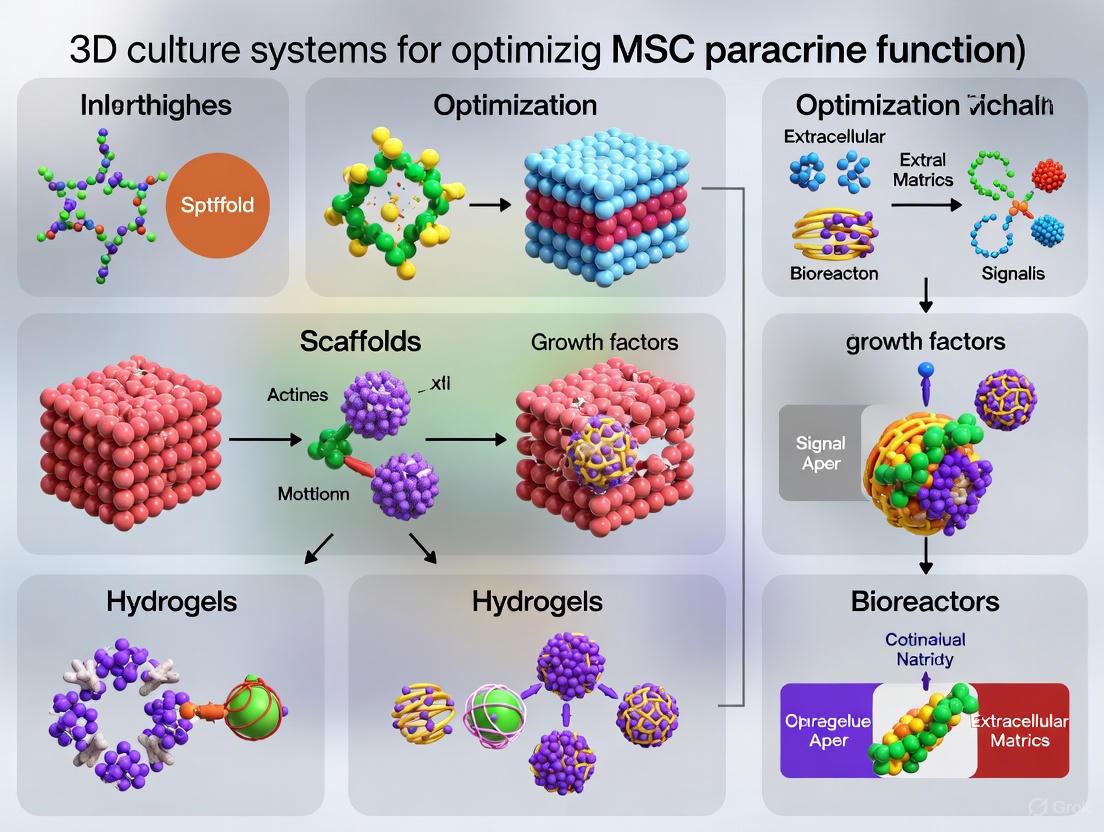
This article comprehensively explores how three-dimensional (3D) culture systems profoundly enhance the paracrine function of Mesenchymal Stem/Stromal Cells (MSCs), a critical factor for their therapeutic efficacy in regenerative medicine.
Boosting MSC Secretome: Advanced 3D Culture Systems for Enhanced Paracrine Function and Therapeutic Potency
Abstract
This article comprehensively explores how three-dimensional (3D) culture systems profoundly enhance the paracrine function of Mesenchymal Stem/Stromal Cells (MSCs), a critical factor for their therapeutic efficacy in regenerative medicine. Aimed at researchers and drug development professionals, we detail the molecular and cellular mechanisms by which 3D microenvironments—including spheroids, hydrogels, scaffolds, and cell sheets—boost the production of immunomodulatory, angiogenic, and regenerative secretome factors compared to traditional 2D monolayers. The content provides a methodological guide to current 3D platforms, strategies for troubleshooting common challenges like scalability and senescence, and a comparative analysis of system performance based on recent pre-clinical and clinical validation studies. This resource is designed to inform the development of robust, high-potency, and clinically translatable MSC-based therapies.
The Paracrine Shift: How 3D Microenvironments Fundamentally Enhance MSC Secretome
The therapeutic paradigm for Mesenchymal Stem Cells (MSCs) has shifted fundamentally from a focus on cellular differentiation and engraftment to understanding their paracrine-mediated effects. It is now widely recognized that transplanted MSCs exert their primary therapeutic influence through the secretion of bioactive factors rather than direct tissue replacement [1] [2]. This secretome, comprising both soluble factors and extracellular vesicles (EVs), delivers a multifaceted regenerative signal capable of modulating immune responses, promoting angiogenesis, inhibiting apoptosis, and stimulating endogenous repair mechanisms [1] [3]. The composition and potency of this secretome are not static; they are dynamically shaped by the MSC's microenvironment [1]. Research demonstrates that transitioning from traditional two-dimensional (2D) monolayer culture to three-dimensional (3D) culture systems—such as spheroids or microcarrier-based bioreactors—more closely mimics the native stem cell niche and potently enhances the output and therapeutic profile of the MSC secretome [4] [5]. This application note details the definition of MSC paracrine function and provides protocols for its study, specifically framed within the context of 3D culture optimization for research and drug development.
Composition of the MSC Secretome
The MSC secretome is a complex, bioactive mixture that mediates the cells' systemic effects. It is broadly categorized into soluble factors and vesicular components.
Soluble Factors: This fraction includes a wide array of proteins and cytokines with demonstrated therapeutic effects. Key factors include:
- Immunomodulatory Factors: Prostaglandin E2 (PGE2), Indoleamine 2,3-dioxygenase (IDO), and Transforming Growth Factor-beta (TGF-β) which suppress pro-inflammatory T-cell responses and promote regulatory T-cell formation [1] [3].
- Trophic and Pro-regenerative Factors: Vascular Endothelial Growth Factor (VEGF), Hepatocyte Growth Factor (HGF), and Fibroblast Growth Factor (FGF) which stimulate angiogenesis and cell proliferation [1] [2].
- Anti-fibrotic & Anti-apoptotic Factors: Factors like HGF and IL-10 help reduce tissue scarring and prevent programmed cell death in injured tissues [1] [6].
Vesicular Components: Extracellular Vesicles (EVs): MSC-derived EVs, including exosomes and microvesicles, are phospholipid-bilayer enclosed structures that act as natural delivery vehicles for bioactive molecules [2] [3]. Their cargo includes:
- microRNAs (e.g., miR-21, miR-146a): Post-transcriptionally regulate gene expression in recipient cells, contributing to anti-inflammatory and pro-survival pathways [2].
- Proteins and Lipids: Reflect the functional status of the parent MSCs and can directly activate signaling pathways in target cells [6] [3].
Table 1: Key Functional Components of the MSC Secretome and Their Roles
| Component Category | Key Examples | Primary Documented Functions | Relevant 3D Culture Impact |
|---|---|---|---|
| Immunomodulatory Factors | PGE2, IDO, IL-10, TSG-6 | Suppresses T-cell proliferation; induces M2 macrophage polarization; reduces pro-inflammatory cytokines (IFN-γ, TNF-α) [1] | 3D spheroid culture upregulates anti-inflammatory factor secretion [4] |
| Trophic & Growth Factors | VEGF, HGF, FGF, IGF-1 | Promotes angiogenesis, cell survival, and proliferation; stimulates tissue progenitor cells [1] [2] | 3D dynamic culture enhances production of pro-angiogenic VEGF and HGF [5] |
| Extracellular Vesicles (EVs) | Exosomes, Microvesicles | Carriers for miRNA, mRNA, and proteins; mediate intercellular communication; reduce apoptosis and oxidative stress [2] [3] | 3D culture systems can improve EV yield and modify miRNA cargo (e.g., increasing miR-21) [7] [2] |
| Anti-fibrotic Factors | HGF, MMPs | Reduces collagen deposition and fibrotic scarring in liver, lung, and kidney injury models [1] [6] | Not specifically quantified in search results, but enhanced HGF secretion is noted. |
The Rationale for 3D Culture Systems
Traditional 2D plastic adherence, while a defining criterion for MSCs, presents a suboptimal environment that fails to recapitulate the physiological, three-dimensional niche where these cells reside in vivo [4] [8]. Cells in 2D culture often undergo senescence, exhibit altered morphology, and show genetic and functional drift away from their original state [4] [8]. The 3D culture paradigm addresses these limitations by restoring critical cell-cell and cell-extracellular matrix (ECM) interactions [4].
The transition to 3D culture systems directly enhances the MSC paracrine function through several mechanistic pathways, as illustrated below.
Diagram 1: How 3D culture enhances the MSC secretome.
Experimental Protocols
This section provides detailed methodologies for establishing 3D MSC cultures and analyzing the resulting secretome.
Protocol: Establishing 3D MSC Spheroid Cultures
Principle: Scaffold-free spheroid formation promotes self-assembly of MSCs into 3D aggregates, enhancing cell-cell interactions and recreating aspects of the native microenvironment that upregulate paracrine function [4].
Materials:
- Cells: Human MSCs (e.g., bone marrow, umbilical cord Wharton's Jelly, adipose tissue) at passage 3-5.
- Basal Medium: DMEM/F12.
- Supplements: 10% Fetal Bovine Serum (FBS), 1% L-Glutamine, 1% Penicillin-Streptomycin.
- Equipment: Low-attachment 96-well U-bottom plates or Petri dishes.
Procedure:
- Cell Preparation: Harvest confluent (≈90%) MSCs from 2D culture using 0.25% trypsin-EDTA. Neutralize trypsin with complete medium and create a single-cell suspension.
- Cell Counting and Seeding: Count cells using a hemocytometer or automated counter. Centrifuge the cell suspension and resuspend in complete medium to a concentration of 1 x 10^5 cells/mL.
- Spheroid Formation:
- For 96-well plates: Pipette 150 µL of cell suspension (15,000 cells/well) into each well of a low-attachment U-bottom plate.
- For Petri dishes: Seed 2 mL of cell suspension (200,000 cells) into a 35mm low-attachment dish.
- Incubation: Place the plates/dishes in a humidified incubator at 37°C with 5% CO₂ for 72 hours.
- Harvesting: After 72 hours, compact, spherical structures should be visible. Gently transfer the medium containing spheroids to a conical tube. Allow spheroids to settle by gravity or gentle centrifugation (100-200 x g for 2 min) for downstream applications.
Protocol: 3D Dynamic Culture on PGM-HA Microcarriers
Principle: A dynamic 3D culture system using porous gelatin microcarriers crosslinked with hyaluronic acid (PGM-HA) in a spinner flask provides a high surface-area-to-volume ratio for large-scale expansion and improves the MSC secretome profile through constant nutrient exchange and mechanical stimulation [5].
Materials:
- Cells: Human MSCs.
- Microcarriers: Porous Gelatin Microcarriers (PGM) crosslinked with Hyaluronic Acid (PGM-HA).
- Bioreactor System: 500 mL spinner flask assembled with a peristaltic pump and O₂ exchange equipment.
- Culture Medium: As described in 4.1.
Procedure:
- Microcarrier Preparation: Hydrate and sterilize 0.8 g (dry weight) of PGM-HA microcarriers according to manufacturer instructions.
- Cell Seeding: Mix P3 MSCs with the prepared PGM-HA at a density of 5,000 cells/cm² in a 50 mL centrifuge tube.
- System Assembly: Transfer the MSC-PGM-HA mixture to the 500 mL spinner flask. Add 150 mL of pre-warmed culture medium. Connect the flask to the dynamic perfusion system.
- Initial Adhesion Phase: Set the stirring regime to intermittent stirring (30 rpm for 2 minutes every 30 minutes) for 16 hours (32 cycles) to allow for efficient cell attachment to the microcarriers.
- Expansion Phase: After the adhesion phase, switch to continuous stirring at 30 rpm for cell expansion. Culture for 7-10 days, with medium changes as required.
- Harvesting: For secretome collection, switch to serum-free medium for the final 24-48 hours. The conditioned medium can then be harvested, and cells/microcarriers can be separated by low-speed centrifugation and filtration (0.22 µm) [5].
The following workflow integrates these culture methods with downstream secretome processing and analysis.
Diagram 2: Experimental workflow for 3D MSC secretome production and analysis.
Protocol: Functional Validation of Secretome
Principle: The therapeutic potential of the 3D-derived secretome must be validated through in vitro bioassays that quantify its regenerative and immunomodulatory capacities.
A. Endothelial Tube Formation Assay (Angiogenesis)
- Prepare ECM: Thaw Matrigel on ice and coat a 96-well plate (50 µL/well). Polymerize for 30-60 minutes at 37°C.
- Seed Cells: Trypsinize Human Umbilical Vein Endothelial Cells (HUVECs) and resuspend in the test conditioned medium (from 3D or 2D cultures) or control medium. Seed 20,000 HUVECs/well onto the polymerized Matrigel.
- Incubate and Image: Incubate for 4-8 hours at 37°C.
- Quantify: Image wells under a microscope. Use image analysis software to quantify the total tube length, number of master junctions, and number of meshes formed.
B. T-Cell Proliferation Assay (Immunomodulation)
- Isolate T-Cells: Isolate human peripheral blood mononuclear cells (PBMCs) and subsequently isolate CD3+ T-cells using a magnetic bead separation kit.
- Label and Activate: Label T-cells with CellTrace CFSE dye. Activate the labeled T-cells using anti-CD3/CD28 activation beads.
- Co-culture: Co-culture the activated T-cells with test conditioned medium or control medium for 4-5 days.
- Analyze: Analyze the cells by flow cytometry. The dilution of CFSE fluorescence in daughter cells is proportional to the number of cell divisions. Compare the proliferation index of T-cells cultured in 3D vs. 2D secretome to assess immunomodulatory potency.
The Scientist's Toolkit: Key Research Reagent Solutions
Table 2: Essential Materials for 3D MSC Secretome Research
| Category & Item | Function/Application | Example from Literature |
|---|---|---|
| 3D Culture Substrates | ||
| Low-Attachment Plates (U-bottom) | Enforces scaffold-free spheroid formation by preventing cell adhesion [4]. | Used for 3D MSC spheroid formation and enhancing paracrine factor production [4]. |
| Porous Gelatin Microcarriers (PGM-HA) | Provides a 3D scaffold for high-density cell expansion in dynamic bioreactors; HA coating improves biocompatibility [5]. | Crosslinked with hyaluronic acid for a dynamic 3D culture system that boosted MSC-PP yield and functionality [5]. |
| Bioreactor Systems | ||
| Spinner Flask with Perfusion | Provides a controlled, scalable environment for 3D dynamic culture with continuous nutrient supply and waste removal [5] [8]. | A 500 mL spinner flask with a peristaltic pump and O₂ exchange was used for large-scale 3D MSC expansion [5]. |
| Secretome Analysis | ||
| Ultracentrifugation | The gold-standard method for isolating extracellular vesicles (EVs) from conditioned medium based on size and density [2]. | Used for pelleting EVs for downstream characterization (NTA, Western Blot, miRNA sequencing) [2]. |
| Nanoparticle Tracking Analysis (NTA) | Characterizes EV preparations by determining particle size distribution and concentration [2]. | Standard technique for quantifying and sizing EVs derived from MSC conditioned medium. |
| Enzyme-Linked Immunosorbent Assay (ELISA) | Quantifies specific, soluble secretory factors (e.g., VEGF, HGF, PGE2) in conditioned medium [1]. | Used to measure concentrations of key trophic and immunomodulatory factors in the secretome. |
The strategic application of 3D culture systems is a critical advancement in harnessing the full therapeutic potential of the MSC secretome. By more accurately mimicking the in vivo cellular microenvironment, 3D cultures—both static spheroids and dynamic microcarrier-based systems—consistently yield a secretome with enhanced regenerative, immunomodulatory, and pro-angiogenic properties compared to standard 2D cultures [4] [5]. The protocols and tools detailed in this application note provide a foundation for researchers and drug developers to standardize the production, characterization, and functional validation of this potent, cell-free therapeutic. Future efforts will focus on further optimizing 3D culture parameters and establishing rigorous, standardized potency assays to facilitate the clinical translation of MSC secretome-based therapies for a wide range of inflammatory and degenerative diseases.
In the field of regenerative medicine, mesenchymal stem cells (MSCs) represent a cornerstone for therapeutic development due to their multipotency, immunomodulatory properties, and paracrine activity. As of March 2025, more than 1,800 clinical studies involving MSCs have been registered, targeting over 920 medical conditions [9]. However, a fundamental paradox plagues their clinical translation: conventional two-dimensional (2D) monolayer culture systems, the workhorse of laboratory expansion, induce progressive functional decline that directly undermines therapeutic efficacy [9]. This application note delineates the molecular and functional consequences of 2D culture-induced senescence and functional decay, and provides validated protocols for implementing three-dimensional (3D) culture systems designed to preserve MSC stemness and paracrine function.
Molecular and Phenotypic Consequences of 2D Culture
Drivers of Senescence and Functional Loss
The rigid, planar environment of tissue culture plastic (Young's modulus ~100,000 kPa) provides a starkly non-physiological contrast to the soft, three-dimensional niche where MSCs naturally reside [9]. This discrepancy triggers a cascade of detrimental effects:
- Transcriptional Dysregulation: Key stemness-maintaining transcription factors, including TWIST1, OCT4, SOX2, and various HOX family genes, are significantly downregulated during serial 2D passaging [10]. TWIST1 suppression, for instance, removes inhibition of senescence genes p14 and p16, leading to irreversible cell cycle arrest [10].
- Morphological Deterioration: MSCs undergo progressive enlargement in 2D culture. This increased cell size directly compromises biodistribution after systemic administration, as larger cells are more likely to become trapped in the lung microvasculature, preventing reaching target tissues and potentially causing vascular complications [9].
- Secretory Degradation: The therapeutic secretome, rich in immunomodulatory and pro-regenerative factors, becomes impoverished. A pro-inflammatory senescence-associated secretory phenotype (SASP) often emerges, further degrading the regenerative microenvironment [10].
Quantitative Evidence of 2D Culture Limitations
Table 1: Documented Functional Deficits in 2D Monolayer Culture Systems
| Parameter | 2D Culture Performance | Functional Consequence | Citation |
|---|---|---|---|
| Cell Size | Progressive enlargement over passages | Impaired biodistribution, lung entrapment, risk of vascular occlusion | [9] |
| Senescence | Significant increase in senescence markers (p16, p21, SA-β-gal) | Reduced proliferative capacity, altered secretome (SASP) | [10] [11] |
| Trilineage Differentiation | Progressive loss of differentiation potential | Reduced capacity for functional tissue repair | [11] |
| Stemness Gene Expression | Downregulation of OCT4, SOX2, NANOG, LIF | Loss of progenitor phenotype and self-renewal capability | [10] [11] |
| Secretome Production | Decline in VEGF, HGF, IL-10; EV production declines 30-70% | Diminished paracrine-mediated tissue repair and immunomodulation | [12] [11] |
3D Culture Systems as a Solution: Mechanisms and Evidence
Three-dimensional culture systems reconstitute a tissue-like microenvironment that preserves MSC function through enhanced cell-cell and cell-extracellular matrix (ECM) interactions [4]. The following diagram illustrates the core signaling pathways and biological processes enhanced in 3D cultures that help maintain MSC stemness and function.
Multiple 3D platforms have been developed, each with distinct advantages for preserving MSC properties, as quantified in the table below.
Table 2: Performance Comparison of Advanced 3D Culture Systems vs. 2D Monolayer
| System | Proliferation | Senescence | Secretome Production | Key Advantages |
|---|---|---|---|---|
| 2D Monolayer | Baseline | Baseline | Baseline (Reference) | Simple, low-cost, established |
| 3D Spheroids | Reduced or maintained [9] [13] | Reduced 30-37% [11] | EV production declined 30-70% [11] | Enhanced cell-cell contact, simple setup |
| Hydrogel (Bio-Blocks) | ~2-fold higher [11] | Reduced 30-37% [11] | Secretome protein preserved; EV production increased ~44% [11] | Tunable mechanics, mimics native ECM, scalable |
| 3D Cell Sheets | Not reported | Not reported | VEGF secretion/MSC increased 2.1-fold [12] | Preserves native ECM and cell junctions |
| Alternating 2D/3D | Maintained over passages [9] | Slowed senescence [9] | Anti-inflammatory activity preserved [9] | Combines scalability of 2D with functional enhancement of 3D |
Detailed Protocols for Implementing 3D MSC Culture
Protocol 1: Alternating 2D/3D Culture for Scalable Expansion
This protocol combines the proliferative capacity of 2D culture with the functional enhancement of 3D spheroid formation, effectively mitigating senescence and enlargement during serial passaging [9].
Step 1: 2D Expansion Phase
- Culture MSCs on conventional tissue culture plastic or in multilayer flasks using standard growth media (e.g., EBM-2 complete medium with 10% FBS) [9].
- Incubate at 37°C, 5% CO₂ until cells reach 70-80% confluence.
- Passage cells using standard trypsinization techniques.
Step 2: 3D Spheroid Formation Phase
- Following trypsinization, resusend the MSC pellet in spheroid formation medium. The medium can be supplemented with extracellular matrix components and should be chemically defined to enhance viability [9].
- Seed cells into low-attachment 96-well round-bottom plates (e.g., 2.5 x 10⁴ cells/well) [14]. Alternatively, use agarose-coated plates or PEG hydrogel microwells to promote aggregate formation [13].
- Centrifuge plates at 300-400 x g for 5 minutes to aggregate cells at the well bottom.
- Incubate for 24-72 hours at 37°C, 5% CO₂ to allow spheroid maturation.
Step 3: Harvest and Re-plating
- Gently collect spheroids by pipetting. For subsequent 2D expansion, spheroids can be dissociated with trypsin or directly transferred to 2D culture vessels where they will attach and spread out [9].
- Repeat this alternating cycle with each passage to maintain functional properties during long-term culture.
The workflow for this protocol, including the dynamic transition between culture states, is illustrated below.
Protocol 2: Dynamic 3D Bioprocessing for Secretome Enhancement
This protocol is optimized for large-scale production of MSC-derived secretome, particularly extracellular vesicles (EVs), using dynamic suspension culture [13].
Step 1: Large-Scale Spheroid Formation
- Utilize a polyethylene glycol (PEG) hydrogel microwell array (e.g., 200 μm diameter microwells) for homogeneous, size-controlled spheroid production [13].
- Seed MSCs at a density of approximately 400 cells/microwell in standard growth medium.
- Allow 12 hours for spontaneous aggregation into spheroids.
Step 2: Dynamic Suspension Culture
- Transfer formed spheroids to a low-attachment culture vessel (e.g., petri dish or bioreactor).
- Place on an orbital shaker at 30 rpm to maintain suspension and enhance nutrient/waste exchange [13].
- Culture for up to 7 days in serum-free production medium (e.g., Ultraculture with 1% Glutamax) to condition the media for EV collection [14] [13].
Step 3: Conditioned Media Collection and EV Isolation
- Collect conditioned media and centrifuge at 300 × g for 10 minutes (4°C) to remove cells.
- Centrifuge supernatant at 2,000 × g for 10 minutes (4°C) to remove dead cells.
- Centrifuge at 10,000 × g for 30 minutes (4°C) to remove cellular debris.
- Perform ultracentrifugation of the final supernatant at 100,000 × g for 120 minutes (4°C) to pellet EVs [14].
- Resusend the EV pellet in PBS or appropriate buffer for therapeutic application.
The Scientist's Toolkit: Essential Reagents and Materials
Table 3: Key Research Reagent Solutions for 3D MSC Culture
| Reagent/Material | Function | Example Product/Citation |
|---|---|---|
| Low-Attachment Plates | Prevents cell adhesion, forces 3D aggregation | Non-adherent 96-well round-bottom plates [14] |
| PEG Hydrogel Microwells | Enables scalable, size-controlled spheroid formation | Custom-engineered microwell arrays [13] |
| RGD-Functionalized Alginate | Provides integrin-binding sites for cell adhesion in hydrogels | Alginate hydrogel tubes (AlgTubes) [9] |
| Temperature-Responsive Dishes | Enables harvest of intact cell sheets with native ECM | Temperature-responsive culture dishes (TRCD) [12] |
| Chemically Defined Media | Supports viability and function in 3D culture; reduces variability | ECM-supplemented, defined media [9] |
| Orbital Shaker Platform | Provides dynamic culture conditions for suspension spheroids | 30-rpm orbital shaker [13] |
| Serum-Free Production Media | Allows collection of contaminant-free secretome/EVs | Ultraculture with Glutamax [14] |
| Methylcellulose | Enhances spheroid integrity and reduces centrifugation needs | 0.25% methylcellulose in culture medium [14] |
The limitations of 2D monolayer culture represent a critical bottleneck in the clinical translation of MSC-based therapies. The documented phenomena of senescence, functional decline, and inconsistent potency are direct consequences of a non-physiological growth environment. The protocols and systems detailed herein provide a validated path forward. Implementing 3D culture strategies—whether spheroids, hydrogels, cell sheets, or alternating protocols—systematically addresses these limitations by recapitulating critical tissue-like cues. For researchers and drug development professionals, adopting these methodologies is no longer optional but essential for generating the high-potency, reproducible MSC populations required for successful clinical applications.
Within the field of regenerative medicine, the therapeutic potential of mesenchymal stem cells (MSCs) is largely attributed to their paracrine function—the secretion of bioactive factors that promote tissue repair, modulate the immune system, and stimulate angiogenesis [15]. A growing body of evidence indicates that cultivating MSCs in three-dimensional (3D) architectures, as opposed to traditional two-dimensional (2D) monolayers, significantly enhances this paracrine function [15] [16]. This application note delves into the core biomechanical and molecular mechanisms behind this enhancement: the profound cytoskeletal remodeling and consequent alterations in nuclear shape driven by the 3D microenvironment. Understanding these mechanisms is crucial for researchers and drug development professionals aiming to standardize and optimize 3D culture systems to fully harness the therapeutic power of MSCs.
Core Mechanisms: From 3D Architecture to Nuclear Reconfiguration
The transition from a 2D to a 3D culture system initiates a cascade of physical and biological events. In 2D culture, cells are forced into a state of unnatural polarity and basal adhesion, creating tension in the actin cytoskeleton [15]. Releasing cells from this adherent state, as occurs in scaffold-free 3D spheroid or cell sheet cultures, triggers a spontaneous contraction and a dramatic physical restructuring.
The following diagram illustrates the sequential mechanism by which the 3D microenvironment leads to altered cell function.
Cytoskeletal Remodeling
The actin cytoskeleton is a primary sensor of mechanical cues. In 3D cultures, the loss of strong basal adhesion causes a dismantling of the large, aligned stress fibers characteristic of 2D-cultured MSCs. This is replaced by a more isotropic, multidirectional actin network [15] [16]. Treatment with cytochalasin D, an actin polymerization inhibitor, disrupts the formation of 3D spheroids, confirming that actin remodeling is essential for 3D aggregation [16]. This shift from a tense, aligned cytoskeleton to a relaxed, multidirectional one is a fundamental step in establishing the 3D cellular phenotype.
Nuclear Shape Change and Mechanotransduction
The cytoskeleton is physically connected to the nucleus via the LINC (Linker of Nucleoskeleton and Cytoskeleton) complex. Therefore, contraction and reorganization of the actin cortex directly exert physical forces on the nucleus, leading to a change in its morphology. Quantitative image analysis reveals that nuclei in 3D MSC cultures transition from an elongated shape in 2D to a more rounded morphology [15]. This is quantified by a significant increase in nuclear circularity (from 0.43 in 2D to 0.69 in 3D) [15]. This altered nuclear shape can influence gene expression by modifying chromatin organization and nuclear pore distribution, thereby facilitating differential access to the genetic code.
The physical and functional changes in MSCs resulting from 3D culture can be quantified across multiple parameters. The tables below summarize key morphological, gene expression, and functional data collected from comparative studies of 2D versus 3D MSC cultures.
Table 1: Morphological and Physical Changes in 3D MSC Cultures
| Parameter | 2D Culture Value | 3D Culture Value | Change | Significance |
|---|---|---|---|---|
| Nuclear Circularity | 0.43 ± 0.12 | 0.69 ± 0.092 | ~60% increase | p = 2.1 × 10⁻⁹ [15] |
| Cell Sheet Thickness | Baseline (single layer) | 8.0-fold increase | 800% increase | p = 4.4 × 10⁻⁷ [15] |
| Cell Sheet Diameter | Baseline | 2.4-fold reduction | 58% reduction | p = 6.0 × 10⁻¹⁸ [15] |
| Tissue Volume | Baseline | 36% increase | 36% increase | p = 0.023 [15] |
Table 2: Gene Expression and Secretory Changes in 3D MSC Cultures
| Parameter | 2D Culture Expression | 3D Culture Expression | Change | Function |
|---|---|---|---|---|
| VEGF Secretion | Baseline | 2.1-fold increase | 110% increase | Angiogenesis [15] |
| β-catenin Gene Expression | Baseline | Upregulated | Enhanced cell-cell adhesion [15] | |
| Integrin β1 Gene Expression | Baseline | Upregulated | Enhanced cell-matrix adhesion [15] | |
| Connexin 43 Gene Expression | Baseline | Upregulated | Enhanced gap junction communication [15] | |
| Senescence Markers (e.g., SA-β-gal) | Present | Reduced/Lost | Loss of senescent phenotype [16] |
Signaling Pathways and Functional Outcomes
The mechanical changes driven by 3D architecture are not the endpoint; they activate critical signaling pathways that ultimately enhance the MSC's therapeutic profile. The diagram below outlines the key signaling molecules and functional outcomes resulting from 3D-induced mechanotransduction.
A key molecular player is the mammalian target of rapamycin (mTOR). In senescent MSCs in 2D culture, active mTOR complexes are predominantly cytoplasmic. 3D cultivation induces the nuclear localization of mTOR, which is associated with a reduction in its active cytoplasmic form and a loss of senescent markers [16]. This, coupled with probable chromatin remodeling, shifts the cell's resources from proliferation and stress response in 2D to a specialized secretory and regenerative state in 3D. The outcome is an enhanced paracrine function, characterized by the increased secretion of pro-regenerative cytokines like VEGF, HGF, and IL-10, and a reduction in the senescent phenotype that often plagues extensively expanded 2D MSCs [15] [16].
Detailed Experimental Protocols
Protocol 1: Generating 3D MSC Spheroids via Hanging Drop Method
This scaffold-free protocol is widely used for generating uniform 3D MSC spheroids for mechanistic studies [16].
Key Materials:
- Late-passage human MSCs (e.g., adipose tissue-derived)
- Standard growth medium (e.g., DMEM with low glucose, 10% FBS, penicillin/streptomycin)
- Sterile phosphate-buffered saline (PBS)
- 0.25% trypsin-EDTA solution
- Petri dishes with lids (e.g., 60 mm or 100 mm)
- Multi-channel pipette
Methodology:
- Cell Preparation: Culture MSCs in standard 2D conditions until 80% confluent. Wash with PBS and dissociate with 0.25% trypsin-EDTA for ~4 minutes at 37°C.
- Cell Counting: Centrifuge the cell suspension, resuspend in fresh growth medium, and perform a cell count.
- Drop Formation: Prepare a cell suspension at a density of 7,000 cells in 25 μL of medium. Using a multi-channel pipette, carefully pipette 25 μL droplets onto the inner surface of the lid of a sterile Petri dish. The number of droplets should correspond to the desired number of spheroids.
- Inversion and Culture: Gently invert the lid and place it over the bottom of the Petri dish, which can be filled with sterile PBS to maintain humidity. The drops will now hang from the lid.
- Incubation: Incubate the dish for 48-72 hours at 37°C and 5% CO₂.
- Spheroid Harvesting: After incubation, carefully open the lid and pipette each individual spheroid from the hanging drop for downstream applications.
Protocol 2: 3D Cell Sheet Detachment and Contraction
This protocol uses temperature-responsive culture dishes (TRCD) to harvest intact MSC sheets that spontaneously contract into 3D constructs, preserving native extracellular matrix [15].
Key Materials:
- Human MSCs (e.g., umbilical cord-derived)
- Temperature-responsive culture dishes (TRCD)
- Standard cell culture incubator (37°C)
- Refrigerated incubator or room temperature (20°C) environment
Methodology:
- 2D Monologue Culture: Seed MSCs onto TRCD and culture in standard growth medium until a confluent monolayer is achieved.
- Temperature Reduction: To initiate detachment, remove the culture medium and replace it with a fresh, pre-cooled medium. Transfer the TRCD from a 37°C incubator to a 20°C environment for approximately 30-60 minutes.
- Sheet Release and Contraction: The temperature change alters the surface property of the TRCD from hydrophobic to hydrophilic, releasing the adherent cells as a contiguous sheet. Upon release, the sheet will spontaneously contract, resulting in a 2.4-fold reduction in diameter and an 8.0-fold increase in thickness.
- Collection: The contracted 3D cell sheet can be carefully collected using a wide-bore pipette or spatula for further analysis.
Protocol 3: Immunofluorescence Analysis of Cytoskeleton and Nucleus
This protocol is for the fixed-cell analysis of the key morphological changes in 3D spheroids versus 2D monolayers [16].
Key Materials:
- Cultured 2D monolayers or 3D spheroids
- Coverslips (for 2D cells)
- 4% Paraformaldehyde (PFA) in PBS
- 0.025% Triton X-100 in PBS
- Blocking solution (e.g., 3% normal goat serum)
- Primary antibodies (e.g., anti-mTOR, phalloidin for F-actin)
- Fluorophore-conjugated secondary antibodies
- DAPI (4′,6-diamidino-2-phenylindole) for nuclear staining
- Mounting medium
- Confocal laser scanning microscope
Methodology:
- Fixation: For 2D monolayers on coverslips and 3D spheroids (embedded in pitch and sectioned), fix samples with 4% PFA for 15 minutes at room temperature.
- Permeabilization: Permeabilize cells with 0.025% Triton X-100 for 30 minutes.
- Blocking: Incubate samples with a blocking solution for 1 hour to prevent non-specific antibody binding.
- Primary Antibody Staining: Incubate samples with primary antibodies diluted in blocking solution at 4°C overnight.
- Secondary Antibody Staining: Wash unbound primary antibodies and incubate with fluorophore-conjugated secondary antibodies for 1 hour at room temperature, protected from light.
- Nuclear Staining: Counterstain nuclei with DAPI.
- Mounting and Imaging: Mount samples on slides and image using a confocal microscope. Acquire Z-stacks for 3D samples to capture full structural details.
The Scientist's Toolkit: Essential Research Reagents
Table 3: Key Reagents for Studying 3D Architecture-Driven Changes in MSCs
| Item | Function/Application in Research | Example & Notes |
|---|---|---|
| Temperature-Responsive Culture Dishes (TRCD) | Harvesting intact, contractible 3D cell sheets with preserved ECM and cell junctions. | Commercial TRCDs (e.g., UpCell) enable 2D-to-3D transition via temperature reduction [15]. |
| Low-Attachment U-Bottom Plates | Facilitating scaffold-free spheroid formation by preventing cell adhesion to the plastic surface. | Essential for high-throughput spheroid generation; compatible with automated imaging systems [17]. |
| Cytoskeletal Inhibitors | Probing the role of actin dynamics in 3D aggregation and signaling. | Cytochalasin D (actin polymerization inhibitor) disrupts spheroid formation [16]. |
| Natural Hydrogel Matrices | Providing a biologically active 3D scaffold that mimics the native ECM. | Matrigel or Geltrex; note batch-to-batch variability. Collagen I is a common alternative [17]. |
| Synthetic PEG Hydrogels | Offering a defined, tunable 3D microenvironment with controllable mechanical properties. | Polyethylene glycol (PEG) hydrogels allow precise control over stiffness and biofunctionalization [18]. |
| Flow Imaging Microscopy | Automated, high-throughput quantitative analysis of 3D cell cluster size, shape, and morphology. | FlowCam technology provides real-time quality control for organoid/spheroid cultures [19]. |
| Antibodies for Mechanobiology | Visualizing and quantifying key targets in the mechanotransduction pathway. | Anti-mTOR (for localization studies), Phalloidin (for F-actin staining), Anti-β-catenin (for cell adhesion) [16]. |
The therapeutic benefits of Mesenchymal Stromal/Stem Cells (MSCs) are increasingly attributed to their paracrine activity rather than their direct differentiation potential. Key regenerative cytokines, including Vascular Endothelial Growth Factor (VEGF), Hepatocyte Growth Factor (HGF), Interleukin-10 (IL-10), and Prostaglandin E2 (PGE2), play crucial roles in promoting angiogenesis, tissue repair, and immunomodulation. A growing body of evidence demonstrates that transitioning from traditional two-dimensional (2D) monolayer culture to three-dimensional (3D) culture systems significantly enhances the production and secretion of these therapeutic factors, thereby amplifying the functional potency of MSCs for research and clinical applications [20] [12] [21]. This application note provides a detailed summary of quantitative data and standardized protocols for leveraging 3D culture systems to optimize the paracrine function of MSCs.
The following tables consolidate experimental data from recent studies, providing a clear comparison of cytokine expression and secretion between 2D and various 3D culture systems.
Table 1: Summary of Key Cytokine Upregulation in 3D vs. 2D MSC Culture
| Cytokine | Reported Fold-Change in 3D vs. 2D | 3D Culture System | Functional Role |
|---|---|---|---|
| VEGF | 2.1-fold increase in secretion [12] | 3D Cell Sheet | Angiogenesis, Endothelial Cell Survival |
| HGF | Significant gene upregulation [12] | 3D Cell Sheet | Anti-fibrotic, Mitogenic, Immunomodulation [20] [22] |
| IL-10 | Significant gene upregulation [12] | 3D Cell Sheet | Anti-inflammatory, Immunosuppression [20] |
| PGE2 | Major increase in secretion [20] | MSC Spheroids | Immunomodulation, Macrophage Polarization to M2 phenotype [20] |
Table 2: Comparative Paracrine Factor Production Across 3D Platforms
| Parameter | 3D Spheroids | 3D Hydrogels | 3D Cell Sheets |
|---|---|---|---|
| Key Upregulated Factors | PGE2, TGF-β, IL-10, HGF [20] | Varies with polymer/stiffness [23] | VEGF, HGF, IL-10, β-catenin, Integrin β1 [12] |
| Mechanistic Drivers | Enhanced cell-cell contact [4] | Mimics cell-ECM interaction; tunable properties [23] | Preserved endogenous ECM and cell junctions [12] |
| Key Advantages | Simple formation; scalable in bioreactors [21] | Protects cells; enhances in vivo retention [23] | Scaffold-free; retains native ECM architecture [12] |
Experimental Protocols for 3D Culture and Analysis
This section outlines detailed methodologies for establishing major types of 3D MSC cultures and evaluating their secretory profiles.
Protocol 1: Generation of MSC Spheroids using the Hanging Drop Method
This scaffold-free technique is widely used for consistent spheroid formation [20] [4].
Step 1: Cell Preparation
- Harvest MSCs (e.g., human umbilical cord, adipose tissue) from 2D culture using standard trypsinization.
- Create a single-cell suspension at a concentration of 1.0–2.5 x 10^5 cells/mL in complete growth medium. Note: The optimal density should be determined empirically for different MSC sources.
Step 2: Droplet Formation
- Pipette 20-30 µL droplets of the cell suspension onto the lid of a sterile tissue culture dish.
- Carefully invert the lid and place it over the bottom dish filled with phosphate-buffered saline (PBS) to maintain humidity and prevent evaporation.
Step 3: Spheroid Culture
- Culture the hanging drops for 48-72 hours in a standard 37°C, 5% CO2 incubator.
- Within this period, cells will aggregate and form a single, compact spheroid at the bottom of each droplet.
Step 4: Spheroid Harvesting
- Gently pipette 100-200 µL of medium to wash the spheroid from the lid into a collection tube or a low-adhesion plate for subsequent experiments or conditioning.
Protocol 2: Formation of 3D MSC Cell Sheets
This protocol uses temperature-responsive culture dishes to create scaffold-free tissue-like constructs [12].
Step 1: Seeding and Monolayer Formation
- Seed MSCs onto commercially available temperature-responsive culture dishes (e.g., UpCell).
- Culture the cells to full confluence using standard growth medium, allowing them to deposit their own extracellular matrix (ECM) and form robust cell-cell junctions.
Step 2: Detachment and 3D Transition
- Once confluent, replace the medium and transfer the culture to a 20°C incubator for approximately 30-60 minutes.
- The temperature change induces a hydrophilic shift in the culture surface, prompting the intact cell monolayer to detach spontaneously without enzymatic treatment.
Step 3: Spontaneous Contraction
- Upon detachment, the cell sheet will spontaneously contract, reducing in diameter and increasing in thickness by approximately 8.0-fold, forming a 3D tissue-like structure [12].
Step 4: Collection
- The contracted 3D cell sheet can be carefully transferred using a pipette or spatula for implantation or further analysis.
Protocol 3: Collection of Conditioned Medium (CM) for Secretome Analysis
Standardized collection of CM is critical for analyzing secretory profiles [24] [21].
Step 1: Preparation
- Generate 3D constructs (spheroids, cell sheets, or hydrogel-encapsulated MSCs) as described above.
Step 2: Conditioning
- Wash the 3D constructs gently with PBS to remove residual serum-containing medium.
- Incubate the constructs in a defined, serum-free medium for 24-48 hours. Note: The duration and medium composition should be optimized based on experimental goals.
Step 3: Collection and Clarification
- Collect the medium and centrifuge at 2,000–4,000 x g for 10–20 minutes to remove cellular debris and microvesicles.
- For exosome/intact vesicle isolation, perform ultracentrifugation (e.g., 100,000 x g for 70 minutes) [24].
Step 4: Concentration and Storage (Optional)
- Concentrate the clarified CM using centrifugal filter units (e.g., 3-kDa cutoff) if necessary.
- Aliquot and store the CM at -80°C to preserve labile factors.
Protocol 4: Analytical Methods for Cytokine Quantification
- Gene Expression: Use quantitative RT-PCR to assess the upregulation of cytokine genes (VEGF, HGF, IL-10) and cell interaction genes (β-catenin, Integrin β1, Connexin 43) [12].
- Protein Secretion: Quantify secreted protein levels in the CM using Enzyme-Linked Immunosorbent Assay (ELISA) or multiplex bead-based arrays (e.g., Luminex) [12].
Signaling Pathways and Workflow Visualization
The following diagrams illustrate the experimental workflow and the core signaling pathways involved in the enhanced paracrine function of MSCs in 3D cultures.
The Scientist's Toolkit: Essential Research Reagents
Table 3: Key Reagents and Materials for 3D MSC Research
| Item Category | Specific Examples | Function/Application |
|---|---|---|
| 3D Culture Substrates | Temperature-responsive dishes (e.g., UpCell) [12], Low-adhesion U-bottom plates [4], Hyaluronic acid/Alginate/Gelatin-based hydrogels [23] | Platform for forming 3D cell sheets, spheroids, or encapsulated constructs. |
| Characterization Antibodies | Anti-CD105, -CD90, -CD73, -CD34, -CD45 [22] | Confirmation of MSC phenotype via flow cytometry. |
| Cytokine Analysis Kits | VEGF, HGF, IL-10, PGE2 ELISA Kits [12] | Quantification of specific cytokine levels in conditioned medium. |
| Gene Expression Assays | qPCR primers for VEGF, HGF, IL-10, COX-2, β-catenin, Integrin β1 [12] | Assessment of transcriptional upregulation of target genes. |
| Cell Viability/Cytotoxicity Kits | Live/Dead Staining (Calcein-AM/EthD-1), MTS/XTT Assay Kits | Monitoring cell health and viability within 3D structures. |
Within the field of regenerative medicine, the therapeutic efficacy of Mesenchymal Stem Cells (MSCs) is increasingly attributed to their potent paracrine activity rather than their differentiation capacity alone. A key strategy to enhance this paracrine function involves culturing MSCs in three-dimensional (3D) systems that more closely mimic the physiological niche. This application note details how the transition from two-dimensional (2D) monolayers to 3D tissue-like structures fundamentally enhances the molecular triad of β-catenin, Integrin β1, and Connexin 43 (Cx43). We provide a quantitative summary of 3D-induced enhancements, detailed protocols for replicating key 3D culture models, and visualizations of the underlying signaling pathways, offering researchers a toolkit to optimize MSC-based therapies and drug screening platforms.
Transitioning MSCs from 2D to 3D culture systems leads to significant upregulation of key proteins governing cell interactions and paracrine signaling. The table below summarizes quantitative changes observed in 3D MSCs compared to 2D controls.
- Table 1: Quantitative Enhancements of Key Targets in 3D MSC Culture Systems
| Target Molecule | Function | Quantitative Change in 3D vs. 2D | Significance / Functional Outcome |
|---|---|---|---|
| β-catenin [15] | Adherens junction protein; key transcriptional co-activator in Wnt signaling | Gene expression significantly increased [15] | Enhanced cell-cell adhesion; activation of pro-proliferative and anti-apoptotic pathways [25] [26] |
| Integrin β1 [15] | Mediates cell-matrix adhesion and outside-in signaling | Gene expression significantly increased [15] | Strengthened ECM attachment; activation of intracellular survival and proliferation signals [27] |
| Connexin 43 (Cx43) [26] | Gap junction protein enabling direct intercellular communication | mRNA and protein levels increased [26] | Improved ion and small molecule exchange; enhanced electrical coupling and coordinated cellular responses [26] [28] |
| VEGF Secretion [15] | Pro-angiogenic paracrine factor | Secretion per MSC increased 2.1-fold [15] | Enhanced pro-angiogenic capacity, critical for tissue repair [15] [27] |
| Tissue Volume [15] | Macroscopic structure of 3D cell sheet | Increased by 36% [15] | Formation of a more physiologically relevant, tissue-like construct [15] |
Detailed Experimental Protocols
Protocol 1: Generating 3D MSC Sheets Using Temperature-Responsive Culture Dishes
This scaffold-free method harvests intact MSC sheets with preserved extracellular matrix and intercellular junctions [15].
Workflow Diagram: 3D MSC Sheet Generation
Materials and Reagents
- Temperature-Responsive Culture Dishes (e.g., UpCell dishes from Nunc)
- Complete MSC culture medium (e.g., α-MEM supplemented with 10% FBS and antibiotics)
- Human MSCs (e.g., bone marrow or umbilical cord-derived)
- Phosphate-Buffered Saline (PBS)
- Refrigerated incubator or cold room (capable of maintaining 20°C)
Step-by-Step Procedure
- Cell Seeding: Seed MSCs onto temperature-responsive culture dishes at a standard density (e.g., 5,000 - 10,000 cells/cm²) in complete culture medium.
- Culture to Confluence: Incubate at 37°C in a 5% CO₂ atmosphere, changing the medium every 2-3 days, until a fully confluent, fibroblast-like monolayer is formed.
- Temperature Reduction: Remove the culture medium and wash the cell layer gently with pre-warmed PBS. Add a small volume of fresh medium or PBS. Transfer the culture dish to a 20°C environment for approximately 30-60 minutes. Critical Note: The surface property change from hydrophobic to hydrophilic is time-dependent; monitor sheet detachment visually.
- Sheet Harvest: Once the cell sheet has fully detached from the surface, gently transfer the contiguous, free-floating 3D sheet to a new vessel using a wide-bore pipette or by carefully pouring. The sheet will have spontaneously contracted, resulting in an ~8-fold increase in thickness [15].
Downstream Analysis
Protocol 2: Assessing Paracrine-Mediated Cardioprotection via MSC-Conditioned Media
This protocol uses MSC-conditioned media to isolate and study the paracrine effects on cardiac cell electrophysiology, a process dependent on Cx43 upregulation via Wnt/β-catenin signaling [26].
Workflow Diagram: Cardioprotective Paracrine Assay
Materials and Reagents
- Microelectrode Array (MEA) System (e.g., from Multi Channel Systems)
- HL-1 Cardiomyocyte cell line or primary cardiomyocytes
- Tyrode's solution
- Conditioned Tyrode (ConT): Prepare by incubating tyrode's solution with a confluent layer of MSCs (e.g., 80% confluent 10 cm dish with 10 ml solution) for 15 hours at 37°C [26].
- Pathway Inhibitors: Cardamonin (β-catenin inhibitor, 10 µM), LiCl (GSK-3 inhibitor, 5 mM), IWP-2 (Wnt secretion inhibitor, 5 µM) [26].
Step-by-Step Procedure
- Conditioned Media Preparation: Culture MSCs to 80% confluence. Replace standard medium with pre-warmed Tyrode's solution. Incubate for 15 hours at 37°C. Collect the supernatant (ConT), centrifuge to remove debris, and store at 4°C for immediate use or -20°C for later [26].
- Cardiac Cell Culture and Treatment: Plate HL-1 cells or primary cardiomyocytes on MEA plates. Replace the culture medium with ConT or control Tyrode's solution. For inhibition studies, pre-treat cells with cardamonin, LiCl, or IWP-2 for 1 hour before adding ConT [26].
- Electrophysiological Recording: Place the MEA plate in the recording setup maintained at 37°C. Record field potentials from spontaneously beating monolayers at baseline (t=0) and after 4 hours of treatment (t=4h). Calculate conduction velocity (θ) from the recorded signals [26].
- Molecular Analysis: In parallel, treat cardiomyocytes in culture dishes identically. After 4 hours, harvest cells for RNA or protein extraction. Quantify Cx43 mRNA levels via qRT-PCR and protein levels via Western blot [26].
Expected Results ConT treatment should significantly increase conduction velocity (θ) and upregulate Cx43 expression after 4 hours. This effect should be blocked by inhibitors of the Wnt/β-catenin pathway, confirming the pathway's role in mediating this paracrine effect [26].
Signaling Pathways and Molecular Mechanisms
The enhanced expression of β-catenin, Integrin β1, and Cx43 in 3D cultures is interconnected and driven by specific signaling pathways.
- Signaling Pathway Diagram: Integration in 3D MSC Culture
Key Mechanistic Insights:
- β-catenin as a Central Hub: The 3D microenvironment promotes β-catenin stabilization via both canonical (Wnt ligands like Wnt3a) and non-canonical (EGF/Ras) pathways [25] [29]. Nuclear β-catenin acts as a transcription co-activator to upregulate target genes including Cx43 and the pluripotency factor Nanog, enhancing self-renewal and gap junction communication [25] [26].
- Integrin β1 and Angiogenesis: 3D-enhanced Integrin β1 activates the ERK1/2 signaling cascade. Phosphorylated ERK1/2 stabilizes HIF-1α, which in turn drives the transcription of VEGF-A, a key angiogenic factor [27].
- Cx43 Beyond Gap Junctions: Beyond forming gap junctions, Cx43 can be transported from MSCs to cardiomyocytes via tunneling nanotubes (TNTs), a process enhanced under stress, contributing directly to cardioprotection [28].
The Scientist's Toolkit: Essential Research Reagents
The following table lists key reagents used in the cited studies to investigate β-catenin, Integrin β1, and Cx43 in MSCs.
- Table 2: Key Research Reagents and Their Applications
| Reagent | Function / Target | Example Application in Context |
|---|---|---|
| Recombinant EGF (rEGF) [25] | Activates EGFR, leading to β-catenin upregulation via Ras. | Used to treat MSCs in 2D culture to mimic 3D-like β-catenin enhancement and study Nanog upregulation [25]. |
| Cardamonin [26] | Inhibitor of β-catenin signaling. | Validates the role of β-catenin in MSC-conditioned media-induced Cx43 upregulation and improved cardiac conduction [26]. |
| Lithium Chloride (LiCl) [26] | Pharmacological inhibitor of GSK-3. | Activates Wnt/β-catenin signaling by preventing β-catenin degradation; used as a positive control in pathway studies [26]. |
| IWP-2 [26] | Small molecule inhibitor of Wnt secretion. | Suppresses MSC paracrine secretion of Wnt ligands, confirming their role in mediating therapeutic effects on cardiomyocytes [26]. |
| Dickkopf-1 (DKK1) [29] | Canonical Wnt pathway inhibitor. | Used to block the interaction between Wnt ligands and their receptors, reversing aberrant MSC differentiation in disease models [29]. |
| Anti-Cx43 Antibody [30] [28] | Detects Cx43 expression and localization. | Used in immunofluorescence, Western blot, and immunoelectron microscopy to visualize Cx43 in gap junctions and TNTs [30] [28]. |
A Practical Guide to 3D MSC Culture Platforms: From Spheroids to Dynamic Bioreactors
Within regenerative medicine, the therapeutic potential of mesenchymal stem cells (MSCs) is increasingly attributed to their paracrine function—the secretion of bioactive factors that promote angiogenesis, modulate immune responses, and support tissue repair [31] [12]. Conventional two-dimensional (2D) monolayer cultures fail to replicate the intricate three-dimensional (3D) microenvironment that cells experience in vivo, leading to altered cell morphology, reduced stemness, and compromised secretory profiles [31] [32]. Scaffold-free 3D culture systems, primarily spheroids and cell sheets, have emerged as powerful technologies to overcome these limitations. By preserving crucial cell-cell and cell-extracellular matrix (ECM) interactions, these systems closely mimic natural biological niches, thereby enhancing the intrinsic paracrine capabilities of MSCs and providing more physiologically relevant models for research and therapeutic development [31] [12] [33]. These application notes detail the protocols, analytical methods, and key reagents for implementing these technologies to maximize cell interactions and optimize MSC paracrine function research.
Performance Comparison: 2D vs. Scaffold-Free 3D Culture Systems
The transition from 2D to 3D scaffold-free culture induces profound changes in MSC phenotype and function. The table below summarizes key quantitative differences that underscore the superiority of 3D systems in preserving a more native cell state and enhancing therapeutic potency.
Table 1: Comparative Phenotypic and Functional Analysis of MSCs in 2D vs. 3D Scaffold-Free Cultures
| Parameter | 2D Monolayer Culture | 3D Cell Sheet | 3D Spheroid Culture |
|---|---|---|---|
| Cell Morphology | Mostly spindle-shaped, forced polarity [31] | Rounded, unaligned cell shape [31] [12] | Rounded, more homogenous shape [31] |
| ECM Deposition | Limited [31] | Enriched (Fibronectin, Laminin) [31] | Enriched (Tenascin C, Collagen VI α3) [31] |
| Cell-Cell Interaction | Limited [31] | Enhanced (Connexin 43, Integrin β1) [31] [12] | Enhanced [31] |
| Cytokine/Growth Factor Secretion | Reduced baseline [31] | Increased VEGF, HGF, IL-10; Increased immunomodulatory factors (CTRP3) [31] [12] | Increased VEGF, HGF, FGF2; Increased anti-fibrotic & immunomodulatory factors (TSG-6, PGE2) [31] |
| Stemness Markers | Compromised [31] | Enhanced Sox-2, Oct-4, Nanog [31] | Enhanced Sox-2, Oct-4, Nanog [31] |
| Typical Thickness/Diameter | Single cell layer | ~50 - 200 µm (after contraction) [12] [33] | 100 - 500 µm [34] |
Protocol 1: Generation and Analysis of MSC Spheroids
Principle
This protocol utilizes low-adherence surfaces to encourage cells to self-assemble into 3D aggregates, thereby promoting extensive cell-cell contact and the formation of a self-produced ECM [31] [35]. This method is simple, scalable, and does not require specialized equipment, making it ideal for high-throughput applications [35].
Materials and Reagents
- Mesenchymal Stem Cells: Human bone marrow-derived MSCs (BM-MSCs) or adipose-derived stem cells (ASCs) between passages 3-5.
- Complete Culture Medium: α-MEM or DMEM/F12, supplemented with 10% FBS, 1% L-glutamine, and 1% penicillin/streptomycin.
- Spheroid Formation Plates: Commercially available ultra-low attachment (ULA) round-bottom 96-well plates.
- Phosphate Buffered Saline (PBS), without calcium and magnesium.
- Enzymatic Dissociation Reagent: Trypsin-EDTA (0.25%) or a non-enzymatic cell dissociation buffer.
- Fixative: 4% Paraformaldehyde (PFA) in PBS.
- Staining Solutions: Phalloidin (for F-actin), DAPI (for nuclei), and antibodies for immunostaining (e.g., against Connexin 43, Integrin β1).
Experimental Workflow
The following diagram illustrates the sequential steps for generating and analyzing MSC spheroids.
Detailed Methodological Steps
- Cell Preparation: Harvest MSCs from conventional 2D culture using a mild enzymatic treatment (e.g., trypsin-EDTA). Neutralize the enzyme with complete medium, centrifuge the cell suspension, and resuspend the pellet in fresh complete medium. Perform a viable cell count.
- Cell Seeding and Aggregation: Prepare a cell suspension at a concentration of 1-5 x 10^5 cells/mL. Seed 100 µL of this suspension into each well of a 96-well ULA round-bottom plate, resulting in a seeding density of 1,000-5,000 cells/well. Centrifuge the plate at 500 x g for 5 minutes to pellet the cells at the bottom of the well and encourage aggregation.
- Culture Maintenance: Incubate the plate at 37°C with 5% CO2 for 3-7 days. Spheroids will typically form within 24-48 hours. Do not disturb the plate for the first 24-48 hours to allow for stable spheroid formation.
- Harvesting: After the culture period, gently pipette the medium containing the spheroids to transfer them to a collection tube. Avoid vigorous pipetting to prevent disintegration.
- Downstream Analysis:
- Viability Assessment: Use live/dead staining kits (e.g., calcein-AM/ethidium homodimer-1) according to manufacturer instructions.
- Gene Expression: Collect 10-20 spheroids per sample. Extract total RNA and perform qPCR for genes of interest (e.g., VEGF, HGF, Sox2, Nanog, Connexin 43).
- Protein Secretion: Collect conditioned media from spheroid cultures. Analyze cytokine levels using ELISA kits for VEGF, HGF, or IL-10. Normalize to the total DNA content or cell number of the spheroids.
- Morphological Analysis: Fix spheroids with 4% PFA for 1 hour, permeabilize with 0.1% Triton X-100, and stain with Phalloidin (F-actin) and DAPI (nuclei). Image using confocal microscopy.
Protocol 2: Fabrication and Analysis of MSC Sheets
Principle
Cell sheet technology uses temperature-responsive culture dishes (TRCD) grafted with polymers like poly(N-isopropylacrylamide) (pNIPAM) [12] [33]. Cells are cultured to confluence, depositing their own ECM and forming robust cell-cell junctions. Upon temperature reduction below 32°C, the surface becomes hydrophilic, releasing the intact, contiguous cell sheet without enzymatic digestion, thus preserving all critical biological structures [12] [33].
Materials and Reagents
- Temperature-Responsive Culture Dishes (TRCD): Commercially available (e.g., UpCell dishes).
- Mesenchymal Stem Cells: As in Protocol 3.2.
- Complete Culture Medium: As in Protocol 3.2.
- Harvesting Solution: Pre-warmed (20°C) standard culture medium or PBS.
Experimental Workflow
The process of creating a 3D cell sheet involves culture, detachment, and a spontaneous 2D-to-3D transition.
Detailed Methodological Steps
- Cell Seeding and Culture: Seed MSCs onto TRCD at a standard density (e.g., 10,000 cells/cm²) and culture in complete medium at 37°C with 5% CO2 until 100% confluent, refreshing the medium every 2-3 days.
- Cell Sheet Detachment:
- Once confluent, carefully remove the culture medium and wash the cell layer gently with pre-warmed (20°C) PBS.
- Add pre-warmed harvesting solution (20°C) to cover the cell layer.
- Incubate the TRCD at 20°C (room temperature) for approximately 30-60 minutes. Monitor the dish under a microscope. The cell sheet will spontaneously detach from the hydrophobic/hydrophilic transition and contract.
- Cell Sheet Harvesting: Once fully detached, gently transfer the contracted cell sheet using a wide-bore pipette or by carefully manipulating it with a sterile spatula.
- Downstream Analysis:
- Morphological and Cytoskeletal Analysis: Process the cell sheet for histological cross-sectioning (H&E staining) or whole-mount immunostaining for F-actin (phalloidin) and nuclei (DAPI). Quantify nuclear circularity (3D sheets have more circular nuclei, ~0.69, vs. elongated in 2D, ~0.43) [12].
- Gene and Protein Expression: Analyze gene expression (qPCR) for ECM proteins (collagen, fibronectin), junctional proteins (Connexin 43, β-catenin, Integrin β1), and paracrine factors (VEGF, HGF, IL-10) [12]. Compare fold-increases relative to 2D monolayers. Assess cytokine secretion via ELISA of conditioned media.
- Mechanical Properties: If applicable, use a micro-indentation system or tensile tester to measure the Young's modulus of the cell sheet.
Signaling Pathways Enhanced by 3D Structure
The enhanced cell interactions in 3D scaffold-free constructs activate key intracellular signaling pathways that underpin the improved paracrine function. The diagram below summarizes this signaling network.
The Scientist's Toolkit: Essential Research Reagents and Materials
Successful implementation of scaffold-free cultures relies on a defined set of core reagents and tools. The following table catalogs the essential solutions for this field.
Table 2: Key Research Reagent Solutions for Scaffold-Free 3D Culture
| Item | Function/Application in Protocol | Key Considerations |
|---|---|---|
| Temperature-Responsive Culture Dishes (TRCD) | Fabrication of intact cell sheets with preserved ECM and junctions [12] [33]. | Critical to use pre-warmed (20°C) medium for harvesting. Avoid enzymatic contact. |
| Ultra-Low Attachment (ULA) Plates | Facilitating cell aggregation and spheroid formation in round- or V-bottom wells [31] [35]. | Round-bottom wells promote a single, centered spheroid per well. |
| Mesenchymal Stem Cell Media Supplements | Supporting MSC expansion and maintenance of stemness in 2D prior to 3D culture. | Use serum-free, defined supplements for standardized, reproducible outcomes. |
| Live/Dead Viability/Cytotoxicity Assay Kits | Quantifying cell viability within 3D structures (e.g., spheroids, sheets) [35]. | Confocal imaging is required for accurate 3D assessment of viability distribution. |
| Cytokine Analysis Kits (ELISA) | Quantifying secretion of paracrine factors (VEGF, HGF, IL-10) into conditioned media [31] [12]. | Always normalize measured concentrations to total cell number or DNA content. |
| qPCR Assays for Stemness & Interaction Markers | Evaluating transcriptional upregulation of genes (e.g., Sox2, Oct4, Nanog, Connexin 43) [31] [12]. | Requires effective RNA extraction from 3D constructs, which can be challenging. |
The therapeutic paradigm for Mesenchymal Stem/Stromal Cells (MSCs) has shifted from direct cell replacement to leveraging their potent paracrine function. MSCs secrete a wide array of bioactive factors—including cytokines, growth factors, and extracellular vesicles (EVs)—that orchestrate immunomodulation, angiogenesis, and tissue repair [36] [37]. However, conventional two-dimensional (2D) monolayer cultures on stiff plastic substrates provide a non-physiological environment that fails to mimic the natural stem cell niche, leading to inconsistent paracrine profiles and insufficient yields of therapeutic products like MSC-derived EVs [36].
Biomaterial-based three-dimensional (3D) culture systems present a promising solution. By closely mimicking the native extracellular matrix (ECM), these systems—particularly hydrogels and porous scaffolds—can regulate MSC morphology, adhesion, proliferation, and, most critically, their secretory capacity [36] [38]. This application note details protocols and mechanistic insights for using alginate-based hydrogels, polyethylene glycol (PEG) hydrogels, and macroporous scaffolds to create mimetic niches that significantly amplify the paracrine function of MSCs for research and therapeutic development.
Application Notes: Key System Comparisons and Outcomes
The selection of biomaterial system directly influences MSC behavior and paracrine output. The tables below summarize the core characteristics and functional outcomes of the major systems discussed.
Table 1: Comparison of Key 3D Biomaterial Systems for MSC Culture
| Biomaterial System | Key Characteristics | Primary Effects on MSCs |
|---|---|---|
| Alginate-HA Hydrogel [39] | Natural polymer blend; nanoporous; high hydrophilicity and biocompatibility. | Enhances proliferation, stemness (OCT-4, NANOG, SOX2), and telomere activity. |
| Macroporous Alginate Scaffold [40] | RGD-functionalized; large pores (~122 μm); facilitates cell spreading and migration. | Promotes robust cell-cell interactions; significantly increases secretion of VEGF, IGF-1, and other paracrine factors. |
| Peptide-Functionalized Alginate [41] | Functionalized with HAVDI peptide (N-cadherin mimetic); nanoporous. | Mimics cell-cell interactions; sensitizes MSCs to soluble factors (e.g., IGF-1), amplifying paracrine effects. |
| PEG Thermosensitive Hydrogel [5] | Synthetic, tunable; forms a gel at physiological temperatures. | Serves as a sustained-release depot for paracrine proteins; improves delivery and retention at target sites. |
Table 2: Quantitative Paracrine Output from MSCs in Different 3D Environments
| Culture Condition | Reported Outcome | Significance |
|---|---|---|
| 3D AL-HA Hydrogel [39] | Upregulation of stemness genes (OCT-4, NANOG, SOX2, SIRT1) and proliferation gene (Ki67). | Maintains MSCs in a more primitive, potent state compared to 2D culture. |
| 3D Macroporous Scaffold [40] | Secretion of VEGF increased >4-fold compared to nanoporous hydrogels. | Enhanced angiogenic potential, critical for healing ischemic tissues and bone regeneration. |
| 3D Silk-Collagen Hydrogel [42] | Mechanopriming enhanced angiogenic and immunomodulatory functions. | Optimized hydrogels direct MSCs toward specific therapeutic phenotypes for regenerative applications. |
| 3D PGM-HA Dynamic Culture [5] | Produced paracrine proteins that promoted fibroblast migration and proliferation in vitro. | Enables large-scale production of potent MSC secretome for cell-free therapies. |
Experimental Protocols
Protocol 1: Encapsulation of MSCs in Alginate-Hyaluronic Acid (AL-HA) Hydrogels to Maintain Stemness
This protocol is adapted from a study demonstrating that 3D AL-HA hydrogels effectively maintain the stemness and proliferative capacity of human MSCs [39].
- Primary Objective: To create a 3D microenvironment that preserves MSC multipotency and enhances proliferation.
Materials & Reagents:
- Sodium Alginate (e.g., Sigma A0682)
- Hyaluronic Acid, low molecular weight (e.g., Sigma 40583)
- Sterile deionized (DI) water
- Calcium chloride (CaCl₂) crosslinking solution
- Human MSCs (e.g., Umbilical cord-derived)
- Complete α-MEM culture medium
Step-by-Step Methodology:
- Hydrogel Preparation: Dissolve sodium alginate and hyaluronic acid in sterile DI water at 37°C under stirring to create a final combined 1 wt% sterile aqueous solution.
- Cell Harvesting: Trypsinize and harvest log-phase hMSCs. Centrifuge and resuspend the cell pellet to a high-density suspension of 2 × 10^6 cells/mL.
- Cell Encapsulation: Mix the cell suspension with the AL-HA hydrogel solution at a 1:1 ratio. This results in a final cell density of 1 × 10^6 cells/mL within the hydrogel precursor.
- Crosslinking: Pipette the cell-hydrogel mixture into a mold or well plate. Gently overlay the mixture with a CaCl₂ solution to ionically crosslink the alginate, forming a stable gel. Incubate for 30 minutes at 37°C.
- Culture: After gelation, remove the crosslinking solution, add complete α-MEM culture medium, and culture the constructs for up to 14 days, changing the medium every 2-3 days.
Key Technical Considerations:
- Maintain sterility throughout the hydrogel preparation and encapsulation process.
- The viscosity of the solution requires careful pipetting to avoid bubble formation.
- The 3D culture period of 14 days is optimal for observing significant upregulation of stemness markers like OCT-4 and NANOG [39].
Protocol 2: Culturing MSCs in Macroporous vs. Nanoporous Scaffolds to Enhance Paracrine Output
This protocol is designed to compare the paracrine secretion of MSCs in structurally distinct 3D microenvironments, based on research showing macroporous architectures dramatically enhance trophic factor production [40].
- Primary Objective: To investigate the effect of scaffold porosity on MSC cell-cell interactions and subsequent paracrine function.
Materials & Reagents:
- RGD-Modified Alginate (Pronova LVG/MVG)
- MSCs (e.g., rat bone marrow-derived)
- Cell Culture Medium
- For Macroporous Scaffolds: Freeze-dryer
- For Nanoporous Hydrogels: Calcium chloride (CaCl₂) solution
Step-by-Step Methodology:
- Fabrication of RGD-Alginate Substrates:
- Macroporous Scaffolds: Fabricate RGD-alginate scaffolds using a freeze-drying technique to create pores with a mean diameter of ~120 μm [40].
- Nanoporous Hydrogels: Crosslink RGD-alginate solution with CaCl₂ to form non-porous hydrogels where diffusion occurs through the nanoporous network (~5-70 nm) [40].
- Cell Seeding: Seed MSCs onto the pre-formed macroporous scaffolds or encapsulate within the nanoporous hydrogels at a standardized density (e.g., 1-5 million cells/mL).
- Conditioned Media Collection: Culture the constructs for 48-72 hours. After this period, collect the culture medium and centrifuge it to remove any cells or debris, obtaining Conditioned Media (CM).
- Analysis: Analyze the CM for paracrine factors using ELISA (e.g., for VEGF, IGF-1) and/or test its functional efficacy in a bioassay (e.g., myoblast migration or proliferation assay [40]).
- Fabrication of RGD-Alginate Substrates:
Key Technical Considerations:
- Ensure the biochemical (RGD concentration) and mechanical properties (e.g., stiffness) of the two scaffold types are comparable to isolate the effect of porosity.
- Functional blocking experiments using an N-cadherin blocking antibody can be introduced to confirm the role of cell-cell junctions in amplifying paracrine function [40] [41].
Protocol 3: Sustained Delivery of MSC Paracrine Proteins using PEG Hydrogels
This protocol outlines a cell-free therapeutic strategy for delivering MSC-derived paracrine proteins (PP) in a sustained manner using a PEG-based hydrogel, validated in a rabbit burn model [5].
- Primary Objective: To develop a hydrogel depot for the localized and prolonged release of MSC-PP for tissue regeneration.
Materials & Reagents:
- Purified MSC Paracrine Proteins (MSC-PP) [5]
- Polyethylene Glycol (PEG) Thermosensitive Hydrogel
- Physiological Buffer (e.g., PBS)
Step-by-Step Methodology:
- MSC-PP Production and Purification: Generate MSC-PP from a 3D dynamic culture system (e.g., using PGM-HA microcarriers) and purify via ultrafiltration [5].
- Hydrogel Loading: Gently mix the purified MSC-PP with the liquid PEG hydrogel precursor solution on ice to ensure uniform distribution.
- Gelation and Release In Vitro: Transfer the PP-hydrogel mixture to a transwell or release apparatus. Incubate at 37°C to trigger gelation. Add buffer to the top of the gel and collect the eluent at predetermined time points over 28 days for analysis via protein quantification assays (e.g., BCA assay) to establish a release profile [5].
- In Vivo Application: For pre-clinical models, after mixing MSC-PP with the PEG solution, apply the liquid mixture directly to the wound site (e.g., a third-degree burn), where body temperature will induce gelation and form a local protein-release depot.
Key Technical Considerations:
- The PEG hydrogel composition must be optimized to balance a manageable viscosity for injection/mixing and a rapid enough gelation time at 37°C to prevent diffusion.
- This system is particularly valuable for treating injuries where the microenvironment is hostile for direct cell transplantation [5].
Signaling Pathways and Mechanotransduction
The enhanced paracrine function in 3D biomaterial systems is driven by precise mechanochemical signaling.
Diagram: Mechanochemical Signaling Amplifies MSC Paracrine Function. Matrix stiffness and adhesive ligands engage integrins, activating FAK/Src signaling. Macroporosity enables cell-cell contacts via N-cadherin, activating Rho/ROCK. These pathways converge on actin cytoskeleton remodeling, driving enhanced paracrine secretion. Soluble factors can synergize with N-cadherin signaling to further amplify output [40] [41] [42].
The Scientist's Toolkit: Essential Research Reagent Solutions
Table 3: Key Reagents for Biomaterial-Based MSC Niche Research
| Research Reagent | Function/Application | Example Use Case |
|---|---|---|
| RGD-Modified Alginate | Provides integrin-mediated cell adhesion to otherwise non-adhesive alginate. | Essential for MSC survival and spreading in both nanoporous and macroporous alginate systems [40]. |
| HAVDI Peptide | Mimics the extracellular domain of N-cadherin, artificially promoting pro-paracrine "cell-cell" signaling. | Functionalized into nanoporous hydrogels to sensitize MSCs to soluble factors like IGF-1 [41]. |
| N-Cadherin Blocking Antibody | Inhibits native N-cadherin mediated cell-cell interactions. | A critical tool for mechanistic studies to confirm the role of cell-cell contact in paracrine amplification [40] [41]. |
| Porous Gelatin Microcarrier (PGM-HA) | Provides a high-surface-area 3D scaffold for dynamic large-scale MSC culture. | Used in bioreactors to produce large quantities of therapeutically potent MSC paracrine proteins [5]. |
| PEG Thermosensitive Hydrogel | Synthetic, injectable polymer that forms a gel at body temperature. | Acts as a sustained-release delivery vehicle for MSC paracrine proteins in vivo [5]. |
| Y-27632 (ROCK Inhibitor) | Selectively inhibits Rho-associated protein kinase (ROCK). | Used to probe the contribution of the Rho/ROCK mechanosignaling pathway to MSC paracrine function [42]. |
The transition from traditional two-dimensional (2D) planar culture to three-dimensional (3D) dynamic systems represents a paradigm shift in mesenchymal stromal cell (MSC) production for clinical applications. While 2D culture has been the conventional workhorse, it fails to replicate the physiological cellular microenvironment, often resulting in altered cell morphology, polarity, and function [8]. More critically for therapeutic efficacy, 3D dynamic culture systems have been demonstrated to significantly enhance the paracrine function of MSCs—the mechanism by which they secrete bioactive factors that mediate tissue repair and immunomodulation [5] [43]. By combining microcarriers that provide a 3D scaffold with bioreactors that impart crucial mechanical stimulation, these systems enable the large-scale expansion of MSCs with superior therapeutic potential, including enhanced angiogenic, anti-inflammatory, and wound-healing capabilities [43] [44]. This protocol outlines the application of an automated, closed, and scalable 3D microcarrier-bioreactor system optimized for the clinical-scale production of MSCs with augmented paracrine function.
System Components and Quantitative Performance
Essential Research Reagent Solutions
The successful implementation of a 3D dynamic culture system requires specific, high-quality components. The table below catalogs the essential materials and their functions.
Table 1: Key Research Reagent Solutions for 3D Dynamic MSC Culture
| Item | Function/Description | Key Characteristics |
|---|---|---|
| Recombinant Humanized Collagen Microcarriers [43] | Serves as a GMP-compliant, animal-origin free (AOF) 3D scaffold for cell adhesion and expansion. | Porous structure (≥90% porosity, 125-250 μm diameter); Composed of pharmaceutical excipient-grade Type I collagen; FDA Master File (MF) qualified. |
| Xeno-Free / Serum-Free Culture Medium [45] [43] | Provides nutrients and signaling molecules for cell growth without animal-derived components. | Formulated for clinical compliance (e.g., UltraMedia); often supplemented with human platelet lysate. |
| Stirred-Tank Bioreactor System [43] [44] | Provides a controlled, dynamic environment for scalable 3D culture. | Automated, enclosed system with impeller; precise control over temperature, pH, dissolved O₂, and agitation. |
| Microcarrier Digestion Solution [44] | Enzymatically degrades the microcarrier matrix for efficient cell harvest. | GMP-grade solution (e.g., 3D FloTrix Digest); allows for high cell recovery while maintaining viability and potency. |
Comparative Performance of Culture Systems
Quantitative data demonstrates the clear advantages of 3D dynamic culture over traditional 2D methods. The following table summarizes key performance metrics documented in recent studies.
Table 2: Quantitative Comparison of 2D vs. 3D Dynamic Culture Outcomes for MSCs
| Performance Metric | 2D Static Culture | 3D Dynamic Culture | Significance/Reference |
|---|---|---|---|
| Cell Yield & Scalability | Limited by surface area; requires repeated passaging. | High surface-to-volume ratio; enables large-scale expansion in a single vessel. | More space-efficient for clinical-scale manufacturing [45]. |
| Senescence | Increased senescence with repeated passaging [43]. | Reduced senescence markers across passages [43]. | Prolongs functional cell lifespan. |
| Paracrine Protein Production | Standard secretion profile. | Upregulated production of pro-regenerative factors [5]. | Mass spectrometric analysis confirms enhanced secretome [5]. |
| Mitochondrial Transfer via TNTs | Standard TNT formation and mitochondrial transfer. | Enhanced TNT-mediated mitochondrial transfer to recipient cells (e.g., endothelial cells) [44]. | Direct mechanism for boosting angiogenesis and wound healing. |
| Gene Expression Profile | Standard expression of therapeutic genes. | Upregulation of genes related to angiogenesis and anti-inflammatory pathways [43]. | Validated by RNA-sequencing, qRT-PCR, and Western blot [43]. |
| In Vivo Therapeutic Efficacy | Moderate improvement in wound healing models. | Significantly accelerated wound closure, angiogenesis, and skin appendage regeneration [5] [43]. | Demonstrated in diabetic mouse and third-degree burn rabbit models. |
Experimental Protocols
Protocol 1: Establishing a Dynamic 3D MSC Culture System
This protocol describes the setup for the large-scale expansion of human Umbilical Cord MSCs (hUCMSCs) using an automated bioreactor system, as validated by recent studies [43] [44].
Part A: System Assembly and Microcarrier Preparation
- Bioreactor Setup: Assemble a 125 mL breathable stirred-tank bioreactor (e.g., Regenbio or DASEA system) according to manufacturer's instructions. Ensure all fluidic and gas exchange lines are securely connected.
- Microcarrier Hydration: Aseptically transfer 100 mg of recombinant humanized collagen microcarriers into the bioreactor vessel.
- Initial Hydration: Add 20 mL of pre-warmed, xeno-free culture medium (e.g., UltraMedia).
- Swelling Cycle: Initiate an agitation regime of 40 rpm on the bioreactor platform for several hours or overnight at 37°C with 5% CO₂ to allow microcarriers to fully swell and hydrate.
Part B: Cell Seeding and Initial Adhesion
- Cell Preparation: Harvest P2-P3 hUCMSCs from 2D culture using a GMP-grade dissociation agent (e.g., UltraTryple). Quantify cell count and viability via trypan blue exclusion.
- Seeding: Transfer the cell suspension into the bioreactor containing the hydrated microcarriers to achieve a final seeding density of approximately 20-30 cells per microcarrier (or 5,000 cells/cm² microcarrier surface area) in a total working volume of 50 mL [5] [43].
- Adhesion Phase: Program the bioreactor to an intermittent agitation regime (e.g., 40 rpm for 5 minutes, followed by 55 minutes of rest). Cycle this regime for 16-24 hours to facilitate maximum cell attachment to the microcarriers without excessive shear stress.
Part C: Active Expansion Phase
- Initiate Continuous Culture: After the adhesion phase, replenish the medium to a 75 mL working volume.
- Set Parameters: Switch the bioreactor to continuous agitation at 40 rpm. Maintain culture at 37°C, 5% CO₂.
- Feeding Schedule: Perform a 50-70% medium exchange with fresh, pre-warmed xeno-free medium every 48 hours.
- Process Monitoring: Monitor key parameters daily, including glucose consumption, lactate production, and dissolved oxygen, to assess cell growth and metabolic activity. The culture is typically maintained for 5-7 days until target cell density is achieved.
The workflow is summarized in the following diagram:
Protocol 2: Functional Validation of MSC Paracrine Efficacy
Following expansion, it is critical to validate the enhanced paracrine function of 3D-cultured MSCs (3D-MSCs). This protocol outlines a co-culture assay to quantify angiogenic effects via tunneling nanotubes (TNTs) and mitochondrial transfer [44].
Part A: Direct Co-culture with Endothelial Cells
- MSC Harvest: Harvest 3D-MSCs from microcarriers using a GMP-grade digestion solution (e.g., 3D FloTrix Digest). Gently dissociate cells and neutralize the enzyme. In parallel, harvest 2D-cultured MSCs (2D-MSCs) as a control.
- HUVEC Culture: Maintain human umbilical vein endothelial cells (HUVECs) in standard endothelial growth medium.
- Co-culture Setup: Seed HUVECs in a suitable plate (e.g., 24-well plate) at a density of 1x10⁴ cells per well. After 24 hours, add 3D-MSCs or 2D-MSCs to the HUVEC cultures at a 1:5 (MSC:HUVEC) ratio.
- Incubation: Co-culture cells for 24-48 hours under standard conditions to allow for cellular interaction.
Part B: Visualization and Quantification of TNTs and Mitochondrial Transfer
- Cell Staining: Following co-culture, stain live cells with fluorescent dyes:
- Mitotracker Red CMXRos: (200 nM, 30 min) to label MSC mitochondria.
- CellTracker Green CMFDA: (5 μM, 30 min) to label HUVEC cytoplasm.
- Fixation and Imaging: Gently wash cells and fix with 4% paraformaldehyde for 15 minutes. Acquire high-resolution z-stack images using a confocal laser scanning microscope with appropriate filter sets.
- Image Analysis: Quantify the following:
- TNT Structures: Count the number of thin (diameter < 1 μm), actin-positive (via phalloidin staining), long membrane extensions connecting MSCs and HUVECs that are not attached to the substrate.
- Mitochondrial Transfer: Identify and count HUVECs (green) that contain red fluorescent mitochondria, indicating successful transfer from MSCs.
The mechanistic pathway enhanced by 3D culture is illustrated below:
The integration of GMP-compliant microcarriers within controlled bioreactor systems provides a robust and scalable platform for producing MSCs with superior therapeutic potency. The documented enhancements in paracrine function, including upregulated secretion of regenerative factors and augmented mitochondrial transfer via TNTs, validate this 3D dynamic approach as the frontier for clinical-grade MSC manufacturing. The protocols detailed herein offer a concrete pathway for researchers and drug development professionals to implement this technology, ultimately advancing the translation of more effective MSC-based therapies for regenerative medicine.
The therapeutic efficacy of mesenchymal stem cells (MSCs) is largely attributed to their paracrine function, the secretion of bioactive factors that modulate immune responses, promote angiogenesis, and drive tissue regeneration [46] [47]. However, a significant challenge exists in manufacturing the large quantities of MSCs required for clinical applications while preserving this critical paracrine function. Conventional two-dimensional (2D) culture on rigid substrates promotes replicative senescence, cell enlargement, and loss of secretory potency, ultimately compromising therapeutic outcomes [9].
Three-dimensional (3D) culture systems, particularly spheroids, better mimic the native MSC niche and have been demonstrated to enhance paracrine function, reduce cell size, and mitigate senescence [48] [9]. A major limitation of 3D culture alone, however, is poor cell proliferation, rendering it unsuitable for large-scale expansion. To resolve this, hybrid and alternating protocols that strategically combine the rapid scalability of 2D expansion with the functional priming of 3D culture have emerged as a powerful methodology. This protocol details the application of these integrated systems to produce functionally enhanced MSCs for research and therapeutic development.
Background and Rationale
The Limitations of Conventional MSC Culture
In vivo, MSCs reside in a soft, three-dimensional (3D) niche rich in cell-cell and cell-matrix interactions [9]. In stark contrast, conventional expansion occurs on rigid 2D plastic surfaces, a microenvironment that induces profound physiological changes:
- Senescence and Functional Decline: MSCs rapidly undergo senescence in 2D culture, losing their replicative ability and therapeutic potency, which may explain the discrepancy between compelling preclinical data and less effective clinical outcomes [9].
- Cell Enlargement: A critical issue is MSC enlargement during in vitro passage. Larger cells are more susceptible to being trapped in the lung microvasculature following systemic administration, impairing their ability to reach target tissues and potentially causing microcirculation obstruction [9].
- Altered Paracrine Signature: The physical microenvironment, including substrate stiffness, is a strong driver of MSC paracrine activity. Culture on standard rigid plastic produces a secretome that is suboptimal for certain therapeutic functions compared to that produced by cells in softer, 3D environments [49].
The Functional Benefits of 3D Spheroid Culture
Transitioning MSCs to 3D spheroids has been shown to counteract many of the drawbacks of 2D culture [48] [9]. Key advantages include:
- Enhanced Paracrine Function: Spheroid culture increases the secretion of pro-angiogenic, immunomodulatory, and pro-regenerative factors. Hybrid spheroids composed of MSCs and endothelial colony-forming cells (ECFCs) further promote the secretion of angiogenic factors like angiopoietin-2 and platelet-derived growth factor [48].
- Reduced Cell Size and Senescence: Culturing MSCs as spheroids significantly reduces cell size and helps maintain a younger phenotypic state, improving subsequent biodistribution [9].
- Improved In Vivo Survival and Engraftment: Spheroids mimic a tissue-like environment, which enhances the in vivo viability and engraftment efficiency of transplanted cells. This is crucial for cell-based therapies for ischemic diseases, where poor cell survival is a major hurdle [48].
The alternating 2D/3D protocol leverages the high proliferative capacity of 2D culture for scalable expansion, while using transient 3D spheroid formation as a "priming" step to rejuvenate cells and enhance their secretory profile before therapeutic application.
Experimental Protocols
Alternating 2D/3D Culture for MSC Expansion and Priming
This protocol is adapted from recent research demonstrating that alternating between 2D expansion and 3D spheroid culture reduces cell size and extends the lifespan of placenta-derived MSCs [9].
Workflow Overview:
Materials:
- Cell Source: Human placenta-derived MSCs (or other sources like bone marrow, adipose tissue).
- Basal Media: EBM-2 or α-MEM.
- Supplements: Fetal Bovine Serum (10%), Penicillin-Streptomycin (1%).
- 3D Culture Vessel: Corning Elplasia plates or other ultra-low attachment, round-bottom plates.
- Hydrogel System (Optional): RGD-functionalized alginate hydrogel tubes (AlgTubes) for a continuous, scalable system [9].
Step-by-Step Procedure:
- 2D Expansion Phase:
- Culture MSCs as an adherent monolayer in standard tissue culture flasks with complete medium (e.g., EBM-2 supplemented with 10% FBS and 1% Penicillin-Streptomycin).
- Maintain cells in a humidified incubator at 37°C with 5% CO₂, changing the medium every 2-3 days.
- Once cells reach 70-80% confluence, harvest them using a standard trypsin-based method (e.g., 0.05% trypsin‐EDTA for 5 min at 37°C).
Transition to 3D Priming Phase:
- Count the harvested cells and seed them into ultra-low attachment, round-bottom plates at a density of 1,000 - 5,000 cells per spheroid.
- Centrifuge the plates (e.g., 500 × g for 5 minutes) to aggregate cells at the bottom of each well.
- Incubate the plates for 24 to 72 hours to allow for spheroid formation. The optimal duration should be determined empirically for specific MSC sources and applications.
Post-Spheroid Culture:
- For continued expansion, gently dissociate spheroids back into a single-cell suspension using a digestive enzyme (e.g., 0.075% collagenase type I at 37°C for 30 min) and return to 2D culture conditions.
- For therapeutic application, spheroids can be used directly or dissociated, depending on the intended delivery method.
Generating Hybrid Spheroids for Therapeutic Angiogenesis
This protocol describes the creation of hybrid spheroids containing both MSCs and endothelial colony-forming cells (ECFCs) to promote therapeutic angiogenesis, as demonstrated in a murine hindlimb ischemia model [48].
Workflow Overview:
Materials:
- Cells: MSCs and ECFCs (e.g., isolated from human cord blood).
- ECFC Medium: EBM-2 supplemented with the EGM-2 MV SingleQuots kit (contains VEGF, FGF-2, EGF, IGF-1, and ascorbic acid) and 5% FBS.
- Coating Material: Rat tail collagen I for ECFC culture.
- Spheroid Formation Plates: Ultra-low attachment (ULA), U-bottom 96-well plates.
Step-by-Step Procedure:
- Cell Preparation: Culture MSCs and ECFCs separately using their respective standard protocols. Ensure ECFCs are cultured on collagen I-coated surfaces.
- Cell Harvesting: Harvest both cell types at 70-80% confluence using appropriate methods (trypsin for MSCs; collagenase for ECFCs may be preferable).
- Mixing and Seeding: Mix MSCs and ECFCs at a desired ratio (e.g., a 2:1 ratio of MSCs to ECFCs has been successfully used). Resuspend the cell mixture in a combined medium and seed into U-bottom ULA plates. A common seeding density is 1,000 - 10,000 total cells per well.
- Spheroid Formation: Centrifuge the plate at 500 × g for 10 minutes to aggregate the cells at the well bottom. Incubate for 24-48 hours to form compact, hybrid spheroids.
- Therapeutic Application: Harvest the hybrid spheroids for in vivo transplantation. These spheroids have been shown to substantially increase the survival of co-transplanted ECFCs and enhance therapeutic angiogenesis in models of peripheral artery disease [48].
Data Presentation and Analysis
Quantitative Analysis of Secretome Profiles
The table below summarizes key paracrine factors upregulated in MSC spheroids and their associated biological functions, based on proteomic and cytokine analysis [46] [48] [49].
Table 1: Key Paracrine Factors Enhanced in 3D MSC Spheroids and Their Functions
| Biological Function | Key Upregulated Factors | Key microRNAs (miRNAs) |
|---|---|---|
| Angiogenesis | VEGF, bFGF, Angiopoietin-2, PDGF, HGF, IL-8 | miR-21, miR-23, miR-27, miR-126, miR-130a, miR-210, miR-378 |
| Immunomodulation | HGF, PGE2, TGF-β1, TSG-6, IL-10 | miR-21, miR-146a, miR-375 |
| Antifibrosis | HGF, PGE2, IDO, IL-10 | miR-26a, miR-29, miR-125b, miR-185 |
| Anti-apoptosis | VEGF, STC-1, IGF-1 | miR-25, miR-214 |
Impact of Culture Strategy on Cell Morphology and Function
This table compares the critical characteristics of MSCs cultured using conventional 2D, 3D spheroid, and alternating 2D/3D methods [50] [9].
Table 2: Functional and Phenotypic Comparison of 2D, 3D, and Alternating 2D/3D MSC Culture
| Feature | Conventional 2D | 3D Spheroid Only | Alternating 2D/3D |
|---|---|---|---|
| Proliferation Rate | High | Low | High during 2D phase |
| Cell Size | Increases with passage | Significantly reduced | Reduced vs. 2D, maintained over passages |
| Senescence | High, rapid onset | Mitigated | Delayed |
| Secretory Profile | Standard | Enhanced angiogenic/immunomodulatory factors | Improved vs. 2D, can be tailored |
| In Vivo Engraftment | Poor | Improved | Improved (inferred) |
| Scalability | Excellent | Poor | Good |
The Scientist's Toolkit: Essential Research Reagents
The following table lists key materials and reagents required to implement the hybrid and alternating protocols described in this document.
Table 3: Essential Research Reagents for 2D/3D MSC Culture Protocols
| Reagent / Material | Function / Application | Example Product / Note |
|---|---|---|
| Ultra-Low Attachment (ULA) Plates | Prevents cell adhesion, forcing 3D spheroid formation via self-assembly. | Corning Elplasia plates, U-bottom 96-well ULA plates. |
| RGD-functionalized Alginate | Synthetic hydrogel for scaffold-based 3D culture; promotes cell adhesion. | Used in AlgTubes for continuous, scalable alternating culture [9]. |
| Extracellular Matrix (ECM) Supplements | Enhances cell viability and function in 3D by mimicking native matrix. | Collagen, laminin, fibronectin [51]. |
| Defined MSC & ECFC Media | Supports expansion and maintains phenotype of MSCs and co-cultured ECFCs. | EBM-2 basal medium with growth factor supplements (e.g., FGF-2, VEGF) [48]. |
| Collagenase Type I | Gently dissociates 3D spheroids and tissues for cell retrieval. | Preferred over trypsin for recovering cells from 3D structures [48]. |
The strategic integration of 2D and 3D culture systems represents a significant advancement in MSC manufacturing. The protocols outlined here—the alternating 2D/3D culture for scalable production of rejuvenated MSCs and the generation of functionally enhanced hybrid spheroids—provide researchers with robust methodologies to overcome the critical limitations of conventional culture. By enabling the production of MSCs with a superior paracrine profile and improved therapeutic potential, these approaches promise to accelerate the translation of MSC-based therapies from the laboratory to the clinic, particularly for applications in regenerative medicine, immunomodulation, and therapeutic angiogenesis.
The regeneration of full-thickness skin after a third-degree burn remains a significant clinical challenge, primarily due to severe scar formation and poor appendage regeneration [5]. Stem cell therapy has shown great potential, with increasing evidence suggesting that the therapeutic benefits of mesenchymal stem cells (MSCs) are primarily mediated through their paracrine activity [5] [52]. This application note details a cell-free therapy system utilizing paracrine proteins from MSCs (MSC-PP) derived from a three-dimensional (3D) dynamic culture system, delivered via a polyethylene glycol (PEG) temperature-sensitive hydrogel for sustained release in a third-degree burn model [5] [53].
Table 1: In Vitro Characterization of 3D-Cultured MSCs and Their Paracrine Proteins
| Parameter | 2D Culture System | 3D Dynamic Culture System (PGM-HA) | Measurement Method |
|---|---|---|---|
| Cell Apoptosis | Higher | Reduced | Flow Cytometry [5] |
| Lactic Acid Content | Higher | Decreased | Biochemical Assay [5] |
| Cell Cycle Progression | Standard | Regulated | Flow Cytometry [5] |
| Paracrine Protein Function | Baseline | Promoted cell proliferation, migration, and adhesion | In vitro functional assays [5] |
Table 2: In Vivo Therapeutic Efficacy in Rabbit Third-Degree Burn Model
| Treatment Group | Wound Healing | Scar Formation | Skin Appendage Regeneration |
|---|---|---|---|
| Saline | Baseline | Significant | Poor [5] |
| PEG Hydrogel Only | No significant improvement | Significant | Poor [5] |
| MSC-PP Only | Improved | Reduced | Moderate [5] |
| MSC-PP + PEG | Significantly improved | Inhibited | Facilitated [5] |
Experimental Protocols
Protocol: Establishment of a 3D Dynamic Culture System for MSC Expansion
Objective: To large-scale expand MSCs using a porous gelatin microcarrier crosslinked with hyaluronic acid (PGM-HA) in a dynamic perfusion system, enhancing their bioactivity and paracrine protein secretion [5].
Materials:
- Porous Gelatin Microcarrier (PGM): Provides a scaffold for cell attachment [5].
- Hyaluronic Acid (HA): Crosslinked with PGM to improve the microenvironment [5].
- Umbilical Cord-derived MSCs: Isolated from Wharton's jelly of full-term infant umbilical cords [5].
- Dynamic Perfusion System: Includes a spinner flask, peristaltic pump, and O2 exchange equipment [5].
Procedure:
- PGM-HA Preparation: Activate PGM with EDC/NHS solution. Crosslink with 400 µg/mL HA solution under ultrasonic shaking, followed by incubation, freezing, and lyophilization [5].
- Cell Seeding: Harvest MSCs and mix with 0.8 g of dried PGM-HA at a density of 5,000 cells/cm² in a 50 mL tube [5].
- System Assembly: Transfer the cell-PGM-HA mixture to a 500 mL spinner flask connected to the dynamic perfusion system [5].
- Initial Adhesion: Allow cells to adhere under intermittent stirring (30 rpm for 2 min every 30 min) for 16 hours with 150 mL of culture medium [5].
- Cell Expansion: After adhesion, set the system to continuous stirring at 30 rpm for large-scale expansion. Monitor cell growth and viability [5].
Protocol: MSC Paracrine Protein (MSC-PP) Harvest and Purification
Objective: To harvest and characterize the paracrine proteins secreted by MSCs in the 3D dynamic culture system [5].
Procedure:
- Collection: Collect the culture supernatant from the 3D dynamic culture system after the expansion phase [5].
- Purification: Purify the paracrine proteins from the supernatant using standard protein purification techniques (e.g., centrifugation, filtration, chromatography) [5].
- Characterization: Characterize the purified MSC-PP using mass spectrometric analysis to identify the protein components [5].
Protocol: In Vivo Evaluation in a Third-Degree Burn Model
Objective: To assess the therapeutic efficacy of the MSC-PP + PEG sustained-release system in promoting wound healing and reducing scarring [5].
Materials:
- Animal Model: Rabbit third-degree burn model [5].
- Treatment Groups: Saline (control), PEG hydrogel only, MSC-PP only, MSC-PP + PEG sustained-release system [5].
Procedure:
- Burn Creation: Create third-degree burn wounds on the rabbit model [5].
- Treatment Application: Apply the respective treatments to the wounds according to the predefined groups.
- Monitoring: Observe the wounds over a defined period (e.g., 28 days) for healing progression, scar formation, and skin appendage regeneration [5].
- Analysis: Perform histological and morphological analyses on the healed tissue to evaluate the quality of regeneration [5].
Signaling Pathways and Experimental Workflows
Experimental Workflow
Mechanotransduction in 3D Culture
The Scientist's Toolkit: Research Reagent Solutions
Table 3: Essential Materials and Reagents for 3D MSC Paracrine Protein Research
| Item | Function/Application | Specific Example |
|---|---|---|
| Porous Gelatin Microcarrier (PGM) | Serves as the core scaffold in the 3D bioreactor for MSC attachment and expansion [5]. | Sigma [5] |
| Hyaluronic Acid (HA) | Crosslinked with PGM to create a biomimetic, hydrogel-based microenvironment (PGM-HA) that enhances cell viability and function [5]. | Sigma [5] |
| PEG-based Thermosensitive Hydrogel | Acts as a sustained-release delivery vehicle for MSC-PP, gelling at body temperature to maintain localized therapeutic concentration at the wound site [5]. | Polyethylene Glycol temperature-sensitive hydrogel [5] |
| Dynamic Perfusion Bioreactor | Provides a controlled 3D culture environment with continuous medium perfusion and gas exchange for large-scale MSC expansion [5]. | System with spinner flask, peristaltic pump, and O2 exchange equipment [5] |
| Biomimetic Hydrogel Platform | Provides a tissue-mimetic 3D microenvironment for culturing MSCs, shown to preserve stem cell phenotype, reduce senescence, and enhance secretome production compared to conventional systems [54]. | Bio-Block platform [54] |
| RGD-functionalized Alginate | Used to create hydrogel tubes (AlgTubes) that enable dynamic transitions between 2D and 3D culture states, facilitating scalable manufacturing [9]. | AlgTubes [9] |
| Polycaprolactone (PCL) Scaffolds | Used to fabricate topology scaffolds with specific microstructures (e.g., 10 µm gratings) to enhance MSC paracrine function via mechanotransduction [52]. | PCL (Average Mw ~14,000) [52] |
Overcoming Production Hurdles: Strategies for Scalable, Potent, and Consistent MSC Secretome
The therapeutic potential of Mesenchymal Stem Cells (MSCs) in regenerative medicine is significantly hampered by two critical challenges that emerge during in vitro expansion: cellular enlargement and senescence. Conventional two-dimensional (2D) monolayer culture on rigid substrates induces MSC senescence and enlargement, compromising their therapeutic function and biodistribution after administration [55]. The significance of cell size is particularly crucial for systemic infusions; larger MSCs are more likely to become trapped in the microvasculature of filter organs like the lungs, impairing their ability to reach target tissues and potentially causing microcirculation obstruction [55]. This application note details standardized protocols within the context of 3D culture systems, framing them as essential strategies for optimizing MSC paracrine function and preserving therapeutic efficacy for research and drug development applications.
Quantitative Analysis of MSC Senescence and Culture Impact
The tables below summarize key characteristics of senescent MSCs and comparative outcomes of different culture methods, providing a quantitative foundation for assessing intervention strategies.
Table 1: Key Identifiers of Senescent Mesenchymal Stem Cells
| Characteristic | Manifestation in Senescent MSCs | Detection Method |
|---|---|---|
| Morphology | Flattened, enlarged "fried egg" shape with constricted nuclei and granular cytoplasm [56]. | Phase-contrast microscopy, Nuclear morphometric analysis [56]. |
| Cell Size | Significant increase in cell diameter [55]. | Cell sizing analyzers, Flow cytometry. |
| Senescence-Associated β-Galactosidase (SA-β-gal) | Increased intracellular activity [56]. | SA-β-gal staining assay. |
| Surface Marker Expression (Positive) | Downregulation of CD73, CD90, CD105, CD106, CD146 [56]. | Flow cytometry. |
| Surface Marker Expression (Negative) | Upregulation of CD26, CD264 [56]. | Flow cytometry. |
| Proliferation Capacity | Irreversible growth arrest, reduced replicative potential [57]. Population Doubling Time increases. | Growth curves, Population doubling time calculation. |
| Senescence-Associated Secretory Phenotype (SASP) | Secretion of pro-inflammatory factors (e.g., IL-6, TNF-α), proteases, and other factors [58]. | ELISA, Multiplex immunoassays, Mass spectrometry. |
Table 2: Impact of Culture Strategies on MSC Phenotype and Function
| Parameter | Conventional 2D Culture | 3D Spheroid Culture | Alternating 2D/3D Culture |
|---|---|---|---|
| Cell Size | Significant enlargement [55] | Significantly reduced [55] | Slowed enlargement over passages [55] |
| Senescence Markers | High SA-β-gal activity, increased p16/p21 expression [56] | Reduced SA-β-gal activity [55] | Delayed senescence over passages [55] |
| Immunomodulatory Function | Compromised [55] | Enhanced [55] | Preserved anti-inflammatory activity [55] |
| Proliferative Capacity | Rapidly declining (replicative senescence) [55] | Limited proliferation [55] | Preserved proliferative capacity [55] |
| Secretome Production | Altered, potentially less therapeutic | Increased secretion of trophic factors [55] | Maintains potent secretome (inferred) |
| In Vivo Biodistribution | Poor due to cell enlargement and embolization [55] | Improved potential due to smaller size [55] | Improved potential due to controlled size [55] |
Experimental Protocols
Protocol 1: Alternating 2D/3D Culture System
This protocol combines the high proliferative capacity of 2D culture with the functional enhancement of 3D spheroid formation to mitigate senescence and cell enlargement [55].
Workflow Overview:
Materials:
- MSCs: Isolated from bone marrow, adipose tissue, or placenta.
- 2D Culture Medium: DMEM/F12 supplemented with 10% FBS and 1% Penicillin-Streptomycin.
- 3D Spheroid Formation Medium: Serum-free, chemically defined medium, potentially supplemented with extracellular matrix components [55].
- Vessels: Tissue culture-treated flasks/plates (2D), Low-adhesion U-bottom plates or agarose-coated plates (3D).
Procedure:
- 2D Expansion Phase:
- Culture MSCs in standard 2D conditions until they reach 80-90% confluence.
- Harvest cells using 0.25% trypsin-EDTA and count.
3D Spheroid Formation Phase:
- Resuspend the harvested cells in 3D spheroid formation medium.
- Seed cells into low-adhesion vessels at an optimized density (e.g., 1,000 - 10,000 cells per well in a 96-well U-bottom plate).
- Centrifuge the plate at a low speed (e.g., 300 x g for 5 minutes) to aggregate cells at the well bottom.
- Incubate for 24-72 hours to allow compact spheroid formation.
Harvest and Transition:
- Collect spheroids gently. For dissociation, use a mild enzymatic solution (e.g., TrypLE Select) or mechanical disruption to create a single-cell suspension.
- Either return cells to 2D conditions for further expansion or proceed to characterization and use.
Key Notes:
- The optimal duration of the 3D phase and the number of cycles required may vary based on the MSC source and specific application.
- Cell viability after spheroid dissociation should be monitored carefully.
Protocol 2: 3D Dynamic Culture in Bioreactors for Secretome Enhancement
This protocol describes a scalable 3D culture system using microcarriers in a dynamic bioreactor, suitable for large-scale production of MSC secretome or cells with enhanced functionality [5].
Workflow Overview:
Materials:
- Porous Gelatin Microcarriers (PGM) crosslinked with Hyaluronic Acid (PGM-HA) [5].
- Stirred-Tank Bioreactor System with perfusion capabilities and oxygen control.
- Dynamic Culture Medium: As per research requirements, potentially serum-free.
Procedure:
- Microcarrier Preparation:
- Hydrate and sterilize PGM-HA microcarriers according to manufacturer's instructions.
- Cell Seeding:
- Mix a suspension of MSCs with the PGM-HA microcarriers in a suitable vessel.
- Use intermittent stirring (e.g., 30 rpm for 2 min every 30 min for 16 hours) to facilitate cell attachment onto the microcarriers [5].
- Bioreactor Culture:
- Transfer the cell-microcarrier complex to the bioreactor vessel.
- Initiate dynamic perfusion culture with continuous stirring (e.g., 30 rpm) and controlled oxygen supply.
- Culture for the desired period, monitoring glucose consumption and lactate production.
- Harvest:
- For cell harvest, separate the microcarriers from the culture medium. Cells can be recovered from microcarriers using enzymatic treatment.
- For secretome collection, centrifuge the culture medium to remove microcarriers and cells, then concentrate and characterize the paracrine proteins (MSC-PP) as needed.
Signaling Pathways in MSC Senescence and 3D-Mediated Rejuvenation
The diagram below illustrates the core molecular pathways involved in conventional 2D-induced MSC senescence and the potential counteracting mechanisms activated by 3D culture.
The Scientist's Toolkit: Research Reagent Solutions
Table 3: Essential Reagents and Materials for Implementing MSC Culture Strategies
| Item | Function/Application | Examples / Key Characteristics |
|---|---|---|
| RGD-functionalized Alginate Hydrogel (AlgTubes) | Provides a scaffold for dynamic transitions between adherent and spheroid states in a continuous, scalable format [55]. | RGD peptide confers adhesion points. Alginate allows for gentle dissolution for cell harvest. |
| Porous Gelatin Microcarrier (PGM-HA) | Serves as a scaffold for 3D dynamic culture in bioreactors. HA coating enhances the microenvironment [5]. | Used in spinner flask bioreactors for large-scale expansion and improved secretome production. |
| Chemically Defined, Serum-Free Media | Supports 3D spheroid culture and secretome production, reducing variability and enhancing safety profile. | Formulations are optimized for MSC viability and function in 3D, often with ECM supplements [55]. |
| Low-Adhesion U-Bottom Plates | Facilitates the formation of single, uniform spheroids by promoting cell aggregation at the well bottom. | Surface is covalently bonded hydrogel preventing cell attachment. |
| Senescence-Associated β-Galactosidase (SA-β-gal) Kit | Histochemical detection of SA-β-gal activity, a hallmark of senescent cells. | Staining at pH 6.0. Senescent cells show blue cytoplasmic precipitate. |
| Antibody Panels for Flow Cytometry | Quality control for surface markers (CD73, CD90, CD105) and detection of senescence-associated markers (CD26, CD264) [56]. | Include positive and negative ISCT-recommended markers. |
| PEG-based Thermosensitive Hydrogel | Serves as a delivery vehicle for sustained release of MSC-derived paracrine proteins (MSC-PP) in therapeutic applications [5]. | Liquid at room temperature, gel at body temperature, allowing for minimal invasion application. |
The strategic implementation of alternating 2D/3D culture systems and 3D dynamic bioreactors presents a robust methodology to combat the critical challenges of MSC enlargement and replicative senescence. These protocols directly address the bottleneck in producing clinically relevant quantities of MSCs that maintain a therapeutic phenotype, including a small cell size conducive to improved biodistribution. By preserving proliferative capacity, immunomodulatory function, and enhancing paracrine output, these advanced culture paradigms ensure that MSC-based therapies can translate more reliably from promising in vitro results to effective in vivo applications, thereby advancing the field of regenerative medicine and drug development.
The therapeutic efficacy of Mesenchymal Stem Cells (MSCs) is largely attributed to their paracrine activity—the secretion of bioactive molecules such as growth factors, cytokines, and extracellular vesicles (EVs) that mediate immunomodulation and tissue repair [59] [60]. The core objective of this protocol is to detail preconditioning strategies using Interferon-gamma (IFN-γ) and Transforming Growth Factor-beta 1 (TGF-β1) to enhance this paracrine potency. Crucially, these strategies are framed within the advanced context of three-dimensional (3D) culture systems, which have been demonstrated to profoundly amplify MSC secretory function and therapeutic homogeneity compared to conventional two-dimensional (2D) monolayers [61] [20].
Preconditioning, or "priming," involves exposing MSCs to specific biochemical or physical stimuli to elicit a targeted and potentiated therapeutic response [60] [62]. When such priming is conducted in a 3D environment, the benefits are synergistic. Research confirms that 3D-cultured MSCs, particularly in spheroid form, exhibit a dramatically reduced cell size heterogeneity and are synchronized into a uniform, highly immunosuppressive phenotype [61]. They express higher levels of key immunomodulatory factors and demonstrate enhanced homing to inflamed tissues in vivo [61]. Furthermore, the yield of critical paracrine effectors like extracellular vesicles is significantly improved in 3D systems, enhancing their therapeutic efficacy for applications such as heart repair [7]. This document provides integrated Application Notes and Protocols for leveraging these combined advantages to generate highly potent MSCs for research and drug development.
Key Preconditioning Strategies & Mechanisms of Action
The following table summarizes the primary cytokine preconditioning strategies, their molecular mechanisms, and the resultant enhanced secretory profile.
Table 1: Key Cytokine Preconditioning Strategies for MSCs
| Preconditioning Agent | Core Signaling Pathway | Key Transcriptional Regulators | Major Enhanced Secretome Components | Primary Therapeutic Outcomes |
|---|---|---|---|---|
| IFN-γ | JAK-STAT signaling [63] | IRF1, STAT1 [63] | PGE2 [64], IDO, TGF-β1, PD-L1 [63] | Enhanced immunomodulation; Polarization of M2 macrophages [64]; Potent suppression of T-cell proliferation [63] |
| TGF-β1 | SMAD-dependent signaling [63] | SMAD2/3 [63] | Surface-bound latent TGF-β1 (via GARP) [63], Fibronectin, PAI-1 | Induction of Treg cells [63]; Contact-dependent suppression of effector T-cells [63] |
| 3D Culture (Spheroid) | Integrin-mediated mechanotransduction, HIF-1α stabilization [60] | HIF-1α [60] | PGE2, TSG-6, HGF, miR-21-5p, miR-146a [61] [20] [62] | Increased homing to inflamed tissue; Synchronized immunosuppressive phenotype; Enhanced T-cell suppression [61] |
The molecular interplay of these pathways, particularly the synergy between IFN-γ priming and 3D culture, can be visualized below.
Figure 1: Synergistic signaling in primed 3D MSCs. IFN-γ and 3D culture activate distinct pathways that converge to enhance the immunomodulatory secretome.
Experimental Protocols for Preconditioning & Analysis
This section provides detailed, actionable methodologies for implementing the described preconditioning strategies and analyzing their efficacy.
Protocol 1: IFN-γ Priming of 3D MSC Spheroids
This protocol is designed to maximize the immunomodulatory potential of MSCs by combining the benefits of 3D spheroid culture with IFN-γ priming [65] [64].
Workflow Overview:
Figure 2: Workflow for priming 3D MSC spheroids with IFN-γ.
Step-by-Step Procedure:
- Cell Preparation: Harvest MSCs (e.g., human amnion-derived MSCs - hAMSCs [65] or umbilical cord-derived MSCs [5]) from conventional 2D culture at 80-90% confluency. Create a single-cell suspension and perform a viable cell count.
- 3D Spheroid Formation:
- IFN-γ Priming:
- After spheroid formation, supplement the serum-free medium with 200 IU/mL of human IFN-γ1b [65].
- Incubate the spheroids for 48 hours under standard culture conditions.
- Conditioned Medium (CM) Collection:
- Carefully collect the CM after the 48-hour priming period.
- Centrifuge the CM sequentially at 300 × g for 10 min (to remove cells) and 16,500 × g for 20 min (to remove cell debris) [65].
- The clarified CM can be used directly for functional assays or stored at -80°C for downstream EV isolation.
- EV/Exosome Isolation (Optional):
- Ultracentrifuge the clarified CM at 120,000 × g for 90 minutes at 4°C to pellet EVs/Exosomes [65].
- Resuspend the EV pellet in sterile PBS and quantify protein content using a BCA assay.
- Characterization & Validation:
- Nanoparticle Tracking Analysis (NTA): Determine the size distribution and concentration of isolated EVs using a system like NanoSight NS3000 [65].
- Functional Assay: Proceed to Protocol 3.3 to validate enhanced immunomodulatory function.
Protocol 2: Analysis of miRNA Cargo in MSC-Derived EVs
Preconditioning alters the miRNA profile of MSC-EVs, which is a key mechanism of their enhanced function [65] [62]. This protocol outlines the steps for miRNA analysis.
Table 2: Key miRNAs Modulated by Preconditioning and Their Functions
| miRNA | Response to Preconditioning | Primary Function | Associated Disease Model |
|---|---|---|---|
| miR-146a | Upregulated by IFN-γ, TNF-α, IL-1β [62] | Anti-inflammatory; Promotes M2 macrophage polarization [62] | Sepsis, Neuroinflammation [62] |
| miR-21-5p | Upregulated in 3D spheroids & by TNF-α [62] | Enhances cell proliferation & migration; Immunomodulation [62] | Psoriasis, Wound healing [61] |
| miR-34 | Upregulated by TNF-α (20 ng/mL) [62] | Immunomodulation; Regulation of cell cycle [62] | Inflammatory diseases [62] |
| miR-181a-5p | Upregulated by LPS preconditioning [62] | Mitigates inflammatory damage [62] | Inflammatory damage [62] |
Procedure for miRNA Profiling:
- RNA Isolation: Isolate total RNA from purified EVs using commercial kits (e.g., miRCURY RNA Isolation Kit) designed for small RNA and low-concentration samples.
- Library Prep and Sequencing: Prepare miRNA sequencing libraries using a platform like Illumina. This typically involves adapter ligation, reverse transcription, and PCR amplification.
- Bioinformatic Analysis:
- Quality Control: Assess raw sequencing data with FastQC.
- Alignment & Quantification: Map reads to the human genome (e.g., GRCh38) and quantify miRNA expression using tools like miRDeep2.
- Differential Expression: Identify miRNAs that are significantly upregulated or downregulated in primed samples (e.g., IFN-γ 3D) compared to control (2D) using packages like DESeq2 in R.
- Target & Pathway Prediction: Use databases (TargetScan, miRDB) and enrichment tools (DAVID, KEGG) to predict the biological pathways and genes targeted by the differentially expressed miRNAs [65].
Protocol 3: Functional Validation via T-Cell Suppression Assay
The ultimate validation of priming efficacy is a functional assay demonstrating enhanced immunosuppression [63] [61].
Materials:
- Preconditioned MSCs (from Protocol 3.1) or their CM.
- Peripheral Blood Mononuclear Cells (PBMCs) from healthy donors.
- T-cell activator (e.g., anti-CD3/CD28 antibodies).
- Cell proliferation dye (e.g., CFSE).
- ELISA kits for IFN-γ.
Procedure:
- Co-culture Setup:
- Activate PBMCs or purified T-cells with anti-CD3/CD28 antibodies.
- Label the T-cells with CFSE to track proliferation.
- Co-culture the activated T-cells with:
- Include controls with activated T-cells alone and with non-primed MSCs.
- Incubation: Incubate co-cultures for 3-5 days at 37°C, 5% CO₂.
- Analysis:
- T-cell Proliferation: Analyze CFSE dilution by flow cytometry. Enhanced suppression by primed MSCs will result in a higher percentage of non-divided (CFSE^hi) T-cells.
- Cytokine Production: Collect supernatant and measure IFN-γ levels by ELISA. Effective priming will show a more significant reduction in IFN-γ [63].
- Treg Induction: Analyze cells by flow cytometry for CD4+/CD25+/FoxP3+ regulatory T-cells (Tregs), as both IFN-γ and TGF-β1 priming can promote Treg formation [63] [64].
The Scientist's Toolkit: Essential Research Reagents
Table 3: Key Reagents for MSC Preconditioning and Analysis
| Reagent / Kit | Vendor Examples | Critical Function in Protocol |
|---|---|---|
| Human IFN-γ1b, Premium Grade | Miltenyi Biotec [65] | Gold-standard cytokine for priming MSCs to enhance immunomodulatory function. |
| Ultralow Attachment Plates | Corning [65] | Essential for the formation of 3D MSC spheroids; prevents cell adhesion. |
| NanoSight NS3000 (NTA) | Malvern Panalytical [65] | Characterizes size and concentration of isolated extracellular vesicles. |
| Micro BCA Protein Assay Kit | Thermo Scientific [65] | Quantifies total protein in EV samples for normalization in functional studies. |
| miRCURY RNA Isolation Kit | Qiagen | Isolates high-quality total RNA including small miRNAs from EV samples. |
| FACS Celesta SORP Flow Cytometer | BD Biosciences [65] | High-resolution analysis of cell surface markers and T-cell proliferation (CFSE). |
| CD3/CD28 T-cell Activator | Thermo Fisher, Stemcell Technologies | Activates T-cells for functional suppression assays with primed MSCs. |
| IL-1β & TNF-α | R&D Systems, PeproTech | Alternative inflammatory cytokines for preconditioning MSCs [62]. |
Application Notes & Concluding Remarks
- Synergy is Critical: The greatest enhancement of MSC potency is achieved by combining 3D culture with cytokine priming. The 3D environment inherently upregulates key pathways that are further amplified by IFN-γ, leading to a super-additive effect on the secretome [61] [20].
- Standardization is Key: For reproducible results, meticulously standardize spheroid size (controlled by seeding density), priming duration, and cytokine concentration. Variability in these parameters can significantly impact experimental outcomes [5].
- Adopt a Cell-Free Approach: For many therapeutic applications, the conditioned medium or purified EVs from primed 3D MSCs are safer and more effective than the cells themselves, mitigating risks associated with cell transplantation [5] [62].
- Functional Validation is Non-Negotiable: While molecular characterization (e.g., miRNA profiling) is informative, the gold standard for assessing priming success is a robust functional assay, such as the T-cell suppression assay detailed in Protocol 3.3 [63] [61].
In conclusion, the strategic preconditioning of MSCs with cytokines like IFN-γ within 3D culture systems represents a powerful methodology to unlock their full therapeutic potential. The protocols outlined herein provide a roadmap for researchers to generate highly potent, consistently immunosuppressive MSCs or MSC-derived products, advancing the field towards more effective and reliable cell-based therapies.
Mesenchymal stem/stromal cells (MSCs) play crucial biological roles in tissue repair, angiogenesis, immunomodulation, and anti-fibrotic processes, making them highly valuable for regenerative medicine [24]. However, significant challenges associated with direct cell transplantation, including potential tumorigenesis, host immune rejection, and lung microvasculature complications, have prompted a paradigm shift toward cell-free therapeutic strategies [24]. The recognition that the beneficial therapeutic effects of MSCs primarily arise from their paracrine activity rather than direct cell replacement has focused attention on their secretory products, collectively known as the secretome [24]. This complex mixture includes cytokines, chemokines, microRNAs, proteins, growth factors, and extracellular vesicles (EVs), mainly exosomes and microparticles, which collectively exhibit anti-inflammatory, anti-apoptotic, anti-fibrotic, anti-bacterial, pro-angiogenic, anti-tumorigenic, and regenerative characteristics [24]. Beyond the secretome, MSC-lysed intracellular contents (lysate) also present significant therapeutic effects in various pathological conditions [24].
The transition to cell-free approaches offers multiple advantages, including the potential for off-the-shelf therapies that can be collected, processed, and stored for future use, overcoming many limitations associated with direct stem cell transplantation [24]. MSC-derived biotherapeutics consequently hold promising prospects in regenerative medicine, wound healing, and immune disorders, with applications being explored in neurodegenerative diseases, cardiovascular disorders, and cancer therapy [24]. Nevertheless, the development and standardization of cell-free approaches for clinical implementation face considerable challenges, particularly regarding the highly dynamic nature of secretome composition, which varies significantly based on factors such as MSC tissue source, donor health status, in vitro preconditioning, preparation methods, and administration routes [24] [66]. This application note addresses these challenges by providing standardized protocols for the isolation of MSC-derived lysate, conditioned medium, and exosomes, with particular emphasis on optimization within 3D culture systems to enhance paracrine function.
MSC Culture Systems for Clinical Grade Secretome Production
Comparative Analysis of 2D vs. 3D Culture Platforms
Before investigating and identifying the most effective protocols for extracting MSC lysate, secretome, or EVs, it is essential to address the limitations and challenges associated with current culture systems. Traditional two-dimensional (2D) culture on rigid plastic substrates provides a non-physiological environment that adversely affects cell growth and biofactor secretion [24] [67]. Conventional 2D cultivation on plastic surfaces under static conditions provides oxygen and nutrient distribution to cells grown in flat layers that do not represent their physiological environment [67]. Moreover, 2D cultures have a relatively lower surface area to volume ratio, necessitating many dishes or flasks to attain the high cell density required for clinical applications, and MSCs rapidly undergo senescence in these conditions, losing their replicative ability and therapeutic potency [67] [9].
In contrast, three-dimensional (3D) culture systems more closely mimic the physiological environment of cells [66]. MSC spheroids create a specialized niche with tight cell-cell and cell-extracellular matrix (ECM) interactions, optimizing their cellular function by mimicking the in vivo environment [67]. The abundant ECM in MSC spheroids compared with 2D MSCs is implicated in the enhancement of MSC functions, including anti-apoptosis, enhanced proliferation, and increased paracrine effects [67]. Research has demonstrated that spheroid culture mitigates senescence, preserving a youthful phenotype with smaller cell size, improved survival, increased secretion of trophic factors, and elevated expression of stemness-related genes [9].
Table 1: Comparison of 2D vs. 3D Culture Systems for Secretome Production
| Parameter | 2D Culture System | 3D Culture System |
|---|---|---|
| Cell-Matrix Interactions | Limited to single plane | Mimics physiological 3D environment |
| Oxygen & Nutrient Gradient | Uniform distribution | Creates hypoxic core in spheroids |
| Surface Area to Volume Ratio | Lower | Higher |
| Secretome Yield | Standard | Enhanced (anti-inflammatory, angiogenic factors) |
| Therapeutic Potency | Diminishes with passages | Better maintained |
| Scalability | Requires multiple vessels | More efficient in bioreactors |
| Senescence | Rapid onset | Delayed |
| Extracellular Matrix Production | Reduced | Abundant |
Dynamic Culture Systems for Enhanced Secretome Production
Methods for 3D cultivation of MSCs can be classified into two main forms: static suspension culture and dynamic suspension culture [67]. Static suspension culture involves seeding MSCs onto low-adhesion plates with microwells to allow cell aggregation and formation of cell clusters or spheroids over several hours to a few days [67]. While this method offers simplicity by not requiring special equipment, it often poses technical challenges for media exchange, making it necessary to either use cell aggregates immediately after formation or transition to a dynamic suspension culture for maintenance [67].
Dynamic suspension culture involves culturing cells in a suspended environment with agitation or rotation, using methods such as rotation platforms or shaker flasks [67]. Compared with static suspension cultures, controlling the size and number of cell aggregates is more challenging in dynamic systems. However, they offer significant advantages in terms of nutrient and oxygen supply, enabling long-term cultivation [67]. Recent studies highlight the benefits of dynamic suspension cultures of MSC spheroids, including faster formation of more compact spheroids and long-term maintenance of stemness properties [67]. The dynamic culture environment promotes the formation of cell aggregates more effectively than static suspension culture, serving as an indicator for evaluating the timing of spheroid formation [67].
Advanced Culture Strategies: Alternating 2D/3D Systems
An innovative approach that combines the benefits of both 2D and 3D culture methods is the alternating 2D/3D culture protocol [9]. This strategy involves expanding MSCs as adherent monolayers in 2D flasks for several days, then transitioning them to a non-adherent environment for 24–72 hours to form 3D spheroids after each passage [9]. This method effectively overcomes limitations of conventional MSC expansion by mitigating enlargement, delaying senescence, and preserving both proliferative capacity and immunoregulatory potency [9]. Research demonstrates that spheroid culture significantly reduces cell size and enhances immunomodulatory function, and the alternating 2D/3D protocol slows MSC enlargement and senescence over multiple passages while preserving anti-inflammatory activity [9].
To address scalability in alternating culture systems, researchers have developed RGD-functionalized alginate hydrogel tubes (AlgTubes) that enable dynamic transitions between adherent and spheroid states for continuous culture [9]. This technology successfully supports the alternating culture strategy in a continuous and scalable format, representing a promising approach for MSC manufacturing [9].
Diagram Title: Culture System Comparison for Secretome Production
Standardized Protocols for MSC-based Product Isolation
Conditioned Medium Collection and Secretome Isolation
The principal protocol for harvesting secretomes includes several critical steps to ensure product quality and consistency [66]. Initially, cells are grown in culture media without fetal bovine serum (FBS) to minimize interferences from proteins supplemented with FBS [66]. The absence of FBS is crucial for preventing contamination of the secretome with exogenous proteins, which could complicate downstream applications and analysis. Following culture, the conditioned medium (CM) is collected and subjected to centrifugation to remove cells and debris [66]. The resulting supernatant is the crude secretome, which can be concentrated and purified based on the intended application.
The optimal method for obtaining the secretome of MSCs for clinical utilization involves a comprehensive approach that includes non-destructive collection methods, time optimization, multiple collection rounds, optimization of culture conditions, and rigorous quality control measures [68]. The exact mechanism by which the secretome is modulated or altered by the microenvironment remains unidentified, and the components of the culture media represent another parameter to consider for secretome production [24]. Furthermore, the lack of a standard protocol for MSC expansion, isolation, collection, and bioprocessing of secretome/lysate that can be impacted by the preparation method presents a significant challenge [24].
Table 2: Standardized Protocol for Conditioned Medium Collection
| Step | Procedure | Parameters | Quality Control |
|---|---|---|---|
| Cell Culture | Culture MSCs in FBS-free media | 2D/3D system, 1-5×10^5 cells/mL, 37°C, 5% CO2 | Cell viability >90% |
| Conditioning Period | Collect secreted factors | 24-72 hours | Monitor pH changes |
| Initial Collection | Harvest conditioned medium | Volume: Based on culture vessel | Document collection time |
| Centrifugation | Remove cells & debris | 300-2000×g, 10-30 min, 4°C | Check for residual cells |
| Filtration | Clarify supernatant | 0.22μm filter | Sterility testing |
| Concentration | Ultrafiltration | MWCO: 3-100kDa | Measure protein concentration |
| Preservation | Aliquot & storage | -80°C | Record batch information |
Extracellular Vesicle and Exosome Isolation
The isolation and purification of specific factors, particularly extracellular vesicles (EVs) such as exosomes, from the MSC-conditioned medium represent another approach to cell-free therapy [24]. Exosomes are small vesicles (30-150 nm) that contain proteins, lipids, and nucleic acids, including mRNA and miRNA, which can mediate intercellular communication and confer therapeutic effects [24]. The most common methods for exosome isolation include ultracentrifugation, size-based techniques, immunoaffinity capture, and precipitation.
Ultracentrifugation remains the gold standard for exosome isolation, involving sequential centrifugation steps to remove cells, debris, and larger vesicles, followed by high-speed centrifugation to pellet exosomes [24]. However, this method requires specialized equipment and may not be suitable for large-scale production. Size-exclusion chromatography and filtration techniques offer alternatives that can preserve vesicle integrity and function while allowing for better scalability. Immunoaffinity capture using antibodies against exosome surface markers (e.g., CD9, CD63, CD81) provides high purity but may be cost-prohibitive for large volumes [24]. The choice of isolation method significantly impacts the yield, purity, and functionality of the resulting exosomes, making standardization essential for clinical translation.
Cell Lysate Preparation
Beyond the MSC-secretome, MSC-lysed intracellular contents (lysate) present therapeutic effects in different pathological conditions [24]. Cell lysate contains the complete intracellular components of MSCs, including organelles, cytosolic proteins, and nucleic acids, which may exert regenerative effects through different mechanisms than the secretome [24]. The preparation of MSC lysate typically involves harvesting cells, washing to remove culture media, and subjecting them to physical or chemical lysis.
Physical methods include freeze-thaw cycles, sonication, or mechanical homogenization, while chemical methods may utilize detergents or enzymatic digestion [24]. The choice of lysis method affects the composition and bioactivity of the lysate, with physical methods generally preserving native protein structures better than detergent-based methods. After lysis, the lysate is clarified by centrifugation to remove insoluble debris, and the supernatant is collected, quantified, and stored appropriately [24]. The therapeutic potential of MSC lysate has been demonstrated in various models of tissue injury and inflammation, offering an alternative to secretome-based approaches [24].
Quality Control and Characterization of MSC-derived Products
Analytical Methods for Product Characterization
Comprehensive characterization of MSC-derived products is essential for ensuring batch-to-batch consistency, quality, and therapeutic efficacy. The specific compositions of MSC-derived secretome/lysate and EVs vary and largely depend on numerous factors that affect their therapeutic potential [24]. Key parameters for characterization include protein concentration, vesicle concentration and size distribution, specific biomarker expression, and functional activity.
Protein concentration can be determined using standard assays such as BCA or Bradford assay, while nanoparticle tracking analysis (NTA) or tunable resistive pulse sensing (TRPS) can assess vesicle concentration and size distribution [24]. The presence of specific biomarkers can be confirmed through western blot, flow cytometry, or ELISA for markers such as CD9, CD63, CD81 for exosomes, and TSG101 or Alix for EVs [24]. Functional assays should evaluate the biological activity of the products, such as angiogenic potential using endothelial tube formation assays, immunomodulatory activity using lymphocyte proliferation assays, or regenerative capacity in relevant disease models [24].
The Impact of MSC Source and Preconditioning
The tissue source of MSCs directly influences the synthesis of MSC-derived factors [24]. Studies have shown that MSCs from different tissue origins have different secretion profiles and distinct exosome compositions [24]. For example, the secretome of adipose-derived MSCs (AD-MSCs) contains a wider range of angiogenic factors and therefore this population can be preferred over other types of MSCs for angiogenesis-mediated tissue regeneration [24]. Moreover, AD-MSCs secretome has a stronger immunomodulatory function than bone marrow MSCs [24].
Beyond tissue source, preconditioning or priming of MSCs significantly alters their paracrine components and functions [24]. Preconditioning strategies include exposure to hypoxic conditions, inflammatory cytokines (e.g., IFN-γ, TNF-α), biochemical stimuli, or drug treatments [66]. Culturing MSCs under hypoxic conditions (1-10% O2) better mimics their physiological niche and enhances the production of factors promoting neovascularization, such as vascular endothelial growth factor (VEGF), through the upregulation of hypoxia-inducible factor 1-α (HIF-1α) [66]. Similarly, stimulation with inflammatory factors increases anti-inflammatory and regenerative factors, including prostaglandin E, interleukin-6, transforming growth factor, and hepatocyte growth factor [66]. These preconditioning strategies can be leveraged to tailor the secretome composition for specific therapeutic applications.
Diagram Title: MSC Product Isolation Workflow
The Scientist's Toolkit: Essential Research Reagents and Materials
Table 3: Essential Research Reagents for Secretome and Exosome Isolation
| Category | Specific Reagents/Products | Function/Application | Notes |
|---|---|---|---|
| Cell Culture | FBS-free media (DMEM/F12, MEM) | MSC expansion without serum interference | Essential for clinical translation |
| Low-attachment plates (Corning, Nunclon) | 3D spheroid formation | Enable scaffold-free culture | |
| RGD-functionalized alginate | Dynamic 3D culture systems | Enhances cell-matrix interactions | |
| Separation & Isolation | Ultracentrifugation equipment | Exosome pelleting | Gold standard method |
| Size-exclusion columns (qEV, IZON) | EV separation based on size | Preserves vesicle integrity | |
| MWCO filters (Amicon, Millipore) | Secretome concentration | Various molecular weight cutoffs | |
| Characterization | BCA/Bradford protein assay | Protein quantification | Standard concentration measurement |
| Nanoparticle Tracking Analysis | Vesicle size and concentration | Nanosight, ZetaView systems | |
| Antibody panels (CD9, CD63, CD81) | EV marker identification | Flow cytometry, western blot | |
| Storage & Preservation | Cryopreservation media (DMSO, trehalose) | Long-term product storage | Maintains bioactivity |
The field of MSC-based cell-free therapies represents a promising frontier in regenerative medicine, offering potential treatments for a wide range of degenerative, inflammatory, and immune-mediated disorders. The decision to use the secretome of MSCs or their cell lysate for clinical purposes depends on the specific therapeutic objectives and context (disease, delivery method, etc.) [24]. Both approaches have their advantages and limitations, and careful consideration should be given to factors such as production scalability, stability, and mechanism of action when selecting the appropriate therapeutic modality [24].
Despite significant progress, several challenges remain before widespread clinical implementation can be achieved. A major concern is the lack of standardized protocols for MSC expansion, isolation, collection, and bioprocessing of secretome/lysate that can be impacted by the preparation method [24]. Additionally, the exact mechanism by which the secretome is modulated or altered by the microenvironment remains unidentified [24]. Addressing these challenges will require collaborative efforts to establish standardized protocols, comprehensive characterization methods, and rigorous quality control measures.
Future research directions should focus on optimizing culture conditions to enhance the yield and potency of MSC-derived products, developing advanced bioreactor systems for scalable production, establishing comprehensive potency assays to predict therapeutic efficacy, and conducting well-designed clinical trials to validate safety and effectiveness in specific patient populations. The continued refinement of secretome and lysate isolation protocols, particularly within the context of 3D culture systems, will be essential for realizing the full potential of MSC-based cell-free therapies in regenerative medicine.
Addressing Scalability and Batch Variation in 3D Bioreactor Systems
Within the context of optimizing mesenchymal stem cell (MSC) paracrine function, the transition from two-dimensional (2D) planar flasks to three-dimensional (3D) bioreactor systems is a critical step for clinical and industrial application. This shift is driven by the need for large cell numbers and the enhanced secretory profile that 3D cultures provide [5] [69]. However, scaling up these processes introduces significant challenges in maintaining consistent cell quality and reproducible paracrine output between batches. This application note details scalable bioreactor technologies and standardized protocols designed to maximize the yield and consistency of MSC-derived paracrine factors, such as proteins and extracellular vesicles, for research and drug development.
Scalable Bioreactor Technologies for MSC Culture
Selecting an appropriate bioreactor system is foundational to a scalable and reproducible process. The table below compares the primary bioreactor types used for the 3D culture of MSCs, highlighting their suitability for producing paracrine factors.
Table 1: Comparison of Scalable Bioreactor Systems for 3D MSC Culture
| Bioreactor Type | 3D Structure | Key Advantages | Scalability | Considerations for Paracrine Function |
|---|---|---|---|---|
| Stirred-Tank Bioreactor (STB) | Spheroids or Microcarriers | • Homogeneous culture environment• Precise monitoring & control (pH, DO)• Well-defined engineering parameters for scale-up [70] [71] | High (mL to 1000L) | • Controlled shear stress can enhance secretion [69]• Enables continuous harvest of conditioned medium [69] |
| Vertical Wheel Bioreactor | Uniform 3D Clusters | • Low, uniform shear stress• Efficient mixing at low agitation speeds• Single-use, closed-system available [71] | High (0.1L to 500L demonstrated) [71] | • Promotes uniform cluster size, reducing batch variation [71]• Used for high-yield production of functional cells [71] |
| Rotary Bioreactor | Spheroids | • Simplicity of use• Low cost• Enhanced paracrine secretion vs. 2D [69] [72] | Low to Medium | • Potential for heterogeneous spheroid sizes [69]• Limited process control compared to STBs |
| 3D-Printed Single-Use Bioreactor | Adherent culture on 3D surfaces | • Customizable, large surface area• Closed-system, reduces contamination• Facilitates automation [73] | Scalable via design | • Enables scalable production of MSCs and exosomes [73]• Phenotype and function maintained during expansion [73] |
Strategies to Minimize Batch Variation
Achieving consistency requires control over both the biological system and the engineering parameters. Key strategies include:
- Defined Engineering Parameters for Scale-Up: Maintaining constant power input per unit volume (P/V) is a critical scale-up criterion to ensure consistent hydrodynamic environments across different bioreactor scales, protecting cells from damaging shear stresses while ensuring adequate mixing [70]. Studies have successfully scaled hiPSC processes from 0.2 L to 2 L stirred-tank bioreactors using a constant P/V of 4.6 W/m³ without compromising cell quality [70].
- Process Monitoring and Control: Advanced bioreactor systems allow for real-time monitoring of dissolved oxygen (DO), pH, and temperature [70] [71]. Implementing feedback control for these parameters is essential to maintain a consistent microenvironment, which directly influences MSC metabolism and paracrine secretion [70].
- Standardized Cell Quality Assessment: Implementing rigorous, routine quality control checks is non-negotiable. This includes monitoring key quality attributes such as aggregate morphology, viability, expansion rate, and specific marker expression (e.g., OCT4, TRA-1-60 for pluripotency) at the end of each passage [74] [71]. For MSCs, flow cytometry for surface markers (CD90, CD105, CD73) and trilineage differentiation potential should be confirmed at predefined passages [5] [69].
Control Strategy for Scalable 3D MSC Bioreactor Processes
Detailed Experimental Protocols
Protocol 4.1: Establishing a 3D Dynamic Culture System for MSC-PP Production
This protocol describes the establishment of a scalable 3D dynamic culture system using porous gelatin microcarriers to produce mesenchymal stem cell paracrine proteins (MSC-PP) with enhanced therapeutic efficacy [5].
Key Research Reagent Solutions: Table 2: Essential Reagents for 3D Dynamic Culture of MSCs
| Reagent / Material | Function / Application | Example |
|---|---|---|
| Porous Gelatin Microcarrier (PGM) | Provides a high-surface-area 3D scaffold for cell attachment and expansion. | Commercially available PGM (e.g., Sigma) [5] |
| Hyaluronic Acid (HA) | Modifies the microcarrier surface to better mimic the native extracellular matrix and improve biocompatibility. | Crosslinked to PGM using EDC/NHS chemistry [5] |
| Dynamic Perfusion System | Provides continuous medium exchange, ensuring nutrient delivery and waste removal for high-density cultures. | System with peristaltic pump and O₂ exchange equipment [5] |
| Stirred-Tank Bioreactor | The vessel for scalable 3D culture under controlled agitation. | Spinner flask or controlled STB (e.g., DASGIP) [5] [70] |
| Serum-Free / Xeno-Free Medium | Provides defined, consistent nutrients for cell growth and avoids batch variability introduced by serum. | Commercially available MSC serum-free media [74] |
Methodology:
- Microcarrier Preparation: Activate porous gelatin microcarriers (PGM) in an EDC/NHS solution. Crosslink with Hyaluronic Acid (HA) to create PGM-HA. After incubation, freeze-dry the PGM-HA for storage [5].
- Bioreactor Seeding: Harvest MSCs and mix with sterile PGM-HA at a density of 5,000 cells/cm² in a spinner flask. Connect the flask to a dynamic perfusion system [5].
- Initial Cell Adhesion: Set the agitation regime to intermittent stirring (30 rpm for 2 min every 30 min) for 16 hours to allow for efficient cell attachment to the microcarriers [5].
- Expansion Phase: Once cells are attached, switch to continuous stirring at 30 rpm for large-scale cell expansion. Maintain culture for the desired period, with periodic medium exchanges [5].
- MSC-PP Harvest and Characterization: Collect the culture supernatant. Centrifuge to remove cells and debris. The purified MSC-PP can be characterized using mass spectrometric analysis to define the secretome profile [5].
Protocol 4.2: Scale-Up of hiPSC Expansion in Stirred-Tank Bioreactors
This protocol outlines a rational engineering approach for scaling up human induced pluripotent stem cell (hiPSC) expansion, a critical step for producing MSCs or their derivatives at a clinical scale [70].
Methodology:
- Bioreactor Characterization: Determine the impeller power number (Nₚ) for your specific small-scale bioreactor configuration. This is essential for calculating the power input per unit volume (P/V) [70].
- Parameter Matching for Scale-Up: Calculate the P/V for the successful small-scale process. When moving to a larger vessel, set the agitation speed to achieve the same P/V value to maintain a consistent hydrodynamic environment. For example, a study successfully used a constant P/V of 4.6 W/m³ to scale from a 0.2 L to a 2 L bioreactor [70].
- Cell Expansion: Seed hiPSCs as single cells or small aggregates into the bioreactor. Maintain critical parameters (pH, DO, temperature) within setpoints. The agitation rate should be set based on the P/V calculation from Step 2.
- Quality Control Monitoring: Monitor key quality attributes throughout the process. This includes daily metrics like viability, total cell count, and aggregate size distribution. At the end of the run, assess critical quality attributes including pluripotency marker expression (e.g., by flow cytometry for OCT4, TRA-1-60) and differentiation potential to confirm the cells retain their fundamental properties post-expansion [74] [70] [71].
The Scientist's Toolkit: Research Reagent Solutions
Table 3: Essential Tools for 3D Bioreactor Research and Process Development
| Category | Product / Technology | Specific Function |
|---|---|---|
| Specialized Media | TeSR-AOF 3D / mTeSR 3D | Animal-origin free (AOF) or defined media enabling fed-batch workflows for consistent 3D hPSC expansion [74]. |
| Characterized Cells | High-Quality hPSC/MSC Lines | Well-characterized and quality-controlled cell banks are the foundation for a reproducible process [71]. |
| Process Monitoring | Automated Cell Counters (e.g., NucleoCounter) | Provides robust and consistent measurements of cell concentration and viability in aggregate cultures [74]. |
| Analytical Tools | Flow Cytometry Panels | For quantifying expression of specific surface markers (e.g., CD90, CD105, CD73 for MSCs) to ensure phenotypic stability [5] [71]. |
| Molecular Analysis | Single-Cell RNA Sequencing | Enables deep characterization of cellular heterogeneity and confirmation of target cell populations post-differentiation [71]. |
The path to robust and scalable 3D bioreactor processes for MSC paracrine function research requires an integrated approach. By leveraging defined engineering parameters like constant P/V for scale-up, implementing rigorous process control and quality monitoring, and utilizing standardized reagents, researchers can effectively mitigate batch-to-batch variation. The protocols and strategies outlined here provide a framework for producing highly consistent and therapeutically potent MSC-derived secretomes, accelerating their translation into reliable tools for drug discovery and regenerative medicine.
The Impact of MSC Source and Donor Variability on 3D Culture Output and Secretome Composition
The therapeutic efficacy of mesenchymal stem cells (MSCs) is largely attributed to their paracrine activity—the secretion of a complex mixture of bioactive factors known as the secretome, which includes proteins, lipids, RNA, and extracellular vesicles (EVs) [2] [75]. This secretome modulates immune responses, promotes angiogenesis, and facilitates tissue repair, making it a promising cell-free therapeutic tool for regenerative medicine [2]. However, the composition and potency of the MSC secretome are highly dependent on the cell source and donor-specific characteristics, introducing significant variability that challenges clinical translation [76] [75] [77]. Furthermore, traditional two-dimensional (2D) monolayer culture fails to mimic the native tissue microenvironment, often leading to MSC senescence and reduced secretory function [11] [9].
Three-dimensional (3D) culture systems have emerged as a superior platform for MSC expansion, better replicating in vivo conditions and enhancing secretome production [11] [78] [9]. This Application Note, framed within a broader thesis on optimizing MSC paracrine function, synthesizes current evidence on how MSC source and donor variability impact 3D culture output and secretome composition. It provides standardized protocols and analytical frameworks to guide researchers in developing robust, reproducible bioprocesses for MSC-based therapeutics.
Quantitative Impact of Source and Donor on Secretome
The therapeutic profile of an MSC secretome is not universal; it is intrinsically shaped by the tissue of origin and the biological context of the donor. Understanding these quantitative differences is essential for selecting the right cell source for a specific regenerative application.
Table 1: Impact of MSC Source on Secretome Composition and Functional Output
| MSC Source | Key Secretome Factors | Documented Functional Advantages | Considerations |
|---|---|---|---|
| Umbilical Cord (UC-MSCs) | High levels of proliferative & telomere maintenance proteins; Pro-angiogenic factors (VEGF, HGF) [2] [77]. | Potent immunomodulation (strong M2 macrophage polarization); Enhanced neuro-restoration and endothelium repair; High proliferative capacity [2] [78] [77]. | Natal source; non-invasive harvest; immune-privileged phenotype [2]. |
| Adipose Tissue (ASCs) | Varied proangiogenic factor expression; High ECM and pro-regenerative proteins in resting state [75] [77]. | Favorable for cell proliferation, migration, and adhesion; Preserved secretome in 3D Bio-Blocks [11] [5]. | Donor age and metabolic state may influence potency; some studies show variable angiogenic potential [75]. |
| Bone Marrow (BM-MSCs) | Enriched in fibrotic and ECM-related proteins; Pro-angiogenic factors [75] [77]. | Preferred for therapeutic angiogenesis in some studies; Robust osteogenic potential [75]. | Invasive harvest; donor-age related functional decline [2]. |
| iPSC-Derived (iMSCs) | Proteins indicating proliferative potential and telomere maintenance; Recapitulates inflammatory licensing [77]. | Scalable and reproducible source; Capable of MSC2 immunomodulatory phenotype (high IDO secretion) [77]. | Defined differentiation protocol required; relatively new cell source [77]. |
Table 2: Documented Impact of Donor Variability on MSC Function and Secretome
| Factor | Impact on MSCs and Secretome | Recommendations |
|---|---|---|
| Age | Functional decline and altered secretome profiles in MSCs from older donors [75]. | Prioritize younger donors (e.g., umbilical cord, placental sources) for consistent high-potency output [2]. |
| Inter-population Heterogeneity | Variable proportions of functionally distinct MSC subpopulations between donors [75]. | Implement donor screening and batch-specific secretome profiling to ensure consistency [75] [77]. |
| Intra-population Heterogeneity | Significantly higher trophic factor production in large MSC subpopulations vs. small/medium ones [75]. | Consider cell sorting to isolate subpopulations with the most suitable secretome profile for a specific application [75]. |
| Inflammatory Licensing | Dynamic secretome shift upon cytokine exposure; a conserved response across sources [77]. | Pre-conditioning with IFNγ and TNFα can enhance immunomodulatory capacity (IDO secretion) and harmonize donor-derived variations [77]. |
Experimental Protocols for 3D Culture and Analysis
Standardized protocols are critical for meaningful comparison of secretomes derived from different MSC sources and donors. The following sections detail methodologies for 3D culture, inflammatory licensing, and functional secretome analysis.
Protocol 1: Establishing 3D MSC Cultures in Hydrogel-Based Systems
This protocol is adapted from studies utilizing Bio-Block platforms and other hydrogels to enhance MSC phenotypic preservation and secretome output [11] [42].
Key Materials:
Procedure:
- Preparation: Expand MSCs in conventional 2D culture to Passage 1-3. Harvest cells using 0.05% Trypsin/EDTA and neutralize with serum-containing media [11].
- Encapsulation: Resuspend the MSC pellet in the prepared hydrogel precursor solution at a density of 5-10 million cells/mL. Follow manufacturer's instructions for crosslinking (e.g., ionic, UV) to form stable 3D constructs [11] [42].
- Culture Maintenance: Transfer the hydrogel constructs to culture plates or bioreactors. Refresh the culture medium every 2-3 days for up to four weeks.
- Conditioned Media (CM) Collection: To collect the secretome, wash constructs and incubate in a serum-free, low-particulate medium (e.g., RoosterCollect EV-Pro) for 24-48 hours. Collect the supernatant and centrifuge at 2,000 × g for 10 minutes to remove cells and debris. Filter through a 0.22 µm filter and store at -80°C or proceed to purification [11].
The workflow for this 3D culture process is summarized in the following diagram:
Protocol 2: Inflammatory Licensing of MSCs
Licensing MSCs with inflammatory cytokines shifts their phenotype to a potent immunomodulatory state (MSC2), which is critical for applications targeting immune-related diseases [77].
Key Materials:
- Cytokines: Recombinant Human IFNγ and TNFα.
- Media: Serum-free basal medium.
Procedure:
- Cell Preparation: Culture MSCs (2D or 3D) until 70-80% confluency.
- Licensing Stimulation: Replace the medium with fresh serum-free medium containing 15 ng/mL of both IFNγ and TNFα [77].
- Incubation: Incubate cells for 48 hours under standard culture conditions (37°C, 5% CO₂).
- Validation and CM Collection: Validate successful licensing by measuring the upregulation of surface markers HLA-ABC and HLA-DR via flow cytometry and the secretion of Indoleamine 2,3-dioxygenase (IDO) by ELISA (a >10-fold increase is expected) [77]. Collect CM as described in Protocol 1.
Protocol 3: Functional Characterization of MSC Secretome
The therapeutic potential of the secretome must be assessed through functional assays targeting key regenerative pathways.
- Angiogenic Potential (Endothelial Cell Assay):
- Immunomodulatory Potential (Macrophage Polarization Assay):
- Method: Differentiate THP-1 cells or isolate primary monocytes into M0 macrophages. Stimulate with LPS (100 ng/mL) to induce M1 phenotype. Co-culture with MSC-EVs or CM for 24-48 hours. Analyze M2 polarization via qPCR (for Arg1, CD206) and flow cytometry (for Arg1, CD206 proteins) [78]. µg-EVs from microgravity culture showed a 7.7-fold increase in yield and superior M2 polarization capacity [78].
- Osteogenic Potential (Differentiation Assay):
- Method: Treat Periodontal Ligament Stem Cells (PDLSCs) or similar with MSC-EVs in osteogenic medium. After 7-21 days, assess differentiation by Alkaline Phosphatase (ALP) staining (early marker), Alizarin Red S (ARS) staining (mineralization), and qPCR for osteogenic genes (ALP, OSX, RUNX2) [78].
Signaling Pathways and Experimental Workflows
The molecular mechanisms by which 3D environments enhance MSC function are deeply linked to mechanotransduction pathways. The following diagram illustrates the key signaling cascade activated when MSCs sense the mechanical properties of a 3D hydrogel, leading to improved therapeutic outcomes.
The Scientist's Toolkit: Essential Research Reagents
This table catalogs key reagents and materials, derived from the cited literature, that are essential for implementing the protocols described in this application note.
Table 3: Essential Research Reagents for 3D MSC Secretome Studies
| Item | Specific Example (from Literature) | Function/Application |
|---|---|---|
| MSC Sources | Human ASCs (Lonza, Cat# PT-5006) [11]; UCMSCs [78]; iMSCs (Cynata Therapeutics) [77]. | Starting biological material; choice influences secretome profile. |
| 3D Culture Systems | Bio-Block Hydrogel Platform [11]; Rotary Cell Culture System (RCCS) for Microgravity [78]; PGM-HA Microcarriers [5]; Alginate Hydrogel Tubes [9]. | Provides a biomimetic 3D environment for enhanced cell growth and secretome production. |
| Cell Culture Media | RoosterNourish MSC-XF (Growth) [11]; RoosterCollect EV-Pro (Serum-free CM production) [11]. | Supports cell expansion and enables collection of well-defined, serum-free conditioned media. |
| Licensing Cytokines | Recombinant Human IFNγ (15 ng/mL) and TNFα (15 ng/mL) [77]. | Induces immunomodulatory (MSC2) phenotype. |
| EV Isolation Kits | Not specified in results; common methods include gradient ultracentrifugation [78] and Tangential Flow Filtration (TFF) [2]. | Isolates and purifies extracellular vesicles from conditioned media. |
| Hydrogel Materials | Silk-Collagen (SC) binary-protein hydrogels [42]; RGD-functionalized Alginate [9]. | Tunable 3D scaffolds that facilitate MSC mechanosensing and priming. |
| Analysis Kits | ELISA for IDO [77]; Nanoparticle Tracking Analysis (NTA) for EV concentration/size [78]; LC-MS/MS for proteomics [77]. | Characterizes and quantifies secretome composition and functional markers. |
Concluding Remarks
The convergence of MSC source selection, donor stratification, and advanced 3D culture technology is pivotal for unlocking the full therapeutic potential of the MSC secretome. Evidence consistently shows that 3D systems, from hydrogel scaffolds to dynamic microgravity bioreactors, not only mitigate the limitations of 2D culture but also actively enhance the angiogenic, immunomodulatory, and regenerative properties of the secretome [11] [78] [9]. Furthermore, while donor variability presents a challenge, it can be managed through rigorous donor screening, cellular pre-conditioning (e.g., inflammatory licensing), and subpopulation selection [76] [75] [77].
The protocols and frameworks provided herein are designed to aid researchers in standardizing the manufacturing of MSC secretome-derived products. By systematically considering the impact of source and donor within optimized 3D culture paradigms, the field can advance towards more reliable, potent, and clinically effective cell-free therapies for tissue regeneration.
Benchmarking 3D Systems: Quantitative Metrics and Pre-Clinical Validation of Therapeutic Efficacy
The field of regenerative medicine is increasingly shifting from cell-based therapies toward harnessing the potent paracrine secretions of Mesenchymal Stem/Stromal Cells (MSCs). These secretions, collectively known as the secretome, contain bioactive factors, cytokines, and extracellular vesicles (EVs) that mediate tissue regeneration, immunomodulation, and angiogenesis [36]. A critical challenge in clinical translation has been the inability of conventional two-dimensional (2D) monolayer cultures to maintain the native MSC phenotype during expansion, leading to compromised secretome quality and potency [54] [11].
Three-dimensional (3D) culture systems have emerged as a solution, better mimicking the in vivo microenvironment. Among these, hydrogels, spheroids, Matrigel, and the novel Bio-Block platform represent leading approaches. Each system uniquely influences MSC behavior through distinct biophysical and biochemical cues, such as cell-cell interactions, cell-matrix adhesion, and mechanical properties [36] [4] [79]. This application note provides a structured, data-driven comparison of these four systems, focusing on their capacity to preserve and enhance the intrinsic paracrine functions of MSCs for research and therapeutic development.
Quantitative System Comparison
The following tables synthesize key quantitative findings from comparative studies, offering a clear overview of each system's performance in maintaining MSC health, phenotype, and secretome production.
Table 1: Comparative Analysis of MSC Health and Phenotype in 3D Culture Systems
| Culture System | Proliferation (Fold Change) | Senescence (Reduction) | Apoptosis (Decrease) | Trilineage Differentiation | Stem-like Markers |
|---|---|---|---|---|---|
| 2D (Control) | Baseline | Baseline | Baseline | Baseline | Baseline |
| Spheroids | Lower than Bio-Block | 30-37% reduction | 2-3 fold decrease | Lower than Bio-Block | Lower than Bio-Block |
| Matrigel | Lower than Bio-Block | 30-37% reduction | 2-3 fold decrease | Lower than Bio-Block | Lower than Bio-Block |
| Bio-Block | ~2-fold higher than Spheroid/Matrigel | 30-37% reduction | 2-3 fold decrease | Significantly higher | Significantly higher (e.g., LIF, OCT4, IGF1) |
Table 2: Comparative Analysis of MSC Secretome and Extracellular Vesicle (EV) Output
| Culture System | Secretome Protein Production | EV Production | Functional EV Potency (on Endothelial Cells) |
|---|---|---|---|
| 2D (Control) | Declined by 35% | Declined by 30-70% | Variable |
| Spheroids | Declined by 47% | Declined by 30-70% | Induced senescence and apoptosis |
| Matrigel | Declined by 10% | Declined by 30-70% | Variable |
| Bio-Block | Preserved / No decline | Increased by ~44% | Enhanced proliferation, migration, and VE-cadherin expression |
Detailed Experimental Protocols
To ensure reproducibility, this section outlines standardized protocols for establishing and analyzing the featured 3D culture systems.
Protocol 1: Establishing 3D MSC Culture Systems
A. Spheroid Culture Formation
- Cell Preparation: Harvest MSCs (e.g., adipose-derived ASCs) at ~80% confluency using 0.05% Trypsin/EDTA. Neutralize with serum-containing media, centrifuge at 500 g for 5 minutes, and resuspend in serum-free media (e.g., RoosterCollect EV-Pro) [11].
- Seeding for Aggregation: Use the hanging drop method or low-adherence U-bottom plates.
- Hanging Drop: Suspend cells at a density of 1-5 x 10^5 cells/mL. Pipette 20-30 µL drops onto the lid of a culture dish. Invert the lid and place over a medium-filled bottom dish to maintain humidity.
- U-bottom Plates: Seed 1-5 x 10^4 cells per well in a low-adherence 96-well U-bottom plate.
- Culture: Incubate at 37°C with 5% CO₂ for 48-72 hours to allow for compact spheroid self-assembly [4] [61].
B. Matrigel Encapsulation
- Matrix Preparation: Thaw Matrigel matrix overnight at 4°C. Keep all reagents and tips on ice to prevent premature polymerization.
- Cell-Matrix Mixture: Gently mix harvested MSCs with cold Matrigel at a 1:1 volume ratio to achieve a final cell density of ~3,300 cells/µL. Final Matrigel protein concentration should be ≥8-9 mg/mL [80].
- Polymerization: Evenly spread the cell-Matrigel mixture in a culture well (e.g., 250 µL per well of a 24-well plate). Incubate the plate at 37°C for 30 minutes to allow the matrix to solidify.
- Culture Maintenance: Carefully add pre-warmed growth medium on top of the polymerized gel. Change the medium every 2-3 days [80].
C. Bio-Block Culture
- System Preparation: Acquire or fabricate Bio-Blocks, which are hydrogel-based platforms with a unique micro-/macro-architecture designed to mimic soft tissue mechanics (e.g., adipose tissue) [54] [11] [81].
- Cell Seeding: Prepare a single, homogenous batch of MSCs. Seed the cells onto the Bio-Blocks according to the manufacturer's protocol. The puzzle-piece design allows for easy expansion without subculturing.
- Long-term Culture: Culture the seeded Bio-Blocks for up to four weeks. The system functions as a continuous bioreactor; add or subtract Bio-Blocks as needed to scale the culture without passaging, thereby reducing cellular stress [11].
Protocol 2: Assessing MSC Secretome and EV Functionality
A. Conditioned Media Collection
- At desired time points (e.g., after 7-28 days in 3D culture), aspirate the culture media.
- Wash the 3D constructs (spheroids, Matrigel, Bio-Blocks) 3x with HBSS or PBS to remove serum contaminants.
- Add fresh, serum-free, low-particulate media (e.g., RoosterCollect EV-Pro).
- Condition the media for 24-48 hours.
- Collect the conditioned media (CM) and centrifuge at 2,000 × g for 10 minutes to remove dead cells and debris. Aliquot and store the supernatant (containing secretome) at -80°C [11].
B. Analysis of Secretome and EVs
- Protein Quantification: Quantify total protein content in the CM using a colorimetric assay like BCA or Bradford to assess global secretome production [54].
- EV Isolation: Isolate EVs from CM using sequential ultracentrifugation, size-exclusion chromatography, or precipitation kits.
- EV Characterization:
- Nanoparticle Tracking Analysis (NTA): Determine EV particle size and concentration.
- Western Blotting: Confirm the presence of EV markers (e.g., CD63, CD81, TSG101) [36].
C. Functional Potency Assay on Endothelial Cells (ECs)
- Cell Culture: Maintain human umbilical vein endothelial cells (HUVECs) in VascuLife EnGS Endothelial Medium.
- EV Treatment: Seed ECs and treat with MSC-derived EVs (e.g., 10^8-10^9 particles/mL) from each 3D system.
- Functional Assays:
- Proliferation: Assess using an MTS assay or by staining with Ki67 after 24-48 hours.
- Migration: Perform a scratch/wound healing assay and measure gap closure over 12-24 hours.
- Tube Formation: Plate EV-treated ECs on Matrigel and quantify tube length and branch points after 4-8 hours [11].
Signaling Pathways and Mechanistic Insights
The enhanced paracrine function in 3D cultures is driven by specific mechanotransduction pathways and cell-cell interactions. The following diagram illustrates the key signaling cascade, particularly as elucidated in niche-mimicking hydrogels.
Diagram 1: Signaling Pathway in 3D Microenvironments. Microporous environments enable N-cadherin contacts that prime IGF-1R signaling, leading to cytoskeletal and nuclear changes that enhance pro-regenerative gene expression and secretome production [79] [12] [61].
The workflow for a complete comparative study, from cell culture to functional validation, is outlined below.
Diagram 2: Experimental Workflow for Comparative Analysis. The process begins with MSC expansion and proceeds through system setup, long-term culture, secretome collection, and comprehensive analysis, culminating in functional validation of the derived biologics.
The Scientist's Toolkit: Research Reagent Solutions
Table 3: Essential Materials and Reagents for 3D MSC Secretome Research
| Item | Function / Application | Example Products / Components |
|---|---|---|
| Adipose-Derived MSCs (ASCs) | Primary cell source for secretome production. | Lonza Poietics Human ASCs (Cat. #PT-5006) [11]. |
| Serum-Free Media | For cell expansion and conditioned media collection; reduces contaminating proteins. | RoosterNourish MSC-XF (expansion), RoosterCollect EV-Pro (CM collection) [11]. |
| Temperature-Responsive Dish | For cell sheet generation without enzymatic digestion. | UpCell (Thermo Fisher Scientific) [12]. |
| Basement Membrane Matrix | Provides a natural ECM environment for 3D encapsulation. | Corning Matrigel Matrix (#354234) [80]. |
| Alginate Polymers | For fabricating tunable, peptide-functionalized hydrogels. | Pronova MVG & LVG Alginates [79]. |
| Synthetic Peptides | Functionalization of hydrogels to mimic niche signaling. | RGD (G4RGDSP), HAVDI (Ac-HAVDIGGGK) peptides [79]. |
| EV Isolation Kits | Concentration and purification of extracellular vesicles from CM. | Size-exclusion chromatography columns, precipitation kits (e.g., System Biosciences). |
| Endothelial Cells | Target cells for functional validation of MSC-EV potency. | Lifeline Cell Technology Human Umbilical Vein ECs (Cat. #FC-0003) [11]. |
| Live/Dead Staining Kit | Assessment of cell viability within 3D constructs. | Calcein-AM / Propidium Iodide (PI) kits [80]. |
Within the broader thesis on 3D culture systems for optimizing mesenchymal stem cell (MSC) paracrine function, the precise quantification of critical cellular processes is paramount. The therapeutic efficacy of MSCs, largely mediated by their secretome including extracellular vesicles (EVs), is heavily influenced by their proliferative capacity, viability, and state of senescence [82] [10]. This document outlines standardized protocols and key performance indicators (KPIs) for quantifying proliferation, apoptosis, senescence, and EV production, providing a essential framework for ensuring consistent and high-quality MSC populations in research and pre-clinical drug development.
Quantifying Proliferation and Apoptosis
Monitoring proliferation and apoptosis is fundamental for assessing MSC health and expansion potential during in vitro culture.
Key Performance Indicators and Data
Table 1: Key Performance Indicators for Proliferation and Apoptosis
| KPI | Assay Method | Measurement Output | Significance |
|---|---|---|---|
| Population Doubling Time | Cell counting over sequential passages | Time (hours) per doubling | Indicates replicative capacity and stemness retention [83] [10]. |
| Metabolic Activity | CCK-8 or MTT assay | Optical Density (OD) | Proxy for viable cell number and overall health. |
| DNA Synthesis | EdU incorporation assay | % EdU-positive cells | Direct measure of active proliferation. |
| Apoptotic Rate | Flow cytometry with Annexin V/PI staining | % Early (Annexin V+/PI-) and Late (Annexin V+/PI+) Apoptotic cells | Quantifies spontaneous and induced cell death. |
| Caspase-3/7 Activity Luminescent caspase activity assay | Relative Light Units (RLU) | Specific measurement of key apoptotic pathway activation. |
Detailed Protocol: Population Doubling Time and Apoptosis Assay
Part A: Calculating Population Doubling Time
- Seed MSCs at a known density (e.g., 5,000 cells/cm²) in 3D (e.g., microcarriers, spheroids) or 2D control cultures.
- Harvest and Count cells at 70-80% confluence. Use enzymatic digestion for 3D cultures to achieve a single-cell suspension.
- Calculate Population Doublings (PD) for each passage using the formula:
PD = log₂(N_harvest / N_seed)whereN_harvestis the total harvested cell number andN_seedis the total seeded cell number. - Calculate Cumulative PDs by summing PDs across passages.
- Calculate Doubling Time for a specific passage:
Doubling Time = Culture Duration (hours) / PD
Part B: Annexin V/Propidium Iodide (PI) Apoptosis Assay
- Harvest and Wash: Collect approximately 1x10⁵ cells and wash twice with cold PBS.
- Resuspend in Binding Buffer: Resuspend cell pellet in 100 µL of 1X Annexin V binding buffer.
- Stain Cells: Add 5 µL of fluorescently labeled Annexin V and 5 µL of PI (or 7-AAD) working solution to the cell suspension. Incubate for 15 minutes at room temperature in the dark.
- Analyze by Flow Cytometry: Within 1 hour, add 400 µL of binding buffer and analyze using a flow cytometer.
- Viable cells: Annexin V⁻ / PI⁻
- Early apoptotic cells: Annexin V⁺ / PI⁻
- Late apoptotic/necrotic cells: Annexin V⁺ / PI⁺
Figure 1: Workflow for Annexin V/PI Apoptosis Assay
Assessing Cellular Senescence
Cellular senescence is a major barrier to producing clinically potent MSCs, characterized by irreversible growth arrest and a distinct secretory phenotype [82].
Key Performance Indicators and Data
Table 2: Key Performance Indicators for Cellular Senescence
| KPI | Assay Method | Measurement Output | Significance |
|---|---|---|---|
| Senescence-Associated β-Galactosidase (SA-β-gal) | X-gal based staining at pH 6.0 | % SA-β-gal positive cells | Gold standard, visual marker of senescence [82]. |
| Cell Cycle Arrest | qRT-PCR or Western Blot for p16, p21, p53 | Gene expression (fold change) or protein level | Key regulators of senescence-induced cell cycle exit [82] [10]. |
| Senescence-Associated Secretory Phenotype (SASP) | ELISA / Multiplex Assay | Cytokine concentration (pg/mL) in conditioned media | Measures pro-inflammatory secretome (e.g., IL-6, IL-8) [10]. |
| Surface Marker Alteration | Flow Cytometry (e.g., CD26, CD105, CD90) | Mean Fluorescence Intensity (MFI) or % positive cells | CD26↑ and CD105↓ correlate with senescence [82]. |
Detailed Protocol: SA-β-gal Staining and Senescence Marker Analysis
Part A: SA-β-gal Staining (using a commercial kit)
- Culture & Wash: Plate MSCs in an appropriate vessel and wash with PBS once reaching confluence.
- Fix Cells: Aspirate PBS and add enough Fixative Solution to cover cells. Incubate for 10-15 minutes at room temperature.
- Wash: Aspirate fixative and wash cells 2-3 times with PBS.
- Prepare Staining Solution: Mix Staining Solution, Staining Supplement, and X-gal Solution per kit instructions.
- Stain Cells: Add enough staining solution to cover cells. Seal the vessel with parafilm to prevent evaporation and incubate at 37°C without CO₂ for 4-16 hours. Observe periodically for blue color development.
- Analyze: Count a minimum of 400 cells under a bright-field microscope. Senescent cells will display perinuclear blue staining.
Part B: mRNA Extraction and qRT-PCR for p16/p21
- Extract Total RNA from MSCs using a column-based kit.
- Quantify RNA and synthesize cDNA using a reverse transcription kit.
- Prepare qPCR Reaction: Use SYBR Green master mix, gene-specific primers for CDKN2A/p16 and CDKN1A/p21, and a reference gene (e.g., GAPDH, HPRT1).
- Run qPCR and analyze using the comparative ΔΔCt method to determine fold-change in gene expression relative to a control group (e.g., low-passage MSCs).
Figure 2: Key Signaling Pathways in MSC Senescence
Measuring Extracellular Vesicle Production
The therapeutic potential of MSC-derived EVs necessitates accurate quantification of both yield and potency [83] [84].
Key Performance Indicators and Data
Table 3: Key Performance Indicators for Extracellular Vesicle Production
| KPI | Assay Method | Measurement Output | Significance |
|---|---|---|---|
| Particle Yield | Nanoparticle Tracking Analysis (NTA) | Particles per mL, Total yield (particles) | Quantifies physical particle number; critical for dosing [83] [84]. |
| Protein Content | BCA or Bradford Assay | µg protein per mL, Total µg protein | Standard biochemical quantification [83]. |
| Particle-to-Protein Ratio | NTA yield / Protein content | Particles per µg protein | Indicator of vesicle purity; higher ratios suggest less contaminating protein [83]. |
| Therapeutic Potency | Functional assay (e.g., siRNA transfer, T cell proliferation) | % Inhibition, % Uptake, RLU | Functional measure of biological activity, more important than yield alone [83] [84]. |
Detailed Protocol: EV Production via 3D Culture and Tangential Flow Filtration (TFF)
Part A: Scalable 3D Culture of MSCs in a Hollow Fiber Bioreactor
- System Setup: Condition the hollow fiber bioreactor (e.g., FiberCell System) with PBS and then culture media for 24 hours prior to cell seeding [84].
- Cell Seeding: Inoculate 2x10⁸ MSCs into the extracapillary (external) space of the bioreactor.
- Continuous Culture: Circulate culture media through the intracapillary (internal) space. Monitor glucose concentration and replace media when it drops by 50%.
- Harvest Conditioned Media: For EV collection, switch the extracapillary space to serum-free media and collect supernatants every 24-48 hours for processing.
Part B: EV Isolation and Concentration via TFF
- Initial Clarification: Centrifuge conditioned media at 2,000 x g for 30 minutes to remove cells and large debris.
- Tangential Flow Filtration: Use a TFF system with a 100-500 kDa molecular weight cut-off (MWCO) cartridge.
- Concentrate the clarified supernatant to a manageable volume (e.g., 50x concentration).
- Perform diafiltration with 3-5 volumes of PBS or a suitable buffer to exchange the medium and remove soluble contaminants.
- Final Concentration: Re-concentrate the retentate to the desired final volume (e.g., 1-10 mL).
- Sterile Filtration (Optional): Pass the concentrated EV sample through a 0.22 µm PES syringe filter.
- Characterization: Analyze the final product using NTA (for concentration and size), Western Blot (for markers CD81, CD9, CD63), and TEM (for morphology) [83] [84].
Figure 3: Workflow for Scalable EV Production from 3D MSC Cultures
The Scientist's Toolkit: Essential Research Reagents
Table 4: Essential Reagents for MSC KPI Analysis
| Category / Item | Specific Example | Function / Application |
|---|---|---|
| 3D Culture Systems | Hollow Fiber Bioreactor (FiberCell), Microcarriers, Nunclon Sphera Low-Attachment Plates | Provides a scalable, physiologically relevant microenvironment for MSC expansion and enhanced EV production [83] [84] [85]. |
| EV Isolation Kits | Tangential Flow Filtration (TFF) System, Ultracentrifugation Tubes | Efficiently concentrates and purifies EVs from large volumes of conditioned media [83]. |
| Senescence Detection | SA-β-gal Staining Kit (e.g., Cell Signaling Technology), Antibodies vs p16/p21/p53 | Enables identification and quantification of senescent cells via histochemical and protein-level analysis [82]. |
| Proliferation Assays | CCK-8 Kit, EdU Click-iT Kit | Measures metabolic activity and DNA synthesis rates as proxies for cell proliferation. |
| Flow Cytometry | Antibodies vs CD73/90/105, CD26, CD264, Annexin V/PI Apoptosis Kit | Verifies MSC phenotype, detects senescence-associated surface markers, and quantifies apoptosis [82]. |
| Characterization | Nanoparticle Tracking Analyzer (NTA), Transmission Electron Microscope (TEM) | Determines EV size, concentration, and visualizes morphology [83] [84]. |
The therapeutic paradigm for Mesenchymal Stem Cells (MSCs) has shifted from direct cell replacement to paracrine-mediated repair, largely orchestrated through their secretome [86] [2]. The secretome comprises a complex mixture of soluble proteins, cytokines, growth factors, and extracellular vesicles (EVs) that modulate immune responses, promote angiogenesis, and facilitate tissue regeneration [59] [2]. When MSCs are cultured in three-dimensional (3D) configurations—such as spheroids or within biomaterial scaffolds—they experience physiological cell-cell and cell-matrix interactions that profoundly enhance their paracrine potential compared to conventional two-dimensional (2D) monolayers [5] [87]. This application note details the functional analysis of the MSC secretome, with a specific focus on proteomic profiling and potency assays for angiogenic and immunomodulatory activity, framed within the context of optimizing 3D culture systems.
Proteomic Profiling of the MSC Secretome
Proteomic analysis provides a comprehensive map of the proteins secreted by MSCs, enabling researchers to connect specific factors to functional outcomes.
Key Functional Protein Categories
Liquid chromatography-tandem mass spectrometry (LC-MS/MS) is the cornerstone technique for secretome characterization [88] [89]. The table below summarizes the major functional categories of proteins identified in MSC secretomes and their roles in regeneration.
Table 1: Key Functional Components of the MSC Secretome Identified via Proteomics
| Functional Category | Key Protein Components | Primary Regenerative Roles |
|---|---|---|
| Pro-angiogenic Factors | VEGF, IGF-1, HGF, FGF-2, ANGPT2 [2] [89] | Stimulation of endothelial cell proliferation, migration, and new blood vessel formation [87] [89]. |
| Immunomodulatory Mediators | TSG-6, IL-10, PGE2, HO-1 [87] [2] | Suppression of pro-inflammatory cytokine production, modulation of macrophage polarization, and T-cell regulation [86] [2]. |
| Extracellular Matrix (ECM) Modulators | Biglycan (BGN), Tenascin C (TNC), Matrix Metalloproteinases (MMPs) [88] | Regulation of ECM remodeling, cell adhesion, and migration during tissue repair [88]. |
| Anti-apoptotic Molecules | bFGF, TGF-β, GM-CSF [2] | Enhancement of cell survival and proliferation in injured tissues. |
Impact of 3D Culture on Secretome Composition
Proteomic data confirms that the secretome from 3D-cultured MSCs is quantitatively and qualitatively superior. A study comparing 2D and 3D MSC-derived EVs identified distinct proteomic profiles, with 3D conditions enriching for proteins involved in immune response and membrane organization [14]. Furthermore, a direct comparison of secretomes from adipose-derived MSCs (ADSCs) versus a mixed culture of ADSCs and tenocytes revealed 182 significantly differentially expressed proteins, with the mixed secretome showing an upregulation of tendon-specific ECM proteins like Biglycan (BGN) and Tenascin C (TNC) [88].
Potency Assays for Functional Validation
Beyond cataloging proteins, functional potency assays are critical for confirming biological activity. The following workflow illustrates the integrated process from secretome generation to functional validation.
Angiogenesis Potency Assays
3.1.1 In Ovo Chicken Chorioallantoic Membrane (CAM) Assay
- Purpose: To evaluate the pro-angiogenic potential of the secretome in a complex, in vivo-like environment [88].
- Protocol:
- Incubate fertilized chicken eggs for 7-10 days.
- Carefully open a small window in the eggshell to access the CAM.
- Place a sterile ring on the CAM and apply the secretome (e.g., concentrated conditioned medium or EVs) or a control solution within the ring.
- Seal the window and return the eggs to the incubator for 48-72 hours.
- Image the CAM vasculature under a microscope and quantify the number of new blood vessel branches radiating from the application site using image analysis software (e.g., ImageJ). Calculate an Angiogenic Activity Index to compare samples [88].
3.1.2 Endothelial Tube Formation Assay
- Purpose: A robust in vitro test measuring the secretome's ability to induce endothelial cells to form capillary-like structures [87].
- Protocol:
- Coat a multi-well plate with a basement membrane matrix (e.g., Matrigel) and allow it to polymerize.
- Seed human umbilical vein endothelial cells (HUVECs) onto the coated surface in a medium containing the MSC secretome or control.
- Incubate for 4-16 hours.
- Image the formed networks and quantify parameters such as total tube length, number of master junctions, and number of meshes using automated image analysis platforms [89].
Immunomodulation Potency Assays
3.2.1 Indoleamine 2,3-Dioxygenase (IDO) Activity Assay
- Purpose: To measure the activation of a key enzymatic pathway in MSC-mediated immunosuppression [14]. IDO catabolizes tryptophan to kynurenine, suppressing T-cell proliferation.
- Protocol:
- Stimulate MSCs with a pro-inflammatory cytokine (e.g., IFN-γ) in 2D vs. 3D culture to trigger IDO expression.
- Collect conditioned media after 24-72 hours.
- Measure the conversion of tryptophan to kynurenine in the supernatant. This can be done by adding trichloroacetic acid to the sample, centrifuging, and mixing the supernatant with Ehrlich's reagent.
- Measure the absorbance at 490nm. Higher kynurenine concentration correlates with greater immunomodulatory potency [14].
3.2.2 Macrophage Phagocytosis and Phenotyping Assay
- Purpose: To assess the secretome's capacity to modulate innate immune responses by altering macrophage function.
- Protocol:
- Differentiate human monocyte cell lines (e.g., THP-1) into macrophages using PMA.
- Pre-treat macrophages with MSC-conditioned medium or EVs derived from 2D and 3D cultures.
- To assess phagocytosis, incubate macrophages with fluorescently-labeled particles (e.g., pHrodo E. coli BioParticles). Measure fluorescence intensity (which increases upon phagocytosis) using a flow cytometer or plate reader.
- To assess phenotype, stain macrophages for surface markers (e.g., CD206 for anti-inflammatory M2, CD86 for pro-inflammatory M1) and analyze via flow cytometry. A reduction in phagocytic activity and a shift toward an M2 phenotype indicate enhanced anti-inflammatory potency [14].
The Scientist's Toolkit: Essential Research Reagents
The table below lists critical reagents and their applications for conducting the described secretome analyses.
Table 2: Key Reagent Solutions for Secretome Functional Analysis
| Reagent / Material | Function / Application | Experimental Context |
|---|---|---|
| Porous Gelatin Microcarrier (PGM-HA) | Provides a 3D scaffold for dynamic large-scale MSC expansion, improving cell viability and secretome production [5]. | 3D Culture & Secretome Production |
| Serum-Free Media (e.g., Ultraculture) | Used during secretome collection to avoid contamination with serum-derived proteins and EVs [14]. | Secretome Collection |
| Matrigel / Basement Membrane Extract | Synthetic basement membrane for endothelial tube formation assays to assess angiogenic potency [87]. | Angiogenesis Potency Assay |
| Recombinant IFN-γ | A pro-inflammatory cytokine used to precondition MSCs to enhance immunomodulatory secretome factors like IDO [14]. | Immunomodulation Potency Assay |
| LXW7-DS-SILY (LDS) Peptide | A collagen-bound proteoglycan mimetic that modulates the EPC/MSC secretome to enhance angiogenic protein content [89]. | Secretome Modulation & Enhancement |
| Alginate Hydrogel | A biocompatible material for encapsulating MSC spheroids, protecting them from oxidative stress and controlling paracrine factor release [87]. | 3D Culture & Delivery System |
Integrating advanced 3D culture systems with rigorous proteomic profiling and mechanism-based potency assays is essential for unlocking the full therapeutic potential of the MSC secretome. The methodologies outlined herein provide a standardized framework for researchers to quantitatively assess the critical quality attributes of secretome products—specifically their angiogenic and immunomodulatory capabilities. This data-driven approach is fundamental for the development of potent, reproducible, and clinically effective cell-free therapies in regenerative medicine.
Within the broader scope of research on three-dimensional (3D) culture systems for optimizing mesenchymal stem cell (MSC) paracrine function, in vivo validation remains a critical step. Translating promising in vitro findings into a living organism requires robust animal models and precise measurement techniques. This document provides detailed application notes and protocols for assessing the therapeutic efficacy of 3D MSC-derived products, specifically focusing on wound healing kinetics, scar inhibition, and angiogenesis in animal models. The protocols below synthesize established methodologies with recent advances in the field, offering a standardized framework for preclinical validation.
Animal Model Selection and Establishment
Selecting an appropriate animal model is paramount for generating clinically relevant data. The chosen model should closely mimic the human wound healing and scarring process.
Rabbit Ear Hypertrophic Scar Model
This model is exceptionally well-characterized for studying hypertrophic scarring, a common challenge in deep burn healing [5] [90].
- Animal: Female New Zealand White rabbits (approximately 3.5 kg) [90].
- Wound Creation:
- Anesthetize animals using a combination of ketamine (45 mg/kg) and xylazine (5 mg/kg) administered intramuscularly [90].
- Create four full-thickness 8 mm diameter excisional wounds on the ventral side of each ear, down to the bare cartilage, carefully removing the epidermis, dermis, and perichondrium [90].
- Apply a thin layer of Mastisol adhesive around the wounds and cover with Tegaderm film dressing [90].
- Model Advantages: The poorly vascularized cartilage base creates a hypoxic environment that promotes the formation of hyper-vascularized, raised hypertrophic scars, similar to those in humans [90].
Mouse Full-Thickness Excisional Model
Ideal for high-throughput studies of wound closure rates and initial screening of therapeutic agents [91].
- Animal: Balb/c or other standard strains [91].
- Wound Creation:
Experimental Workflow and Treatment Groups
A typical in vivo validation study follows a structured workflow from model establishment to final analysis. The diagram below outlines the key stages.
Treatment Groups must include appropriate controls to validate the therapeutic effect [92] [93]. For a study testing a 3D MSC-paracrine protein (PP) sustained-release system, groups should be:
- Group 1 (Control): Saline or vehicle solution.
- Group 2 (Placebo Control): PEG hydrogel only (to account for any effects from the delivery vehicle) [5].
- Group 3 (Active Treatment): MSC-PP in solution [5].
- Group 4 (Experimental Therapy): MSC-PP + PEG sustained-release system [5].
Key Signaling Pathways in Wound Healing and Scarring
Understanding the molecular pathways allows for targeted interventions and mechanistic insights. The following diagram illustrates key pathways that can be modulated to enhance healing and reduce scarring.
Quantitative Assessment and Data Collection
Rigorous quantification is essential for objective evaluation of treatment efficacy. The following parameters should be measured.
Wound Healing Kinetics
- Wound Area Reduction: Capture digital images of wounds at regular intervals (e.g., days 0, 3, 5, 7, 9). Calculate wound area using image analysis software (e.g., ImageJ) and express as percentage of original wound area [91].
- Wound Closure Time: Record the number of days required for complete wound epithelialization, defined as 100% wound area closure [5].
Scar Quality and Morphology
- Scar Elevation Index (SEI): A gold standard for quantifying hypertrophic scarring in cross-section. It is calculated as the ratio of the total scar area area to the area of normal underlying dermis [90].
- Histological Analysis:
- Skin Appendage Regeneration: The presence of new hair follicles or sebaceous glands within the healed wound is a superior indicator of regenerative healing versus simple repair [5].
Angiogenesis Assessment
- Functional Blood Vessel Density: Quantify the percentage area of CD31-positive staining (an endothelial cell marker) in wound tissue sections via immunohistochemistry [90].
- Molecular Analysis: Measure mRNA or protein levels of key angiogenic factors, such as Vascular Endothelial Growth Factor (VEGF-A), in wound tissue using real-time PCR or ELISA [94] [90].
Table 1: Key Quantitative Metrics for In Vivo Wound Healing Assessment
| Assessment Category | Specific Metric | Measurement Technique | Interpretation of Improved Outcome |
|---|---|---|---|
| Healing Kinetics | Wound Area Reduction | Serial digital photography & planimetry | Faster rate of area reduction over time [91] |
| Time to Complete Closure | Visual inspection & photography | Fewer days to 100% re-epithelialization [5] | |
| Scar Morphology | Scar Elevation Index (SEI) | Histological cross-section measurement | SEI value closer to 1 (similar to normal skin) [90] |
| Collagen Deposition | Masson's Trichrome staining | Reduced collagen area & more organized structure [5] [91] | |
| Epidermal Thickness | H&E staining of cross-sections | Thickness closer to normal, unwounded skin [91] | |
| Angiogenesis | Blood Vessel Density | CD31 IHC & image analysis | Peak at ~14 days (e.g., 2.7%), lower by day 28 (e.g., 1.7%) - a dynamic, appropriate response [90] |
| Pro/Anti-angiogenic Factors | RT-qPCR for VEGF-A, PEDF | Balanced expression; timely VEGF peak followed by PEDF increase [90] | |
| Skin Regeneration | Appendage Regeneration | Histological identification of follicles/glands | Presence of new hair follicles and sebaceous glands [5] |
Detailed Experimental Protocols
Protocol: Sustained-Release Hydrogel Application for MSC-PP
This protocol utilizes a polyethylene glycol (PEG) thermosensitive hydrogel for the sustained delivery of MSC paracrine proteins (MSC-PP) [5].
- Hydrogel Preparation: Prepare a sterile, biocompatible PEG thermosensitive hydrogel according to manufacturer specifications.
- MSC-PP Incorporation: Gently mix the purified MSC-PP fraction with the liquid PEG hydrogel solution on ice to ensure even distribution.
- Application: Once the animal model is established and wounds are created, apply the MSC-PP+PEG mixture directly to the wound bed.
- Gelation: Allow the hydrogel to undergo sol-gel transition at body temperature, forming a stable matrix that provides sustained release of MSC-PP over several weeks [5].
Protocol: Intradermal Injection of Anti-Angiogenic Factors
To investigate the role of angiogenesis in scarring, this protocol administers recombinant PEDF (rPEDF) [90].
- Reagent Preparation: Reconstitute rPEDF or the PEDF-335 peptide in sterile normal saline to the desired concentration (e.g., 30 µg/wound for rPEDF) [90].
- Administration: Using a 1 mL insulin syringe, perform intradermal injections at multiple sites around the wound perimeter.
- Dosing Schedule: Commence treatment on day 4 post-wounding and continue with injections every 3 days until day 19 (a total of 6 injections) [90]. This timeframe targets the peak angiogenic phase.
Protocol: Visible Light Irradiation Protocol
This non-invasive protocol uses specific light wavelengths to modulate healing via the STAT3 pathway [91].
- Light Source Setup: Use LED arrays emitting light at 630 nm (Red) or 450 nm (Blue) wavelengths.
- Irradiation Parameters:
- Safety: Ensure animal eyes are protected during irradiation sessions.
The Scientist's Toolkit: Essential Research Reagents
Table 2: Key Research Reagent Solutions for Wound Healing Studies
| Reagent / Material | Function / Application | Example Usage in Protocol |
|---|---|---|
| PEG Thermosensitive Hydrogel | Sustained-release delivery vehicle for proteins/cells. | Forms a scaffold that releases MSC paracrine proteins over 28 days in the wound bed [5]. |
| Recombinant PEDF (rPEDF) / PEDF-335 Peptide | Anti-angiogenic factor to investigate scar reduction. | Administered via intradermal injection (30 µg/wound) to inhibit excessive blood vessel growth [90]. |
| CD31 (PECAM-1) Antibody | Endothelial cell marker for immunohistochemistry. | Used to stain and quantify functional blood vessel density in wound tissue sections [90]. |
| Masson's Trichrome Stain Kit | Histological stain for collagen visualization. | Differentiates collagen (blue) from cytoplasm (red) to assess deposition and organization in scars [5] [90]. |
| 630 nm & 450 nm LED Light Source | Non-invasive modulator of STAT3 signaling pathway. | 630 nm (red) light promotes healing; 450 nm (blue) light reduces scarring via STAT3 regulation [91]. |
| Porous Gelatin Microcarrier (PGM-HA) | 3D dynamic culture substrate for MSC expansion. | Used in a bioreactor to produce high-potency MSC-PP for subsequent in vivo testing [5]. |
Data Analysis and Reporting Standards
- Statistical Analysis: Predefine statistical tests and significance levels (e.g., p < 0.05). For multiple comparisons, use ANOVA followed by post-hoc tests. Report exact n-values per group and account for the experimental unit (e.g., the wound, not the animal, if multiple wounds are on one animal) [92] [93].
- Reporting Standards: Adhere to the ARRIVE guidelines (Essential 10) when publishing animal research. This includes clear reporting of study design, sample size justification, randomization, blinding, and statistical methods [92] [93].
The therapeutic paradigm for Mesenchymal Stem Cells (MSCs) has fundamentally shifted from cell replacement to paracrine-mediated repair. MSCs secrete a diverse array of bioactive factors—growth factors, cytokines, and extracellular vesicles (EVs)—that orchestrate tissue regeneration, immune modulation, and angiogenesis [95] [96]. However, conventional two-dimensional (2D) monolayer culture systems fail to mimic the physiological tissue microenvironment, often compromising MSC potency and limiting clinical translation [11] [97]. This application note details how three-dimensional (3D) culture systems can optimize the MSC secretome for producing high-potency, cell-free therapeutic bioproducts, providing standardized protocols for their evaluation.
Quantitative Comparison of 3D Culture Systems
The choice of 3D culture system profoundly impacts MSC phenotype, secretome output, and therapeutic potential. The table below summarizes key performance metrics of common 3D platforms compared to traditional 2D culture, with data derived from a recent comparative study [11].
Table 1: Functional Outcomes of ASCs in Different 3D Culture Systems Over Four Weeks
| Culture System | Proliferation (Fold Change) | Senescence Reduction | Apoptosis Reduction | Secretome Protein | EV Production |
|---|---|---|---|---|---|
| 2D (TCP) | Baseline | Baseline | Baseline | Declined by 35% | Declined by 70% |
| Spheroids | ~0.5x vs. Bio-Block | 30% reduction | 2-3 fold decrease | Declined by 47% | Declined by 30% |
| Matrigel | ~0.5x vs. Bio-Block | 37% reduction | 2-3 fold decrease | Declined by 10% | Not Specified |
| Bio-Block Hydrogel | ~2-fold higher | 30-37% reduction | 2-3 fold decrease | Preserved | Increased by ~44% |
Table 2: Therapeutic Potency of MSC-Derived Extracellular Vesicles (EVs)
| EV Source | Endothelial Cell Proliferation | Endothelial Cell Migration | VE-cadherin Expression | Senescence/Apoptosis Induction |
|---|---|---|---|---|
| 2D Culture EVs | Baseline | Baseline | Baseline | Baseline |
| Spheroid-Derived EVs | Not Enhanced | Not Enhanced | Not Enhanced | Induced Senescence/Apoptosis |
| Bio-Block-Derived EVs | Enhanced | Enhanced | Enhanced | Not Induced |
Detailed Experimental Protocols
Protocol 1: Establishing a Hydrogel-Based 3D MSC Culture (Bio-Block System)
This protocol outlines the methodology for culturing Adipose-derived MSCs (ASCs) in a biomimetic hydrogel system to maintain stemness and enhance secretome production [11].
Materials:
- Cells: Human Adipose-derived MSCs (ASCs) (e.g., Lonza, Cat. #PT-5006)
- Growth Media: RoosterNourish MSC-XF (RoosterBio, Cat. #K82016)
- Production Media (Serum-Free): RoosterCollect EV-Pro (RoosterBio, Cat. #K41001)
- Hydrogel System: Bio-Block platform or similar tunable hydrogel
- Trypsin/EDTA: 0.05% Trypsin/EDTA (Lonza, Cat. #CC-3232)
- Neutralization Solution: DMEM with 5% FBS
Procedure:
- Initial MSC Expansion:
- Thaw cryopreserved Passage 0 (P0) ASCs and culture in T-150 flasks with MSC-GM.
- Incubate at 37°C with 5% CO₂ until cells reach ~80% confluency.
- Subculture by washing 3x with HBSS, then incubating with 0.05% Trypsin/EDTA at 37°C for 5 minutes.
- Neutralize trypsin with serum-containing DMEM, centrifuge at 500 g for 5 minutes, and resuspend the cell pellet in fresh MSC-GM.
- Characterify Passage 1 (P1) ASCs for standard MSC surface markers and trilineage differentiation potential as a baseline.
3D Seeding in Hydrogel:
- Prepare a single, large batch of P1 ASCs in suspension and determine the exact cell count using a hemacytometer.
- Dilute the cell suspension to the recommended seeding density for the Bio-Block system using MSC-GM.
- Mix the cell suspension with the hydrogel precursor solution according to the manufacturer's instructions to achieve a final cell concentration that mimics the mechanical properties of the target tissue (e.g., adipose).
- Allow the hydrogel to polymerize completely under standard culture conditions (37°C, 5% CO₂).
Long-Term Maintenance and Media Collection:
- After 24 hours, replace the MSC-GM with serum-free production media (RoosterCollect EV-Pro) to avoid serum-derived EV contamination in subsequent analyses.
- Culture the constructs for up to four weeks, refreshing the production media as scheduled (e.g., every 2-3 days).
- Collect conditioned media at defined intervals and store at -80°C for subsequent secretome and EV analysis.
Protocol 2: Functional Potency Assay for MSC-Derived EVs
This protocol assesses the functional potency of MSC-derived EVs by evaluating their ability to promote angiogenesis using endothelial cells (ECs) as a target [11].
Materials:
- Target Cells: Human Umbilical Vein Endothelial Cells (HUVECs) (e.g., Lifeline Cell Technology, Cat. #FC-0003)
- Endothelial Cell Media: VascuLife EnGS Endothelial Medium Complete Kit (Lifeline, Cat. #LL-0002)
- Isolated EVs: From Protocol 1, conditioned media
- Assay Kits: MTS/MTT assay kit for proliferation, suitable materials for migration assay (e.g., transwell inserts)
- Antibodies: Anti-VE-cadherin antibody for immunostaining or Western blot
Procedure:
- EV Isolation from Conditioned Media:
- Thaw conditioned media on ice and sequentially centrifuge to remove cells and debris: 300 g for 10 min, 2,000 g for 10 min, and 10,000 g for 30 min (all at 4°C).
- Subject the clarified supernatant to ultracentrifugation at 100,000 g for 70 minutes at 4°C.
- Wash the EV pellet in a large volume of PBS and repeat the ultracentrifugation step.
- Resuspend the final, purified EV pellet in a small volume of PBS and quantify particle number/concentration (e.g., via Nanoparticle Tracking Analysis). Confirm EV identity by probing for classic markers (CD81, CD63, CD9) and the absence of calnexin.
- Endothelial Cell Functional Assays:
- Proliferation: Seed HUVECs in a 96-well plate. The next day, treat cells with isolated EVs (e.g., 1 x 10⁹ particles/mL) from different culture systems. After 48-72 hours, measure cell proliferation using an MTS assay according to the manufacturer's instructions.
- Migration: Seed HUVECs in the top chamber of a transwell insert. Add EV-containing media to the bottom chamber as a chemoattractant. After 6-24 hours, fix the cells, stain, and count the number of cells that migrated through the membrane.
- VE-cadherin Expression: Culture HUVECs on glass coverslips with EV treatment for 24-48 hours. Fix, permeabilize, and stain cells with an anti-VE-cadherin antibody. Use a fluorescent secondary antibody and visualize via confocal microscopy. Quantify fluorescence intensity or perform a Western blot analysis on cell lysates.
Signaling Pathways and Experimental Workflow
The following diagrams outline the logical workflow for evaluating 3D culture systems and the subsequent cellular signaling pathways influenced by the enhanced MSC secretome.
Diagram 1: Experimental workflow for the comprehensive evaluation of 3D-cultured MSCs and their bioproducts.
Diagram 2: Molecular signaling pathways enhanced by 3D culture that lead to improved therapeutic outcomes.
The Scientist's Toolkit: Key Research Reagent Solutions
The table below catalogs essential materials and reagents required for implementing the protocols described in this application note.
Table 3: Essential Research Reagents for 3D MSC Secretome Studies
| Item | Function/Application | Example Product/Catalog Number |
|---|---|---|
| Human Adipose-Derived MSCs (ASCs) | Primary cell source for 3D culture and secretome production. | Lonza, Cat. #PT-5006 [11] |
| Chemically Defined MSC Media | Serum-free expansion and production media for consistent, xeno-free culture. | RoosterNourish MSC-XF (Cat. #K82016) & RoosterCollect EV-Pro (Cat. #K41001) [11] |
| Temperature-Responsive Culture Dish | Enables scaffold-free 3D cell sheet formation. | UpCell (e.g., Thermo Scientific Nunc) [12] |
| Ultra-Low Attachment Plates | Facilitates spheroid formation via forced aggregation. | Corning Costar Ultra-Low Attachment Plates [14] [72] |
| Tunable Hydrogel System | Provides a biomimetic 3D scaffold for cell growth (e.g., Bio-Block). | Commercial PEG-based or peptide hydrogels [11] [98] |
| Extracellular Vesicle Isolation Kits | For purification of EVs from conditioned media. | Ultracentrifugation-based or kit-based methods (e.g., from System Biosciences, Thermo Fisher) [11] [14] |
| Human Umbilical Vein Endothelial Cells (HUVECs) | Target cells for in vitro functional potency assays of MSC-EVs. | Lifeline Cell Technology, Cat. #FC-0003 [11] |
| Endothelial Cell Growth Medium | Specialized medium for maintaining HUVEC health and function. | VascuLife EnGS Endothelial Medium (Lifeline, Cat. #LL-0002) [11] |
| Anti-Human CD81/CD63/CD9 Antibodies | Characterization of isolated EVs via Western Blot or flow cytometry. | Multiple suppliers (e.g., Abcam, Thermo Fisher) [14] |
| Anti-VE-cadherin Antibody | Detection of endothelial junctional protein for potency assessment. | Multiple suppliers (e.g., Cell Signaling Technology) [11] |
Conclusion
The transition from 2D to 3D culture systems represents a paradigm shift in harnessing the full therapeutic potential of MSCs, primarily by powerfully augmenting their paracrine function. Evidence confirms that 3D microenvironments—whether scaffold-free or biomaterial-based—consistently enhance the production of a potent secretome rich in regenerative and immunomodulatory factors, while concurrently mitigating critical issues of cellular senescence and enlargement encountered in traditional expansion. Future progress hinges on standardizing scalable 3D biomanufacturing processes, establishing rigorous potency release criteria for the resulting secretome, and advancing clinical trials for cell-free therapies derived from 3D-cultured MSCs. For researchers and drug developers, mastering these advanced culture platforms is no longer optional but essential for creating the next generation of robust, effective, and clinically viable regenerative medicines.
References
- 1. Mesenchymal stem cell secretome for regenerative medicine [https://pmc.ncbi.nlm.nih.gov/articles/PMC11976416/]
- 2. Exploring the therapeutic potential of MSC-derived ... [https://stemcellres.biomedcentral.com/articles/10.1186/s13287-025-04616-8]
- 3. Immunomodulatory and Regenerative Effects of Mesenchymal ... [https://pmc.ncbi.nlm.nih.gov/articles/PMC7893976/]
- 4. Three-Dimensional Spheroid Culture of Human Mesenchymal ... [https://pmc.ncbi.nlm.nih.gov/articles/PMC10184701/]
- 5. Mesenchymal stem cells paracrine proteins from three ... [https://pmc.ncbi.nlm.nih.gov/articles/PMC10658564/]
- 6. A review on mesenchymal stem cells and their secretome ... [https://link.springer.com/article/10.1007/s12672-025-03088-9]
- 7. A 3D culture system improves the yield of MSCs-derived ... [https://www.sciencedirect.com/science/article/pii/S0753332223003451]
- 8. Current Advances in 3D Dynamic Cell Culture Systems [https://www.mdpi.com/2310-2861/8/12/829]
- 9. Alternating 2D and 3D culture reduces cell size and ... [https://www.frontiersin.org/journals/bioengineering-and-biotechnology/articles/10.3389/fbioe.2025.1632810/full]
- 10. Understanding the molecular basis of mesenchymal stem ... [https://www.nature.com/articles/s41419-025-08094-x]
- 11. Comparison of 3D culture systems on mesenchymal stem cell ... [https://pmc.ncbi.nlm.nih.gov/articles/PMC12562725/]
- 12. 3D cell sheet structure augments mesenchymal stem ... [https://www.nature.com/articles/s41598-021-87571-7]
- 13. Efficient scalable production of therapeutic microvesicles ... [https://www.nature.com/articles/s41598-018-19211-6]
- 14. Effect of 2D and 3D Culture Microenvironments on ... [https://pmc.ncbi.nlm.nih.gov/articles/PMC8882622/]
- 15. 3D cell sheet structure augments mesenchymal stem ... [https://pmc.ncbi.nlm.nih.gov/articles/PMC8046983/]
- 16. Mesenchymal stem cells lose the senescent phenotype under ... [https://stemcellres.biomedcentral.com/articles/10.1186/s13287-023-03599-8]
- 17. 3D Cell Culture Tips To Optimize Your Workflow [https://www.technologynetworks.com/cell-science/how-to-guides/3d-cell-culture-tips-to-optimize-your-workflow-398326]
- 18. 3D Cell Culture Methods and Applications [https://elveflow.com/microfluidic-reviews/3d-cell-culture-methods-and-applications-a-short-review/]
- 19. Optimizing Organoid Research with Quality Control of 3D ... [https://www.fluidimaging.com/blog/optimizing-organoid-research-with-quality-control-of-3d-cell-cultures]
- 20. Increased Paracrine Immunomodulatory Potential of ... [https://pmc.ncbi.nlm.nih.gov/articles/PMC4964752/]
- 21. Dynamic Culture of Mesenchymal Stromal/Stem Cell ... [https://pmc.ncbi.nlm.nih.gov/articles/PMC9421039/]
- 22. Adipose-derived mesenchymal stromal/stem cells in type 1 ... [https://www.nature.com/articles/s42003-025-08244-z]
- 23. Enhancing Immunomodulatory Function of Mesenchymal ... [https://pmc.ncbi.nlm.nih.gov/articles/PMC10854565/]
- 24. Updated protocols for cell lysate, secretome, and exosome ... [https://www.sciencedirect.com/science/article/abs/pii/S1046202325000568]
- 25. β-Catenin Accumulation is Associated with Increased ... [https://pmc.ncbi.nlm.nih.gov/articles/PMC5657765/]
- 26. Mesenchymal stem cells improve cardiac conduction by ... [https://pmc.ncbi.nlm.nih.gov/articles/PMC3566487/]
- 27. Human umbilical cord mesenchymal stem cell promotes ... [https://stemcellres.biomedcentral.com/articles/10.1186/s13287-022-02770-x]
- 28. Bone marrow mesenchymal stem cells transport connexin43 ... [https://stemcellres.biomedcentral.com/articles/10.1186/s13287-025-04339-w]
- 29. Wnt/β-catenin signaling mediates the abnormal osteogenic ... [https://www.nature.com/articles/s41419-021-03570-6]
- 30. Connexin 43 mediated gap junctional communication ... [https://pmc.ncbi.nlm.nih.gov/articles/PMC1175070/]
- 31. Scaffold-free 3D culture systems for stem cell-based tissue ... [https://pmc.ncbi.nlm.nih.gov/articles/PMC11446583/]
- 32. Perspective of 3D culture in medicine: transforming ... [https://www.frontiersin.org/journals/bioengineering-and-biotechnology/articles/10.3389/fbioe.2024.1491669/full]
- 33. Scaffold-free cell-based tissue engineering therapies [https://www.nature.com/articles/s41536-021-00133-3]
- 34. Scaffold-free cell delivery for use in regenerative medicine [https://www.sciencedirect.com/science/article/pii/S0169409X10000396]
- 35. Current strategies with implementation of three- ... [https://pmc.ncbi.nlm.nih.gov/articles/PMC9372643/]
- 36. Effects of Hydrogels on Mesenchymal Stem/Stromal Cells ... [https://pmc.ncbi.nlm.nih.gov/articles/PMC11911545/]
- 37. Progress and emerging techniques for biomaterial-based ... [https://biomaterialsres.biomedcentral.com/articles/10.1186/s40824-023-00371-0]
- 38. 3D Bone Biomimetic Scaffolds for Basic and Translational ... [https://www.mdpi.com/1422-0067/19/10/3150]
- 39. 3D culture of alginate-hyaluronic acid hydrogel supports ... [https://www.nature.com/articles/s41598-024-54912-1]
- 40. Biomaterials that promote cell-cell interactions enhance the ... [https://www.sciencedirect.com/science/article/abs/pii/S0142961217304180]
- 41. Niche-mimicking interactions in peptide-functionalized 3D ... [https://pubmed.ncbi.nlm.nih.gov/31776021/]
- 42. Mechanosignaling and 3D morphological adaptation of ... [https://www.sciencedirect.com/science/article/pii/S2452199X25003202]
- 43. Automated and Enclosed Three-Dimensional ... [https://pmc.ncbi.nlm.nih.gov/articles/PMC12104559/]
- 44. Dynamic three-dimensional culture enhances tunneling ... [https://jnanobiotechnology.biomedcentral.com/articles/10.1186/s12951-025-03655-w]
- 45. Mapping the microcarrier design pathway to modernise ... [https://www.sciencedirect.com/science/article/abs/pii/S0167779924000015]
- 46. Effects of Mesenchymal Stem Cell‐Derived Paracrine Signals ... [https://pmc.ncbi.nlm.nih.gov/articles/PMC7995150/]
- 47. The Paracrine Function of Mesenchymal Stem Cells in ... [https://pmc.ncbi.nlm.nih.gov/articles/PMC7784560/]
- 48. Hybrid spheroids containing mesenchymal stem cells promote ... [https://stemcellres.biomedcentral.com/articles/10.1186/s13287-023-03435-z]
- 49. Substrate mechanical properties bias MSC paracrine ... [https://www.sciencedirect.com/science/article/pii/S1742706123003732]
- 50. 3D vs. 2D Culture Systems: A Comprehensive Comparison ... [https://www.creative-biolabs.com/3d-biology/3d-vs-2d-culture-systems.htm]
- 51. Bridging the gap: from 2D cell culture to 3D microengineered ... [https://pmc.ncbi.nlm.nih.gov/articles/PMC4780579/]
- 52. Topology Scaffolds-Enhanced Paracrine of BMSCs ... [https://www.sciencedirect.com/science/article/abs/pii/S0142961225004375]
- 53. Mesenchymal stem cells paracrine proteins from three- ... [https://pubmed.ncbi.nlm.nih.gov/38023693/]
- 54. Comparison of 3D culture systems on mesenchymal stem cell ... [https://pubmed.ncbi.nlm.nih.gov/41077855/]
- 55. Alternating 2D and 3D culture reduces cell size and extends ... [https://pmc.ncbi.nlm.nih.gov/articles/PMC12411557/]
- 56. Mesenchymal Stem Cells Senescence: Mechanism and ... [https://www.medsci.org/v22p3692.htm]
- 57. Emerging Landscape of Mesenchymal Stem Cell ... [https://pubmed.ncbi.nlm.nih.gov/39144566/]
- 58. Mechanisms and therapeutic strategies linking ... [https://www.frontiersin.org/journals/endocrinology/articles/10.3389/fendo.2025.1625806/full]
- 59. Mesenchymal stem cell secretome for regenerative medicine [https://www.sciencedirect.com/science/article/pii/S2090123224001814]
- 60. Mesenchymal Stromal Cells Preconditioning: A New Strategy ... [https://pmc.ncbi.nlm.nih.gov/articles/PMC8878691/]
- 61. 3D spheroid culture synchronizes heterogeneous MSCs ... [https://www.sciencedirect.com/science/article/pii/S2589004224020364]
- 62. preconditioning strategies for MSC-derived extracellular ... [https://www.frontiersin.org/journals/pharmacology/articles/10.3389/fphar.2025.1509418/full]
- 63. Mesenchymal stem cells inhibit T cell activation by releasing ... [https://pmc.ncbi.nlm.nih.gov/articles/PMC5725131/]
- 64. Interferon-γ enhances the therapeutic effect of ... [https://www.nature.com/articles/s41598-020-79664-6]
- 65. 3D Culture and Interferon-γ Priming Modulates Characteristics ... [https://pmc.ncbi.nlm.nih.gov/articles/PMC10451847/]
- 66. Method standardization of secretome production, collection ... [https://pmc.ncbi.nlm.nih.gov/articles/PMC12423684/]
- 67. Current perspectives on the dynamic culture of mesenchymal ... [https://pmc.ncbi.nlm.nih.gov/articles/PMC11954588/]
- 68. Updated protocols for cell lysate, secretome, and exosome ... [https://pubmed.ncbi.nlm.nih.gov/40058715/]
- 69. Dynamic Culture of Mesenchymal Stromal/Stem Cell ... [https://www.frontiersin.org/journals/bioengineering-and-biotechnology/articles/10.3389/fbioe.2022.916229/full]
- 70. Engineering Characterization of Small‐Scale Bioreactors ... [https://pmc.ncbi.nlm.nih.gov/articles/PMC12406179/]
- 71. Scale up manufacturing approach for production of human ... [https://www.nature.com/articles/s41536-025-00409-y]
- 72. 3D Culture of MSCs for Clinical Application [https://www.mdpi.com/2306-5354/11/12/1199]
- 73. Novel 3D Printed, Single-Use, and Scalable Cell ... [https://mtec-sc.org/technology-showcase/novel-3d-printed-single-use-scalable-cell-expansion-bioreactor-advanced-development-demonstration]
- 74. Scaling Up and Differentiating hPSCs in 3D Suspension ... [https://www.isctglobal.org/telegrafthub/blogs/ken-ip1/2025/03/12/scaling-up-and-differentiating-hpscs-in-3d-suspens]
- 75. Towards the Standardization of Mesenchymal Stem Cell ... [https://www.mdpi.com/1422-0067/24/16/12594]
- 76. Donor Variability and 3D Culture Models Influence Human ... [https://pubmed.ncbi.nlm.nih.gov/40407303/]
- 77. Proteomic profiling of iPSC and tissue-derived MSC ... [https://www.nature.com/articles/s41536-024-00382-y]
- 78. Microgravity-driven Rab27B activation amplifies ... [https://pmc.ncbi.nlm.nih.gov/articles/PMC12570638/]
- 79. Niche-mimicking interactions in peptide-functionalized 3D ... [https://www.sciencedirect.com/science/article/abs/pii/S0142961219307380]
- 80. three-dimensional culture of stem cells in Matrigel for tissue ... [https://pmc.ncbi.nlm.nih.gov/articles/PMC11128131/]
- 81. Revolutionary Study Introduces Advanced Approach to ... [https://bioinformant.com/ronawk-msc-secretome-bio-blocks/]
- 82. Mesenchymal Stem Cells Senescence - PubMed Central - NIH [https://pmc.ncbi.nlm.nih.gov/articles/PMC12434831/]
- 83. Exosomes Produced from 3D Cultures of MSCs by ... [https://pmc.ncbi.nlm.nih.gov/articles/PMC6277553/]
- 84. Three-dimensional culture of MSCs produces exosomes with ... [https://stemcellres.biomedcentral.com/articles/10.1186/s13287-020-01719-2]
- 85. 5 steps to creating 3D cell culture models [https://www.thermofisher.com/us/en/home/life-science/cell-culture/organoids-spheroids-3d-cell-culture/5-steps-creating-3d-cell-models.html]
- 86. Mesenchymal Stem/Stromal Cells and Their Paracrine Activity ... [https://pmc.ncbi.nlm.nih.gov/articles/PMC8875256/]
- 87. Tridimensional configurations of human mesenchymal ... [https://www.sciencedirect.com/science/article/abs/pii/S016816561731684X]
- 88. Therapeutic Potential of Mesenchymal Stem Cell and ... [https://pubmed.ncbi.nlm.nih.gov/40332130/]
- 89. Extracellular matrix ligands modulate the endothelial ... [https://pubmed.ncbi.nlm.nih.gov/39954753/]
- 90. Pigment epithelium-derived factor attenuates angiogenesis ... [https://pmc.ncbi.nlm.nih.gov/articles/PMC8561719/]
- 91. Visible light accelerates skin wound healing and alleviates ... [https://www.nature.com/articles/s42003-024-06973-1]
- 92. Guidance for reporting a study using laboratory animals [https://www.goodreports.org/reporting-checklists/arrive2/info/]
- 93. Reporting animal research: Explanation and elaboration for ... [https://pmc.ncbi.nlm.nih.gov/articles/PMC7360025/]
- 94. Wound healing and signaling pathways - PMC [https://pmc.ncbi.nlm.nih.gov/articles/PMC12412379/]
- 95. Translational potential of mesenchymal stem cells in ... [https://stemcellres.biomedcentral.com/articles/10.1186/s13287-024-03885-z]
- 96. Mesenchymal stem cells in treating human diseases [https://www.nature.com/articles/s41392-025-02313-9]
- 97. Current Advances in 3D Dynamic Cell Culture Systems - PMC [https://pmc.ncbi.nlm.nih.gov/articles/PMC9778081/]
- 98. What Is Scaffold-Based 3D Culture? Techniques And ... [https://cellculturecollective.com/blog/what-is-scaffold-based-3d-culture-techniques-and-applications/?srsltid=AfmBOoqUvxPNlCIA0ZNSi152o13v2k8oTOmt2QN2sULCh1On9QbZEMTj]