In Situ Bioprinting in Surgery: Current Breakthroughs, Clinical Applications, and Future Pathways
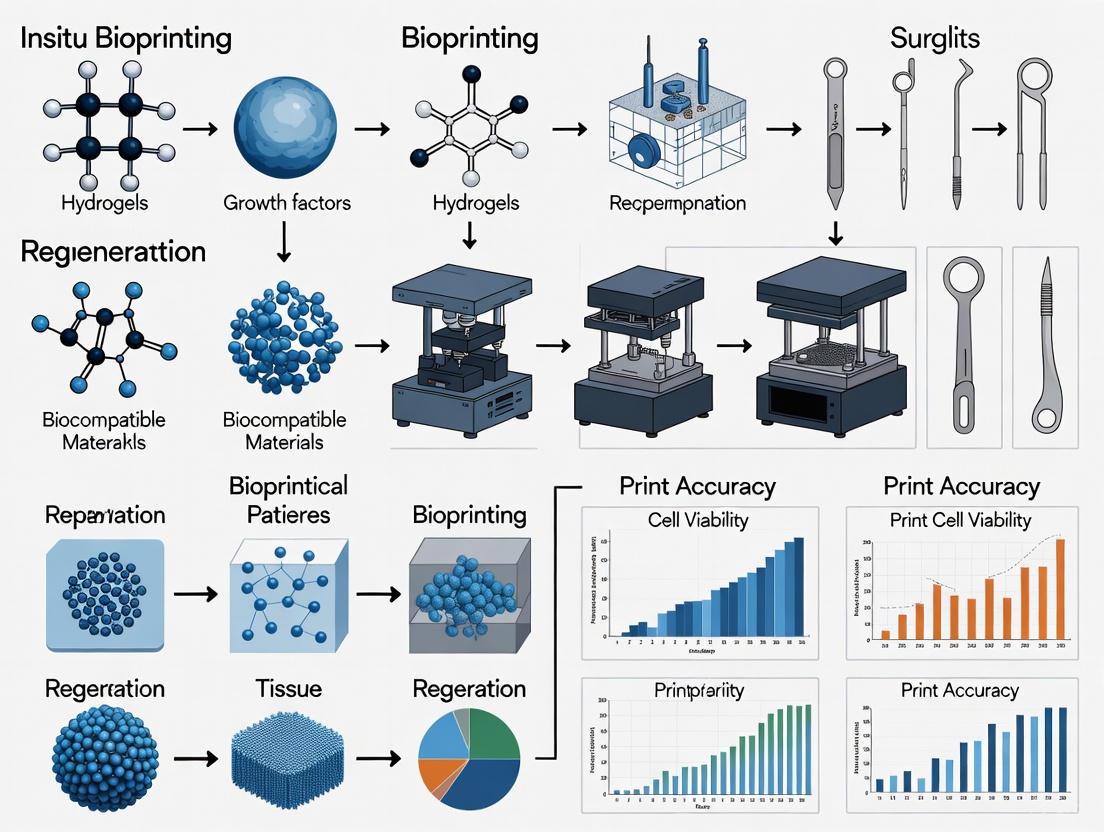
In situ bioprinting represents a paradigm shift in regenerative medicine, enabling the direct deposition of cells and biomaterials into defect sites during surgical procedures.
In Situ Bioprinting in Surgery: Current Breakthroughs, Clinical Applications, and Future Pathways
Abstract
In situ bioprinting represents a paradigm shift in regenerative medicine, enabling the direct deposition of cells and biomaterials into defect sites during surgical procedures. This article provides a comprehensive overview for researchers and drug development professionals, covering the foundational principles of this technology. It delves into the two primary methodological approaches—robotic and handheld systems—and their specific applications in skin, bone, and cartilage repair. The content further addresses critical challenges such as bioink development and printing fidelity, presenting recent optimization strategies involving AI and novel materials. Finally, it synthesizes validation data from preclinical and emerging clinical studies, evaluating the translational potential and comparative advantages of in situ bioprinting over conventional tissue engineering methods.
What is In Situ Bioprinting? Defining the Next Frontier in Surgical Regeneration
The field of regenerative medicine is undergoing a significant transformation, moving from traditional in vitro fabrication of biological constructs to the advanced paradigm of direct in vivo printing. This transition represents a fundamental shift in approach, where the human body itself becomes the bioreactor for tissue maturation. In situ bioprinting, the process of directly depositing bio-inks into anatomical defects during surgical procedures, offers substantial advantages over conventional methods, including the creation of customized implants that perfectly match patient-specific defects, reduced risks of infection associated with implant handling, and utilization of the body's native biological environment to enhance tissue integration and regeneration [1]. This application note delineates the core technologies, quantitative parameters, and standardized protocols enabling this transformative shift toward direct in vivo printing for surgical applications.
Core Technologies and Modalities for In Vivo Printing
Several technological platforms have emerged as frontrunners in the pursuit of reliable in vivo bioprinting. Each offers distinct mechanisms for addressing the critical challenges of precision, cell viability, and integration within a surgical context.
Autonomous Robotic Bioprinting Systems: These systems integrate multi-degree-of-freedom robotic manipulators with real-time visual feedback to achieve precise deposition. One documented framework utilizes a seven-degree-of-freedom robotic arm coupled with a structured light 3D camera system. This setup enables online measurement and reconstruction of printed constructs, allowing for quantitative evaluation of geometric parameters such as thickness and uniformity, which are vital for ensuring biological functionality [1].
Handheld Co-Axial Bioprinting Devices: Designed for intra-surgical application, devices like the "Biopen" employ a co-axial extrusion nozzle to address the challenge of photocrosslinking cytotoxicity. This design segregates cells in a photo-initiator-free core bio-ink, which is simultaneously encapsulated by a shell bio-ink containing the photo-initiator. Upon exposure to ultraviolet (UV) light, the shell undergoes rapid polymerization, providing immediate structural integrity while shielding the encapsulated cells from cytotoxic free radicals [2].
Ultrasound-Guided In Vivo Sound Printing (DISP): This breakthrough modality enables the non-invasive fabrication of structures deep within tissues. The DISP technique involves injecting a specialized bio-ink containing low-temperature–sensitive liposomes and a gas vesicle contrast agent into the target area. Ultrasound waves are then used for two purposes: imaging guidance by bouncing off the gas vesicles, and precise heating to trigger a phase transition in the liposomes, causing the solution to solidify into a gel-like consistency at the target site [3].
Sacrificial Bioprinting: This approach is not used for the final implant but is crucial for creating complex internal architectures, such as vascular networks. A sacrificial ink, which exhibits properties like appropriate viscosity, yield stress, and shear-thinning behavior, is printed to form a temporary scaffold. This scaffold is later removed under mild conditions (e.g., via dissolution or temperature change), leaving behind perfusable channels within the primary bio-ink construct [4].
Table 1: Comparative Analysis of In Situ Bioprinting Modalities
| Technology | Mechanism of Action | Key Advantage | Representative Application |
|---|---|---|---|
| Autonomous Robotic System [1] | Robotic manipulator guided by 3D visual feedback | High precision and automated quantitative evaluation | Treatment of volumetric muscle loss (VML) injuries |
| Handheld Co-Axial Bioprinting [2] | Core/Shell extrusion with UV crosslinking | Protects cells from photo-initiation cytotoxicity; surgeon-guided | In situ surgical cartilage repair |
| Deep Tissue Sound Printing (DISP) [3] | Ultrasound-triggered gelation of injected bio-ink | Non-invasive printing deep within tissues | Targeted drug delivery (e.g., to bladder tumors) |
| Sacrificial Bioprinting [4] | Printing of removable support structures | Enables creation of complex internal channels (e.g., for vasculature) | Fabrication of vascularized tissue constructs |
Quantitative Evaluation and Performance Metrics
The success of an in situ bioprinting procedure is critically dependent on the ability to quantitatively assess the quality of the printed construct. Moving beyond qualitative visual assessments is essential for standardizing protocols and ensuring clinical reliability.
A proposed framework for autonomous systems employs a structured light camera and computer vision algorithms to measure key geometric parameters post-printing. This facilitates the calculation of novel assessment metrics, such as Volume Score and Uniformity Score, which collectively help identify optimal printing parameters to ensure the biological functionality of the printed construct [1].
For handheld systems, the primary quantitative metrics revolve around the optimization of the crosslinking process. The goal is to achieve a scaffold with a compressive modulus sufficient to withstand physiological forces while maintaining high cell viability. Research on co-axial bioprinting for cartilage repair has demonstrated that using a lithium-acylphosphinate (LAP) photo-initiator at 0.1% (w/v) and a high UV-A intensity of 700 mW/cm² for just 10 seconds can produce constructs with a Young's modulus of approximately 200 kPa and cell viability exceeding 90% [2].
Table 2: Key Quantitative Parameters for In Situ Bioprinting Evaluation
| Parameter | Description | Measurement Technique | Target Value (Example) |
|---|---|---|---|
| Young's (Compressive) Modulus [2] | Stiffness of the printed construct; resistance to deformation | Mechanical compression testing | ~200 kPa (for cartilage repair) [2] |
| Cell Viability [2] | Percentage of living cells post-printing | Live/Dead assay, metabolic assays | >90% [2] |
| Volume Score [1] | Quantitative measure of the accuracy of deposited bio-ink volume | 3D visual measurement framework | System-dependent; used for parameter optimization |
| Uniformity Score [1] | Measure of the thickness consistency of the printed strand | 3D visual measurement framework | System-dependent; used for parameter optimization |
| Printability Window [4] | Range of process parameters (pressure, speed) for successful extrusion | Rheological and printability testing | Varies by bio-ink; a wider window is preferred |
Experimental Protocols
Protocol: In Situ Bioprinting for Cartilage Repair Using a Handheld Co-Axial System
This protocol outlines the procedure for direct surgical repair of chondral lesions using a co-axial biopen, based on established research [2].
I. Research Reagent Solutions Table 3: Essential Materials for Co-Axial Bioprinting
| Item | Function | Example / Specification |
|---|---|---|
| Gelatin Methacryloyl (GelMA)/Hyaluronic Acid Methacrylate (HAMA) | Photocrosslinkable bio-ink matrix | 10% (w/v) GelMA, 2% (w/v) HAMA [2] |
| Lithium Acylphosphinate (LAP) | Cytocompatible photo-initiator | 0.1% (w/v) in shell bio-ink [2] |
| Mesenchymal Stem Cells (MSCs) | Cell source for chondrogenesis | e.g., Adipose-derived MSCs (ADSCs) [2] |
| Co-Axial Bioprinting Device | Surgical tool for bio-ink deposition | e.g., "Biopen" with core/shell nozzles [2] |
| UV Light Source | For bio-ink photopolymerization | 365 nm wavelength, ~700 mW/cm² intensity [2] |
II. Step-by-Step Procedure
- Bio-ink Preparation:
- Core Bio-ink: Suspend MSCs in the GelMA/HAMA hydrogel solution. Do not add photo-initiator.
- Shell Bio-ink: Prepare the same GelMA/HAMA hydrogel solution and incorporate the LAP photo-initiator at 0.1% (w/v).
- Load the core and shell bio-inks into their respective reservoirs in the biopen device.
- Surgical Site Preparation: Debride the chondral lesion to create a stable, bleeding subchondral bed. Isolate the area to prevent bio-ink runoff.
- In Situ Deposition: Manually guide the biopen over the defect. Extrude the bio-ink in a controlled, layer-by-layer manner to fill the lesion. The co-axial nozzle will simultaneously deposit the cell-laden core and the photo-initiator-containing shell.
- Immediate Photocrosslinking: Simultaneously illuminate the deposited bio-ink with UV light (365 nm, 700 mW/cm²) for approximately 10 seconds to crosslink the shell hydrogel, forming a stable scaffold.
- Closure and Recovery: Conduct standard surgical closure procedures. Monitor the implant site as per post-operative care protocols.
The following workflow diagram illustrates the core-shell bioprinting process:
Protocol: Non-Invasive Printing via Deep Tissue In Vivo Sound Printing (DISP)
This protocol describes the methodology for using ultrasound to print biostructures deep within the body without surgical incision, based on the DISP technique [3].
I. Research Reagent Solutions Table 4: Essential Materials for DISP
| Item | Function | Example / Specification |
|---|---|---|
| DISP Bio-ink | Injectable solution containing sensitive liposomes | Includes low-temperature-sensitive liposomes [3] |
| Gas Vesicle Contrast Agent | Enables ultrasound imaging guidance | Expressed in bio-ink [3] |
| Therapeutic Cargo | Drug or cells for delivery | e.g., Chemotherapy drug [3] |
| Ultrasound Imaging System | For real-time guidance and monitoring | Clinical ultrasound machine |
| Focusing Ultrasound Transducer | For precise acoustic energy delivery | To trigger gelation at target site [3] |
II. Step-by-Step Procedure
- Bio-ink Formulation and Administration: Formulate the DISP bio-ink by incorporating the gas vesicle contrast agent and the therapeutic cargo (e.g., chemotherapeutic agents). Administer the bio-ink systemically or via localized injection/catheterization to the region of interest.
- Ultrasound Guidance and Monitoring: Use the ultrasound imaging system to monitor the distribution and accumulation of the gas vesicle-containing bio-ink in the target tissue (e.g., a bladder tumor).
- Acoustic Triggering for Gelation: Apply a focused ultrasound beam to the specific target area. The acoustic energy causes a localized temperature increase of ~5°C, which triggers the phase transition of the liposomes, leading to rapid crosslinking and gelation of the bio-ink.
- In Vivo Validation: Use non-invasive imaging (e.g., high-resolution T2 MRI) to confirm the formation, location, and structure of the printed gel depot [5] [3].
The mechanism of the DISP technology is summarized in the following diagram:
Biocompatibility and In Vivo Assessment
Rigorous biocompatibility testing is a non-negotiable step in translating in situ bioprinting technologies to the clinic. Assessments must evaluate both the local tissue response and systemic effects.
Key Assessment Modalities:
- In Vivo Biocompatibility: Studies implant material in animal models to monitor the foreign body response, fibrotic encapsulation, and tissue integration. For example, a PEGDA-GelMA composite has been shown to facilitate a permissive glial layer, induce neovascularization, and attract neuronal progenitors in brain lesion models, positioning it as a promising biomaterial [5].
- In Vivo Biodegradation: Tracks the breakdown of the implanted material over time and correlates it with new tissue formation. For instance, magnesium-based metal matrix nanocomposites (MMNCs) are investigated for bone implants due to their biodegradability and ability to promote osteointegration and new bone formation with minimal gas evolution [6].
- Non-Invasive Monitoring: Techniques like MRI are invaluable for longitudinal assessment. High-resolution T2 MRI can capture scaffold structures, while Arterial Spin Labeling (ASL) MRI can quantify cerebral blood flow to monitor the progressive revascularization of implants non-invasively [5].
The evolution from in vitro fabrication to direct in vivo printing marks a pivotal advancement in surgical regenerative medicine. The technologies outlined here—ranging from robotic and handheld systems to non-invasive sound printing—provide a robust toolkit for addressing complex clinical challenges. The critical factors for success include the selection of cytocompatible and mechanically appropriate materials, the refinement of quantitative evaluation metrics, and the adherence to standardized, rigorous experimental and biocompatibility protocols. As these technologies mature through large animal models and toward human trials, their integration into clinical practice holds the promise of enabling truly personalized, efficient, and minimally invasive reconstruction of tissues and organs. Future work will focus on expanding the library of clinical-grade bio-inks, enhancing the resolution and speed of printing modalities, and developing more sophisticated real-time feedback systems to ensure printing fidelity and long-term functional integration.
Conventional implants, including autologous bone grafts and standardized prosthetics, face significant limitations in orthopedic surgery and regenerative medicine. These include poor anatomical conformity, biochemical mismatches with the defect site, and an inability to dynamically integrate with the host's tissue regeneration process [7] [8]. Autologous grafts, while the gold standard, create additional injury sites and have limited availability for large defects [9]. Standardized implants often fail to meet the demand for personalization, particularly for patients with complex or irregular defects [8]. These challenges represent a critical clinical imperative for developing advanced solutions that can provide patient-specific therapeutics, with in situ bioprinting emerging as a transformative technology to address these limitations directly in the surgical setting.
Limitations of Conventional Implant Strategies
The performance criteria for ideal bone scaffolds highlight the significant shortcomings of conventional approaches. The following table summarizes these key limitations and their clinical consequences:
Table 1: Performance Gaps of Conventional Implants Compared to Ideal Scaffolds
| Performance Criteria | Conventional Implant Limitations | Clinical Consequences |
|---|---|---|
| Anatomical Conformity | Poor fit with complex defect geometries [8] | Reduced stability and integration; suboptimal functional outcomes |
| Mechanical Properties | Difficulty balancing strength and flexibility [8] | Stress shielding or mechanical failure; mismatch with host bone properties |
| Biocompatibility & Integration | Limited host tissue integration; risk of immune rejection [8] | Fibrous tissue formation; inflammation; implant failure |
| Bioactive Functionality | Lack of osteoinductivity and dynamic precision [8] | Limited bone regeneration capacity; passive role in healing process |
| Porous Structure | Inability to replicate hierarchical pore architecture of native bone [8] | Impaired nutrient transport, cell proliferation, and vascularization |
| Degradation Profile | Mismatch between degradation rate and new bone formation [8] | Insufficient mechanical support or interference with tissue regeneration |
Beyond these performance limitations, the standard of care for burn injuries—autologous split-thickness skin grafts (STSGs)—presents similar challenges, including painful donor sites, scarring, and limited availability for patients with large burns [9]. These constraints across multiple clinical domains underscore the pressing need for innovative approaches that can provide personalized, bioactive, and precisely engineered solutions.
In Situ Bioprinting: A Paradigm Shift in Implant Fabrication
In situ bioprinting represents a transformative approach that directly addresses the limitations of conventional implants by enabling the direct deposition of biomaterials and cells into or onto the defect site during surgical procedures. This paradigm shift from pre-fabricated to on-demand implant fabrication offers several distinct advantages, including perfect anatomical conformity, reduced risk of infection (by eliminating construct transport), and the ability to leverage the natural cellular microenvironment of the body for improved integration [10].
Comparative Advantages of In Situ Bioprinting
Table 2: Comparing Conventional Implants with In Situ Bioprinting Approaches
| Aspect | Conventional Implants | In Situ Bioprinting Solutions |
|---|---|---|
| Personalization | Standardized shapes; limited customization [8] | Patient-specific printing based on defect anatomy [7] |
| Surgical Workflow | Multiple steps; prefabrication required [7] | Direct deposition into defect; streamlined intraoperative process [7] |
| Biomaterial Integration | Limited multifunctionality [7] | Tunable composites with antibacterial effects, osteoconductivity [7] |
| Mechanical Properties | Fixed properties post-production [8] | Adjustable by modulating material composition (e.g., HA content in PCL) [7] |
| Tissue Integration | Biochemical mismatches [7] | Natural microenvironment utilization; robust new bone formation demonstrated [7] [10] |
Technical Platforms for In Situ Bioprinting
The implementation of in situ bioprinting spans multiple technological platforms, each with specific clinical applications:
Bedside Mounted Bioprinters: These systems fit around the patient and print directly onto the area of interest, typically using computer-aided design (CAD) models for precision. They offer high precision for defined anatomical locations but may have limitations in accessing confined surgical sites [10].
Handheld Bioprinters: These portable devices provide surgeons with increased flexibility and surgical dexterity, allowing application in complex anatomical areas. They enable concurrent delivery of hydrogel precursor solutions and crosslinkers directly to the wound site, facilitating direct printing and shaping of constructs without prefabrication [7] [10].
Robotic Bioprinting Systems: Advanced frameworks integrate bioprinting tools with seven-degree-of-freedom robotic manipulators for precise autonomous bioprinting procedures. These systems incorporate 3D visual measurement frameworks with structured light cameras and computer vision algorithms for accurate reconstruction of bioprinted constructs, addressing challenges of printing on non-planar surfaces common in the human body [1].
High-Throughput Systems: Technologies like HITS-Bio (High-throughput Integrated Tissue Fabrication System for Bioprinting) enable rapid positioning of multiple spheroids simultaneously using digitally-controlled nozzle arrays, achieving speeds ten times faster than existing techniques while maintaining high cell viability (>90%) [11]. This approach is particularly valuable for intraoperative bioprinting applications where time is a critical factor.
Application Notes & Experimental Protocols
Protocol 1: In Situ Printing of Bone Scaffolds for Critical-Sized Defects
This protocol outlines the methodology for in situ fabrication of bone implants composed of polycaprolactone (PCL) and hydroxyapatite (HA) for critical-sized bone defects, based on recent research demonstrating successful implementation in animal models [7].
4.1.1 Experimental Workflow
The following diagram illustrates the complete workflow for in situ bioprinting of bone scaffolds:
4.1.2 Materials and Reagents
Table 3: Research Reagent Solutions for In Situ Bone Bioprinting
| Reagent/Material | Function/Application | Specifications/Notes |
|---|---|---|
| Polycaprolactone (PCL) | Primary scaffold material; biodegradable polymer | Adjust molecular weight to tune mechanical properties [7] |
| Hydroxyapatite (HA) | Osteoconductive component; enhances bioactivity | Vary content to optimize mechanical and biological properties [7] |
| Antibiotics | Incorporated for infection control | Specific antibiotics selected based on application requirements [7] |
| Solvent-free Composite | Printing material for low-temperature extrusion | Enables direct printing without tissue damage [7] |
4.1.3 Detailed Methodology
Step 1: Biomaterial Preparation and Optimization
- Prepare PCL/HA composite materials with varying HA content (typically 10-30% by weight)
- Adjust the molecular weight of PCL to optimize mechanical properties and degradation profile
- Incorporate selected antibiotics at concentrations effective for preventing infection
- Characterize composite properties including viscosity, melting temperature, and shear-thinning behavior
Step 2: Printing Platform Setup
- Configure portable in situ printing device with temperature-controlled extrusion system
- Calibrate printing parameters including extrusion pressure, printing speed, and nozzle temperature
- Set low-melting-point extrusion parameters to maintain temperature below tissue damage threshold
- Ensure sterility of all components contacting the surgical site
Step 3: Defect Site Preparation and Mapping
- Prepare critical-sized bone defect using standard surgical techniques
- Assess defect geometry and dimensions through intraoperative measurement
- Determine printing path and deposition pattern based on defect morphology
- Ensure hemostasis and appropriate wound bed conditions for printing
Step 4: In Situ Printing Process
- Directly extrude PCL/HA composite into the defect site without prefabrication
- Maintain printing temperature below 60°C to prevent tissue damage
- Layer-by-layer deposition to build 3D scaffold structure conforming to defect anatomy
- Adjust printing parameters in real-time based on surgical observations
Step 5: Post-Printing Assessment
- Evaluate scaffold integration with surrounding tissue
- Assess mechanical stability and adhesion to defect margins
- Monitor new bone formation through appropriate imaging modalities (micro-CT, histology)
- Quantify bone regeneration metrics at predetermined time points (4, 8, 12 weeks)
4.1.4 Key Parameters for Optimization
- Mechanical Properties: Adjust HA content and PCL molecular weight to match target tissue properties
- Biological Performance: Optimize composition for osteoconductivity and vascularization
- Printing Fidelity: Balance resolution and printing speed for clinical practicality
- Degradation Profile: Tune material composition to match rate of new bone formation
Protocol 2: Autonomous Robotic Bioprinting for Volumetric Muscle Loss
This protocol details the implementation of an autonomous in situ bioprinting surgical robotic framework for treating volumetric muscle loss (VML) injuries, based on recently developed systems that enable precise deposition with quantitative evaluation [1].
4.2.1 Experimental Workflow
4.2.2 System Components and Specifications
Table 4: Robotic Bioprinting System Components
| Component | Specifications | Function |
|---|---|---|
| Robotic Manipulator | 7 degrees of freedom (KUKA LBR iiwa) [1] | Precise positioning of bioprinting tool in complex anatomical sites |
| Visual Measurement | Structured light camera (Zivid Two M70) [1] | High-accuracy 3D reconstruction of bioprinted constructs |
| Computer Vision | Complementary 2D/3D algorithms [1] | Online measurement and analysis of geometric parameters |
| Quantitative Evaluation | Novel assessment metrics [1] | Characterization of bioprinting process performance |
| Control System | Robot Operating System (ROS) [1] | Integrated control of all system components |
4.2.3 Detailed Methodology
Step 1: Bioink Preparation and Characterization
- Formulate generic bioprinting material appropriate for muscle tissue regeneration
- Characterize rheological properties including viscosity, shear-thinning behavior, and yield stress
- Assess biocompatibility and support of myoblast proliferation and differentiation
- Optimize bioink composition for printability and cell viability
Step 2: Robotic System Configuration
- Calibrate 7-DOF robotic manipulator for surgical workspace
- Integrate bioprinting tool with end-effector compatible with sterilization protocols
- Configure structured light camera system for intraoperative imaging
- Implement collision detection and safety protocols for patient safety
Step 3: Vision System Implementation
- Calibrate structured light camera for accurate 3D reconstruction
- Implement computer vision algorithms for real-time construct assessment
- Develop segmentation protocols for geometric parameter extraction
- Validate measurement accuracy against standard reference methods
Step 4: Autonomous Bioprinting Execution
- Program robotic printing paths based on defect geometry
- Execute autonomous deposition with controlled parameters
- Monitor printing process in real-time using vision feedback
- Adjust printing parameters based on online quality assessment
Step 5: Quantitative Performance Evaluation
- Apply novel assessment metrics for construct characterization
- Evaluate geometric parameters including thickness and uniformity
- Assess biological functionality through appropriate assays
- Correlate printing parameters with construct quality outcomes
4.2.4 Performance Optimization
- Conduct multiple experimental iterations (e.g., 90 experiments as referenced) [1]
- Identify optimal bioprinting parameters using quantitative assessment metrics
- Validate biological functionality through in vitro and in vivo testing
- Refine system parameters for specific clinical applications
Advanced Biomaterial Strategies for In Situ Bioprinting
The success of in situ bioprinting depends critically on advanced biomaterial systems that support both printability and biological function. Several key strategies have emerged to address the complex requirements of direct printing in surgical settings.
Crosslinking Mechanisms for In Situ Bioprinting
Different crosslinking strategies offer distinct advantages for clinical translation, with selection dependent on specific application requirements:
Table 5: Crosslinking Mechanisms for In Situ Bioprinting Applications
| Crosslinking Mechanism | Advantages | Limitations | Clinical Applicability |
|---|---|---|---|
| Ionic Crosslinking | Fast crosslinking; room temperature operation [9] | Lower mechanical strength; potential ion toxicity [9] | High - suitable for alginate-based systems |
| Covalent Crosslinking | Strong mechanical properties [9] | Slower process; potential crosslinker toxicity [9] | Medium - requires biocompatible crosslinkers |
| Photocrosslinking | Fast and efficient; spatial control [9] | UV light toxicity; limited penetration depth [9] | Medium - requires light access to wound site |
| Thermal Crosslinking | Physiological temperature triggering [9] | Slow gelation; reversible process; heat effects [9] | Medium - suitable for temperature-sensitive materials |
Sacrificial Inks for Complex Structure Fabrication
Sacrificial inks represent a powerful strategy for creating complex tissue architectures that would be impossible with conventional approaches. These materials provide temporary support during the printing process and are subsequently removed under mild conditions, creating intricate vascular networks and complex microarchitectures essential for tissue viability [4].
Key Material Requirements for Sacrificial Inks:
- Appropriate Viscosity: Prevents droplet formation while enabling extrusion [4]
- Yield Stress: Maintains shape when static but flows when pressure applied [4]
- Shear-Thinning Behavior: Viscosity decreases with increasing shear rate [4]
- Elastic Recovery: Quick recovery of viscosity after extrusion [4]
- Effective Removal: Mild removal process that preserves construct integrity [4]
Common Sacrificial Ink Systems:
- Gelatin: Temperature-sensitive natural polymer with excellent biocompatibility [4]
- Pluronic F127: Thermoresponsive triblock copolymer with sol-gel transition near body temperature [4]
In situ bioprinting represents a paradigm shift in addressing the clinical imperative for advanced implant solutions that overcome the limitations of conventional approaches. By enabling patient-specific, anatomically conformal, and bioactive implant fabrication directly at the defect site, this technology addresses critical challenges in personalized medicine and regenerative surgery. The protocols and methodologies outlined herein provide researchers with practical frameworks for implementing these advanced approaches in both orthopedic and soft tissue applications.
Future development will focus on enhancing material biofunctionality, improving printing speed and resolution, and addressing the challenges of vascularization in thick tissue constructs. The integration of organoid technology with bioprinting presents particularly promising opportunities for creating more physiologically relevant tissue models and implants [8]. As these technologies mature, in situ bioprinting is poised to transform clinical practice across multiple surgical disciplines, ultimately improving patient outcomes through personalized, biologically integrated implant solutions.
In situ bioprinting represents a transformative shift in regenerative medicine, defined as the direct deposition of cell-laden bioinks at a defect site to create or repair living tissues and organs during a clinical procedure [12]. This approach stands in contrast to traditional ex vivo methods, where constructs are bioprinted in a laboratory, matured in bioreactors, and later implanted. The paradigm of in situ bioprinting leverages the human body’s intrinsic biological environment as a natural "in vivo bioreactor," which governs the subsequent development, maturation, and integration of the printed construct [12]. This methodology offers a powerful combination of surgical precision, seamless integration with native tissues, and the harnessing of the body's own regenerative capacities.
The clinical workflow for in situ bioprinting typically begins with medical imaging (e.g., CT or MRI) to create a digital model of the defect. This model is translated into a printing path for a bioprinter, which can be a handheld device for flexibility or a robotic arm for high accuracy [12] [13]. The bioink, containing living cells and biomaterials, is then deposited directly onto the wound site in a layer-by-layer fashion, conforming to the often irregular geometry of the defect [14]. This direct application minimizes surgical time, reduces the risk of contamination associated with handling and transportation of pre-fabricated constructs, and enhances the scaffold's integration with the host tissue [12].
Key Advantage 1: Unparalleled Precision
Precision in situ bioprinting enables the creation of patient-specific constructs that perfectly match complex defect geometries, which is crucial for functional and aesthetic outcomes in regenerative surgery.
Customization and Accuracy
The precision of in situ bioprinting is multi-faceted, encompassing anatomical conformity, cellular placement, and material deposition. Robotic-arm systems achieve this through advanced imaging and motion control. For instance, one system utilizes a 3-axis movable bioprinting unit that operates under surgeon control, capitalizing on a pre-printed plan defined by computer-aided design (CAD) to regulate the spatial location of all tissue components [12]. This digital blueprint allows for the fabrication of constructs with physiological equivalence to native structures. A recent advancement in motor-free soft robotic systems demonstrated this capability, achieving precise motion control with mean errors of less than 300 µm, effectively minimizing physical tremors during procedures [15].
The following table summarizes key quantitative data related to the precision of different in situ bioprinting systems:
Table 1: Precision Metrics in In Situ Bioprinting Systems
| System Type | Key Precision Metric | Reported Value/Outcome | Application Context |
|---|---|---|---|
| Robotic Arm [15] | Motion Control Accuracy | Mean errors < 300 µm | Minimally Invasive Surgery |
| Handheld Biopen [16] | Scaffold Stiffness | ~200 kPa Compressive Modulus | Cartilage Repair |
| Portable Skin Printer [13] | Workspace Customization | 3-DOF robotic arm for irregular wounds | Skin Wound Repair |
| Traditional 3D Bioprinter [14] | Defect Conformity | Seamless integration with native bone | Craniofacial Bone Repair |
Experimental Protocol: Precision Scanning and Printing for Cutaneous Wounds
Objective: To repair a full-thickness skin wound using a portable, robotic-arm in situ bioprinting system by first creating a precise 3D model of the wound for customized printing [13].
Materials:
- Portable 3D Bioprinting System: Integrates a 3-degree-of-freedom (3-DOF) robotic arm, a digital camera (e.g., SONY IMX214), and a printhead.
- Bioink: Typically a fibrin-based hydrogel containing human dermal fibroblasts and epidermal keratinocytes.
- Animal Model: Rats with full-thickness dorsal skin defects.
Methodology:
- Wound Imaging and 3D Modeling:
- Position the camera mounted on the robotic arm 30 cm above the wound center.
- Capture 24 images of the wound at 15° intervals.
- Process the photographs using the Scale Invariant Feature Transform (SIFT) algorithm for feature extraction.
- Reconstruct the 3D model of the wound using Structure from Motion (SFM) methodology.
Path Planning and Printing:
- Convert the 3D wound model into a toolpath for the bioprinter.
- Load the cell-laden bioink into the printing cartridge.
- Use the robotic arm to deposit the bioink directly onto the wound bed in a layer-by-layer manner, following the contours of the 3D model to ensure complete and conformal coverage.
Validation:
- Assess printing accuracy by scanning a 2D checkerboard template and comparing the reconstructed model to the original.
- Evaluate wound healing over time compared to controls (e.g., commercial dressings).
Diagram 1: Precision workflow for skin wound repair.
Key Advantage 2: Enhanced Host Integration
A paramount advantage of in situ bioprinting is its ability to promote enhanced integration between the printed construct and the host's native tissue, overcoming a significant challenge faced by pre-fabricated implants.
The Body as a Dynamic Environment
When a cell-laden construct is printed directly into a defect, it is immediately exposed to the host's physiological environment. This includes a rich milieu of endogenous growth factors, immune cells, and mechanical cues that actively guide the processes of tissue remodeling and regeneration [12]. This direct exposure avoids the potential mismatch that can occur when a construct matured in a static, artificial in vitro environment is introduced into a dynamic, complex in vivo setting. The body's natural wound healing response is harnessed from the moment of printing, facilitating rapid vascularization and innervation from the surrounding tissue into the printed scaffold. This approach also mitigates issues such as scaffold deformation, contraction, or damage that can occur during the handling and implantation of fragile pre-cultured constructs [12].
Experimental Protocol: In Situ Bioprinting for Cartilage Repair
Objective: To repair a chondral lesion by surgically depositing a co-axial core/shell scaffold laden with stem cells that shields cells from cytotoxic crosslinking while achieving immediate mechanical stability [16].
Materials:
- Device: Handheld co-axial bioprinter (e.g., "Biopen").
- Bioink (Core): Gelatin methacryloyl (GelMa)/Hyaluronic acid methacrylate (HAMa) (10%/2%) hydrogel encapsulating infrapatellar Adipose-derived Mesenchymal Stem/Stromal Cells (ADSCs). No photo-initiator.
- Bioink (Shell): Identical GelMa/HAMa hydrogel (10%/2%) containing 0.1% (w/v) Lithium Acylphosphinate (LAP) as the photo-initiator.
- Crosslinking Source: 365 nm UV-A light at an intensity of 700 mW/cm².
Methodology:
- Lesion Preparation: Debride the osteochondral lesion to create a stable, bleeding bed.
- Bioink Loading: Fill the core cartridge with the cell-laden bioink (without PI). Fill the shell cartridge with the PI-containing bioink.
- Co-axial Deposition and Crosslinking:
- Use the handheld Biopen to manually fill the lesion, extruding the core and shell bioinks simultaneously.
- Immediately expose the deposited filament to UV light for 10 seconds to photo-crosslink the shell.
- The crosslinked shell provides an initial compressive modulus of approximately 200 kPa, sufficient to withstand forces in the joint.
- The core-shell structure protects the encapsulated ADSCs from the cytotoxic free radicals generated during crosslinking, resulting in >90% cell viability.
- In Vivo Maturation: The protected ADSCs, now in the joint environment, are stimulated to undergo chondrogenesis, forming functional hyaline cartilage over time.
Diagram 2: Integration protocol for cartilage repair.
Key Advantage 3: The Body as a Bioreactor
The concept of the human body as a natural bioreactor is central to the success of in situ bioprinting, eliminating the need for complex and expensive in vitro maturation systems.
Recapitulating the Native Microenvironment
Traditional ex vivo tissue engineering requires the creation of an artificial microenvironment in a bioreactor to provide biochemical and biophysical cues for tissue development. This is challenging, expensive, and often incomplete. In situ bioprinting bypasses this by leveraging the host's own regulatory systems [12]. The printed construct is immediately perfused by the body's circulatory system, which delivers oxygen and nutrients while removing metabolic waste. Furthermore, the body provides a continuous and dynamic supply of biochemical signals, such as cytokines and growth factors, which direct cell proliferation, differentiation, and tissue organization in a way that is impossible to fully replicate in a laboratory setting [12] [17]. This leads to superior tissue maturation and functional integration.
Experimental Protocol: In Situ Bone Regeneration in a Live Model
Objective: To regenerate a critical-sized craniofacial bone defect by in situ bioprinting of a stem cell-laden bioink, relying on the body's innate healing response to drive osteogenesis [14].
Materials:
- Bioprinter: Traditional 3D Bioprinter (e.g., Envisiontech Bioplotter), stabilized for use on an anesthetized animal.
- Bioink: Alginate/Hydroxyapatite hydrogel laden with autologous adipose-derived stem cells.
- Animal Model: Rabbits with critical-sized defects on the parietal bone.
- Control Groups: Defects treated with non-cell bioink (acellular) and sham surgery.
Methodology:
- Defect Creation and Stabilization: Create a critical-sized bone defect on the rabbit's parietal bone and ensure the animal is securely anesthetized.
- In Situ Printing: Directly print the autologous stem cell-laden bioink into the bone defect using the 3D bioprinter.
- Post-Operative Monitoring: Allow the body's natural bioreactor functions to mediate bone healing. No external bioreactor is used.
- Analysis:
- Micro-CT Scanning: Perform at set time points to quantitatively assess bone volume and percent bone volume.
- Histopathological Analysis: Evaluate bone-material integration and the nature of the healing response (e.g., presence of osteoblasts, new bone matrix, inflammatory cells).
Results: The group treated with the cellular bioink showed the highest bone volume and bone surface density in micro-CT analysis, demonstrating successful regeneration driven by the combined action of the printed stem cells and the host's regenerative microenvironment [14].
Table 2: Quantitative Outcomes in In Situ Bone Regeneration
| Experimental Group | Bone Volume (Micro-CT) | Bone Surface/Volume Ratio | Histological Observations |
|---|---|---|---|
| Cellular Bioink | Highest | Higher | Evidence of active bone formation and integration. |
| Acellular Bioink | Intermediate | Higher | Fibrous capsule; periosteal proliferation. |
| Sham (Control) | Lowest | Lower | Primarily fibrocytes and collagen, indicating failed regeneration. |
The Scientist's Toolkit: Essential Research Reagents and Materials
The successful implementation of in situ bioprinting relies on a carefully selected suite of reagents and materials. The following table details key components used in the protocols and research cited herein.
Table 3: Key Research Reagents and Materials for In Situ Bioprinting
| Item | Function/Description | Example Application |
|---|---|---|
| Gelatin Methacryloyl (GelMa) | A photopolymerizable hydrogel derived from gelatin; provides cell-adhesive motifs and tunable mechanical properties. | Primary hydrogel in co-axial cartilage repair [16]. |
| Hyaluronic Acid Methacrylate (HAMa) | A modified glycosaminoglycan; enhances biofunctionality and printability of hydrogels. | Used in combination with GelMa for cartilage scaffolds [16]. |
| Lithium Acylphosphinate (LAP) | A highly efficient, cytocompatible photo-initiator for UV light-induced crosslinking. | Enables rapid shell crosslinking (10s) in the Biopen protocol [16]. |
| Alginate/Hydroxyapatite Bioink | A composite bioink; alginate provides printability, while hydroxyapatite provides osteoconductivity. | Used for in situ bioprinting of craniofacial bone [14]. |
| Adipose-Derived Stem Cells (ADSCs) | Multipotent mesenchymal stem cells; can differentiate into osteogenic and chondrogenic lineages. | Seed cells for cartilage [16] and bone [14] regeneration. |
| Fibrin-based Hydrogel | A naturally derived hydrogel formed from fibrinogen and thrombin; excellent for cell encapsulation and wound healing. | Base bioink for in situ skin printing applications [13]. |
| Handheld Co-Axial Bioprinter | A surgical tool allowing simultaneous extrusion of core and shell bioinks for cell protection during crosslinking. | Enables in situ cartilage repair (Biopen) [16]. |
| Robotic Arm Bioprinter | A multi-axis automated system for high-precision, customized deposition of bioinks on contoured surfaces. | Used for accurate repair of large skin wounds [13]. |
Historical Context and Evolution of the Technology
In situ bioprinting represents a paradigm shift in regenerative medicine and surgical applications, moving from traditional in vitro fabrication of biological constructs to direct intraoperative deposition of bioinks into defect sites. This technology has evolved from early 3D printing concepts to sophisticated clinical tools that enable surgeons to reconstruct complex tissues with unprecedented precision. Within the broader thesis on in situ bioprinting for surgical applications research, understanding this historical evolution is crucial for appreciating current capabilities and future directions. The technology's development spans multiple decades, intersecting advances in engineering, biomaterials science, and clinical medicine to create a transformative approach for addressing unmet surgical needs.
Historical Development and Key Milestones
The foundation of in situ bioprinting begins with the broader history of 3D printing. The invention of stereolithography by Charles Hull in 1984 established the fundamental principles of additive manufacturing that would later enable bioprinting technologies [18]. However, the specific application to biological materials did not emerge until more than a decade later. The earliest attempts to create cell growth on pre-fabricated 3D surfaces began in 1998, when researchers modified biodegradable polylactic acid (PLA) polymers with polyethylene oxide (PEO) and polypropylene oxide (PPO) to achieve adhesion of liver cells and fibroblasts [19].
The conceptual foundation for bioprinting was established in 2003 with the first article proposing printing cells layer by layer on a thermo-reversible gel to form 3D organs as a potential solution to the organ shortage crisis [19]. The term "bioprinting" first appeared in 2004 when researchers developed a system of 12 piezoelectric ejectors capable of printing biological materials by droplet ejection on an XY platform, allowing the printing of arbitrary patterns [19]. This period also saw researchers realizing that viable cells could be printed using modified commercial inkjet printers with multiple nozzles to create structures with mixed cell types [19].
A pivotal moment in the field occurred with the First Annual Charleston Bioprinting Symposium in 2006, organized by the Medical University of South Carolina's Bioprinting Research Center, which demonstrated that despite technological challenges, bioprinting was a feasible solution to organ shortage [19]. The first direct printing of living cells in alginate gel using an inkjet printing system occurred in 2009, alongside the successful recreation of skin grafts by printing collagen hydrogel precursors, fibroblasts, and keratinocytes [19]. The period from 2010 onward witnessed rapid advancement in high-performance laser printing of cells and biomaterials, with hydrogels emerging as materials of choice for direct biofabrication techniques [19].
The specific concept of in situ bioprinting emerged as researchers recognized the limitations of conventional in vitro approaches. The traditional paradigm involved fabricating constructs in laboratory settings followed by implantation, which presented challenges including construct deformation during implantation, poor integration with host tissues, and the need for multiple surgical procedures [20]. In situ bioprinting was proposed to address these limitations by enabling direct deposition of bioinks into the defect site during a single surgical procedure.
Table 1: Historical Milestones in Bioprinting Development
| Year | Milestone Achievement | Significance |
|---|---|---|
| 1984 | Invention of stereolithography [18] | Established foundational principles for additive manufacturing |
| 1998 | First modified biodegradable polymers for cell adhesion [19] | Demonstrated potential for 3D cell culture scaffolds |
| 2003 | First concept of layer-by-layer cell printing for organs [19] | Proposed bioprinting as solution to organ shortage |
| 2004 | Term "bioprinting" first used; piezoelectric ejector system [19] | Created first specialized equipment for biological printing |
| 2006 | First Charleston Bioprinting Symposium [19] | Established bioprinting as legitimate scientific discipline |
| 2009 | Direct printing of living cells in alginate; skin graft recreation [19] | Proved feasibility of printing viable tissues |
| 2012 | Bioprinting with amniotic fluid-derived cells for wound treatment [21] | Demonstrated therapeutic efficacy in preclinical models |
| 2018 | Handheld Biopen device for intraoperative use [21] | Enabled surgical sculpting of tissues in clinical setting |
| 2020s | Development of minimally invasive robotic bioprinters [21] [20] | Advanced capability for internal tissue repair |
The evolution of in situ bioprinting has been characterized by parallel development in two main technology streams: bedside-mounted systems that provide automated printing around a subject, and handheld devices that offer manual operation with surgical dexterity [21]. This dual-path development has enabled the technology to address diverse surgical scenarios from large-scale wound repair to minimally invasive procedures.
Evolution of Bioprinting Technologies and Methods
The technological evolution of in situ bioprinting has progressed through several generations of printing methodologies, each with distinct capabilities and applications. Early bioprinting approaches adapted existing additive manufacturing techniques for biological applications, including Selective Laser Sintering (SLS), Thermal Inkjet Printing (TIJ), and Fused Deposition Modeling (FDM) [22]. These methods provided the foundation but required significant modification to handle living cells and biological materials.
Extrusion-based bioprinting has emerged as the predominant technique for in situ applications, utilizing pneumatic or mechanical dispensing systems to deposit continuous filaments of bioinks [23]. This approach offers advantages in printing speed, structural integrity, and compatibility with high cell densities. Alternative methods include droplet-based bioprinting (adapting inkjet technology for biological materials) and photocuring-based bioprinting (using light to crosslink photosensitive hydrogels) [23]. Each method presents distinct trade-offs in resolution, printing speed, cell viability, and material requirements.
A significant advancement in in situ bioprinting has been the development of coaxial and multi-material printing systems that enable fabrication of heterogeneous tissue constructs with vascular-like channels [23]. These systems allow simultaneous deposition of multiple bioink compositions and creation of core-shell structures that better mimic native tissue architecture.
Table 2: Comparison of Major Bioprinting Technologies for Surgical Applications
| Printing Method | Mechanism | Resolution | Speed | Cell Viability | Key Applications |
|---|---|---|---|---|---|
| Extrusion-Based | Pneumatic or mechanical dispensing of continuous bioink filaments | 50-500 μm | Medium | 80-95% [21] | Skin, bone, cartilage, vascular tissues |
| Droplet-Based | Thermal, piezoelectric, or acoustic droplet ejection | 20-100 μm | High | 85-90% [22] | High-precision patterning, thin tissues |
| Laser-Assisted | Laser-induced forward transfer of bioink droplets | 10-50 μm | Low | 70-95% [19] | High-resolution structures, delicate tissues |
| Photocuring-Based | Light-induced crosslinking of photosensitive bioinks | 10-100 μm | Medium-High | 75-90% [24] | Complex architectures, organ-on-chip models |
Recent innovations focus on enhancing process control and reproducibility. A 2025 development from MIT introduced an AI-based monitoring system that captures high-resolution images of tissues during printing and rapidly compares them to intended designs, identifying defects such as over- or under-deposition of bioink [25]. This approach represents a significant advancement toward intelligent process control in embedded bioprinting, enabling real-time inspection, adaptive correction, and automated parameter tuning.
The evolution of in situ bioprinting platforms has progressed from modified commercial 3D printers to specialized systems designed specifically for surgical environments. These include:
- Bedside-mounted systems: Computer-controlled printers that fit around the patient and print directly onto areas of interest [21]
- Handheld devices: Manually operated instruments that provide surgical dexterity and flexibility [21] [20]
- Robotic assisted systems: Integrated with robotic arms for enhanced precision and access to internal structures [21]
- Minimally invasive catheters: Ferromagnetic soft catheter robots (FSCR) that can print internal organs through minor incisions [21]
This progression demonstrates a clear trend toward greater integration with surgical workflows, enhanced accessibility for healthcare providers, and improved compatibility with the constraints of clinical environments.
Experimental Protocols and Methodologies
Handheld Bioprinting for Cartilage Repair
The Biopen device represents a significant advancement in handheld in situ bioprinting technology for orthopedic applications [21]. The experimental protocol involves:
Pre-bioprinting Stage:
- Bioink Preparation: Formulate a hyaluronic acid-gelatin methacrylamide (HA-GelMa) composite bioink. The core bioink contains allogeneic adipose-derived mesenchymal stem cells (MSCs) at a concentration of 10-20 million cells/mL, while the shell bioink incorporates photoinitiator for crosslinking.
- Imaging and Planning: Acquire MRI scans of the joint defect and reconstruct a 3D model of the lesion using segmentation software. Convert to STL format for surgical guidance.
- Device Sterilization: Sterilize the Biopen device and bioink cartridges using ethylene oxide gas or gamma irradiation.
Intraoperative Bioprinting Protocol:
- Surgical Access: Perform standard arthroscopic approach to expose the chondral defect.
- Defect Preparation: Debride the damaged cartilage until reaching healthy surrounding tissue with good vascular supply. Create a stable border for graft integration.
- Bioink Loading: Aseptically load cell-laden bioink into the core cartridge and photoinitiator-containing bioink into the shell cartridge.
- Layer-by-Layer Deposition: Manually deposit bioink in a layered fashion directly into the defect site, maintaining a consistent extrusion rate of 4-6 μL/s.
- Simultaneous Crosslinking: Activate integrated UV light source (365 nm, 5-10 mW/cm²) during deposition to achieve immediate partial crosslinking (30-60 seconds per layer).
- Final Curing: Apply additional UV exposure (60-120 seconds) to ensure complete crosslinking of the entire construct.
- Wound Closure: Perform standard surgical closure after confirming graft stability.
Validation Methods:
- Cell Viability Assessment: Analyze using live/dead staining at 24 hours post-printing, demonstrating >97% viability [21].
- Histological Evaluation: Process explants at 4, 8, and 12 weeks for safranin-O staining to assess glycosaminoglycan content and collagen type II immunohistochemistry.
- Mechanical Testing: Perform indentation testing to evaluate compressive modulus and integration with surrounding native tissue.
Automated In Situ Bioprinting for Cutaneous Wounds
Robotic in situ bioprinting systems provide automated, high-precision deposition for large skin wounds [21] [20]. The methodology includes:
Preoperative Planning Phase:
- Wound Scanning: Use structured-light scanning (SLS) to capture 3D topography of the wound bed with accuracy up to 100 μm. For internal defects, utilize CT or MRI imaging.
- Model Reconstruction: Process point cloud data to generate a 3D model of the defect, converting to G-code that dictates printing path.
- Bioink Selection: Prepare fibrin-based bioinks containing human dermal fibroblasts (HDFs) and keratinocytes at optimized ratios (typically 3:1 fibroblast:keratinocyte).
Robotic Bioprinting Protocol:
- System Calibration: Register the bioprinter coordinate system with the patient anatomy using fiduciary markers.
- Wound Bed Preparation: Cleanse wound and achieve hemostasis while preserving viable tissue components.
- Multi-Layer Deposition:
- Dermal Layer: Print HDFs (10-15 million cells/mL) in fibrin-collagen hydrogel at 22-26°C with 0.5-1 mm strand spacing.
- Epidermal Layer: Deposit keratinocytes (5-8 million cells/mL) in similar bioink with tighter strand spacing (0.3-0.5 mm).
- In Situ Crosslinking: Utilize biological crosslinking through fibrin polymerization initiated by thrombin-calcium chloride solution applied via mist sprayer.
- Real-time Monitoring: Implement camera systems with computer vision algorithms to detect printing defects and adjust parameters accordingly.
Outcome Assessment:
- In Vivo Performance: Evaluate in porcine wound models, with complete re-epithelialization achieved in 3 out of 4 treated wounds compared to 1 out of 4 controls [21].
- Histological Analysis: Assess epidermal thickness, collagen organization, and mature basement membrane formation at 28 days post-treatment.
- Biomechanical Testing: Measure tensile strength and elasticity compared to native skin and conventional treatments.
Diagram 1: In Situ Bioprinting Workflow
The Scientist's Toolkit: Research Reagent Solutions
Successful implementation of in situ bioprinting requires carefully selected materials and reagents optimized for both printability and biological function. The following table details essential research reagent solutions for in situ bioprinting applications:
Table 3: Essential Research Reagent Solutions for In Situ Bioprinting
| Reagent Category | Specific Examples | Function and Application Notes |
|---|---|---|
| Natural Polymer Bioinks | Gelatin methacryloyl (GelMa), hyaluronic acid methacrylate (HAMA), alginate, fibrin, collagen, decellularized ECM (dECM) [21] [26] [24] | Provide biocompatibility, cell adhesion motifs, and tunable physical properties. GelMa-HAMA composites excellent for cartilage regeneration [21]. dECM provides tissue-specific biochemical cues. |
| Synthetic Polymer Bioinks | Polycaprolactone (PCL), polylactic acid (PLA), polyvinyl alcohol (PVA), polyethylene glycol (PEG) derivatives [26] [24] | Enhance mechanical properties and structural integrity. PCL provides long-term stability for load-bearing applications. PEG-based hydrogels offer highly tunable physical properties. |
| Crosslinking Agents | Calcium chloride (for alginate), photoinitiators (Irgacure 2959, LAP), enzymatic crosslinkers (microbial transglutaminase), thermal initiators [21] [24] | Enable in situ solidification of bioinks. UV photoinitiators critical for handheld devices like Biopen [21]. Ionic crosslinkers provide rapid gelation for structural fidelity. |
| Cell Sources | Mesenchymal stem cells (MSCs), amniotic fluid-derived stem (AFS) cells, fibroblasts, keratinocytes, chondrocytes [21] [19] | AFS cells demonstrate high proliferation capacity, multipotency, and immunomodulatory activity for wound healing [21]. MSCs offer multilineage potential and immunoprivileged status. |
| Bioink Additives | Nano-hydroxyapatite (n-HA), graphene, silica nanoparticles, growth factors (TGF-β, VEGF, BMP-2) [21] [26] | Enhance mechanical properties (n-HA for bone [21]), conductivity (graphene for neural/cardiac tissues), or biological activity (growth factors for directed differentiation). |
| Support Bath Materials | Carbopol, gelatin microparticles, Pluronic F127 [25] | Enable printing of complex structures on curved or irregular surfaces by providing temporary support during printing process. |
The selection and optimization of bioink compositions represent an active research area, with recent advances focusing on multi-component systems that balance mechanical requirements with bioactivity. Natural-synthetic hybrid bioinks have demonstrated particular promise by combining the biocompatibility of natural polymers with the mechanical robustness of synthetic materials [26] [24]. For example, composite bioinks of methyl methacrylate-modified xanthan gum and gelatin exhibit excellent shear-thinning properties and biocompatibility [26].
The development of in situ crosslinking strategies has been equally critical for clinical translation. Advanced approaches include dual-crosslinking systems that combine rapid initial gelation (e.g., ionic crosslinking) with secondary stabilization (e.g., photo-crosslinking or enzymatic crosslinking) to achieve both structural fidelity and long-term stability in the dynamic in vivo environment [21] [20].
The historical context and evolution of in situ bioprinting technology reveal a trajectory from conceptual frameworks to clinically viable solutions for surgical applications. This evolution has been characterized by parallel advancements in bioprinting modalities, bioink development, and surgical integration strategies. The technology has progressed from simple deposition of single-cell types to sophisticated systems capable of fabricating complex, multi-tissue structures directly in surgical sites.
Current research directions focus on enhancing the intelligence of bioprinting systems through AI-driven monitoring [25], developing minimally invasive delivery approaches [21] [20], and creating next-generation bioinks with dynamic responsiveness (4D bioprinting) [26]. These advancements continue to bridge the gap between laboratory research and clinical implementation, moving toward a future where in situ bioprinting becomes a standard tool in regenerative surgery.
The historical perspective provided herein establishes a foundation for understanding current capabilities and future trajectories of in situ bioprinting within the broader thesis context. As the technology continues to evolve, its potential to transform surgical practice through personalized, precise tissue reconstruction represents a significant frontier in regenerative medicine.
Surgical Bioprinting in Action: Robotic and Handheld Systems for Tissue Repair
In situ bioprinting, the direct deposition of bioinks onto defective living tissues, represents a transformative approach in regenerative medicine. This technology primarily utilizes two distinct delivery platforms: automated robotic systems and handheld devices [27] [28]. The choice between these platforms significantly influences the surgical workflow, precision, complexity of printable constructs, and ultimately, the clinical application. Automated systems, often comprising multi-axis robotic arms, offer computer-controlled precision and the ability to execute complex, pre-programmed printing paths [27] [29]. Conversely, handheld bioprinters provide surgeons with unparalleled intraoperative flexibility, allowing for manual, free-form deposition of biomaterials based on real-time visual assessment of the defect [30] [10]. This article provides a detailed technological comparison of these platforms, supplemented with application notes and experimental protocols for their implementation in surgical research.
Technical Specifications and Comparative Analysis
Automated Robotic Systems
Robotic systems used for in situ bioprinting are characterized by their configuration, degrees of freedom, and integration with ancillary digital tools.
- Configurations: The three primary robot configurations are Cartesian, articulated, and parallel mechanisms [27]. Cartesian (or gantry) systems offer high platform stiffness and are technologically transferable from conventional 3D printing, but are often limited in their ability to print on non-planar, complex surfaces [27]. Articulated robots, with multiple 360° rotating joints (often 6 or more axes), provide superior dexterity and a large working space, enabling deposition on sophisticated anatomical curvatures from multiple angles [27]. Parallel robots (e.g., delta configurations) offer high speed and accuracy within a more confined workspace.
- Workflow Integration: A fully automated workflow typically involves: 1) Pre-operative defect scanning using computed tomography (CT) or magnetic resonance imaging (MRI); 2) 3D model reconstruction and printing path planning via computer-aided design (CAD) software; and 3) Registration of the digital plan to the patient's anatomy in the operating room, often aided by fiducial markers [28] [29]. This integration allows for the precise fabrication of patient-specific implants.
Handheld Devices
Handheld bioprinters are designed for manual operation by a surgeon, prioritizing ergonomics and procedural simplicity.
- Design Principles: A standard handheld bioprinter includes a handle, one or multiple bioink cartridges, a deposition nozzle (which may be coaxial), and an extrusion system that can be motor-driven or pneumatically-driven [30] [2]. Many devices also incorporate an integrated curing module, such as a UV light source for photo-crosslinking bioinks, to stabilize the deposited structure immediately [30] [2].
- Operational Advantages: These devices eliminate the need for complex and time-consuming pre-operative scanning and path planning [30] [10]. They offer the surgeon the freedom to directly dress an injury site, with the ability to instantly interrupt, restart, or adjust the deposition process in response to patient movement or surgical findings [30]. Their portability and smaller form factor make them cost-effective and convenient for bedside use [30] [31].
Table 1: Comparative Analysis of Automated Robotic Systems and Handheld Devices for In Situ Bioprinting.
| Feature | Automated Robotic Systems | Handheld Devices |
|---|---|---|
| Control Mechanism | Computer-controlled, automated [27] [28] | Surgeon-controlled, manual [30] [10] |
| Pre-operative Planning | Mandatory (3D scanning, CAD, path planning) [28] [29] | Not required [30] |
| Degrees of Freedom | High (e.g., 6+ axes in articulated arms) [27] | Limited by human dexterity |
| Printing Resolution/Accuracy | High (e.g., ~0.5 mm accuracy reported [32]) | Lower, user-dependent [29] |
| Suitability for Complex Geometries | Excellent for complex, 3D overhanging structures [27] [29] | Best for surfaces and less complex shapes [30] [29] |
| Key Advantage | High precision, reproducibility, and ability to create complex architectures [27] [29] | Flexibility, portability, cost-effectiveness, and real-time surgical adjustment [30] [10] |
| Primary Clinical Use-Case | Large, structurally complex defects (e.g., cranial [29], long bone [32]) | Skin wounds [30] [10], chondral defects [2] |
Detailed Experimental Protocols
Protocol 1: Robotic-Based In Situ Bioprinting for Cranial Regeneration
This protocol, adapted from a simulated neurosurgical case study, outlines the workflow for robotic-assisted repair of a cranial defect [29].
1. Pre-operative Planning and Model Generation: * Acquire high-resolution CT scans of the cranial defect. * Reconstruct a 3D digital model of the defect and the desired implant using CAD software. * Convert the implant model into a toolpath (e.g., G-code) for the robotic system.
2. System and Bioink Preparation: * Sterilize the robotic end-effector (printhead) and all components that will enter the sterile field. * Prepare a osteogenic bioink. Example formulation: A hydrogel composite such as GelMA (gelatin methacryloyl) supplemented with nanohydroxyapatite (HAp) and bone morphogenetic protein-2 (BMP-2) or human bone marrow-derived mesenchymal stem cells (hBMSCs) [10] [29]. * Load the bioink into a sterile syringe and mount it onto the robotic printing system.
3. Intra-operative Registration: * Position fiducial markers around the surgical area on the patient. * Use a tracking system to register the pre-operative 3D plan to the actual patient anatomy by aligning the fiducials in the digital model with their physical positions [29].
4. In Situ Bioprinting Process: * The robotic arm follows the pre-planned toolpath, extruding the bioink in a layer-by-layer fashion directly onto the cranial defect. * If using a photocrosslinkable bioink like GelMA, a UV light source (365-405 nm wavelength) is used to cure each layer after deposition. Exposure parameters (e.g., 700 mW/cm² for 10-30 seconds) must be optimized for bioink thickness and cell viability [2].
5. Post-printing and Closure: * After printing is complete, ensure the scaffold is fully integrated and adhered to the native bone margins. * Close the surgical site following standard procedures.
Diagram Title: Robotic In Situ Bioprinting Workflow
Protocol 2: Handheld In Situ Bioprinting for Cartilage Repair
This protocol details the use of a co-axial handheld bioprinter (e.g., "Biopen") for the repair of chondral defects, a method validated in a scientific study [2].
1. Bioink Preparation: * Shell Bioink: Prepare a solution of GelMA/HAMa (e.g., 10% w/v GelMA, 2% w/v HAMa) containing a photoinitiator such as Lithium phenyl-2,4,6-trimethylbenzoylphosphinate (LAP) at 0.1% w/v [2]. * Core Bioink: Prepare the same GelMA/HAMa solution but without photoinitiator. Resuspend infrapatellar adipose-derived stem cells (ADSCs) or chondrocytes in this solution at a concentration of 5-20 x 10^6 cells/mL [2]. * Keep bioinks on ice or in a cooled cartridge to prevent premature gelation.
2. Device Setup and Loading: * Assemble the sterile, handheld bioprinter. Load the core bioink (with cells) and shell bioink (with photoinitiator) into their respective, independently controlled cartridges [2]. * Connect the device to a pneumatic or mechanical extrusion system and the integrated UV light source.
3. Intra-operative Printing: * Debride and prepare the chondral defect to a stable, bleeding base. * The surgeon manually directs the printer nozzle over the defect. The device is activated (e.g., via a foot pedal) to co-axially extrude the bioinks. * The shell bioink, containing the photoinitiator, is simultaneously exposed to UV-A light (e.g., 365 nm at 700 mW/cm² for 10 seconds) to form a structurally stable, crosslinked sheath [2]. * The core bioink, shielded from the free radicals by the sheath, encapsulates viable cells in a softer, more conducive microenvironment.
4. Curing and Assessment: * Ensure the entire printed construct is adequately crosslinked. * Confirm good adhesion of the bioprinted scaffold to the surrounding native cartilage.
Table 2: Key Research Reagent Solutions for In Situ Bioprinting.
| Reagent/Material | Function/Description | Example Application |
|---|---|---|
| Gelatin Methacryloyl (GelMA) | Photocrosslinkable hydrogel derived from gelatin; provides cell-adhesive motifs and tunable mechanical properties [2] [10]. | Cartilage, bone, and skin bioprinting [2] [10]. |
| Hyaluronic Acid Methacrylate (HAMa) | Photocrosslinkable derivative of HA; enhances bioactivity and mimics the native cartilage ECM [2]. | Often combined with GelMA for cartilage repair [2]. |
| Lithium phenyl-2,4,6-trimethylbenzoylphosphinate (LAP) | A cytocompatible photoinitiator that cleaves upon UV exposure to initiate hydrogel crosslinking [2]. | Enables rapid crosslinking of GelMA/HAMa hydrogels under high-intensity UV [2]. |
| Fibrin/Hyaluronic Acid (HA) Bioink | Enzymatically crosslinked (via thrombin-fibrinogen) bioink; forms a natural fibrin clot matrix supportive for cell growth [30] [10]. | In situ generation of skin sheets and wound dressings [30] [10]. |
| Nanohydroxyapatite (HAp) | A calcium phosphate ceramic that provides osteoconductivity and enhances the compressive modulus of bioinks [29]. | Bone tissue regeneration in cranial and segmental defects [29]. |
The choice between automated robotic systems and handheld devices is not a matter of superiority, but of application-specific suitability. Robotic systems are the tool of choice for repairing large, anatomically complex defects requiring high precision and structural integrity, such as in cranial and long bone reconstruction [32] [29]. Handheld bioprinters excel in scenarios demanding surgical flexibility, speed, and the ability to conform to irregular surfaces without complex planning, making them ideal for skin burns and focal cartilage lesions [30] [2] [10]. Future research will focus on enhancing the synergy between these platforms, developing novel bioinks that rapidly achieve mechanical competence under physiological conditions, and validating the long-term functional integration of bioprinted tissues in clinical settings. The convergence of these technologies holds the promise of making in situ bioprinting a standard tool in regenerative surgery.
In situ bioprinting represents a transformative approach in regenerative medicine, enabling the direct deposition of cell-laden bioinks into or onto damaged tissues and organs during surgical procedures. Unlike ex situ bioprinting, which involves prefabricating constructs in vitro, in situ bioprinting eliminates the challenges associated with transporting pre-made constructs, reduces infection risks, and may enhance integration by leveraging the body's natural cellular microenvironment [21]. The core of this technology lies in the bioink—a sophisticated formulation of biomaterials, living cells, and bioactive molecules that must fulfill stringent requirements for printability, structural stability, and biocompatibility [33] [34]. This protocol outlines a comprehensive framework for designing surgical-grade bioinks, with a specific focus on reconciling the often conflicting demands of rheological properties essential for extrusion and biological functionality necessary for tissue regeneration.
Fundamental Bioink Properties for Surgical Applications
The Biofabrication Window: Balancing Printability and Biocompatibility
A foundational concept in bioink design is the "biofabrication window," which describes the critical compromise between printability and biocompatibility [34]. Printability encompasses the bioink's ability to be smoothly extruded through a nozzle and maintain its structural integrity post-deposition to form complex 3D architectures. Simultaneously, biocompatibility requires that the bioink supports high cell viability, proliferation, and differentiation without eliciting adverse local or systemic effects in the host [34]. For in situ surgical applications, this balance becomes particularly challenging as bioinks must rapidly stabilize under operating room conditions while maintaining a cell-friendly environment.
Table 1: Key Bioink Properties for In Situ Surgical Applications
| Property Category | Key Parameters | Target Range/Characteristics | Surgical Application Significance |
|---|---|---|---|
| Rheological Properties | Viscosity | Non-Newtonian, shear-thinning | Enables extrusion through fine nozzles while preventing post-deposition collapse [33] |
| Storage Modulus (G′) | Tissue-specific, typically 100-500 Pa | Provides elastic solid-like behavior for shape retention [35] | |
| Loss Modulus (G″) | Optimized ratio to G′ (tan δ) | Contributes to viscous flow during extrusion [35] | |
| Loss Tangent (tan δ = G″/G′) | 0.25-0.45 for extrusion bioprinting | Optimal balance between extrusion uniformity and structural integrity [35] | |
| Yield Stress | Material-dependent | Minimum stress to initiate flow, prevents oozing [36] | |
| Crosslinking Properties | Gelation Time | Seconds to minutes | Rapid stabilization for surgical handling in moist environments [37] |
| Crosslinking Mechanism | Physical, chemical, or dual | Determines structural stability and cytocompatibility [37] | |
| Crosslinking Density | Tunable based on tissue target | Influences mechanical properties and nutrient diffusion [38] | |
| Biological Properties | Cell Viability | >90% post-printing and long-term | Essential for functional tissue formation and integration [34] |
| Biofunctional Motifs | RGD, MMP-sensitive sequences | Promotes cell adhesion, migration, and tissue remodeling [36] | |
| Degradation Rate | Matches tissue regeneration rate | Ensures gradual transfer of load to new tissue [36] |
Rheology as a Roadmap for Printability
Rheological properties provide a predictive roadmap for bioink performance during the bioprinting process. The dynamic modulus, comprising storage modulus (G′) and loss modulus (G″), fundamentally determines extrusion behavior and shape fidelity [35]. A systematic study of gelatin-alginate composites established that a loss tangent (tan δ = G″/G′) between 0.25 and 0.45 represents an optimal compromise, where materials exhibit sufficient fluidity for uniform extrusion while maintaining adequate elasticity for structural integrity [35]. Shear-thinning behavior, characterized by a decrease in viscosity under shear stress, is equally critical as it facilitates smooth extrusion through printing nozzles while enabling rapid recovery of viscosity post-deposition to support layered structures [33] [36].
Comprehensive Protocol for Hydrogel-Based Bioink Design
Material Selection and Formulation
Recommended Base Materials:
- Alginate (Alg): A natural polysaccharide renowned for its rapid ionic crosslinking with divalent cations like calcium (Ca²⁺). It provides excellent shear-thinning properties but lacks inherent cell-adhesion motifs [39] [36].
- Gelatin Methacryloyl (GelMA): A modified natural polymer containing photopolymerizable methacrylate groups and intrinsic RGD (arginine-glycine-aspartic acid) sequences that promote cell adhesion and proliferation [36] [2].
- Carboxymethyl Cellulose (CMC): A cellulose derivative that enhances viscosity and provides structural reinforcement to composite bioinks [36].
Benchmark Formulation: A rigorously optimized composite bioink consists of 4% Alg – 10% CMC – 16% GelMA. This formulation has demonstrated excellent printability, long-term mechanical stability (up to 21 days), and enhanced cell proliferation capabilities, making it suitable for gradient tissue regeneration applications [36].
Rheological Characterization Protocol
Equipment: Discovery Hybrid Rheometer-2 (TA Instruments) or equivalent with parallel plate geometry. Test Sequence and Parameters:
- Amplitude Sweep
- Purpose: Determine the linear viscoelastic region (LVE) and yield stress.
- Parameters: Shear strain range: 0.02% to 1.0%; Constant frequency: 1 Hz [35].
- Output: Maximum strain within LVE; Yield stress (transition from elastic to viscous behavior).
Frequency Sweep
- Purpose: Characterize material's frequency-dependent behavior and structural relaxation time.
- Parameters: Frequency range: 0.1-100 rad/s; Strain within LVE (e.g., 0.5%).
- Output: Crossover point (G′ = G″); Structural relaxation time.
Flow Sweep (Shear-Thinning Evaluation)
- Purpose: Quantify shear-thinning behavior critical for extrudability.
- Parameters: Shear rate range: 0.01-100 s⁻¹.
- Output: Power law parameters; Viscosity profile.
Thixotropy Test (Structural Recovery)
- Purpose: Mimic printing conditions to assess recovery after shear.
- Parameters: Alternating low (0.1% strain) and high (100% strain) oscillatory shear.
- Output: Recovery time and percentage of initial G′ and G″.
Temperature Ramp
- Purpose: Optimize printing temperature for thermo-responsive bioinks.
- Parameters: Temperature range: 4-37°C; Constant frequency and strain.
- Output: Gelation temperature; Moduli variation with temperature.
Table 2: Experimental Protocol for Printability Assessment
| Test | Objective | Methodology | Quantitative Metrics |
|---|---|---|---|
| Extrudability | Determine minimum pressure for continuous extrusion | Extrude bioink at set flow rate (e.g., 200 mm/min) through a 260-μm nozzle; record pressure vs. extrudate weight [35] | Power law relationship between pressure and flow rate |
| Extrusion Uniformity | Assess consistency of extruded filament | Print straight filament onto substrate; capture image | Diameter variation coefficient (< 10% target) |
| Structural Integrity | Evaluate shape fidelity and stacking ability | Print multi-layered grid structure (e.g., 10x10x5 mm) | Printability value (Pr); Shape fidelity score; Angle accuracy |
Crosslinking Strategies for Surgical Applications
Rapid, controlled crosslinking is paramount for in situ bioprinting to ensure constructs stabilize quickly in the surgical field.
Dual Crosslinking Protocol:
- Primary Ionic Crosslinking:
- Secondary Photocrosslinking:
Co-Axial Extrusion for Enhanced Cytocompatibility: For UV-sensitive cells, implement a co-axial printing strategy:
- Core: Cell-laden GelMA/HAMa hydrogel (10%/2%) WITHOUT photoinitiator.
- Shell: Same hydrogel formulation WITH 0.1% LAP photoinitiator. This approach confines potentially cytotoxic free radicals to the shell region, protecting encapsulated cells in the core while achieving rapid stiffening necessary for surgical handling [2].
Biocompatibility Assessment Protocol
Cell Viability Analysis:
- Staining: At 24 hours post-printing, incubate constructs with live/dead assay (e.g., Calcein AM/Ethidium homodimer-1) for 30-45 minutes.
- Imaging: Capture multiple z-stack images using confocal microscopy.
- Quantification: Analyze images with ImageJ or similar software; calculate viability as (live cells/total cells) × 100%. Target >90% viability [34] [2].
Cell-Material Interaction Assessment:
- Immunostaining: At 3-7 days, fix constructs and stain for F-actin (cytoskeleton), vinculin (focal adhesions), and nuclei.
- Morphometric Analysis: Quantify cell spreading area, aspect ratio, and process formation.
- Proliferation Assay: Perform AlamarBlue or MTS assay at days 1, 3, and 7 to track metabolic activity.
Diagram 1: Comprehensive workflow for surgical bioink development, integrating material design with functional validation for in situ applications.
The Scientist's Toolkit: Essential Research Reagents
Table 3: Key Research Reagent Solutions for Bioink Development
| Reagent/Category | Specific Examples | Function/Purpose | Considerations for Surgical Use |
|---|---|---|---|
| Natural Polymers | Sodium Alginate, Gelatin, Hyaluronic Acid, Carboxymethyl Cellulose (CMC) | Provide biocompatibility, biomimicry, and tunable rheology | Sterile endotoxin-free grades; batch-to-batch consistency [39] [36] |
| Modified Polymers | Gelatin Methacryloyl (GelMA), Hyaluronic Acid Methacrylate (HAMA) | Enable photopolymerization while maintaining bioactivity | Degree of functionalization controls crosslinking density [36] [2] |
| Photoinitiators | LAP (Lithium phenyl-2,4,6-trimethylbenzoylphosphinate), IRGACURE 2959 | Generate free radicals upon light exposure to initiate crosslinking | LAP offers superior cytocompatibility and rapid curing under visible/UV light [2] |
| Ionic Crosslinkers | Calcium Chloride (CaCl₂), Barium Chloride | Rapid physical crosslinking of anionic polymers like alginate | CaCl₂ (100 mM) most common; concentration affects gelation kinetics [39] |
| Cell Adhesion Motifs | RGD peptides, MMP-sensitive sequences | Promote cellular attachment, spreading, and matrix remodeling | Critical in synthetic polymer systems lacking innate bioactivity [36] |
| Analytical Tools | Rotational rheometer, Confocal microscope, Mechanical tester | Characterize rheology, cell viability, and mechanical properties | Establish quality control benchmarks for clinical translation |
Advanced In Situ Bioprinting Strategies
Handheld Bioprinting Devices
Surgical implementation of in situ bioprinting requires specialized handheld devices that enable precise deposition directly at the treatment site. The "Biopen" represents a pioneering example, allowing surgeons to manually deposit cell-laden bioinks in a freeform manner with simultaneous UV crosslinking [2]. Similarly, handheld skin printers have been developed for depositing stratified biomaterial sheets onto wound beds, demonstrating complete re-epithelialization in porcine models [21]. These devices typically weigh <0.8 kg, offer high portability, and can be sterilized for operating room use.
Minimally Invasive Delivery Systems
Emerging technologies enable bioprinting on internal organs through minor incisions. The Ferromagnetic Soft Catheter Robot (FSCR) bioprinter system can navigate internally and print patterns on curved surfaces like the liver, demonstrating 98.6% cell viability in rat models [21]. Such systems utilize compliant nozzles and magnetic steering to access confined anatomical spaces previously inaccessible to rigid bioprinting platforms.
Diagram 2: Co-axial bioprinting approach for surgical applications, segregating cells from cytotoxic crosslinking elements while achieving rapid structural stabilization.
Concluding Remarks
The development of advanced bioinks for in situ surgical bioprinting requires meticulous attention to the interplay between rheological properties, crosslinking kinetics, and biological performance. The protocols outlined herein provide a systematic framework for designing bioinks that navigate the critical "biofabrication window," balancing the mechanical demands of extrusion and structural stability with the biological imperative of maintaining cell viability and function. As handheld and minimally invasive bioprinting technologies continue to evolve, the role of standardized, quantitatively-driven bioink development will become increasingly crucial for translating this promising technology from research laboratories to clinical operating rooms. Future directions should focus on expanding the library of surgical-grade bioinks, establishing quality control standards, and validating long-term functional outcomes in clinically relevant models.
In situ bioprinting represents a transformative approach in regenerative medicine for surgical applications, particularly for skin wound healing and burn treatment. Unlike conventional in vitro methods that construct tissues in a laboratory setting, in situ bioprinting involves the direct deposition of bioinks—comprising biomaterials, living cells, and bioactive factors—onto wound sites in a single surgical procedure [9] [40]. This paradigm shift offers significant advantages for clinical translation, including the potential for personalized wound coverage, reduced operative times, and improved integration with native tissue [41]. For patients with extensive burns, where the scarcity of healthy donor skin for autografts presents a major clinical challenge, in situ bioprinting promises a revolutionary solution by enabling the creation of patient-specific skin substitutes directly at the point-of-care [42] [43].
Current Landscape and Clinical Impact
The treatment of burns and complex wounds remains a significant global health burden. Current standards of care, primarily autologous split-thickness skin grafts (STSGs), necessitate the creation of a secondary wound at the donor site and are often insufficient for patients with full-body or large-surface-area burns [9]. According to the World Health Organization, approximately 9 million burn injuries occur annually, resulting in about 180,000 fatalities, with 2.3 million cases requiring surgical intervention such as excision and grafting [9].
In situ bioprinting is poised to address these limitations through several key mechanisms:
- Architectural Precision: Enables precise spatial control over the deposition of multiple cell types (e.g., keratinocytes, fibroblasts) and biomaterials to replicate the multi-layered structure of native skin [44] [40].
- Minimized Surgical Trauma: Eliminates the need for painful donor site harvesting, reducing overall patient morbidity [45] [46].
- Personalized Therapeutics: Facilitates the incorporation of a patient's own cells (including stem cells from both healthy and, notably, burned skin) into the bioink, enhancing biocompatibility and healing outcomes [42] [43].
- Enhanced Healing Dynamics: Promotes accelerated re-epithelialization, neovascularization, and reduced scarring compared to conventional treatments [40].
Table 1: Clinical Trials and Applications of Bioprinting for Skin Wounds
| Trial/Initiative | Technology | Application | Key Findings | Status/Reference |
|---|---|---|---|---|
| LIGŌ Device Trial | Handheld robotic bioprinter | Burn injuries and soft tissue wounds | Direct delivery of patient's cells via bioink; No stitches or skin grafts required; Enhanced healing | World-first clinical trial at Concord Repatriation General Hospital [45] |
| NSW Health 3D Bioprinting | Automated, patient-specific bioprinting | Donor site wounds in skin graft surgery | No adverse events; Patients reported less pain at bioprinted sites; Safe and usable | Phase I trial on 9 patients completed [46] |
| HHS Stem Cell Trial | Stem cells from burned skin + 3D bioprinter | Extensive burns | Feasibility of extracting viable stem cells from burned tissue (previously considered waste) | Health Canada-approved Phase I trial starting early 2025 [42] [43] |
Key Bioprinting Techniques and Crosslinking Mechanisms
The success of in situ bioprinting hinges on the interplay between the bioprinting technique and the crosslinking mechanism that solidifies the bioink into a stable, tissue-like construct.
Bioprinting Techniques
- Microextrusion Bioprinting: This is the dominant approach in skin tissue engineering. It allows for the deposition of high-viscosity bioinks, including cell-laden hydrogels and dECM (decellularized extracellular matrix), facilitating the creation of dense, multi-layered constructs [44].
- Inkjet Bioprinting: Valued for its accessibility and speed, this method is suitable for lower-viscosity bioinks and simpler cellular arrangements. It enables medium-resolution constructs and is often used in preclinical testing [44]. The LIGŌ device, for instance, operates on a principle similar to inkjet printing, depositing nano-sized droplets of bioink into wounds [45].
- Laser-Assisted Bioprinting (LAB): While less common, LAB offers high-resolution patterning capabilities, though its clinical translation for in situ use presents greater challenges [9].
Crosslinking Mechanisms
Crosslinking is critical for polymerizing the deposited bioink into a stable hydrogel. The choice of mechanism is dictated by the biomaterial properties and clinical requirements.
Table 2: Crosslinking Mechanisms for In Situ Bioprinting of Skin
| Mechanism | Principle | Common Bioinks | Advantages | Disadvantages |
|---|---|---|---|---|
| Ionic Crosslinking | Forms ionic bonds between polymers of opposite charges. | Sodium Alginate, with calcium salts (e.g., CaCl₂) [9] | Fast process; achievable at room temperature and neutral pH [9] | Lower mechanical strength; high ion concentration can be cytotoxic [9] |
| Covalent Crosslinking | Forms strong covalent bonds using chemical agents. | Fibrin (with thrombin), Collagen, Hyaluronic Acid, PEG [9] | Superior mechanical strength [9] | Slower gelation; potential cytotoxicity of crosslinkers (e.g., glutaraldehyde) [9] |
| Photocrosslinking | Uses light (UV/visible) to initiate a free-radical reaction via a photoinitiator. | GelMA, PEGDA, Methacrylated Hyaluronic Acid [9] | Fast speed and high crosslinking efficiency [9] | Potential cytotoxicity from prolonged UV exposure; limited light penetration in tissue [9] |
| Thermal Crosslinking | Relies on temperature change to induce gelation. | Gelatin, Collagen, Chitosan, Poloxamers [9] | Advantageous for injection; gels at body temperature [9] | Slower gelation; reversible process; heat can affect cell viability [9] |
The following diagram illustrates the workflow for an in situ bioprinting procedure in a clinical burn treatment scenario, integrating imaging, print path planning, and the bioprinting process with a dual-crosslinking bioink.
Detailed Experimental Protocol: 3D Bioprinting a Multi-layered Skin Model
This protocol details the methodology for fabricating an in vitro co-culture skin model using an extrusion-based bioprinter and a fibrin-based bioink, incorporating key cell types of human skin. This model serves as a robust platform for studying wound healing, host-microbe interactions, and for preclinical testing of therapies [47].
Background and Applications
This protocol addresses the limitations of traditional 2D models and animal studies by creating a physiologically relevant 3D structure that mimics the dermal and epidermal layers of human skin. Its applications include:
- Investigating host-microbe interactions and skin microbiome dynamics.
- Studying bacterial infections, such as co-cultures of Staphylococcus epidermidis and Staphylococcus aureus [47].
- Screening antimicrobial therapeutics and evaluating immune responses in a human-relevant context.
Materials and Reagents
Table 3: Research Reagent Solutions for 3D Skin Bioprinting
| Reagent/Material | Function/Application | Example Specifications |
|---|---|---|
| Primary Epidermal Keratinocytes (HEKa) | Forms the epidermal layer of the bioprinted skin model. | ATCC, PCS-200-011 [47] |
| Human Dermal Fibroblasts (HDFs) | Populates the dermal layer, secreting ECM components. | Cell Applications Inc., 106-05a [47] |
| Fibrin-Based Bioink | Serves as the primary hydrogel scaffold, providing high biocompatibility and structural integrity. | High-viscosity formulation (e.g., TissuePrint) [47] |
| Chemical Crosslinker | Polymerizes the fibrin-based bioink to stabilize the 3D construct. | Thrombin solution [9] [47] |
| Dermal Cell Basal Media | Base medium for fibroblast culture and maintenance. | ATCC, PCS-200-030 [47] |
| Keratinocyte Growth Kit | Supplement for keratinocyte media to support growth and differentiation. | ATCC, PCS-200-040 [47] |
| Fibroblast Growth Media | Complete media formulation for HDF culture. | Cell Applications Inc., 116-500 [47] |
| Trypsin-EDTA | Enzymatic detachment of adherent cells (both keratinocytes and fibroblasts) for passaging and bioink preparation. | Cell Applications Inc. (for HDFs) and ATCC (for HEKa) [47] |
Step-by-Step Methodology
Step 1: Cell Culture and Expansion
- Culture primary human epidermal keratinocytes (HEKa) in Dermal Cell Basal Medium supplemented with a Keratinocyte Growth Kit.
- Culture human dermal fibroblasts (HDFs) in dedicated Fibroblast Growth Medium.
- Maintain both cell types in a humidified incubator at 37°C and 5% CO₂, and passage upon reaching 80-90% confluence using cell-specific Trypsin-EDTA solutions [47].
Step 2: Bioink and Crosslinker Preparation
- Prepare the high-viscosity fibrin-based bioink according to manufacturer specifications.
- Harvest keratinocytes and fibroblasts at the desired passage using trypsinization, neutralize the trypsin, and pellet the cells via centrifugation.
- Resuspend the cell pellets in the fibrin-based bioink at a pre-optimized cell density (e.g., 5-10 million cells/mL) to create the cell-laden bioink. Keep on ice until printing.
- Prepare the chemical crosslinker (e.g., thrombin solution) in an appropriate buffer [47].
Step 3: 3D Bioprinting Process
- Load the cell-laden bioink into a sterile cartridge of an extrusion-based bioprinter.
- Using bioprinter software, design a multi-layered construct (e.g., a grid structure) to serve as the dermal equivalent.
- Print the construct directly into a sterile petri dish or transwell system. The printing parameters (e.g., pressure, speed, nozzle gauge) must be optimized for the specific bioink viscosity to ensure continuous filament formation and high cell viability.
- Immediately after deposition, apply the crosslinker solution (e.g., via spraying or immersion) to polymerize the fibrin hydrogel and form a stable 3D structure [47].
Step 4: Maturation and Inoculation
- Transfer the bioprinted constructs to an air-liquid interface culture system to promote keratinocyte differentiation and stratum corneum formation, which is crucial for epidermal maturation.
- To create an infection model, inoculate the surface of the matured construct with a bacterial suspension of S. aureus and S. epidermidis.
- Incubate the co-culture for a set period (e.g., 72 hours) to study bacterial survival and host-cell responses [47].
Step 5: Analysis and Assessment
- Bacterial Survival: At designated time points, homogenize parts of the construct and perform serial dilutions for colony-forming unit (CFU) enumeration on agar plates [47].
- Cell Viability: Assess using a live/dead assay kit and confocal microscopy.
- Histology: Fix, section, and stain the constructs (e.g., H&E) to visualize the multi-layered architecture and cellular morphology.
The following diagram summarizes the key stages of this protocol, from cell preparation to analysis.
Emerging Trends and Future Directions
The field of in situ bioprinting for skin repair is rapidly evolving, with several cutting-edge trends shaping its future:
- 4D Bioprinting: This involves the use of stimuli-responsive ("smart") materials that can dynamically change their structure or function in response to environmental cues (e.g., pH, temperature, enzymes) within the wound bed. This allows the bioprinted construct to adapt to the complex healing microenvironment over time, the fourth dimension [41] [40].
- Stem Cell Integration: The use of autologous stem cells is a key focus. Groundbreaking research has demonstrated that viable stem cells can be extracted from a patient's own burned skin, a tissue previously considered medical waste. This discovery is pivotal for treating patients with extensive burns and minimal healthy donor skin, and is the subject of a Phase I clinical trial starting in early 2025 [42] [43].
- Advanced Biofabrication Intelligence: The integration of Artificial Intelligence (AI) and machine learning is enhancing bioprinting precision. AI algorithms can analyze wound topography from integrated imaging systems to generate optimal print paths, ensuring complete and conformal coverage of irregular wound beds [41] [40].
- Functionalized Constructs: Research is progressing towards bioprinting more than just a passive scaffold. This includes incorporating antimicrobial agents, growth factors, and even conductive polymers to create "smart" skin grafts capable of infection control, enhanced healing, and potentially sensory function [45] [40].
In situ bioprinting for skin wound healing and burn treatment is transitioning from a promising experimental technology to a tangible clinical reality. Supported by positive early-stage clinical trials and continuous advancements in bioink design, crosslinking strategies, and bioprinting hardware, this approach is poised to redefine the standard of care in burn surgery and regenerative medicine. The ongoing convergence of stem cell science, smart biomaterials, and robotic automation heralds a future where surgeons can seamlessly reconstruct complex wounds with living, personalized skin substitutes directly in the operating room, ultimately improving survival, functionality, and quality of life for patients worldwide.
This application note details the use of in situ bioprinting for the repair of craniofacial and articular cartilage defects, positioned within the broader research on surgical applications of bioprinting. Cartilage, a tissue with limited self-repair capacity, poses significant clinical challenges when damaged by trauma or degeneration [48]. This document provides a consolidated overview of current data, detailed experimental protocols, and essential research tools to support scientists and drug development professionals in advancing this transformative technology.
Current Landscape and Quantitative Data
The field of cartilage repair is evolving rapidly, with bioprinting emerging as a key enabling technology. The following tables summarize the key quantitative data and technological characteristics relevant to the field.
Table 1: Cartilage Repair Market and Clinical Impact Data
| Parameter | Value / Trend | Context / Source |
|---|---|---|
| Global Cartilage Disorder Prevalence | Affects >500 million people worldwide [49] | Major cause of musculoskeletal disorders; drives demand for new solutions. |
| Cartilage Repair & Regeneration Market Projection (2025) | $500.6 million [50] | Indicator of significant and growing clinical and research investment. |
| Projected Market CAGR (2025-2033) | 7.3% [50] | Reflects expected expansion and adoption of new technologies. |
| Key Market Restraint | High cost of treatment [50] | Limits affordability and accessibility of advanced therapies. |
Table 2: Key Bioprinting Technologies for Cartilage Repair
| Bioprinting Technology | Key Characteristics | Viscosity Range | Cell Density | Suitable Applications |
|---|---|---|---|---|
| Inkjet Bioprinting [51] | Non-contact, picoliter droplets, piezoelectric/thermal actuation | 3 - 30 mPa·s | Limited range | High-precision patterning, thin structures, disease modeling. |
| Extrusion Bioprinting [51] | Continuous filament deposition, pneumatic/piston/screw-driven | 30 mPa·s to >6x10⁷ mPa·s | >10⁸ cells/mL | Fabricating complex 3D structures, osteochondral plugs, craniofacial scaffolds. |
| Novel Methods (e.g., Laser-assisted, Stereolithography) [52] | High resolution, integration with AI for optimization | Varies with material | Varies with material | Complex craniofacial defects (zygomatic, orbital, mandibular). |
Experimental Protocols
Protocol 1: Bioprinting an Osteochondral Plug for Articular Repair
This protocol outlines the fabrication of a cylindrically shaped plug for repairing osteochondral defects, integrating a bone layer and a cartilage layer [53].
Workflow Diagram: Osteochondral Plug Bioprinting
Detailed Steps:
- Digital Model Design: Utilize patient CT or MRI scans to create a 3D digital model of the defect. The model is segmented into two distinct regions: a lower, porous bone layer and a upper, smooth cartilage layer [53].
- Bioink Preparation:
- Isolate Mesenchymal Stem Cells (MSCs) from bone marrow (BMSCs) or other sources like umbilical cord (UC-MSCs) [54].
- Suspend cells at a high density (e.g., >10⁸ cells/mL) in a hydrogel-based bioink. The bioink for the bone layer may include additives like hydroxyapatite or tricalcium phosphate to promote osteogenesis [51] [53].
- Extrusion Bioprinting:
- Use a pneumatic or piston-driven extrusion bioprinter.
- First, print the lower bone layer using the specialized osteogenic bioink.
- Without interrupting the process, switch to the chondrogenic bioink to print the upper cartilage layer directly onto the bone layer. This requires a multimaterial printing capability [53].
- Cross-linking and Maturation: Induce cross-linking of the hydrogel (e.g., via UV light or ionic solution) to stabilize the structure. Culture the construct in a bioreactor with a dual-medium regime: first in osteogenic medium to differentiate the bone layer, then in chondrogenic medium (e.g., containing TGF-β3) for the cartilage layer [54].
- Implantation: The mature osteochondral plug is surgically implanted into the prepared defect site [53].
Protocol 2: In Situ Bioprinting for Craniofacial Cartilage Reconstruction
This protocol is tailored for the repair of complex craniofacial structures, such as in the nasal or orbital region, potentially in a surgical setting [52].
Workflow Diagram: Craniofacial Reconstruction
Detailed Steps:
- Pre-operative Planning and Scaffold Design:
- Acquire a high-resolution 3D scan of the craniofacial defect.
- Use AI-driven software to design a patient-specific scaffold that precisely fits the defect and mirrors the anatomical contours of the original structure (e.g., nasal cartilage, orbital floor) [52].
- Bioink Formulation: Prepare a composite bioink optimized for craniofacial repair. This typically involves a blend of hydrogels (e.g., gelatin methacryloyl (GelMA) and hyaluronic acid) to provide printability, mechanical strength, and chondroinductive signals. Primary chondrocytes or MSCs are suspended in this bioink [52] [55].
- In Situ Bioprinting:
- In a surgical setting, prepare the defect bed to ensure a clean, vascularized wound area.
- Using a sterilized extrusion bioprinter, deposit the cell-laden bioink directly into the defect. The printing path is controlled by the pre-operative digital model.
- Post-operative Monitoring and Analysis:
- Monitor healing via medical imaging (MRI, CT).
- Assess functional outcomes using standardized scoring systems (e.g., International Cartilage Repair Society (ICRS) score for gross appearance) [48].
- Perform histological analysis on biopsy samples (if applicable) post-recovery, using Safranin-O staining for Glycosaminoglycans (GAGs) and immunohistochemistry for collagen type II to confirm hyaline cartilage formation [48].
The Scientist's Toolkit: Key Research Reagent Solutions
Successful execution of the above protocols relies on a suite of essential materials and reagents.
Table 3: Essential Research Reagents and Materials for Bioprinting Cartilage
| Item Category | Specific Examples | Function / Rationale |
|---|---|---|
| Seed Cells [54] | Bone Marrow MSCs (BMSCs), Umbilical Cord MSCs (UC-MSCs), Induced Pluripotent Stem Cells (iPSCs), Chondrocytes | Possess self-renewal and chondrogenic differentiation capacity; form the living component of the bioink. |
| Hydrogel Carriers (Bioink Base) [51] [54] | Alginate, Gelatin Methacryloyl (GelMA), Hyaluronic Acid (HA), Fibrin, Collagen | Mimic the native extracellular matrix (ECM); provide a 3D environment that supports cell survival, proliferation, and differentiation. |
| Bioactive Additives [49] [54] | TGF-β3 (Transforming Growth Factor), BMPs (Bone Morphogenetic Proteins), ESC-sEVs (Embryonic Stem Cell-derived small Extracellular Vesicles) | Promote and direct chondrogenic differentiation of stem cells; enhance matrix synthesis and tissue maturation. |
| Scaffold Reinforcements [51] | Hydroxyapatite, Tricalcium Phosphate, Polycaprolactone (PCL) | Incorporated into bioinks to enhance the mechanical strength and structural integrity of the printed construct, especially for bone or osteochondral regions. |
| Critical Assay Kits [48] | Safranin-O/Fast Green stain, Alcian Blue stain, Antibodies for Collagen Type II, Aggrecan | Enable qualitative and quantitative assessment of cartilage-specific ECM components (GAGs, collagen) in vitro and in vivo. |
In situ bioprinting represents a paradigm shift in regenerative medicine, moving from conventional in vitro fabrication and subsequent implantation to the direct printing of scaffolds and tissues at the site of injury during a surgical procedure. This approach addresses critical limitations associated with engineered tissue grafts, including poor integration with native tissue and the inability to fabricate customized implants for complex, irregular defects [28]. Minimally invasive implementations further advance this field by enabling access to deep internal organs without requiring large open surgical incisions, thereby accelerating patient recovery and reducing surgical risks [56].
Key Bioprinting Strategies for Surgical Applications
Two primary strategies have emerged for implementing in situ bioprinting, each with distinct advantages and limitations for surgical use.
Table 1: Comparison of In Situ Bioprinting Implementation Strategies
| Strategy | Key Features | Reported Benefits | Inherent Challenges |
|---|---|---|---|
| Automated & Robotic Systems | Computer-controlled printing path and deposition; often integrated with 3D scanning [28] [1]. | High precision and reproducibility; capable of complex 3D structures; eliminates user tremor and fatigue [28] [1]. | Can be bulky and expensive; requires complex pre-operative planning and registration; limited adaptability to intraoperative changes [28]. |
| Handheld Devices | Surgeon-operated devices for direct manual deposition [28]. | High flexibility and maneuverability; easily adapts to the surgical workflow and defect geometry [28]. | Low geometric accuracy; print quality dependent on surgeon skill and stability; not suitable for large, complex 3D structures [28]. |
A promising trend is the development of robotic-assisted bioprinting, which seeks to integrate the accuracy of automated systems with the intelligence and adaptability of a human surgeon [28]. For instance, one research framework utilizes a 7-degree-of-freedom robotic manipulator to perform autonomous bioprinting, paired with a 3D structured light camera for online measurement and reconstruction of the printed construct. This system demonstrated the capability to perform 90 experimental parameter tests to identify optimal conditions for ensuring biological functionality [1].
Emerging Miniaturized Tools for Deep Organ Access
Recent innovations focus on miniaturizing printing tools to enable access to internal organs. A landmark study demonstrated a minimally invasive bioprinting system using a ferromagnetic soft catheter robot for extrusion. This system, with a 2.7-mm-wide print head, was designed to navigate like an elephant's trunk and was successfully used for in situ printing within a partial liver resection in a live rat model [56] [57]. This approach, complemented by a digital laparoscope for monitoring and CT for 3D defect reconstruction, establishes a feasible pathway for repairing volumetric defects in deep organs in a minimally invasive manner [56].
Experimental Protocols
The following protocols detail the core methodologies for establishing a minimally invasive bioprinting procedure, from bioink preparation to final quantitative assessment.
Protocol 1: Minimally Invasive Bioprinting for Liver Regeneration
This protocol is adapted from a study demonstrating in situ printing of electroactive hydrogel scaffolds in a live rat liver model [56].
1. Preoperative Planning and Bioink Preparation
- Bioink Formulation: Synthesize an electroactive, self-healing hydrogel bioink. The ink should possess key properties including tissue adhesiveness, hemostatic capability, biocompatibility, biodegradability, and extrudability [56].
- Defect Mapping: Perform a computed tomography (CT) scan of the target organ (e.g., liver). Use the data to perform a 3D reconstruction of the defect to guide the printing path [56].
2. Surgical and Bioprinting Setup
- Pneumoperitoneum Establishment: Insert a Veress needle to establish a pneumoperitoneum, creating a working space in the abdominal cavity [56].
- Instrument Insertion: Introduce the ferromagnetic soft catheter robot and a digital laparoscope through minimally invasive ports. The laparoscope provides real-time visual feedback for in situ monitoring [56].
3. In Situ Bioprinting Process
- Scaffold Fabrication: Using the predefined printing path, extrude the electroactive hydrogel bioink directly into the liver defect site via the catheter robot.
- Real-time Monitoring: Use the digital laparoscope to monitor the deposition of the scaffold and ensure fidelity to the planned structure [56].
4. Post-Printing and Analysis
- In Vivo Regeneration Assessment: Monitor the animal to evaluate in situ tissue regeneration. Key metrics include the promotion of cell proliferation, migration, and differentiation, as well as the maintenance of overall liver function [56].
Protocol 2: Quantitative Evaluation of Bioprinting Parameters
This protocol provides a framework for rigorously evaluating print quality, essential for optimizing any bioprinting system [1].
1. System Configuration
- Hardware Setup: Integrate a bioprinting tool (e.g., an extrusion system) with a multi-degree-of-freedom robotic manipulator.
- Vision System Integration: Install a high-accuracy 3D structured light camera (e.g., Zivid Two M70) positioned to capture the printing surface [1].
2. Printing and Data Acquisition
- Parameter Testing: Conduct a series of printing experiments (e.g., n=90) varying key parameters such as robot speed, injection rate, and print height.
- Image Acquisition: After printing each construct, use the 3D camera to capture high-resolution images of the deposited hydrogel pattern [1].
3. Quantitative Analysis
- 3D Reconstruction: Use complementary 2D/3D computer vision algorithms to create a 3D model of the printed construct from the captured images.
- Metric Calculation: Analyze the reconstructed model using novel assessment metrics. Key metrics include [1]:
- Path Uniformity (U): Measures the consistency of the printed strand's thickness.
- Path Fidelity (F): Quantifies the geometric accuracy of the printed path compared to the digital design.
4. Parameter Optimization
- Identify Optimal Settings: Determine the combination of printing parameters that yields the highest scores for uniformity and fidelity, as these are critical for ensuring a conducive environment for subsequent cell growth and biological function [1].
The workflow for this quantitative evaluation system is outlined below.
Research Reagent Solutions and Essential Materials
Successful minimally invasive bioprinting requires a carefully selected toolkit of reagents and materials. The table below details key components and their functions.
Table 2: Essential Research Reagents and Materials for Minimally Invasive Bioprinting
| Category / Item | Specific Example(s) | Function and Application Notes |
|---|---|---|
| Bioink Polymers | Gelatin Methacryloyl (GelMA), Poly(ethylene glycol) dimethacrylate (PEGDMA) [58] [28] | Forms the hydrogel scaffold's backbone; provides structural support and biofunctional cues (e.g., cell-adhesion motifs in GelMA). |
| Photoinitiators | Lithium phenyl-2,4,6-trimethylbenzoylphosphinate (LAP) [58] | Generates free radicals upon light exposure to crosslink the bioink polymer. Chosen for its hydrophilic nature and low cytotoxicity. |
| Photoabsorbers | Yellow photoabsorber (e.g., for 405 nm light) [58] | Synchronizes the bioink's absorption wavelength with the printer's light source (e.g., 405 nm DLP). Critical for preventing over-crosslinking and achieving high print fidelity. |
| Electroactive Hydrogels | Custom-formulated conductive hydrogels [56] | Provides electroactive properties to the scaffold, which has been shown to promote cell proliferation, migration, and differentiation in situ. |
| Process Monitoring Tools | Structured Light Camera (e.g., Zivid Two M70) [1] | Enables high-accuracy, online 3D measurement and reconstruction of the bioprinted construct for quantitative evaluation. |
| Quantitative Metrics | Path Uniformity (U), Path Fidelity (F) [1] | Novel scoring metrics used to quantitatively characterize the geometric quality of printed constructs and ensure optimal conditions for cell growth. |
Advanced Optimization and Troubleshooting
Bioink Printability Optimization for DLP Printing
For light-based bioprinting techniques like Digital Light Processing (DLP), optimizing printability is a critical step. A major challenge is the synchronization between the absorption wavelength of the bioink and the projection wavelength of the printer.
Protocol: Synchronization of Wavelengths and Exposure Energy
- Identify Printer Wavelength: Determine the peak wavelength of the DLP projector (commonly 405 nm) [58].
- Characterize Bioink Absorption: Using a spectrophotometer, measure the absorption peak of the bioink with your photoinitiator (e.g., LAP, which absorbs at 300-350 nm without modification) [58].
- Select a Photoabsorber: Incorporate a photoabsorber whose color matches the printer's peak wavelength. Research indicates that a yellow photoabsorber is highly effective for synchronizing with a 405 nm light source, achieving a printability ratio of up to 96.49% [58].
- Determine Optimal Exposure Energy: Employ photorheological measurements as an alternative to trial-and-error methods. This technique provides precise numerical data on the gelation time and the optimal light exposure energy required for successful crosslinking without causing defects like over-penetration [58].
The logical relationship between synchronization, light behavior, and print outcomes is visualized below.
Integration of AI for Process Control
A significant drawback of many current bioprinting approaches is the lack of process control, leading to defects and poor inter-tissue reproducibility. A novel solution involves integrating a modular AI-based monitoring technique.
- Method: A digital microscope captures high-resolution images of tissues during the layer-by-layer printing process. An AI-based image analysis pipeline then rapidly compares these images to the intended digital design [25].
- Outcome: This system enables real-time identification of print defects, such as over- or under-deposition of bioink. It serves as a foundation for intelligent process control, adaptive correction, and automated parameter tuning, ultimately improving reproducibility and reducing material waste [25].
Overcoming Technical Hurdles: Bioinks, Fidelity, and Process Control
In situ bioprinting, the direct deposition of bioinks into a defect site during surgery, presents unique challenges for bioink design. Unlike in vitro bioprinting, where conditions can be carefully controlled, surgical environments demand materials that perform under physiological conditions with minimal opportunity for optimization during the procedure [59]. Successful bioinks for this application must satisfy three critical, and often competing, requirements: printability under surgical constraints, biocompatibility to support rapid tissue regeneration, and structural integrity to withstand the dynamic in vivo environment. This application note details the key properties of advanced bioink systems and provides standardized protocols for their development and evaluation, framed within the context of a broader thesis on in situ bioprinting for surgical applications.
Quantitative Analysis of Advanced Bioink Systems
The following table summarizes the composition and key performance metrics of several bioink systems reported in recent literature, highlighting their suitability for in situ surgical applications.
Table 1: Composition and Properties of Representative Bioink Systems for In Situ Bioprinting
| Bioink System (Abbreviation) | Key Composition | Cross-linking Mechanism | Reported Printability | Key Mechanical / Biological Property | Primary Application Focus |
|---|---|---|---|---|---|
| Gel/Alg/HAP [60] | Gelatin, Alginate, Hydroxyapatite | Dual-network: Ionic (Ca²⁺) & Photo-crosslinking | High fidelity via DLP printing | Enhanced osteogenic differentiation | Calvarial bone regeneration |
| ALGEC [61] | Alginate, Gelatin, TO-NFC | Ionic (Ca²⁺) & Thermal | Optimized for extrusion | Predictive viscosity model (R²=0.98) | Data-driven formulation |
| Alginate-Xanthan Gum (AL₄XA₄) [62] | Alginate, Xanthan Gum | Ionic (CaCl₂) | High structural fidelity; unsupported spans up to 6 mm | Shear-thinning, rapid thixotropic recovery | Cartilage repair, organ scaffolding |
| HITS-Bio Spheroids [11] | High-density cell spheroids in support bioink | Aspiration-assisted placement | >90% cell viability; 10x faster than standard techniques | Physiologically-relevant cell density | Calvarial bone, scalable cartilage |
Detailed Experimental Protocols
Protocol: One-Pot Synthesis of Gel/Alg/HAP Hybrid Bioink
This protocol describes the synthesis of a methacrylated gelatin/alginate/hydroxyapatite (Gel/Alg/HAP) bioink suitable for digital light processing (DLP) printing, adapted from a published procedure for bone regeneration [60].
3.1.1 Reagents and Equipment
- Gelatin (Type A, from porcine skin)
- Sodium Alginate (high G-content)
- Methacrylic anhydride (MA)
- Hydroxyapatite (HAP) nanoparticles
- Dialysis tubing (MWCO 12-14 kDa)
- Deionized water
- Lyophilizer
- ¹H NMR spectrometer or FTIR for characterization
3.1.2 Step-by-Step Procedure
- Gelatin Solution Preparation: Dissolve 10 g of gelatin in 100 mL of deionized water at 50°C with continuous stirring for 3 hours to obtain a clear 10 wt% solution.
- Methacrylation Reaction: Slowly add 4 mL of methacrylic anhydride to the gelatin solution dropwise while maintaining temperature at 50°C and stirring.
- Reaction Termination and Dialysis: After 3 hours, add 300 mL of warm deionized water to terminate the reaction. Transfer the solution to dialysis tubing and dialyze against deionized water for 5-7 days at 40°C to remove unreacted reagents and by-products.
- Lyophilization: Freeze the dialyzed solution and lyophilize for 48-72 hours to obtain pure GelMA as a white, porous foam.
- Hybrid Bioink Formulation: To synthesize the final Gel/Alg/HAP bioink, dissolve the prepared GelMA, sodium alginate, and HAP nanoparticles in a suitable buffer (e.g., PBS or cell culture medium) at the desired concentrations (e.g., 10-20% w/v total polymer). Sterilize the bioink by filtration (0.22 µm) if intended for cell-laden printing.
3.1.3 Characterization and Validation
- ¹H NMR / FTIR: Confirm methacrylation by identifying characteristic peaks (e.g., vinyl protons at ~5.3 and 5.5 ppm in ¹H NMR) [60].
- Rheology: Assess viscosity and shear-thinning behavior.
- In Vitro Biocompatibility: Evaluate cell viability, proliferation, and osteogenic differentiation potential using standard assays (e.g., Live/Dead, AlamarBlue, ALP activity).
Protocol: Rheological Optimization of Alginate-Based Hybrid Inks
This protocol provides a framework for the systematic rheological optimization of hybrid hydrogels, such as alginate-xanthan gum formulations, for extrusion-based in situ bioprinting [62].
3.2.1 Reagents and Equipment
- Base polymers (e.g., Sodium Alginate, Xanthan Gum)
- Ionic cross-linker (e.g., CaCl₂ solution)
- Rheometer (cone-plate or parallel plate)
- Extrusion-based 3D bioprinter
- Image analysis software (e.g., ImageJ)
3.2.2 Step-by-Step Procedure
- Formulation Screening: Prepare a series of hybrid ink formulations by varying the ratios of the constituent polymers (e.g., alginate and xanthan gum) while keeping the total solid content within a printable range (e.g., up to 8%).
- Rheological Characterization:
- Shear-Thinning Behavior: Measure viscosity over a shear rate range of 0.1 to 100 s⁻¹. Fit data to the Power-Law model to obtain the flow behavior index (n) and consistency index (K).
- Thixotropic Recovery: Perform a three-interval thixotropy test (3ITT) to quantify the ink's ability to recover its structure after the high-shear event of extrusion.
- Yield Stress Determination: Use oscillatory stress or strain sweeps to identify the yield stress, which is critical for shape fidelity post-deposition.
- Printability Assessment:
- Filament Collapse Test: Print a filament over a gap of increasing length. Measure the maximum unsupported span before collapse occurs.
- Macropore Fidelity Analysis: Print a cross-hatched grid structure. Calculate the Printability Ratio (PR) as a function of the printed macropore's perimeter and area compared to the digital design [62].
- Post-Printing Stability: Immerse the printed construct in a cross-linking bath (e.g., 1.5-3% CaCl₂) and monitor dimensional stability and swelling behavior over time.
3.2.3 Data Analysis and Modeling
- Develop predictive models (e.g., polynomial or multiple regression models) to correlate ink composition with rheological properties and printability outcomes [61].
- Use these models to reverse-engineer ink formulations that target specific viscosity or yield stress values required for a given surgical printing application.
Workflow and Pathway Visualizations
Bioink Development and Surgical Application Workflow
Key Property Interplay in Surgical Bioink Design
The Scientist's Toolkit: Essential Research Reagents and Materials
Table 2: Key Reagents and Materials for Surgical Bioink Development
| Reagent/Material | Function / Role | Key Characteristics | Example Applications |
|---|---|---|---|
| Gelatin Methacryloyl (GelMA) | Base hydrogel matrix; provides cell-adhesive motifs [60]. | Photocrosslinkable, tunable mechanical properties, biocompatible. | DLP bioprinting, cartilage and bone regeneration [60] [63]. |
| Alginate | Provides rapid ionic gelation and improves printability [60] [62]. | Shear-thinning, biocompatible, crosslinks with Ca²⁺. | Hybrid bioinks, sacrificial matrices, wound dressings [64]. |
| Nanofibrillated Cellulose (TO-NFC) | Rheological modifier; enhances mechanical strength [61]. | High aspect ratio, reinforces network, shear-thinning. | Extrusion-based bioprinting, load-bearing constructs [61]. |
| Hydroxyapatite (HAP) | Bioactive ceramic; promotes osteogenesis [60]. | Mimics bone mineral, improves mechanical stiffness. | Bone tissue engineering, composite bioinks [60]. |
| Calcium Chloride (CaCl₂) | Ionic cross-linker for alginate-containing bioinks [62]. | Divalent cations form bridges between polymer chains. | Post-printing stabilization of alginate-based constructs [62]. |
| Chitosan | Natural polymer; provides hemostatic and antimicrobial properties [64] [65]. | Cationic, mucoadhesive, biocompatible. | Wound healing, interpolymer complexes with alginate [64]. |
The development of bioinks for the surgical environment requires a meticulous, multi-parametric approach that balances material science with biological and clinical constraints. The protocols and data presented herein provide a foundational framework for researchers aiming to design and validate next-generation bioinks for in situ bioprinting. Future work must focus on integrating smart functionalities, such as stimuli-responsiveness [63], and on standardizing validation models that more accurately predict in vivo performance [65]. By systematically addressing the challenge of bioink design, the field moves closer to the clinical reality of directly printed, functional tissues.
In situ bioprinting represents a transformative approach in regenerative medicine, allowing for the direct deposition of bioinks into defect sites during surgical interventions. However, a significant challenge impeding its widespread clinical adoption is the difficulty in maintaining printing fidelity on complex, often moving, anatomical surfaces. Unlike conventional bioprinting on static, flat plates, in vivo environments present dynamic, curved, and irregular geometries. This complexity can lead to deviations in bioink placement, compromising the structural integrity and biological function of the printed construct. This document details application notes and protocols centered on an optimization-based conformal path planning strategy and an AI-driven monitoring platform to directly address this challenge, thereby enhancing the precision and reproducibility of in situ bioprinting for surgical applications [66] [67].
Application Note: Conformal Path Planning and Real-Time Monitoring
Optimization-Based Conformal Path Planning
A novel strategy employs constrained optimization to determine the optimal printhead trajectory directly on a 3D surface representation of the wound site [66]. The core objective is to ensure a high degree of similarity between pre-designed 2D paths and their final 3D-mapped counterparts on the complex surface.
- Methodology: The target surface (e.g., a skin wound) is first approximated as a point cloud. A constrained optimization algorithm is then applied to this point cloud to identify optimal waypoints. This process ensures that the 3D-mapped paths maintain consistent properties, such as equidistant spacing, which are crucial for uniform tissue deposition [66].
- Multi-Layer Capability: The strategy supports the generation of 3D-equidistant zigzag curves along surface tangents, enabling multi-layer conformal path planning. This is essential for treating volumetric injuries, as it allows for the sequential deposition of multiple tissue layers that faithfully conform to the underlying anatomy [66].
AI-Driven In Situ Monitoring for Defect Detection
To complement advanced path planning, a modular and low-cost sensing platform has been developed for real-time process monitoring. This system utilizes an AI-based image-analysis pipeline to detect printing defects as they occur [67].
- Functionality: The platform uses a compact imaging system to capture 2D in situ images during the printing process. A vision transformer model, a type of deep learning architecture, then performs image segmentation on these images to assess print quality [67].
- Outcome: This AI-driven monitoring enables the rapid detection of flaws such as over- or under-extrusion by analyzing filament geometries. It establishes critical thresholds for printing parameters (e.g., print velocity) and provides a feedback mechanism that is a critical precursor to adaptive closed-loop control systems, ensuring fidelity throughout the procedure [67].
Experimental Protocols
Protocol A: Conformal Bioprinting for Skin Repair
This protocol outlines the steps for applying the optimization-based conformal path planning strategy to repair complex skin defects, as validated in a murine model [66].
1. Surface Topography Acquisition: * Utilize 3D scanning or medical imaging (e.g., structured light scanning, stereo-photogrammetry) to capture the precise geometry of the skin defect. * Process the acquired data to generate a point cloud approximation of the wound surface.
2. Path Planning Algorithm Execution: * Input the point cloud into the constrained optimization algorithm. * Define printing parameters, including initial printhead velocity (e.g., starting from 1-20 mm/s for precision [68]) and filament spacing. * Execute the algorithm to generate the conformal toolpath. The output is a set of waypoints that define a 3D-equidistant zigzag pattern across the wound surface [66].
3. System Calibration and Bioink Preparation: * Calibrate the bioprinter's pressure system. The required pressure can vary significantly with bioink composition (e.g., a range of 6.9–827.4 kPa is common for various commercial systems [68]). * Prepare a cell-laden bioink suitable for skin tissue engineering (e.g., a gelatin-based hydrogel).
4. In Situ Bioprinting: * Navigate the printhead to the defect site using the generated conformal path. * Initiate printing, depositing the bioink layer-by-layer according to the planned trajectory. * Employ crosslinking mechanisms (e.g., 365 nm or 405 nm UV light, if available on the system [68]) to stabilize each printed layer.
Protocol B: Embedded Bioprinting of Multilayered Arterial Tissues
This protocol provides guidance for creating complex, multilayered tissues with cellular alignment using embedded bioprinting, a technique highly relevant for printing within supportive, confined volumes [69].
1. Material and Support Bath Preparation: * Prepare a thermoresponsive bioink, such as gelatin methacryloyl (GelMA), and a yield-stress support bath (e.g., a Carbopol slurry or a similar shear-thinning hydrogel). * Load the bioink into a printing syringe and maintain a controlled temperature (e.g., using a printhead with a 2–50°C temperature control module [68]) to optimize viscosity.
2. Flow Rate Simulation and Calibration: * Run simulations to predict the bioink flow rate, accounting for temperature-dependent viscosity changes [69]. * Empirically calibrate the extrusion pressure to achieve the target filament diameter based on simulation results.
3. 3D Print Path Generation: * Design print paths based on the targeted tissue characteristics. For a multilayered artery, this involves creating concentric, circular paths for each layer to promote cellular alignment [69].
4. Embedded Printing and Crosslinking: * Perform the bioprinting within the support bath, which acts as a temporary suspension for the deposited filaments, preventing structural collapse. * After printing is complete, crosslink the entire construct (e.g., via photoinitiation with UV light) and gently remove the support bath to harvest the mature tissue construct.
Data Presentation
Table 1: Commercial Bioprinter Specifications for In Situ Applications
| Manufacturer | Model | Print Precision (XY) | Print Pressure Range | Printhead Temp Control | Key Feature |
|---|---|---|---|---|---|
| Allevi | Allevi 3 | 1 µm [68] | Up to 700 kPa [68] | 4–160°C [68] | Three print heads for multi-material printing [68] |
| CellInk | Lumen X | 1.6 µm [68] | 6.9–827.4 kPa [68] | N/A | Projection Stereolithography for high resolution [68] |
| Fluicell | Biopixlar | 1 µm [68] | N/A | RT | Microfluidic hydrodynamic confined flow for high precision [68] |
| FELIX | BIOprinter | 7.5 µm [68] | 6.9–827.4 kPa [68] | 2–50°C [68] | Available UV crosslinking [68] |
| Advanced Solutions | BioAssemblyBot | 150 µm [68] | N/A | Depends on head | Six-axis robotic arm for complex geometries [68] |
Table 2: Research Reagent Solutions for Bioprinting Fidelity
| Reagent / Material | Function in Protocol | Key Parameter |
|---|---|---|
| GelMA (Gelatin Methacryloyl) | A versatile bioink polymer; provides a cell-adhesive microenvironment and can be crosslinked with UV light for structural stability [68]. | Concentration, degree of functionalization |
| Yield-Stress Support Bath | A shear-thinning hydrogel used in embedded bioprinting to temporarily support the printed structure, preventing collapse on complex or moving surfaces [69]. | Yield stress, viscosity |
| Carbopol | A common polymer used to formulate yield-stress support baths for embedded bioprinting [69]. | Concentration, neutralization pH |
| Photoinitiator | A chemical compound (e.g., LAP) that initiates polymerization of the bioink upon exposure to specific wavelength UV light, solidifying the printed structure [68]. | Cytotoxicity, absorption wavelength |
Workflow and Pathway Visualizations
Conformal Bioprinting Workflow
Path Planning Strategy Logic
Conformal 3D printing represents a paradigm shift from traditional layer-by-layer additive manufacturing by enabling the direct fabrication of structures on non-planar, free-form surfaces. This approach is particularly valuable for in situ bioprinting in surgical applications, where it allows for the precise deposition of bioinks directly onto complex anatomical defect sites. Unlike traditional 3D printing that operates primarily on flat surfaces with consistent Z-axis movements, conformal printing simultaneously coordinates motion across XYZ axes to maintain optimal print head orientation and deposition accuracy on curved biological surfaces [70]. This capability enhances adhesion between the printing material and the target tissue, enables creation of specialized structures along specified trajectories, and reduces postoperative healing time [70]. For surgical applications, this technology facilitates the repair of complex volumetric injuries including skin wounds and bone defects through customized, patient-specific approaches that traditional methods cannot adequately address [66] [70].
Technical Approach: Optimization-Based Conformal Path Planning
Core Algorithmic Framework
The conformal path planning process begins with a standard planar printing trajectory, which is then transformed onto a three-dimensional surface represented as a triangular mesh (typically in STL format). The fundamental algorithmic approach involves:
- Input Requirements: The algorithm requires both the target printing path (as a sequence of XY coordinates) and the STL file of the printing substrate containing geometric information about all triangular meshes, including normal vectors and spatial coordinates of vertices [70].
- Point Density Optimization: To address the challenge of potential nozzle collisions and printing inaccuracies when projecting points with large horizontal distances, the algorithm inserts additional points between original trajectory points. The spacing parameter 'd' controls conformal accuracy, with smaller values (e.g., 1 mm) producing printing tracks that more closely follow the substrate surface [70].
- Mathematical Projection: The core transformation utilizes vector projection to map 2D coordinates onto 3D surfaces. For each trajectory point P(x,y,z) and projection vector →v, the algorithm calculates the intersection point with the triangular mesh planes using the plane equation Ax+By+Cz+D=0, where coefficients A, B, C, and D are derived from the coordinates of the three vertices of each triangular mesh [70].
Path Planning Strategy for Complex Defects
Advanced conformal path planning employs constrained optimization to identify optimal waypoints on point cloud-approximated curved surfaces, ensuring high similarity between pre-designed planar paths and their surface-mapped 3D counterparts [66]. This strategy generates 3D-equidistant zigzag curves along surface tangents and enables multi-layer conformal path planning essential for treating volumetric injuries [66]. The optimization-based approach maintains printing fidelity during in situ bioprinting, particularly addressing challenges related to model layering and path planning for complex skin and soft tissue defects [66].
Table 1: Key Algorithm Parameters for Conformal Path Planning
| Parameter | Description | Typical Value | Impact on Printing |
|---|---|---|---|
| Point Spacing (d) | Distance between interpolated path points | 1 mm | Smaller values improve surface conformity but increase computation time |
| Projection Vector (→v) | Direction for mapping 2D points to 3D surface | Normal to surface | Ensures optimal material deposition angle |
| Mesh Resolution | Density of triangular elements in STL file | Situation-dependent | Higher resolution improves accuracy but requires more processing |
Quantitative Characterization of Bioprinting Performance
Assessment Metrics for Bioprinting Fidelity
Comprehensive quantitative evaluation is essential for ensuring the biological functionality of bioprinted constructs. A novel autonomous in situ bioprinting surgical robotic framework incorporates specialized assessment metrics to characterize printing quality [1]. These metrics enable researchers to move beyond qualitative visual comparisons and instead perform rigorous, reproducible evaluations of geometric parameters including uniformity, thickness, and structural integrity of printed hydrogel constructs [1]. This quantitative approach is critical because geometric uniformity directly influences conditions for cell growth and subsequent biological function of engineered tissues [1].
Integrated Visual Measurement System
Advanced bioprinting systems incorporate high-accuracy 3D structured light cameras coupled with complementary 2D/3D computer vision algorithms to enable online, accurate measurement and reconstruction of bioprinted constructs [1]. This visual measurement framework operates in tandem with the printing process, allowing for real-time quality assessment and parameter adjustment without the need for time-consuming and expensive offline evaluation using sophisticated microscopes [1].
Table 2: Quantitative Metrics for Bioprinting Evaluation
| Evaluation Metric | Measurement Method | Target Range | Biological Significance |
|---|---|---|---|
| Print Uniformity | 3D structured light scanning with computer vision algorithms | >90% consistency | Ensures homogeneous cell distribution and maturation |
| Layer Thickness | Cross-sectional analysis of reconstructed 3D model | 100-500 μm | Affects nutrient diffusion and cell migration |
| Structural Fidelity | Comparison between designed and printed construct geometry | >95% accuracy | Maintains intended mechanical properties and spatial organization |
| Surface Adhesion | Mechanical testing of interface strength | Situation-dependent | Critical for implant integration and stability |
Experimental Protocols for Conformal Bioprinting
Robotic Bioprinting Platform Configuration
Purpose: To establish an autonomous in situ bioprinting system capable of precise deposition on complex biological surfaces.
Equipment Requirements:
- Seven-degree-of-freedom robotic manipulator (e.g., KUKA LBR iiwa) for precise tool positioning [1]
- Bioprinting tool with pneumatic or mechanical extrusion system
- High-accuracy 3D structured light camera (e.g., Zivid Two M70) for visual measurement [1]
- Host computer running Robot Operating System (ROS) for integrated control [1]
- Multi-nozzle 3D printing system with Duet 2 WIFI control board for material handling [70]
System Calibration Protocol:
- Coordinate system alignment between robotic manipulator and 3D vision system
- Nozzle height calibration relative to target surface at multiple points
- Extrusion rate calibration for each bioink material
- Path planning validation using synthetic test surfaces
- Integrated system testing with simplified geometric patterns
Conformal Printing on Anatomical Surfaces
Purpose: To apply conformal 3D printing for repair of skin and bone defects.
Materials Preparation:
- Hydrogel Formulation: Prepare 40% (w/v) Pluronic F-127 solution in distilled water, standing for 30 minutes at 45°C until fully dissolved [70]
- Bioink Enhancement: For multi-material demonstration, add food coloring or fluorescent markers to distinct hydrogel batches [70]
- Sacrificial Inks: Utilize gelatin methacryloyl (GelMA) or Pluronic F-127 with appropriate photoinitiators for support structures [4]
Defect Model Preparation:
- Skin Model: Obtain human hand model from 3D model-sharing platforms (e.g., Diwei Model) and print using PLA material [70]
- Bone Defect Model: Scan pig tibia, convert to STL format, and edit in Magics 21.0 software to create standardized defects (e.g., 12mm length × 14mm width × 6mm depth) [70]
- Support Structure: Maintain support structures on printed models to stabilize during subsequent printing experiments [70]
Conformal Printing Execution:
- Import defect model STL file and define target printing area
- Generate initial 2D printing path using standard slicer software
- Apply conformal algorithm to project 2D path onto 3D surface with point spacing of 1mm
- Execute printing with material-specific parameters (extrusion pressure, print speed)
- Validate adhesion and structural integrity through mechanical testing
The Scientist's Toolkit: Research Reagent Solutions
Table 3: Essential Materials for Conformal Bioprinting Research
| Material/Reagent | Composition/Type | Function in Bioprinting | Key Properties |
|---|---|---|---|
| Gelatin Methacryloyl (GelMA) | Methacrylated porcine gelatin hybrid hydrogel | Primary bioink providing cell support matrix | Photocrosslinkable, excellent biocompatibility, temperature-sensitive gelling [71] [4] |
| Pluronic F-127 | PEG-PPO-PEG triblock copolymer | Sacrificial ink for temporary support structures | Thermoreversible gelation (20-30°C), excellent shear-thinning properties [70] [4] |
| Methacrylated Collagen (ColMA) | Type I collagen with methacrylate groups | Bioink for enhanced structural integrity | Photocrosslinkable, mimics natural extracellular matrix [71] |
| LAP Photoinitiator | Lithium phenyl-2,4,6-trimethylbenzoylphosphinate | Initiates polymerization under light exposure | Enables covalent crosslinking of methacrylated bioinks [71] |
| Hyaluronic Acid Methacrylate (HAMA) | Methacrylated hyaluronic acid | Bioink component for specialized tissue applications | Enhances viscoelastic properties, supports cell migration [71] |
| Matrigel | Engelbreth-Holm-Swarm murine tumor-derived extract | Basement membrane mimic for complex tissue constructs | Contains natural basement membrane components, gels at 37°C [71] |
In situ bioprinting represents a transformative approach in regenerative medicine for treating volumetric tissue injuries directly within the surgical site [1] [72]. However, the biological functionality of printed constructs critically depends on the precise and uniform deposition of bioinks, which is challenging to maintain during complex surgical procedures [1]. This document details a comprehensive solution strategy integrating artificial intelligence for real-time monitoring and defect correction in autonomous in situ bioprinting systems, specifically framed within surgical applications for volumetric muscle loss (VML) treatment [1].
System Architecture & Core Components
The proposed framework consists of three integrated components that form a closed-loop control system for precision bioprinting.
Robotic Bioprinting Platform
A seven-degree-of-freedom (DoF) robotic manipulator (KUKA LBR iiwa) provides precise spatial control of the bioprinting tool, enabling complex 3D motion trajectories necessary for printing on anatomical surfaces [1]. This system offers sufficient dexterity to accommodate patient movement and print complex 3D structures across different anatomies, addressing limitations of previous systems limited to X-Y-Z motions [1].
AI-Powered Visual Measurement Framework
A high-accuracy 3D structured light camera (Zivid Two M70) coupled with complementary 2D/3D computer vision algorithms enables online measurement and reconstruction of bioprinted constructs [1]. This system facilitates real-time quantitative assessment of critical geometric parameters, moving beyond subjective visual evaluations that have limited previous approaches [1].
Quantitative Evaluation Module
Novel assessment metrics characterize and evaluate bioprinting process performance, enabling identification of optimal printing parameters for any generic bioink material [1]. This module transforms qualitative visual comparisons into quantitative, data-driven evaluations that directly correlate with biological functionality [1].
Table 1: Core System Components and Their Functions
| Component | Specific Implementation | Primary Function |
|---|---|---|
| Robotic Manipulator | KUKA LBR iiwa (7-DoF) | Precise spatial control of bioprinting tool trajectory |
| Visual Measurement System | Zivid Two M70 structured light camera | 3D reconstruction and real-time geometric analysis of printed constructs |
| AI Processing Core | Computer vision and machine learning algorithms | Defect detection, classification, and correction parameter calculation |
| Bioink Delivery System | Extrusion-based bioprinting tool | Controlled deposition of cellularized hydrogels |
AI-Driven Defect Detection & Classification
The integration of artificial intelligence enables sophisticated defect tracking that significantly outperforms traditional manual inspection methods.
Multi-Modal Data Fusion
AI agents combine visual inspection data with sensor readings, production parameters, and historical records to create a comprehensive quality assessment [73]. This contextual intelligence interprets quality data within the broader framework of environmental factors and historical patterns, understanding how interconnected variables influence printing outcomes [73].
Adaptive Learning Capabilities
Machine learning models continuously evolve their detection algorithms based on new defect types and production variations [73]. This ensures the system maintains high detection accuracy even as bioink compositions, environmental conditions, or printing parameters change over time.
Performance Metrics
AI-powered visual inspection systems have demonstrated remarkable capabilities in defect detection, reducing false positives by up to 86% while maintaining high detection accuracy [74]. Implementation of these systems in manufacturing environments has shown productivity increases of 21% and scrap rate reductions of 25% [74]. In a specific case, BMW's AI-driven inspection system reduced flaws by nearly 40% while enabling rapid retraining for new product designs [73].
Table 2: AI Defect Detection Performance Metrics
| Performance Indicator | Baseline (Manual Inspection) | AI-Enhanced System | Improvement |
|---|---|---|---|
| False Positive Rate | Industry Standard | Up to 86% reduction [74] | Significant |
| Defect Detection Accuracy | Variable (70% in steel production example) | 98% in optimized systems [73] | ~40% increase |
| Inspection Speed | 10-12 images/second (human) | Thousands of parts/minute [73] | Orders of magnitude |
| Productivity Impact | Standard | 21% increase [74] | Substantial |
| Material Waste | Standard | 25% reduction in scrap rates [74] | Significant |
Experimental Protocols & Methodologies
Protocol for Quantitative Bioprinting Evaluation
Objective: To quantitatively assess geometric parameters of bioprinted constructs and identify optimal printing parameters for specific bioinks.
Materials:
- Autonomous in situ bioprinting robotic system
- Structured light 3D camera system
- Test substrate simulating tissue properties
- Bioink of interest
Procedure:
- System Calibration: Calibrate the structured light camera using certified reference standards to ensure measurement traceability.
- Parameter Matrix Definition: Establish a comprehensive testing matrix varying critical parameters:
- Extrusion pressure (10-100 kPa)
- Print speed (1-20 mm/s)
- Nozzle height (0.1-1.0 mm)
- Layer thickness (0.1-0.5 mm)
- Construct Printing: Execute 90 experimental trials to ensure statistical significance [1].
- Real-Time Monitoring: Acquire 3D topographic data during and immediately after printing using the structured light camera.
- Data Processing: Apply custom computer vision algorithms to extract quantitative geometric parameters.
- Metric Calculation: Compute uniformity scores, thickness variation, and alignment indices for each trial.
- Parameter Optimization: Identify parameter sets that maximize performance metrics correlating with biological functionality.
Validation: Cross-validate optimal parameters through in vitro cell culture studies assessing cell viability, alignment, and maturation.
Protocol for AI Model Training
Objective: To develop and train machine learning models for real-time defect detection in bioprinted constructs.
Data Collection:
- Acquire extensive image datasets of both acceptable and defective prints across multiple bioink formulations.
- Ensure comprehensive representation of defect types including:
- Non-uniform strand deposition
- Layer misalignment
- Voids and discontinuities
- Dimensional inaccuracies
- Apply data augmentation techniques to increase dataset diversity.
Model Training:
- Implement transfer learning using pre-trained convolutional neural networks.
- Utilize deep learning models for enhanced defect classification by processing extensive datasets to recognize intricate patterns [73].
- Establish continuous learning protocols where models improve through exposure to diverse data, adapting to new production variables and defect types [73].
Integration:
- Deploy trained models within the real-time monitoring framework.
- Establish feedback loops to continuously improve model performance based on new defect patterns.
Research Reagent Solutions & Essential Materials
Table 3: Key Research Reagents and Materials for In Situ Bioprinting
| Material/Reagent | Function | Application Notes |
|---|---|---|
| Bioink (generic) | Cellularized hydrogel providing structural support and cell delivery | Formulation must balance printability with bioactivity; optimal parameters are material-dependent [1] |
| Mesenchymal Stem Cells | Primary cell source for muscle regeneration | Promote tissue regeneration through differentiation and paracrine signaling [72] |
| Growth Factors (e.g., BMP-2) | Bioactive molecules guiding stem cell differentiation | Critical for proper tissue maturation; delivery challenges include limited half-life and rapid degradation [72] |
| Structural Proteins | Enhancement of mechanical properties in printed constructs | Improve integration with native tissue and provide mechanical stability |
| Crosslinking Agents | Stabilization of printed hydrogel structures | Enable rapid solidification post-deposition; concentration optimization critical for cell viability |
Workflow Visualization
Real-Time Monitoring and Correction Workflow
Implementation Strategy
Successful implementation of AI-powered monitoring systems requires addressing several critical factors.
Data Quality Requirements
AI defect tracking systems depend heavily on the quality and variety of training data [74]. Key considerations include:
- Comprehensive Datasets: Collection of diverse product and defect examples representing actual production conditions
- Standardized Labeling: Implementation of consistent labeling protocols to ensure model accuracy
- Balanced Representation: Inclusion of both defective and non-defective samples to prevent algorithmic bias
Integration Approach
A phased implementation strategy yields optimal results:
- Targeted Initial Deployment: Begin with specific processes where AI can quickly demonstrate value
- Team Training: Equip staff with comprehensive training covering technical and strategic aspects of AI systems
- Continuous Monitoring: Establish feedback loops to analyze performance and identify enhancement opportunities
- Iterative Refinement: Regularly update AI models based on real-world performance data
Technical Considerations
Implementation must address common challenges including system compatibility issues, particularly with legacy systems, and organizational adaptation to new workflows [74]. Combining AI with traditional testing methods creates a robust quality assurance framework that leverages both automated efficiency and human expertise [74] [73].
| Category | Reagent/Material | Function/Description |
|---|---|---|
| Base Biomaterials | Gelatin Methacryloyl (GelMA) | Photocrosslinkable hydrogel polymer; serves as the foundational "cement" or matrix in bioinks due to its biocompatibility and tunable mechanical properties [75]. |
| Poly(N-isopropylacrylamide) (pNiPAM) | Thermoresponsive polymer used to create dynamic, stimuli-responsive microgels for granular bioinks [76]. | |
| Crosslinkers & Initiators | N,N'-bis(acryloyl)cystamine (BAC) | A crosslinker containing dynamic covalent disulfide bonds, enabling stimuli-responsive (reducible) crosslinking within microgels [76]. |
| Photoinitiator (e.g., LAP) | A chemical that initiates the crosslinking of GelMA upon exposure to specific light wavelengths (e.g., 405 nm blue light) [75]. | |
| Tris(2-carboxyethyl)phosphine (TCEP) | A reducing agent used to cleave disulfide bonds (e.g., in BAC), inducing microgel swelling and jamming for improved printability [76]. | |
| Cell Culture & Preparation | Cryopreservation Medium | A solution for freezing and long-term storage of cell-laden microgels (bioink "aggregate") to ensure portability and readiness for emergency use [75]. |
| MicroRNA (miR) Transfection Reagents | Chemicals or vectors for delivering specific microRNAs into cells to direct stem cell differentiation (e.g., osteogenic commitment) within spheroids [11]. |
Application Notes and Protocols: Bioconcrete and Granular Hydrogel Bioinks for In-Situ Bioprinting
In-situ bioprinting represents a transformative approach in regenerative medicine, involving the direct deposition of therapeutic bioinks onto a patient's defective organs or wounds during a surgical procedure. This paradigm is particularly attractive for emergency medicine, offering potential treatments for soldiers, athletes, and drivers who may suffer traumatic injuries requiring immediate intervention [75]. However, the transition of this technology from the laboratory to the operating room is hindered by significant challenges related to the bioinks themselves. Traditional bioinks often struggle with a fundamental trade-off between printability and biological functionality [77]. They must demonstrate robust rheological properties to be extrudable and maintain shape fidelity in a complex surgical environment (e.g., at 37°C and in the presence of blood), while also providing a supportive, dynamic microenvironment that allows encapsulated cells to survive, proliferate, and perform their therapeutic functions [75] [77].
To address these challenges, two innovative classes of bioinks have emerged: bioconcrete bioinks and granular hydrogel bioinks. Both leverage a composite, micro-scale architecture to decouple the mechanical requirements of printing from the biological requirements of the cells. The "bioconcrete" concept, named for its structural analogy to concrete, uses cell-laden microgels as the "aggregate" and a hydrogel precursor solution as the "cement" [75]. Meanwhile, granular bioinks are composed entirely of jammed, densely packed microgels that create an intrinsically porous scaffold [77]. These advanced materials promise to enhance cell viability, oxygen/nutrient transport, and tissue maturation, which are critical for the success of in-situ bioprinting in clinical settings [77] [11].
Protocol: Formulation and Application of Bioconcrete Bioink
Background and Principle
The bioconcrete bioink system is designed to overcome the specific limitations of operating in complex surgical environments. Its core principle is the separation of functions: the microgel "aggregate" (A-component) provides robust, temperature-independent rheology and houses the therapeutic cells, while the hydrogel "cement" (C-component) ensures fluidity during printing and strong bonding to the wound site after crosslinking [75]. This A/C structure simultaneously self-adapts to biocompatibility and the mechanical microenvironment of different tissues. A key advantage is its portability; the components can be stored cryogenically and rapidly prepared at the point-of-care, making it suitable for emergency accidents [75].
Materials and Equipment
- Cells: Primary or cell line relevant to the target tissue (e.g., mesenchymal stem cells for bone repair).
- Polymers: GelMA with low and high degrees of substitution (e.g., EFL-GM-30 and EFL-GM-300).
- Photoinitiator: Lithium phenyl-2,4,6-trimethylbenzoylphosphinate (LAP) or similar.
- Equipment: Electrospraying setup, 405 nm blue light flashlight for crosslinking, syringe with cone printing nozzle, portable heating pad (37°C), liquid nitrogen storage container, freezing tubes.
Step-by-Step Procedure
Fabrication of Microgel Aggregate (A-component):
- Prepare a 5% (w/v) solution of low-DS GelMA (e.g., EFL-GM-30) in cell culture medium and mix with the photoinitiator.
- Encapsulate cells within this precursor solution at the desired density.
- Use an electrospraying technique to generate cell-laden microgels approximately 500 μm in diameter. Collect the microgels and crosslink them using a brief exposure to 405 nm light [75].
- Suspend the crosslinked microgels in a cryopreservation medium and store them in freezing tubes within a liquid nitrogen container [75].
Preparation of Hydrogel Cement (C-component):
- Prepare a high-concentration GelMA precursor solution as the C-component. The specific type depends on the target tissue's mechanical needs:
- Add photoinitiator, mix thoroughly, and store the solution in a separate freezing tube in liquid nitrogen [75].
Emergency Preparation and Bioprinting:
- Thaw the A and C-component freezing tubes using a portable heating pad at 37°C or body temperature in urgent situations [75].
- Remove the cryopreservation medium from the A-component using a syringe and napkin.
- Transfer the A-component microgels into the C-component solution at a volume ratio of approximately 74:26 (A:C), which mimics hexagonal closest packing for optimal packing density [75]. Stir gently to achieve a homogeneous bioconcrete bioink.
- Load the bioink into a syringe fitted with a conical printing nozzle.
- Directly deposit the bioink in-situ onto the patient's wound defect, either using a handheld printer or manual extrusion.
- Immediately crosslink the deposited structure by exposing it to a 405 nm blue flashlight, which is safe for clinical use [75].
Critical Parameters for Success
- Viscosity and Rheology: The composite bioink should exhibit shear-thinning behavior for easy extrusion and immediate shape retention upon deposition.
- Inter-particle Friction: The C-component must fully infiltrate the spaces between microgels to generate sufficient internal friction, preventing structural collapse before photocrosslinking [75].
- Tissue Bonding: The fluid C-component is crucial for infiltrating the wound surface, enabling strong binding post-crosslinking via hydrogen bonds and friction [75].
Bioconcrete Bioink Workflow: From component fabrication to in-situ application, highlighting cryostorage and final crosslinking for tissue repair.
Protocol: Development and 3D Bioprinting of Granular Hydrogel Bioinks
Background and Principle
Granular hydrogel bioinks represent a shift from traditional, monolithic (continuous polymer network) bioinks. They are composed of densely packed, jammed microgels—typically spherical or irregular particles—that create a scaffold with inherent and interconnected porosity [77]. This architecture is critical for overcoming the "printability-functionality" trade-off. The jammed microgel particles exhibit shear-thinning behavior (flow under extrusion stress) and self-healing properties (re-solidify after stress), which are ideal for extrusion-based bioprinting [77]. Most importantly, the void spaces between microgels facilitate enhanced cell migration, proliferation, and ECM deposition, while also improving oxygen and nutrient diffusion—a vital requirement for fabricating large, human-scale tissues [77]. Their modular nature also allows for the easy creation of tissue-like heterogeneity by mixing microgels with different properties (e.g., stiffness, cell type, bioactivity) within a single bioink [77].
Materials and Equipment
- Polymers: pNiPAM, alginate, GelMA, or other biocompatible hydrogels.
- Crosslinkers: N,N'-bis(acryloyl)cystamine (BAC) for dynamic disulfide bonds, calcium chloride for ionic crosslinking (e.g., for alginate).
- Chemical Modulators: Tris(2-carboxyethyl)phosphine (TCEP) as a reducing agent, sodium periodate (NaIO₄) as an oxidizing agent.
- Equipment: Microfluidic device or batch emulsion setup for microgel fabrication, rheometer, extrusion bioprinter.
Step-by-Step Procedure
Microgel Fabrication via Microfluidics or Batch Emulsion:
- Microfluidics: Pump a hydrogel precursor solution (e.g., pNiPAM with BAC crosslinker) through a microfluidic device to form uniform droplets in an oil phase. This allows precise control over microgel size and shape [77].
- Batch Emulsion: Add the hydrogel precursor to a large volume of oil and agitate vigorously to form an emulsion. Crosslink the droplets to form microgels. This method is scalable but produces a broader size distribution [77].
- Alternative: Electrospraying can also be used to generate microgels from a dilute polymer solution [77].
- Characterize the resulting microgels for size, shape, and swelling properties using dynamic light scattering (DLS) or similar techniques [76].
Chemical-Induced Jamming and Bioink Tuning:
- Disperse the synthesized microgels in a buffer like PBS.
- To induce jamming and improve printability, add a chemical trigger. For example, with disulfide-crosslinked pNiPAM microgels, adding the reductant TCEP cleaves the bonds, causing the microgels to swell. This swelling increases particle-particle interactions, effectively jamming the suspension and increasing its yield stress without permanent crosslinking [76].
- Perform rheological analysis to confirm the bioink exhibits shear-thinning and self-healing behavior.
Extrusion Bioprinting and Post-Printing Stabilization:
- Load the jammed granular bioink into a syringe cartridge for extrusion bioprinting.
- Print the desired 3D structure (e.g., a multi-layered mesh scaffold). The inherent yield stress of the jammed microgels provides excellent shape fidelity, allowing the construction of tall, free-standing structures [76].
- To provide long-term stability, immerse the printed construct in a crosslinking solution. For the pNiPAM-BAC system, immersion in sodium periodate (NaIO₄) reforms stable disulfide bonds both within and between microgels, locking the structure in place [76].
- Perform biocompatibility tests (e.g., with primary fibroblasts) to validate the construct's suitability for tissue engineering [76].
Critical Parameters for Success
- Microgel Characteristics: The size, shape (spherical vs. irregular), and polydispersity of the microgels directly impact printability, pore connectivity, and final construct stability [77].
- Jamming Degree: The extent of jamming, controlled by particle concentration or chemical swelling, must be optimized to balance easy extrusion with high shape fidelity.
- Dynamic Crosslinking: The use of reversible covalent bonds (e.g., disulfides) allows for post-printing annealing, transforming a granular ink into a stable, porous scaffold [76].
Comparative Analysis and Quantitative Data
The following table summarizes key characteristics and performance metrics of bioconcrete and granular hydrogel bioinks, highlighting their respective advantages.
Table 1: Quantitative Comparison of Advanced Bioink Formulations
| Parameter | Bioconcrete Bioink | Granular Hydrogel Bioink (Chemically Jammed) |
|---|---|---|
| Core Composition | Microgel "Aggregate" in a hydrogel "Cement" [75] | Densely packed, jammed microgels (no continuous fluid phase) [77] |
| Key Rheological Property | Bingham fluid-like behavior; robust across a temperature range (4-37°C) [75] | Shear-thinning and self-healing; tunable yield stress via chemical jamming [76] [77] |
| Reported Cell Viability | Implied high viability due to microgel protection and soft A-component [75] | Generally >90% post-printing, facilitated by reduced shear stress [11] |
| Intrinsic Porosity | Limited to inter-microgel space within the cement matrix | High and tunable; interconnected pores from void space between microgels [77] |
| Key Fabrication Method | Electrospraying for microgels [75] | Microfluidics, Batch Emulsion, Electrospraying [77] |
| Typical Microgel Size | ~500 µm [75] | ~800 nm to 1 mm (highly tunable) [77] |
| Mechanical Heterogeneity | A/C structure provides low/high modulus regions [75] | Achieved by mixing different microgel types (stiffness, bioactivity) [77] |
| Primary Crosslinking | Photocrosslinking of cement (GelMA) with 405 nm light [75] | Dynamic covalent chemistry (e.g., disulfide reformation) [76] |
High-Throughput Bioprinting of Spheroids for Scalable Fabrication
A significant advancement complementary to these bioink innovations is High-throughput Integrated Tissue Fabrication System for Bioprinting (HITS-Bio). This technology addresses the slow speed of existing spheroid bioprinting techniques, which can take around 20 seconds per spheroid, by using a Digitally-Controlled Nozzle Array (DCNA) to pick and place multiple spheroids simultaneously [11]. This achieves an order-of-magnitude faster printing speed while maintaining cell viability above 90% [11].
In this context, bioinks serve as the "cement" to support and envelop the spheroid "bricks" [11]. The protocol involves aspirating multiple spheroids onto the DCNA within a culture medium, extruding a substrate bioink, depositing the spheroids onto it with high precision, and then enveloping the structure with another layer of bioink before final crosslinking [11]. This method has been successfully demonstrated for intraoperative bioprinting to repair critical-sized calvarial bone defects in a rat model, achieving near-complete defect closure, and for fabricating large-scale cartilage constructs containing ~600 spheroids in under 40 minutes [11]. This high-throughput approach is vital for making the in-situ bioprinting of clinically relevant tissue volumes a practical reality.
HITS-Bio Spheroid Assembly: The high-throughput process for rapid tissue fabrication from spheroids, demonstrating significantly accelerated assembly speed.
From Bench to Bedside: Preclinical Efficacy and Clinical Trial Progress
Preclinical validation in live animal models is a critical step in the translation of new bone regeneration technologies from the laboratory to clinical practice. Within the broader context of in situ bioprinting for surgical applications, these models provide the essential physiological environment to evaluate the integration, biomechanical stability, and long-term success of novel biomaterials and constructs [78]. They serve as the foundational bridge between in vitro studies and human clinical trials, allowing researchers to assess the performance of bone regeneration strategies under conditions that closely mimic the mechanical loading, systemic influences, and biological healing processes of the human body [78]. This document outlines key successful outcomes, provides structured quantitative data, and details the experimental protocols essential for researchers and drug development professionals working in this field.
Key Findings from Animal Models
The success of bone regeneration strategies is evaluated through a combination of histological, imaging, and biomechanical analyses. The following case studies and summarized data highlight critical findings from recent preclinical research.
Case Studies of Successful Regeneration
- HA/PLGA/Bleed Scaffolds in Rat Calvarial Defects: A study comparing two composite scaffolds in critical-sized bone defects in rats demonstrated that a scaffold composed of Hydroxyapatite, Poly(lactic-co-glycolic) acid, and a hemostatic polysaccharide (Bleed) promoted a significantly higher amount of collagen-1 fibers in its tissue matrix compared to a scaffold of HA/PLGA alone [79]. This was consistent with enhanced tissue remodeling, as indicated by increased immunoexpression of RANK-L, a key factor in bone degradation and subsequent renewal [79].
- Co-Axial Bioprinting for Cartilage Repair: Utilizing a handheld co-axial bioprinter ("Biopen"), researchers successfully deposited a core/shell construct laden with adipose-derived stem cells (ADSCs) encapsulated in Gelatin methacryloyl (GelMa) and Hyaluronic acid methacrylate (HAMa) [2]. This approach segregated cells from the cytotoxic photo-initiator in the shell, resulting in scaffolds with a stiffness of 200 kPa after only 10 seconds of UV exposure and maintaining over 90% cell viability, a crucial milestone for in situ surgical cartilage engineering [2].
- Octacalcium Phosphate (OCP) in Rabbit Calvaria: Research on rabbit calvarial defects grafted with two forms of OCP—a 90% purity powder and a 76% purity granule—showed that both materials were biocompatible and supported new bone formation [80]. The study concluded that while OCP concentration did not significantly hinder new bone formation, higher concentration (90% OCP) correlated with reduced graft volume maintenance over time, an important consideration for clinical application [80].
The quantitative outcomes from various animal studies are summarized in the table below for easy comparison.
Table 1: Quantitative Outcomes of Bone Regeneration in Preclinical Models
| Animal Model | Biomaterial/Intervention | Key Quantitative Outcome | Assessment Method | Reference |
|---|---|---|---|---|
| Rat (Calvaria) | HA/PLGA/Bleed Scaffold | ↑ Collagen-1 fibers; ↑ RANK-L immunoexpression at 30 & 60 days | Histomorphometry, Immunohistochemistry | [79] |
| Ovine (Mandible) | PEK Scaffold with βTCP/GelMA/ADSCs | Successful long-term reconstruction of segmental defects; Osseointegration and osteoconduction | Clinical function, Imaging, Histology | [81] |
| Rabbit (Calvaria) | 76% OCP Granules | Higher new bone volume at 2 weeks vs. 90% OCP | Micro-CT | [80] |
| In vitro / In vivo | Core/Shell GelMa/HAMa (Biopen) | >90% cell viability; Scaffold stiffness ~200 kPa | Photo-rheology, Compression testing, Cell viability assay | [2] |
| Rat (Tibia) | Macroindentation Test | Indentation force increased time-dependently from 4 to 12 weeks (p<0.001) | Macroindentation test | [82] |
Detailed Experimental Protocols
To ensure reproducibility and rigor in preclinical research, the following detailed methodologies are provided for key experiments cited in this field.
Protocol: Critical-Sized Calvarial Defect in Rats
This protocol is adapted from a study comparing two hydroxyapatite-based scaffolds [79].
Objective: To evaluate the efficacy of novel biomaterials for bone regeneration in a critical-sized defect model.
Materials:
- Animals: 70 male Wistar rats (280 ± 20 g).
- Anesthesia: Ketamine and xylazine cocktail.
- Surgical Tools: Low-speed electrical drill, trephine drill (8 mm diameter).
- Biomaterials: Test scaffolds (e.g., HA/PLGA, HA/PLGA/Bleed), suture (3-0 nylon).
- Analgesia: Paracetamol solution.
Procedure:
- Preoperative Preparation: Anesthetize the rat via intraperitoneal injection. Trichotomize and rigorously aseptically prepare the surgical site on the skull.
- Surgical Exposure: Make a linear incision (approx. 1.5 cm) along the midline of the skull. Gently reflect the skin and periosteum to expose the calvarial bone.
- Defect Creation: Using a low-speed drill and an 8-mm trephine drill, create a full-thickness, critical-sized defect in the central part of the calvaria. Continuous irrigation with saline is crucial to prevent thermal necrosis of the bone.
- Implantation: Randomly assign animals to experimental groups. Implant the test scaffold into the defect site. The control group remains untreated.
- Closure: Reposition the periosteum and suture the skin incision closed.
- Postoperative Care: Administer analgesia (e.g., Paracetamol, 25 mg/kg) for the first 48 hours. Allow animals free access to food and water and monitor daily for signs of distress or infection.
- Euthanasia and Sample Collection: Euthanize animals at predetermined endpoints (e.g., 15, 30, 60 days) via anesthetic overdose. Harvest the calvaria and fix in 10% buffered formalin for subsequent analysis (e.g., histology, micro-CT).
Protocol: In Situ Bioprinting with Handheld Co-Axial Device
This protocol outlines the methodology for direct surgical deposition of cell-laden constructs, a key technique in in situ bioprinting [2].
Objective: To directly print a viable, mechanically robust, cell-laden construct at the site of a bone or cartilage defect.
Materials:
- Bioprinter: Handheld co-axial bioprinting device (e.g., Biopen).
- Bioink (Core): GelMa/HAMa (10%/2%) hydrogel encapsulating therapeutic cells (e.g., ADSCs).
- Bioink (Shell): GelMa/HAMa (10%/2%) hydrogel containing photo-initiator (e.g., LAP, 0.1% w/v).
- Crosslinking Source: UV light (365 nm) at a defined intensity (e.g., 700 mW/cm²).
Procedure:
- Bioink Preparation: Sterilely prepare the core and shell bioinks. The core bioink must be kept cold to prevent premature gelation until printing.
- Device Loading: Load the core and shell bioinks into their separate, sterile reservoirs within the handheld biopen.
- Surgical Access: Expose the defect site following standard sterile surgical procedures.
- In Situ Deposition: Manually deposit the bioink directly into the defect. The co-axial nozzle simultaneously extrudes the cell-laden core and the photo-initiator-containing shell.
- Simultaneous Crosslinking: Immediately expose the deposited filament to UV light to photo-polymerize the shell, creating a stable structure that protects the cells in the core.
- Layer-by-Layer Fabrication: Repeat the deposition and crosslinking process in a layer-by-layer manner to fill the defect completely.
- Closure and Recovery: Close the surgical site according to standard protocol and monitor the animal post-operatively.
Visualization of Co-Axial Bioprinting Workflow
The following diagram illustrates the core/shell mechanism that protects cell viability during the in situ bioprinting process.
In Situ Bioprinting via Co-Axial Extrusion
The Scientist's Toolkit
Successful preclinical research in bone regeneration relies on a suite of specialized reagents and materials. The table below details essential components for developing and testing bioinks and scaffolds.
Table 2: Essential Research Reagents and Materials for Bone Regeneration Studies
| Category/Item | Specific Examples | Function & Application | Key Considerations |
|---|---|---|---|
| Hydrogels | Gelatin Methacryloyl (GelMa), Hyaluronic Acid Methacrylate (HAMa), PEGDA | Provides a biocompatible, printable 3D matrix that mimics the extracellular environment for cell encapsulation. | Degree of functionalization, viscosity, gelation kinetics, mechanical properties post-crosslinking. [2] |
| Photo-initiators | Lithium phenyl-2,4,6-trimethylbenzoylphosphinate (LAP), Irgacure 2959 | Initiates free radical polymerization upon light exposure, converting liquid bioink into a solid hydrogel. | Cytotoxicity profile, required wavelength (UV vs. visible light), crosslinking efficiency. [2] |
| Synthetic Bone Grafts | Hydroxyapatite (HA), β-Tricalcium Phosphate (β-TCP), Octacalcium Phosphate (OCP) | Provides osteoconductive mineral framework; supports cell adhesion and new bone ingrowth. | Ca/P ratio, crystallinity, porosity, degradation rate, resorbability. [79] [80] |
| Biodegradable Polymers | Poly(lactic-co-glycolic) acid (PLGA), Polylactic acid (PLA), Polycaprolactone (PCL) | Imparts mechanical integrity to composite scaffolds; degrades over time as new tissue forms. | Degradation rate (matched to healing), mechanical strength, byproducts. [78] [79] |
| Crosslinking Agents | Calcium Chloride (for Alginate), Genipin, Glutaraldehyde | Forms ionic or covalent bonds to stabilize hydrogel structures post-printing. | Crosslinking speed, bond strength (mechanical properties), biocompatibility. [9] |
Experimental Optimization and Pathways
The journey from concept to validated protocol involves systematic optimization of multiple parameters. The following workflow maps this critical process.
Preclinical Validation Workflow
In situ bioprinting represents a paradigm shift in regenerative medicine, enabling the direct deposition of cell-laden bioinks at a defect site to create or repair tissues. This approach contrasts with traditional bone grafting methods, which, despite being the clinical gold standard, face significant limitations. This review synthesizes current evidence, presenting quantitative data and detailed protocols to compare the performance of in situ bioprinting against traditional grafts, providing researchers and drug development professionals with a clear assessment of this emerging technology's capabilities.
Comparative Performance Data
The efficacy of in situ bioprinting and alternative bone graft materials has been evaluated through multiple pre-clinical and clinical studies. The quantitative outcomes are summarized in the table below.
Table 1: Quantitative Comparison of Bone Graft Performance
| Graft Material / Technique | Experimental Model | Key Quantitative Outcomes | Reference |
|---|---|---|---|
| In Situ Bioprinting (Alginate/HAp + ASCs) | Rabbit critical-sized cranial defect | Superior bone regeneration & integration vs. sham and bioink-only controls; Increased bone formation on micro-CT & histology. | [83] |
| Bioactive Glass (BG) | Human maxillofacial reconstruction (Meta-analysis) | ↑ Total bone volume retention at 6 months vs. autografts (SMD = 0.796, p = 8.74 × 10⁻⁶); ↓ Graft resorption (SMD = -0.768, P = 0.011). | [84] |
| Autogenic Bone Graft | Human maxillofacial reconstruction (Meta-analysis) | Considered gold standard but showed greater resorption rate and less volume retention compared to Bioactive Glass. | [84] |
| Robotic In Situ Bioprinting | Phantom model of cranial defect | Successful, accurate deposition onto a patient-specific cranial defect phantom; Demonstrated feasible surgical workflow. | [29] |
| Handheld Co-Axial Bioprinting (GelMa/HAMa) | In vitro construct for cartilage repair | High cell viability (>90%); Achieved scaffold stiffness of ~200 kPa after only 10s UV exposure. | [2] |
The data indicates that advanced strategies like in situ bioprinting and bioactive glass not only match but can surpass autografts in specific performance metrics, such as volume retention, while overcoming their inherent limitations.
Detailed Experimental Protocols
Protocol: In Situ Bioprinting for Cranial Regeneration
This protocol, adapted from a study demonstrating successful bone regeneration in a live animal model, outlines the key procedures for applying in situ bioprinting to a bone defect [83].
3.1.1 Materials and Equipment
- Bioink: 6% (w/v) alginate solution mixed with 8% (w/v) hydroxyapatite (HAp) particles. Sterilize via UV irradiation.
- Cells: Autologous Adipose-derived Stem Cells (ASCs).
- Crosslinking Solution: 0.5 M sterile Calcium Chloride (CaCl₂).
- Bioprinter: A standard 3D bioprinter or a robotic arm system (e.g., 7-DoF manipulator) calibrated for surgical use [83] [1].
- 3D Scanner: High-resolution scanner (e.g., structured light scanner) for defect mapping [83] [1].
- Animal Model: Rabbit with critical-sized cranial defect (e.g., 8 mm diameter).
3.1.2 Step-by-Step Procedure
- Preoperative Planning and Defect Mapping:
- Create a critical-sized bone defect in the parietal bone of the animal under approved ethical guidelines.
- Use a high-resolution 3D scanner to capture the geometry of the defect from multiple angles.
- Process the scan data to generate a precise 3D digital model (STL file) of the defect site [83] [29].
Bioink Preparation and Cell Seeding:
- Mix the sterile alginate and HAp powders with PBS and penicillin/streptomycin to create the bioink.
- Isolate and expand autologous ASCs. Immediately before printing, mix ASCs into the bioink at a density of 5 × 10⁶ cells/mL to create the cell-laden bioink [83].
Robotic Bioprinting Procedure:
- Load the cell-laden bioink into a sterile printing cartridge.
- Register the digital defect model with the physical surgical site using fiducial markers [29].
- Initiate the autonomous printing process. The robotic arm deposits the bioink directly into the defect according to the pre-planned path.
- Simultaneously, a crosslinking solution (CaCl₂) is misted onto the deposited bioink to initiate ionic gelation and stabilize the structure [83].
Post-operative Evaluation:
- Monitor animals for the desired period (e.g., 8-12 weeks).
- Analyze bone regeneration using micro-Computed Tomography (micro-CT) for 3D bone morphology and volume.
- Perform histopathological analysis (e.g., H&E staining) on explanted samples to assess bone-material integration and tissue morphology [83].
Protocol: Handheld Co-Axial Bioprinting for Cartilage Repair
This protocol details a co-axial bioprinting approach designed to protect cells during the crosslinking process, ideal for in situ surgical applications like cartilage repair [2].
3.2.1 Materials and Equipment
- Bioink (Core and Shell): Gelatin Methacryloyl (GelMa) / Hyaluronic Acid Methacrylate (HAMa) (10%/2%) hydrogel.
- Photoinitiator (Shell only): Lithium-acylphosphinate (LAP) at 0.1% (w/v).
- Cells: Adipose-derived Mesenchymal Stem/Stromal Cells (ADSCs) or chondrocytes.
- Bioprinting Device: Handheld co-axial bioprinter (e.g., "Biopen") [2].
- Light Source: UV-A light (365 nm) at 700 mW/cm² intensity.
3.2.2 Step-by-Step Procedure
- Bioink Preparation:
- Core Bioink: Encapsulate ADSCs within the GelMa/HAMa hydrogel. Do not add photoinitiator.
- Shell Bioink: Prepare the same GelMa/HAMa hydrogel, but incorporate 0.1% LAP photoinitiator. Keep it cell-free.
- Co-Axial Bioprinting and Crosslinking:
- Load the Core and Shell bioinks into their respective reservoirs in the handheld bioprinter.
- During extrusion, the device deposits a continuous filament where the cell-laden Core is surrounded by the cell-free, photoinitiator-containing Shell.
- Immediately expose the deposited construct to UV-A light (700 mW/cm²) for a short duration (e.g., 10 seconds) to crosslink the Shell hydrogel.
- This rapid crosslinking provides immediate structural integrity (achieving ~200 kPa stiffness) while shielding the core cells from the cytotoxic effects of free radicals and UV light, resulting in high cell viability (>90%) [2].
Signaling Pathways and Experimental Workflows
The following diagrams illustrate the key workflow for robotic in situ bioprinting and the logical relationship between bioprinting parameters and their critical outcomes.
Diagram 1: Robotic In Situ Bioprinting Surgical Workflow. This chart outlines the standardized workflow from medical imaging to post-operative evaluation for regenerating damaged tissues, such as cranial defects [1] [29].
Diagram 2: The Biofabrication Window: Inputs and Outcomes. This diagram illustrates the logical relationships and critical trade-offs between bioprinting input parameters and the resulting construct outcomes, a concept central to optimizing the biofabrication process [85] [86].
The Scientist's Toolkit: Key Research Reagent Solutions
Successful implementation of in situ bioprinting relies on a carefully selected suite of materials and technologies. The following table details essential components for building a research toolkit.
Table 2: Essential Research Reagents and Materials for In Situ Bioprinting
| Category | Item | Function / Application Notes |
|---|---|---|
| Base Biomaterials | Alginate | A naturally derived polymer; widely used for its rapid ionic crosslinking (with Ca²⁺) and good printability [83] [86]. |
| Gelatin Methacryloyl (GelMa) | A photocrosslinkable hydrogel derived from gelatin; provides excellent cell adhesion motifs and tunable mechanical properties [86] [2]. | |
| Hyaluronic Acid Methacrylate (HAMa) | A photocrosslinkable derivative of hyaluronic acid; often used with GelMa to enhance chondrogenesis and matrix deposition [2]. | |
| Bioactive Additives | Hydroxyapatite (HAp) | A calcium phosphate ceramic; incorporated into bioinks (e.g., 8% w/v) to provide osteoconductivity and enhance mechanical strength for bone regeneration [83]. |
| Bioactive Glass (BG) | A silicate-based material; releases osteoinductive ions (e.g., Si, Ca) that stimulate bone regeneration; can be used as granules or as a bioink additive [84]. | |
| Crosslinking Agents | Calcium Chloride (CaCl₂) | A source of Ca²⁺ ions used to ionically crosslink alginate-based bioinks, providing immediate structural stability upon deposition [83]. |
| Photoinitiators (e.g., LAP) | A molecule (e.g., Lithium-acylphosphinate) that generates free radicals upon UV light exposure to initiate chemical crosslinking of methacrylated polymers (e.g., GelMa). LAP allows for rapid crosslinking at lower cytotoxic levels [2]. | |
| Cell Sources | Adipose-Derived Stem Cells (ASCs) | Mesenchymal stem cells isolated from adipose tissue; used in autologous strategies for their osteogenic and chondrogenic potential [83] [2]. |
| Advanced Scaffold Designs | Triply Periodic Minimal Surfaces (TPMS) | Mathematically defined lattice structures (e.g., Gyroid, Schwarz-P); offer high porosity, excellent mechanical properties, and enhanced cell seeding efficiency for bone tissue engineering [87]. |
| Voronoi Stochastic Scaffolds | Lattice structures with randomized pore sizes; closely mimic the irregular architecture of natural trabecular bone, promoting osseointegration [87]. |
Advanced Techniques and Future Directions
The field is rapidly advancing beyond simple material deposition. Key developments include:
- Quantitative Robotic Evaluation: Novel autonomous surgical frameworks now integrate 3D structured light cameras and computer vision algorithms to perform online, quantitative assessment of printed constructs' geometric parameters (e.g., thickness, uniformity), enabling robust identification of optimal printing parameters for any bioink [1].
- Sophisticated Scaffold Architectures: The use of computationally designed lattice scaffolds, such as Triply Periodic Minimal Surfaces (TPMS) like gyroids, is gaining traction. These structures provide superior mechanical strength, high interconnectivity for nutrient diffusion, and have been shown to enhance osteogenic differentiation and vascular infiltration in vivo [87].
- Multi-material and Graded Constructs: Emerging bioprinting systems allow for the deposition of multiple materials within a single construct. This is crucial for replicating complex tissue interfaces (e.g., osteochondral tissue) by creating controlled gradients of stiffness, bioactivity, and cell types [87].
The field of in situ bioprinting for surgical applications is advancing toward clinical translation, underscored by both technological breakthroughs and evolving regulatory pathways. This domain represents a convergence of biomedical engineering, surgical science, and regulatory strategy. The recent FDA De Novo approval of the first bioprinted medical device in June 2025 marks a critical precedent, establishing a regulatory framework for subsequent technologies [88]. This application note details the current regulatory landscape and provides structured experimental protocols, enabling researchers to align their development processes with the rigorous demands of regulatory bodies while accelerating the path from laboratory innovation to clinical commercialization.
Current Regulatory Landscape and Key Approvals
Analysis of 2025 FDA Novel Drug Approvals
The regulatory environment in 2025 demonstrates significant activity, with the third quarter alone matching the total novel approvals from the first half of the year. Commercial projections for these Q3 approvals exceed $16 billion by 2030, indicating strong market confidence in innovative therapies [89]. These approvals span diverse therapeutic areas, creating a supportive ecosystem for advanced therapeutic products. The following table summarizes select novel drug approvals from 2025 with relevance to tissue engineering and regenerative medicine contexts.
Table 1: Select FDA Novel Drug Approvals in 2025 (as of November 25, 2025)
| Drug Name | Active Ingredient | Approval Date | FDA-Approved Use |
|---|---|---|---|
| Hyrnuo | Sevabertinib | 11/19/2025 | Locally advanced or metastatic non-squamous NSCLC with HER2 mutations [90] |
| Redemplo | Plozasiran | 11/18/2025 | Reduce triglycerides in adults with familial chylomicronemia syndrome [90] |
| Komzifti | Ziftomenib | 11/13/2025 | Relapsed/refractory acute myeloid leukemia with NPM1 mutation [90] |
| Kygevvi | Doxecitine and Doxribtimine | 11/03/2025 | Thymidine kinase 2 deficiency with symptom onset ≤12 years [90] |
| Jascayd | Nerandomilast | 10/07/2025 | Treatment of idiopathic pulmonary fibrosis in adults [90] |
| Forzinity | Elamipretide | 09/19/2025 | Improve muscle strength in patients with Barth syndrome (≥30 kg) [90] |
| Modeyso | Dordaviprone | 08/06/2025 | Diffuse midline glioma with H3 K27M mutation and progressive disease [90] |
Pioneering Regulatory Milestones in Bioprinting
The most significant 2025 regulatory milestone for the field of in situ bioprinting is the FDA De Novo approval granted in June to 3D Systems and TISSIUM for their COAPTIUM CONNECT peripheral nerve repair device. This approval represents the first bioprinted medical device to achieve full regulatory clearance, establishing a new regulatory pathway and classification for future bioprinted constructs. The device, a bioabsorbable polymer conduit, demonstrated a 100% surgical success rate in clinical trials and is scheduled for commercial rollout in 2026 [88]. This milestone provides a critical regulatory blueprint for in situ bioprinting technologies targeting other tissue types.
Concurrently, the field is witnessing accelerated clinical translation. Inventia Life Science's LIGŌ system is conducting the world's first clinical trial for in-situ skin bioprinting, having treated 5 of 10 enrolled patients by mid-2025. This trial involves the direct delivery of patient-derived cells into gum and burn wounds using inkjet technology [88]. These advancements signal a pivotal shift from preclinical research to tangible clinical applications, guided by an increasingly clear, though complex, regulatory roadmap.
Quantitative Evaluation of In Situ Bioprinting Constructs
Experimental Protocol for Autonomous Robotic Bioprinting and Evaluation
The following protocol is adapted from a novel framework for the autonomous in situ bioprinting of volumetric muscle loss (VML) injuries, which can be adapted for other surgical applications such as skin and cartilage repair [1].
Objective: To precisely deposit a bioink into a simulated injury defect and perform an online, quantitative evaluation of the geometric parameters of the printed construct to ensure uniformity and identify optimal printing parameters for biological functionality.
Materials and Reagents:
- Bioink: A generic, biocompatible hydrogel (e.g., gelatin-based, collagen-based, or a composite bioink).
- Simulated Defect Model: A sterile, anatomically relevant substrate (e.g., a collagen gel or explanted tissue).
- Robotic Bioprinting System: A integrated system comprising:
- A 7-DoF robotic manipulator (e.g., KUKA LBR iiwa).
- An extrusion-based bioprinting tool.
- A high-accuracy 3D structured light camera (e.g., Zivid Two M70) fixed over the printing stage.
- Host Computer: Running the Robot Operating System (ROS) to control all components [1].
Procedure:
- System Calibration:
- Calibrate the robotic manipulator according to the manufacturer's instructions.
- Perform a hand-eye calibration between the robotic arm and the 3D structured light camera to ensure accurate spatial registration.
Printing Parameter Optimization (Pre-bioprinting):
- Using the proposed assessment metrics (see Section 3.2), perform a series of 20-30 simple line-printing experiments on a sterile, flat surface to identify the optimal parameters for the chosen bioink.
- Systematically vary injection speed and robot translational speed.
- Use the 3D camera and evaluation module to calculate the Printing Fidelity Score (PFS) and Uniformity Index (UI) for each set of parameters.
- Select the parameter set that yields the highest combined score for the subsequent defect-filling procedure.
Defect Filling via Autonomous Bioprinting:
- Secure the simulated defect model in the printing stage.
- The structured light camera scans the defect to create a 3D point cloud of the target area.
- A path planning algorithm on the host computer generates a toolpath to fill the defect.
- The robotic manipulator autonomously executes the toolpath, depositing the bioink into the defect using the pre-optimized parameters.
Online Quantitative Evaluation:
- Immediately after printing, the structured light camera performs a second 3D scan of the printed construct.
- The 3D point cloud is processed using custom 2D/3D computer vision algorithms to segment the construct from the background substrate.
- The quantitative evaluation module calculates the key assessment metrics (PFS, UI, and TI) by comparing the printed construct's geometry to the original toolpath and design specifications [1].
Data Analysis:
- Constructs are evaluated based on their metric scores. A high-fidelity, uniform construct suitable for further biological testing should have a PFS and UI > 0.85.
- This process is repeated (n=90 experiments are suggested for robust results) to statistically confirm the optimal bioprinting parameters for the specific bioink and defect type [1].
Novel Quantitative Assessment Metrics
The following metrics are critical for moving beyond qualitative visual assessment and ensuring the printed construct can support biological function [1].
Table 2: Novel Quantitative Metrics for Bioprinting Evaluation
| Metric Name | Calculation Formula | Target Value & Interpretation | ||
|---|---|---|---|---|
| Printing Fidelity Score (PFS) | ( PFS = 1 - \frac{\sum_{i=1}^{n} | Ai - Ai' | }{n \cdot Ad} ) Where ( Ai ) is the area of the i-th segment of the printed construct, ( Ai' ) is the area of the corresponding segment in the digital design, ( Ad ) is the designed area, and ( n ) is the total number of segments. | Target: > 0.85 A score of 1 represents perfect fidelity. Lower scores indicate deviation from the intended design, risking improper defect coverage. |
| Uniformity Index (UI) | ( UI = 1 - \frac{\sigmaT}{\muT} ) Where ( \sigmaT ) is the standard deviation of the thickness across the construct, and ( \muT ) is the mean thickness. | Target: > 0.85 A score of 1 represents perfect thickness uniformity. Low uniformity indicates inconsistent deposition, leading to regions with potential for cell death or mechanical failure. | ||
| Thickness Index (TI) | ( TI = \begin{cases} \frac{\muT}{Td} & \text{if } \muT \leq Td \ \frac{Td}{\muT} & \text{if } \muT > Td \end{cases} ) Where ( T_d ) is the designed thickness. | Target: > 0.90 Measures how close the average printed thickness is to the designed thickness. Ensures the construct has the correct volumetric dimensions. |
Workflow and Pathway Visualization
The diagram below illustrates the integrated workflow of the autonomous in situ bioprinting and quantitative evaluation framework.
Diagram 1: Autonomous Bioprinting Workflow (76 chars)
The Scientist's Toolkit: Essential Research Reagents and Materials
Successful development and regulatory preparation of in situ bioprinting technologies rely on a carefully selected toolkit of reagents and materials. The table below details critical components, with an emphasis on sacrificial inks which are pivotal for creating complex structures.
Table 3: Essential Research Reagents for In Situ Bioprinting
| Category / Item | Function / Rationale | Key Characteristics & Considerations |
|---|---|---|
| Sacrificial Inks | Provides temporary mechanical support during the printing of complex 3D structures (e.g., vascular channels), and is removed post-printing under mild conditions [4]. | |
| • Gelatin | Thermoreversible sacrificial ink; gels at low temps, dissolves at ~37°C. Excellent biocompatibility and biodegradability [4]. | Low viscosity and unstable gelation can limit printability; often requires blending with other polymers [4]. |
| • Pluronic F127 | Thermogelling triblock copolymer (PEG-PPO-PEG). Liquid at low temps, forms a solid gel at room/body temperature. Easily removed by dissolution in aqueous media [4]. | Mechanical strength is concentration-dependent. At 20% (w/v), storage modulus is 1,000–5,000 Pa [4]. |
| Advanced Bioinks | The primary material containing cells and biochemical signals to form the functional tissue construct. | |
| • Electrospun Fiber Inks | Creates 5–10 μm fiber networks within hydrogels to mimic natural capillary structures, enhancing nutrient transport and mechanical stability [88]. | Improves cell viability (>85%) and addresses diffusion limits of traditional hydrogels (~200 μm) [88]. |
| • Aptamer-Programmable Inks | Contains DNA-based aptamers that allow dynamic, programmable control of angiogenic signaling and vascular network formation post-printing [88]. | Enables real-time adjustment of blood vessel branching and maturation during tissue culture. |
| Robotic & Sensing Hardware | Enables precise, autonomous deposition of bioinks on contoured anatomical surfaces. | |
| • 7-DoF Robotic Manipulator | Provides the dexterity needed to print on non-planar and complex 3D surfaces akin to human anatomy [1]. | Essential for translating pre-operative plans into accurate in-situ constructs. |
| • 3D Structured Light Camera | Enables online, high-accuracy 3D scanning for defect mapping and quantitative evaluation of printed construct geometry [1]. | Critical for closed-loop feedback and non-destructive quality control. |
The path to commercializing in situ bioprinting technologies necessitates a dual focus: robust, quantitatively-validated experimental protocols and a proactive understanding of the regulatory landscape. The protocols detailed herein, centered on autonomous robotic systems and rigorous geometric evaluation, provide a framework for generating the high-quality, reproducible data required for regulatory submissions. The recent FDA approval of a bioprinted nerve device and the ongoing clinical trials for in-situ skin printing demonstrate that the regulatory pathway, while challenging, is navigable. By integrating these advanced experimental methodologies with strategic regulatory planning from the earliest stages of research, scientists and developers can significantly accelerate the translation of in situ bioprinting from a promising surgical technology to a commercially viable and clinically impactful reality.
The field of regenerative medicine has witnessed a paradigm shift with the advent of in situ 3D bioprinting, a transformative approach that directly deposits bioinks containing living cells and biomaterials onto a patient's wound site during surgical procedures. Unlike traditional bioprinting that constructs tissues in vitro for later implantation, in situ bioprinting offers real-time precision and adaptability to complex anatomical defects [91]. This technology is particularly revolutionary for surgical applications involving skin loss, such as severe burns, chronic wounds, and traumatic injuries, where it promises to overcome limitations of conventional skin grafts, including donor site morbidity, limited availability, and poor integration [44] [91].
The clinical trial landscape for this technology is now rapidly evolving from preclinical validation to first-in-human studies. This progress marks a critical transition from laboratory research to clinical reality, establishing the safety and feasibility of bioprinted skin constructs in human patients. For researchers and surgical professionals, understanding this emerging landscape—including the technical protocols, regulatory milestones, and clinical parameters of ongoing trials—is essential for advancing the field toward standardized therapeutic applications [88].
Clinical Trial Landscape: Current Status and Key Parameters
As of 2025, the clinical application of skin bioprinting has moved decisively from proof-of-concept to initial human trials. The most advanced clinical effort is a world-first trial utilizing the LIGŌ medical device, a handheld in situ bioprinter that deposits patient-specific bioinks directly into wounds [45] [88]. This groundbreaking study represents the vanguard of the field, establishing preliminary safety and technical feasibility parameters that will guide future research.
Table 1: Key Parameters of a Pioneering In Situ Skin Bioprinting Clinical Trial
| Parameter | Details |
|---|---|
| Device Name | LIGŌ In Situ Bioprinter [45] |
| Trial Location | Concord Repatriation General Hospital [45] |
| Patient Enrollment | 10 patients (5 treated by mid-2025) [88] |
| Indications | Burn injuries and skin wounds [45] [88] |
| Technology Type | Inkjet-based, handheld bioprinting [45] [88] |
| Bioink Content | Patient's own cells (exact types not specified) combined with biomaterials [45] |
| Key Advantages | Eliminates need for traditional skin grafts; provides precise cell delivery; tailored for wound depth [45] |
| Future Applications | Acute wounds from cancer excision, chronic wounds (e.g., diabetic ulcers), muscle/cartilage repair [45] |
This trial employs a specialized surgical robot that functions like an inkjet printer, depositing nano-sized droplets of bioink to create a scaffold that guides the regeneration of new skin layers mimicking natural skin [45]. The device incorporates a high-resolution vision system, allowing clinicians to accurately plan where and what to bioprint, ensuring unprecedented precision [45]. The approach aims to improve patient outcomes by enabling faster healing, reducing complications, and making regenerative treatments more accessible.
Experimental Protocol: In Situ Bioprinting for Cutaneous Wounds
The following protocol details the methodology for in situ bioprinting of skin, synthesized from current pioneering clinical approaches and related preclinical research.
Preoperative Procedures and Bioink Preparation
- Patient Screening and Consent: Identify eligible patients with partial or full-thickness skin wounds (e.g., thermal burns, traumatic wounds). Obtain full informed consent under an institutional review board (IRB)-approved protocol [92] [45].
- Cell Harvesting and Expansion: Under aseptic conditions, obtain a small skin biopsy from the patient. Isolate and expand key cellular components, which may include fibroblasts, keratinocytes, and melanocytes, in vitro to achieve sufficient quantities for bioink formulation [93] [92]. The specific cell types used can be tailored to the depth and nature of the wound [45].
- Bioink Formulation: Resuspend the expanded autologous cells in a sterile, biocompatible bioink solution. The LIGŌ trial uses a proprietary biomaterial matrix, while other research models have successfully utilized plant-derived recombinant human collagen (rhCollagen) as a base material for its excellent bioactivity and compatibility [93] [92]. Final cell density should be optimized for viability and printability, typically ranging from 1x10^6 to 10x10^6 cells/mL.
- Wound Bed Preparation: Debride the wound site surgically to remove all non-viable tissue and achieve a clean, vascularized wound bed—a critical step for successful graft integration.
Intraoperative Bioprinting Procedure
- Device Setup and Sterilization: Aseptically load the prepared bioink into the sterile cartridge of the handheld bioprinter (e.g., LIGŌ). Calibrate the printer according to the manufacturer's instructions [45].
- Wound Imaging and Mapping: Use the integrated high-resolution vision system of the bioprinter to scan the wound geometry. This creates a digital 3D map of the defect, which is used to plan the deposition path [45].
- Layer-by-Layer Deposition: Directly deposit the bioink into the wound according to the digital plan.
- For Deep Wounds: A layered approach is used. First, a base layer containing fibroblasts within a dermal matrix (e.g., rhCollagen) is printed to initiate dermis regeneration [92].
- For Epidermal Reconstruction: Subsequent layers containing keratinocytes and melanocytes are deposited to reconstitute the stratified epidermis and pigment network [93] [92].
- Crosslinking: Ensure the bioprinted structure stabilizes in the wound bed. This may involve applying a fine mist of crosslinking agent (e.g., CaCl₂ for alginate-based inks) or relying on physical (e.g., thermal) crosslinking methods, depending on the bioink formulation.
Postoperative Care and Monitoring
- Protective Dressing: Apply a non-adherent, sterile dressing to protect the bioprinted wound site from mechanical disruption and infection.
- Standard Wound Care: Follow established protocols for moist wound healing, with regular dressing changes under sterile conditions.
- Outcome Assessment: Monitor the wound weekly for key efficacy endpoints:
- % Wound Closure: Calculate the reduction in wound surface area over time [88].
- Epithelialization: Visually assess and document the rate of new skin formation.
- Tissue Quality: Evaluate the healed skin for elasticity, pigment, and vascularization.
- Safety: Record all adverse events, particularly related to infection, graft failure, or abnormal healing [45].
The logical workflow of this protocol, from cell isolation to postoperative assessment, is summarized in the diagram below.
Figure 1: Experimental Workflow for In Situ Skin Bioprinting. This diagram outlines the key stages of a first-in-human clinical trial protocol, from initial cell harvesting to final assessment of the bioprinted skin.
The Scientist's Toolkit: Essential Research Reagents and Materials
Successful translation of in situ skin bioprinting from bench to bedside relies on a carefully selected toolkit of reagents and technologies. The table below catalogs core components cited in active clinical and advanced preclinical research.
Table 2: Key Research Reagent Solutions for In Situ Skin Bioprinting
| Reagent/Material | Function & Rationale | Example Use in Context |
|---|---|---|
| Recombinant Human Collagen (rhCollagen) [93] [92] | Plant-derived core bioink component; provides a bioactive, non-animal, human-compatible scaffold for cell attachment and tissue formation. | Used as the primary matrix in the first fully humanized 3D bioprinted skin model; enables high-throughput production of personalized skin models [93] [92]. |
| Autologous Fibroblasts, Keratinocytes, Melanocytes [93] [92] [45] | Essential functional cells of skin; provide the living component for regenerating the dermal and epidermal layers, including pigment production. | Combined with rhCollagen bioink to create a multi-layered, stratified skin model that structurally resembles human skin [93] [92]. |
| LIGŌ Bioprinter / Handheld Robotic Device [45] | Delivery system for in situ deposition; enables precise, layer-by-layer placement of bioink directly into the wound bed in an operating room setting. | Used in the world's first clinical trial for directly printing patient cells into wounds such as burns, eliminating the need for traditional skin grafts [45]. |
| Specialized Crosslinkers (e.g., CaCl₂ for alginate) | Stabilizes the bioink post-printing; converts the liquid bioink into a stable gel that maintains its structure in the wound environment. | Critical for ensuring the printed construct retains its shape and cell placement upon contact with the body. |
| Tissue-specific Biomaterial Additives (e.g., Antimicrobials, Growth Factors) [45] | Enhances functionality; can be mixed into the bioink to minimize infection risk, accelerate healing, and guide specific tissue regeneration. | The LIGŌ device can be configured to deliver these tailored additives alongside cells to enhance treatment outcomes [45]. |
The relationships between these core components within the experimental system are visualized below.
Figure 2: Core Component Relationships. This diagram shows how key reagents and tools interact in the bioprinting process, from bioink formulation to the final stabilized construct.
The initiation of first-in-human clinical trials for in situ skin bioprinting represents a watershed moment for regenerative surgery. Early data from these pioneering studies demonstrate that the technology is technically feasible, can utilize autologous cells effectively, and is poised to address complex wound challenges without traditional skin grafts [45] [88]. The successful application of this protocol in a clinical setting paves the way for its expansion to treat a wider array of skin injuries, including those resulting from cancer excision and chronic diseases like diabetes.
The future trajectory of this field will be shaped by ongoing efforts to enhance bioink complexity, integrate vascular networks, and achieve regulatory approvals across global markets [44] [88]. As these technologies mature, the protocol outlined here will evolve, incorporating advances such as AI-driven process control for improved reproducibility and new biomaterials for enhanced functional integration [25]. For researchers and clinicians, these initial human trials provide a foundational framework and a compelling validation that in situ bioprinting is transitioning from a visionary concept to a practical surgical tool.
Analyzing the Translational Gap and Identifying Key Success Metrics
In situ bioprinting, defined as the direct deposition of bioinks onto or into a wound site within a surgical setting, represents a paradigm shift in regenerative medicine [10]. Unlike conventional ex situ bioprinting, which involves the creation of constructs in a laboratory setting prior to implantation, in situ approaches offer enhanced personalization, improved integration with native tissues, and the potential to address complex anatomical defects in real-time [10]. This technology holds particular promise for surgical applications involving skin wounds, cartilage repair, and tubular organs like the urethra [94] [10].
Despite rapid technological advancements and significant preclinical progress, a substantial translational gap persists between laboratory research and routine clinical application [95] [94]. As of 2025, while the first clinical trials for in-situ skin bioprinting are underway and initial FDA approvals for related biofabricated medical devices have been secured, no in situ bioprinting technology has yet become a standard, widely available clinical tool [88]. The commercial viability of biofabricated in vitro models, including in situ applications, remains limited compared to established systems like organ-on-a-chip or transwell models [95]. This document analyzes the key barriers creating this gap and outlines the critical metrics and protocols necessary to bridge it, providing a roadmap for researchers and developers in the field.
Analyzing the Translational Gap
The journey from a promising laboratory technology to a clinically adopted therapy is hindered by a multi-faceted set of challenges. Understanding these barriers is the first step in overcoming them.
Key Barriers to Clinical Translation
Technological and Material Limitations: A core challenge lies in the "biofabrication window," which describes the difficult trade-off between bioink printability and cell viability [86]. Bioinks must be viscous enough to maintain a defined structure upon deposition but must also subject cells to minimal shear stress during extrusion [86]. Furthermore, achieving rapid in situ gelation and providing sufficient mechanical integrity to withstand the physiological environment of a wound site remains a significant hurdle [10]. The lack of hierarchical complexity, including functional vascular networks to support nutrient and oxygen transport in thick tissues, further limits the application of current in situ bioprinted constructs [95].
Regulatory and Manufacturing Hurdles: The path to regulatory approval (e.g., from the FDA or EMA) for Advanced Medicinal Therapeutic Products (AMTPs) is complex and requires stringent quality control [94]. A major barrier is the transition from laboratory-scale prototyping to Good Manufacturing Practice (GMP)-compliant production [94] [96]. This necessitates standardized, reproducible processes for bioink manufacture and cell expansion, which is complicated by the batch-to-batch variability often seen in natural, mammalian-origin matrices [95]. Ensuring long-term stability and sterility of bioinks and final constructs is also a critical requirement for clinical translation [10].
Clinical and Commercialization Challenges: From a clinical perspective, the integration and long-term functionality of bioprinted constructs within the host body are not fully understood [10]. The risk of immunological rejection, even with autologous cells, and the potential for inconsistent outcomes in wound healing present significant obstacles [10]. From a business standpoint, the high cost of implementation, scalability of the technology, and the need for clear market positioning have thus far prevented widespread commercial adoption, leaving the potential of in situ bioprinting largely untapped [95].
Table 1: Key Barriers in the Translation of In Situ Bioprinting Technologies
| Category | Specific Challenge | Impact on Translation |
|---|---|---|
| Technological | Biofabrication Window (Printability vs. Viability) | Limits structural fidelity and cell survival, affecting therapeutic efficacy [86]. |
| Technological | Lack of Integrated Vascularization | Restricts tissue thickness and long-term viability due to inadequate nutrient/waste transport [95]. |
| Technological | Slow Gelation Kinetics & Poor Mechanical Properties | Leads to poor shape fidelity and integration at the wound site [10]. |
| Regulatory | Lack of Standardized GMP Manufacturing | Hinders scalable, reproducible production required for clinical trials and market approval [94] [96]. |
| Regulatory | Complex Regulatory Pathway for AMTPs | Extends development timelines and increases costs for bringing a product to market [94]. |
| Clinical | Uncertain Long-term Function & Host Integration | Raises safety and efficacy concerns for regulators and clinicians [10]. |
| Commercial | High Implementation Cost & Unproven Scalability | Deters investment and limits accessibility for healthcare systems [95]. |
Quantitative Benchmarks and Current State of Translation
Tracking progress against quantitative benchmarks is essential for gauging the maturity of in situ bioprinting technologies. The following table summarizes recent milestones and performance targets based on the current state of the field as of 2025.
Table 2: Quantitative Benchmarks and Recent Milestones in In Situ Bioprinting (2025)
| Metric Category | Benchmark / Recent Achievement | Technology / Entity | Significance |
|---|---|---|---|
| Cell Viability | >90% post-printing viability [88] | HITS-Bio Platform (Penn State) | Surpasses the critical threshold for maintaining sufficient living cells for tissue repair. |
| Printing Speed | 10x faster than existing methods [88] | HITS-Bio Platform (Penn State) | Addresses a major bottleneck for manufacturing scalability and clinical adoption. |
| In Vivo Efficacy | 91-96% wound healing in rat calvarial defects [88] | HITS-Bio Platform (Penn State) | Demonstrates functional therapeutic efficacy in a live organism model. |
| Regulatory Milestone | First FDA De Novo approval for a bioprinted nerve repair device (June 2025) [88] | COAPTIUM CONNECT (3D Systems & TISSIUM) | Pioneers the regulatory pathway for bioabsorbable, bioprinted medical devices. |
| Clinical Trial Progress | World's first in-situ skin bioprinting trial; 5 of 10 patients treated by mid-2025 [88] | LIGŌ (Inventia Life Science) | Represents a critical leap from preclinical research to human testing for in-situ applications. |
| Funding & Investment | >$200M in H1 2025 [88] | Sector-wide (e.g., Aspect Biosystems, CELLINK) | Signals strong commercial confidence and enables scaling of production capabilities. |
Key Success Metrics for Translational Research
To systematically bridge the translational gap, research and development must be guided by a comprehensive set of success metrics that span from initial bioink design to long-term clinical outcomes.
Critical Quantitative and Qualitative Metrics
A multi-faceted evaluation strategy is required to fully characterize the potential of an in situ bioprinting therapy. The table below details the key metrics across different stages of development.
Table 3: Key Success Metrics for Evaluating In Situ Bioprinting Technologies
| Development Stage | Metric | Description & Measurement Method |
|---|---|---|
| Pre-printing & Bioink | Printability | Ability to form and maintain stable filaments. Measured via rheology (viscosity, shear-thinning) and filament collapse tests [86]. |
| Pre-printing & Bioink | Gelation Kinetics | Speed of crosslinking (physical, chemical, or photo). Measured by time to stable storage modulus (G') via rheometry [10]. |
| Printing Process | Cell Viability | Percentage of living cells post-printing. Quantified using live/dead assays (e.g., Calcein AM/EthD-1) at multiple time points [97] [86]. |
| Printing Process | Printing Fidelity | Accuracy of the deposited structure compared to the CAD model. Measured using microscopy and image analysis software [86]. |
| Post-Printing & In Vitro | Mechanical Properties | Elastic (Young's) modulus and compressive strength matching native tissue. Measured via uniaxial compression testing [86]. |
| Post-Printing & In Vitro | Metabolic Activity & Proliferation | Indicators of long-term cell health. Measured using metabolic assays (e.g., AlamarBlue) and immunofluorescence for Ki67 [97]. |
| Post-Printing & In Vitro | Cell Phenotype & Identity | Maintenance of desired cell function. Assessed via immunofluorescence for lineage-specific markers (e.g., collagen II for chondrocytes) [97]. |
| In Vivo & Clinical | Host Integration | Functional and structural connection to native tissue. Assessed histologically (H&E staining) for cell migration and ECM deposition at the interface [10]. |
| In Vivo & Clinical | Vascularization | Formation of new blood vessels. Quantified by immunohistochemistry for CD31+ structures and perfusion studies [95] [10]. |
| In Vivo & Clinical | Functional Recovery | Restoration of tissue/organ function (e.g., wound closure, restored urine flow). Measured via clinical scoring and functional tests [94] [10]. |
| In Vivo & Clinical | Absence of Adverse Events | Lack of significant immune response, fibrosis, or infection. Monitored via histology and blood tests in animal studies and clinical trials [10]. |
Experimental Protocols for Key Analyses
This section provides detailed methodologies for critical experiments used to evaluate in situ bioprinting technologies, focusing on the metrics outlined above.
Protocol 1: Assessment of Cell Viability and Apoptosis Post-Bioprinting
1.1 Objective: To quantify the short- and long-term viability of cells within a bioprinted construct and differentiate between live, apoptotic, and necrotic cell populations.
1.2 Materials:
- Bioprinted construct
- Live/Dead Viability/Cytotoxicity Kit (e.g., Calcein AM and Ethidium Homodimer-1 (EthD-1))
- Annexin V Binding Buffer
- Fluorescently conjugated Annexin V
- Propidium Iodide (PI)
- Phosphate Buffered Saline (PBS)
- Cell culture incubator (37°C, 5% CO₂)
- Confocal or fluorescence microscope
1.3 Procedure:
- Sample Preparation: At designated time points post-printing (e.g., 1, 7, 14 days), carefully transfer the bioprinted construct to a well plate.
- Live/Dead Staining: a. Prepare the working solution by diluting Calcein AM (2 µM final concentration) and EthD-1 (4 µM final concentration) in PBS or culture medium. b. Incubate the construct with the working solution for 30-45 minutes at 37°C, protected from light. c. Gently rinse the construct with PBS to remove excess dye. d. Image immediately using a confocal microscope (Calcein AM: Ex/Em ~495/~515 nm; EthD-1: Ex/Em ~495/~635 nm). Take z-stack images to assess viability throughout the construct's thickness.
- Annexin V/PI Apoptosis Assay: a. Gently wash the construct with PBS and then incubate with Annexin V binding buffer. b. Prepare a staining solution containing fluorescent Annexin V (as per manufacturer's instructions) and PI (1 µg/mL) in binding buffer. c. Incubate the construct in the staining solution for 15 minutes at room temperature, protected from light. d. Wash with binding buffer and image immediately. (Annexin V: Ex/Em will depend on fluorophore; PI: Ex/Em ~535/~617 nm).
- Analysis: Use image analysis software (e.g., ImageJ, FIJI) to count the number of live (Calcein AM positive), dead (EthD-1 positive), apoptotic (Annexin V positive, PI negative), and necrotic (Annexin V positive, PI positive) cells. Report viability as a percentage of live cells from the total cell count [97].
Protocol 2: Evaluation of Host Integration and Vascularization In Vivo
2.1 Objective: To histologically assess the integration of the bioprinted construct with host tissue and the formation of functional vascular networks in an animal model.
2.2 Materials:
- Tissue samples containing the bioprinted construct and surrounding native tissue.
- 10% Neutral Buffered Formalin
- Ethanol series (70%, 95%, 100%)
- Xylene
- Paraffin
- Microtome
- Glass slides
- Hematoxylin and Eosin (H&E) stain
- Primary antibody: Anti-CD31 (Platelet Endothelial Cell Adhesion Molecule)
- Species-appropriate fluorescently labeled secondary antibody
- Mounting medium with DAPI
- Light and fluorescence microscopes
2.3 Procedure:
- Tissue Harvesting and Processing: a. At the experimental endpoint, surgically retrieve the implant site. b. Fix the tissue sample in 10% formalin for 24-48 hours at room temperature. c. Dehydrate the tissue through a graded series of ethanol, clear in xylene, and embed in paraffin.
- Sectioning: a. Using a microtome, cut 5 µm thick sections and mount them on glass slides. b. Dry the slides overnight at 37°C.
- H&E Staining: a. Deparaffinize and rehydrate the sections through xylene and a descending ethanol series to water. b. Stain with Hematoxylin for 3-8 minutes, then rinse. c. Differentiate and blue as per standard protocol. d. Counterstain with Eosin for 1-5 minutes. e. Dehydrate, clear, and mount with a permanent mounting medium.
- Immunofluorescence for CD31: a. Deparaffinize and rehydrate sections as above. b. Perform antigen retrieval using a suitable method (e.g., citrate buffer, heat-induced). c. Block sections with a protein block (e.g., 5% normal serum) for 1 hour. d. Incubate with primary anti-CD31 antibody diluted in blocking buffer overnight at 4°C. e. Wash and incubate with fluorescent secondary antibody for 1 hour at room temperature, protected from light. f. Counterstain nuclei with DAPI and mount with an aqueous mounting medium.
- Analysis:
- Integration: Using H&E slides, score the interface between the construct and host tissue for the presence of a gap, inflammatory cell infiltration, and new extracellular matrix deposition.
- Vascularization: Using CD31-stained sections, count the number of CD31+ tubular structures in at least 5 random fields of view at the implant site and adjacent host tissue. Report the microvessel density (vessels/mm²) [97] [10].
Visualization of Workflows and Relationships
The In Situ Bioprinting Translation Pathway
This diagram outlines the critical pathway from technology development to clinical application, highlighting the key stages and the major barriers ("Valleys of Death") that must be overcome.
Multi-faceted Construct Evaluation Workflow
This flowchart details the comprehensive evaluation strategy for a bioprinted construct, from immediate post-printing checks to long-term in vivo assessment.
The Scientist's Toolkit: Essential Research Reagents and Materials
Successful research and development in in situ bioprinting rely on a core set of materials and reagents. The following table details these essential components and their functions.
Table 4: Key Research Reagent Solutions for In Situ Bioprinting
| Category / Item | Specific Examples | Function & Rationale | Key Considerations |
|---|---|---|---|
| Base Hydrogel Polymers | Gelatin Methacryloyl (GelMA), Hyaluronic Acid (HA), Fibrinogen, Alginate [30] [10] [86] | Forms the scaffold of the bioink, providing a tunable 3D microenvironment that mimics the native extracellular matrix (ECM). | GelMA offers excellent biocompatibility and photocrosslinkability. Fibrinogen enables enzymatic crosslinking for rapid gelation. Batch-to-batch variability is a concern for natural polymers [95]. |
| Crosslinkers & Initiators | Thrombin (for Fibrin), Calcium Chloride (for Alginate), LAP or Irgacure 2959 (Photoinitiators) [30] [10] | Induces gelation of the bioink precursor to form a stable hydrogel. Enables in situ solidification upon deposition. | Crosslinking kinetics must be fast enough for shape fidelity but gentle enough to maintain cell viability. Photoinitiator cytotoxicity must be evaluated [97]. |
| Cell Sources | Mesenchymal Stem/Stromal Cells (MSCs), Dermal Fibroblasts, Epidermal Keratinocytes, Amniotic Fluid-derived Stem (AFS) Cells [30] [10] | The living component of the bioink, responsible for tissue formation, regeneration, and integration. | Autologous cells avoid immune rejection but require harvesting and expansion. Allogeneic cells offer off-the-shelf potential but risk rejection. Stem cells offer multipotency. |
| Viability & Staining Assays | Calcein AM / EthD-1, Annexin V / Propidium Iodide, Phalloidin, DAPI [97] | Allows for quantification of live/dead cells, detection of apoptosis, and visualization of cell morphology and nuclei. | Dye penetration can be challenging in dense 3D constructs. Genetically engineered fluorescent proteins provide a stable alternative for long-term tracking [97]. |
| Characterization Antibodies | Anti-Ki67, Anti-Collagen I/II, Anti-CD31 [97] | Used in immunofluorescence to assess cell proliferation (Ki67), matrix deposition, and vascularization (CD31). | Validation for use in 3D hydrogel cultures is essential. Penetration of antibodies into thick sections can require optimization. |
| Handheld Bioprinter Components | Motorized or pneumatic extrusion system, bioink cartridge, nozzle (coaxial or single), built-in UV/LED light source [30] | The platform for direct, surgeon-guided deposition of bioinks onto wound sites. Offers portability and surgical flexibility. | Design must be ergonomic, sterilizable, and allow for precise control over extrusion flow rate and pressure [30]. |
Conclusion
In situ bioprinting has matured from a conceptual framework to a technology demonstrating tangible therapeutic outcomes in complex regenerative scenarios. The synthesis of advanced robotic platforms, innovative bioinks, and intelligent process control is systematically addressing initial challenges of printability and integration. Compelling preclinical data, coupled with pioneering clinical trials and regulatory approvals for related bioprinted medical devices, signals an accelerating transition to clinical adoption. For researchers and drug development professionals, the future pathway is clear: continued collaboration across engineering, biology, and medicine is essential to refine automation, establish standardized bioink libraries, and navigate the regulatory landscape. The ongoing convergence of these elements promises to firmly establish in situ bioprinting as a cornerstone of next-generation, personalized surgical medicine.
References
- 1. Development and Quantitative Evaluation of a Novel ... [https://pmc.ncbi.nlm.nih.gov/articles/PMC12520205/]
- 2. Handheld Co-Axial Bioprinting: Application to in situ ... [https://www.nature.com/articles/s41598-017-05699-x]
- 3. 3D printing in vivo with ultrasound marks breakthrough ... [https://ceramics.org/ceramic-tech-today/3d-printing-in-vivo-with-ultrasound/]
- 4. The sculpting tool in bioprinting: research and application ... [https://www.frontiersin.org/journals/bioengineering-and-biotechnology/articles/10.3389/fbioe.2025.1486459/full]
- 5. In vivo biocompatibility assessment of 3D printed ... [https://www.sciencedirect.com/science/article/pii/S2352320424001822]
- 6. In vitro and in vivo biodegradation and biocompatibility ... [https://www.frontiersin.org/journals/bioengineering-and-biotechnology/articles/10.3389/fbioe.2025.1685918/full]
- 7. In situ printing of biodegradable implant for healing critical- ... [https://www.sciencedirect.com/science/article/pii/S2666998625001863]
- 8. unveiling the Real challenges in clinical translation of 3D ... [https://pmc.ncbi.nlm.nih.gov/articles/PMC11337604/]
- 9. Bioprinting-By-Design of Hydrogel-Based Biomaterials for ... [https://pmc.ncbi.nlm.nih.gov/articles/PMC11854875/]
- 10. Development of in situ bioprinting: A mini review [https://www.frontiersin.org/journals/bioengineering-and-biotechnology/articles/10.3389/fbioe.2022.940896/full]
- 11. High-throughput bioprinting of spheroids for scalable tissue ... [https://www.nature.com/articles/s41467-024-54504-7]
- 12. In situ bioprinting – Bioprinting from benchside to bedside? [https://www.sciencedirect.com/science/article/abs/pii/S1742706119306105]
- 13. Development and application of a mechanical arm-based in ... situ [https://link.springer.com/article/10.1007/s42452-024-06043-5]
- 14. of craniofacial bone: preclinical study in... | AVESİS in situ bioprinting [https://avesis.ankara.edu.tr/yayin/aaeb6cd7-77ca-40a4-8740-83eee67e3619/in-situ-bioprinting-of-craniofacial-bone-preclinical-study-in-a-live-rabbit-model]
- 15. Motor-Free Soft Robots for Cancer Detection, Surgery , and In ... Situ [https://pubmed.ncbi.nlm.nih.gov/39962833/]
- 16. Handheld Co-Axial Bioprinting : Application to in ... situ surgical [https://www.nature.com/articles/s41598-017-05699-x?error=cookies_not_supported]
- 17. : Tailored printing strategies for regenerative medicine In situ bioprinting [https://accscience.com/journal/IJB/0/0/10.36922/ijb.3366]
- 18. 3D Bioprinting in Tissue Engineering: Advancements, ... [https://www.jscimedcentral.com/jounal-article-info/JSM-Regenerative-Medicine-and-Bioengineering/3D-Bioprinting-in-Tissue-Engineering:-Advancements,-Challenges,-and-Pathways-to-Clinical-Translation-12103]
- 19. Evolution of bioprinting and current applications - PMC [https://pmc.ncbi.nlm.nih.gov/articles/PMC10261138/]
- 20. In Situ Bioprinting: Intraoperative Implementation of ... [https://pmc.ncbi.nlm.nih.gov/articles/PMC9481658/]
- 21. Development of in situ bioprinting: A mini review - PMC [https://pmc.ncbi.nlm.nih.gov/articles/PMC9355423/]
- 22. 3D Bioprinting – Technology: Where it Started and ... [https://opentextbooks.clemson.edu/sts1010fidlerfall2021/chapter/3d-bioprinting/]
- 23. Development of 3D bioprinting: From printing methods to ... [https://www.sciencedirect.com/science/article/pii/S1818087619311869]
- 24. Recent Trends and Future Directions in 3D Printing of ... [https://www.mdpi.com/2504-4494/9/4/129]
- 25. New 3D bioprinting technique may improve production of ... [https://news.mit.edu/2025/new-3d-bioprinting-technique-may-improve-production-engineered-tissue-0917]
- 26. 3D bioprinting patient-specific grafts for tendon/ligament ... [https://pmc.ncbi.nlm.nih.gov/articles/PMC12411511/]
- 27. Robotic-assisted automated in situ bioprinting - PMC [https://pmc.ncbi.nlm.nih.gov/articles/PMC9830995/]
- 28. Review In situ bioprinting: intraoperative implementation of ... [https://www.sciencedirect.com/science/article/abs/pii/S0167779922000774]
- 29. Analysis of the Robotic-Based In Situ Bioprinting Workflow ... [https://www.mdpi.com/2306-5354/10/5/560]
- 30. Handheld bioprinting strategies for in situ wound dressing [https://pmc.ncbi.nlm.nih.gov/articles/PMC8720383/]
- 31. Portable hand‐held bioprinters promote in situ tissue ... [https://pmc.ncbi.nlm.nih.gov/articles/PMC9472017/]
- 32. Robotic in situ 3D bio-printing technology for repairing ... [https://www.sciencedirect.com/science/article/pii/S209012322030237X]
- 33. Rheological, Structural, and Biological Trade-Offs in Bioink ... [https://pmc.ncbi.nlm.nih.gov/articles/PMC12385449/]
- 34. Characterization of Biocompatibility of Functional Bioinks ... [https://pmc.ncbi.nlm.nih.gov/articles/PMC10135811/]
- 35. Optimization of gelatin-alginate composite bioink printability ... [https://pmc.ncbi.nlm.nih.gov/articles/PMC6040670/]
- 36. A comprehensive protocol for hydrogel-based bioink design [https://pubs.rsc.org/en/content/articlehtml/2025/tb/d5tb00737b]
- 37. Crosslinking Strategies for Three-Dimensional Bioprinting ... [https://pmc.ncbi.nlm.nih.gov/articles/PMC7754762/]
- 38. Bioinks with varying densities of physical and chemical ... [https://www.sciencedirect.com/science/article/pii/S1369702125001300]
- 39. Bioink: Composition Testing - 2025 UBC iGEM Wiki [https://2025.igem.wiki/ubc-vancouver/bioprinter/bioink-composition-testing]
- 40. Skin bioprinting for burn reconstruction: From stem cell ... [https://www.accscience.com/journal/IJB/articles/online_first/5683]
- 41. Pioneering 3D and 4D Bioprinting Strategies for Advanced ... [https://pubmed.ncbi.nlm.nih.gov/40831328/]
- 42. Upcoming Trial to Use 3D Bioprinting in Improving ... [https://www.3dnatives.com/en/upcoming-trial-3d-bioprinting-treatment-burns-021220245/]
- 43. HHS study could revolutionize care worldwide for patients ... [https://www.hamiltonhealthsciences.ca/share/hhs-study-could-revolutionize-care-worldwide-for-patients-with-extensive-burns/]
- 44. 3D bioprinting in regenerative medicine: From skin to ... [https://www.sciencedirect.com/science/article/abs/pii/S0294126025001128]
- 45. Novel 3D bioprinting device 'prints' skin-growing ink from ... [https://medicalresearch.nsw.gov.au/about/news/2025/novel-3d-bioprinting-device-prints-skin-growing-ink-from-patient-cells-in-world-first-clinical-trials]
- 46. 3D Bioprinting Skin to Revolutionise Burn and Wound Care [https://www.health.nsw.gov.au/awards/2025/Pages/3D-bioprinting.aspx]
- 47. Protocol for 3D Bioprinting a Co-culture Skin Model Using ... [https://pmc.ncbi.nlm.nih.gov/articles/PMC12304462/]
- 48. Modern experimental methods for assessing the ... [https://www.frontiersin.org/journals/bioengineering-and-biotechnology/articles/10.3389/fbioe.2025.1595116/full]
- 49. Cartilage Repair in 2025: Hope, Hype, or Horizon? - PMC [https://pmc.ncbi.nlm.nih.gov/articles/PMC12536974/]
- 50. Cartilage Repair & Regeneration 2025-2033 Trends [https://www.archivemarketresearch.com/reports/cartilage-repair-regeneration-145766]
- 51. Recent advances in 3D bioprinting for cartilage and ... [https://accscience.com/journal/IJB/11/3/10.36922/IJB025120098]
- 52. Bioprinting for craniofacial reconstruction: A review of ... [https://pubmed.ncbi.nlm.nih.gov/41168061/]
- 53. Run Out of Cartilage? USU Researcher Studies Bioprinted ... [https://news.usuhs.edu/2025/03/run-out-of-cartilage-usu-researcher.html]
- 54. 3D bioprinting bone/cartilage organoids - PubMed Central - NIH [https://pmc.ncbi.nlm.nih.gov/articles/PMC12451290/]
- 55. 3D bioprinting for facial reconstruction: Advances and ... [https://www.sciencedirect.com/science/article/pii/S2950575525000310]
- 56. Minimally invasive bioprinting for in situ liver regeneration [https://www.sciencedirect.com/science/article/pii/S2452199X23000968]
- 57. World's smallest 3D bioprinter could rebuild tissue during ... [https://www.nature.com/articles/d41586-025-03538-y]
- 58. Improving Printability of Digital-Light-Processing 3 via... D Bioprinting [https://pmc.ncbi.nlm.nih.gov/articles/PMC9143265/]
- 59. In situ 3D bioprinting: A promising technique in advanced ... [https://www.sciencedirect.com/science/article/abs/pii/S2405886623000039]
- 60. One-pot synthesis of hydroxyapatite hybrid bioinks for ... [https://www.sciencedirect.com/science/article/abs/pii/S1005030224000392]
- 61. Data-Driven Optimization of Bioink Formulations for ... [https://pubmed.ncbi.nlm.nih.gov/41112526/]
- 62. Rheological optimization of hybrid alginate–xanthan gum ... [https://link.springer.com/article/10.1007/s00289-025-05923-z]
- 63. Advancements in Hydrogels: A Comprehensive Review of ... [https://www.mdpi.com/2073-4360/17/15/2026]
- 64. 3D bioprinted alginate/chitosan-based sandwich-structured ... [https://www.sciencedirect.com/science/article/abs/pii/S0141813025089858]
- 65. Biological Models for Evaluating Hydrogel-Based ... [https://pmc.ncbi.nlm.nih.gov/articles/PMC12469554/]
- 66. Optimization-based conformal path planning for in situ ... [https://link.springer.com/article/10.1631/bdm.2300365]
- 67. Modular and AI-driven in situ monitoring platform for real- ... [https://www.sciencedirect.com/science/article/abs/pii/S2666998625002406]
- 68. Beginner's Guide to Bioprinting [https://meow.wse.jhu.edu/protocols/beginners-guide-to-bioprinting/]
- 69. Protocol for embedded 3D bioprinting of arterial models ... [https://www.sciencedirect.com/science/article/pii/S2666166725002266]
- 70. Conformal 3D Printing Algorithm for Surfaces and Its In Situ ... [https://pmc.ncbi.nlm.nih.gov/articles/PMC11279153/]
- 71. Comparison of the potential for bioprinting of different 3D ... [https://pmc.ncbi.nlm.nih.gov/articles/PMC10236351/]
- 72. Applications of 3D Bioprinting in Tissue Engineering and ... [https://pmc.ncbi.nlm.nih.gov/articles/PMC8584432/]
- 73. How AI agents reduce defects in quality control [https://www.glean.com/perspectives/how-ai-agents-reduce-defects-in-quality-control]
- 74. How AI Improves Defect Tracking Accuracy [https://www.testingtools.ai/blog/how-ai-improves-defect-tracking-accuracy/]
- 75. In situ 3D bioprinting with bioconcrete bioink - PMC [https://pmc.ncbi.nlm.nih.gov/articles/PMC9225998/]
- 76. Chemical-induced jamming of granular hydrogels as ... [https://indico3.conference4me.psnc.pl/event/86/contributions/10987/]
- 77. Emerging granular hydrogel bioinks to improve biological ... [https://pmc.ncbi.nlm.nih.gov/articles/PMC10939978/]
- 78. Animal Models as Foundational Tools in Preclinical ... [https://pmc.ncbi.nlm.nih.gov/articles/PMC12561796/]
- 79. Comparison of two different biomaterials in the bone ... [https://pmc.ncbi.nlm.nih.gov/articles/PMC8291905/]
- 80. Comparative Analysis of Bone Regeneration According to ... [https://www.mdpi.com/2306-5354/11/3/215]
- 81. Mechanobiologically-optimized non-resorbable artificial ... [https://www.nature.com/articles/s41467-025-64466-z]
- 82. QUANTITATIVE EVALUATION OF EXPERIMENTAL BONE ... [https://pmc.ncbi.nlm.nih.gov/articles/PMC5474416/]
- 83. In Situ Bioprinting Enhances Bone Regeneration in a Live ... [https://pmc.ncbi.nlm.nih.gov/articles/PMC12344647/]
- 84. Efficacy of bioactive glass versus traditional bone grafts in ... [https://pmc.ncbi.nlm.nih.gov/articles/PMC12553929/]
- 85. A Review of Bioprinting Techniques, Scaffolds, and Bioinks [https://pmc.ncbi.nlm.nih.gov/articles/PMC11447703/]
- 86. Bioprinting 101: Design, Fabrication, and Evaluation of Cell ... [https://pmc.ncbi.nlm.nih.gov/articles/PMC7480731/]
- 87. Lattice Scaffolds in Bioprinting for Tissue Engineering [https://www.cellink.com/blog/lattice-scaffolds-in-bioprinting-for-tissue-engineering/]
- 88. What are the recent bioprinting breakthroughs? (July 2025) [https://quickmarketpitch.com/blogs/news/bioprinting-news]
- 89. FDA new drug approvals in Q3 2025 [https://www.nature.com/articles/d41573-025-00170-3]
- 90. Novel Drug Approvals for 2025 [https://www.fda.gov/drugs/novel-drug-approvals-fda/novel-drug-approvals-2025]
- 91. Advances in In Situ Bioprinting: A Focus on Extrusion and ... [https://link.springer.com/article/10.1007/s40883-025-00420-1]
- 92. First-in-kind 3D bioprinted human skin model using ... [https://pubmed.ncbi.nlm.nih.gov/40220209/?utm_source=SimplePie&utm_medium=rss&utm_campaign=pubmed-2&utm_content=1DqqIY7i9Icf9J_BIwh0PRg_lq4ZdpZVa2NCCBt_Z5SBUCUY-a&fc=20220524054013&ff=20250412225109&v=2.18.0.post9+e462414]
- 93. First-in-Kind Fully Humanized 3D Bioprinted Human Skin ... [https://ir.collplant.com/news-events/press-releases/detail/186/first-in-kind-fully-humanized-3d-bioprinted-human-skin]
- 94. Bioprinted tissue bridges the gap between basic research ... [https://www.strong-ur.eu/news-events/in-the-press-bioprinted-tissue-bridges-the-gap-between-basic-research-and-clinical-application/]
- 95. Bridging the Gap: Unlocking the Potential of Biofabrication ... [https://pmc.ncbi.nlm.nih.gov/articles/PMC12356071/]
- 96. STRategies for Optimised bioprinting of Next Generation ... [https://cordis.europa.eu/project/id/101191695]
- 97. advances in imaging and analysis for 3D-bioprinted tissues [https://pmc.ncbi.nlm.nih.gov/articles/PMC12187805/]