Inkjet vs Extrusion vs Laser-Assisted Bioprinting: A Comparative Analysis of Resolution and Applications
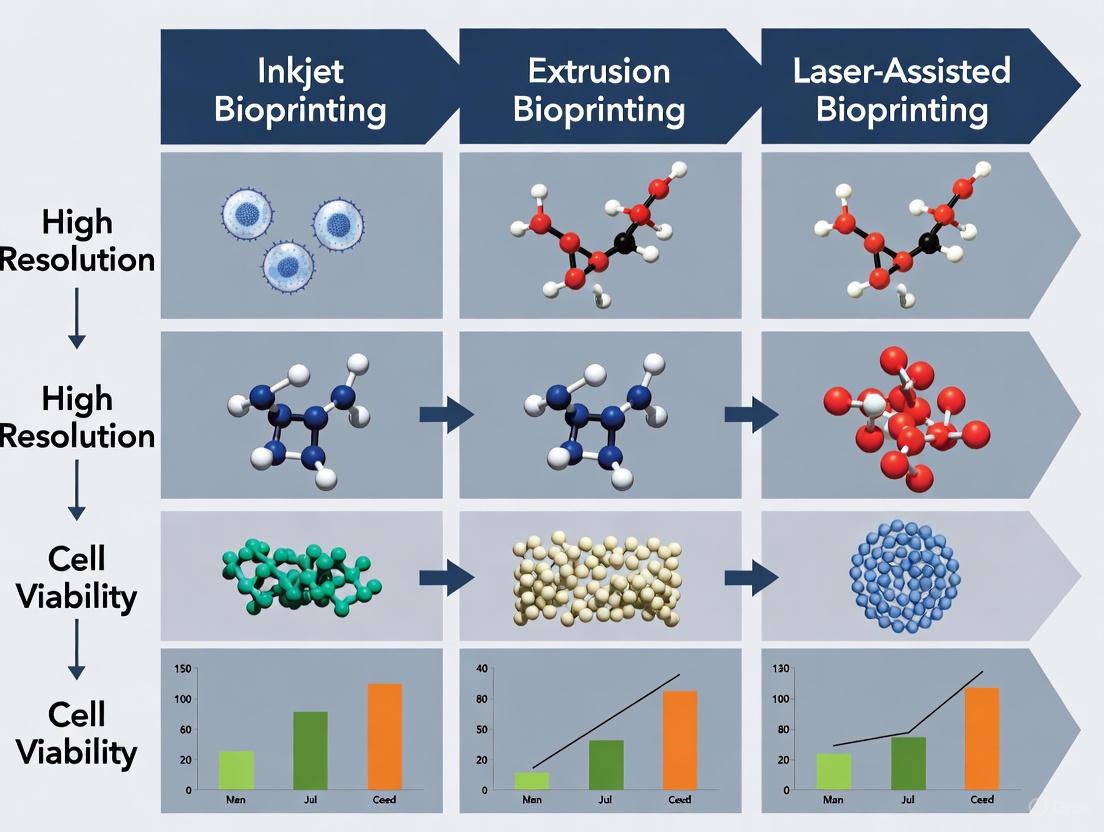
This article provides a comprehensive comparative analysis of the three primary 3D bioprinting technologies—inkjet, extrusion, and laser-assisted—with a focused examination of their printing resolution, a critical parameter for biomedical research...
Inkjet vs Extrusion vs Laser-Assisted Bioprinting: A Comparative Analysis of Resolution and Applications
Abstract
This article provides a comprehensive comparative analysis of the three primary 3D bioprinting technologies—inkjet, extrusion, and laser-assisted—with a focused examination of their printing resolution, a critical parameter for biomedical research and drug development. It explores the foundational principles governing resolution in each method, details their specific methodological approaches and ideal applications in fields like tissue engineering and cancer modeling, and offers practical troubleshooting and optimization strategies to maximize print fidelity and cell viability. By synthesizing validation data and providing a direct comparative framework, this resource equips researchers and scientists with the knowledge to select the optimal bioprinting technology for their specific project requirements, from high-throughput drug screening to the fabrication of complex, multi-cellular tissues.
Understanding Bioprinting Resolution: Core Principles and Technical Definitions
In the field of tissue engineering and regenerative medicine, three-dimensional (3D) bioprinting has emerged as a transformative technology for fabricating complex, cell-laden constructs. The success of these engineered tissues depends fundamentally on how closely their architectural features mimic the intricate microenvironments of native human tissues [1]. Resolution—encompassing precision, accuracy, and minimum feature size—serves as a critical benchmark for evaluating bioprinting performance and directly impacts the biological functionality of printed constructs. Different bioprinting technologies, primarily inkjet-based, extrusion-based, and laser-assisted systems, achieve resolution through distinct physical mechanisms, each with unique advantages and limitations [2].
The pursuit of higher resolution is not merely a technical challenge but a biological imperative. Different tissues require specific feature sizes for proper functionality: from the <5 μm neurites in neural tissue to the 200 μm diameter of alveoli in lung tissue [1]. Furthermore, the effective resolution in bioprinting represents the combined impacts of the printing process, bioink properties, and post-printing factors such as crosslinking and maturation [1]. This guide provides a systematic comparison of resolution across major bioprinting modalities, supported by experimental data and methodologies essential for researchers selecting appropriate technologies for specific applications in drug development and tissue engineering.
Comparative Analysis of Bioprinting Technologies
Inkjet-based bioprinting operates through either thermal or piezoelectric actuators to generate precise picoliter droplets of bioink. Thermal inkjet printers use heated elements to nucleate bubbles that create pressure pulses for droplet ejection, while piezoelectric systems employ crystal deformations to generate acoustic waves for bioink deposition [3] [2]. This technology offers high printing speeds and relatively low cost but is constrained to low-viscosity bioinks (typically 3.5-12 mPa/s [4]) to prevent nozzle clogging, which limits its ability to create stable 3D structures [3].
Extrusion-based bioprinting utilizes pneumatic pressure, pistons, or screws to continuously deposit bioinks through microscale nozzles. This approach accommodates a wide range of material viscosities (30 to 6×10⁷ mPa/s [4]) and enables high cell densities, making it particularly suitable for constructing large tissue models [5]. However, cells experience significant shear stress during extrusion, potentially affecting viability, while resolution limitations (typically around 200 μm [4]) present challenges for replicating fine anatomical features.
Laser-assisted bioprinting (LAB) employs a pulsed laser source (often UV wavelength) focused on a ribbon coated with bioink, generating vapor bubbles that propel bioink droplets onto a receiving substrate. As a nozzle-free, non-contact process, LAB eliminates clogging issues and minimizes mechanical stress on cells, enabling printing of high-viscosity bioinks (10-100 Pa·s) and high cell densities (~10⁸ cells/mL) with exceptional precision [6] [2].
Table 1: Fundamental Characteristics of Major Bioprinting Technologies
| Technology | Actuation Mechanism | Bioink Viscosity Range | Cell Density Support | Key Resolution Factors |
|---|---|---|---|---|
| Inkjet-Based | Thermal bubble or piezoelectric actuator | 3.5-12 mPa/s [4] | Low to moderate | Nozzle diameter, surface tension, droplet formation |
| Extrusion-Based | Pneumatic pressure, piston, or screw | 30 - 6×10⁷ mPa/s [4] | High (up to spheroids) | Nozzle diameter, flow rate, gelation kinetics |
| Laser-Assisted | Laser-induced forward transfer | 10-100 Pa·s [6] | Very high (~10⁸ cells/mL) | Laser spot size, bioink layer thickness, energy absorption |
Resolution Performance Across Technologies
Practical resolution capabilities vary significantly across bioprinting platforms, with each technology exhibiting distinct performance characteristics for different tissue types. The following diagram illustrates the key parameters governing resolution in each bioprinting technology.
Key Parameters Governing Bioprinting Resolution
Inkjet bioprinting typically achieves resolutions of 50-100 μm, with some systems capable of depositing single cells per droplet [3]. For instance, thermal inkjet printing has been used to create bone-like tissues with feature sizes of approximately 50 μm, maintaining 86% cell viability with human mesenchymal stem cells [3]. The primary factors limiting resolution include droplet spacing, substrate wettability, and gelation kinetics.
Extrusion bioprinting generally offers resolutions in the 100-200 μm range, though specialized approaches can achieve finer features. In creating vascularized tissues, extrusion systems have fabricated bifurcating blood vessel chips with feature sizes of ~200 μm using sacrificial Pluronic-F127 in gelatin-based hydrogels [1]. Renal proximal tubules with diameters of approximately 100 μm have also been demonstrated using customized extrusion systems [1]. Resolution is primarily governed by nozzle inner diameter, extrusion pressure, and bioink viscoelastic properties.
Laser-assisted bioprinting achieves the highest resolutions among established technologies, typically ranging from 10-50 μm for cell patterning applications [1]. LAB has successfully printed liver organoids with feature sizes of approximately 50 μm using dual-material bioprinting of gelatin and hyaluronic acid [1]. Some systems can position individual cells with picoliter precision, making LAB particularly valuable for creating intricate tissue microarchitectures.
Table 2: Achieved Resolution in Tissue-Specific Applications
| Tissue/Organ Model | Bioprinting Technique | Cited Feature Size | Cell Type(s) | Reference |
|---|---|---|---|---|
| Liver Organoid | Laser-Assisted | ~50 μm | Hepatocytes [1] | [1] |
| Renal Proximal Tubule | Extrusion-Based | ~100 μm | Renal cells [1] | [1] |
| Bone-like Tissue | Inkjet-Based | ~50 μm | Human mesenchymal stem cells [3] | [3] |
| Cardiac Muscle | Extrusion-Based | ~150 μm | Cardiomyocytes [1] | [1] |
| Neural Network | Inkjet-Based | Single cells | Neuronal cells [3] | [3] |
| Skin Graft | Laser-Assisted | Multi-layered | Fibroblasts & keratinocytes [6] | [6] |
Experimental Protocols for Resolution Assessment
Standardized Methodologies for Quantifying Resolution
Researchers employ standardized experimental protocols to quantitatively assess bioprinting resolution, focusing on shape fidelity, printing accuracy, and feature size maintenance. These methodologies enable objective comparison across different technologies and bioink formulations.
The filament collapse test evaluates structural integrity by printing free-standing filaments across gaps of increasing width. The maximum span achievable without collapse indicates the bioink's self-supporting capacity, directly influencing vertical resolution in 3D constructs [5]. This test is particularly relevant for extrusion-based bioprinting, where filament fusion between layers can limit Z-axis resolution.
Grid printing accuracy tests involve printing calibrated grid patterns (typically 10×10 mm with varying strand spacing) and comparing the printed dimensions to the designed CAD model. Measurements of strand diameter, pore size, and pore shape accuracy are quantified using microscopic image analysis [5]. The deviation between designed and printed features serves as a key metric for XY-resolution.
For droplet-based systems, drop-on-demand tests characterize resolution by analyzing droplet diameter, spacing, and placement accuracy using high-speed imaging. Researchers measure the minimum center-to-center distance between adjacent droplets without coalescence, defining the practical resolution limit for inkjet platforms [5].
Advanced Monitoring Techniques
Emerging monitoring approaches incorporate real-time imaging and artificial intelligence for enhanced resolution assessment. A recently developed modular monitoring technique integrates a digital microscope that captures high-resolution images during the printing process, rapidly comparing them to the intended design through an AI-based image analysis pipeline [7]. This system enables rapid identification of print defects, such as over- or under-deposition of bioink, facilitating optimization of print parameters with resolution values quantitatively tracked throughout the process.
The Scientist's Toolkit: Essential Research Reagents and Materials
Successful resolution-optimized bioprinting requires careful selection of bioinks, crosslinking methods, and support materials. The table below details essential research reagents and their functions in achieving high-resolution structures.
Table 3: Key Research Reagents for High-Resolution Bioprinting
| Category | Specific Reagents | Function in Bioprinting | Compatibility |
|---|---|---|---|
| Natural Polymers | Collagen, gelatin, alginate, fibrin, hyaluronic acid [6] | Provide ECM-like environment, cell adhesion sites | All technologies |
| Synthetic Polymers | PEGDMA, Pluronic F-127, PCL [1] [5] | Enhance mechanical properties, sacrificial molding | Extrusion, inkjet |
| Photoinitiators | LAP, Irgacure 2959 [8] | Enable photopolymerization for shape fixation | SLA, DLP, LAB |
| Crosslinking Agents | CaCl₂ (for alginate), thrombin (for fibrin) [3] | Induce hydrogel solidification | Extrusion, inkjet |
| Support Materials | Carbomer, Pluronic F-127 [5] | Enable embedded printing of complex structures | Extrusion |
Bioink formulation critically influences achievable resolution. Natural polymers like collagen and fibrin provide excellent biocompatibility and biological cues but often lack mechanical strength for high-resolution structures. Synthetic polymers such as PEG-based hydrogels offer tunable mechanical properties and better maintenance of printed features but may require modification with cell-adhesive motifs [5]. Composite bioinks blending natural and synthetic components have shown particular promise for optimizing both resolution and biological functionality.
Crosslinking strategies significantly impact final resolution. Ionic crosslinking (e.g., CaCl₂ for alginate) enables rapid gelation but may cause resolution loss through diffusion. Photocrosslinking provides superior spatial control but requires careful optimization of photoinitiator concentration and light exposure to maintain cell viability [5]. Support bath materials like Carbomer and Pluronic F-127 enable embedded printing of complex structures that would otherwise collapse, effectively extending the practical resolution limits of extrusion-based systems [4].
Technological Advances and Future Perspectives
The field of bioprinting resolution continues to evolve through technological innovations. Coaxial bioprinting has emerged as an extrusion-based approach that enables fabrication of hollow tubular structures with superior resolution through simultaneous deposition of multiple materials [4]. This technique has proven particularly valuable for creating vascular networks, a critical challenge in tissue engineering.
Projection-based bioprinting (digital light processing - DLP) offers significant advantages in resolution and speed compared to traditional extrusion methods. DLP can achieve feature sizes below 50 μm by photopolymerizing entire layers simultaneously using digital micromirror devices [4]. This approach provides exceptional surface smoothness and structural reproducibility while eliminating nozzle-related issues.
Embedded bioprinting represents another significant advance, enabling freeform fabrication within a supportive gel medium. This approach allows creation of complex structures with overhanging features and internal channels that would be impossible using conventional layer-by-layer deposition [4]. The support bath prevents collapse of fine features during printing, effectively enhancing resolution capabilities.
The following diagram illustrates the experimental workflow for assessing bioprinting resolution, incorporating both traditional and advanced monitoring approaches.
Resolution Assessment Workflow
Future directions in bioprinting resolution research include the integration of machine learning algorithms for predictive modeling of bioink behavior and printing outcomes [7]. Additionally, multi-modal bioprinting approaches that combine the strengths of different technologies are emerging as powerful strategies for creating tissues with both high resolution and biological functionality. As these technologies mature, resolution benchmarks will continue to advance, enabling the fabrication of increasingly complex tissue models for drug development and regenerative medicine applications.
Inkjet bioprinting has emerged as a pivotal technology in biomedical research for its ability to precisely deposit picoliter volumes of cell-laden bioinks. As a non-contact, drop-on-demand method, it enables high-resolution patterning for applications ranging from tissue engineering to pharmaceutical testing [9] [10]. Among its various implementations, thermal and piezoelectric actuation mechanisms represent the two primary approaches for droplet generation, each with distinct operational principles, performance characteristics, and suitability for different biofabrication scenarios. Understanding these mechanical differences is essential for researchers selecting appropriate bioprinting technologies for specific applications.
This guide provides a systematic comparison of thermal and piezoelectric inkjet bioprinting technologies, objectively analyzing their performance relative to extrusion-based and laser-assisted bioprinting methods. We present quantitative experimental data, detailed methodologies, and analytical frameworks to inform selection criteria for research and development purposes within the broader context of resolution-focused bioprinting research.
Fundamental Mechanical Principles
Thermal Inkjet Mechanics
Thermal inkjet bioprinting operates through rapid, localized vaporization of bioink to generate droplet-ejecting pressure pulses. A microheater adjacent to the nozzle chamber achieves temperatures of 200-300°C within microseconds, creating vapor bubbles that expand and collapse to propel droplets through the nozzle [9]. Despite the extreme temperatures, the short duration (typically 2-20 µs) and minimal thermal mass limit heat transfer to cells, with reported cell viabilities of 74-85% [9]. The primary advantages include compatibility with various aqueous bioinks and relatively simple printhead design. However, the thermal and mechanical stresses present potential challenges for delicate primary cells and temperature-sensitive biomaterials.
Piezoelectric Inkjet Mechanics
Piezoelectric inkjet bioprinting utilizes piezoelectric ceramic materials (typically PZT) that deform when subjected to electrical pulses, directly generating pressure waves within the bioink chamber [11] [12]. This deformation rapidly changes the chamber volume, creating acoustic waves that propagate and eject droplets without thermal stress. The piezoelectric pulse waveform—characterized by parameters like pulse width, amplitude, and shape—precisely controls droplet formation and ejection dynamics [12]. This mechanism avoids thermal stress but subjects cells to shear and mechanical deformation forces during ejection. Optimal operation requires careful tuning of pulse parameters to specific bioink properties for consistent droplet generation without satellite formation [12].
Comparative Performance Analysis
Quantitative Performance Metrics
Table 1: Performance comparison of major bioprinting technologies
| Technology | Mechanism | Resolution | Efficiency | Cell Viability | Bioink Viscosity | Key Applications |
|---|---|---|---|---|---|---|
| Thermal Inkjet | Thermal bubble vaporization | ~10-50 μm [9] | 1.67×10⁻⁷ to 0.036 mm³/s [9] | 74-85% [9] | 3-50 mPa·s [10] | High-throughput patterning, biosensors, drug screening |
| Piezoelectric Inkjet | Piezoelectric actuator deformation | ~10-50 μm [9] | 1.67×10⁻⁷ to 0.036 mm³/s [9] | 74-85% [9] | 3-50 mPa·s [10] | Precision cellular patterning, organ-on-chip models |
| Extrusion Bioprinting | Mechanical pressure dispensing | ≥100 μm [9] | 0.00785-62.83 mm³/s [9] | 40-90% [9] | 100-30,000 mPa·s [10] | Large tissue constructs, cartilage, bone regeneration |
| Laser-Assisted Bioprinting | Laser-induced forward transfer | ~10-50 μm [9] | Varies with laser system | Varies with energy transfer | Moderate viscosity [9] | High-resolution patterning, sensitive cell types |
| Vat Polymerization (DLP) | Photopolymerization | ~2-50 μm [9] | 0.648-840 mm³/s [9] | Varies with photoinitiator toxicity | Photopolymerizable resins [10] | High-resolution scaffolds, dental applications |
Technology Selection Workflow
The following decision pathway illustrates the systematic selection process for bioprinting technologies based on research requirements:
Bioprinting Technology Selection Pathway
Resolution Comparison in Bioprinting Context
When evaluating bioprinting technologies for resolution-focused research, inkjet methods (both thermal and piezoelectric) offer superior resolution (10-50 μm) compared to extrusion bioprinting (≥100 μm) but are typically outperformed by vat polymerization techniques like digital light processing (DLP), which can achieve resolutions as fine as 2 μm [9]. However, resolution represents only one dimension of performance, as the fundamental trade-offs among printing efficiency, structural integrity, and cell viability remain challenging barriers [9]. Inkjet bioprinting achieves its high resolution through micro-droplet ejection mechanisms but faces limitations in fabricating large, mechanically robust tissues due to bioink viscosity constraints and potential nozzle clogging at high cell densities [9].
Experimental Protocols and Methodologies
Piezoelectric Parameter Optimization Protocol
Based on pharmaceutical inkjet printing research, systematic optimization of piezoelectric parameters ensures consistent droplet formation [12]:
Apparatus Setup:
- High-speed drop-on-demand analysis system (e.g., JetXpert)
- Piezoelectric printhead (e.g., EPSON I3200-A1 with 20 μm orifice diameter)
- Signal generator and printhead driver electronics
- High-speed digital camera (minimum interframe time: 3 μs)
Methodology:
- Waveform Configuration: Apply continuous square waveform pulses with adjustable parameters
- Parameter Screening: Systematically vary pulse width (3.0-4.5 μs), ink supply pulse width (3.5-5.0 μs), and jet frequency (1-19 kHz)
- Droplet Analysis: Capture droplet formation dynamics using high-speed imaging
- Performance Metrics: Quantify droplet flight velocity, volume, filament breakage, and satellite droplet formation
- Optimal Range Identification: Determine parameters producing consistent droplet generation with minimal satellite formation
Experimental Findings: For Newtonian bioinks with viscosity 3-50 mPa·s, optimal parameters typically include inkjet pulse width of 3.5 μs, ink supply pulse width of 4.5 μs, and jet frequency of 5-19 kHz [12].
Bioink Printability Assessment Protocol
The inverse Ohnesorge number (Z) provides a key metric for predicting bioink printability in inkjet systems [12]:
Calculation Method:
Where:
- γ = surface tension (mN/m)
- ρ = density (g/cm³)
- a = nozzle diameter (μm)
- η = viscosity (mPa·s)
Experimental Procedure:
- Surface Tension Measurement: Use pendant drop method with drop shape analyzer (e.g., DSA25)
- Density Determination: Calculate via mass-to-volume ratio using precision volumetric flask
- Viscosity Characterization: Employ digital viscometer with cone spindle (e.g., Brookfield viscometer)
- Printability Assessment: Z values between 4-14 indicate suitable printability, with values <4 causing ejection difficulties and >14 promoting excessive satellite droplet formation [12]
Research Reagent Solutions
Table 2: Essential materials for inkjet bioprinting experimentation
| Reagent/Material | Function | Application Context | Performance Considerations |
|---|---|---|---|
| Polyvinylpyrrolidone (PVP K30) | Bioink additive enhancing stability and viscosity | Pharmaceutical inkjet printing [12] | Improves droplet formation; concentration typically 0.1% (w/w) |
| Glycerol | Viscosity modifier for bioinks | Adjusting fluid properties for consistent ejection [12] | Typically used at 4% (w/w) concentration in aqueous solutions |
| Aqueous Isopropanol Solution | Base solvent system | Pharmaceutical ink formulations [12] | 40% (v/v) concentration balances solubility and evaporation rate |
| Decellularized ECM (dECM) | Bioactive bioink component | Enhancing tissue-specific functionality [10] | Improves biological recognition but requires viscosity optimization |
| Natural Polymers (Alginate, Gelatin) | Bioink base materials | Providing biocompatible scaffolding [9] [10] | Offer excellent biocompatibility but limited mechanical strength |
| Synthetic Polymers (PEG, PLA) | Structural bioink components | Enhancing mechanical properties [9] | Provide tunable mechanics but may require surface modification |
| Photoinitiators (LAP, Irgacure 2959) | Crosslinking agents for photopolymerization | Vat polymerization bioinks [10] | Concentration must balance crosslinking efficiency with cytotoxicity |
Discussion and Research Implications
Strategic Technology Selection
The comparative analysis reveals that inkjet bioprinting technologies occupy a distinct niche in the resolution-focused research landscape. While extrusion bioprinting demonstrates superior deposition rates (0.00785-62.83 mm³/s) for large tissue constructs, and vat polymerization offers exceptional resolution (2 μm minimum) for high-precision scaffolds, inkjet methods provide an optimal balance for applications requiring moderate resolution with living cells [9]. The critical limitation of inkjet bioprinting remains its constraint to low-viscosity bioinks (3-50 mPa·s), which restricts the mechanical robustness of fabricated constructs compared to extrusion-based approaches that can handle viscosities up to 30,000 mPa·s [10].
Emerging Innovations and Future Directions
Recent advances in piezoelectric actuator design aim to address current limitations through innovative approaches like real-time nozzle diameter adjustment mechanisms [11]. These systems utilize piezoelectric stick-slip actuators to dynamically modify nozzle geometry, potentially enabling single-printhead operation across multiple droplet size requirements without manual nozzle changes. Such developments could significantly enhance the versatility of piezoelectric inkjet systems for multi-scale bioprinting applications. Additionally, the emergence of nanoparticle-enhanced bioinks and granular hydrogel formulations shows promise for improving the structural integrity of inkjet-bioprinted constructs while maintaining printability through shear-thinning behavior and reduced extrusion stress [10].
Thermal and piezoelectric inkjet bioprinting technologies offer complementary capabilities for resolution-focused biomedical research. Thermal systems provide simplicity and cost-effectiveness for high-throughput applications with aqueous bioinks, while piezoelectric systems deliver precise droplet control essential for complex cellular patterning. When evaluated against extrusion and laser-assisted alternatives, inkjet technologies consistently demonstrate superior resolution but face inherent limitations in bioink viscosity range and structural scale. The optimal selection between thermal, piezoelectric, and other bioprinting technologies ultimately depends on the specific research requirements, prioritizing among resolution, speed, structural integrity, and cell viability. Continuing advancements in printhead design, bioink formulation, and process optimization promise to further expand the capabilities of inkjet bioprinting for increasingly complex tissue engineering and drug development applications.
Three-dimensional (3D) bioprinting represents a transformative approach in tissue engineering and regenerative medicine, enabling the fabrication of complex tissue constructs through the precise deposition of cell-laden bioinks. Among the various bioprinting technologies, extrusion-based systems have emerged as the most versatile and widely adopted method, particularly for their ability to process high-viscosity materials at high cell densities [13] [5]. The fundamental principle of extrusion bioprinting involves the continuous deposition of bioinks through a nozzle onto a substrate, facilitated by either pneumatic or mechanical dispensing systems. Unlike inkjet bioprinting, which offers excellent resolution but is limited by bioink viscosity and cell density, and laser-assisted bioprinting, which provides high resolution but requires complex instrumentation and suffers from limited scalability, extrusion bioprinting strikes a balance between construct size, cell viability, and material versatility [13] [1]. This comparative guide focuses on the two primary extrusion mechanisms—pneumatic and piston-driven—evaluating their performance characteristics, resolution capabilities, and suitability for different bioprinting applications within the broader context of tissue engineering and drug development.
Table 1: Core Bioprinting Technologies Comparison
| Technology | Mechanism | Resolution | Cell Viability | Bioink Viscosity | Key Advantages | Major Limitations |
|---|---|---|---|---|---|---|
| Inkjet | Thermal/piezoelectric droplet ejection | ~50-300 μm [1] | 80-90% [13] | Low | High speed, low cost | Limited bioink/cell density, nozzle clogging |
| Extrusion | Pneumatic/piston-driven continuous deposition | ~100-500 μm [1] | 40-96% [13] | Low to very high | High cell density, material versatility | Shear stress on cells, moderate speed |
| Laser-Assisted | Laser-induced forward transfer | ~10-100 μm [1] | 80-95% | Low to medium | No nozzle clogging, high resolution | Limited materials, complex setup |
| Vat Polymerization | Photo-crosslinking of liquid resin | ~25-100 μm [13] | Varies | Medium | High resolution, smooth surfaces | Limited bioinks, potential cytotoxicity |
Extrusion Mechanism Fundamentals
Pneumatic Systems
Pneumatic extrusion systems utilize compressed air to generate pressure within a sealed material cartridge, forcing the bioink through a deposition nozzle. The pressure applied can be precisely controlled through regulators, with typical dispensing pressures ranging from 15-100 kPa depending on bioink viscosity and nozzle diameter [13]. The key advantage of pneumatic systems lies in their straightforward configuration and ease of pressure parameter adjustment during the printing process. This mechanism is particularly suitable for lower to medium viscosity hydrogels and allows for continuous replenishment of bioinks in large-volume cartridges. However, pneumatic systems may exhibit less precise flow control at very low extrusion rates and can be susceptible to pressure fluctuations that affect deposition consistency [13] [14].
Piston-Driven Systems
Piston-driven extrusion employs mechanical force applied by a piston or plunger directly onto the bioink within a syringe barrel. This direct displacement mechanism provides more stable volumetric flow control, typically operating at flow rates of approximately 10 mm³/s for standard bioinks [13]. The mechanical advantage of piston systems enables the processing of significantly higher viscosity materials, including cellulose acetate solutions and concentrated polymer blends, which often exceed the capabilities of pneumatic systems [14]. This makes piston-driven systems indispensable for printing scaffolds requiring high structural integrity and shape fidelity. The primary limitations include potential pulsatile flow at extremely low speeds and the finite volume capacity of standard syringes, which may necessitate pausing for reloading during large construct fabrication [13] [14].
Performance Comparison: Quantitative Analysis
Bioprinting Parameters
Computational fluid dynamics simulations and experimental studies provide comprehensive data on the performance characteristics of pneumatic versus piston-driven extrusion systems. These analyses reveal critical differences in how each mechanism manages parameters such as shear stress, pressure distribution, and flow continuity, which directly impact cell viability and printing resolution [13].
Table 2: Extrusion System Performance Metrics
| Parameter | Pneumatic System | Piston-Driven System | Impact on Bioprinting |
|---|---|---|---|
| Dispensing Pressure | 15-100 kPa [13] | Not applicable | Higher pressure needed for viscous bioinks |
| Volumetric Flow Rate | Pressure-dependent | ~10 mm³/s (stable) [13] | Piston provides more consistent flow |
| Max Shear Stress | 5-15 kPa [13] | 5-15 kPa [13] | Directly impacts cell viability (76-96%) |
| Response Time | Fast, but potential lag | Immediate mechanical response | Piston better for start/stop control |
| Viscosity Range | Low to medium | Low to very high [14] | Piston superior for high-viscosity materials |
Resolution and Fidelity
The effective resolution in extrusion bioprinting is governed by multiple factors including nozzle diameter, bioink properties, crosslinking mechanism, and extrusion parameters. For micro-tissue fabrication in organ-on-a-chip platforms, extrusion bioprinting typically achieves feature sizes between 100-500 μm, with demonstrated applications in liver models (50-200 μm), kidney proximal tubules (~100 μm), and vascular constructs (~150-200 μm) [1]. Nozzle geometry significantly influences printing resolution, with computational simulations showing that standard 3D printing nozzles increase flow rate while reducing dispensing pressure compared to conical tips, maintaining similar shear stress levels [13]. Shape fidelity—the ability of deposited bioinks to maintain their intended architecture—is notably higher in piston-driven systems for high-viscosity materials, while both systems perform comparably with medium-viscosity hydrogels when optimized parameters are employed [5].
Experimental Protocols and Methodologies
Computational Simulation Protocols
Computational fluid dynamics (CFD) simulations provide invaluable insights into extrusion mechanics without the need for extensive experimental trials. The following methodology, adapted from Gómez-Blanco et al. and detailed in PMC literature, enables comprehensive analysis of key bioprinting parameters [13]:
Geometry Modeling: Create 2D axisymmetric models of both standard 3D printing nozzles (e.g., E3D V6) and conical bioprinting tips (e.g., 22G) using CAD software.
Mesh Generation: Implement structured mesh with refinement zones near walls and interfaces to capture critical flow gradients.
Physics Configuration:
- Select two-phase flow level-set method interface
- Define bioink as non-Newtonian shear-thinning fluid using appropriate viscosity model (e.g., Power Law or Carreau)
- Set wall boundary conditions to no-slip
- Configure air as Newtonian fluid with significantly lower viscosity
Solver Settings:
- Apply dispensing pressure (15-100 kPa) for pneumatic simulation
- Apply volumetric flow rate (10 mm³/s) for piston-driven simulation
- Use time-dependent study with adaptive time stepping
- Set convergence criteria for velocity and level-set fields
Parameter Extraction: Calculate pressure distribution, velocity profiles, shear stress fields, and material deformation throughout the extrusion process.
This computational approach enables researchers to optimize nozzle geometry and extrusion parameters before experimental validation, significantly reducing development time and material waste [13].
Experimental Validation Protocols
To quantitatively assess printability and system performance, researchers employ standardized evaluation methodologies:
Extrudability Assessment:
- Measure minimum extrusion pressure/force required for continuous filament formation
- Quantify strand uniformity through diameter consistency measurements
- Calculate coefficient of variation across multiple printed strands [5]
Shape Fidelity Analysis:
- Print grid structures (e.g., 10×10 mm with 1 mm spacing)
- Quantify filament collapse, fusion, and pore area accuracy
- Measure dimensional accuracy compared to CAD model [5]
Biological Outcome Evaluation:
- Assess cell viability post-printing using live/dead staining (e.g., calcein-AM/propidium iodide)
- Quantify metabolic activity (AlamarBlue, MTT assays) at 1, 3, and 7 days post-printing
- Evaluate cell functionality through tissue-specific markers (immunostaining, qPCR) [14]
The Scientist's Toolkit: Essential Research Reagents and Materials
Successful implementation of extrusion bioprinting requires careful selection of materials and equipment optimized for specific research applications.
Table 3: Essential Research Reagents and Equipment
| Category | Specific Examples | Function/Purpose | Compatibility |
|---|---|---|---|
| Hydrogel Bioinks | Alginate, Gelatin methacryloyl (GelMA), Cellulose acetate, Hyaluronic acid | Provide 3D environment for cell encapsulation | Both systems (viscosity-dependent) |
| Crosslinking Agents | Calcium chloride (alginate), UV light with photoinitiators (GelMA), Thermal initiators | Stabilize printed constructs | Both systems |
| Nozzle Geometries | Standard 3D printing nozzles (E3D V6), Conical tips (22G), Custom designs | Control deposition resolution and flow characteristics | System-specific compatibility |
| Cell Types | Mesenchymal stem cells, Hepatocytes, Fibroblasts, Endothelial cells | Tissue-specific functionality | Viability depends on shear stress management |
| Characterization Tools | Rheometers, Computational fluid dynamics software, Confocal microscopes | Assess bioink properties and printing outcomes | Essential for protocol optimization |
The comparative analysis of pneumatic and piston-driven extrusion systems reveals distinct advantages tailored to specific research requirements in tissue engineering and drug development. Pneumatic systems offer greater flexibility for parameter adjustment and are ideal for lower viscosity bioinks and applications requiring continuous printing from larger reservoirs. In contrast, piston-driven systems provide superior control for high-viscosity materials and applications demanding precise volumetric deposition, such as high-resolution scaffold fabrication for bone tissue engineering [14]. Both systems face the critical challenge of balancing printing resolution with cell viability, as higher resolution typically requires smaller nozzles that generate greater shear stress—a primary factor in cell damage [13].
Future developments in extrusion bioprinting will likely focus on intelligent systems that dynamically adjust parameters based on real-time feedback, hybrid approaches combining multiple extrusion mechanisms, and advanced nozzle designs that minimize shear stress while maintaining high resolution. For researchers and drug development professionals, selection between pneumatic and piston-driven systems should be guided by specific application requirements, with pneumatic systems favoring versatility across multiple material types and piston-driven systems excelling in high-fidelity fabrication with viscous bioinks. As the field progresses toward clinical applications, understanding these fundamental extrusion mechanics will be crucial for developing reproducible, scalable, and effective bioprinting strategies for regenerative medicine and pharmaceutical research.
Three-dimensional (3D) bioprinting represents a transformative advancement in tissue engineering and regenerative medicine, enabling the precise fabrication of complex biological structures through layer-by-layer deposition of living cells, biomaterials, and bioactive factors [15] [9]. This technology addresses critical challenges in healthcare, including organ transplantation shortages and the need for more physiologically relevant disease models [16] [17]. Among the various bioprinting modalities, three principal technologies have emerged: inkjet-based, extrusion-based, and laser-assisted bioprinting, each employing distinct mechanisms to pattern biological materials [9].
Inkjet-based bioprinting operates similarly to conventional paper printing, utilizing thermal or piezoelectric actuators to eject precise droplets of bioink onto a substrate [18] [17]. This approach offers advantages in printing speed and cost-effectiveness but faces limitations in handling high-viscosity bioinks and achieving high cell densities due to potential nozzle clogging [9]. Extrusion-based bioprinting employs mechanical or pneumatic pressure to continuously deposit bioink filaments through a micro-nozzle [9] [19]. While capable of processing higher viscosity materials and creating larger tissue constructs, this method imposes significant shear stress on cells during extrusion, potentially compromising viability [9].
Laser-assisted bioprinting, particularly Laser-Induced Forward Transfer (LIFT), represents a nozzle-free approach that eliminates clogging issues and minimizes mechanical stress on cells [15] [20]. First proposed by Bohandy in 1986 and adapted for bioprinting in 2004, LIFT utilizes laser pulses to propel bioink droplets from a donor substrate to a receiving platform [15]. This technology stands out for its high printing resolution (micron-level precision), ability to handle high-cell-density and high-viscosity bioinks, and exceptional cell viability rates [15] [17]. As the field advances toward clinical applications, understanding the comparative performance characteristics of these bioprinting technologies becomes essential for researchers selecting appropriate methodologies for specific biomedical applications.
LIFT Technical Mechanics and Experimental Protocols
Fundamental Operating Principles
Laser-Induced Forward Transfer (LIFT) operates on a sophisticated physical principle that converts laser energy into precise droplet ejection. The core LIFT system consists of three primary components: a pulsed laser source, a specialized donor substrate, and a receiving platform [15]. The donor substrate features a transparent support (typically quartz or glass) coated with a thin energy-absorbing layer (usually metal or metal oxide), upon which a uniform film of bioink is applied [15]. When the laser pulse passes through the transparent support and focuses on the absorbing layer, the rapid energy conversion generates a high-pressure vapor bubble that propels a portion of the bioink toward the receiving substrate [15]. This process enables the controlled transfer of cell-laden droplets without direct contact between the printing mechanism and the deposition surface.
The LIFT process involves precisely calibrated physical interactions. The laser parameters—including wavelength, pulse duration, energy density, and spot size—must be optimized to match the absorption properties of the donor layer and the rheological characteristics of the bioink [15]. Nanosecond-pulsed lasers are most commonly employed, with ultraviolet wavelengths frequently selected for their compatibility with various absorbing materials [15]. The laser energy density (fluence) emerges as a critical parameter, directly influencing droplet formation, ejection velocity, and ultimately, printing resolution and cell viability [15]. Below a threshold fluence, insufficient vaporization occurs without droplet ejection, while excessive energy causes satellite droplet formation and potential cell damage [20].
LIFT Experimental Protocol
Standardized experimental protocols for LIFT bioprinting involve meticulous preparation and parameter optimization to ensure reproducible results:
Bioink Preparation: Bioinks for LIFT typically consist of cells suspended in a biocompatible hydrogel matrix such as alginate, gelatin, collagen, or hyaluronic acid at concentrations ranging from 1×10^6 to 50×10^6 cells/mL [15] [21]. The bioink must demonstrate appropriate viscosity (1-300 mPa·s) and surface tension to facilitate film formation and controlled droplet ejection [20]. For example, a representative bioink formulation might combine 3% alginate, 4% gelatin, and 0.5% TEMPO-oxidized nanofibrillated cellulose (TO-NFC) to achieve optimal printability and cell support [21].
Donor Slide Preparation: The transparent donor substrate (typically 25mm × 75mm quartz slides) is coated with a 50-100nm thick gold or titanium absorbing layer using sputter deposition [15] [20]. This bioink solution is then spread uniformly across the absorbing layer using a precision blade coater to achieve a consistent thickness typically ranging from 10-50μm [15]. Maintaining uniform bioink film thickness proves critical for reproducible droplet ejection.
LIFT Printing Process: The laser is focused through the transparent donor substrate onto the energy-absorbing layer. A typical setup employs a 532nm wavelength nanosecond-pulsed laser with pulse energies ranging from 50-150μJ [20]. The receiving substrate (often coated with culture medium or a hydrogel layer) is positioned parallel to the donor slide with a controllable stand-off distance typically between 0.5-1mm [20]. Computer-controlled translation stages move the donor and receiver substrates according to pre-programmed patterns while the laser pulses at frequencies up to 5000Hz [17], depositing droplets layer-by-layer to construct 3D structures.
Post-Printing Processing: Following printing, crosslinking of hydrogel bioinks may be necessary using methods such as ionic crosslinking (e.g., calcium chloride for alginate) or photo-crosslinking for modified polymers [15]. Constructs are then transferred to cell culture incubators maintained at 37°C and 5% CO2 for further maturation, with medium changes performed according to standard cell culture protocols [20].
Advanced LIFT Variations
Recent technological advancements have led to LIFT variations that address specific limitations. Laser-Induced Side Transfer (LIST) modifies the conventional geometry by focusing laser pulses inside a glass microcapillary filled with bioink, generating a transient microbubble that ejects micro-jets perpendicular to the irradiation axis [20]. This approach eliminates the need for thin film preparation while maintaining high cell viability (98%) and functionality [20]. LIST demonstrates particular promise for applications requiring multiscale bioprinting capabilities, such as developing 3D drug screening models and artificial tissues with complex architectures.
LIFT Bioprinting Experimental Workflow
This flowchart illustrates the standardized protocol for LIFT bioprinting experiments, from bioink preparation to functional assessment.
Performance Comparison of Bioprinting Technologies
Quantitative Performance Metrics
Direct comparison of key performance metrics reveals the distinctive advantages and limitations of each bioprinting technology. The table below synthesizes experimental data from multiple studies to provide a comprehensive performance profile:
Table 1: Bioprinting Technology Performance Comparison
| Performance Metric | Inkjet-Based Bioprinting | Extrusion-Based Bioprinting | Laser-Assisted Bioprinting (LIFT) |
|---|---|---|---|
| Printing Resolution | 10-50 μm [9] | 100-500 μm [9] | 10-100 μm [15] [9] |
| Printing Efficiency | 1.67×10⁻⁷ - 0.036 mm³/s [9] | 0.00785 - 62.83 mm³/s [9] | Varies with laser frequency [17] |
| Cell Viability | 74-85% [9] | 40-90% [9] | 90-98% [15] [20] |
| Bioink Viscosity Range | 3.5-12 mPa·s [20] | 30 mPa·s - 6×10⁷ mPa·s [20] | 1-300 mPa·s [20] |
| Maximum Cell Density | Low to moderate [9] | High (≥100 million cells/mL) [17] | High (≥100 million cells/mL) [15] |
| Droplet/Ejection Frequency | 1-10,000 Hz [18] | Continuous deposition [19] | Up to 5,000 Hz [17] |
| Key Strengths | High speed, low cost [9] [18] | High viscosity materials, structural integrity [9] [19] | No nozzle clogging, high precision, high cell viability [15] |
| Key Limitations | Nozzle clogging, thermal/piezoelectric stress [9] [17] | Shear stress, lower resolution [9] | Film preparation complexity, cost [15] |
The data demonstrates that LIFT technology achieves the highest cell viability rates (90-98%) among the three modalities, significantly exceeding the 40-90% viability typical of extrusion-based approaches [9]. This exceptional viability stems from LIFT's nozzle-free operation, which eliminates the shear stress encountered during nozzle passage in extrusion and inkjet systems [15]. Additionally, LIFT matches inkjet printing in resolution capabilities while supporting substantially higher bioink viscosity ranges (1-300 mPa·s), enabling the processing of more concentrated hydrogel formulations [20].
Technology-Specific Applications and Limitations
Each bioprinting technology demonstrates particular strengths suited to specific applications in tissue engineering and regenerative medicine. Inkjet-based bioprinting excels in high-throughput applications requiring rapid deposition of low-viscosity bioinks, such as generating biomolecular microarrays or thin tissue layers [22] [18]. However, its limitations in handling high cell densities and viscous materials restrict its utility for creating complex, volumetric tissues [9].
Extrusion-based bioprinting dominates applications requiring structural integrity and mechanical stability, such as bone [15], cartilage [15], and large tissue constructs [19]. Its ability to process exceptionally high-viscosity materials (up to 60 million mPa·s) and deposit continuous filaments enables fabrication of self-supporting structures [20]. The trade-off emerges in significantly lower cell viability (as low as 40% in some cases) due to extreme shear forces during extrusion [9].
LIFT technology finds optimal application in precision-oriented tasks demanding high resolution and maximum cell viability. Its nozzle-free design eliminates clogging issues entirely, making it particularly suitable for bioinks containing dense cellular components or delicate primary cells [15]. Documented successes include printing of human endothelial cells [15], mesenchymal stem cells [15], and various tissue types including skin [15], blood vessels [15], and nerve guides [17]. The principal limitations of LIFT include the technical challenge of preparing uniform bioink films and the substantial equipment costs associated with laser systems [15].
Advanced LIFT Applications and Research Reagent Solutions
Innovative Applications in Tissue Engineering
LIFT technology has demonstrated remarkable versatility across diverse biomedical applications, particularly where precision and high cell viability are paramount. In skin tissue engineering, researchers have successfully employed LIFT to create stratified skin constructs incorporating multiple cell types with precise spatial organization [15] [17]. These bioprinted skin grafts have shown promising results in animal models, accelerating wound healing and promoting proper tissue regeneration [17]. The high resolution of LIFT enables replication of the complex dermal-epidermal junction critical for skin function.
Vascular tissue engineering represents another area where LIFT's capabilities excel. The technology has been used to pattern human endothelial cells into tubular structures mimicking native vasculature [15]. A particularly innovative approach combines LIFT with other bioprinting technologies to create hierarchical vascular networks, addressing the critical challenge of vascularization in thick tissue constructs [17]. The ability to print high-cell-density bioinks without compromising viability proves essential for creating functional vascular tissues with adequate cell-cell interactions.
Emerging applications include the fabrication of complex organoids and disease models for drug screening [16] [17]. LIFT's precision enables controlled deposition of multiple cell types to recreate the intricate microarchitecture of human organs, producing more physiologically relevant models than traditional 2D cultures [17]. Additionally, the technology shows promise for in situ bioprinting applications, where tissues are printed directly onto wound sites [19]. Recent advances in handheld and robotic-assisted bioprinters have begun to explore LIFT's potential for clinical applications during surgical procedures [19].
The Scientist's Toolkit: Essential Research Reagents
Table 2: Essential Research Reagents for LIFT Bioprinting
| Reagent Category | Specific Examples | Function and Application |
|---|---|---|
| Hydrogel Polymers | Alginate (0-5.25%) [21], Gelatin (0-5.25%) [21], Collagen, Hyaluronic acid, Fibrinogen [15] | Provides 3D extracellular matrix environment for cells; determines bioink rheology and printability |
| Viscosity Modifiers | TEMPO-oxidized NFC (0-1.5%) [21], Glycerol [15] | Enhances bioink shear-thinning behavior and structural fidelity without compromising biocompatibility |
| Cell Types | Human Umbilical Vein Endothelial Cells (HUVECs) [20], Mesenchymal Stem Cells [15], Osteosarcoma cells [15], Dermal fibroblasts [17] | Primary cells and cell lines for constructing specific tissues; maintain functionality post-printing |
| Absorbing Layers | Gold (50-100nm) [20], Titanium, Titanium oxide [15] | Converts laser energy to thermal energy for bubble formation; critical for droplet ejection |
| Crosslinking Agents | Calcium chloride (for alginate), Photoinitiators (e.g., LAP [23]) | Stabilizes printed constructs through ionic, chemical, or photochemical crosslinking |
| Support Substrates | Fibrin gels [20], Agarose, Gelatin microparticle baths | Provides temporary support for printed structures during maturation; enables freeform fabrication |
The development and optimization of bioink formulations represent an active research frontier in LIFT technology. Recent advances include data-driven approaches using machine learning to predict bioink viscosity based on composition and shear rate, significantly reducing the traditional trial-and-error optimization process [21]. These computational models can accurately predict viscosity with R² values up to 0.98, enabling rational design of bioinks with tailored properties for specific applications [21]. Hybrid hydrogel systems combining multiple polymers (e.g., alginate-gelatin-cellulose composites) demonstrate enhanced printability while maintaining excellent biocompatibility [21].
LIFT Mechanism and Component Relationships
This diagram illustrates the key components and mechanistic sequence of Laser-Induced Forward Transfer bioprinting.
Future Perspectives and Research Directions
The evolution of LIFT technology continues to address existing challenges while expanding application horizons. Current research focuses on enhancing the technology's scalability and throughput to enable fabrication of clinically relevant tissue volumes [15] [17]. Integration of LIFT with other bioprinting modalities in hybrid approaches represents a promising direction, leveraging the respective strengths of each technology to create more complex tissue architectures [19]. For instance, combining LIFT's high-resolution capabilities with extrusion printing's structural capacity could yield vascularized tissues with hierarchical organization.
Bioink development remains a critical frontier, with emerging emphasis on "smart" materials that respond to physiological stimuli or promote specific cellular functions [16] [21]. The incorporation of nanotechnology-enhanced biomaterials shows particular promise for improving the mechanical and biological properties of LIFT-printed constructs [16]. Additionally, the application of artificial intelligence and machine learning in bioink formulation and printing parameter optimization is poised to revolutionize the reproducibility and efficiency of LIFT processes [21].
Clinical translation of LIFT faces regulatory and standardization challenges that require multidisciplinary collaboration [17]. Establishing standardized protocols for bioink characterization, printing processes, and quality assessment will be essential for regulatory approval and eventual clinical adoption [17]. Despite these challenges, the exceptional resolution and cell viability demonstrated by LIFT position it as a leading technology for creating sophisticated tissue models and, ultimately, functional tissues for therapeutic applications [15]. As laser costs decrease and automation improves, LIFT is anticipated to become more accessible, potentially transforming regenerative medicine and personalized healthcare in the coming decade [15].
The Critical Link Between Resolution, Cell Viability, and Construct Functionality
In the rapidly advancing field of 3D bioprinting, researchers face a fundamental trade-off: achieving high printing resolution often comes at the cost of cell viability, ultimately determining the functional success of engineered tissues. As biofabrication moves toward creating increasingly complex tissue models and therapeutic constructs, understanding the intricate relationship between these three parameters—resolution, viability, and functionality—becomes paramount for technology selection and protocol optimization. This comparative analysis examines how the three predominant bioprinting technologies—inkjet, extrusion, and laser-assisted—navigate this critical balance, providing researchers with experimental data and methodological frameworks to inform their experimental design.
Technology Comparison: Resolution, Viability, and Functional Outcomes
The selection of an appropriate bioprinting technology requires careful consideration of its inherent capabilities and limitations. The following comparative analysis synthesizes performance data across key parameters that dictate experimental success in biomedical applications.
Table 1: Comparative Analysis of Bioprinting Technologies
| Parameter | Inkjet Bioprinting | Extrusion Bioprinting | Laser-Assisted Bioprinting |
|---|---|---|---|
| Resolution Range | 50-100 μm [24] [25] | 100-500 μm [26] [27] | 10-100 μm [25] [10] |
| Cell Viability | 80-90% (post-printing) [24] | 40-95% (highly parameter-dependent) [24] [26] | 90-98% (no nozzle contact) [25] [10] |
| Viscosity Range | 3.5-12 mPa·s [24] [25] | 100-30,000 mPa·s [26] [10] | 1-300 mPa·s [25] |
| Max Cell Density | ~10⁶ cells/mL [24] | High (theoretically unlimited) [26] | Moderate [25] |
| Throughput | High-speed [24] | Medium to low [26] | Low to medium [25] |
| Key Advantages | High speed, low cost, reliable droplet control [24] | Wide material compatibility, structural stability for 3D constructs [26] [27] | Highest resolution, no nozzle clogging, excellent viability [25] [10] |
| Primary Limitations | Low viscosity requirements, thermal/mechanical stress, droplet evaporation [24] [25] | Shear stress-induced cell damage, limited resolution [24] [26] [27] | Limited material options, specialized equipment requirements [25] |
Table 2: Functional Application Suitability by Technology
| Application Domain | Inkjet | Extrusion | Laser-Assisted |
|---|---|---|---|
| Vascular Networks | Moderate (limited by viscosity) [25] | High (coaxial nozzles for channels) [25] | High (excellent for capillary structures) [25] |
| Skin Tissue Engineering | High [24] [25] | High (including in situ printing) [19] | High (high-fidelity patterning) [25] |
| Organ-on-a-Chip Models | Moderate [25] | High (heterogeneous tissue fabrication) [25] | Limited (developing area) [25] |
| Bone/Cartilage Regeneration | Low (insufficient mechanical properties) [26] | High (support for osteogenic blends) [26] [10] | Moderate (resolution suitable for micro-architecture) [25] |
| Auricular Reconstruction | Low | High (clinical trials demonstrated) [27] | Low |
The relationship between printing parameters and biological outcomes follows a predictable pattern across technologies. The following diagram illustrates the fundamental trade-offs and decision pathways that govern bioprinting success:
Experimental Protocols for Assessing Resolution and Viability
Quantifying Printability and Shape Fidelity
The assessment of printing resolution extends beyond mere feature size to encompass the structural integrity and dimensional accuracy of fabricated constructs. The following standardized protocols enable quantitative comparison across technologies and bioink formulations.
Filament Fusion Test (FFT)
Purpose: To evaluate the tendency of printed filaments to merge, determining the minimum achievable feature size without loss of structural definition [28].
Methodology:
- Print a rectangular grid pattern with progressively decreasing spacing between adjacent filaments (1.0-3.0× nozzle diameter)
- Image immediately after deposition using a standardized optical setup with patterned background for scale reference
- Quantify the degree of fusion by measuring the width at filament contact points compared to isolated filaments
- Calculate the fusion ratio: ( FR = \frac{Wc}{Wi} ) where ( Wc ) is width at contact and ( Wi ) is isolated filament width
- Determine the critical spacing where FR > 1.2, indicating unacceptable fusion [28]
Data Interpretation: Lower critical spacing values indicate superior resolution capability. Hydrogels with rapid solidification mechanisms (ionic crosslinking, thermosensitive) typically outperform slow-setting polymers in this assay.
Filament Collapse Test (FCT)
Purpose: To assess the structural stability of printed filaments under gravitational loading, particularly relevant for extrusion-based printing of large structures [28].
Methodology:
- Fabricate a substrate with pillars at varying gap distances (2-20 mm)
- Print single filaments spanning these gaps using consistent printing parameters
- Capture side-view images at defined time intervals (0, 5, 15, 30 minutes post-printing)
- Measure the deflection angle (θ) or sag-to-span ratio
- Calculate the Collapse Area Factor: ( Cf = \frac{Aa}{At} \times 100\% ) where ( Aa ) is actual area and ( A_t ) is theoretical area [28]
Data Interpretation: Materials with ( C_f > 85\% ) across 10 mm gaps are considered suitable for unsupported spanning elements in tissue constructs. Time-dependent measurements reveal viscoelastic recovery properties.
Standardized Cell Viability Assessment
Purpose: To quantitatively evaluate cell survival following the bioprinting process using standardized methodologies that enable cross-technology comparison.
Methodology:
- Bioink Preparation: Encapsulate reference cell lines (e.g., NIH/3T3 fibroblasts, hMSCs) at standardized density (1-5×10⁶ cells/mL) in representative bioinks (e.g., alginate, GelMA, collagen)
- Printing Parameters: Maintain constant environmental conditions (37°C, 95% humidity, 5% CO₂ when possible)
- Post-Printing Culture: Culture printed constructs in appropriate media for 24 hours to recover before assessment
- Viability Quantification:
- Perform live/dead staining (calcein-AM/ethidium homodimer)
- Capture minimum of 5 images from different construct regions using confocal microscopy
- Analyze using ImageJ/Fiji with automated thresholding and particle counting
- Calculate viability: ( Viability (\%) = \frac{N{live}}{N{live} + N_{dead}} \times 100\% )
- Statistical Analysis: Perform one-way ANOVA with post-hoc Tukey test across minimum n=3 independent experiments [24] [26]
Technology-Specific Considerations:
- Inkjet: Assess thermal and impact stress effects by comparing different actuator voltages and droplet sizes [24]
- Extrusion: Correlate viability with specific shear stress history using computational fluid dynamics simulations [24] [26]
- Laser-Assisted: Evaluate laser energy transfer effects by varying absorber layer composition and pulse duration [25]
The Scientist's Toolkit: Essential Research Reagents and Materials
Successful bioprinting experimentation requires careful selection of materials and reagents that balance printability with biological performance. The following toolkit summarizes key components referenced in experimental protocols.
Table 3: Essential Research Reagents for Bioprinting Experiments
| Category | Specific Examples | Function/Application | Technology Compatibility |
|---|---|---|---|
| Natural Polymer Bioinks | Alginate, Gelatin Methacrylate (GelMA), Fibrin, Collagen, Hyaluronic Acid | Provide biocompatible microenvironment supporting cell adhesion and function | Extrusion: Excellent [26] [10]Inkjet: Low-viscosity variants [24]Laser: Moderate [25] |
| Synthetic Polymer Bioinks | Poly(ethylene glycol)-diacrylate (PEGDA), Pluronic F127, Polyvinyl alcohol | Offer tunable mechanical properties and reproducible fabrication | Extrusion: Excellent [10]Inkjet: Limited [24]Laser: Photopolymerizable variants [25] |
| Crosslinking Mechanisms | Ionic (CaCl₂ for alginate), Photochemical (LAP, Irgacure 2959), Thermal | Stabilize printed constructs post-fabrication | Extrusion: All types [26] [10]Inkjet: Primarily ionic [24]Laser: Photochemical [25] |
| Cell Viability Assays | Live/Dead Kit (calcein-AM/ethidium homodimer), AlamarBlue, MTT | Quantify cell survival and metabolic activity post-printing | Universal application across technologies |
| Rheological Modifiers | Nanocellulose, Silicate nanoplatelets, Gellan gum | Enhance shear-thinning behavior and shape fidelity | Primarily extrusion bioprinting [26] [10] |
| Photoinitiators | Lithium phenyl-2,4,6-trimethylbenzoylphosphinate (LAP), Irgacure 2959 | Enable photopolymerization of bioinks | Laser-assisted and extrusion with UV curing [25] [10] |
The comparative analysis presented herein reveals that no single bioprinting technology currently dominates across all performance metrics. Instead, technology selection must be guided by application-specific requirements:
Inkjet bioprinting offers compelling capabilities for high-throughput patterning of low-viscosity bioinks when extreme resolution is not required, particularly suitable for thin tissue models and pharmaceutical screening platforms [24] [25].
Extrusion bioprinting remains the workhorse for creating structural tissue constructs with robust mechanical properties, despite ongoing challenges in balancing resolution with cell viability through parameter optimization [26] [27].
Laser-assisted bioprinting provides unparalleled resolution and viability preservation for precision tissue engineering applications, though material limitations and throughput constraints remain significant considerations [25] [10].
The future of functional tissue engineering lies not in identifying a superior technology, but in developing integrated approaches that leverage the complementary strengths of each modality. Furthermore, advanced computational modeling and machine learning approaches are increasingly enabling researchers to predict and optimize printing outcomes before costly experimental iterations [26] [28]. As bioink formulations continue to evolve and printing technologies mature, the critical link between resolution, viability, and functionality will remain the central consideration guiding technology selection for specific biomedical applications.
Method-Specific Resolutions and Their Target Applications in Biomedicine
In the rapidly evolving field of 3D bioprinting, researchers are faced with a critical choice between several competing technologies, each with distinct advantages and limitations. The ongoing resolution research debate primarily centers on three principal methods: inkjet, extrusion-based, and laser-assisted bioprinting. Inkjet bioprinting has established itself as a prominent technology characterized by high printing speeds and resolution capabilities of approximately 50 µm, making it particularly suitable for applications requiring precise cellular patterning in thin tissues and high-throughput drug screening platforms [29] [30]. This technology utilizes thermal, piezoelectric, or acoustic forces to eject picoliter droplets of low-viscosity bioinks, enabling the precise deposition of living cells and biomaterials in predefined patterns [29] [25].
The fundamental working principle of inkjet bioprinting involves the controlled ejection of bioink droplets through a nozzle onto a substrate, with droplet volumes typically ranging from 1 to 100 picoliters, corresponding to diameters of approximately 10-50 µm [30]. This droplet-based approach allows for non-contact printing and rapid fabrication of complex biological structures. As the field advances with emerging technologies like volumetric bioprinting and high-throughput systems [29] [31], understanding the specific niche and capabilities of inkjet bioprinting becomes increasingly important for researchers designing experiments in tissue engineering and pharmaceutical development.
Comparative Analysis of Bioprinting Technologies
Performance Metrics Across Bioprinting Platforms
Table 1: Comprehensive comparison of major bioprinting technologies
| Technology | Resolution | Speed | Cell Viability | Bioink Viscosity | Key Applications | Primary Limitations |
|---|---|---|---|---|---|---|
| Inkjet | ~5-50 µm [29] [30] | Very High (up to 1000 droplets/sec) [29] | >82% [29] | Low (3.5–12 mPa·s) [25] | Thin tissues, drug screening, cellular patterning [32] [29] | Limited to low-viscosity bioinks, low cell concentration [25] |
| Extrusion-Based | ≥100 µm [33] | Medium | Variable (shear stress can reduce viability) [31] | Wide range (30 to 6×10⁷ mPa·s) [30] | Bone, cartilage, vascular grafts [30] | Lower resolution, shear stress on cells [30] |
| Laser-Assisted | ~10-50 µm [33] | Low | Lower than other methods [31] | Medium | Small-scale constructs [31] | Slow printing speed, not suitable for large tissues [31] |
| Two-Photon Polymerization | Highest (sub-micron) [33] | Very Low | High | Specialized photosensitive materials | High-resolution patterning | Limited characteristic dimension for tissue engineering [33] |
Technology Selection Framework
Table 2: Application-based technology selection guide
| Application Requirement | Recommended Technology | Rationale |
|---|---|---|
| High-throughput drug screening | Inkjet [32] | Rapid printing, precise droplet control for miniaturized assays |
| Thin tissue fabrication (skin, retinal layers) | Inkjet [30] | Excellent resolution for layered cellular structures |
| Volumetric tissues with high mechanical strength | Extrusion-based [30] | Handles high-viscosity bioinks, creates structurally stable constructs |
| Ultra-high resolution patterning | Two-Photon Polymerization [33] | Sub-micron resolution for detailed microarchitectures |
| Scaffold-free spheroid-based tissues | HITS-Bio [31] | High-throughput spheroid assembly with high cell viability |
Experimental Protocols and Methodologies
Standardized Inkjet Bioprinting Workflow
Bioink Formulation and Preparation
- Material Selection: Low-viscosity hydrogels such as alginate, polyethylene glycol (PEG), chitosan, and collagen are commonly used due to their compatibility with inkjet printing mechanisms [30]. These materials typically maintain viscosities below 10 mPa·s to ensure consistent droplet formation [25].
- Cell Incorporation: Cell densities are generally maintained at relatively low levels (typically <10 million cells/mL) to prevent nozzle clogging and ensure consistent droplet ejection [30]. The bioink is prepared under sterile conditions and maintained at appropriate temperatures to preserve cell viability before printing.
- Rheological Optimization: Bioink rheological properties are adjusted using concentration modifiers to achieve surface tensions and viscosities that facilitate stable droplet formation without satellite droplet generation.
Printer Setup and Calibration
- Nozzle Selection: Nozzle diameters typically range from 50-100 µm, with appropriate selection based on desired droplet size and cell diameter [30].
- Droplet Generation Mechanism: Thermal inkjet printers utilize rapid localized heating (250-350°C for microseconds) to generate vapor bubbles that propel droplets, while piezoelectric systems use mechanical deformation without significant temperature rise [30].
- Droplet Validation: Before biological printing, droplet consistency, velocity, and trajectory are verified using high-speed imaging and test patterns to ensure printing precision.
Printing Process Parameters
- Substrate Preparation: Printing surfaces are typically treated with adhesion-promoting compounds or maintained at specific temperatures to control hydrogel gelation.
- Droplet Deposition Pattern: Controlled by CAD models converted to printer path instructions, with droplet spacing optimized for cell viability and pattern fidelity.
- Cross-linking Strategy: Immediate or sequential cross-linking using methods such as ionic cross-linking for alginate or photo-cross-linking for PEG-based hydrogels.
Validation Methodologies for Bioprinted Constructs
Cell Viability Assessment
- Live/Dead Staining: Conducted at 24, 48, and 72 hours post-printing using fluorescent markers (calcein-AM for live cells, ethidium homodimer for dead cells) to quantify viability percentages [29].
- Metabolic Activity Assays: MTT or PrestoBlue assays performed at regular intervals to monitor cellular metabolic activity and proliferation capacity post-printing.
Structural and Functional Analysis
- Resolution Verification: Microscopic measurement of printed feature fidelity compared to CAD models, with quantitative analysis of line width, droplet placement accuracy, and pattern consistency.
- Tissue-Specific Functionality: For drug screening applications, functional responses to pharmacological agents are quantified using ELISA, qPCR, or calcium imaging depending on the tissue model.
- Mechanical Characterization: Atomic force microscopy or rheological testing to verify mechanical properties of printed constructs, particularly important for tissue models requiring specific stiffness.
The Scientist's Toolkit: Essential Research Reagents and Materials
Table 3: Key research reagents and materials for inkjet bioprinting
| Category | Specific Materials | Function/Application | Technical Notes |
|---|---|---|---|
| Base Hydrogel Materials | Alginate, Polyethylene Glycol (PEG), Chitosan, Collagen [30] | Provide structural support and biochemical cues | Low viscosity (<10 mPa·s) critical for printability |
| Cross-linking Agents | Calcium chloride (for alginate), Photoinitiators (LAP, I2959) [33] | Induce hydrogel solidification and stabilization | Concentration optimization essential for cell viability |
| Cell Types | Human adipose-derived stem cells, Chondrocytes, Retinal pigment epithelial cells [30] | Tissue-specific functionality | Low cell density (<10M cells/mL) required |
| Specialized Additives | Gelatin methacryloyl (GelMA), Decellularized ECM (dECM) [33] [29] | Enhance bioactivity and cell-material interactions | Can be blended with base materials in small percentages |
| Characterization Tools | Live/Dead viability assay, Metabolic activity kits (MTT, PrestoBlue) [29] | Assess printing outcomes and tissue functionality | Standardized protocols enable cross-study comparisons |
Application-Specific Implementation
Drug Screening Platforms
Inkjet bioprinting has emerged as a transformative technology for creating physiologically relevant 3D models for pharmaceutical research. These bioprinted tissues reduce interspecies variability and support ethical testing aligned with the 3Rs principles (Replacement, Reduction, Refinement) [32]. The technology enables creation of complex 3D tissue structures that closely mimic structural and functional characteristics of native tissues, ensuring high reproducibility in drug testing applications [32].
Case studies have demonstrated successful applications in bioprinted skin, cardiac, hepatic, renal, bone, and cancer models for pharmaceutical research [32]. The high resolution of inkjet bioprinting (~50 µm) allows for precise spatial arrangement of multiple cell types, creating tissue-specific microenvironments that more accurately predict human drug responses compared to traditional 2D cultures or animal models.
Thin Tissue Engineering
The precision of inkjet bioprinting has proven particularly valuable for engineering thin tissues requiring precise cellular layering. Notable applications include:
- Retinal Tissue Layers: High-precision placement of retinal pigment epithelial cells for constructing organized retinal tissue [30].
- Neural Networks: Patterned deposition of neuronal cells to form organized neural networks with controlled connectivity [30].
- Stratified Epithelial Tissues: Fabrication of layered skin models with defined epidermal and dermal compartments for transplantation and disease modeling.
The ability to deposit cells in specific patterns at resolutions approaching single-cell dimensions enables recreation of complex tissue interfaces that are essential for physiological function.
Future Perspectives and Concluding Remarks
Inkjet bioprinting continues to evolve with ongoing research addressing its current limitations, particularly in bioink development and scalability. Emerging trends include the development of novel composite bioinks that balance printability with biological functionality, and integration with other bioprinting technologies in multi-modal printing systems [25] [30].
The convergence of inkjet bioprinting with microphysiological systems (MPS) and organ-on-a-chip technology represents a particularly promising direction [25] [30]. These integrated systems leverage the strengths of both technologies—precision cellular patterning from inkjet bioprinting and dynamic microenvironments from microfluidics—to create more physiologically relevant human tissue models for drug screening and disease modeling.
While extrusion-based bioprinting dominates applications requiring high mechanical strength and volumetric tissue construction, and laser-assisted methods offer superior resolution for specialized applications, inkjet bioprinting maintains its distinct position in the bioprinting landscape through its unique combination of speed, resolution, and precision. As the field advances, inkjet technology is poised to play an increasingly important role in automated tissue fabrication systems, particularly for pharmaceutical applications and engineered tissue models where precision and throughput are paramount.
Three-dimensional bioprinting has emerged as a transformative tool in tissue engineering and regenerative medicine, with extrusion-based bioprinting establishing itself as the most prevalent platform, featuring in over half of all bioprinting publications [27]. Within the context of a broader research thesis comparing inkjet, extrusion, and laser-assisted bioprinting, each technology occupies a distinct niche based on its resolution, versatility, and application suitability. Extrusion bioprinting is characterized by its capability for continuous filament deposition of bioinks through a nozzle using pneumatic, piston, or screw-driven systems [19] [34]. This method uniquely balances the ability to create complex macroscopic structures with the deposition of high-viscosity bioinks and high cell densities, making it particularly suitable for engineering dense tissues and bone [19].
While inkjet bioprinting offers higher printing speeds and laser-assisted techniques provide superior resolution for single-cell positioning, extrusion bioprinting fills the critical gap where structural integrity and volumetric tissue fabrication are paramount [34] [35]. Its typical resolution range of approximately 100-500 µm positions it as an ideal technology for constructing tissues where fine detail is secondary to mechanical strength and overall construct volume, such as in bone, cartilage, and dense connective tissues [34]. This review objectively examines the capabilities of extrusion bioprinting within the cross-technology landscape, focusing on its specific advantages for challenging regenerative applications.
Comparative Analysis of Bioprinting Resolution and Performance
Understanding the relative positioning of extrusion bioprinting requires direct comparison with other predominant bioprinting technologies. The following tables summarize key performance metrics and characteristics across the three main bioprinting platforms.
Table 1: Quantitative comparison of key bioprinting technologies
| Technology | Typical Resolution | Cell Viability | Print Speed | Bioink Viscosity | Key Strengths |
|---|---|---|---|---|---|
| Extrusion Bioprinting | ~100-500 µm [34] | Variable (pressure-dependent) [34] | Medium | Low to High [19] | Structural integrity, multi-material printing [36] |
| Inkjet Bioprinting | 50-300 µm [34] | >85% [34] | High | Low | High speed, low cost [19] [27] |
| Laser-Assisted Bioprinting | Sub-micron to single-cell [35] | High (no nozzle stress) [34] | Low | Low to Medium [35] | Excellent resolution, high cell viability [34] |
Table 2: Application-focused analysis of bioprinting technologies
| Parameter | Extrusion Bioprinting | Inkjet Bioprinting | Laser-Assisted Bioprinting |
|---|---|---|---|
| Best Suited Applications | Bone, cartilage, dense tissues, large constructs [19] [37] | Skin layers, thin tissues, drug delivery [19] | High-precision structures, cell patterning, micro-vascularization [34] |
| Multi-Material Capability | Excellent (multiple printheads) [36] | Limited | Challenging (requires cleaning cycles) [36] |
| Structural Integrity | High (continuous filaments) [36] | Low (droplet-based) | Medium (point-by-point) |
| Scalability | Excellent for macroscopic tissues | Limited to thinner constructs | Limited by speed |
The data reveals a clear technology trade-off: extrusion bioprinting sacrifices the ultra-high resolution of laser-assisted methods and the speed of inkjet systems to achieve superior structural properties and material versatility. This makes it uniquely positioned for applications requiring mechanical robustness, such as bone and cartilage regeneration, where the ~100-500 µm resolution is sufficient to create functional tissue architectures [37].
Experimental Workflows and Methodologies in Extrusion Bioprinting
The typical workflow for extrusion bioprinting involves a multi-stage process from digital design to final tissue maturation, with specific protocols optimized for different tissue types.
General Workflow for Bone and Dense Tissue Bioprinting
The following diagram illustrates the standard experimental workflow for creating dense tissues and bone constructs using extrusion bioprinting.
Diagram 1: Extrusion bioprinting workflow for dense tissues
Key stages in this workflow include:
- Bioink Formulation: Preparing composite materials typically consisting of hydrogels (e.g., alginate, gelatin methacryloyl (GelMA), hyaluronic acid) combined with primary cells (e.g., mesenchymal stem cells, osteoblasts) or stem cells (e.g., BMSCs, ADSCs) [34] [16]. For bone applications, bioinks often incorporate ceramic particles (e.g., hydroxyapatite, β-tricalcium phosphate) to enhance osteoconductivity and mechanical strength [37].
- Printing Process: Utilizing pneumatic or mechanical dispensing systems to extrude bioinks through nozzles typically ranging from 100-500 µm in diameter, with precise control over pressure, temperature, and deposition speed [19] [34].
- Post-Printing Processing: Applying crosslinking mechanisms (photo-initiators for UV crosslinking, calcium chloride for ionic crosslinking) to stabilize the printed structure, followed by maturation in bioreactors that provide mechanical stimulation and nutrient perfusion [37].
Resolution Optimization Techniques
Achieving the optimal resolution in extrusion bioprinting requires addressing several technical challenges. The relationship between key parameters and resolution outcomes can be visualized as follows:
Diagram 2: Parameters affecting extrusion printing resolution
Advanced strategies to enhance resolution while maintaining structural integrity include:
- FRESH (Freeform Reversible Embedding of Suspended Hydrogels): Printing within a support bath to prevent deformation of fine features during the printing process, enabling resolution improvements beyond standard extrusion limitations [36].
- Low-Temperature-Assisted Cryogenic Printing: Utilizing instantaneous freezing to maintain filament shape and create micro-scale topological features beneficial for bone tissue engineering [37].
- Sacrificial Template Integration: Incorporating sacrificial materials that can be later removed to create complex multi-scale porous networks within printed constructs [37].
Research Reagent Solutions for Extrusion Bioprinting
Successful implementation of extrusion bioprinting protocols requires specific reagents and materials optimized for this technology. The following table details essential components for constructing dense tissues and bone.
Table 3: Key research reagents and materials for extrusion bioprinting
| Reagent Category | Specific Examples | Function in Extrusion Bioprinting |
|---|---|---|
| Base Hydrogels | Alginate, Gelatin methacryloyl (GelMA), Collagen, Fibrin, Hyaluronic acid, Chitosan [34] [16] | Provides 3D microenvironment for cells; determines bioink rheology and printability |
| Composite Materials | Hydroxyapatite, β-tricalcium phosphate, Bioglass ceramics [37] | Enhances mechanical strength and osteoconductivity in bone constructs |
| Crosslinking Agents | Calcium chloride (ionic), Photo-initiators (Irgacure 2959 for UV) [34] | Stabilizes printed structure; enables shape retention post-printing |
| Cells for Dense Tissues | Mesenchymal stem cells (BMSCs, ADSCs), Osteoblasts, Chondrocytes [38] [37] | Provides living component for tissue formation and regeneration |
| Bioactive Factors | Bone morphogenetic proteins (BMPs), Vascular endothelial growth factor (VEGF) [37] | Directs cell differentiation and tissue maturation |
The selection of appropriate bioink components is critical for achieving the optimal rheological properties required for extrusion—sufficient viscosity to maintain shape after deposition while allowing smooth flow through the nozzle. Natural hydrogels like alginate and GelMA are particularly valuable as they offer a favorable balance between printability and biocompatibility [34]. For bone-specific applications, composite bioinks incorporating ceramic materials such as hydroxyapatite at concentrations of 10-20% (w/v) have demonstrated significantly improved osteogenic differentiation and mechanical properties comparable to native bone [37].
Within the comparative framework of bioprinting technologies, extrusion bioprinting establishes its distinctive value through unmatched versatility in processing diverse biomaterials and creating structurally robust, volumetric tissues. While its ~100-500 µm resolution may not match the precision of laser-assisted systems for micro-scale features, this resolution range proves optimally suited for engineering dense tissues and bone where mechanical integrity and macroscopic organization are paramount.
The technology's capacity for multi-material deposition, compatibility with high cell densities, and ability to incorporate osteoconductive minerals position it as the leading approach for bone tissue engineering applications. Furthermore, ongoing advancements in resolution enhancement strategies like FRESH printing and cryogenic assistance continue to push the boundaries of what can be achieved with extrusion platforms. As the field progresses toward clinical translation, extrusion bioprinting is poised to maintain its central role in addressing the complex challenge of regenerating functional dense tissues and skeletal structures.
In the evolving field of bioprinting, the quest for high resolution is paramount for replicating the intricate microarchitectures of native human tissues. Laser-Assisted Bioprinting (LaBP), particularly methods like Laser-Induced Forward Transfer (LIFT), has emerged as a leading technology for high-fidelity fabrication. It occupies a unique niche by offering high precision and resolution in the ~10-50 micrometer (µm) range, a scale critical for engineering delicate but essential tissue structures such as vascular networks and neural tissues [35] [39]. This guide objectively compares the performance of laser-assisted bioprinting against two other established technologies—inkjet and extrusion-based bioprinting—situating its capabilities within the broader research context of resolving complex tissue geometries.
Comparative Analysis of Bioprinting Technologies
The choice of bioprinting technology often involves a trade-off between printing efficiency, resolution, and cell viability [9]. The table below provides a quantitative comparison of the three primary modalities, highlighting their respective performance characteristics and optimal use cases.
Table 1: Quantitative Comparison of Key Bioprinting Technologies
| Feature | Laser-Assisted Bioprinting (LaBP) | Inkjet Bioprinting | Extrusion-Based Bioprinting |
|---|---|---|---|
| Typical Resolution | ~10-50 µm [39] [40] | 20-100 µm [40] | 100-500 µm [40] |
| Cell Viability | High [35] | 74-85% [9] | 40-90% (highly variable) [9] |
| Printing Speed / Efficiency | Lower speed, limited scalability [35] [41] | Moderate speed [9] | 0.00785-62.83 mm³/s (highly variable) [9] |
| Key Advantage | High precision, minimal cell damage, excellent for co-cultures [35] [39] | High resolution, moderate speed [9] | High cell density, versatile bioink compatibility [9] [40] |
| Primary Limitation | High cost, technical complexity, slower for large structures [35] [41] | Limited to low-viscosity bioinks, risk of nozzle clogging [9] [39] | Lower resolution, high shear stress can damage cells [9] [39] |
| Ideal Application | Vascular networks, neural tissues, high-resolution patterning [39] | High-resolution tissue models, drug screening [18] | Large, dense tissues, bone, cartilage [9] |
Laser-Assisted Bioprinting in Action: Experimental Protocols
The superior resolution of laser-assisted bioprinting makes it a powerful tool for creating complex biological constructs. The following experimental workflows and reagent toolkit are representative of protocols used in cutting-edge research.
Workflow Diagram: Bioprinting a Neural Tissue Model
The diagram below outlines a generalized protocol for creating a neural tissue model using laser-assisted bioprinting.
Figure 1: Experimental workflow for bioprinting a neural tissue model, detailing key steps from bioink preparation to final analysis.
The Scientist's Toolkit: Essential Research Reagents
Successful execution of high-precision bioprinting experiments relies on a suite of specialized reagents and materials. The table below details critical components for laser-assisted bioprinting, particularly for neural and vascular applications.
Table 2: Essential Research Reagent Solutions for Laser-Assisted Bioprinting
| Reagent/Material | Function & Importance | Example Applications |
|---|---|---|
| Natural Polymer Hydrogels (Gelatin, Hyaluronic Acid, Collagen) [9] [39] | Serve as the primary component of bioinks, providing a biocompatible 3D environment that mimics the native extracellular matrix (ECM) and supports cell adhesion and growth. | Creating a supportive scaffold for neuronal growth and vascular network formation [39]. |
| Schwann Cells & Neural Stem/Progenitor Cells [39] | Key cellular components for neural tissue engineering. Schwann cells are critical for supporting and guiding axon regeneration in the peripheral nervous system. | Fabricating Nerve Guidance Conduits (NGCs) and models for studying peripheral nerve injury and recovery [39]. |
| Vascular Endothelial Cells (e.g., HUVECs) | The foundational building blocks for forming blood vessels. These cells self-assemble into tubule structures when patterned appropriately. | Engineering perfusable vascular networks within larger tissue constructs to ensure nutrient and oxygen supply [42]. |
| Neurotrophic Growth Factors (e.g., NGF, BDNF) [39] | Bioactive signaling molecules that are incorporated into the bioink to promote neuron survival, neurite outgrowth, and synaptic formation. | Enhancing the functional maturation and connectivity of bioprinted neural tissues [39]. |
| Photosensitive Bioinks (e.g., GelMA) [9] [39] | Hydrogels that crosslink and solidify upon exposure to specific light wavelengths (e.g., UV or visible light), providing structural integrity to the printed construct. | Used in various light-based bioprinting techniques to achieve high-resolution, stable structures [9]. |
Technology Comparison Diagram
The following diagram illustrates the core operational principles of each bioprinting technology, highlighting the fundamental differences that lead to their varied performance.
Figure 2: A comparison of the fundamental principles and resulting outcomes of the three primary bioprinting technologies.
Laser-assisted bioprinting stands out as the premier technology for applications demanding the highest level of spatial precision, such as fabricating vascular networks and neural tissues. Its nozzle-free, high-resolution (~10-50 µm) approach minimizes shear stress and maintains high cell viability, enabling the creation of complex, multi-cellular architectures. However, this precision comes with trade-offs in speed, scalability, and cost. The choice between inkjet, extrusion, and laser-assisted bioprinting is not a matter of identifying a single superior technology, but rather of matching the technology's strengths to the specific requirements of the tissue engineering challenge. For researchers focused on replicating the fine, delicate structures of the human body's most complex systems, laser-assisted bioprinting offers an unparalleled tool.
The development of effective cancer therapeutics is fundamentally impeded by the inability of conventional two-dimensional (2D) cell cultures and animal models to accurately replicate the complex human tumor microenvironment (TME). According to recent surveys, the success rate of new therapeutics in clinical trials remains less than 10%, largely due to these model inadequacies [43]. Three-dimensional (3D) bioprinting has emerged as a transformative technology that addresses this critical gap by enabling the fabrication of complex, patient-specific tumor models with controlled size, shape, and cellular heterogeneity [43] [44].
These advanced models better mimic the in vivo architecture of tumors, including the interplay between cancer cells, stromal cells, and extracellular matrix components. This biomimicry provides a more physiologically relevant platform for drug screening and personalized treatment strategies [43]. The precision of bioprinting technologies allows for fixed-point deposition of biomolecules, cytokines, DNA, and cells within the constructed models, creating heterogeneous environments that closely resemble actual tumor physiology [43]. As cancer remains one of the leading causes of death worldwide, claiming nearly one-sixth of all global deaths in 2020, such innovative approaches are urgently needed to accelerate therapeutic discovery and personalized medicine [44].
Bioprinting Technology Comparison: Resolution, Performance, and Applications
Three primary bioprinting technologies dominate current cancer research applications: inkjet, extrusion, and laser-assisted bioprinting. Each technique offers distinct advantages and limitations in resolution, speed, cell viability, and suitability for specific applications in cancer model development.
Table 1: Comparison of Major Bioprinting Technologies for Cancer Modeling
| Technology | Theoretical Resolution | Practical Resolution (Tissue Models) | Speed | Cell Viability | Advantages | Limitations |
|---|---|---|---|---|---|---|
| Inkjet | Single cell (~20-100 μm) [1] | ~400 μm (co-culture models) [1] | 1.2 m/s (new print heads) [45] | Medium (thermal/piezoelectric stress) [46] | High speed, multi-nozzle capability, cost-effective [44] | Low bioink viscosity requirements, nozzle clogging, limited cell density [44] [46] |
| Extrusion | ~100 μm [1] | 100-200 μm (vascular models) [1] | Varies with pressure/viscosity | 40-95% (shear stress) [46] | High-viscosity bioinks, high cell density, structural integrity [44] | Lower resolution, shear stress on cells, nozzle clogging [44] [46] |
| Laser-Assisted | ~10-50 μm (single cell) [47] | ~50 μm (liver models) [1] | 5 kHz (laser pulse rate) [47] | High (nozzle-free) [46] | Highest resolution, no nozzle clogging, high cell density (>10^8 cells/mL) [47] | High equipment cost, slower for large constructs [46] |
Table 2: Key Performance Metrics for Cancer Model Bioprinting
| Parameter | Inkjet | Extrusion | Laser-Assisted |
|---|---|---|---|
| Max Cell Density | <5×10^6 cells/mL [44] | High (tissue-like density) | >10^8 cells/mL [47] |
| Bioink Viscosity Range | Low to medium [46] | Wide range (high viscosity compatible) [46] | Wide range (1-300 mPa·s optimal) [47] |
| Architectural Complexity | Medium | High (structural support) | High (microscale precision) |
| Thermal Stability | Improved (new print heads <3.2°C increase) [45] | Good | Excellent (no thermal stress) |
The resolution of bioprinting technologies plays a crucial role in determining their suitability for specific cancer modeling applications. High-resolution printing (below 100 μm) enables precise patterning of cell-laden constructs that better replicate the heterogeneous nature of tumors [1]. For instance, laser-assisted bioprinting can achieve single-cell resolution, allowing for the creation of micro-scale tissue architectures that mimic natural tumor organization [47]. Recent advancements in inkjet print head technology using PMN-PZT thin films have demonstrated the ability to print hydrogels at 32μm diameter with 60 times faster speed than conventional methods while reducing heat generation by 73.4% [45].
Diagram 1: Bioink Optimization Workflow for Cancer Model Bioprinting. This workflow illustrates the systematic approach to developing optimal bioinks for cancer modeling, highlighting key parameters that require optimization at each stage.
Experimental Protocols for Cancer Model Bioprinting
Bioink Formulation and Optimization
The foundation of successful cancer model bioprinting lies in the careful formulation and optimization of bioinks. These cell-laden materials typically consist of a hydrogel base combined with patient-derived cancer cells, stromal cells, extracellular matrix (ECM) proteins, and growth factors [44]. Both natural hydrogels (alginate, collagen, fibrin) and synthetic hydrogels (PEG, GelMA) have been utilized, with natural hydrogels generally offering better biocompatibility while synthetic variants provide more tunable mechanical properties [46].
A systematic bioprinting protocol should include three key assessments: extrusion, deposition, and printability [48]. The extrusion test evaluates hydrogel flow at the nozzle outlet by quantifying the mass deposition rate under varying printing pressure conditions. Research indicates that a pressure range of 70-80 kPa typically yields reliable extrusion flow for many bioink formulations [48]. The deposition test aims to achieve a filament diameter closely matching the nozzle tip diameter by printing monolayer structures and measuring filament diameter across the entire construct under varying combinations of pressure and printing speed. Finally, the printability test evaluates structural fidelity in 3D multilayer constructs, assessing pore morphology and layer stacking integrity [48].
Process Parameter Optimization for Different Bioprinting Technologies
Each bioprinting technology requires specific parameter optimization to maximize cell viability and structural fidelity:
Extrusion Bioprinting Optimization: For extrusion-based systems, the flow rate (Q) of shear-thinning bioinks can be modeled using the Power Law equation: η = Kγ̇^(n-1), where η is viscosity, K is the consistency index, γ̇ is the shear rate, and n is the power law index [49]. Experimental measurements have shown that for Cellink Start hydrogel, n=0.23 and K=222 Pa·s^n provided optimal flow characteristics [49]. Printing speed must be matched to the extrusion speed, defined as the speed of advancement of the dispensed hydrogel strand, to account for the extrudate swell phenomenon where the emerging strand's diameter is larger than the nozzle's inner diameter [49].
Inkjet Bioprinting Optimization: For inkjet systems, recent advancements in piezoelectric print heads using PMN-PZT thin films have significantly improved performance. These systems can achieve printing speeds of 1.2 m/s with droplet diameters of 32μm while limiting temperature increase to below 3.2°C, crucial for maintaining viability of temperature-sensitive bioinks [45]. The resolution in inkjet bioprinting is dominated by the surface contact angle and bioink viscosity [1].
Laser-Assisted Bioprinting Optimization: LAB systems require precise optimization of laser energy and bioink viscosity. Studies have demonstrated that a bioink with a viscosity of at least 120 mPa·s and a cell density of 10^8 cells/mL can be processed at 5 kHz to print cells almost one by one with precise positioning [47]. The laser energy deposit must be tightly adjusted according to the bioink viscosity to control droplet size and ensure consistent printing [47].
Cancer Model Validation and Drug Testing Applications
Model Characterization and Functional Validation
Bioprinted cancer models must undergo rigorous validation to ensure they accurately recapitulate key features of native tumors. This includes histological analysis to confirm the development of appropriate tissue morphology and organization similar to in vivo tumors [43]. Immunohistochemical staining is used to verify the expression of cancer-specific biomarkers and the presence of heterogeneous cell populations within the printed construct [43].
Functional validation typically includes assessments of cell viability, proliferation, and migration within the 3D environment. Advanced models may also incorporate vascular networks to better mimic nutrient and drug delivery in real tumors [43]. The integration of microfluidics with 3D bioprinting creates dynamic systems that allow for continuous perfusion and more accurate replication of the tumor microenvironment [43]. These bioprinted models have been shown to replicate the 3D tumor architecture, cellular heterogeneity, and physiological gradients that are absent in traditional 2D models [43].
Application to Drug Screening and Personalized Therapy
Bioprinted cancer models offer significant advantages for drug discovery and personalized medicine approaches. They provide a platform for high-throughput screening of compound libraries against patient-specific tumor models, potentially identifying more effective therapeutic strategies [43] [44]. These models have been applied to study various cancer types, including breast, liver, and brain cancers, allowing researchers to investigate tumor progression, metastasis, and treatment response in a more physiologically relevant context [43].
The personalization aspect is particularly promising, as bioprinted models can be fabricated using patient-derived cells, enabling the testing of multiple therapeutic regimens on a patient's specific cancer phenotype before administering treatments clinically [44]. This approach could significantly improve treatment outcomes by identifying the most effective drugs for individual patients while minimizing exposure to ineffective treatments and their associated side effects.
Diagram 2: Cancer Model Validation and Drug Testing Workflow. This workflow outlines the key stages in validating bioprinted cancer models and applying them to drug testing applications, from structural characterization to therapeutic insights.
Essential Research Reagent Solutions for Bioprinted Cancer Models
Table 3: Key Research Reagents for Bioprinting Cancer Models
| Reagent Category | Specific Examples | Function in Cancer Model | Compatibility with Bioprinting Technologies |
|---|---|---|---|
| Hydrogel Bases | Alginate, GelMA, Collagen, Fibrin, Hyaluronic Acid | Provides extracellular matrix mimicry, structural support | Varies by viscosity: Low viscosity for inkjet (0-30 mPa·s), medium-high for extrusion (30-6000 mPa·s), wide range for laser-assisted (1-300 mPa·s optimal) [47] [46] |
| Crosslinking Agents | Calcium chloride (alginate), UV light (GelMA), thrombin (fibrin) | Enables stabilization of printed structures | Extrusion: ionic/thermal/photo-crosslinking; Stereolithography: photo-crosslinking only [33] |
| Cell Types | Patient-derived cancer cells, cancer cell lines, stromal cells, endothelial cells | Recapitulates tumor heterogeneity and microenvironment | All technologies, but density varies: Inkjet (<5×10^6/mL), Extrusion (high density), LAB (very high density >10^8/mL) [44] [47] |
| Bioink Additives | Growth factors, ECM proteins, drugs, nanoparticles | Enhances biological functionality, enables drug testing | Compatibility depends on material properties and printing mechanism |
Emerging Trends and Future Perspectives
The field of bioprinting for cancer models is rapidly evolving, with several emerging trends shaping its future trajectory. The integration of artificial intelligence and machine learning for process optimization represents a significant advancement. Recent research has demonstrated that AI-based monitoring techniques can quickly identify print defects by comparing high-resolution images of tissues during printing with the intended design, enabling rapid identification of optimal print parameters for different materials [7].
The combination of microfluidics with 3D bioprinting to create more dynamic systems that better replicate the tumor microenvironment is another promising direction [43]. These integrated platforms allow for continuous perfusion and more accurate modeling of nutrient and drug gradients within tumors. Additionally, the development of multi-material printing systems enables the creation of more complex, heterogeneous tissue models that better mimic the intricate architecture of human tumors [44].
As resolution and speed continue to improve across all bioprinting technologies, we can anticipate more widespread adoption of these platforms in pharmaceutical development and clinical decision-making. The ongoing refinement of bioink formulations and printing processes will further enhance the physiological relevance of these models, ultimately leading to more accurate prediction of drug efficacy and patient-specific treatment responses [43] [44].
The successful engineering of thick, functional tissues is critically dependent on the integration of functional vascular networks. Upon implantation, a major challenge for clinically relevant large-size grafts is maintaining cell viability in the scaffold's core, as diffusion from the surrounding blood supply only reaches the outer 1-2 mm, inevitably leading to cell death in the central core [50] [51]. This diffusion limit severely restricts tissue ingrowth and integration. Furthermore, a functional vasculature is not merely a passive conduit for oxygen and nutrients; it actively recruits specialized circulating progenitors and reparative cells that contribute significantly to tissue regeneration and remodeling [51]. Consequently, therapeutic angiogenesis—the generation of new blood vessels by delivering specific factors—has become a cornerstone strategy in regenerative medicine, essential both for rapidly vascularizing tissue-engineered constructs and for treating ischemic conditions like coronary and peripheral artery disease [50]. The field has moved beyond simplistic delivery of single factors toward sophisticated biofabrication strategies that combine advanced bioprinting technologies with a deep understanding of vascular biology to create pre-vascularized tissues capable of rapid inosculation with the host circulation.
Biological Foundations of Vascular Network Engineering
VEGF Biology and Spatial Control
Vascular Endothelial Growth Factor (VEGF-A, hereafter VEGF) is the master regulator of angiogenesis, but its therapeutic application requires precise spatial and temporal control. A key biological insight is that VEGF's activity is profoundly regulated by its interaction with the extracellular matrix (ECM). Alternative splicing of the Vegfa gene produces isoforms with differing heparin-binding affinities, which dictate its spatial distribution and gradient formation [50]. The VEGF164/165 isoform exhibits an intermediate matrix affinity, generating concentration gradients that are optimal for guiding physiological vascular morphogenesis. In contrast, the highly diffusible VEGF120/121 leads to aberrant, enlarged vessels, while the tightly matrix-bound VEGF188/189 causes hyperbranching with small diameters [50]. This establishes that a balance between diffusibility and ECM binding—not merely the presence of VEGF—is the critical determinant of functional vascular patterning.
Cellular Mechanisms and Sprouting Angiogenesis
The cellular process of sprouting angiogenesis is a highly coordinated cascade. It begins with VEGF gradient sensing, which triggers the specification of endothelial cells into distinct tip cells and stalk cells [50]. Tip cells extend filopodia to guide sprout migration, while stalk cells proliferate to form the new vessel trunk. This process is regulated by Dll4/Notch1 signaling, where the leading cell adopting the tip phenotype upregulates Dll4, activating Notch1 in adjacent cells to suppress tip cell genes and enforce the stalk cell fate [50]. Subsequently, tip cells from different sprouts fuse (anastomose) to form new, perfusable vascular loops, a process that can be facilitated by macrophages acting as chaperones [50]. For engineered tissues to persist, these nascent vessels must then associate with mural cells (pericytes and smooth muscle cells) in a maturation and stabilization phase, which allows them to survive indefinitely without continuous growth factor signaling.
Diagram 1: Key stages in the sprouting angiogenesis process, from initial VEGF gradient sensing to final vessel maturation.
Comparative Analysis of Bioprinting Technologies for Vascularization
Technology Performance Metrics
Different bioprinting technologies offer distinct advantages and limitations for fabricating vascularized tissues, with critical trade-offs between printing efficiency, precision, and cell viability [9]. The table below provides a quantitative comparison of the three primary bioprinting modalities.
Table 1: Quantitative comparison of key bioprinting technologies for vascular tissue fabrication.
| Technology | Minimum Resolution | Printing Efficiency | Cell Viability | Key Strengths | Key Limitations |
|---|---|---|---|---|---|
| Inkjet-Based | 10 µm [9] | 1.67×10⁻⁷ to 0.036 mm³/s [9] | 74–85% [9] | High resolution and speed; suitable for droplet-based patterning | Limited to low-viscosity bioinks; risk of nozzle clogging; lower cell density capacity [9] [31] |
| Extrusion-Based | 100 µm [9] | 0.00785–62.83 mm³/s [9] | 40–90% [9] | Versatile with bioink viscosities; capable of high cell densities; suitable for large constructs [9] [19] | Higher shear stress can compromise cell viability; speed-precision trade-offs [9] |
| Laser-Assisted | Not specified in results | Lower speed compared to other methods [31] | Lower viability compared to other methods [31] | Nozzle-free; avoids clogging issues | Slow printing speed; higher cost; limited scalability for larger tissues [31] |
Application-Specific Suitability for Vascularization
Inkjet Bioprinting excels in creating fine, detailed patterns ideal for microvascular network designs. Its non-contact nature and high resolution enable precise deposition of endothelial cells in predefined architectures. However, its limitation to low-viscosity bioinks can challenge the creation of structurally stable, volumetric vascularized constructs [9] [22].
Extrusion Bioprinting dominates in creating larger, prevascularized tissue constructs. Its ability to handle high-viscosity bioinks and high cell densities makes it suitable for fabricating tissue grafts with embedded vascular channels. Co-axial nozzle systems have further advanced its capability to directly print hollow, perfusable vessel-like structures [9] [19]. The trade-off between bioink viscosity and cell viability remains a significant design consideration [21].
Laser-Assisted Bioprinting, while less common, offers a nozzle-free alternative that eliminates shear stress-related cell damage and clogging issues. It shows particular promise for high-precision patterning of sensitive cell types, though its slower speed and scalability challenges have limited its widespread application for large vascularized tissues [31].
Advanced Paradigms and Experimental Approaches
High-Throughput Spheroid Bioprinting for Volumetric Tissues
A transformative approach to achieving physiological cell densities is spheroid-based bioprinting, where pre-formed cellular aggregates serve as building blocks. The HITS-Bio (High-throughput Integrated Tissue Fabrication System for Bioprinting) platform addresses previous throughput limitations by using a digitally-controlled nozzle array (DCNA) to position multiple spheroids simultaneously [31]. This technology achieves printing speeds ten times faster than conventional single-nozzle systems while maintaining cell viability exceeding 90% [31]. The platform's utility has been demonstrated in calvarial bone regeneration, where intraoperative bioprinting of microRNA-transfected human adipose-derived stem cell spheroids achieved near-complete defect closure (~96% bone coverage area in 6 weeks) in a rat model [31].
Diagram 2: High-throughput spheroid bioprinting workflow using a multi-nozzle array for scalable tissue fabrication.
In Situ Bioprinting for Direct Clinical Application
In situ bioprinting represents a paradigm shift by directly depositing bioinks onto the patient's defect site, eliminating the need for prefabrication and subsequent implantation [19]. This approach, utilizing either handheld devices or robotic systems, offers superior adaptation to patient-specific anatomical geometries and significantly reduces contamination risks associated with handling and transportation [19]. Handheld bioprinters are particularly valuable for patients with restricted mobility, such as those with severe burns, enabling precise cell deposition directly into wounds [19]. While drop-on-demand (inkjet) methods offer superior precision for detailed work, extrusion-based methods are generally preferred for in situ applications due to their compatibility with more viscous bioinks and capacity for depositing larger tissue volumes [19].
Experimental Protocol: Data-Driven Bioink Optimization for Vascularization
Objective: To systematically formulate and optimize a hybrid bioink (ALGEC) supporting both printability and vasculogenic potential.
Background: Bioink performance depends on a delicate balance between printability, shape fidelity, and biocompatibility. Traditional optimization relies on resource-intensive trial-and-error approaches [21].
Materials:
- Alginate (0–5.25%): Provides structural framework and excellent gelation properties [21].
- Gelatin (0–5.25%: Enhances cell adhesion and viability through RGD sequences [21].
- TEMPO-oxidized Nanofibrillated Cellulose (TO-NFC, 0–1.5%): Improves rheological properties and printability through enhanced shear-thinning [21].
- Human adipose-derived mesenchymal stem cells (hMSCs) or endothelial cells.
Methodology:
- Bioink Formulation: Prepare ALGEC bioinks with varying concentrations of components, maintaining a maximum total solid content of 8% [21].
- Rheological Characterization: Conduct steady shear sweep tests using a rotational rheometer across shear rates from 0.1 to 100 s⁻¹ to measure viscosity [21].
- Machine Learning Modeling: Employ polynomial fit and multiple regression models to predict viscosity based on composition and shear rate using 252 experimental data points (80% for training, 20% for validation) [21].
- Printability Assessment: Fabricate constructs using optimized compositions and evaluate filament characteristics and structural fidelity [21].
- Biological Validation: Culture hMSCs or endothelial cells in optimized bioinks and assess cell viability, proliferation, and vasculogenic potential (tube formation assay).
Expected Outcomes: This data-driven approach enables predictive optimization of bioink formulations, achieving an R² of 0.98 for viscosity prediction while balancing mechanical requirements with biological performance for vascular tissue engineering [21].
The Scientist's Toolkit: Essential Research Reagents and Materials
Table 2: Key research reagents and materials for bioprinting vascularized tissues.
| Reagent/Material | Function in Vascular Tissue Engineering | Example Application |
|---|---|---|
| VEGF165 Isoform | Key signaling molecule for guided angiogenesis; intermediate ECM affinity enables physiological gradient formation [50]. | Stimulation of endothelial sprouting in bioprinted constructs; concentration typically optimized for specific delivery system. |
| Alginate-Gelatin-Cellulose (ALGEC) Bioink | Hybrid hydrogel providing structural support (alginate), cell-adhesive motifs (gelatin), and improved rheology (TO-NFC) [21]. | Serves as printable matrix for embedding endothelial cells and vascular precursors in extrusion bioprinting. |
| Fibrin Matrix | Natural hydrogel supporting endothelial network formation and maturation; contains native adhesion sites and protease sensitivity [52] [51]. | 3D culture substrate for microvascular self-assembly in co-culture systems with endothelial and supporting cells. |
| Endothelial Colony-Forming Cells (ECFCs) | Progenitor cells with high proliferative potential for generating engineered microvascular networks [52]. | Creation of "immunoevasive" endothelium via CIITA ablation to prevent allogeneic rejection in transplanted constructs [52]. |
| Adipose-Derived Stem Cell Spheroids | High-density cellular building blocks secreting ECM and pro-angiogenic factors [31]. | Intraoperative bioprinting for bone regeneration; can be differentiated toward endothelial lineages. |
The convergence of bioprinting technologies with advanced biological understanding is steadily overcoming the critical challenge of vascularization in regenerative medicine. Each bioprinting modality—inkjet, extrusion, and laser-assisted—offers distinct capabilities that can be strategically deployed based on the specific vascularization requirements, whether for high-resolution microvascular networks or volumetric, perfusable tissue constructs. The emergence of high-throughput spheroid bioprinting and in situ bioprinting platforms represents particularly promising directions, enabling the fabrication of tissues with physiological cell densities and direct clinical application. Future advancements will likely focus on integrating multiple bioprinting technologies in hybrid approaches, further refining bioink design through machine learning, and incorporating additional vascular components such as lymphatic capillaries to achieve comprehensive vascular integration in engineered tissues.
Optimizing Bioprinting Resolution: Tackling Common Challenges and Technical Limitations
Mitigating Nozzle Clogging and Shear Stress in Inkjet and Extrusion Systems
Bioprinting technology stands as a revolutionary force in tissue engineering and regenerative medicine, enabling the precise fabrication of complex biological structures. This advancement is pivotal for diverse biomedical applications, including drug screening, disease modeling, and the development of personalized medical treatments [9]. The core of this technology involves the precise deposition of cell-laden materials, or bioinks, to build three-dimensional tissues layer-by-layer [9]. Among the various modalities available, inkjet, extrusion, and laser-assisted bioprinting have emerged as the primary technologies, each with distinct advantages and challenges.
A fundamental challenge in the clinical translation of bioprinting is the inherent trade-off among printing efficiency, precision, and cell viability [9]. This tripartite challenge remains a core technical bottleneck in the field. For inkjet and extrusion systems, two specific and persistent obstacles are nozzle clogging and destructive shear stress on cells. Nozzle clogging, often caused by solvent evaporation, ink aggregation, or the presence of large particles, severely hampers printing reliability and resolution [53]. Concurrently, the shear forces generated during bioink extrusion or jetting can damage or kill cells, compromising the functionality of the final printed construct [54]. This guide provides a comparative analysis of these issues across inkjet and extrusion bioprinting, presenting experimental data and mitigation strategies to inform researchers and drug development professionals.
Comparative Analysis of Bioprinting Technologies
The selection of a bioprinting technology is a critical decision that directly impacts the feasibility and outcome of a research project. The table below offers a structured comparison of the three main technologies based on key performance metrics, highlighting their relative strengths and weaknesses in handling clogging, shear stress, and achieving desired resolution.
Table 1: Comparative Analysis of Key Bioprinting Technologies
| Feature | Inkjet Bioprinting | Extrusion Bioprinting | Laser-Assisted Bioprinting |
|---|---|---|---|
| Basic Patterning Unit | Droplets (Dot) [9] | Continuous Filament (Line) [9] | Droplets (Dot) [9] |
| Mechanism | Thermal or piezoelectric actuation to eject droplets [19] | Pneumatic or mechanical (piston/screw) pressure to force out material [19] | Laser-induced forward transfer (LIFT) of bioink [9] |
| Printing Efficiency | 1.67×10⁻⁷ to 0.036 mm³/s [9] | 0.00785–62.83 mm³/s [9] | 0.648–840 mm³/s (for vat photopolymerization) [9] |
| Typical Resolution | ~10 - 50 µm [9] [1] | ~100 µm [9] [1] | ~2 µm (DLP); <100 nm (Two-Photon) [9] |
| Cell Viability | 74–85% [9] | 40–90% (Highly parameter-dependent) [9] | >95% (No nozzle contact) [9] |
| Clogging Propensity | High, especially with high cell density or viscosity [9] | Moderate, accommodates higher viscosities but risk exists [9] [53] | Very Low, nozzle-free process [9] |
| Shear Stress Source | Moderate (during droplet ejection) [9] | High (during extrusion through nozzle) [54] | Low (gentle droplet transfer) [9] |
| Ideal Bioink Viscosity | Low (< 30 mPa·s) [54] | Wide Range (Low to High, including yield-stress fluids) [54] | Low to Moderate (< 300 mPa·s) [54] |
Nozzle Clogging: Mechanisms and Mitigation Strategies
Root Causes of Clogging
Nozzle clogging is a multi-faceted problem. In conventional systems, it primarily stems from solvent evaporation and ink drying at the nozzle tip, which leads to the aggregation and precipitation of solid particles suspended in the ink [53]. This issue is exacerbated when inks remain stagnant for prolonged periods. Furthermore, in particulate suspensions, clogging can be induced by heterocoagulation—where micrometer-sized aggregates and nanoparticles form clumps—in the elongational flow field at the nozzle exit. Critically, this can occur even when the aggregate size is below the nozzle diameter and their concentration is only a few hundred parts per million (ppm) [55].
Comparative Experimental Data on Clogging Mitigation
Different strategies are employed to mitigate clogging in inkjet and extrusion systems. The following table summarizes key experimental approaches and their outcomes as documented in recent research.
Table 2: Experimental Approaches to Mitigate Nozzle Clogging
| Mitigation Strategy | Experimental Methodology | Key Findings & Performance Data | Technology Applicability |
|---|---|---|---|
| Ink Formulation & Colloidal Stability | Using a ring-slit device to detect aggregates; optimizing Z-number (Oh⁻¹) for jettability [55]. | Increased colloidal stability of nanoparticles and reduced aggregate concentration to a few hundred ppm significantly improved drop jettability and suppressed clogging [55]. | Primarily Inkjet |
| Coaxial Nozzle Design | Employing a nozzle with inner (ink injection) and outer (ink withdrawal) capillaries for continuous ink circulation [53]. | Enabled continuous ink circulation, preventing stagnation. With feedback control, achieved dot sizes comparable to single-capillary printing while virtually eliminating clogging [53]. | Primarily Extrusion (EHD printing) |
| Nozzle Geometry Optimization | Mathematical modeling of fluid flow in axisymmetric nozzles; experimental validation with hydrogels [56]. | A shorter nozzle design and increased flow velocity reduce the ink's exposure time to elongational flow, helping to avoid aggregate formation and clogging [55]. | Inkjet & Extrusion |
| Solvent & Additive Selection | Formulating inks with low evaporation rate solvents and adding humectants/surfactants [53]. | Solvents with low evaporation rates and humectant additives decrease the solvent evaporation rate, preventing particle aggregation at the nozzle tip [53]. | Inkjet & Extrusion |
Experimental Protocol: Coaxial Nozzle for Clogging Mitigation
The coaxial nozzle design presents a robust engineering solution to clogging. The following workflow outlines its key operational and experimental steps.
Shear Stress: Impact on Cell Viability and Resolution
Understanding the Shear Stress Challenge
In extrusion bioprinting, mechanical energy in the form of principal and shear stress fields directly impacts cells during their passage through the narrow nozzle [54]. The magnitude of this stress is influenced by multiple factors, including bioink viscosity, flow rate, and nozzle geometry. Experimental data consistently shows that cell viability decreases as shear stress increases beyond a threshold value [54]. For example, in a key study, the application of a critical strain-based model predicted that cell viability decreases with increasing flow rate, increasing bioink viscosity, increasing nozzle length, or decreasing nozzle radius [54].
Quantitative Models and Experimental Data
Researchers have developed quantitative models to predict and mitigate shear-induced cell damage. The table below compiles findings from recent studies that quantify the relationship between process parameters and cell viability.
Table 3: Experimental Data on Shear Stress and Cell Viability
| Investigated Parameter | Experimental Model / Bioink | Impact on Cell Viability | Reference |
|---|---|---|---|
| Shear Stress Magnitude | Alginate-based bioinks with varying rheology [54] | Cell viability was observed to decrease as shear stress increased beyond a system-specific threshold. A model linking cell damage percentage to shear stress magnitude and duration was developed. [54] | [54] |
| Nozzle Diameter | General extrusion bioprinting models [9] [54] | A smaller nozzle diameter improves printing precision but increases shear stress, adversely affecting cell viability. It also lowers volumetric deposition rate, reducing efficiency. [9] | [9] [54] |
| Bioink Viscosity & Flow Rate | Power-law and Herschel-Bulkley bioink models [54] | The critical strain-based model predicts that viability decreases with increasing flow rate or bioink viscosity, as both factors increase the shear stress experienced by cells. [54] | [54] |
| Cell Mechanical Properties | Various eukaryotic cell types (e.g., stem cells, endothelial cells) [54] | Cell types with different stiffness and fluidity respond differently to identical shear conditions. Incorporating single-cell mechanical properties into models improves the prediction of viability. [54] | [54] |
Experimental Protocol: Optimizing Parameters for Viability
A systematic approach to optimizing process parameters is crucial for maintaining high cell viability. The following diagram outlines the logical relationship between key parameters and their combined impact on the final printing outcome.
The Scientist's Toolkit: Essential Research Reagents and Materials
Successful bioprinting requires careful selection of both the base biomaterials and functional additives. The following table lists key components used in the research cited throughout this guide.
Table 4: Key Reagents and Materials for Bioprinting Research
| Material / Reagent | Function / Application | Example Use Case |
|---|---|---|
| Alginate | A natural polymer hydrogel; widely used as a base bioink for its good gelation properties with divalent cations. | Serves as a model bioink for studying shear-induced cell damage [54]. |
| Poly(ethylene glycol) (PEG) | A synthetic polymer; used in photocrosslinkable bioinks for its structural uniformity and tunable mechanics. | Modified with bioactive groups to enhance cytocompatibility in light-assisted bioprinting [9]. |
| Gelatin | A denatured collagen; provides excellent biocompatibility and cell-responsive motifs (e.g., RGD sequences). | Used in composite bioinks for extrusion printing of tissue models [9]. |
| Hyaluronic Acid | A natural polysaccharide; a key component of the extracellular matrix, especially in neural and cartilage tissues. | Employed in dual-material bioprinting for liver tissue models [1]. |
| Dicumyl Peroxide (DCP) | A radical initiator; used in reactive extrusion to promote crosslinking and branching in polymer blends. | Enhanced the stretchability and melt strength of PBAT/PLA blends for biodegradable films [57]. |
| Glycidyl Methacrylate (GMA) | A chain extender; used to increase molecular weight and improve compatibility in polymer blends. | Reacted with PLA/PBAT blends to enhance interfacial adhesion and mechanical properties [57]. |
| Pluronic F-127 | A sacrificial polymer; used to create temporary channels or scaffolds that are later removed. | Printed as a sacrificial filament within a hydrogel to create perfusable vascular channels [1]. |
The choice between inkjet, extrusion, and laser-assisted bioprinting is fundamentally a exercise in navigating trade-offs. Inkjet bioprinting offers high resolution and good cell viability but is severely limited by clogging when using high-viscosity or high-cell-density bioinks. Extrusion bioprinting provides unparalleled versatility in material choice and the ability to create large, structurally stable constructs, but it imposes significant shear stress on cells, requiring meticulous parameter optimization. Laser-assisted bioprinting, while offering excellent viability and resolution without clogging concerns, faces its own constraints related to bioink optics and material availability.
Mitigating clogging and shear stress is not a matter of eliminating these challenges entirely but of managing them through an integrated strategy. This involves the rational design of advanced nozzles (e.g., coaxial designs), the formulation of next-generation bioinks with tailored rheological and colloidal properties, and the implementation of data-driven process control informed by predictive models. As the field progresses, the synergy between engineering innovation and biological understanding will continue to push the boundaries of what is possible, bringing us closer to the reliable fabrication of functional human tissues for drug discovery and regenerative medicine.
Bioink formulation stands as a fundamental determinant of success in 3D bioprinting, directly impacting the feasibility of creating complex, functional tissues for regenerative medicine, drug testing, and disease modeling [8]. The printability of a bioink—its ability to be accurately deposited and maintain structural fidelity—is governed by a delicate balance between its material composition and cellular components. Among these, viscosity, crosslinking mechanisms, and cell density emerge as the three pillars controlling both printing outcomes and subsequent biological function [58] [59]. The optimization of these parameters is not universal but is highly dependent on the specific bioprinting technology employed, whether it be inkjet, extrusion, or laser-assisted methods [33] [19]. This guide provides a comparative analysis of how these core properties interact with different bioprinting technologies, supported by experimental data and methodologies, to inform researchers and drug development professionals in selecting and formulating bioinks for their specific applications.
Core Bioink Properties and Printability Metrics
Viscosity and Rheology
Viscosity dictates a bioink's flow behavior during the printing process. It must be low enough to permit extrusion through a nozzle yet high enough to prevent collapsing after deposition.
- Inkjet Bioprinting: Requires low-viscosity bioinks (typically 3.5-12 mPa·s) to facilitate droplet formation [18]. These bioinks often rely on low-concentration hydrogels like alginate or gelatin methacrylate (GelMA).
- Extrusion Bioprinting: Accommodates a much wider range of viscosities (30 mPa·s to >10^4 mPa·s), enabling the use of higher polymer content and cell densities [19] [60]. Shear-thinning behavior is highly desirable, where viscosity decreases under shear stress within the nozzle and recovers upon deposition.
- Laser-Assisted Bioprinting: Is less constrained by viscosity, as it utilizes a laser-induced forward transfer process, but is generally better suited for lower-viscosity bioinks [31].
Crosslinking Mechanisms
Crosslinking transforms a viscous polymer solution into a stable, solid-like gel, providing mechanical integrity to the printed construct. Mechanisms are categorized as physical or chemical.
- Physical Crosslinking: Involves reversible bonds based on temperature (e.g., gelatin, gellan gum), ionic strength (e.g., alginate with Ca²⁺), or pH. It's rapid and often used for initial stabilization post-printing.
- Chemical Crosslinking: Creates irreversible covalent bonds, typically via photoinitiators and UV light (e.g., GelMA) or enzymatic reactions (e.g., fibrin). This provides superior mechanical strength but requires careful control to avoid cytotoxicity [59].
- Dual Crosslinking: Many advanced bioinks employ a hybrid strategy—physical crosslinking for immediate shape fidelity after extrusion, followed by chemical crosslinking for long-term stability [58].
Cell Density
Achieving physiologically relevant cell densities (often 10-100 million cells/mL) is crucial for fabricating functional tissues [31]. However, high cell density can significantly alter a bioink's rheological properties.
- A study on a GelMA-gellan gum bioink found that cell densities ranging from 5 to 40 million cells/mL did not significantly alter printing outcomes such as filament formation or pore architecture, despite measurable changes in rheology [58]. This suggests that within a defined range, bioink rheology may dominate printability over cellular content.
- Conversely, spheroid-based bioprinting bypasses the traditional compromise by using dense cellular aggregates as building blocks, achieving native-tissue cell densities without increasing bioink polymer concentration [31].
Table 1: Comparative Analysis of Bioink Property Requirements by Bioprinting Technology
| Bioprinting Technology | Typical Viscosity Range | Preferred Crosslinking | Max Cell Density Feasibility | Key Printability Challenge |
|---|---|---|---|---|
| Inkjet | 3.5 - 12 mPa·s | Primarily chemical (post-printing) | Low (~10 million cells/mL) | Clogging, shear stress on droplets |
| Extrusion | 30 mPa·s - >10⁴ mPa·s | Physical, chemical, or dual | High (up to 100 million cells/mL) | Shear-induced cell damage, resolution limits |
| Laser-Assisted | Broad, lower preferred | Chemical (post-printing) | Moderate | Low throughput, cost |
Key Experimental Findings
Recent investigations have yielded quantitative data critical for bioink formulation.
- Printing Parameters vs. Cell Density: A systematic study on GelMA/GG bioink printed using extrusion bioprinting identified the speed ratio (flowrate/feedrate) as the dominant parameter affecting deposition. The study tested feedrates (37.5-600 mm/min) and flowrates (21-336 mm³/min), finding that a speed ratio between 0.07 and 2.24 mm² produced acceptable prints. Within this range, variations in feedrate and flowrate had negligible impact, and crucially, cell density (5-40 million cells/mL) did not affect printing outcomes like filament width or pore shape, despite slight rheological changes [58].
- Cell Viability in Extrusion Bioprinting: A 2025 model incorporating bioink rheology and cell mechanics predicts that cell viability decreases with increasing flow rate, bioink viscosity, and nozzle length, or with decreasing nozzle radius [60]. This underscores the interaction between hardware parameters and bioink properties.
- High-Throughput Spheroid Printing: The HITS-Bio technology demonstrated the printing of cell-dense constructs using spheroids, achieving over 90% cell viability at speeds ten times faster than conventional spheroid-printing techniques. This approach effectively decouples cell density from bioink viscosity [31].
Detailed Experimental Protocol: Assessing Parameter Impact on Printability
The following methodology, adapted from a key study, provides a framework for evaluating bioink printability [58].
1. Bioink Preparation:
- Materials: Synthesize or procure GelMA. Prepare a composite bioink by dissolving 1.2% (w/v) Gellan Gum (GG) and 10% (v/v) glycerol in deionized water at 80°C with stirring. Reduce temperature to 60°C and add 4% (w/v) GelMA until fully dissolved.
- Sterilization: Filter the hot bioink solution using pre-warmed 0.45 μm syringe filters.
- Cell Encapsulation: For cellular experiments, suspend cells at the target densities (e.g., 5, 10, 20, and 40 × 10⁶ cells/mL) in the cooled, liquid bioink.
2. Bioprinting Setup:
- Equipment: Utilize a precision extrusion bioprinter (e.g., a custom-built ITOP system) equipped with a temperature-controlled printhead, pneumatic pressure control, and a 330-μm cylindrical nozzle.
- Environment: Maintain a closed printing chamber with a stabilized temperature (e.g., 19°C).
3. Printing and Analysis:
- Test Structures: Print two standard structures for quantification: a) a single-layer crosshatch grid to analyze pore area and filament continuity, and b) a five-layer tubular structure to assess multi-layer stacking and dimensional accuracy.
- Parameter Matrix: Print acellular bioinks using a full-factorial matrix of feedrates (e.g., 37.5, 75, 150, 300, 600 mm/min) and flowrates (e.g., 21, 42, 84, 168, 336 mm³/min). Print cell-laden bioinks at a fixed feedrate and flowrate (e.g., 150 mm/min and 84 mm³/min).
- Quantitative Measurement: Image the printed structures. For the crosshatch, measure pore area and count broken filaments. For the tube, measure wall thickness, height, and width. Calculate the speed ratio for all prints.
4. Data Interpretation:
- Correlate the measured printing outcomes (pore area, filament breaks, dimensions) with the speed ratio, feedrate, flowrate, and cell density to determine dominant factors.
Bioink Printability Workflow
The Scientist's Toolkit: Essential Research Reagents and Materials
Table 2: Key Reagents and Materials for Bioink Formulation and Printability Testing
| Item | Function/Description | Example Use-Case |
|---|---|---|
| Gelatin Methacrylate (GelMA) | A photopolymerizable hydrogel providing excellent cell responsiveness [58]. | Primary scaffold in composite bioinks; crosslinked with UV light after printing. |
| Gellan Gum (GG) | A thermos-responsive polysaccharide that acts as a viscosity enhancer [58]. | Improves the initial shape fidelity of extruded filaments via physical gelation. |
| Photoinitiator (e.g., LAP) | A compound that generates free radicals upon UV exposure to initiate crosslinking. | Used for chemical crosslinking of GelMA-based bioinks; concentration critical for cell viability. |
| Ionic Crosslinker (e.g., CaCl₂) | A source of divalent cations for ionic crosslinking of polymers like alginate. | Can be used as a support bath or post-printing crosslinking bath for alginate-containing bioinks. |
| Fluorescein Dye | A fluorescent tracer for visualizing printed structures and filament morphology. | Added to bioink at ~0.01 mg/mL to qualitatively assess printing accuracy [58]. |
The optimal formulation of a bioink is a strategic decision that must align with the chosen bioprinting technology and the biological objectives of the construct. The experimental data reveals that for extrusion bioprinting, the speed ratio is a more critical parameter than individual feedrate or flowrate settings, and within a broad range, cell density may not be the primary driver of printability failure. For applications demanding very high cell densities, spheroid-based approaches like HITS-Bio offer a promising alternative to traditional cell-encapsulated hydrogels [31]. Ultimately, successful bioink development relies on a holistic understanding of the interplays between viscosity, crosslinking kinetics, and cellular components, guided by robust quantitative assessment of printing outcomes.
In the advancing field of 3D bioprinting, the calibration of process-specific parameters is a critical determinant of success. Achieving high resolution and cell viability hinges on the precise optimization of core technical inputs: pressure and speed in extrusion-based systems, droplet ejection in inkjet technologies, and laser energy in laser-assisted bioprinting [33] [9]. These parameters are not only interconnected but often involve inherent trade-offs with printing efficiency and the health of the printed cells [9]. This guide provides a structured, data-driven comparison of these calibration protocols across the three primary bioprinting technologies, offering researchers a framework for optimizing performance within the context of their specific applications.
Comparative Performance Data at a Glance
The following tables summarize key performance metrics and optimization targets for each bioprinting technology, providing a baseline for comparison and experimental design.
Table 1: Overall Performance Metrics by Bioprinting Technology
| Technology | Typical Resolution | Cell Viability | Printing Efficiency | Key Strength |
|---|---|---|---|---|
| Inkjet-Based | 10 - 100 μm [9] [22] | 74% - 85% [9] | 1.67×10⁻⁷ to 0.036 mm³/s [9] | High resolution & speed for low-viscosity inks |
| Extrusion-Based | ≥ 100 μm [9] | 40% - 90% [9] | 0.00785 - 62.83 mm³/s [9] | High-viscosity bioinks & structural diversity |
| Laser-Assisted | < 10 μm to single-cell [47] | > 95% [47] | Varies with laser repetition rate (e.g., 5 kHz) [47] | Highest cell density & micro-scale organization |
Table 2: Core Parameter Optimization Targets
| Technology | Key Parameter | Optimization Target | Primary Effect |
|---|---|---|---|
| Inkjet-Based | Droplet Formation | Stable satellite-free droplet generation [22] | Determines placement precision and cell survival |
| Extrusion-Based | Nozzle Shear Stress | Minimize stress to preserve viability [9] [61] | Directly impacts percentage of cell damage |
| Laser-Assisted | Laser Fluence | Sufficient to generate jet, below damage threshold [47] | Controls droplet diameter and cell integrity |
Technology-Specific Calibration Protocols
Extrusion-Based Bioprinting: Optimizing Pressure and Speed
Extrusion-based bioprinting uses pneumatic or mechanical pressure to dispense continuous filaments of bioink. The core challenge is balancing the shear stress induced during extrusion with the need for structural fidelity [61].
Key Calibration Parameters:
- Pressure: Optimized to achieve consistent filament flow without dripping.
- Print Speed: Must be synchronized with flow rate to ensure uniform deposition.
- Nozzle Diameter: A smaller diameter improves resolution but increases shear stress and requires higher pressure, adversely affecting cell viability [9].
- Bioink Viscosity: Non-Newtonian, shear-thinning properties are critical for shape retention post-deposition [21].
Experimental Protocol for Shear Stress Minimization:
- Bioink Preparation: Formulate a shear-thinning bioink, such as an ALGEC (Alginate-Gelatin-Cellulose) composite [21].
- Rheological Analysis: Characterize the bioink's viscosity across a shear rate range of 0.1 to 100 s⁻¹ using a rotational rheometer [21].
- Mathematical Modeling: Model the relationship between shear stress (( \tau )), extrusion parameters, and cell damage. A common model is the power law function:
CD% = kτ^a, whereCD%is the percentage of cell damage [61]. - Parameter Sweeping: Systematically print test structures (e.g., linear filaments, simple grids) while varying pneumatic pressure and print head speed.
- Viability Assessment: Quantify cell viability post-printing using a live/dead assay. Viability in extrusion typically ranges from 40% to 90%, heavily dependent on these parameters [9].
- Fidelity Assessment: Measure the dimensional accuracy of printed structures against the digital model to ensure precision.
The workflow below illustrates the iterative process of optimizing extrusion parameters to balance the critical outcomes of cell viability and structural fidelity.
Inkjet-Based Bioprinting: Precision through Waveform Control
Inkjet bioprinting operates on a drop-on-demand principle, using thermal or piezoelectric actuators to generate micro-droplets. Calibration focuses on waveform tuning for reliable droplet formation [22].
Key Calibration Parameters:
- Voltage/Pulse Profile: The shape and amplitude of the electrical pulse applied to the piezoelectric actuator.
- Jet Frequency: The rate of droplet ejection, which impacts printing speed and requires synchronization with stage movement.
- Bioink Properties: Low viscosity (typically 3.5 to 12 mPa·s [9]) is essential to prevent clogging and ensure consistent jetting.
Experimental Protocol for Droplet Optimization:
- Waveform Initialization: Set a standard bipolar waveform (a positive rise, negative fall, and settling pulse).
- Stroboscopic Imaging: Use a synchronized camera and light source to visually capture droplet formation and flight in real-time.
- Parameter Adjustment: Adjust the voltage amplitude and pulse duration to achieve a single, stable, satellite-free droplet with a straight flight path.
- Resolution Validation: Print predefined patterns of dots to assess droplet placement accuracy and minimum achievable feature size, which can be as fine as 10 μm [9].
- Viability Check: Despite the gentle process, assess cell viability, which typically ranges from 74% to 85% [9], to ensure the electrical and shear forces during ejection are not detrimental.
Laser-Assisted Bioprinting: Tuning Laser Fluence
Laser-Induced Forward Transfer (LIFT) uses a pulsed laser beam to vaporize a small portion of a donor ribbon, propelling a micro-droplet of bioink onto a substrate. The laser fluence (energy per unit area) is the most critical parameter [47].
Key Calibration Parameters:
- Laser Fluence: Must be set above the printing threshold but below the level that causes bubble formation or splashing.
- Bioink Coating Thickness: The thickness of the bioink layer on the ribbon, which influences droplet volume.
- Ribbon-Substrate Gap: The distance the droplet must travel, affecting placement accuracy.
Experimental Protocol for Laser Fluence Optimization:
- Ribbon Preparation: Coat a laser-transparent ribbon with a thin, absorbing layer (e.g., gold or titanium) and then with the bioink.
- Fluence Sweep: Print a matrix of droplets at incrementally increasing laser fluence levels.
- Droplet Analysis: Image the resulting droplets to measure their diameter and circularity. The goal is a consistent, circular droplet. Research shows that with a bioink viscosity of 120 mPa·s and tuned fluence, droplets containing single cells can be achieved [47].
- Viability Confirmation: As LAB is a non-contact method, it generally results in very high cell viability, often exceeding 95% [47]. This should be confirmed via live/dead assay.
The following workflow outlines the precise calibration needed for laser-assisted bioprinting, where laser energy must be finely tuned to achieve high-resolution patterning without compromising bioink integrity.
The Scientist's Toolkit: Essential Research Reagents
Successful parameter calibration relies on the use of well-characterized materials and tools. The following table details key reagents and their functions in bioprinting optimization.
Table 3: Key Reagents and Materials for Bioprinting Optimization
| Reagent/Material | Function in Calibration | Example Formulation/Type |
|---|---|---|
| Shear-Thinning Hydrogel | Serves as the primary bioink matrix, enabling extrusion and shape fidelity. | ALGEC bioink (Alginate, Gelatin, TO-NFC) [21] |
| Photoinitiator | Enables crosslinking of bioinks during or after printing for structural stability. | Irgacure 2959 or LAP for UV or blue light crosslinking [33] |
| Viscosity Modifier | Tunes bioink rheology to meet the requirements of specific printing technologies. | TEMPO-oxidized Nanofibrillated Cellulose (TO-NFC) [21] |
| Live/Dead Viability Assay | Critical for quantifying cell survival post-printing and validating parameter sets. | Fluorescent dyes (e.g., Calcein AM / Propidium Iodide) |
| Absorbing Layer | Essential for LAB, converts laser energy to propel bioink droplets. | Thin titanium or gold film (e.g., 60 nm) on a glass ribbon [47] |
The optimization of pressure, speed, and laser energy is a foundational step that dictates the performance and biological success of a bioprinting technology. Extrusion-based systems offer material versatility but require careful management of shear-induced cell damage. Inkjet printing provides high speed and resolution for low-viscosity bioinks, contingent upon precise droplet control. Laser-assisted bioprinting stands out for its exceptional resolution and capacity for high cell-density patterning, though it involves more complex instrumentation [9] [47]. The choice of technology and its subsequent calibration is not a one-size-fits-all process but must be aligned with the specific requirements of the target tissue, balancing the often-competing demands of resolution, viability, and throughput. The experimental frameworks and data provided here serve as a guide for researchers to navigate this critical optimization phase systematically.
Three-dimensional (3D) bioprinting represents a transformative approach in tissue engineering and regenerative medicine, enabling the fabrication of complex, cell-laden constructs. A significant challenge in this field lies in achieving high resolution while maintaining cell viability and biological functionality [33]. Resolution—the ability to precisely deposit bioinks into defined spatial arrangements—directly impacts the structural fidelity, microenvironmental cues, and ultimately the functional maturation of bioprinted tissues. The pursuit of higher resolution is particularly critical for replicating the intricate, heterocellular architectures found in native human tissues and organs [33] [27].
The biofabrication community primarily employs three bioprinting technologies: inkjet, laser-assisted, and extrusion-based systems, each with distinct resolution capabilities and limitations [62] [25]. This guide provides a comparative analysis of these technologies, with a specific focus on advanced strategies like Freeform Reversible Embedding of Suspended Hydrogels (FRESH) and multi-material printing that are pushing the boundaries of resolution in extrusion bioprinting.
Comparative Analysis of Bioprinting Technologies
The choice of bioprinting technology involves trade-offs between resolution, speed, cell viability, and material compatibility. The table below summarizes the key performance metrics for the primary bioprinting modalities.
Table 1: Comparative Analysis of Bioprinting Technologies
| Technology | Mechanism | Resolution Range | Bioink Viscosity | Cell Viability | Key Advantages | Primary Limitations |
|---|---|---|---|---|---|---|
| Inkjet Bioprinting | Thermal or piezoelectric droplet ejection [62] | 10 - 200 μm [62] | Low (< 10 mPa·s) [62] | ~85 - 90% [62] | High speed, low cost, precise deposition [62] | Low cell density, nozzle clogging, limited material options [62] [25] |
| Laser-Assisted Bioprinting (LAB) | Laser-induced forward transfer [62] | 20 - 100 μm [62] | Low to Medium (1 - 300 mPa·s) [62] | > 90% [62] | High resolution, high cell density, nozzle-free [62] | High cost, low throughput, complex setup [62] |
| Extrusion Bioprinting | Pneumatic or mechanical dispensing [62] | 100 - 2000 μm [62] | Medium to High (30 - 1x10⁶ mPa·s) [62] | ~50 - 95% [62] | High cell density, wide material compatibility, scalability [62] [25] | Low resolution, shear stress on cells, nozzle clogging [62] |
| Embedded/FRESH | Extrusion into a support bath [62] | Micron-scale (e.g., 100 μm filaments) [63] [62] | Low to High (enables weak inks) [62] | High (e.g., maintained hiPSC viability) [63] | Enables complex structures, high shape fidelity [62] | Post-print removal of support bath, optimization complexity [62] |
As evidenced in Table 1, extrusion bioprinting, while the most popular and versatile technology, traditionally suffers from the lowest resolution among the major methods. This inherent limitation has driven the development of advanced techniques like embedded bioprinting to overcome these constraints [62] [27].
Advanced Extrusion Strategies for Enhanced Resolution
Embedded FRESH Bioprinting
Embedded bioprinting, also known as FRESH (Freeform Reversible Embedding of Suspended Hydrogels), is a gel-in-gel approach that has revolutionized the printing of low-viscosity bioinks [62]. This strategy involves depositing a bioink into a temporary, self-healing support bath that acts as a sacrificial microgel, providing external support during the printing process. This bath overcomes gravitational limitations and prevents the collapse of complex, overhanging structures [62].
Table 2: Key Experimental Parameters for Embedded FRESH Bioprinting
| Parameter | Typical Range/Examples | Function & Impact on Resolution |
|---|---|---|
| Support Bath Materials | Gelatin microparticles, Carbopol, Pluronic F127, Agarose [62] | Provides yield-stress environment; rheology dictates maximum achievable complexity and resolution. |
| Bioink Formulation | Collagen, Alginate, Fibrin, GelMA, dECM [62] | Low-viscosity inks (< 30 mPa·s) can be used, enabling high cell densities and fine features. |
| Nozzle Diameter | 100 μm and larger [63] | Directly limits the theoretical minimum filament diameter. |
| Extrusion Pressure | Optimized for nozzle size and bioink viscosity [28] | Must be tuned to ensure continuous flow without excessive shear stress on cells. |
| Crosslinking Mechanism | Ionic (e.g., CaCl₂ for alginate), Photo (e.g., UV for GelMA), Thermal [62] | Stabilizes the printed structure within the bath; kinetics affect shape fidelity. |
Experimental Workflow for Embedded Bioprinting Assessment: The following diagram illustrates the critical steps and assessment metrics for establishing an embedded bioprinting protocol.
Diagram 1: Embedded Bioprinting Workflow and Assessment. This workflow outlines the iterative process for developing an embedded bioprinting protocol, highlighting the key quality assessment points.
Detailed Experimental Protocol:
- Support Bath Preparation: A common method involves preparing a yield-stress gel from gelatin microparticles suspended in a suitable buffer. The bath is cast into a printing chamber and leveled [62].
- Bioink Formulation: Bioinks are prepared by mixing hydrogel precursors (e.g., collagen, alginate) with cells at high densities (typically 1x10⁶ to 1x10⁸ cells/mL). The bioink is loaded into a sterile syringe fitted with a nozzle (e.g., 100-400 μm inner diameter) [62].
- Printing Process: The bioink is extruded pneumatically or mechanically into the support bath. The motion path is controlled by G-code to create the desired 3D structure. The support bath's rheology allows the needle to move through it while immediately supporting the deposited ink [62].
- Post-Printing Processing: After printing, the entire construct within the support bath is often crosslinked, for example, by a change in temperature or by applying a crosslinking agent. The support bath is then removed by melting (e.g., at 37°C for a gelatin bath) or dissolution, leaving the freestanding, bioprinted construct [62].
- Assessment of Print Quality:
- Shape Fidelity: Quantified by comparing the dimensions of the printed construct (e.g., strand diameter, pore size) to the original CAD model using imaging software. The Filament Fusion Test (FFT) can be used to assess spreading [28].
- Cell Viability: Assessed 24 hours post-printing using live/dead staining kits (e.g., calcein AM/propidium iodide) and fluorescence microscopy. Viability should remain high (>90% for hiPSCs as demonstrated with ModiPrint) [63] [62].
- Resolution: Measured as the minimum achievable filament diameter, often quantified via optical microscopy. High-resolution systems can achieve ~100 μm filaments with alginate bioinks [63].
Multi-Material Printing
Multi-material bioprinting aims to create heterocellular tissue constructs that mimic the complex zonal organization of native organs. This is achieved by integrating multiple printheads or using a single nozzle with switching capabilities to deposit different bioinks or cell types in a pre-defined pattern [63] [64]. The primary challenge is maintaining resolution and preventing cross-contamination between materials.
Experimental Setup for Multi-Material Printing:
- Hardware Configuration: Systems are equipped with multiple extruders, each dedicated to a specific bioink. For example, the open-source Printer.HM uses up to four independently controlled, piston-driven printheads mounted on a robotic arm [64].
- Print Path Planning: G-code is generated to coordinate the motion of the printheads and the sequential deposition of different materials. This requires careful planning to avoid collisions and ensure accurate registration between materials [64].
- Validation of Heterogeneity: The success of multi-material printing is validated through:
- Histology: Staining for tissue-specific markers to confirm the spatial localization of different cell populations.
- Concentration Gradients: As demonstrated with ModiPrint, combining extrusion and drop-on-demand printing can generate embedded concentration gradients of small molecules or cytokines within hydrogels, which can be quantified via fluorescence imaging [63].
The Scientist's Toolkit: Essential Research Reagents and Materials
Table 3: Key Reagents and Materials for High-Resolution Bioprinting
| Item | Function | Example Applications |
|---|---|---|
| Alginate | A natural polysaccharide bioink; ionically crosslinked with divalent cations like Ca²⁺. | Widely used for its gentle gelation; high-resolution (100 μm) extrusion demonstrated [63] [62]. |
| Gelatin Methacrylate (GelMA) | A photopolymerizable bioink derived from gelatin; combines biocompatibility with tunable mechanics. | Used in embedded and UV-assisted bioprinting for creating complex tissue models [62] [25]. |
| Pluronic F127 | A sacrificial polymer and support bath material with thermoreversible properties. | Used as a fugitive ink to create hollow channels or as a component in support baths [62]. |
| Decellularized ECM (dECM) | Bioink derived from native tissues; provides tissue-specific biochemical cues. | Enhances biological functionality in printed liver, heart, and cartilage constructs [62]. |
| Collagen Type I | The major component of the native extracellular matrix; forms fibrillar networks. | A primary bioink for embedded bioprinting of physiologically relevant tissues like vascular models [62]. |
Visualization of the Embedded Bioprinting Mechanism
The following diagram illustrates the core principle of embedded bioprinting, showing how the support bath enables the fabrication of complex structures.
Diagram 2: Embedded Bioprinting Principle. The support bath's yield-stress properties allow a moving nozzle to extrude bioink, which is temporarily held in place, enabling the creation of complex 3D geometries that would otherwise collapse.
The field of bioprinting is actively addressing the resolution gap through innovative strategies like embedded FRESH and sophisticated multi-material systems. While extrusion bioprinting may not achieve the single-cell resolution of laser-based or inkjet methods, these advanced techniques significantly enhance its capability to create complex, volumetric, and biologically relevant tissues with high cell density and viability [62] [27].
Future progress hinges on the synergistic development of novel bioinks with supramolecular functionality, improved crosslinking mechanisms, and more accessible high-resolution hardware, including open-source platforms [63] [65] [64]. Furthermore, standardized quantitative assessment protocols, such as advanced optical modeling of strut spreading and trajectory, are crucial for objectively comparing print quality and resolution across different technologies and laboratories [28]. By continuing to refine these advanced techniques, the biofabrication community moves closer to its ultimate goal of engineering functional human tissues for research and therapeutic applications.
The Role of AI and Real-Time Monitoring in Enhancing Print Precision and Reproducibility
Three-dimensional (bioprinting faces a fundamental challenge: balancing the competing demands of print precision, structural integrity, and cell viability [9]. As this technology advances toward clinical applications, ensuring reproducible fabrication of complex biological constructs becomes paramount. The inherent trade-offs among these parameters have traditionally limited the reliability of bioprinted tissues and organs [9]. Different bioprinting technologies—including inkjet, extrusion-based, and laser-assisted methods—exhibit characteristic performance profiles with distinct advantages and limitations in resolution, speed, and biocompatibility [9] [33].
Recently, artificial intelligence (AI) and real-time monitoring have emerged as transformative technologies capable of overcoming these limitations. These systems provide unprecedented control over the bioprinting process by enabling immediate detection of defects and dynamic adjustment of printing parameters [66]. This technological evolution represents a critical step toward closed-loop control systems that can maintain optimal printing conditions despite the complex, dynamic nature of bioinks and cellular environments. This article examines how these advanced technologies are reshaping the landscape of bioprinting precision and reproducibility across major bioprinting modalities.
Quantitative Comparison of Major Bioprinting Technologies
The performance characteristics of different bioprinting technologies establish the foundation for understanding where AI and monitoring can provide the greatest impact. The table below summarizes key metrics for the three primary bioprinting modalities.
Table 1: Performance Characteristics of Major Bioprinting Technologies
| Technology | Resolution Range | Cell Viability | Printing Efficiency | Key Limitations |
|---|---|---|---|---|
| Inkjet | 10-80 μm [9] | 74-85% [9] | Moderate speed [9] | Limited to low-viscosity bioinks; risk of nozzle clogging [9] |
| Extrusion-Based | 100-2000 μm [9] | 40-90% [9] | 0.00785-62.83 mm³/s [9] | High shear stress damages cells [9] |
| Digital Light Processing (DLP) | 2-50 μm [9] | 75-95% [9] | 0.648-840 mm³/s [9] | Photoinitiator toxicity concerns; limited light penetration [9] |
| Laser-Induced Forward Transfer (LIFT) | Information missing | Lower than other methods [31] | Slow printing speed [31] | Limited suitability for large-scale constructs [31] |
Each technology presents distinct resolution-viability-efficiency trade-offs. Extrusion-based bioprinting offers versatility with a wide range of compatible bioink viscosities but exhibits variable cell viability due to shear-induced damage [9]. Inkjet bioprinting provides high resolution but struggles with higher viscosity bioinks and cell densities [9] [22]. Light-based technologies like DLP achieve excellent resolution and efficiency but face challenges with material biocompatibility and penetration depth [9]. These inherent limitations create opportunities for AI-driven solutions to enhance performance across metrics.
AI-Driven Monitoring Platforms for Enhanced Process Control
Novel monitoring systems integrated with machine learning algorithms are addressing key challenges in bioprinting reproducibility. These platforms combine sensing technologies with computational analysis to provide unprecedented insight into the printing process.
Modular Imaging and AI Analysis
Recent research has demonstrated modular low-cost sensing platforms that enable in situ imaging during the bioprinting process [66]. These systems utilize vision transformer models, a advanced AI architecture, for rapid image segmentation and defect detection [66]. This approach allows for precise, layer-by-layer evaluation of printed constructs, identifying flaws such as over- or under-extrusion that compromise structural fidelity and biological function [66]. The integration of automated sensing with AI analysis enables rapid optimization of printing parameters, linking process control directly with print quality assessment [66].
Machine Learning for Quality Prediction
Beyond visual monitoring, machine learning CPS (cyber-physical systems) have been developed to improve print quality in additive manufacturing [67]. These systems analyze process parameters in real-time to predict potential quality issues before they manifest in the final construct. However, reproducibility of these ML-based systems remains challenging due to frequently missing critical implementation details in research publications [67]. Formal evaluation methods and reproducibility checklists are emerging to address this limitation, promoting more reliable implementation of these predictive systems across different laboratory environments [67].
Experimental Protocols for AI-Enhanced Bioprinting
In Situ Monitoring and Defect Detection Protocol
Objective: To implement real-time quality control during extrusion bioprinting using AI-driven image analysis. Materials: Modular imaging system, extrusion bioprinter, cellular or acellular bioink, computing platform with vision transformer model [66]. Methodology:
- Position the imaging system to capture the print nozzle and deposition area
- Initiate printing process with predetermined parameters
- Acquire sequential images during filament deposition
- Process images through AI segmentation algorithm trained to identify structural deviations
- Correlate detected defects with specific parameter combinations (e.g., pressure, velocity)
- Establish critical velocity thresholds for printing stability
- Implement corrective parameter adjustments based on AI analysis Validation: Compare AI-detected defects with manual assessment and quantitative measurements of filament diameter consistency [66].
Predictive Modeling for Resolution Optimization
Objective: To predict printed filament diameter based on nozzle geometry and material properties. Materials: Axisymmetric nozzles of varying geometries, power-law fluid bioinks, pressure-controlled extrusion system [56]. Methodology:
- Characterize bioink rheological properties (flow behavior index n, consistency index K)
- Input nozzle geometry parameters into mathematical model
- Relate pressure drop (ΔP) to volumetric flow rate (Q) using the equation: ΔP = 2K[(3n+1)/(4n) * 4Q/π]ⁿ ∫₀ᴸ 1/r(z)³ⁿ⁺¹ dz [56]
- Correlate results with experimental measurements across different nozzle sizes
- Validate model accuracy using materials with known properties (e.g., PVA-based hydrogel)
- Establish "window of printability" to guide parameter selection Validation: Compare predicted filament diameters with actual printed filaments across multiple material types and nozzle geometries [56].
Figure 1: AI-enhanced bioprinting workflow integrating real-time monitoring with predictive modeling for quality control.
The Scientist's Toolkit: Essential Research Reagents and Materials
Successful implementation of AI-enhanced bioprinting requires specific materials and computational resources. The table below outlines key components for establishing these advanced bioprinting workflows.
Table 2: Essential Research Reagents and Materials for AI-Enhanced Bioprinting
| Category | Specific Items | Function/Purpose |
|---|---|---|
| Bioinks | GelMA, Alginate-based materials [33] | Provide structural support and biocompatibility |
| Crosslinking Agents | Ionic crosslinkers (e.g., CaCl₂), Photoinitiators (e.g., LAP) [33] | Enable rapid gelation and shape fidelity post-printing |
| Cell Sources | Tissue spheroids, Stem cells [31] [8] | Building blocks for functional tissues; enable high cell density |
| Monitoring Equipment | Modular imaging systems, In situ cameras [66] | Capture real-time process data for AI analysis |
| Computational Tools | Vision transformer models, Predictive algorithms [66] [56] | Analyze print quality and optimize parameters |
| Printing Hardware | Digitally-controlled nozzle arrays (DCNA) [31] | Enable high-throughput precision printing |
The selection of appropriate bioinks remains particularly critical, as materials must balance printability with biocompatibility [33]. Natural polymers like gelatin and hyaluronic acid offer excellent cellular responsiveness, while synthetic polymers provide more uniform structural properties [9]. For high-throughput applications, digitally-controlled nozzle arrays significantly enhance placement precision and speed [31].
The integration of AI and real-time monitoring represents a paradigm shift in bioprinting technology, directly addressing the longstanding challenges of precision and reproducibility. These intelligent systems enable a move from static printing parameters to dynamic, adaptive control that responds to the complex behavior of bioinks and living cells [66]. By establishing quantitative relationships between process parameters and print outcomes, these approaches reduce the traditional reliance on iterative "print-and-test" methodologies [56].
As these technologies mature, we anticipate increased convergence of computational modeling, real-time sensing, and automated control across all bioprinting modalities. This evolution toward fully integrated cyber-physical systems will ultimately enhance the clinical translation of bioprinted constructs by ensuring consistent, reproducible fabrication of functional tissues [67]. The future of bioprinting precision lies not only in refining individual technologies but in intelligently orchestrating their operation through data-driven insight.
Direct Technology Comparison: Validation Data and Selection Guidelines
This guide provides an objective, data-driven comparison of the three primary 3D bioprinting technologies: Inkjet, Extrusion-based, and Laser-assisted bioprinting. The comparison focuses on critical performance parameters to aid researchers in selecting the appropriate technology for specific applications in tissue engineering and drug development.
Quantitative Comparison of Bioprinting Technologies
The following table summarizes the core performance characteristics of each bioprinting modality, highlighting the inherent trade-offs between resolution, speed, and cell viability [9] [68].
| Technology | Minimum Resolution (μm) | Printing Speed / Efficiency | Cell Viability | Key Cost & Characteristics |
|---|---|---|---|---|
| Inkjet Bioprinting [9] [68] | ~10 [9] | 1.67×10⁻⁷ – 0.036 mm³/s [9] | 74% – 85% [9] | Cost: Generally lower, adapted from commercial printheads [68].Characteristics: Thermal or piezoelectric droplet ejection; limited by bioink viscosity and cell concentration [9] [68]. |
| Extrusion Bioprinting [9] [68] | ~100 [9] | 0.00785 – 62.83 mm³/s [9] | 40% – 90% [9] | Cost: Variable; can be cost-effective but requires high-viscosity bioinks [68].Characteristics: Pneumatic or mechanical dispensing; compatible with high-viscosity bioinks and high cell densities, but shear stress is a major concern [9] [68]. |
| Laser-Assisted Bioprinting [35] [9] [68] | Can achieve sub-micron accuracy [35] | Lower speed, suited for smaller constructs [31] | Can be compromised due to laser energy [35] [9] | Cost: High; complex equipment (laser sources, optics) [35] [68].Characteristics: Nozzle-free; uses laser energy to transfer bioink, allowing high-resolution patterns [35] [68]. |
Detailed Experimental Protocols for Key Assessments
The quantitative data in the comparison table are derived from standardized experimental methods. Below are the protocols for key assays used to evaluate printing precision and cell viability.
Protocol for Assessing Printing Fidelity: Filament Fusion Test (FFT)
The FFT evaluates the shape fidelity and spreading behavior of a printed bioink, which directly influences the final resolution and structural accuracy of a construct [28].
- Objective: To quantify the degree of fusion between adjacent printed filaments and determine the minimum achievable feature size.
- Materials:
- Bioprinter
- Bioink of interest
- Substrate or support bath for printing
- Imaging system (e.g., microscope with camera)
- Methodology:
- Pattern Design: Design a rectangular pattern with a series of straight, parallel lines where the distance between the centerlines of adjacent filaments progressively decreases.
- Printing: Bioprint the pattern using the predefined parameters (pressure, speed, nozzle size).
- Imaging: Capture high-resolution images of the printed pattern immediately after deposition to prevent time-dependent deformation [28].
- Analysis: Measure the printed filament diameter and the point at which two adjacent strands begin to fuse into one. The critical distance is the smallest centerline spacing achievable without fusion, indicating the maximum printing resolution for that bioink and parameter set [28].
Protocol for Assessing Cell Viability Post-Printing
Cell viability is a critical metric for evaluating the biocompatibility of the bioprinting process. A live/dead assay is the standard method.
- Objective: To quantify the percentage of living cells within a bioprinted construct shortly after the printing process.
- Materials:
- Live/Dead Viability/Cytotoxicity Kit (containing calcein AM and ethidium homodimer-1)
- Phosphate Buffered Saline (PBS)
- Cell-laden bioprinted construct
- Fluorescence microscope
- Incubator
- Methodology:
- Preparation: Prepare the live/dead staining solution according to the manufacturer's instructions.
- Staining: Gently wash the bioprinted construct with PBS. Incubate the construct with the staining solution for 30-45 minutes at room temperature, protected from light.
- Imaging: After incubation, image multiple representative areas of the construct using a fluorescence microscope. Calcein AM stains live cells green, and ethidium homodimer-1 stains dead cells red.
- Analysis: Count the number of live (green) and dead (red) cells using image analysis software (e.g., ImageJ). Calculate the percentage of cell viability as follows: % Viability = (Number of Live Cells / Total Number of Cells) × 100 [9].
Visualizing the Bioprinting Trade-Offs and Assessment Workflow
The following diagrams illustrate the core trade-offs between bioprinting technologies and the workflow for a standard post-printing viability assay.
The Bioprinting Trilemma
Viability Assay Steps
The Scientist's Toolkit: Essential Research Reagents and Materials
Successful bioprinting requires careful selection of materials and reagents. The following table details key components used in the field [16] [8] [9].
| Item | Function in Bioprinting |
|---|---|
| Natural Polymer Bioinks (e.g., Gelatin, Alginate, Hyaluronic Acid, Collagen) [16] [9] | Serve as the primary component of bioinks, providing a biocompatible, cell-supportive hydrogel matrix that mimics the native extracellular matrix (ECM). |
| Synthetic Polymer Bioinks (e.g., PEG, PLA, PCL) [9] | Offer tunable mechanical properties and structural stability for scaffolds; often modified with bioactive groups to enhance cytocompatibility. |
| Photoinitiators (e.g., LAP, Irgacure 2959) [9] | Chemicals that absorb light to generate radicals, initiating the cross-linking of light-sensitive bioinks (e.g., GelMA) in vat polymerization and DLP printing. |
| Live/Dead Viability/Cytotoxicity Kit [9] | A standard assay using fluorescent dyes (calcein-AM and ethidium homodimer-1) to visually identify and quantify live and dead cells within a bioprinted construct. |
| Cell Culture Medium | Provides essential nutrients to maintain cell survival before, during, and after the bioprinting process. |
| Crosslinking Agents (e.g., CaCl₂ for Alginate) [9] | Ionic or chemical crosslinkers used to rapidly stabilize extruded bioinks, improving the shape fidelity of the printed construct. |
Three-dimensional (3D) bioprinting represents a transformative advancement in tissue engineering, regenerative medicine, and drug development, enabling the precise fabrication of complex biological constructs. The core technologies—inkjet, extrusion, and laser-assisted bioprinting—each employ distinct mechanisms for depositing cell-laden bioinks, resulting in fundamentally different interactions with biological materials. These interactions critically influence a key metric for bioprinting success: cell viability. Inkjet bioprinting utilizes thermal or piezoelectric actuators to generate droplets, exposing cells to potential thermal and mechanical stress. Extrusion-based bioprinting employs mechanical or pneumatic forces to dispense continuous filaments of bioink, subjecting cells to significant shear stress within the nozzle. Conversely, laser-assisted bioprinting leverages laser-induced forward transfer, where laser energy absorption creates a vapor bubble that propels bioink onto a substrate, potentially exposing cells to laser energy effects. Understanding and quantifying how these distinct energy inputs—shear stress and laser energy—impact cell survival is paramount for technology selection, process optimization, and the eventual fabrication of functional tissues. This guide provides a objective, data-driven comparison of these prevalent bioprinting modalities, focusing on their quantifiable effects on cell viability to inform researchers and drug development professionals.
Comparative Analysis of Bioprinting Technologies
The primary bioprinting technologies can be categorized by their fundamental patterning unit: points (inkjet, laser-assisted), lines (extrusion), or surfaces (vat photopolymerization). The following analysis focuses on the droplet- and extrusion-based methods most relevant to shear and laser energy effects.
Table 1: Fundamental Characteristics of Major Bioprinting Technologies
| Bioprinting Technology | Fundamental Patterning Unit | Basic Principle | Primary Cell Viability Concern |
|---|---|---|---|
| Inkjet-Based | Point (Droplet) | Thermal or piezoelectric actuation ejects controlled bioink droplets [69] [17]. | Thermal stress (thermal inkjet); mechanical deformation (piezoelectric) [17] [9]. |
| Extrusion-Based | Line (Filament) | Pneumatic or mechanical pressure dispenses continuous bioink filaments [61] [17]. | Shear stress during flow through the nozzle [61] [9] [54]. |
| Laser-Assisted (LAB) | Point (Droplet) | A pulsed laser vaporizes a sacrificial layer to propel bioink droplets [31] [17]. | Laser energy absorption and related stresses (e.g., cavitation) [31] [9]. |
Quantitative Performance Comparison
The distinct operating principles of each technology lead to significant differences in key performance metrics, including resolution, speed, and most critically, cell viability. The data below provides a consolidated, quantitative comparison for direct evaluation.
Table 2: Quantitative Performance Metrics Across Bioprinting Technologies [9]
| Bioprinting Technology | Printing Efficiency (mm³/s) | Minimum Resolution (μm) | Reported Cell Viability (%) |
|---|---|---|---|
| Inkjet-Based | 1.67×10⁻⁷ to 0.036 | 10 | 74 - 85% |
| Extrusion-Based | 0.00785 - 62.83 | 100 | 40 - 90% |
| Laser-Assisted (LAB) | Information Missing | Information Missing | Information Missing |
| Vat Photopolymerization (DLP) | 0.648 - 840 | 2 | Information Missing |
The Impact of Shear Stress in Extrusion Bioprinting
Mechanisms of Cell Damage
In extrusion bioprinting, cell-laden bioink is pressurized to flow through a narrow nozzle. During this process, cells experience different velocity gradients depending on their radial position. The maximum shear stress is encountered near the wall of the nozzle, where cells move slower than those in the center. This leads to localized cell deformation and damage, making shear stress a primary cause of reduced cell viability [61]. The stress is governed by multiple parameters, including bioink rheology, flow rate, and nozzle geometry [61] [54]. The relationship between shear stress and cell damage is often modeled using power law functions, where the percentage of cell damage correlates with the magnitude of shear stress and the duration of exposure [61] [54].
Key Experimental Findings and Protocols
Studies quantifying shear stress effects typically involve extruding a standardized bioink (e.g., alginate with encapsulated fibroblasts or mesenchymal stem cells) through nozzles of varying diameters under controlled pressures. Post-printing, cell viability is quantified using live/dead assays (e.g., calcein AM/propidium iodide staining) followed by fluorescence microscopy and image analysis [61] [54].
- Nozzle Diameter: A critical parameter. Reducing the nozzle diameter from 410 μm to 210 μm can decrease cell viability from 90% to 65-70% due to the corresponding increase in shear stress [9].
- Bioink Viscosity: Higher viscosity bioinks require greater extrusion pressure, increasing shear stress. For instance, a 2.5-fold increase in bioink viscosity can lead to a significant reduction in cell viability [54].
- Flow Rate and Pressure: Increasing the volumetric flow rate or extrusion pressure directly elevates shear stress, thereby reducing cell viability. Mathematical models have shown that cell damage percentage (CD%) can be related to shear stress (τ) and exposure time (t) by equations such as
CD% = k * τ^a * t^b[61] [54].
The Impact of Laser Energy in Laser-Assisted Bioprinting
Mechanisms of Cell Damage
Laser-assisted bioprinting (LAB) employs a pulsed laser beam directed at a multilayer "ribbon" consisting of a sacrificial energy-absorbing layer (often a thin metal film) and a bioink layer containing cells. The laser's energy causes rapid local heating of the absorbing layer, leading to vaporization and the generation of a high-pressure vapor bubble. This bubble expansion propels a droplet of the bioink from the ribbon onto the substrate below [31] [17]. While this nozzle-free process avoids the shear stresses inherent to extrusion, it introduces other potential cell damage mechanisms. The primary concerns are the thermal energy from the laser pulse and the cavitation stress associated with bubble formation and collapse [31]. The risk of thermal damage is a function of laser parameters (wavelength, pulse duration, and fluence) and the absorption properties of the sacrificial layer. Ultraviolet (UV) wavelengths, in particular, can be detrimental to cells if not properly controlled [17].
Key Experimental Findings and Protocols
Protocols for assessing laser energy impact involve preparing a bioink ribbon with a specific laser-absorbing layer (e.g., gold or titanium) and a hydrogel layer containing cells. A laser is then fired at specified parameters (wavelength, pulse duration, fluence) to print droplets or patterns. Viability is assessed post-printing via live/dead assays [31] [17].
- High Cell Viability: Despite the potential risks, LAB is capable of achieving high cell viability (>90%) and high resolution, depositing droplets with precision from picometers to micrometers. This is attributed to the extremely short duration of the laser pulse, which limits heat transfer to the cells [17].
- Throughput Limitations: A significant limitation of LAB is its low printing productivity, which can restrict its use for fabricating large tissues. Technical issues also frequently arise after only a few minutes of sustained operation [17].
- Droplet Formation: LAB can achieve high droplet generation rates of up to 5,000 per second, but the process can be sensitive to bioink homogeneity. Cell settling may require additives like glycerol to maintain suspension stability during printing [17].
The Scientist's Toolkit: Essential Research Reagents and Materials
Successful bioprinting experimentation requires careful selection of materials and reagents. The following table details key components used in the featured experiments and the broader field.
Table 3: Essential Research Reagents and Materials for Bioprinting Viability Studies
| Item | Function/Brief Explanation | Example Applications |
|---|---|---|
| Natural Polymer Hydrogels (e.g., Alginate, Gelatin, Collagen) | Serve as the primary component of bioinks, providing a biomimetic 3D microenvironment that supports cell encapsulation, viability, and function [61] [16] [9]. | Widely used across all bioprinting technologies as the cell-laden matrix [61] [17]. |
| Live/Dead Viability/Cytotoxicity Kit | Standard assay for quantifying cell viability post-printing. Typically uses calcein-AM to stain live cells (green) and propidium iodide to stain dead cells (red) [54]. | Essential endpoint analysis for experiments measuring shear stress or laser energy impact [54]. |
| Photoinitiators (e.g., LAP, Irgacure 2959) | Chemicals that generate reactive species upon exposure to light (often UV or visible blue light) to crosslink photocurable bioinks [17]. | Used in vat polymerization and for crosslinking extruded or printed structures post-deposition [17]. |
| Sacrificial Bioinks (e.g., Gelatin, Pluronic F-127) | Used to print temporary structures or vascular channels that are later liquefied (via heating) or dissolved to create hollow, perfusable networks within constructs [17]. | Key for creating vascularized tissues; used in techniques like SWIFT [17]. |
| Gold/Titanium Ribbon Coating | The laser energy-absorbing layer in Laser-Assisted Bioprinting (LAB). It vaporizes upon laser irradiation to generate the pressure for bioink droplet transfer [17]. | A critical consumable specific to the LAB process [17]. |
Integrated Experimental Workflow for Viability Assessment
A standardized workflow is crucial for the objective comparison of cell viability across different bioprinting technologies. The following diagram and protocol outline a generalized process for conducting and analyzing such experiments.
Detailed Experimental Protocol:
- Bioink Formulation: Prepare a standardized bioink, such as 3% (w/v) sodium alginate supplemented with a defined cell type (e.g., human fibroblasts or mesenchymal stem cells) at a specific density (e.g., 5 million cells/mL) [61] [54].
- Bioprinting Process: Print identical construct designs (e.g., a simple grid) using each technology under test.
- For extrusion bioprinting, systematically vary parameters like nozzle gauge (e.g., 25G vs. 27G), extrusion pressure, and print speed.
- For laser-assisted bioprinting, vary the laser fluence (energy per unit area) and pulse duration [17].
- Post-Printing Culture: Transfer the printed constructs to a cell culture incubator (37°C, 5% CO₂) for a standard period (e.g., 24 hours) to allow cell recovery and to identify delayed apoptosis.
- Viability Assessment: At the endpoint, incubate constructs with a live/dead staining solution. Image multiple, random fields of view from each construct using a fluorescence microscope [54].
- Data Quantification & Comparison: Use image analysis software (e.g., ImageJ) to automatically count live and dead cells. Calculate the percentage viability for each experimental condition and perform statistical comparisons to identify significant differences.
The evolution of 3D printing has revolutionized the fabrication of microfluidic devices, offering a compelling alternative to traditional methods like soft lithography [70]. Among the various 3D printing technologies, Digital Light Processing (DLP) and Extrusion-Based Printing have emerged as prominent techniques. This guide provides an objective comparison of these two methods, focusing on their performance in fabricating microfluidic devices, supported by experimental data and detailed protocols. The analysis is framed within a broader thesis on bioprinting resolution, which also encompasses inkjet and laser-assisted methods, providing context for researchers and drug development professionals evaluating fabrication tools for their specific applications.
Extrusion-Based Printing operates on a principle of material deposition. It involves heating thermoplastic filaments to a semi-liquid state and depositing them layer-by-layer through a nozzle onto a build platform, where they cool and solidify to form a three-dimensional object [71] [72]. Its affordability and material versatility have led to wide adoption.
Digital Light Processing (DLP), a vat photopolymerization technique, uses a digital light projector to cure entire layers of liquid photopolymer resin simultaneously [73] [70]. Each layer is exposed to a patterned light source, causing the resin to harden precisely. The build platform then moves to allow uncured resin to flow for the next layer. This process enables high-resolution and smooth surface finishes.
The table below summarizes the core differentiating characteristics of these two technologies.
Table 1: Fundamental Characteristics of Extrusion and DLP Printing
| Characteristic | Extrusion-Based Printing | DLP-Based Printing |
|---|---|---|
| Basic Principle | Fused deposition of thermoplastic materials | Vat photopolymerization via mask projection |
| Resolution (XY-axis) | 100 - 500 μm [74] [75] | 10 - 100 μm [73] [72] |
| Resolution (Z-axis) | 50 - 400 μm [72] | 10 - 50 μm [72] |
| Surface Finish | Layered appearance due to filament deposition [72] | Smooth surfaces due to layer-wise photopolymerization [74] |
| Key Advantage | Material versatility, low cost | High resolution, speed for complex designs |
Performance Comparison and Experimental Data
Quantitative Comparison of Key Metrics
The selection between extrusion and DLP printing involves critical trade-offs in resolution, fabrication speed, and biocompatibility. The following table synthesizes experimental data from recent studies to provide a direct performance comparison.
Table 2: Experimental Performance Data for Microfluidic Fabrication
| Performance Metric | Extrusion-Based Printing | DLP-Based Printing | Experimental Context |
|---|---|---|---|
| Microchannel Resolution | ≥ 100 μm [72] | 20 μm × 20 μm achieved with DZC-VPP strategy [73] | Fabrication of sealed microchannels for droplet generation. |
| Printing Speed | Slower due to point-by-point deposition [72] | Faster for complex chips; complete 3D chips in under 30 minutes [72] | Fabrication of complex 3D microfluidic chips. |
| Biocompatibility | Varies with material; often requires post-processing [71] | Can be achieved with optimized resins and protocols [73] | Cell encapsulation in droplets/microgels post-fabrication. |
| Multi-Material Capability | Possible with multiple printheads [76] | Limited by photopolymerizable resin options [74] | Fabrication of heterogeneous tissue constructs. |
Detailed Experimental Protocol for High-Resolution DLP Printing
Recent research has demonstrated that achieving high resolution with DLP requires precise control over the photopolymerization process. The following protocol, adapted from a study that successfully fabricated 20 μm × 20 μm microchannels, details the critical steps [73].
Objective: To fabricate high-resolution, leak-free microfluidic channels with cross-sectional dimensions as small as 20 μm × 20 μm using a commercial DLP printer.
Materials:
- Commercial DLP Printer: Equipped with a 405 nm UV-LED light source and an optical resolution of 10 μm per pixel.
- Photosensitive Resin: A transparent, biocompatible commercial resin (e.g., HTL resin from BMF Material Technology).
- Software: 3D modeling software (e.g., SolidWorks) and the printer's native slicing software.
- Post-Processing Equipment: Isopropyl alcohol, ultrasonic cleaner, and compressed air or nitrogen.
Methodology:
- Mathematical Modeling: Before printing, characterize the resin's critical irradiation dose (Dc) and penetration depth (ha). Use a modified mathematical model (Eq. 1: ( L = ha \ln(It^*/Dc) )) to predict the accumulated UV irradiance for each layer. This model guides the prevention of channel blockage from overexposure or poor bonding from underexposure [73].
- Parameter Optimization: Fine-tune printing parameters based on the model:
- Exposure Time: Precisely control the duration of UV exposure for each layer.
- Optical Irradiance: Adjust the intensity of the UV light source.
- Projection Region & Step Distance: Define the curing area and layer thickness (e.g., 10-20 μm).
- Printing Strategy: Implement a Dosing- and Zoning-Controlled Vat Photopolymerization (DZC-VPP) strategy. This involves carefully controlling the UV dose and its spatial distribution to prevent light penetration from solidifying resin inside the channel cavities [73].
- Post-Processing:
- Carefully remove the printed device from the build platform.
- Wash the device in an isopropyl alcohol bath, optionally using an ultrasonic cleaner, to remove all uncured resin from the microchannels.
- Dry the channels thoroughly using compressed air or nitrogen.
- Post-cure the device under UV light to ensure complete polymerization and mechanical stability.
Diagram 1: High-Resolution DLP Fabrication Workflow.
The Scientist's Toolkit: Essential Reagents and Materials
Successful fabrication of microfluidic devices relies on a suite of specific materials and reagents. The following table lists key items used in the featured DLP experiment and their functions [73].
Table 3: Research Reagent Solutions for DLP-based Microfabrication
| Item | Function/Description | Role in Experiment |
|---|---|---|
| HTL Resin | A commercial photosensitive polymer resin. | The primary building material, polymerized by UV light to form the chip's structure. |
| Digital Light Processing (DLP) Printer | A 3D printer using a digital projector to cure resin. | The core fabrication instrument, providing a 10 μm pixel resolution. |
| Isopropyl Alcohol (IPA) | A common organic solvent. | Used in post-processing to wash away uncured resin from microchannels. |
| 405 nm UV Light Source | The specific wavelength required to activate the photoinitiator in the resin. | The energy source for the photopolymerization reaction during printing and post-curing. |
| Photoinitiator | A chemical compound within the resin that absorbs light and generates reactive species to start polymerization. | A critical resin component; its concentration and type influence curing speed and final material properties. |
Comparative Analysis in Context
Positioning Among Bioprinting Technologies
The resolution research for bioprinting and microfluidic fabrication typically evaluates four main technologies. The following chart contextualizes DLP and extrusion printing against other high-resolution methods.
Diagram 2: Bioprinting Technology Resolution Spectrum.
As shown, extrusion-based printing offers the lowest resolution among the major technologies (100-500 μm), making it suitable for larger microfluidic features but inadequate for single-cell manipulation or intricate vasculature [74] [33]. DLP printing occupies a middle ground, providing high enough resolution (10-100 μm) for many sophisticated microfluidic applications, including channels for cell encapsulation [73]. For the highest precision, laser-assisted and two-photon polymerization techniques can achieve sub-10 μm and even sub-micron resolutions, but at a significantly higher cost and with slower build times [33].
Application-Oriented Recommendations
Choose DLP Printing when: Your application demands high-resolution features (below 100 μm), smooth channel walls to minimize fluidic resistance, optical transparency for microscopy, and rapid fabrication of complex 3D geometries. It is particularly suited for manufacturing droplet generators, organ-on-a-chip models with intricate architectures, and devices for single-cell analysis [73] [72].
Choose Extrusion Printing when: The priority is low cost, material flexibility (using various thermoplastics), and the fabrication of larger microfluidic components where resolutions of 100 μm or more are sufficient. It is effective for prototyping large-channel devices, manifolds, and fluidic connectors [71] [72].
The choice between DLP and extrusion-based printing for microfluidic device fabrication is a direct trade-off between resolution and cost. Extrusion printing offers an accessible and versatile entry point for prototyping devices with larger features. In contrast, DLP printing, especially with advanced strategies like DZC-VPP, provides superior resolution and surface quality, enabling the creation of devices for more demanding applications like single-cell analysis and complex tissue modeling. For the field of bioprinting and microfluidics to advance, the selection of a fabrication technology must be guided by the specific resolution requirements of the biological model under investigation.
The pursuit of creating biologically relevant tissues in vitro has positioned high-cell-density environments as a critical factor for success. Tissue spheroids, three-dimensional cellular aggregates, have emerged as a promising building block in biofabrication because they natively provide the high cell densities and cell-cell interactions essential for mimicking native tissue physiology [31] [16]. Achieving physiologically relevant cell densities, often in the range of 100-500 million cells/mL, is crucial for effective tissue repair and regeneration; however, this presents a significant challenge for many bioprinting techniques [31]. This case study objectively compares the performance of three prominent bioprinting modalities—Inkjet, Extrusion, and Laser-assisted—in handling and patterning tissue spheroids, with a focus on resolution, cell viability, and scalability. The findings are framed within a broader thesis on bioprinting resolution, examining how each technology's fundamental principles influence its capability to create high-fidelity, high-density tissue constructs.
Quantitative Comparison of Bioprinting Modalities for Spheroid Patterning
The following tables summarize key performance metrics and characteristics of the three bioprinting modalities when applied to spheroid-based fabrication.
Table 1: Performance Metrics for Spheroid Bioprinting
| Metric | Inkjet Bioprinting | Extrusion Bioprinting | Laser-Assisted Bioprinting |
|---|---|---|---|
| Typical Cell Viability | 74% - 85% [9] | 40% - 90% [9] | >90% (with aspiration-assisted) [31] |
| Approximate Minimum Resolution | 10 µm [9] | 100 µm [9] | Capable of positioning 80-800 µm spheroids [31] |
| Printing Efficiency/Speed | 1.67×10⁻⁷ to 0.036 mm³/s [9] | 0.00785–62.83 mm³/s [9] | ~20 sec/spheroid (single-nozzle); 10x faster with multi-nozzle array [31] |
| Spheroid Placement Precision | Limited by droplet mechanics [31] | Low precision, random distribution [31] | High precision (~11% of spheroid size) [31] |
| Suitability for High-Density Spheroids | Limited by low-viscosity bioink requirements [31] | Limited, subjects spheroids to high shear stress [31] | High, enables precise picking and placement with minimal damage [31] |
Table 2: Characteristics and Trade-offs
| Characteristic | Inkjet Bioprinting | Extrusion Bioprinting | Laser-Assisted Bioprinting |
|---|---|---|---|
| Fundamental Patterning Unit | Droplets (Points) [9] | Continuous Filaments (Lines) [9] | Droplets (Points) [9] |
| Key Limitation with Spheroids | Limited by bioink viscosity and droplet formation, lacks precision for scalable spheroid patterning [31] | Lack of control over precise number and placement of spheroids; shear stress damages cells [31] | Low throughput when assembling spheroids one at a time [31] |
| Primary Damage Mechanism | Thermal or shear stress during droplet ejection [9] [68] | High shear stress within nozzle [9] [31] | Potential damage from laser energy and impact [31] |
| Scalability for Large Tissues | Low, constrained by droplet formation and limited precision [31] | Moderate for random mixtures, but low for precise architectures [31] | High when using high-throughput systems like multi-nozzle arrays [31] |
Experimental Protocols for High-Throughput Spheroid Bioprinting
Recent advancements have led to innovative protocols designed to overcome the inherent limitations of standard bioprinting modalities, particularly for spheroid assembly. The following section details a key methodology for high-throughput spheroid patterning.
HITS-Bio Protocol for High-Throughput Spheroid Patterning
The High-throughput Integrated Tissue Fabrication System for Bioprinting (HITS-Bio) represents a significant evolution in spheroid patterning, leveraging a digitally-controlled nozzle array (DCNA) to overcome the speed and precision barriers of traditional laser-assisted techniques [31].
Objective: To achieve rapid, simultaneous, and precise positioning of multiple tissue spheroids for the fabrication of scalable tissue constructs.
Materials and Equipment:
- Digitally-Controlled Nozzle Array (DCNA): A multi-nozzle head enabling selective aspiration [31].
- High-Precision XYZ Linear Stage: For accurate 3D movement of the DCNA [31].
- Extrusion Head: A separate print head for depositing hydrogel support bioinks [31].
- Microscopic Cameras: Integrated for real-time monitoring from isometric, bottom, and side views [31].
- Bioink: A hydrogel substrate (e.g., a photo-crosslinkable bioink) to receive and support the spheroids [31].
- Fabricated Tissue Spheroids: Pre-formed spheroids suspended in a culture medium [31].
Methodology:
- System Setup: The HITS-Bio platform is assembled within a biosafety hood. The DCNA, XYZ stage, extrusion head, and cameras are integrated and controlled via custom software [31].
- Spheroid Aspiration: The DCNA is moved to a Petri dish containing the suspended spheroids. Using controlled aspiration pressure, multiple spheroids are simultaneously picked up by the selectively opened nozzles of the DCNA, as confirmed by the bottom-view camera [31].
- Substrate Deposition: A layer of liquid bioink is extruded onto the printing bed to serve as the foundation for the spheroids [31].
- Spheroid Deposition: The DCNA, loaded with spheroids, is precisely positioned over the bioink substrate. Once contact is made, the aspiration pressure is released to deposit the spheroids onto the soft substrate with high positional accuracy [31].
- Encapsulation and Crosslinking: After spheroid placement, a second layer of bioink is deposited over them to form a complete embedment. The entire structure is then photo-crosslinked using a 405 nm LED light source for approximately one minute to stabilize the 3D architecture [31].
Key Performance Outcomes: This protocol has demonstrated the ability to operate at speeds an order of magnitude faster than existing single-nozzle techniques while maintaining cell viability exceeding 90%. It has been successfully applied to fabricate a 1 cm³ cartilage construct containing approximately 600 spheroids in under 40 minutes [31].
Visualizing Spheroid Bioprinting Workflows and Trade-offs
The following diagrams illustrate the core experimental workflow of the HITS-Bio technology and the fundamental trade-offs inherent to bioprinting modalities.
HITS-Bio Spheroid Patterning Workflow
Diagram 1: HITS-Bio Spheroid Patterning Workflow. This diagram outlines the key steps for high-throughput spheroid assembly, from simultaneous aspiration to final crosslinking.
The Bioprinting Trade-Off Triangle
Diagram 2: The Bioprinting Trade-Off Triangle. A fundamental challenge in bioprinting is the inherent compromise between cell viability, printing precision (resolution), and printing efficiency (speed) [9].
The Scientist's Toolkit: Key Reagents and Materials
Successful bioprinting of high-cell-density spheroids relies on a carefully selected suite of materials and reagents. The following table details essential components for such experiments.
Table 3: Essential Research Reagents and Materials for Spheroid Bioprinting
| Reagent/Material | Function/Application | Key Considerations |
|---|---|---|
| ALGEC Bioink (Alginate-Gelatin-Cellulose) [21] | A novel hybrid hydrogel providing structural support for bioprinted constructs. | Offers tunable viscosity and shear-thinning properties, balancing printability and cell viability [21]. |
| Photoinitiator (e.g., for 405 nm crosslinking) [31] | A chemical that initiates polymerization of bioinks upon exposure to light. | Critical for structural stability; must be non-cytotoxic at working concentrations to ensure high cell viability [33] [31]. |
| Support Bioink/Substrate [31] | A hydrogel that acts as a "cement" or support bath to receive and hold printed spheroids. | Must provide a cell-friendly microenvironment and allow for precise spheroid placement without structural collapse [31]. |
| Tissue Spheroids [31] | The primary building blocks for creating high-density tissues. | Typically composed of human adipose-derived stem cells (hASCs) or other relevant cell types, committed to a target lineage (e.g., osteogenic, chondrogenic) [31]. |
| Lineage-Induction Media [31] | Culture medium containing specific biochemical cues (e.g., micro-RNAs, growth factors). | Used to differentiate spheroids into desired cell types (e.g., bone, cartilage) prior to or after printing [31]. |
This case study demonstrates that the choice of bioprinting modality profoundly impacts the success of manufacturing tissues from high-density spheroids. Inkjet bioprinting offers high resolution but is ill-suited for handling and patterning spheroids at a scalable level due to limitations in precision and bioink viscosity [31]. Extrusion bioprinting, while efficient for depositing large volumes of material, provides poor control over spheroid placement and subjects cells to detrimental shear stress, resulting in highly variable cell viability [9] [31]. In contrast, advanced Laser-assisted techniques, particularly aspiration-based methods like HITS-Bio, excel in precision and maintaining cell viability (>90%) but have historically been limited by low throughput [31].
The emergence of high-throughput systems such as HITS-Bio, which uses a digitally-controlled nozzle array, directly addresses this limitation by enabling the simultaneous placement of multiple spheroids. This innovation underscores a key principle within bioprinting resolution research: the ultimate goal is not merely to achieve fine spatial resolution but to achieve functional resolution—the precise placement of biological components in a manner that preserves their vitality and function to form complex, scalable, and functional tissues [31]. Therefore, for the specific application of high-cell-density tissue spheroids, advanced laser-assisted and aspiration-assisted bioprinting modalities currently present the most promising path forward, effectively balancing the critical trade-offs between precision, viability, and speed.
Three-dimensional (3D) bioprinting represents a transformative advancement in tissue engineering, regenerative medicine, and drug development by enabling the precise fabrication of complex biological structures. This technology facilitates the creation of living tissues through layer-by-layer deposition of bioinks containing cells and biomaterials, offering potential solutions for organ transplantation, disease modeling, and personalized therapeutic screening [33] [19]. The core bioprinting technologies—inkjet, extrusion-based, and laser-assisted—each present distinct advantages, limitations, and performance characteristics that must be carefully matched to specific application requirements and biomaterial properties.
The fundamental challenge in bioprinting lies in navigating the inherent trade-offs between printing efficiency, structural precision, and cell viability. As noted in a comprehensive review, these three parameters exist in constant tension, where optimizing one typically compromises another [9]. For instance, increasing printing speed to enhance efficiency often reduces resolution and structural accuracy, while using smaller nozzles to improve precision typically requires slower printing speeds that diminish throughput. Similarly, bioink formulation requires balancing viscosity for printability against cell-compatibility, as high-viscosity bioinks enable structurally stable constructs but often result in significant cell damage [9].
This guide provides an objective, data-driven comparison of inkjet, extrusion-based, and laser-assisted bioprinting technologies to inform strategic selection based on biomaterial properties and application goals. By synthesizing current research and experimental data, we aim to establish a systematic framework that empowers researchers to navigate the complex bioprinting landscape and align technology capabilities with project objectives.
Fundamental Principles and Mechanisms
Inkjet-based bioprinting operates on a drop-on-demand principle, utilizing thermal or piezoelectric mechanisms to eject precise bioink droplets onto a substrate. Thermal inkjet printers employ localized heating to create vapor bubbles that generate pressure pulses, forcing bioink through the nozzle, while piezoelectric systems use mechanical deformation from applied voltages to achieve droplet ejection [19] [69]. This technology is characterized by its non-contact deposition method and relatively simple operational mechanism.
Extrusion-based bioprinting utilizes mechanical (piston or screw-driven) or pneumatic systems to continuously deposit bioink filaments through microscale nozzles. This continuous deposition mechanism enables the creation of larger 3D structures and supports higher cell densities and material viscosities compared to droplet-based approaches [9] [19]. The technology's versatility with various bioink formulations has established it as the most widely adopted bioprinting method.
Laser-assisted bioprinting employs a laser energy source (typically pulsed lasers) focused on a donor ribbon coated with bioink, generating pressure that propels droplets onto a substrate. This non-contact, nozzle-free approach eliminates issues related to nozzle clogging and reduces shear stress on cells during the printing process [31] [77]. Advanced implementations include two-photon polymerization for ultra-fine resolution and laser-induced forward transfer for precise cell patterning.
Quantitative Performance Comparison
The table below summarizes key performance metrics across the three bioprinting technologies, synthesized from current literature and experimental studies:
Table 1: Comparative Performance Metrics of Major Bioprinting Technologies
| Performance Parameter | Inkjet-Based Bioprinting | Extrusion-Based Bioprinting | Laser-Assisted Bioprinting |
|---|---|---|---|
| Minimum Resolution | 10 μm [9] | 100 μm [9] | 2 μm (projection light-curing) [9] |
| Printing Efficiency | 1.67×10⁻⁷ to 0.036 mm³/s [9] | 0.00785–62.83 mm³/s [9] | 0.648–840 mm³/s (DLP) [9] |
| Cell Viability | 74–85% [9] | 40–90% [9] | >90% [31] |
| Bioink Viscosity Range | Low viscosity (0.003-0.1 Pa·s) [9] | Medium to high viscosity (30 mPa·s to >6×10⁴ mPa·s) [9] [21] | Wide range (1-300 mPa·s) [77] |
| Maximum Cell Density | Low (<10 million cells/mL) [31] | High (100-500 million cells/mL) [31] | Medium to high [77] |
| Throughput Capability | Medium | Low to medium | Low (conventional), High (HITS-Bio: 10x faster) [31] |
Technology Selection Workflow
The following decision framework visualizes the strategic selection process for matching bioprinting technologies to application requirements:
Experimental Protocols and Methodologies
Standardized Bioprinting Assessment Workflow
A comprehensive experimental workflow for evaluating bioprinting performance involves three sequential tests that systematically assess critical parameters from extrusion dynamics to structural fidelity:
Table 2: Core Components of Standardized Bioprinting Assessment
| Test Phase | Key Measured Parameters | Experimental Methodology | Optimal Values/Outcomes |
|---|---|---|---|
| Extrudability Assessment | Mass deposition rate, Flow consistency | Quantify extruded bioink mass across pressure gradients (e.g., 20-100 kPa) | Stable, consistent flow without pulsation [48] |
| Filament Deposition | Filament diameter, Uniformity | Print straight lines; measure diameter variation versus nozzle size | Diameter closely matching nozzle tip size (≤10% variation) [48] |
| Printability Evaluation | Pore morphology, Layer stacking integrity, Structural fidelity | Print multilayer grids; analyze dimensional accuracy versus digital design | >90% fidelity to designed geometry; uniform pore distribution [48] |
For extrusion-based bioprinting, parameter optimization typically reveals that a pressure range of 70-80 kPa combined with speeds between 300-900 mm/min yields reliable extrusion flow, with specific optimal parameters identified at 75 kPa and 600 mm/min for 3D construct fabrication [48]. These parameters mitigate common issues including tip clogging, filament dragging, and unintended merging of adjacent filaments.
High-Throughput Spheroid Bioprinting Protocol
The HITS-Bio (High-throughput Integrated Tissue Fabrication System for Bioprinting) protocol represents a significant advancement in laser-assisted bioprinting, enabling rapid positioning of multiple spheroids simultaneously using a digitally-controlled nozzle array (DCNA). The experimental methodology comprises these key stages:
Spheroid Preparation: Generate tissue spheroids with diameters ranging from 80-800 μm using standard aggregation techniques [31].
DCNA Configuration: Configure the digitally-controlled nozzle array with appropriate aspiration pressure settings to enable simultaneous spheroid collection.
Spheroid Transfer: Utilize the DCNA to aspirate multiple spheroids from the culture medium and transfer them to the printing substrate.
Bioink Deposition and Encapsulation: Deposit a supportive bioink substrate (e.g., gelatin-based hydrogels), position spheroids via pressure release, and envelope with additional bioink layers followed by photo-crosslinking (405 nm LED, 1 minute) [31].
This protocol achieves an unprecedented bioprinting speed approximately ten times faster than conventional techniques while maintaining cell viability exceeding 90%. The technology has demonstrated practical utility in applications ranging from calvarial bone regeneration (achieving ~96% defect closure in rat models within 6 weeks) to fabrication of scalable cartilage constructs (1 cm³ containing approximately 600 chondrogenic spheroids in under 40 minutes) [31].
Data-Driven Bioink Optimization Methodology
Machine learning approaches enable predictive optimization of bioink formulations, substantially reducing traditional trial-and-error experimentation. The experimental workflow for data-driven bioink development involves:
Composition Library Generation: Systematically prepare bioink formulations with varying component ratios (e.g., alginate 0-5.25%, gelatin 0-5.25%, TEMPO-oxidized nanofibrillated cellulose 0-1.5%) with total solid content up to 8% [21].
Rheological Characterization: Conduct steady sweep tests across shear rates from 0.1 to 100 s⁻¹ using rotational rheometry to measure viscosity profiles [21].
Model Training and Validation: Employ polynomial fit and multiple regression models to predict viscosity based on composition and shear rate, using 80% of data for training and 20% for validation [21].
Printability Verification: Fabricate constructs using model-optimized compositions to validate predictive accuracy and structural outcomes.
This methodology has demonstrated high predictive accuracy (R² = 0.98, MAE = 0.12) for viscosity estimation, enabling precise tuning of bioink properties to specific printing technology requirements [21].
Research Reagent Solutions and Essential Materials
Successful implementation of bioprinting technologies requires careful selection of biomaterials and reagents compatible with each printing modality and biological application:
Table 3: Essential Research Reagents for Bioprinting Applications
| Material Category | Specific Examples | Key Functions | Technology Compatibility |
|---|---|---|---|
| Natural Polymers | Alginate, Gelatin, Hyaluronic acid, Chitosan, Collagen, Fibrinogen | Provide biocompatibility, cellular responsiveness, mimic native ECM | Extrusion: HighInkjet: Medium (low viscosity)Laser: Medium [9] [16] |
| Synthetic Polymers | PEG, PLA, PCL | Offer structural uniformity, tunable mechanical properties | Extrusion: HighInkjet: LowLaser: Medium (photocurable) [9] |
| Hybrid Hydrogel Systems | GelMA, ALGEC (Alginate-Gelatin-Cellulose), PEGDA | Balance printability with bioactivity; enable photopolymerization | Extrusion: HighInkjet: MediumLaser: High (photocurable) [21] [48] |
| Crosslinking Agents | CaCl₂ (for alginate), Photoinitiators (LAP, Irgacure 2959) | Enable rapid gelation post-printing; stabilize structure | Extrusion: HighInkjet: HighLaser: High (photocurable systems) [9] [48] |
| Viscosity Modifiers | TEMPO-oxidized NFC, Nanocellulose, Gellan gum | Enhance shear-thinning behavior; improve shape fidelity | Extrusion: HighInkjet: Low (clogging risk)Laser: Medium [21] |
| Cell Support Additives | Growth factors, Adhesion peptides (RGD), Protease-sensitive sequences | Promote cell viability, proliferation, and function | All technologies (formulation-dependent) [9] [16] |
Application-Oriented Technology Matching
Tissue Engineering and Regenerative Medicine
For volumetric tissue fabrication requiring high cell densities, extrusion-based bioprinting demonstrates particular advantage due to its compatibility with high-viscosity bioinks and support for physiologically-relevant cell concentrations (100-500 million cells/mL) [31]. The technology enables fabrication of mechanically robust constructs suitable for load-bearing tissues such as cartilage and bone. However, when engineering complex microarchitectures with fine feature resolution (<50 μm), laser-assisted systems including two-photon polymerization provide superior capabilities for creating vascular networks and hierarchical tissue structures [33] [77].
In in situ bioprinting applications where tissues are printed directly at the injury site, extrusion-based systems dominate due to their adaptability to handheld form factors and compatibility with viscous bioinks that maintain structural integrity when deposited onto curved or irregular anatomical surfaces [19]. Robotic-assisted in situ bioprinting systems increasingly combine extrusion for structural elements with inkjet for precise cell patterning, leveraging the complementary strengths of both technologies [19].
Drug Screening and Disease Modeling
In high-throughput compound screening applications, inkjet bioprinting offers significant advantages due to its printing efficiency (0.036 mm³/s maximum) and capacity for precise microdroplet deposition, enabling rapid fabrication of standardized tissue models for pharmaceutical testing [9] [22]. The technology's compatibility with low-viscosity bioinks facilitates rapid printing speeds essential for industrial-scale screening campaigns.
For complex disease modeling requiring heterocellular interactions and physiologically accurate microenvironments, laser-assisted bioprinting technologies provide the necessary resolution for patterning multiple cell types in precise spatial arrangements. This capability is particularly valuable for modeling tissue interfaces, gradient effects, and cellular interactions underlying disease mechanisms [31] [77].
Emerging Applications and Future Directions
4D bioprinting, which incorporates time-dependent morphological changes in response to stimuli, increasingly utilizes extrusion-based systems with smart materials that enable post-printing transformation [69]. These advanced applications require bioinks with precisely tuned rheological properties that balance printability with dynamic responsiveness.
Vascularized tissue fabrication represents a frontier application that frequently employs multi-technology approaches, combining extrusion for structural elements with laser-assisted or inkjet technologies for endothelial cell patterning. This hybrid approach addresses the fundamental challenge of creating hierarchical vascular networks within volumetric tissues [31].
The strategic selection of bioprinting technology requires systematic evaluation of application-specific requirements against quantifiable technology capabilities. Resolution-driven applications such as microtissue engineering and organ-on-a-chip systems benefit from the ultra-fine capabilities of laser-assisted bioprinting, while throughput-critical applications including drug screening align with inkjet bioprinting efficiencies. Extrusion-based technologies provide the most versatile solution for structural tissue engineering applications requiring high cell densities and mechanical integrity.
Future advancements in multi-modal hybrid systems that integrate complementary technologies will increasingly address current limitations in resolution, scalability, and biological complexity. Similarly, the development of standardized assessment protocols and data-driven optimization methodologies will enhance reproducibility and accelerate clinical translation. By applying the systematic framework presented in this guide, researchers can make informed technology selections aligned with their specific biomaterial requirements and application objectives, ultimately advancing the frontier of bioprinted tissues for therapeutic and investigative applications.
Conclusion
The choice between inkjet, extrusion, and laser-assisted bioprinting is not a search for a superior technology, but a strategic decision based on a trade-off between resolution, speed, cell viability, and cost. Inkjet printing offers speed and fine droplets for thin tissues and high-throughput screening. Extrusion bioprinting provides unparalleled versatility and structural integrity for larger, denser tissues, albeit at a lower resolution. Laser-assisted systems deliver the highest precision for creating intricate microenvironments like vascular networks. The future of the field lies in hybrid approaches that combine these technologies and leverage AI-driven optimization to overcome current limitations in vascularization and scalability. As these technologies mature and converge, they hold the definitive promise of generating functional, patient-specific tissues for advanced regenerative therapies and highly predictive drug development models, fundamentally transforming biomedical research and clinical practice.
References
- 1. Effective Bioprinting Resolution in Tissue Model Fabrication - PMC [https://pmc.ncbi.nlm.nih.gov/articles/PMC6554720/]
- 2. Recent advances in bioprinting techniques: approaches, applications and future prospects | Journal of Translational Medicine | Full Text [https://translational-medicine.biomedcentral.com/articles/10.1186/s12967-016-1028-0]
- 3. An Introduction to 3D Bioprinting: Possibilities, Challenges ... [https://www.mdpi.com/1996-1944/11/11/2199]
- 4. Why choose 3D bioprinting? Part II: methods and bioprinters | Bio-Design and Manufacturing [https://link.springer.com/article/10.1007/s42242-020-00064-w]
- 5. Assessment Methodologies for Extrusion-Based Bioink Printability - PMC [https://pmc.ncbi.nlm.nih.gov/articles/PMC7039534/]
- 6. An Overview of Laser-assisted Bioprinting (LAB) in Tissue ... [https://www.jkslms.or.kr/journal/view.html?doi=10.25289/ML.2021.10.2.76]
- 7. New 3D bioprinting technique may improve production of ... [https://news.mit.edu/2025/new-3d-bioprinting-technique-may-improve-production-engineered-tissue-0917]
- 8. 3D bioprinting and its innovative approach for biomedical ... [https://pmc.ncbi.nlm.nih.gov/articles/PMC9790048/]
- 9. A comprehensive review on the printing efficiency ... [https://www.sciencedirect.com/science/article/abs/pii/S1350453325001675]
- 10. Innovative bioinks for 3D bioprinting - PubMed Central - NIH [https://pmc.ncbi.nlm.nih.gov/articles/PMC11748162/]
- 11. Design and experiment of piezoelectric adjustment ... [https://www.sciencedirect.com/science/article/abs/pii/S0888327025006028]
- 12. The Evaluation and Exploration of Piezoelectric Parameter ... [https://pmc.ncbi.nlm.nih.gov/articles/PMC10599426/]
- 13. Computational simulation-based comparative analysis of ... [https://pmc.ncbi.nlm.nih.gov/articles/PMC10261129/]
- 14. 3D bioprinting with high-viscosity bioinks: A custom- ... [https://accscience.com/journal/IJB/articles/online_first/4715]
- 15. Laser-induced forward transfer based laser bioprinting in ... [https://www.frontiersin.org/journals/bioengineering-and-biotechnology/articles/10.3389/fbioe.2023.1255782/full]
- 16. Current Standing and Future Potential of 3D Bioprinting and ... [https://scifiniti.com/3105-0387/2/2025.0015]
- 17. From Medical Imaging to Bioprinted Tissues [https://pmc.ncbi.nlm.nih.gov/articles/PMC12558632/]
- 18. How Inkjet 3D Bioprinter Works — In One Simple Flow (2025) [https://www.linkedin.com/pulse/how-inkjet-3d-bioprinter-works-one-simple-flow-2025-1xife]
- 19. Advances in In Situ Bioprinting: A Focus on Extrusion and ... [https://link.springer.com/article/10.1007/s40883-025-00420-1]
- 20. Drop-on-demand cell bioprinting via Laser Induced Side ... [https://www.nature.com/articles/s41598-020-66565-x]
- 21. Data-Driven Optimization of Bioink Formulations for ... [https://pmc.ncbi.nlm.nih.gov/articles/PMC12533942/]
- 22. Inkjet-based 3D Bioprinting 2025-2033 Trends [https://www.archivemarketresearch.com/reports/inkjet-based-3d-bioprinting-329173]
- 23. 3D Bioprinting Market Size, Trends & Share Report (2025- ... [https://www.consegicbusinessintelligence.com/3d-bioprinting-market]
- 24. An Overview of 3D Bioprinting Impact on Cell Viability [https://www.mdpi.com/2079-4983/16/12/436]
- 25. Recent Advances in Additive Manufacturing and 3D ... - PMC [https://pmc.ncbi.nlm.nih.gov/articles/PMC8891807/]
- 26. Printability and Cell Viability in Extrusion-Based Bioprinting ... [https://www.mdpi.com/2079-4983/13/2/40]
- 27. Extrusion bioprinting: meeting the promise of human tissue ... [https://pmc.ncbi.nlm.nih.gov/articles/PMC11894458/]
- 28. Advanced optical assessment and modeling of extrusion ... [https://www.nature.com/articles/s41598-024-64039-y]
- 29. A review of 3D bioprinting for organoids - PMC [https://pmc.ncbi.nlm.nih.gov/articles/PMC12362060/]
- 30. Advanced Biomanufacturing Technologies for Micro- ... [https://link.springer.com/article/10.1007/s12541-025-01330-6]
- 31. High-throughput bioprinting of spheroids for scalable tissue ... [https://www.nature.com/articles/s41467-024-54504-7]
- 32. Bioprinting for drug screening: A path toward reducing ... [https://www.sciencedirect.com/science/article/pii/S2452199X25002993]
- 33. Advancements in high-resolution 3D bioprinting [https://www.sciencedirect.com/science/article/pii/S2405886624000484]
- 34. Pioneering the Future of Oral Healthcare: Bioprinting and ... [https://pmc.ncbi.nlm.nih.gov/articles/PMC11914852/]
- 35. Laser-Based 3D Bioprinting Market Size to Hit USD 7.11 ... [https://www.precedenceresearch.com/laser-based-3d-bioprinting-market]
- 36. Extrusion Bioprinting vs DLP Bioprinting, Explained [https://www.cellink.com/blog/extrusion-vs-dlp-3d-bioprinting-explanatory-comparison/]
- 37. Extrusion-based 3D printing of cross-scale porous bone ... [https://www.sciencedirect.com/science/article/abs/pii/S277295082500367X]
- 38. 3D bioprinting bone/cartilage organoids - PubMed Central - NIH [https://pmc.ncbi.nlm.nih.gov/articles/PMC12451290/]
- 39. 3D Bioprinted Neural Tissues: Emerging Strategies for ... [https://pmc.ncbi.nlm.nih.gov/articles/PMC12473785/]
- 40. 3D Bioprinting of Cellular Therapeutic Systems in ... [https://pmc.ncbi.nlm.nih.gov/articles/PMC12474738/]
- 41. Unconventional bioprinting modalities for advanced tissue ... [https://www.sciencedirect.com/science/article/abs/pii/S0142961225006234]
- 42. The nerve center of organ engineering [https://www.nature.com/articles/s41467-025-64801-4]
- 43. Recent advances in 3D bioprinting for cancer research [https://www.sciencedirect.com/science/article/abs/pii/S1359644624000497]
- 44. Advances and Challenges in 3D Bioprinted Cancer Models [https://pmc.ncbi.nlm.nih.gov/articles/PMC11991528/]
- 45. High-performance inkjet print head enhances bioprinting ... [https://www.eurekalert.org/news-releases/1064369]
- 46. A review on cell damage, viability, and functionality during 3D ... [https://mmrjournal.biomedcentral.com/articles/10.1186/s40779-022-00429-5]
- 47. Laser assisted bioprinting of engineered tissue with high ... [https://www.sciencedirect.com/science/article/abs/pii/S0142961210006927]
- 48. An experimental workflow for bioprinting optimization [https://accscience.com/journal/IJB/articles/online_first/4815]
- 49. Hydrogel Extrusion Speed Measurements for the ... [https://pmc.ncbi.nlm.nih.gov/articles/PMC10888060/]
- 50. Therapeutic vascularization in regenerative medicine - PMC [https://pmc.ncbi.nlm.nih.gov/articles/PMC7103618/]
- 51. Editorial: Vascularization for Regenerative Medicine [https://www.frontiersin.org/journals/bioengineering-and-biotechnology/articles/10.3389/fbioe.2018.00175/full]
- 52. A short discourse on vascular tissue engineering [https://www.nature.com/articles/s41536-017-0011-6]
- 53. Ink bridge control in the electrohydrodynamic printing with ... [https://www.sciencedirect.com/science/article/abs/pii/S1526612520307374]
- 54. Cell viability in extrusion bioprinting: the impact of process ... [https://link.springer.com/article/10.1007/s00397-025-01504-z]
- 55. Optimization of experimental parameters to suppress ... [https://snu.elsevierpure.com/en/publications/optimization-of-experimental-parameters-to-suppress-nozzle-cloggi]
- 56. Exploiting nozzle geometry to predict resolution in ... [https://pmc.ncbi.nlm.nih.gov/articles/PMC12606205/]
- 57. Stretchability and Melt Strength Enhancement of ... [https://pmc.ncbi.nlm.nih.gov/articles/PMC12348934/]
- 58. The Influence of Printing Parameters and Cell Density on ... [https://pmc.ncbi.nlm.nih.gov/articles/PMC7780841/]
- 59. Bioinks with varying densities of physical and chemical ... [https://www.sciencedirect.com/science/article/pii/S1369702125001300]
- 60. Cell viability in extrusion bioprinting: the impact of process ... [https://ui.adsabs.harvard.edu/abs/2025AcRhe.tmp...44M/abstract]
- 61. An overview of extrusion-based bioprinting with a focus on ... [https://www.sciencedirect.com/science/article/abs/pii/S2405886620300208]
- 62. Embedded 3D bioprinting – An emerging strategy to ... [https://pmc.ncbi.nlm.nih.gov/articles/PMC10618244/]
- 63. Affordable, high-resolution bioprinting with embedded ... [https://www.sciencedirect.com/science/article/pii/S2405886620300403]
- 64. A hackable, multi-functional, and modular extrusion 3D ... [https://www.nature.com/articles/s41598-022-16008-6]
- 65. Development of a high-performance open-source 3D ... [https://www.nature.com/articles/s41598-022-26809-4]
- 66. Modular and AI-driven in situ monitoring platform for real- ... [https://www.sciencedirect.com/science/article/abs/pii/S2666998625002406]
- 67. Towards reproducible machine learning-based process ... [https://www.sciencedirect.com/science/article/pii/S0952197625022316]
- 68. Bioprinted Scaffolds for Biomimetic Applications: A State-of ... [https://pmc.ncbi.nlm.nih.gov/articles/PMC12467169/]
- 69. Narrative Review and Guide: State of the Art and Emerging ... [https://pmc.ncbi.nlm.nih.gov/articles/PMC11760465/]
- 70. From Soft Lithography to 3D Printing: Current Status and ... [https://pmc.ncbi.nlm.nih.gov/articles/PMC11859042/]
- 71. Fabrication of microfluidic devices by 3D printing [https://www.sciencedirect.com/science/article/pii/S2590123025033250]
- 72. 3D Printing of Individualized Microfluidic Chips with DLP- ... [https://www.mdpi.com/1996-1944/16/21/6984]
- 73. Digital light processing 3D printing for microfluidic chips ... [https://www.nature.com/articles/s41378-023-00542-y]
- 74. Advances in 3D Bioprinting and Microfluidics for Organ-on-a ... [https://pmc.ncbi.nlm.nih.gov/articles/PMC12656030/]
- 75. Advances in 3D Bioprinting and Microfluidics for Organ-on- ... [https://www.mdpi.com/2073-4360/17/22/3078]
- 76. Advances in Microfluidic Bioprinting for Multi-Material ... [https://scifiniti.com/3105-3866/1/2025.0002]
- 77. Laser-Based 3D Bioprinting Market Size 2025 Report [https://www.linkedin.com/pulse/laser-based-3d-bioprinting-market-size-ynnnc/]