Molded vs. 3D Printed Hydrogels: A Comprehensive Comparison of Mechanical Properties for Biomedical Applications
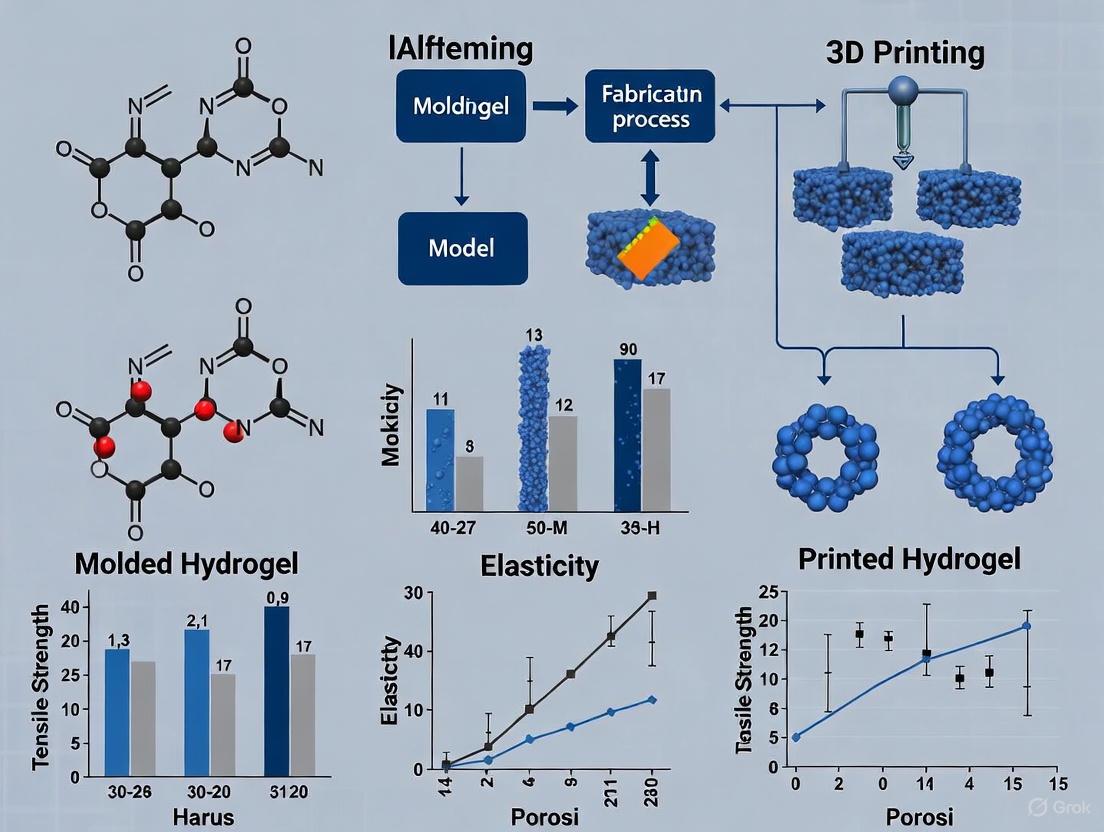
This article provides a systematic analysis of the mechanical properties of hydrogels fabricated through traditional molding versus modern 3D printing techniques.
Molded vs. 3D Printed Hydrogels: A Comprehensive Comparison of Mechanical Properties for Biomedical Applications
Abstract
This article provides a systematic analysis of the mechanical properties of hydrogels fabricated through traditional molding versus modern 3D printing techniques. Aimed at researchers, scientists, and drug development professionals, it explores the fundamental differences in viscoelastic behavior, time-dependent properties, and structural anisotropy induced by the fabrication process. The content covers key material considerations, advanced manufacturing methodologies, optimization strategies for printability and structural fidelity, and validation approaches for comparative analysis. By synthesizing current research, this review serves as a critical resource for selecting appropriate fabrication methods to achieve targeted mechanical performance in biomedical applications such as tissue engineering, drug delivery, and wound healing.
Hydrogel Fundamentals: How Fabrication Shapes Core Mechanical Properties
Hydrogels are three-dimensional (3D) polymer networks characterized by their high water content and crosslinked structure. The crosslinks, which can be either physical (reversible) or chemical (permanent) in nature, are the defining feature that prevents the polymer chains from dissolving and confers mechanical integrity to the gel. The choice between physical and chemical crosslinking fundamentally determines a hydrogel's properties, including its mechanical strength, responsiveness to stimuli, and suitability for biomedical applications such as drug delivery, tissue engineering, and 3D bioprinting [1] [2].
This guide provides an objective comparison of these two crosslinking paradigms. Particular emphasis is placed on their differing mechanical properties, a consideration that is critical within the broader research context of comparing molded and 3D-printed hydrogels. The fabrication process itself—whether a hydrogel is cast in a mold or extruded through a bioprinter nozzle—can introduce microstructural variations that significantly alter mechanical performance, independent of the crosslinking chemistry [3] [4].
Fundamental Mechanisms and Interactions
Physical Crosslinking
Physical hydrogels are formed by reversible, non-covalent interactions. These transient bonds can be disrupted by environmental changes but will typically re-form, allowing these materials to be often injectable or self-healing. The table below summarizes the primary mechanisms of physical crosslinking [1] [2].
Table 1: Key Mechanisms in Physical Crosslinking
| Mechanism | Description | Representative Polymers |
|---|---|---|
| Hydrogen Bonding | Polymer chains are connected by reversible hydrogen bonds between functional groups (e.g., -OH, -NH₂, -COOH). | Poly(vinyl alcohol) (PVA), Cellulose, Chitosan |
| Ionic Interactions | Divalent cations (e.g., Ca²⁺) form electrostatic bridges between anionic polymer chains. | Alginate, Gellan gum |
| Crystallization | Microcrystals act as physical crosslinking points, often formed through freeze-thaw cycles. | PVA |
| Hydrophobic Interactions | In aqueous environments, hydrophobic segments aggregate to minimize contact with water, forming micelles or domains. | Pluronics (PEO-PPO-PEO), Amphiphilic copolymers |
| Sterocomplexation | Complementary stereoregular polymers (e.g., D-PLA and L-PLA) interact to form a complex 3D network. | Polylactic acid (PLA) |
Chemical Crosslinking
Chemical hydrogels feature permanent, covalent bonds between polymer chains. This network is created through chemical reactions, resulting in structures that are generally more stable and mechanically robust than their physical counterparts [1] [2].
Table 2: Common Methods for Chemical Crosslinking
| Method | Description | Representative Systems |
|---|---|---|
| Graft Copolymerization | A polymer backbone is functionalized with reactive groups, and a second monomer is polymerized to form grafted chains. | HEMA-based polymers |
| Reactive Functional Groups | Polymers bearing complementary groups (e.g., amines and carboxylic acids, thiols and vinyl sulfones) react to form covalent links. | PEG-based hydrogels, Chitosan crosslinked with genipin |
| Enzymatic Crosslinking | Enzymes (e.g., transglutaminase, horseradish peroxidase) catalyze the formation of covalent bonds between specific substrates. | Tyramine-modified hyaluronic acid, Gelatin |
| High-Energy Radiation | Gamma or electron beam radiation generates free radicals on polymer chains, which subsequently recombine into crosslinks. | PVA, PVP |
Diagram 1: A comparison of physical and chemical crosslinking mechanisms and their resulting hydrogel properties.
Comparative Mechanical Properties
The mechanical properties of hydrogels are critical for their performance in load-bearing applications and their interaction with biological systems. The crosslinking method is a primary determinant of these properties.
Stiffness and Strength
Chemical crosslinking typically produces hydrogels with higher stiffness and tensile strength due to the strength and permanence of covalent bonds. For instance, hydrogels crosslinked with triethylene glycol dimethacrylate (TEGDA) demonstrate superior stress and strain compared to those using other crosslinkers [5]. However, advanced physical hydrogels can achieve remarkable toughness through structural engineering. Thermally engineered polyacrylamide (PAM) hydrogels have shown an 11-fold increase in tensile strength and a 60-fold increase in toughness over their as-prepared counterparts [6].
Viscoelasticity and Time-Dependent Behavior
A key difference lies in the viscoelastic behavior. Physical hydrogels exhibit more pronounced time-dependent mechanical properties, such as creep (deformation under constant load) and stress relaxation (decrease in stress under constant strain), due to the reversible nature of their bonds. This is highly relevant in bioprinting, where extruded physical hydrogels can show greater creep and swelling over time compared to their molded counterparts, even when their initial stiffness (Young's modulus) is similar [3]. This suggests the extrusion process alters the microstructure, affecting fluid flow and polymer chain rearrangement.
Self-Healing Capabilities
Self-healing is a property almost exclusive to physically crosslinked or dynamically crosslinked hydrogels. The reversible bonds can break and re-form, allowing the hydrogel to autonomously repair damage. The self-healing performance is typically evaluated qualitatively by observing crack closure or quantitatively through rheological tests (recovery of storage modulus, G′) or static tensile tests to determine healing efficiency [7].
Table 3: Quantitative Comparison of Mechanical Properties
| Property | Physical Hydrogels | Chemical Hydrogels | Supporting Experimental Data |
|---|---|---|---|
| Young's Modulus | Lower to Medium | Medium to High | GelMA (Chemical): 27.1–114.4 kPa [8]. Molded vs. Printed GelMA showed no significant difference in Young's Modulus [3]. |
| Tensile Strength | Variable (Low to High) | High | TEGDA-cross-linked HEMA hydrogel: High stress and strain [5]. PAM-TD-RH (Physical): 221 kPa [6]. |
| Toughness | Variable (Can be very high) | High | PAM-TD-RH (Physical): Toughness of 2,572 kJ m⁻³ [6]. |
| Extensibility | Can be very high | Moderate to High | As-prepared PAM: 320% strain; PAM-TD-RH: 2103% strain [6]. |
| Self-Healing Efficiency | High (Up to 100% recovery) | Typically None | Evaluated via rheology (recovery of G′) or tensile tests comparing original and healed strength [7]. |
Experimental Protocols for Mechanical Comparison
To objectively compare the performance of physically and chemically crosslinked hydrogels, and to investigate the effect of fabrication methods like molding vs. printing, standardized experimental protocols are essential.
Protocol: Uniaxial Compression/Tensile Testing
This protocol assesses the elastic and failure properties of hydrogel constructs [3] [4].
- Sample Preparation:
- Molded Samples: Prepare hydrogel precursor solution and pour into a silicone mold of defined dimensions (e.g., cylinders 5mm diameter × 1.4mm height). Allow crosslinking to proceed [3].
- Printed Samples: Design a CAD model of the desired shape (e.g., a cylinder). Use a bioprinter (e.g., pneumatic extruder) to fabricate the construct layer-by-layer using the same hydrogel precursor. Maintain consistent crosslinking conditions (e.g., UV light exposure time) with molded samples [3].
- Equilibration: Immerse all samples in a buffer solution (e.g., PBS or HBSS) to achieve swelling equilibrium before testing.
- Mechanical Testing: Perform uniaxial unconfined compression or tensile tests using a universal testing machine.
- Measure the sample dimensions accurately.
- Apply a constant strain rate (e.g., 1 mm/min).
- Record the force and displacement data.
- Data Analysis:
- Calculate engineering stress (force/original cross-sectional area) and strain (change in length/original length).
- Young's Modulus: Determine the slope of the initial linear region of the stress-strain curve.
- Tensile/Compressive Strength: Identify the maximum stress the sample withstands.
Protocol: Creep Compliance Testing
This test characterizes the time-dependent deformation of hydrogels, which is particularly relevant for distinguishing the behavior of physical networks [3].
- Sample Preparation: Prepare molded and printed samples as in Protocol 4.1.
- Testing: Apply a constant, instantaneous load to the sample and hold it for a defined period.
- Data Acquisition: Continuously measure the strain (deformation) of the sample over time under the constant load.
- Data Analysis:
- Plot strain versus time or calculate creep compliance (strain/stress) versus time.
- Compare the rate and extent of creep between physically and chemically crosslinked hydrogels, and between molded and printed versions of the same hydrogel.
Protocol: Rheological Characterization of Self-Healing
This protocol evaluates the dynamic recovery of physically crosslinked, self-healing hydrogels [7].
- Sample Loading: Place the pre-formed hydrogel on the plate of a rheometer.
- Strain Amplitude Sweep: First, perform an oscillatory strain sweep to identify the critical strain point where the gel structure breaks down (G′ drops and intersects G″).
- Alternating Step Strain Test:
- Apply a small oscillatory strain (e.g., 1%, within the linear viscoelastic region) and measure G′ and G″.
- Switch to a large oscillatory strain (e.g., 500%, well above the critical strain) for a set time to disrupt the network.
- Immediately switch back to the small strain and monitor the recovery of G′ and G″ over time.
- Data Analysis:
- The recovery of G′ after the high-strain破坏 indicates the self-healing capability.
- Healing efficiency can be calculated as (G′afterhealing / G′_initial) × 100%.
Diagram 2: A generalized experimental workflow for comparing the mechanical properties of hydrogels fabricated via different crosslinking and manufacturing methods.
The Scientist's Toolkit: Essential Research Reagents
The table below lists key materials and reagents commonly used in the synthesis and characterization of physically and chemically crosslinked hydrogels.
Table 4: Essential Reagents for Hydrogel Research
| Reagent/Material | Function | Crosslinking Context |
|---|---|---|
| Gelatin Methacrylate (GelMA) | A modified natural polymer that can be crosslinked via UV light. | Chemical (Photo-crosslinking) [3] [2] |
| Alginate | A natural polysaccharide that forms hydrogels in the presence of divalent cations (e.g., Ca²⁺). | Physical (Ionic Crosslinking) [4] [9] |
| Poly(vinyl alcohol) (PVA) | A synthetic polymer that can form hydrogels through repeated freeze-thaw cycles. | Physical (Crystallization) [1] |
| Poly(ethylene glycol) diacrylate (PEGDA) | A synthetic, hydrophilic macromer that forms networks via photo-polymerization. | Chemical (Photo-crosslinking) [8] |
| Lithium Phenyl-2,4,6-trimethylbenzoylphosphinate (LAP) | A cytocompatible photoinitiator activated by visible or UV light (~405 nm). | Chemical (Initiates photo-crosslinking) [3] [6] |
| Calcium Chloride (CaCl₂) | A source of Ca²⁺ ions used to crosslink anionic polymers like alginate. | Physical (Ionic Crosslinking Agent) [4] |
| Triethylene Glycol Dimethacrylate (TEGDA) | A crosslinking agent that improves the mechanical strength and thermal stability of synthetic hydrogels. | Chemical (Crosslinker for HEMA, etc.) [5] |
Traditional molded hydrogels are a cornerstone of biomedical and materials science research, serving as critical components in drug delivery systems, tissue engineering scaffolds, and basic mechanobiology studies. These hydrogels are typically fabricated through simple casting processes where polymer precursors are poured into molds and crosslinked via chemical, physical, or light-initiated mechanisms. The defining characteristic of these materials is their isotropic structure—a network architecture with uniform physical and mechanical properties in all directions. This structural uniformity results directly from the random orientation of polymer chains and pores formed during the mold-based crosslinking process, leading to consistent, direction-independent bulk properties including homogeneous mechanical behavior, uniform swelling kinetics, and consistent diffusion pathways [10] [11].
Understanding the capabilities and limitations of traditional molded hydrogels becomes particularly valuable when contrasted with emerging fabrication techniques like 3D printing, which can produce anisotropic hydrogels with direction-dependent properties. This comparison guide objectively examines the structural characteristics, mechanical performance, and functional capabilities of traditional molded hydrogels, providing researchers with a fundamental baseline for evaluating advanced hydrogel systems.
Structural Characteristics of Molded Hydrogels
Isotropic Network Architecture
The internal architecture of traditional molded hydrogels exhibits structural uniformity across multiple length scales. At the nanoscale, transmission electron microscopy (TEM) of physically crosslinked triblock copolymer hydrogels reveals spherical micelles with consistent diameter (20 ± 1 nm) randomly distributed throughout the network [10]. Small-angle X-ray scattering (SAXS) analysis confirms this structural consistency, showing a primary scattering peak corresponding to a center-to-center micelle distance of approximately 80 nm with minimal variation across different sample conditions [10]. At the microscale, these materials typically lack the oriented pore structures found in their 3D-printed counterparts, instead exhibiting randomly interconnected water-rich pores that contribute to their isotropic swelling behavior and nutrient transport capabilities [10].
The structural isotropy of molded hydrogels stems directly from their fabrication process. Unlike 3D printing, which applies directional shear forces during extrusion, mold-based fabrication allows polymer chains to crosslink in a stress-free environment, resulting in a network without preferred orientation. This fundamental structural characteristic directly governs the bulk properties that researchers observe in experimental settings, from mechanical performance to molecular diffusion rates [10] [11].
Comparative Structural Analysis
Table 1: Structural Comparison Between Molded and Printed Hydrogels
| Structural Feature | Traditional Molded Hydrogels | 3D-Printed Hydrogels |
|---|---|---|
| Polymer Chain Orientation | Random, non-directional | Aligned along printing direction |
| Pore Architecture | Randomly interconnected, isotropic | Anisotropic, often filament-aligned |
| Crosslinking Density | Uniform throughout bulk | Potentially variable between layers |
| Mechanical Properties | Identical in all directions | Direction-dependent (anisotropic) |
| Interfacial Boundaries | None (continuous monolith) | Layer-layer interfaces present |
Mechanical Properties and Experimental Data
Quantitative Mechanical Characterization
The isotropic nature of traditional molded hydrogels manifests clearly in their mechanical performance, with consistent properties regardless of testing direction. Rheological assessment of molded alginate/polyacrylamide hydrogels demonstrates typical viscoelastic behavior with overlapping storage (G') and loss (G'') moduli curves across different rotational axes [11]. This mechanical consistency provides a predictable environment for cell culture and drug release studies where uniform mechanical cues are desirable.
Table 2: Experimentally Measured Mechanical Properties of Molded Hydrogels
| Hydrogel Type | Elastic Modulus | Tensile Strength | Elongation at Break | Compressive Strength | Key Characteristics |
|---|---|---|---|---|---|
| SOS Triblock Copolymer [10] | <1 kPa | Not reported | >1200% | Not reported | Hyperelastic, completely reversible deformation |
| Alginate/Polyacrylamide DN [11] | 10-1000 Pa (shear modulus) | Not reported | Not reported | Not reported | Viscoelastic, tunable stiffness via concentration |
| Starch-Based Hydrogel [12] | 3.12 MPa (compressive) | 0.03 MPa | 1005.3% | 5.15 MPa | Dense 3D network, excellent cyclic recovery |
| PVA/CNF Composite [13] | 5.7-9.5 MPa | 41.9-64.6 MPa | 2590-3850% | Not reported | Ultrahigh toughness (903-1031 MJ·m⁻³) |
Comparative Mechanical Performance
When compared to 3D-printed hydrogels, traditional molded versions lack the customized anisotropic mechanical properties achievable through advanced manufacturing. Printed hydrogel lattices demonstrate direction-dependent stiffness, with scaled vintile unit cells showing significant differences between orthogonal directions (GXZ > GYZ in shear; EX > EY in compression) [14]. This mechanical anisotropy can be precisely tuned in printed systems by modifying structural parameters like unit cell size, strut diameter, and scaling ratio—capabilities absent in traditional molded hydrogels [14].
However, traditional molded hydrogels excel in providing consistent, reproducible mechanical environments for basic research applications. Their structural uniformity eliminates orientation-dependent variables that could complicate experimental interpretation, making them particularly valuable for foundational studies of cellular mechanotransduction, drug release kinetics, and basic material characterization [10] [11] [12].
Experimental Protocols for Hydrogel Characterization
Fabrication of SOS Triblock Copolymer Hydrogels
The following protocol details the preparation of hierarchically ordered yet mechanically isotropic porous hydrogels, as described in search results [10]:
Polymer Solution Preparation: Dissolve poly(styrene)-poly(ethylene oxide)-poly(styrene) (SOS) triblock copolymer (Mn = 192 kg/mol, fO = 0.9, Đ = 1.05) in a water-miscible organic solvent (DMF or THF) at concentrations between 8-15% by weight.
Hydrogel Formation: Inject the polymer solution into deionized water using a syringe with fixed needle diameter and injection rate. The block copolymer self-assembles through a bottom-up process as solvent exchange occurs.
Post-Processing: Maintain the formed hydrogel fibers in water for at least 24 hours to ensure complete solvent diffusion and structural stabilization.
Quality Assessment: Verify water content (typically ≈98% by weight) and porous architecture through cryo-SEM imaging [10].
Mechanical Testing Methodologies
Standardized testing protocols enable accurate characterization of isotropic hydrogel properties:
Rheological Analysis [11]
- Utilize a torsional rheometer with parallel plate geometry
- Perform frequency sweeps (0.1-10 Hz) at constant strain (within linear viscoelastic region)
- Conduct relaxation tests by applying fixed strain and monitoring stress decay over time
- Fit relaxation curves using a two-term Prony series to quantify viscoelastic parameters
Uniaxial Tensile Testing [10] [12]
- Prepare standardized dogbone or fiber specimens
- Apply constant crosshead displacement rate (strain rate typically 10-100% per minute)
- Record engineering stress-strain curves until failure
- Calculate elastic modulus from initial linear region, ultimate tensile strength, and elongation at break
Compression Testing [12]
- Use cylindrical samples (15 mm diameter × 20 mm height)
- Compress at constant strain rate (e.g., 10 mm/min)
- Determine compressive modulus and strength from resulting stress-strain data
- Perform cyclic compression tests to evaluate energy dissipation and recovery
Fabrication Workflow and Material Characterization
Experimental Workflow Diagram
The following diagram illustrates the key stages in creating and characterizing traditional molded hydrogels:
Key Material Characterization Techniques
Multiple analytical methods confirm the isotropic structure of traditional molded hydrogels:
Small-Angle X-ray Scattering (SAXS): Quantifies nanoscale structure through scattering patterns. Isotropic hydrogels exhibit uniform ring patterns, confirming random micelle distribution without directional preference [10].
Transmission Electron Microscopy (TEM): Visualizes nanostructure after staining with heavy metal solutions (e.g., 2 wt% uranyl acetate). Reveals spherical micelles with consistent diameter (20±1 nm) randomly oriented throughout the matrix [10].
Rheological Analysis: Determines viscoelastic properties through oscillatory shear testing. Identical storage and loss moduli across different rotational directions confirm mechanical isotropy [11].
Uniaxial Mechanical Testing: Stress-strain curves collected from multiple orientations show identical mechanical response, further verifying isotropic structure [10] [12].
The Scientist's Toolkit: Essential Research Reagents
Table 3: Key Reagents for Traditional Molded Hydrogel Research
| Reagent/Material | Function | Example Application | Considerations |
|---|---|---|---|
| SOS Triblock Copolymer | Forms physically crosslinked network via self-assembly | Creating highly elastic porous hydrogels [10] | Hydrophobic/hydrophilic balance critical for micelle formation |
| N,N-dimethylformamide (DMF) | Water-miscible organic solvent for polymer dissolution | Solvent for SOS copolymer before injection into water [10] | Choice of solvent (DMF vs THF) affects pore morphology |
| Acrylamide Monomer | Primary network former in synthetic hydrogels | Fabricating polyacrylamide hydrogels for mechanical studies [11] | Often combined with N,N'-methylenebisacrylamide crosslinker |
| Sodium Persulfate (SPS) | Free radical initiator for polymerization | Thermal initiation of acrylamide polymerization [12] | Decomposes at elevated temperature to generate radicals |
| Alginate | Natural polysaccharide for ionotropic gelation | Forming divalent cation-crosslinked hydrogels [11] | Gelation with Ca²⁺ ions; often combined with other polymers |
| Poly(ethylene glycol)-dithiol | Crosslinker for thiol-ene chemistry | Creating mechanically tunable networks [15] | Molecular weight controls mesh size and swelling ratio |
| Uranyl Acetate | Heavy metal stain for electron microscopy | Contrast enhancement for TEM imaging of hydrogel nanostructure [10] | Required for visualizing micelle structure; handle with appropriate safety precautions |
Traditional molded hydrogels provide researchers with materials exhibiting predictable, direction-independent properties stemming from their isotropic structure. While they lack the customizable anisotropy of 3D-printed systems, their structural uniformity makes them invaluable for applications requiring consistent mechanical environments, basic material characterization, and controlled drug release studies. The experimental protocols and characterization methodologies outlined in this guide provide researchers with standardized approaches for evaluating these fundamental material systems. As hydrogel technology advances, traditional molded hydrogels continue to serve as essential benchmarks against which more complex, architecturally engineered materials can be compared, maintaining their crucial role in the foundational understanding of hydrogel structure-property relationships.
Hydrogels, three-dimensional networks of polymer chains swollen with water, are fundamental biomaterials for applications ranging from tissue engineering to drug delivery. The emergence of additive manufacturing has revolutionized their fabrication, enabling the creation of structures with complex, pre-defined geometries. This guide objectively compares the mechanical performance of 3D-printed hydrogels against those produced by conventional molding, framing the analysis within ongoing research on how the layer-by-layer deposition inherent to printing influences key mechanical properties, with a specific focus on the induction of mechanical anisotropy. We synthesize experimental data to provide a clear, evidence-based comparison for researchers and scientists.
A critical difference between these fabrication methods lies in their capacity for creating anisotropic structures. Mechanical anisotropy—differences in a material's mechanical response when loaded in different directions—is a hallmark of many biological tissues, from brain white matter to tendon [16]. While molded hydrogels are typically isotropic, 3D printing, particularly when producing lattice structures or using directed deposition, can be engineered to be highly anisotropic, more accurately mimicking the natural tissue environment [14] [17].
Mechanical Properties Comparison: Molded vs. 3D-Printed Hydrogels
The transition from molding to 3D printing introduces significant changes to the mechanical behavior of hydrogel constructs. The following table summarizes the key differences as established by comparative research.
Table 1: Comparative Mechanical Properties of Molded and 3D-Printed Hydrogels
| Property | Molded Hydrogels | 3D-Printed Hydrogels | Experimental Context |
|---|---|---|---|
| Elastic (Young's) Modulus | No significant difference in initial Young's modulus compared to printed counterparts [3]. | Can be tuned from kPa to MPa ranges; similar initial modulus to molded in some formulations [3] [16]. | Gelatin-based (GelMA) hydrogels in compression; PEGDA lattice structures [3] [16]. |
| Time-Dependent Behavior (Creep) | Lower rate and extent of creep deformation [3]. | Significantly increased rate and extent of creep [3]. | GelMA hydrogels under unconfined compression [3]. |
| Mechanical Anisotropy | Typically isotropic (properties identical in all directions) [16]. | Highly tunable anisotropy. Scaling unit cells can create large differences in shear and compressive moduli between directions [14] [16]. | PEGDA lattices (cubic, diamond, vintile) in dynamic shear and compression testing [16]. |
| Swelling Behavior | Lower equilibrium fluid uptake [3]. | Greater swelling over time, linked to microstructural differences [3]. | GelMA hydrogels in solution [3]. |
| Ultimate Tensile Strength | Highly dependent on specimen geometry [18]. | High strength possible with specific strategies; e.g., one anisotropic hydrogel filament achieved 44 MPa tensile strength [19]. | Alginate/PAM tough hydrogels; Fe3+ crosslinked P(AAm-co-AAc)/Alginate filaments [19] [18]. |
Key Insights from Comparative Data
Elastic Modulus and Time-Dependence: A pivotal study directly comparing molded and extruded gelatin methacrylate (GelMA) hydrogels found that while their initial Young's moduli were statistically identical, the printed constructs exhibited markedly different time-dependent mechanical behavior [3]. The printed hydrogels showed a greater propensity for creep, continuing to deform over time under a constant load. This suggests that the printing process alters the internal microstructure, affecting how polymer chains rearrange and how water moves through the porous network (poroelasticity).
Induction of Anisotropy: 3D printing excels in creating structures with deliberate mechanical anisotropy. Research using stereolithography (SLA) to print polyethylene glycol diacrylate (PEGDA) lattices demonstrates that by scaling unit cell dimensions in one direction, consistent and tunable anisotropy can be achieved [14] [16]. For example, scaling a vintile lattice by a factor of two in the X-direction resulted in a lattice that was stiffer in the scaled direction (higher (EX)) compared to the unscaled direction (lower (EY)) under compression, and different shear moduli ((G{XZ}) vs. (G{YZ})) [16]. This level of directional control is not feasible with standard molding.
High-Strength Composites: Recent advances have pushed the mechanical boundaries of 3D-printed hydrogels. One study reported creating anisotropic, double-network hydrogels with a tensile strength of up to 44 MPa and toughness of 52 MJ m⁻³ [19]. This was achieved by using a semi-flexible polymer chain (sodium alginate) as a "conformation regulator" that locks in a highly oriented structure during the printing process, showcasing the potential for load-bearing biomedical applications.
Detailed Experimental Protocols
To enable replication and critical evaluation, this section outlines the key methodologies from the cited comparative studies.
Protocol 1: Comparing Molded vs. Extruded GelMA Hydrogels
This protocol is derived from the work that directly compared molded and bioprinted hydrogel properties [3].
Objective: To mechanistically understand how the extrusion bioprinting process affects the elastic, time-dependent, and swelling properties of hydrogel constructs.
Materials:
- Hydrogel Formulation: Gelatin methacrylate (GelMA) synthesized from porcine skin gelatin.
- Photoinitiator: Lithium phenyl-2,4,6-trimethylbenzoylphosphinate (LAP).
- Bioprinter: BioBots Beta pneumatic extruder with a 405 nm violet light source.
- Control Group: Molded cylinders of identical dimensions.
Methodology:
- Fabrication:
- Molded Constructs: GelMA solution is pipetted into a mold and allowed to physically gel for 20 minutes. It is then photocrosslinked under violet light. Cylinders (e.g., 5 mm diameter x 1.4 mm height) are punched out using a biopsy punch.
- Extruded Constructs: The same GelMA solution is loaded into a syringe, gelled for 20 minutes, and then pneumatically extruded through a nozzle (e.g., 22G, 420 µm inner diameter) layer-by-layer to form a cylinder of the same dimensions, under constant light irradiation.
Mechanical Testing:
- Unconfined Compression: Cylindrical samples are compressed to determine the Young's modulus from the slope of the linear elastic region.
- Creep Testing: A constant compressive load is applied, and the deformation over time is recorded to quantify time-dependent behavior.
Swelling Kinetics:
- Constructs are immersed in an aqueous solution (e.g., PBS). Their mass is measured periodically after careful blotting to determine fluid uptake over time.
Microstructural Analysis:
- Optical microscopy (e.g., phase contrast at 10x magnification) is used to visualize and compare the internal microstructure of molded and printed hydrogels.
The following workflow diagram illustrates the direct comparison built into this experimental design:
Protocol 2: Characterifying Anisotropy in 3D-Printed Lattices
This protocol is based on studies investigating PEGDA lattice structures for anisotropic tissue phantoms [14] [16].
Objective: To design, fabricate, and characterize 3D-printed hydrogel lattices with controlled structural and mechanical anisotropy.
Materials:
- Resin: Polyethylene glycol diacrylate (PEGDA).
- 3D Printer: Stereolithography (SLA) printer (e.g., LumenX+) with ~100 µm layer resolution.
- Software: CAD software (e.g., Rhinoceros 3D) with plugins (Grasshopper, Intralattice) for lattice generation.
Methodology:
- Lattice Design:
- Unscaled Lattices: Generate cubic, diamond, or vintile unit cells with equal dimensions in all directions (e.g., 1.25 mm spacing).
- Scaled Lattices: Uniformly scale the unit cell by a factor (e.g., 2x) in one specific direction (X-direction) to introduce structural anisotropy.
Fabrication:
- Print lattice structures (e.g., disks for shear testing, cubes for compression) using SLA. Post-print, remove supports and store samples in water at 4°C to prevent dehydration.
Mechanical Characterization:
- Dynamic Shear Test (DST): Measure the apparent shear moduli in two perpendicular planes—one parallel ((G{XZ})) and one perpendicular ((G{YZ})) to the scaling direction.
- Unconfined Compression Test: Measure the apparent Young's moduli by compressing the lattice in three orthogonal directions: the build direction (Z), the scaling direction (X), and the unscaled direction (Y).
Modeling and Validation:
- Use Finite Element Analysis (FEA) to simulate mechanical tests and predict apparent properties.
- Compare experimental results with theoretical models, such as the Gibson-Ashby model, which relates volume fraction to mechanical properties.
The process for creating and validating these anisotropic lattices is summarized below:
The Scientist's Toolkit: Essential Research Reagents and Materials
Successful research into 3D-printed hydrogels relies on a suite of key materials and technologies. The following table details essential items and their functions.
Table 2: Key Research Reagent Solutions for 3D-Printed Hydrogel Research
| Item | Function | Example Use-Cases |
|---|---|---|
| Polyethylene Glycol Diacrylate (PEGDA) | A synthetic, photopolymerizable resin for SLA printing; allows high-resolution fabrication of complex lattice structures [16]. | Anisotropic lattice phantoms for MRE validation [14] [16]. |
| Gelatin Methacrylate (GelMA) | A biofunctional hydrogel derived from gelatin; contains RGD motifs for cell adhesion; suitable for extrusion printing [3]. | Cell-laden constructs for tissue engineering; comparative studies of molding vs. printing [3]. |
| Sodium Alginate | A natural polymer used to form ionically crosslinked (e.g., with Ca²⁺ or Fe³⁺) networks; can act as a rigidifier and conformation regulator [19] [18]. | Tough double-network hydrogels; high-strength anisotropic filaments [19]. |
| Digital Light Processing (DLP) / SLA Bioprinter | High-resolution (80-300 µm) printing technology that uses light to photopolymerize resin in a layer-by-layer fashion [14]. | Fabricating intricate hydrogel lattices with fine features [14] [16]. |
| Pneumatic Extrusion Bioprinter | Printer that uses air pressure to extrude bioinks through a nozzle; versatile for a wide range of hydrogel viscosities [3]. | Printing cell-laden GelMA and other soft, self-supporting materials [3]. |
| Lithium Phenyl-2,4,6-trimethylbenzoylphosphinate (LAP) | A cytocompatible photoinitiator activated by 405 nm violet light, enabling rapid crosslinking of polymers like GelMA and PEGDA [3]. | Photocrosslinking in both SLA and extrusion-based printing setups [3]. |
The choice between molding and 3D printing for hydrogel fabrication is not a simple matter of superiority but one of strategic application. Molding remains a robust and straightforward method for producing isotropic hydrogels with consistent bulk properties. However, 3D printing offers unparalleled spatial control, enabling the creation of structures with complex geometries and, most importantly, tunable mechanical anisotropy that is critical for mimicking biological tissues.
The experimental data show that printing can uniquely engineer direction-dependent stiffness via lattice design and can produce extremely high-strength composite materials. Researchers must be aware that the printing process itself—whether extrusion or SLA—imparts distinct microstructural features that influence not only anisotropy but also time-dependent behaviors like creep and swelling. As the field advances, standardizing testing protocols, such as using specific dumbbell shapes for tensile tests [18], will be crucial for the fair and accurate comparison of these next-generation biomaterials. For applications in tissue-mimicking phantoms, load-bearing implants, or engineered tissue scaffolds where directional mechanics are paramount, 3D printing is an indispensable technology.
In the fields of biomedical engineering, drug delivery, and tissue engineering, hydrogels are prized for their biocompatibility and similarity to native tissues. A significant paradigm shift is occurring as traditional molding techniques are increasingly supplemented or replaced by advanced additive manufacturing, particularly 3D bioprinting. This transition is not merely a change in fabrication technique; it fundamentally alters the internal architecture of hydrogels, thereby impacting their key mechanical metrics—elasticity, viscoelasticity, and porosity. These properties are critical as they directly influence cell behavior, drug release kinetics, and the long-term performance of hydrogel-based devices and scaffolds. This guide provides a objective comparison of the mechanical performance of molded versus 3D-printed hydrogels, drawing on current experimental data to elucidate the strengths, limitations, and ideal application contexts for each manufacturing method.
Comparative Mechanical Performance Data
The manufacturing process imposes distinct micro- and macro-structural features that directly dictate mechanical performance. The following tables summarize quantitative comparisons of key metrics between molded and 3D-printed hydrogels, based on recent experimental studies.
Table 1: Comparison of Elastic Properties (Tensile and Compressive Behavior)
| Hydrogel Material | Manufacturing Method | Tensile Strength (MPa) | Elongation at Break (%) | Compressive Strength (MPa) | Elastic (Young's) Modulus (kPa) | Source |
|---|---|---|---|---|---|---|
| Polyacrylamide (PAAm) | Molded (Casting) | ~0.03* | ~1005* | 5.15 | 20 - 160 [20] | |
| Food Waste Starch | Molded | 0.03 | 1005.30 | 5.15 | 2,770 - 3,120 (Compressive) [12] | |
| Alginate/Polyacrylamide | 3D Bioprinting | Data limited | Data limited | Data limited | Significantly high stiffness reported [11] | |
| PEGDA/Laponite | 3D Bioprinting | N/A | N/A | N/A | Adjustable via print geometry [21] |
Note: Values for Tensile Strength and Elongation at Break for Molded PAAm are representative and can vary significantly with formulation. [12]
Table 2: Comparison of Viscoelastic and Structural Properties
| Hydrogel Material | Manufacturing Method | Storage Modulus, G' | Loss Modulus, G" | Key Structural Characteristics | Source |
|---|---|---|---|---|---|
| Polyacrylamide (PAAm) | Molded (Casting) | Well-characterized | Well-characterized | Isotropic, homogeneous network [20] | |
| Alginate/Polyacrylamide | 3D Bioprinting | High | High | Long relaxation times, viscoelastic [11] | |
| PEGDA/Laponite | 3D Bioprinting | Tunable via porosity | Tunable via porosity | Controlled porosity, anisotropic [21] | |
| Dual-Network Hydrogels | Various | Can exceed 25 MPa (compressive) | Energy dissipating | "Sacrificial bonds" for toughness [22] |
Experimental Protocols for MechanicaI Characterization
To obtain the comparative data presented, researchers employ a suite of standardized and advanced experimental protocols.
Protocol for Tensile and Compression Testing
- Objective: To determine elastic properties like Young's modulus, tensile strength, and elongation at break.
- Methodology: A universal testing machine (UTM) is used. For soft hydrogels, specialized 3D-printed grips are often essential to prevent slippage and sample damage [20]. Cylindrical samples (e.g., 15 mm diameter, 20 mm height) are standard for compression tests, performed at strain rates such as 10 mm/min [12]. Digital Image Correlation (DIC) techniques are sometimes used alongside to accurately measure strain and determine the Poisson's ratio [20].
Protocol for Rheological Testing
- Objective: To characterize the viscoelastic properties (Storage Modulus G' and Loss Modulus G") [11] [21].
- Methodology: A rheometer with a plate-plate geometry is standard. An oscillating stress or strain is applied, and the material's response is measured to determine G' (energy stored elastically) and G" (energy dissipated viscously). Testing is performed within the linear viscoelastic region where properties are strain-independent [11]. For 3D-printed scaffolds, non-destructive, contact-free instruments like the ElastoSens Bio can measure viscoelasticity without damaging the delicate construct [21].
Protocol for Porosity and Structural Analysis
- Objective: To quantify and qualify the internal microstructure and pore architecture.
- Methodology: Scanning Electron Microscopy (SEM) is used to visualize the internal 3D network and pore structure of freeze-dried hydrogels [12]. For bioprinted constructs, porosity is often controlled extrinsically by adjusting printing parameters like filament diameter and spacing, with its mechanical impact confirmed via rheological testing [21]. Advanced in silico models are also being developed to predict mechanical behavior from nanoarchitecture [23].
Structural and Workflow Diagrams
Internal Network Architecture
The fundamental difference between molded and printed hydrogels lies in their internal network structure, which directly dictates their mechanical performance.
Mechanical Testing Workflow
A comprehensive approach is required to fully characterize the mechanical properties of hydrogels, often involving cross-evaluation using multiple testing methods.
The Scientist's Toolkit: Essential Research Reagents and Materials
Successful formulation and testing of hydrogels require a specific set of materials and instruments.
Table 3: Essential Research Reagents and Materials
| Item Name | Function/Application | Specific Examples & Notes |
|---|---|---|
| Alginate | Natural polymer for bioinks; provides biocompatibility and shear-thinning behavior for printability. | Often ionically cross-linked with Ca²⁺; used in wound healing and bioprinting [11]. |
| Polyacrylamide (PAAm) | Synthetic polymer for creating tunable, tough hydrogels. | Cross-linker (e.g., BIS) concentration controls stiffness; elastic modulus can range 0.01 kPa–1 MPa [20]. |
| N,N'-Methylenebisacrylamide (BIS) | Cross-linking agent for polyacrylamide hydrogels. | Key for forming covalent networks; concentration critically impacts final mechanical strength [20] [12]. |
| Acrylamide (AM) Monomer | Precursor for polyacrylamide hydrogel synthesis. | Used in free-radical polymerization [20] [12]. |
| Photoinitiators | Initiate polymerization under UV light for photocurring bioinks. | Essential for vat polymerization (SLA, DLP) and extrusion-based printing of certain resins [11]. |
| Universal Testing Machine (UTM) | Measures tensile, compressive, and cyclic mechanical properties. | Requires specialized grips and fixtures for soft, slippery hydrogels to avoid slippage [20] [12]. |
| Rheometer | Characterizes viscoelastic properties (G', G") under oscillatory shear. | Plate-plate geometry is standard; crucial for bioink development and viscoelasticity assessment [11] [24]. |
| ElastoSens Bio | Measures viscoelasticity via non-destructive, contact-free resonance. | Ideal for fragile 3D-printed scaffolds and long-term studies of the same sample [21]. |
The choice between molded and 3D-printed hydrogels is not a matter of superiority, but of application-specific suitability. Molded hydrogels offer excellent isotropy and homogeneity, making them ideal for fundamental mechanobiology studies where uniform mechanical cues are required [20]. In contrast, 3D-printed hydrogels provide unparalleled spatial control over architecture and porosity, enabling the fabrication of complex, anisotropic structures that mimic native tissue hierarchies [11] [21]. The emerging trend of 4D printing, which adds time-responsive behavior to 3D-printed structures, further expands the dynamic potential of printed hydrogels [25]. Future research will continue to bridge the mechanical performance gap, particularly through innovative material formulations like double-network hydrogels [22], leading to more robust and functionally sophisticated hydrogel-based technologies for drug development and regenerative medicine.
The advancement of additive manufacturing, particularly in biomedical fields such as tissue engineering and drug delivery, hinges on the development of hydrogels with specific rheological properties. Shear-thinning and yield stress have emerged as two fundamental rheological behaviors that determine the printability of hydrogel inks, especially for extrusion-based 3D printing techniques like Direct Ink Writing (DIW) [26] [27]. These properties enable hydrogels to flow under applied stress during extrusion and rapidly recover their structural integrity upon deposition, ensuring shape fidelity in printed constructs [28] [29].
Understanding these rheological requirements is particularly crucial when comparing the properties of printed hydrogel constructs to those created through traditional molding techniques. Evidence suggests that the extrusion printing process itself can alter hydrogel microstructure and consequent mechanical behavior, highlighting the importance of rheological design in achieving targeted performance in final applications [3] [4]. This guide systematically compares the rheological properties governing printability and their impact on the final printed constructs relative to their molded counterparts.
Fundamental Rheological Properties for Printability
Shear-Thinning Behavior
Shear-thinning describes a material's property where viscosity decreases under applied shear stress [26] [28]. This behavior is indispensable for extrusion-based printing, as it allows highly viscous inks to flow through narrow nozzles when pressure is applied, yet maintain stability once deposited [27].
The shear-thinning behavior is quantitatively described by the Power Law model:
η = Kγ̇^(n-1)
Where η is viscosity, K is the consistency index, γ̇ is the shear rate, and n is the flow behavior index (n < 1 for shear-thinning fluids) [30] [31]. This model helps predict pressure requirements for extrusion and optimize printing parameters [27].
Yield Stress
Yield stress represents the critical stress threshold that must be exceeded to initiate flow in a material [27]. Below this stress, the material behaves as a solid; above it, the material flows as a viscous liquid [28]. This property is crucial for preventing unwanted spreading after deposition and supporting subsequent layers during the printing process [27].
Yield stress fluids typically follow the Herschel-Bulkley model:
τ = τ_y + Kγ̇^n
Where τ is shear stress, τ_y is yield stress, K is the consistency index, γ̇ is shear rate, and n is the flow behavior index [29].
Complementary Rheological Properties
Several other rheological properties contribute to printability:
- Thixotropy: Time-dependent shear-thinning behavior where viscosity decreases over time under constant shear stress and recovers when the stress is removed [26]. This property helps protect encapsulated cells from prolonged shear exposure [28].
- Viscoelasticity: The simultaneous display of viscous (liquid-like) and elastic (solid-like) characteristics, typically measured through storage modulus (G′) and loss modulus (G″) [26] [32].
- Rapid Recovery: The ability of a material to quickly regain its structural properties after cessation of shear, essential for maintaining shape fidelity after deposition [29].
Rheological Assessment and Experimental Protocols
A standardized rheological assessment protocol is essential for evaluating hydrogel printability. The following section outlines key experimental methodologies cited in current literature.
Core Rheological Characterization Workflow
The diagram below illustrates the systematic workflow for comprehensive rheological characterization of printable hydrogels:
Detailed Experimental Protocols
Rotational Flow Sweep
Purpose: To characterize shear-thinning behavior and determine viscosity-shear rate relationships [27].
Methodology:
- Load hydrogel sample between parallel plates of a rotational rheometer (typically 40mm diameter)
- Apply progressively increasing shear rates (e.g., 0.01 to 100 s⁻¹)
- Measure resulting viscosity and shear stress
- Fit data to Power Law or Herschel-Bulkley models to extract parameters (n, K, τ_y)
Key Parameters:
- Flow behavior index (n): Quantifies shear-thinning intensity (n < 1)
- Consistency index (K): Indicates viscosity magnitude
- Yield stress (τ_y): Critical stress for flow initiation [27] [31]
Oscillatory Amplitude Sweep
Purpose: To determine yield stress and linear viscoelastic region (LVER) [27].
Methodology:
- Subject hydrogel to oscillatory strain at constant frequency (typically 1-10 Hz)
- Gradually increase strain amplitude (e.g., 0.01% to 100%)
- Monitor storage modulus (G′) and loss modulus (G″)
- Identify point where G′ drops precipitously (indicating structural yielding)
Key Parameters:
- Yield stress: Stress at which G′ = G″ (crossover point)
- LVER: Strain range where structure remains intact [27]
Thixotropic Recovery Test
Purpose: To evaluate time-dependent structural recovery after shear [30].
Methodology:
- Apply low oscillatory stress (within LVER) to measure initial G′
- Apply high shear stress (exceeding yield stress) for set duration
- Immediately return to low stress and monitor G′ recovery over time
- Calculate recovery percentage and rate [30] [31]
Chemorheology for Time-Dependent Solidification
Purpose: To characterize chemical cross-linking or gelation kinetics [27].
Methodology:
- Initiate cross-linking reaction (via UV, temperature, or chemical initiator)
- Monitor G′ and G″ evolution over time at constant frequency and strain
- Determine gelation time (G′/G″ crossover) and curing rate [27]
Comparative Analysis: Molded vs. Printed Hydrogels
The printing process induces significant structural changes in hydrogels compared to traditional molding techniques. The table below summarizes key differences identified in comparative studies:
Table 1: Mechanical and Structural Comparison of Molded vs. Printed Hydrogels
| Property | Molded Hydrogels | Printed Hydrogels | Significance |
|---|---|---|---|
| Young's Modulus | Similar initial values [3] | Similar initial values [3] | Extrusion doesn't necessarily reduce stiffness |
| Time-Dependent Behavior | Lower creep compliance [3] | Higher creep compliance & rate [3] | Printed gels more susceptible to deformation under load |
| Swelling Properties | Limited swelling [3] | Enhanced swelling capacity [3] | Suggests structural differences affecting fluid transport |
| Microstructure | Homogeneous network [3] | Anisotropic alignment [4] | Shear-induced alignment during extrusion |
| Structural Fidelity | Defined by mold geometry [3] | Layer-by-layer resolution [4] | Printing enables complex architectures |
| Mechanical Anisotropy | Typically isotropic [3] | Potentially anisotropic [4] | Direction-dependent properties from printing path |
Underlying Mechanisms for Observed Differences
The table below outlines the fundamental mechanisms driving differences between molded and printed hydrogels:
Table 2: Mechanisms Behind Property Differences in Molded vs. Printed Hydrogels
| Observed Difference | Proposed Mechanism | Experimental Evidence |
|---|---|---|
| Increased Creep Compliance | Altered microstructure affecting fluid flow and polymer network rearrangement [3] | Higher swelling ratios suggest structural differences [3] |
| Enhanced Swelling | Modified network porosity and connectivity [3] | Greater equilibrium swelling mass in printed constructs [3] |
| Structural Anisotropy | Shear-induced alignment of polymer chains/fibrils during extrusion [4] | Microscopic observation of aligned microstructures [4] |
| Layer Interface Effects | Distinct interfacial regions between deposited filaments [4] | Reduced mechanical strength at layer boundaries observed in testing [4] |
Advanced Characterization and Modeling Approaches
Computational Fluid Dynamics (CFD) Modeling
CFD simulations provide insights into flow behavior during extrusion:
Methodology:
- Create 3D model of syringe-nozzle geometry
- Define material rheological parameters (from experimental measurements)
- Solve Navier-Stokes equations for non-Newtonian flow
- Analyze pressure distribution, shear rate profiles, and velocity fields [30] [31]
Applications:
- Predicting extrusion pressures for different nozzle geometries
- Visualizing shear rate distribution to identify potential cell damage zones
- Optimizing nozzle design to minimize destructive shear stresses [30] [31]
Machine Learning for Printability Prediction
Recent approaches employ machine learning to identify critical rheological parameters:
Methodology:
- Compile extensive library of rheological data and printability scores
- Train models to identify key rheological features predictive of printability
- Use interpretable AI to establish physically meaningful relationships [33]
Findings:
- 13 critical rheological measures collectively predict printability
- No single parameter universally predicts printability across formulations
- Collaborative nature of rheological properties determines printability [33]
The Scientist's Toolkit: Essential Research Reagents and Materials
Table 3: Key Research Reagents and Materials for Hydrogel Printability Studies
| Material/Reagent | Function in Research | Examples & Applications |
|---|---|---|
| Rheology Modifiers | Enhance printability of non-printable bioactive polymers [33] | Carbopol microgels, Laponite nanodiscs, Fmoc-FF fibrils [33] |
| Natural Polymers | Base material providing bioactivity and biocompatibility [4] | Alginate, gelatin, hyaluronic acid, κ-carrageenan [30] [4] |
| Cross-linking Agents | Induce chemical or physical network formation for stability [30] | KCl (for κ-carrageenan), Ca²⁺ (for alginate), photoinitiators (e.g., LAP) [30] [31] |
| Nanoparticle Additives | Modulate rheological properties and functionality [29] [31] | Laponite nanosilicates, gold nanoparticles (AuNPs) [29] [31] |
| Photoinitiators | Enable UV-mediated cross-linking for stabilization [3] | Lithium phenyl-2,4,6-trimethylbenzoylphosphinate (LAP) [3] |
| Cell Lines | Assess biofunctionality and cytocompatibility [3] [29] | NIH 3T3 fibroblasts, mesenchymal stem cells (MSCs) [3] [29] |
The rheological requirements for hydrogel printability—primarily shear-thinning behavior and yield stress—play a fundamental role in determining the success of extrusion-based 3D printing processes. While these properties enable fabrication of complex structures, they also induce significant differences in the mechanical behavior and microstructure of printed hydrogels compared to their molded counterparts.
The comparative analysis presented demonstrates that printed constructs often exhibit enhanced time-dependent mechanical compliance and modified swelling behavior, attributable to shear-induced microstructural changes during extrusion. These differences highlight the importance of considering printing-induced anisotropies when designing hydrogel constructs for specific applications, particularly in load-bearing tissue engineering contexts.
Advanced characterization techniques, including CFD modeling and machine learning approaches, are providing new insights into the complex relationships between rheological properties, printing parameters, and final construct performance. As the field progresses, a deeper understanding of these relationships will enable more precise design of bioinks that balance printability with targeted functional performance in biomedical applications.
Fabrication Techniques and Biomechanical Applications
Within the broader research on mechanical properties comparison of molded versus printed hydrogels, the choice of fabrication technique is paramount. Casting and in situ gelation represent two foundational molding strategies, each offering distinct pathways to create the cross-linked polymer networks that define hydrogels. These techniques directly influence critical parameters such as mesh size, swelling behavior, and mechanical toughness, which in turn dictate the hydrogel's performance in biomedical applications such as drug delivery and tissue engineering [34] [35]. This guide provides an objective comparison of these two methods, focusing on their operational principles, resultant hydrogel properties, and experimental protocols to aid researchers in selecting the appropriate fabrication strategy.
Fundamental Principles and Comparative Workflow
At their core, both techniques rely on initiating a sol-gel transition, but they diverge significantly in their sequence and spatial control. Gelation is the process where polymer chains in a solution (sol phase) form cross-links, leading to an insoluble, three-dimensional network (gel phase) [35].
- Casting is a traditional method where the gelation process occurs ex vivo, entirely within a pre-fabricated mold or container. The polymer solution is mixed with cross-linking agents, poured into a mold, and allowed to set into its final shape, which it maintains upon demolding [35].
- In Situ Gelation is characterized by a gelation process that occurs in vivo. The liquid precursor solution, containing polymers and cross-linking agents, is introduced into the target site (e.g., via injection). The gel formation is then triggered by specific physiological or external stimuli in place, conforming perfectly to the available space [34].
The following workflow diagram illustrates the key stages and decision points for these two techniques.
Comparative Analysis of Hydrogel Properties and Performance
The choice between casting and in situ gelation has a profound impact on the final hydrogel's characteristics. The table below summarizes a quantitative comparison of key properties, drawing from experimental data across various studies.
Table 1: Comparative Performance of Casting vs. In Situ Gelation
| Property | Casting | In Situ Gelation | Key Experimental Insights |
|---|---|---|---|
| Spatial Control | Limited to mold geometry; primarily for simple or 2D structures [36]. | High; conforms to irregular tissue cavities, enabling defect-specific filling [34]. | In vivo studies show in situ gels adapt to bone defects or subcutaneous spaces, while cast gels maintain pre-formed shapes like discs or films [34]. |
| Invasiveness | High; typically requires surgical implantation [34]. | Low; amenable to minimally invasive injection [34]. | Clinical use of injectable in situ gels avoids surgical risks; cast systems like INFUSE require implantation [34]. |
| Mechanical Strength | Can achieve higher strength and toughness through controlled, static cross-linking [37]. | Generally lower; must balance injectability with rapid gelation to achieve structural integrity [34] [37]. | Dual-network hydrogels made by casting can exhibit toughness ~1000 J m⁻², mimicking cartilage. In situ gels prioritize gelation speed over ultimate strength [37]. |
| Pore Structure | Can be highly uniform; tunable via freeze-thaw, porogens [35]. | Often less uniform; pore size can be affected by gelation kinetics and local environment. | Cast gelatin and alginate gels form consistent pores via freeze-thaw or ionic cross-linking. In situ gel pores can vary with injection shear and body temperature [35]. |
| Drug Release Profile | Predictable, often sustained release, governed by diffusion through a stable mesh [34]. | Can be complex; influenced by gelation kinetics and dynamic mesh evolution in physiological milieu [34]. | Release data shows cast hydrogels provide more linear, sustained profiles. In situ systems may show initial burst release due to kinetic effects during gel formation [34]. |
| Gelation Trigger | External (UV, temperature change, adding cross-linker) [35]. | Internal/Stimuli-Responsive (physiological temperature, pH, ionic strength, enzymes) [34]. | Cast alginate gels via Ca²⁺ immersion. In situ gels like chitosan/β-glycerophosphate gel via body temperature or pH shift [34] [35]. |
A deeper analysis of the mechanical properties reveals a fundamental trade-off. Cast hydrogels can be engineered for superior mechanical strength and toughness. For instance, innovative designs like dual-network hydrogels—featuring a rigid first network and a ductile second network—are often fabricated via casting, achieving fracture toughness comparable to natural cartilage (approximately 1000 J m⁻²) [37]. The shear modulus ((G)) of a hydrogel network is directly related to its crosslink density ((\nu)), as described by the affine network model: (G = \nu k_B T) [37]. The controlled environment of casting allows for a higher and more homogeneous crosslink density.
In contrast, the mechanical properties of in situ forming gels are constrained by the need for injectability. Their precursors must be low-viscosity liquids to enable administration through needles, which limits the polymer concentration and pre-formed network integrity. While strategies like shear-thinning and self-healing can recover some mechanical properties after injection, their ultimate strength and toughness are generally lower than what can be achieved with robust casting methods [34] [37].
The relationship between fabrication method, crosslinking, and mechanical performance is summarized below.
Experimental Protocols for Hydrogel Fabrication and Characterization
Detailed Protocol for Solvent Casting
This protocol outlines the creation of a simple, ionically cross-linked alginate hydrogel film, a common model system [35].
- Objective: To fabricate a stable, macroscopic alginate hydrogel with uniform structure via ionic cross-linking in a mold.
- Materials:
- Sodium Alginate powder (2-4% w/v in deionized water)
- Calcium Chloride (CaCl₂) solution (50-100 mM)
- Deionized Water
- Magnetic Stirrer & Hotplate
- Petri Dish (or other mold)
- Syringe Pump (optional, for controlled addition)
- Procedure:
- Solution Preparation: Dissolve sodium alginate powder in deionized water under constant stirring and mild heating (∼40°C) for 2-4 hours until a clear, bubble-free solution is obtained. Allow the solution to cool to room temperature.
- Molding: Pour the alginate solution into a clean, level Petri dish to the desired thickness.
- Cross-linking: Gently pour the CaCl₂ solution over the alginate solution in the mold. Alternatively, for more uniform cross-linking, immerse the entire mold into a bath of CaCl₂ solution.
- Gelation: Allow the gelation to proceed for 15-30 minutes. A visible, self-supporting gel will form.
- Demolding and Rinsing: Carefully remove the formed hydrogel from the mold and rinse it thoroughly with deionized water to remove excess Ca²⁺ ions and unreacted polymer.
Detailed Protocol for Thermally-Induced In Situ Gelation
This protocol describes the preparation of a chitosan-based hydrogel that gels upon a temperature shift to 37°C, simulating in vivo conditions [34] [35].
- Objective: To prepare an injectable hydrogel precursor that undergoes sol-gel transition at physiological temperature.
- Materials:
- Chitosan (medium molecular weight, deacetylated)
- β-Glycerophosphate (β-GP)
- Dilute Hydrochloric Acid (HCl) or Acetic Acid
- Ice Bath
- Magnetic Stirrer
- Water Bath or Incubator (37°C)
- Syringe with needle
- Procedure:
- Polymer Dissolution: Dissolve chitosan in a cold, dilute acidic solution (e.g., 0.1 M HCl) under vigorous stirring on an ice bath to obtain a clear, viscous solution (e.g., 2% w/v).
- Neutralization/Cross-linker Addition: Slowly add β-GP powder to the cold chitosan solution while maintaining stirring and the ice bath. The β-GP acts as a cross-linker and neutralizes the solution, raising its pH.
- Precursor Formation: Continue stirring until the mixture is homogeneous and clear. This cold solution remains in the liquid "sol" state.
- In Situ Gelation Test: Draw the cold precursor solution into a syringe. Inject the solution into a pre-warmed vial (37°C) or place a droplet into a 37°C water bath. The gelation should occur within minutes, forming a solid hydrogel.
Key Characterization Methods
- Rheology: Use a rheometer to measure the storage (G') and loss (G'') moduli during the gelation process to identify the gel point (where G' > G'') and final gel strength [36] [37].
- Compression Testing: Use a Universal Testing Machine to perform unconfined compression tests on cylindrical hydrogel samples to determine the compressive modulus and strength [37].
- Swelling Ratio: Measure the mass of the hydrogel in its equilibrium-swollen state (Wₛ) and its dry state (Wd). The mass swelling ratio is calculated as ( Qm = Ws / Wd ) [35] [37].
- Drug Release Kinetics: Immerse a drug-loaded hydrogel in a release medium (e.g., PBS at 37°C). Periodically withdraw samples and analyze drug concentration via HPLC or UV-Vis spectroscopy to construct a release profile [34].
The Scientist's Toolkit: Essential Research Reagents
Table 2: Key Reagents for Hydrogel Fabrication
| Reagent | Function | Example Use Case |
|---|---|---|
| Sodium Alginate | Natural polymer for ionic cross-linking; forms gels with divalent cations like Ca²⁺. | Cast hydrogel films and microspheres for cell encapsulation and drug delivery [35]. |
| Chitosan | Natural, cationic polysaccharide; can form thermo-responsive gels with agents like β-GP. | Injectable, in situ gelling systems for wound healing and tissue engineering [35]. |
| Carboxymethyl Cellulose (CMC) | A biomass-derived polymer with ionized carboxyl groups; offers exceptional hydration. | Used in advanced energy-harvesting moist-electric generators; can be cross-linked with citric acid [38]. |
| Calcium Chloride (CaCl₂) | Ionic cross-linker for anionic polymers (e.g., alginate, CMC). | Standard cross-linking agent for creating stable alginate hydrogels via casting [35]. |
| β-Glycerophosphate (β-GP) | Cross-linker and pH neutralizer for chitosan; enables thermo-responsive gelation. | Key component for creating injectable chitosan-based hydrogels that gel at body temperature [34] [35]. |
| Citric Acid | A natural cross-linker that can form ester bonds with hydroxyl-rich polymers. | Used to create mechanically stable and environmentally friendly hydrogels with CMC [38]. |
| Methacrylated Gelatin (GelMA) | A chemically modified polymer that can be cross-linked via UV light (photopolymerization). | Enables fabrication of complex 3D structures via casting in molds or using 3D printing (e.g., stereolithography) [36] [35]. |
Extrusion-based 3D printing is a foundational additive manufacturing paradigm characterized by the controlled, layer-by-layer deposition of material through a printer nozzle onto a build platform [39]. This technology is distinguished by its design freedom, cost efficiency, and process simplicity compared to liquid- and powder-based additive manufacturing technologies [39]. Within biomedical engineering and regenerative medicine, extrusion-based printing has become indispensable for fabricating both cell-free scaffolds and cell-laden constructs that mimic natural tissues [40]. The three principal extrusion mechanisms—pneumatic, piston-driven, and screw-driven—each employ distinct methods to control material flow, leading to significant differences in their compatibility with materials, resolution capabilities, and impact on cellular viability when processing bioinks. Understanding these differences is critical for researchers selecting appropriate fabrication methods, particularly when the mechanical properties of printed hydrogels must closely match those of native tissues or traditional molded samples.
Comparative Analysis of Extrusion Systems
Operating Principles and Key Characteristics
The three primary extrusion systems function on different mechanical principles, each suited to specific material types and application requirements:
Pneumatic Extrusion utilizes compressed air to apply pressure on the material within a reservoir, forcing it through the deposition nozzle [40]. This system offers a simple equipment structure, good operability and maintainability, and low cost [41]. A significant advantage is its compatibility with a wide range of material viscosities [41], making it highly adaptable for various bioinks. However, it can exhibit less precise flow control at the start and end of extrusion cycles compared to mechanical systems.
Piston-Driven (Syringe-Based) Extrusion employs a motor-driven plunger that moves linearly within a material cartridge, providing direct displacement of the bioink [42]. This system offers more stable volumetric flow control compared to pneumatic systems [43], which is particularly valuable for maintaining consistent strand diameter. The extrusion rate can be easily adjusted by varying the motor speed, though higher viscosity materials require more powerful motors to achieve proper extrusion [42].
Screw-Driven Extrusion features a rotating screw mechanism that continuously conveys material from the cartridge through a narrower tube nozzle [42]. This system provides significant shear force, which can be beneficial for mixing composite materials during the printing process. However, it has been reported as less suitable for inks with very high viscosity and high mechanical strength, which may not achieve proper extrusion for good printing precision [42].
Performance Comparison: Quantitative Data
The following table summarizes key performance characteristics and experimental data for the three extrusion systems, highlighting their distinct operational profiles.
Table 1: Performance Comparison of Extrusion-Based 3D Printing Systems
| Extrusion System | Control Input | Shear Stress Profile | Optimal Material Viscosity | Key Advantages | Reported Limitations |
|---|---|---|---|---|---|
| Pneumatic | Dispensing Pressure (e.g., 15 kPa [43]) | Lower shear stress compared to mechanical systems [43] | Wide range [41] | Simple structure, low cost, good material adaptability [41] | Less precise flow control at extrusion start/stop |
| Piston-Driven | Volumetric Flow (e.g., 10 mm³/s [43]) | Moderate, concentrated at nozzle walls [42] | Medium to High [42] | Stable volumetric flow, direct control [43] [42] | High power demand for high-viscosity inks [42] |
| Screw-Driven | Screw Rotation Speed | High shear forces, beneficial for mixing [42] | Low to Medium [42] | Continuous feeding, mixing capability [42] | Not suitable for very high-viscosity inks [42] |
Computational fluid dynamics (CFD) simulations reveal fundamental differences in how materials behave within these systems. In piston-driven systems, the velocity profile is a simple top-down laminar flow, with velocity increasing uniformly toward the nozzle outlet [42]. In contrast, screw-driven systems exhibit a more complex flow field with higher shear rates due to the screw's rotation, which can cause an accumulation of dispersed phases in multiphase inks [42].
Experimental Protocols for System Evaluation
Computational Simulation of Extrusion Dynamics
Computational simulation provides a powerful tool for analyzing hard-to-measure parameters during the extrusion process without disturbing the flow [43].
- Objective: To comparatively study the performance of different extrusion systems and nozzle geometries by simulating key bioprinting parameters including pressure, velocity, and shear stress [43].
- Software: COMSOL Multiphysics with a two-phase flow level-set interface approach [43] [42].
- Methodology:
- Create 2D axisymmetric geometrical models of the extrusion systems and nozzles being studied [43].
- Define material properties of the bioink (e.g., shear-thinning non-Newtonian behavior) [43].
- Configure simulation inlets according to extrusion type: dispensing pressure (e.g., 15 kPa) for pneumatic systems and volumetric flow (e.g., 10 mm³/s) for piston-driven systems [43].
- Solve for parameters including inlet/outlet pressure, volumetric flow, outlet velocity, and maximum shear stress [43].
- Key Metrics: Maximum shear stress (critical for cellular viability [43]), pressure distribution, and velocity profiles at critical points within the flow path [43].
Mechanical Property Comparison: Printed vs. Molded Hydrogels
Direct comparison of mechanical properties between printed and molded hydrogels is essential for validating extrusion-based fabrication for tissue engineering applications [3].
- Hydrogel Fabrication:
- Printing: Utilize a pneumatic extruder (e.g., BioBots Beta) fitted with various nozzle gauges (e.g., 27G, 22G, 18G). Load photocrosslinkable hydrogel (e.g., GelMA) into a syringe, allow physical gelation (~20 min), then extrude under constant irradiation (e.g., 405 nm wavelength) at specified pressure (e.g., 60-130 psi) and travel feed rates (e.g., 4-12 mm/s) [3].
- Molding: Pour the same hydrogel solution into molds at depths matching printed constructs, allow gelation for the same duration (20 min), and irradiate under the same light source for identical time as extruded samples [3].
- Mechanical Testing: Perform uniaxial unconfined compression tests on cylindrical samples of identical dimensions from both fabrication methods. Use a displacement rate-controlled loading mode (e.g., 0.2 mm/min) to obtain stress-strain curves [3] [44].
- Analysis:
- Elastic Properties: Calculate Young's modulus from the linear region of the stress-strain curve [3].
- Time-Dependent Behavior: Assess viscoelastic/poroelastic properties through creep tests [3].
- Swelling Kinetics: Measure dimensional changes and fluid uptake over time to infer differences in microstructure [3].
Table 2: Essential Research Reagents and Materials for Hydrogel Extrusion Studies
| Item Name | Function/Application | Example Specifications |
|---|---|---|
| Gelatin Methacrylate (GelMA) | Photocrosslinkable bioink; contains cell-binding RGD motifs [3] | 10-20% w/v in PBS [3] |
| Lithium Phenyl-2,4,6-trimethylbenzoylphosphinate (LAP) | Cytocompatible photoinitiator for visible light crosslinking [3] | 0.25-0.5% concentration [3] |
| Polylactic Acid (PLA) | Common thermoplastic for material extrusion (MEX) printing [45] | Filament diameter: 1.75 mm ± 0.05 mm [45] |
| Quartz Sand & Cementitious Materials | Components for rock-like material printing in mechanical studies [44] | Quartz sand (70-200 mesh), Portland cement [44] |
| Cell-Laden Bioink | For printing living tissue constructs; combines hydrogel with cells [40] | High cell density formulations [40] |
Impact on Hydrogel Properties and Research Applications
Mechanical Properties: Printed vs. Molded Constructs
The extrusion process itself can fundamentally alter the properties of hydrogel constructs compared to those prepared by conventional molding. Interestingly, while some studies report that the Young's moduli of extruded and molded constructs from the same material are not significantly different, extruded hydrogels consistently demonstrate increases in both the rate and extent of time-dependent mechanical behavior observed in creep tests [3]. This suggests that extrusion enhances the poroelastic characteristics of the material, allowing for greater fluid flow through the polymer network under sustained load. Furthermore, despite similar polymer densities, extruded hydrogels typically show greater swelling over time compared to their molded counterparts, indicating that the extrusion process creates differences in microstructure that affect fluid flow and osmotic dynamics [3]. These findings highlight the critical need to consider the effects of the fabrication process itself when designing biomaterials for specific mechanical environments.
Cellular Viability and Biomaterial Compatibility
For bioprinting applications, the impact of extrusion forces on cellular viability is a paramount concern. Research indicates that shear stress is a primary factor affecting cell survival during extrusion, with higher stresses leading to increased cell lysis [43]. Studies have classified shear stress ranges into three viability categories: low shear stress (<5 kPa) with high cellular viability up to 96%; medium shear stress (5-10 kPa) with viability around 91%; and high shear stress (>10 kPa) reducing viability to approximately 76% [43]. Nozzle geometry plays a crucial role in modulating these stresses; standard 3D printing nozzles have been shown to increase flow rate while reducing dispensing pressure and maintaining similar shear stress compared to conical tips commonly used in bioprinting [43]. Additionally, the choice of extrusion mechanism influences viability, with pneumatic systems introducing different stress profiles than piston-driven systems [43]. Beyond immediate survival, researchers must also consider the cytotoxicity of materials, solvents, and crosslinking mechanisms, as well as ensuring adequate nutrient and gas exchange within the fabricated scaffolds for long-term culture success [40].
Decision Framework and Research Workflow
Selecting the appropriate extrusion system requires careful consideration of multiple interdependent factors. The following workflow diagram outlines a logical decision-making process for researchers designing extrusion-based bioprinting experiments.
Diagram 1: Decision Workflow for Extrusion-Based Bioprinting
This systematic approach ensures that researchers consider critical factors including bioink viscosity, cell sensitivity, and structural requirements before selecting an extrusion mechanism. The workflow emphasizes the importance of post-selection optimization and validation to achieve constructs with the desired mechanical and biological properties.
Pneumatic, piston-driven, and screw-driven extrusion systems each offer distinct advantages and limitations for 3D printing applications in biomedical research. Pneumatic systems provide versatility and simplicity for a wide viscosity range, piston-driven systems excel in volumetric precision for medium-to-high viscosity materials, and screw-driven systems facilitate mixing but are less suitable for high-viscosity inks. Critically, the extrusion process itself induces microstructural changes in hydrogels that significantly alter their time-dependent mechanical behavior and swelling properties compared to molded equivalents. Furthermore, extrusion-generated shear stresses directly impact cellular viability, necessitating careful parameter optimization based on the specific bioink and cell type. By following a structured decision framework that incorporates computational modeling, systematic parameter optimization, and rigorous mechanical and biological validation, researchers can effectively leverage these technologies to advance fields ranging from drug development to regenerative medicine.
Advanced bioprinting techniques have emerged to overcome the limitations of conventional extrusion-based bioprinting, particularly in creating complex, functional tissue constructs. While conventional monoaxial extrusion is versatile and allows for high cell density, it often struggles with achieving complex vascularized structures and can subject bioinks to significant shear stress [46]. To address these challenges, researchers have developed sophisticated methods including coaxial, embedded, and support-bath printing. These advanced techniques enable the fabrication of intricate tissue architectures with enhanced biological functionality, bringing us closer to engineering viable tissues for regenerative medicine and drug development applications [46] [47].
The significance of these advanced techniques is particularly evident in the context of vascularized tissues, which are essential for nutrient delivery and waste removal in engineered constructs. Coaxial printing allows for direct fabrication of tubular structures mimicking blood vessels, while embedded and support-bath techniques enable freeform fabrication of complex structures that would otherwise collapse under gravity [46] [47]. Understanding the capabilities, limitations, and appropriate applications of each technique is crucial for researchers and drug development professionals seeking to implement these technologies in their work. This guide provides a comprehensive comparison of these advanced bioprinting methodologies, with particular emphasis on their differential effects on the mechanical properties of the resulting constructs—a critical consideration for functional tissue engineering.
Comparative Analysis of Bioprinting Techniques
Table 1: Technical comparison of advanced bioprinting techniques
| Feature | Coaxial Bioprinting | Embedded Biopath Printing | Support-Bath Printing |
|---|---|---|---|
| Core Principle | Simultaneous deposition of multiple material streams through concentric nozzles to create layered structures [46] | 3D printing within a solid or semi-solid matrix that acts as a temporary support [48] | Extrusion into a granular or colloidal suspension that provides omnidirectional support [46] |
| Key Applications | Vascular scaffolds, tubular structures, core-shell constructs [47] | Multilayered arterial tissues, complex organ structures, cellular alignment [48] | Complex architectures, overhanging structures, delicate tissues [46] |
| Structural Complexity | Moderate - primarily tubular and concentric structures | High - enables complex 3D structures with cellular alignment | Very High - allows freeform fabrication of intricate geometries [46] |
| Resolution | 100-500 μm [46] | Varies with support matrix properties | 100-500 μm [46] |
| Cell Viability | 40-80% [46] | Varies with protocol | 40-80% [46] |
| Key Advantages | Direct fabrication of hollow channels; continuous cross-linking during deposition [47] | Prevents collapse during printing; enables precise cellular patterning [48] | Enables printing of low-viscosity bioinks; supports complex, unsupported spans [46] |
| Major Limitations | Limited to tubular structures; cannot fabricate complex branching networks alone [47] | Support removal can damage delicate structures; potential incorporation of support material into construct | Support drying during prolonged printing; potential incorporation of support material into construct [46] |
Table 2: Mechanical properties of bioprinted versus molded hydrogels
| Property | Molded Hydrogels | Extruded/Bioprinted Hydrogels | Significance |
|---|---|---|---|
| Young's Modulus | No significant difference reported compared to extruded constructs [3] | No significant difference reported compared to molded constructs [3] | Elastic response similar despite fabrication method |
| Time-Dependent Behavior | Lower creep compliance [3] | Higher rate and extent of creep [3] | Printed constructs exhibit more pronounced viscoelasticity |
| Swelling Capacity | Lower swelling over time [3] | Greater swelling over time despite similar polymer density [3] | Important for nutrient diffusion and drug release |
| Structural Anisotropy | Isotropic microstructure [3] | Anisotropic microstructure due to layer-by-layer deposition [3] | Affects directional mechanical properties |
| Pore Architecture | Uniform, random porosity | Controlled, designed porosity via print patterning [4] | Critical for cell migration, nutrient diffusion |
Experimental Protocols and Methodologies
Coaxial Bioprinting for Vascular Scaffolds
The fabrication of vascular scaffolds via coaxial bioprinting involves precise optimization of both material properties and process parameters. In a typical protocol, sodium alginate (SA) solution is used as the bioink material, while calcium chloride (CaCl₂) serves as the cross-linking agent [47]. The experimental workflow begins with preparing the bioink by dissolving sodium alginate particles in deionized water using a constant temperature magnetic stirrer to ensure complete dissolution. Similarly, calcium chloride particles are dissolved in deionized water by stirring with a glass rod for approximately 5 minutes until fully dissolved [47].
The coaxial printing process itself employs a specific nozzle configuration where the alginate-based bioink flows through the outer channel while the calcium chloride cross-linking solution is simultaneously extruded through the inner channel. This setup enables immediate ionic cross-linking at the interface between the two streams, forming a continuous hollow hydrogel tube. Critical parameters requiring optimization include the flow rates of both internal and external solutions, bioink concentration (typically 2-8% sodium alginate), and cross-linking agent concentration (usually 1.5-3% CaCl₂) [47] [49]. Through systematic experimentation, researchers have determined that balancing these parameters is essential for achieving vascular scaffolds with satisfactory degradability, water absorption, and mechanical properties suitable for practical applications [47].
Embedded Bioprinting for Multilayered Tissues
Embedded bioprinting protocols enable the creation of complex tissue structures with precise cellular alignment, as demonstrated in the fabrication of multilayered arterial models [48]. This method involves printing within a support matrix that acts as a temporary scaffold during the deposition process. The protocol begins with material preparation, where bioinks are formulated to exhibit appropriate rheological properties for embedded printing, typically involving hybrid hydrogels such as alginate-gelatin composites or other tunable polymer systems [4] [49].
A critical step in this process is the prediction of bioink flow rate with temperature considerations, as temperature significantly influences the viscosity and extrusion behavior of many hydrogel systems [48]. Researchers create precise 3D print paths based on targeted tissue characteristics, often using computer-aided design (CAD) models of the desired tissue structure. For arterial tissue fabrication specifically, the protocol includes steps for constructing multilayered tissues with cellular alignment that enhances vascular smooth muscle function by modulating contractile and synthetic pathways [48]. The supporting matrix enables the fabrication of complex structures that would otherwise collapse under gravity, while also facilitating the precise patterning of multiple cell types in three dimensions.
Support-Bath Printing with Self-Supporting Hydrogels
Support-bath printing, also referred to as suspension printing, utilizes a granular or colloidal medium to provide omnidirectional support during the printing process. The development of optimized hybrid hydrogels is crucial for this technique, as demonstrated in studies focusing on alginate-xanthan gum (AL-XA) formulations [49]. The experimental protocol begins with rigorous rheological characterization to ensure the bioink exhibits suitable shear-thinning behavior, yield stress, and thixotropic recovery—properties essential for successful extrusion and shape maintenance.
The methodology involves a systematic approach to material screening, rheological analysis, predictive modeling, and experimental validation. Power-law-based modeling enables rational adjustment of extrusion pressures and nozzle configurations, leading to consistent deposition with minimal defects [49]. A key assessment in this protocol is the evaluation of the printed construct's self-supporting capacity, quantified through metrics such as the Collapse Index, which provides a quantitative measure of structural stability. Post-printing, constructs are typically cross-linked using calcium chloride (CaCl₂) at concentrations ranging from 1.5-3% to enhance mechanical integrity [49]. Chemorheological testing confirms the reinforcing effect of this ionic cross-linking in enhancing construct stability over time.
The Scientist's Toolkit: Essential Research Reagents
Table 3: Essential research reagents for advanced bioprinting applications
| Reagent/Category | Function in Bioprinting | Examples & Concentrations |
|---|---|---|
| Alginate | Primary bioink component; provides shear-thinning behavior and ionic crosslinking capability [47] [49] | Sodium alginate (2-8% w/v) [47] [49] |
| Gelatin | Enhances cell adhesion; provides thermoresponsive gelling properties [4] | Type A, 300 bloom (5% w/v in AG hydrogels) [4] |
| Crosslinkers | Induces hydrogel solidification via ionic or chemical crosslinking [47] [49] | Calcium chloride (1.5-3% for alginate crosslinking) [47] [49] |
| Rheology Modifiers | Adjusts flow properties and print fidelity of bioinks [49] | Xanthan gum (in AL-XA formulations) [49] |
| Photoinitiators | Enables photopolymerization of light-curable bioinks [50] [3] | LAP (0.25-0.5% for GelMA crosslinking) [3] |
| Cell Culture Components | Maintains cell viability and function during and after printing [4] | DPBS, HBSS, culture media [4] |
Mechanical Properties Comparison: Printed vs. Molded Hydrogels
A critical consideration in bioprinting research is how the extrusion process itself affects the mechanical properties of hydrogel constructs compared to traditional molding techniques. Interestingly, studies comparing molded and extruded hydrogels have found that while Young's moduli—representing elastic behavior—show no significant differences between fabrication methods, pronounced distinctions emerge in time-dependent mechanical properties [3]. Extruded constructs demonstrate increases in both the rate and extent of time-dependent behavior observed in creep tests, suggesting significant microstructural differences induced by the printing process [3].
The swelling behavior of hydrogels is another crucial property affected by fabrication technique. Despite similar polymer densities, extruded hydrogels exhibit greater swelling over time compared to their molded counterparts [3]. This phenomenon has important implications for nutrient diffusion, drug release profiles, and overall construct performance in biological environments. These differences likely derive from variations in microstructure and fluid flow capabilities, highlighting the need for researchers to carefully consider fabrication methods when designing experiments and interpreting results related to hydrogel mechanical behavior.
The comparative analysis of coaxial, embedded, and support-bath bioprinting techniques reveals a complex landscape of complementary technologies, each with distinct advantages for specific tissue engineering applications. Coaxial printing excels in creating vascular-like structures, embedded techniques enable complex 3D architectures with precise cellular alignment, and support-bath methods allow for unprecedented geometrical freedom with delicate bioinks. The growing body of research comparing printed and molded hydrogels underscores the significant impact of fabrication method on mechanical properties, particularly in time-dependent behaviors such as creep and swelling.
For researchers and drug development professionals, these findings highlight the importance of selecting bioprinting techniques not only based on structural requirements but also considering the desired mechanical performance of the final construct. The differential effects of extrusion processes on hydrogel microstructure and properties should inform the design of experimental protocols and the interpretation of results in tissue engineering research. As the field advances, continued refinement of these techniques and deeper understanding of process-property relationships will further enhance our ability to create functional tissue constructs for regenerative medicine and drug development applications.
Mechanical Properties Comparison of Molded vs Printed Hydrogels
The choice between traditional molding and advanced 3D printing for hydrogel fabrication represents a critical crossroads in biomaterials research. This guide provides an objective comparison of mechanical performance between molded and printed hydrogels, focusing on two prominent material systems: alginate-gelatin composites and methacrylated polymers like gelatin methacrylate (GelMA). Understanding these differences is essential for researchers and drug development professionals selecting fabrication methods for specific biomedical applications, from drug delivery systems to tissue engineering scaffolds.
Alginate-Gelatin Composites
Alginate-gelatin hydrogels represent a widely used composite bioink combining natural polymers. Alginate, derived from seaweed, provides excellent gel-forming capabilities through ionic crosslinking, typically with calcium ions [51]. Gelatin, derived from collagen, offers thermo-responsive behavior and bioactive cell-adhesion motifs [52]. Together, they form a versatile biomaterial with tunable mechanical properties suitable for both molding and printing applications. These composites are particularly valued for their high biocompatibility, cost-effectiveness, and adaptable physical characteristics through ratio modification [4].
Methacrylated Polymers
Methacrylated polymers, particularly gelatin methacrylate (GelMA), have emerged as a leading material for advanced biofabrication. GelMA is synthesized by adding methacrylate groups to gelatin, enabling photopolymerization when exposed to light in the presence of photoinitiators [3]. This system provides precise spatial and temporal control over crosslinking, making it exceptionally suitable for manufacturing constructs with complex architectures. The mechanical properties can be finely tuned by varying polymer concentration, photoinitiator concentration, and crosslinking parameters [3].
Comparative Mechanical Properties
Table 1: Comparison of mechanical properties between molded and printed hydrogels
| Material System | Fabrication Method | Young's Modulus (kPa) | Key Mechanical Characteristics | Swelling Behavior | Structural Features |
|---|---|---|---|---|---|
| Alginate-Gelatin | Molded | Data not specified in search results | More isotropic mechanical response | Lower swelling ratio | Homogeneous microstructure |
| 3D Printed | Significantly affected by mesostructure [4] | Anisotropic response dependent on print path; affected by layer height and filament diameter | Higher swelling capacity | Layered structure with interface boundaries | |
| GelMA | Molded | Similar to printed at equilibrium [3] | Lower creep compliance and slower creep rate | Limited swelling | Uniform polymer network |
| 3D Printed | Similar to molded at equilibrium [3] | Increased time-dependent deformation; higher creep rate and extent | Greater swelling over time | Aligned microstructure from extrusion |
Table 2: Influence of geometrical parameters on mechanical properties of 3D printed alginate-gelatin constructs [4]
| Geometrical Parameter | Effect on Mechanical Properties |
|---|---|
| Layer Height | Significantly influences compressive response and stress relaxation behavior |
| Filament Diameter | Affects structural integrity and load-bearing capacity |
| Pore Size | Modulates stiffness and deformation characteristics under load |
| Print Pattern | Creates anisotropic mechanical behavior based on deposition path |
Experimental Protocols
Fabrication Methodologies
Molded Hydrogel Preparation
For molded GelMA samples, solutions are prepared by dissolving synthesized GelMA at 10-20% w/v in PBS along with a photoinitiator such as lithium phenyl-2,4,6-trimethylbenzoylphosphinate (LAP) at 0.25-0.5% concentration [3]. The solution is pipetted into molds and allowed to gelate for approximately 20 minutes. Photocrosslinking is then initiated by exposing the gelled solution to violet light (405 nm wavelength) for a defined duration, typically 10 minutes. Cylindrical constructs are finally created using biopsy punches to ensure standardized dimensions for mechanical testing [3].
For alginate-gelatin molded hydrogels, alternative crosslinking approaches are employed. One method uses polyethylene glycol diglycidyl ether (PEGDE) as a covalent crosslinker, where the crosslinker-to-polymer ratio is varied from 1:1 to 1:50 to control mechanical properties [52]. Another approach utilizes ionic crosslinking where molded constructs are immersed in 0.1M CaCl₂ solution for approximately 10 minutes to facilitate alginate crosslinking [4].
3D Printing Methodology
For extrusion-based 3D printing of alginate-gelatin hydrogels, a systematic approach ensures optimal printability. The bioink, typically comprising 2% alginate and 5% gelatin, is prepared in Dulbecco's Phosphate Buffered Saline [4]. A critical pre-cooling step at 4°C for 5 minutes accelerates gelation and improves structural stability during printing [4]. Printing parameters including pressure (60-130 psi for GelMA), printing speed (4-12 mm/s for GelMA), and nozzle gauge (18G-27G) are optimized based on polymer content and desired resolution [3] [4]. Post-printing, constructs are crosslinked in CaCl₂ solution for alginate-gelatin or via photoexposure for GelMA systems.
Mechanical Characterization Protocols
Mechanical evaluation typically involves unconfined uniaxial compression testing using a universal material tester [51]. Cylindrical specimens of standardized dimensions (e.g., 10mm height × 15mm diameter) are compressed at constant rates (e.g., 10 mm/min for compression, 50 mm/min for tension) until failure to determine Young's modulus, compressive strength, and stress-strain relationships [51].
Time-dependent mechanical properties are assessed through creep testing, where a constant load is applied, and deformation is measured over time [3]. For viscoelastic characterization, stress relaxation tests (measuring force decay under constant strain) and cyclic compression-tension tests are performed to evaluate recovery behavior and energy dissipation [4].
Research Reagent Solutions
Table 3: Essential research reagents for hydrogel fabrication and characterization
| Reagent/Chemical | Function | Example Specifications |
|---|---|---|
| Gelatin (Type A) | Base biopolymer providing thermo-reversible gelation and bioactivity | Porcine skin, 300 bloom [3] [4] |
| Sodium Alginate | Polysaccharide for ionic crosslinking and structural integrity | Molecular weight ~120,000 g·mol⁻¹ [51] |
| GelMA | Photocrosslinkable derivative of gelatin for light-based fabrication | Methacrylation degree dependent on synthesis protocol [3] |
| LAP Photoinitiator | Cytocompatible initiator for visible light crosslinking | Lithium phenyl-2,4,6-trimethylbenzoylphosphinate [3] |
| Calcium Chloride | Ionic crosslinker for alginate-based hydrogels | 0.1M solution for post-printing crosslinking [4] |
| PEGDE Crosslinker | Covalent crosslinker for enhanced mechanical properties | Polyethylene glycol diglycidyl ether [52] |
Discussion
Key Mechanical Differences
The mechanical comparison between molded and printed hydrogels reveals fundamental differences that impact their application potential. While equilibrium elastic properties (Young's modulus) may be similar between molded and printed GelMA constructs, time-dependent mechanical behaviors show significant variations [3]. Printed hydrogels demonstrate greater creep compliance and swelling capacity, attributed to microstructural differences from the extrusion process [3].
For alginate-gelatin systems, the mesostructure created through 3D printing directly influences mechanical performance. Parameters including pore size, layer height, and filament diameter significantly impact the compressive response and stress relaxation behavior [4]. This structural dependency enables targeted tuning of mechanical properties for specific tissue engineering applications but introduces anisotropy not present in molded counterparts.
Biological Implications
The mechanical differences between fabrication methods have direct biological consequences. Printed constructs with higher swelling ratios may enhance nutrient diffusion but potentially compromise structural integrity under load [3]. The anisotropic mechanical behavior of printed mesostructures can be advantageous for engineering oriented tissues like muscle or cartilage, where directional mechanical properties mirror native tissue [4].
Cell viability remains high (>95%) in both molded and printed GelMA constructs, confirming the cytocompatibility of extrusion processes [3]. However, the altered mechanical microenvironment in printed hydrogels may influence cell behavior through mechanotransduction pathways, potentially affecting differentiation, proliferation, and ECM production.
The selection between molded and printed hydrogel fabrication methods involves significant trade-offs in mechanical performance and biological functionality. Molded hydrogels provide isotropic mechanical behavior with more predictable swelling characteristics, making them suitable for applications requiring uniform mechanical properties. Conversely, 3D printed constructs offer architectural control and the ability to create complex mesostructures, albeit with anisotropic mechanical behavior and enhanced time-dependent deformation.
For alginate-gelatin composites, 3D printing enables creation of tailored mesostructures that influence mechanical performance through architectural parameters. For methacrylated polymers like GelMA, the extrusion process introduces microstructural alignment that enhances time-dependent mechanical behavior without significantly altering equilibrium elastic properties.
These findings highlight the importance of considering both static and dynamic mechanical properties when selecting fabrication methods for specific biomedical applications. The developing understanding of how fabrication techniques influence hydrogel microstructure and consequent mechanical behavior continues to enable more sophisticated biomaterial design for tissue engineering and drug delivery applications.
In the fields of regenerative medicine and pharmaceutical sciences, hydrogel-based systems have emerged as pivotal technologies. Tissue scaffolds and drug delivery systems (DDS) represent two primary application categories, each with distinct design philosophies and performance requirements. While both often utilize similar hydrophilic polymer networks, their functional objectives diverge significantly: tissue scaffolds prioritize providing mechanical support and a bioactive environment for cell growth and tissue regeneration [53] [54], whereas drug delivery systems focus on the controlled encapsulation, protection, and release of therapeutic agents [55] [56]. The selection between these systems depends critically on the specific application requirements, with key differentiators including mechanical properties, degradation kinetics, porosity, and biofunctionalization.
This guide provides an objective, data-driven comparison to assist researchers in selecting appropriate systems based on their project goals. The analysis is framed within a broader research context comparing the mechanical and functional properties of molded versus 3D-printed hydrogels, offering experimental data and protocols to inform material selection and fabrication strategy.
Comparative Analysis: Core Functions and Design Objectives
Table 1: Primary Design Objectives and Functional Priorities
| Feature | Tissue Scaffolds | Drug Delivery Systems |
|---|---|---|
| Primary Function | 3D structural support for cell attachment, proliferation, and tissue in-growth [53] [54] | Controlled encapsulation and release of therapeutic agents (drugs, proteins, genes) [55] [56] |
| Mechanical Requirements | Mimic native tissue mechanics (e.g., modulus, elasticity); withstand in vivo stresses [11] [57] | Often lower priority; must protect payload and facilitate release, may require injectability [55] [58] |
| Porosity & Architecture | High, interconnected porosity (often >90%) with pore sizes guiding cell migration and tissue organization [53] [57] | Tunable porosity primarily affects drug loading and diffusion rates; microporosity sufficient for many applications [55] [58] |
| Degradation Profile | Rate should match new tissue formation; degradation products must be non-toxic [53] | Rate should synchronize with drug release kinetics; degradation products must not inactivate payload [55] [56] |
| Key Bioactive Signals | Cell-adhesion motifs (e.g., RGD), enzymatic cleavage sites, growth factors [58] [59] | Therapeutic agents (drugs, growth factors), sometimes targeting ligands [54] [56] |
Performance Comparison: Molded vs. Printed Hydrogels
The fabrication method profoundly influences the properties of the final product. The following table summarizes key performance differences between molded (bulk) and 3D-printed hydrogels, relevant to both scaffold and DDS applications.
Table 2: Molded vs. 3D-Printed Hydrogels - Mechanical and Functional Properties
| Performance Metric | Molded (Bulk) Hydrogels | 3D-Printed Hydrogels | Experimental Support |
|---|---|---|---|
| Architectural Control | Limited to simple shapes (e.g., films, discs); isotropic structure typically [36] | High precision for complex 3D structures; enables anisotropy and graded properties [11] [36] | Micro-CT, SEM imaging [57] |
| Mechanical Properties | Generally homogeneous; can be very soft (<1 kPa) or stiff [57] | Can be anisotropic; interlayer bonding can create weak points [11] [36] | Rheometry, tensile/compression testing [11] [59] |
| Porosity & Pore Structure | Random, often difficult to control pore size and interconnectivity [57] | Precisely designed macro-porosity; micro-porosity depends on ink and crosslinking [53] [36] | SEM, porosity measurement assays [57] |
| Drug Release Profile | Typically exhibits Fickian diffusion-based release [55] | Complex, multi-phasic release possible via multi-material printing and structure design [56] | UV-Vis spectroscopy, HPLC [55] |
| Cell Behavior | Cells may distribute randomly; limited control over cell placement [59] | Enables spatial patterning of multiple cell types and biomolecules [11] [59] | Confocal microscopy, viability assays, immunohistochemistry [59] |
Experimental Protocols for Key Characterization Methods
Rheological Analysis for Printability Assessment
Objective: To characterize the viscoelastic properties of a hydrogel bioink to assess its suitability for extrusion-based 3D printing [11] [36].
Materials:
- Rheometer with parallel plate geometry
- Temperature control unit
- Hydrogel precursor solution (bioink)
Methodology:
- Amplitude Sweep: Determine the linear viscoelastic region (LVR) by applying oscillatory strain (e.g., 0.1% - 100%) at a constant frequency (e.g., 1 Hz). The storage modulus (G') and loss modulus (G") are measured versus strain [11].
- Frequency Sweep: Within the LVR, apply oscillatory frequency sweep (e.g., 0.1 - 100 rad/s) to characterize material stability over different time scales.
- Shear Recovery Test: Apply high shear rate (simulating extrusion) followed by low shear rate (simulating post-printing) to monitor the recovery of G' and G". A rapid recovery indicates good shape fidelity [11] [36].
Data Interpretation: An ideal bioink exhibits shear-thinning (viscosity decreases with increasing shear rate), a high G' (indicating solid-like behavior at rest), and rapid shear recovery [11] [36].
Mechanical Testing of Porous Hydrogel Fibers
Objective: To evaluate the hyperelastic and tensile properties of porous hydrogel fibers, mimicking native tissue mechanics [57].
Materials:
- Universal mechanical tester
- Custom grips for soft, hydrated samples
- Phosphate Buffered Saline (PBS) for hydration
- Hierarchically ordered hydrogel fibers (e.g., SOS triblock copolymer) [57]
Methodology:
- Sample Preparation: Prepare hydrogel fibers via injection processing into a water bath. For molded controls, use traditional casting methods [57].
- Uniaxial Tensile Test: Mount a fiber segment of known length and diameter between grips. Apply uniaxial tension at a constant strain rate until failure. Record stress-strain data.
- Cyclic Loading: Subject the fiber to multiple loading-unloading cycles to assess elasticity, hysteresis, and structural recovery.
Data Interpretation: Porous hydrogels often show J-shaped stress-strain curves characteristic of soft biological tissues, high extensibility (>12x initial length), and low elastic modulus (<1 kPa) [57]. The energy dissipation and recovery between cycles indicate durability.
In Vitro Drug Release Kinetics
Objective: To quantify the controlled release profile of a therapeutic agent from a hydrogel microparticle system [55].
Materials:
- Hydrogel microparticles (HMPs) loaded with model drug (e.g., fluorescent dye, protein)
- Release medium (e.g., PBS, pH 7.4, 37°C)
- Dialysis bags or multi-well plate system
- UV-Vis spectrophotometer or HPLC system
Methodology:
- Incubation: Place a known quantity of drug-loaded HMPs into a volume of release medium under sink conditions.
- Sampling: At predetermined time points, withdraw a small aliquot of the release medium for analysis.
- Analysis: Quantify the drug concentration in the aliquot using a calibrated standard curve (e.g., UV-Vis absorbance, HPLC).
- Replenishment: Replace the medium with fresh pre-warmed medium after each sampling to maintain sink conditions.
Data Interpretation: Plot cumulative drug release (%) versus time. Fit data to mathematical models (e.g., zero-order, first-order, Higuchi, Korsmeyer-Peppas) to identify the dominant release mechanism (e.g., diffusion, swelling, degradation-controlled) [55].
The Scientist's Toolkit: Essential Research Reagents and Materials
Table 3: Key Materials and Their Functions in Hydrogel Research
| Material/Reagent | Function & Application | Key Characteristics |
|---|---|---|
| Gelatin Methacryloyl (GelMA) [58] [60] | Photocrosslinkable bioink for 3D bioprinting; contains RGD sequences for cell adhesion. | Excellent biocompatibility; tunable mechanical properties via UV crosslinking. |
| Alginate [11] [58] | Ionic-crosslinking bioink for bioprinting; used in wound dressings and drug delivery. | Biocompatible, biodegradable; rapid gelation with Ca²⁺ ions; low cell adhesion. |
| Decellularized ECM (dECM) [59] | Bioink derived from native tissues (e.g., porcine skin) providing a biologically relevant microenvironment. | Retains native biochemical cues; promotes cell proliferation and function; challenging mechanical properties. |
| Poly(Ethylene Glycol) (PEG) [58] [60] | Synthetic "blank slate" polymer; can be functionalized (e.g., PEG-DA) for controlled crosslinking. | Highly tunable, low protein adsorption; inherently bio-inert, requires modification for bioactivity. |
| Chitosan [58] [60] | Natural polymer from chitin; used in injectable gels, wound healing, and drug delivery. | Biocompatible, antibacterial properties, mucoadhesive; pH-sensitive solubility. |
| Photo-initiators (e.g., LAP, Irgacure 2959) [11] | Initiate radical polymerization upon UV light exposure for chemical crosslinking of bioinks. | Critical for stereolithography (SLA) and digital light processing (DLP) printing; cytocompatibility is key. |
Selection Workflow and Material Composition
The following diagrams illustrate the logical pathway for selecting between a tissue scaffold and a drug delivery system, and the relationship between material composition and the resulting hydrogel properties.
Diagram 1: Application Selection Workflow. This flowchart guides the initial selection between tissue scaffold and drug delivery system based on primary application requirements.
Diagram 2: From Material Composition to Application. This diagram illustrates how the choice of natural, synthetic, or composite materials influences key properties and directs the system toward its most suitable application.
The selection between tissue scaffolds and drug delivery systems is a fundamental decision driven by application-specific requirements. Tissue scaffolds are the optimal choice when the primary goal is to replace or support the regeneration of damaged tissues, requiring a strong focus on biomimetic architecture, mechanical integrity, and bioactivity to guide cell behavior. Drug delivery systems, particularly hydrogel microparticles, are superior for the precise and controlled administration of therapeutics, prioritizing payload protection, release kinetics, and often, minimally invasive delivery.
The fabrication method—whether molding or 3D printing—imparts distinct mechanical and functional properties that can be leveraged to meet these goals. Molded hydrogels offer simplicity and homogeneity, while 3D printing provides unparalleled spatial control for creating complex, patient-specific architectures. By applying the comparative data, experimental protocols, and selection tools provided in this guide, researchers can make informed, evidence-based decisions to advance their projects in regenerative medicine and pharmaceutical development.
Optimizing Printability and Mechanical Fidelity
In the evolving field of hydrogel biofabrication, extrusion-based 3D bioprinting has emerged as a pivotal technique for creating complex, cell-laden structures for tissue engineering and drug development. Unlike traditional molding, bioprinting offers unparalleled spatial control over construct geometry. However, this process introduces critical challenges, particularly the risk of structural collapse and deformation during and after printing. The mechanical fidelity of the final construct is not solely determined by the hydrogel's chemical composition but is profoundly influenced by the dynamic interaction of physical printing parameters.
This guide objectively compares the effects of nozzle gauge, extrusion pressure, and printing speed on the structural integrity of printed hydrogels, contextualized within broader research comparing the mechanical properties of molded versus printed hydrogels. Understanding these parameters is essential for researchers and scientists to optimize printing protocols, prevent structural collapse, and ensure the functional performance of bioprinted tissues and drug delivery systems.
Comparative Analysis: Key Printing Parameters and Structural Outcomes
The structural integrity of extruded hydrogels is a direct consequence of the chosen printing parameters. The table below summarizes the individual and interactive effects of nozzle gauge, pressure, and speed on critical outcome measures, supported by experimental data.
Table 1: Influence of Printing Parameters on Hydrogel Construct Properties
| Printing Parameter | Effect on Resolution & Geometry | Effect on Mechanical Properties | Impact on Cell Viability | Supporting Experimental Data |
|---|---|---|---|---|
| Nozzle Gauge | Increased resolution with higher gauge (smaller diameter) [61]. Smaller diameters allow for finer feature printing [62]. | Higher polymer content requires higher optimal extruding pressure [63] [3]. Strand width directly influences the final mesostructure and mechanical behavior [64]. | Increased viability with larger nozzle diameter due to reduced shear stress [61]. High viability (>95%) achieved with optimized parameters [63] [3]. | 27G nozzle produced strand widths of ~301 µm, while a 30G nozzle produced widths of ~210 µm at a given pressure and speed [61]. |
| Extrusion Pressure | Increased pressure leads to wider strand deposition [61]. Must be balanced with speed to maintain geometry. | Higher pressure increases shear stress, which can be detrimental to hydrogel microstructure and time-dependent properties [63] [3]. | Significant negative impact; higher pressure drastically increases shear-induced cell injury [61]. | At 8 mm/s with a 30G nozzle, pressure at 70 kPa created a ~250 µm strand, while 130 kPa created a ~400 µm strand [61]. |
| Printing Speed | Decreased strand width with increasing speed [61]. Must be balanced with pressure to ensure continuous flow. | Alters layer adhesion and fusion, affecting the overall cohesion and strength of the printed lattice [64]. | Moderate effect; slower speeds may increase exposure to shear in the nozzle [61]. | For a 30G nozzle at 100 kPa, a speed of 4 mm/s yielded a ~370 µm strand, while 10 mm/s yielded a ~200 µm strand [61]. |
Synthesized Parameter Interactions: The Optimization Balance
The parameters do not act in isolation. Their interaction creates a complex optimization landscape. A key finding is that extrusion pressure has a more detrimental effect on cell viability than nozzle diameter [61]. Consequently, a viable strategy is to use a smaller nozzle gauge (e.g., 30G) paired with a lower, cell-friendly pressure and a moderate printing speed to achieve high resolution without compromising viability [61]. Furthermore, the printability of a hydrogel, including its ability to maintain shape without collapse, is governed by its rheological properties and the printing parameters [65]. For instance, a gelatin-based shape memory hydrogel with added sodium alginate and tannic acid required optimized parameters to balance printability, structural strength, and shape memory performance [65].
Experimental Protocols for Parameter Optimization
To systematically control structural collapse, researchers employ standardized experimental protocols to quantify the impact of printing parameters.
Protocol 1: Quantifying Printing Accuracy and Strand Geometry
This protocol is designed to empirically determine the optimal parameter window for a specific bioink.
- Objective: To assess the influence of nozzle gauge, pressure, and speed on the geometric fidelity of extruded filaments.
- Materials: Bioink (e.g., 7% alginate-8% gelatin blend [61] or gelatin methacrylate (GelMA) [63] [3]), pneumatic extrusion bioprinter (e.g., BioBots Beta [63] [3]), syringes, nozzles of various gauges (e.g., 27G, 30G [61]), and imaging system (e.g., optical microscope).
- Methodology:
- Design & Printing: Design a simple linear pattern. Program the bioprinter to print this pattern while systematically varying one parameter at a time (e.g., pressure: 70-130 kPa; speed: 4-12 mm/s; nozzle gauge: 27G, 30G) [61].
- Curing & Cross-linking: Cross-link the printed filaments post-printing, typically using a CaCl₂ solution for alginate or photo-crosslinking for GelMA [61] [3].
- Imaging & Analysis: Image the extruded lines under a microscope. Use image analysis software (e.g., ImageJ) to measure the average strand width against the theoretical width [61] [3].
- Key Metric: The Parameter Optimization Index (POI) is a standardized metric that combines measures of accuracy and cell viability to identify the optimal parameter set. For a 7% alginate-8% gelatin blend, the highest POI was achieved with a 30G nozzle, 100 kPa pressure, and 4 mm/s speed [61].
Protocol 2: Mechanical Characterization of Printed vs. Molded Hydrogels
This protocol directly addresses the user's need to compare mechanical properties within the broader thesis context.
- Objective: To compare the elastic and time-dependent mechanical properties of extruded constructs against those made by conventional molding [63] [3].
- Materials: Hydrogel (e.g., GelMA), fabrication setups for both molding and bioprinting, universal testing machine.
- Methodology:
- Sample Fabrication: Fabricate cylindrical specimens of identical dimensions using both molding and extrusion-based printing techniques [63] [3].
- Mechanical Testing: Perform uniaxial unconfined compression tests to determine the Young's modulus (elastic property) and creep tests (time-dependent property) on both sample types [63] [3].
- Swelling Kinetics: Measure the swelling ratio of both molded and printed constructs over time in a suitable buffer [63] [3].
- Key Findings: Research using this protocol has revealed that while the Young's moduli of extruded and molded constructs were not significantly different, extruded constructs exhibited increases in both the rate and extent of time-dependent creep behavior and greater swelling over time [63] [3]. This highlights a fundamental difference in microstructure imparted by the extrusion process.
Workflow for Systematic Optimization
The following diagram illustrates the logical workflow integrating the two experimental protocols to achieve optimal print quality and mechanical properties.
The Scientist's Toolkit: Essential Research Reagents and Materials
Successful biofabrication relies on a specific set of materials and reagents. The following table details key components used in the featured experiments.
Table 2: Essential Research Reagents and Materials for Hydrogel Bioprinting
| Item | Typical Function/Use | Example from Research |
|---|---|---|
| Gelatin Methacrylate (GelMA) | A photopolymerizable bioink; provides cell-adhesive RGD motifs and tunable mechanical properties [63] [3]. | Used at 10-20% w/v to fabricate constructs for mechanical comparison studies between molded and printed hydrogels [63] [3]. |
| Alginate-Gelatin Blend | A versatile bioink; alginate provides rapid ionic cross-linking, while gelatin improves cell compatibility and provides thermo-reversibility [61]. | A blend of 7% alginate and 8% gelatin was used to develop a Parameter Optimization Index (POI) [61]. |
| Lithium Phenyl-2,4,6-trimethylbenzoylphosphinate (LAP) | A cytocompatible photoinitiator activated by 405 nm light to cross-link methacrylated polymers like GelMA [63] [3]. | Used at 0.25-0.5% concentration to cross-link GelMA hydrogels in bioprinting studies [63] [3]. |
| Tannic Acid (TA) | A phenolic cross-linking agent; forms hydrogen bonds to enhance the mechanical strength and can be complexed with ions for photothermal properties [65]. | Added at 8% to a gelatin-sodium alginate system to improve structural strength and shape memory effect [65]. |
| Calcium Chloride (CaCl₂) | A cross-linking agent for alginate; divalent Ca²⁺ ions form ionic bridges between guluronate blocks in alginate chains ("egg-box" model) [61] [65]. | Used as a 0.1 M solution to cross-link printed alginate-containing constructs post-fabrication [61]. |
| Sodium Iron EDTA | A source of Fe³⁺ ions; complexes with tannic acid to introduce photothermal responsiveness into the hydrogel system [65]. | Added at 3% to a gelatin-alginate-TA hydrogel to enable photothermal shape memory behavior [65]. |
Controlling structural collapse in 3D bioprinted hydrogels is a multifaceted challenge that hinges on the precise calibration of nozzle gauge, extrusion pressure, and printing speed. The experimental data clearly shows that these parameters directly dictate print resolution, mechanical properties, and cell viability. Furthermore, the comparison between molded and printed hydrogels reveals that the extrusion process itself can alter the fundamental time-dependent mechanical and swelling behaviors of the material, independent of its chemistry.
Moving forward, researchers must adopt a systematic approach to parameter optimization, utilizing standardized protocols and metrics like the POI. The growing toolkit of advanced hydrogels, such as those with enhanced mechanical or photothermal properties, offers exciting new avenues for creating dynamic, functional tissues. By mastering the interplay of physical parameters and material science, scientists and drug development professionals can more reliably fabricate complex, stable structures that meet the demanding requirements of regenerative medicine and pharmaceutical development.
The transition from traditional molding to extrusion-based 3D printing for fabricating hydrogel constructs introduces critical complexities in controlling mechanical properties. While molded hydrogels serve as a mechanical baseline, extrusion printing creates unique microstructures that fundamentally alter time-dependent mechanical behavior and swelling properties, even when using identical polymer compositions [3]. This comparison guide examines the core parameter interplay of gelation time, layer height, and nozzle temperature that researchers must master to reliably produce printed hydrogels with predictable mechanical performance for drug delivery systems and tissue models.
Fundamental Parameter Interplay in Hydrogel Printing
The fidelity and mechanical integrity of a printed hydrogel construct result from a tightly coupled relationship between physical printing parameters and the hydrogel's chemical and rheological behavior. Understanding this interdependence is crucial for experimental design.
Figure 1: Parameter Interplay Logic Flow. This diagram illustrates the causal relationships between key printing parameters and their collective impact on the final hydrogel properties.
Rheological Foundations
The rheological properties of hydrogels serve as the bridge between printing parameters and final construct quality. Successful extrusion requires shear-thinning behavior, where viscosity decreases under the shear stress of extrusion but rapidly recovers after deposition to maintain shape fidelity [36]. The gelation time, dictated by the hydrogel's chemical formulation and temperature, must be synchronized with the printing speed to enable proper layer fusion while preventing structural collapse [66].
Comparative Experimental Data: Quantitative Parameter Effects
The following tables synthesize experimental data from systematic investigations into how printing parameters affect construct properties, providing researchers with benchmark values for experimental design.
Table 1: Effect of Printing Parameters on Line Width and Resolution [66]
| Nozzle Gauge (G) | Nozzle Diameter (μm) | Printing Speed (mm/s) | Air Pressure (psi) | Resulting Line Width (μm) |
|---|---|---|---|---|
| 27G | 200 | 4-12 | 60-130 | 350-650 |
| 22G | 420 | 4-12 | 60-130 | 550-900 |
| 18G | 840 | 4-12 | 60-130 | 950-1500 |
Table 2: Temperature Parameters for Gelatin-Based Hydrogel Printing [67] [66]
| Material System | Nozzle Temperature (°C) | Substrate Temperature (°C) | Critical Temperature Threshold | Effect on Structure |
|---|---|---|---|---|
| Gelatin-Based (SA/Gelatin) | 37 (T₁) | < Gelatin solidification (T₂) | T₁ > Gelatin melting point | Prevents nozzle jamming [66] |
| GelMA/Collagen | - | 17 | Sol-gel transition temperature | Prevents collapse [67] |
| Spatial Gradient | - | 20 (center) to 25 (ambient) | ~3°C vertical gradient | Enables taller constructs [67] |
Table 3: Mechanical Property Comparison: Molded vs. Printed Hydrogels [3]
| Fabrication Method | Young's Modulus | Creep Behavior | Swelling Properties | Microstructural Features |
|---|---|---|---|---|
| Molded Hydrogels | No significant difference | Standard rate and extent | Limited swelling over time | Homogeneous network |
| Extruded Hydrogels | No significant difference | Increased rate and extent | Greater swelling over time | Altered microstructure enhancing fluid flow |
Detailed Experimental Protocols
To ensure reproducible fabrication of hydrogel constructs, researchers should adhere to the following standardized protocols derived from cited experimental procedures.
Protocol A: Printability Assessment for 1D to 3D Structures
This systematic assessment evaluates hydrogel behavior across increasing complexity levels [66].
1. Material Formulation:
- Prepare a sodium alginate (SA)-gelatin composite hydrogel with concentrations of 2-2.5% SA and 4-8% gelatin in PBS.
- Confirm viscosity is within the printable range of 300-30,000 cP using a rheometer.
2. 1D Line Printing:
- Objective: Determine the relationship between air pressure, feed rate, and line width.
- Procedure: Print straight lines at varied air pressures (60-130 psi) and feed rates (4-12 mm/s).
- Measurement: Measure deposited line width using optical microscopy and ImageJ analysis.
3. 2D Lattice/Film Printing:
- Objective: Assess diffusion and fusion at intersections.
- Procedure: Print grid patterns with varying spacing.
- Measurement: Quantify the formation of "dumbbell" shapes at intersections due to hydrogel diffusion.
4. 3D Structure Printing:
- Objective: Evaluate error accumulation in the Z-direction and structural stability.
- Procedure: Print multi-layer constructs (e.g., 6-layer cylinders).
- Measurement: Monitor for layer fusion and collapse over time.
Protocol B: Temperature Gradient Control for Tall Constructs
This protocol addresses the critical challenge of maintaining consistent temperature environment for printing tall structures [67].
1. Substrate Configuration:
- Employ a temperature-controlled substrate with an integrated heat preservation apparatus.
- Cool the substrate center to 20°C while maintaining ambient temperature at 25°C.
2. Finite Element Method (FEM) Modeling:
- Objective: Predict temperature distribution in the printing space.
- Procedure: Develop an axial symmetry model in COMSOL Multiphysics simulating convective heat transfer.
- Output: Identify the steady-state vertical temperature gradient.
3. Printing Validation:
- Procedure: Print hydrogel constructs with the novel substrate configuration versus a conventional cooled substrate.
- Measurement: Compare the maximum achievable height before structural collapse occurs.
Protocol C: Mechanical and Swelling Property Characterization
This protocol standardizes the comparison of mechanical performance between molded and printed hydrogels [3].
1. Sample Preparation:
- Fabricate cylindrical samples (1.4 mm height × 5 mm diameter) using both molding and extrusion methods.
- For molded samples: Use biopsy punches to ensure identical dimensions to printed counterparts.
2. Unconfined Compression Testing:
- Objective: Measure elastic and time-dependent mechanical properties.
- Procedure: Perform uniaxial unconfined compression tests to determine Young's modulus.
- Creep Testing: Apply constant load and measure deformation over time to assess viscoelastic/poroelastic behavior.
3. Swelling Kinetics Study:
- Objective: Quantify fluid uptake capacity and kinetics.
- Procedure: Immerse samples in PBS and measure mass change at regular intervals.
- Calculation: Determine swelling ratio as (Wₛ - W₀)/W₀, where Wₛ is swollen weight and W₀ is initial weight.
4. Microstructural Analysis:
- Objective: Correlate mechanical differences with structural variations.
- Procedure: Image hydrogel surfaces using optical microscopy (10× magnification).
- Analysis: Compare pore structure and network density between molded and printed samples.
The Scientist's Toolkit: Essential Research Reagents and Materials
Table 4: Key Research Reagent Solutions for Hydrogel Printing and Characterization
| Reagent/Material | Function/Application | Example Formulation | Key Considerations |
|---|---|---|---|
| Gelatin Methacrylate (GelMA) | Photocrosslinkable bioink for cell-laden constructs [3] | 10-20% w/v in PBS with 0.25-0.5% LAP photoinitiator [3] | Contains RGD motifs for cell adhesion [3] |
| Sodium Alginate-Gelatin Composite | Thermally gelling system for extrusion [66] | 2-2.5% SA, 4-8% gelatin in aqueous solution [66] | CaCl₂ crosslinking post-printing enhances stability [66] |
| Lithium Phenyl-2,4,6-trimethylbenzoylphosphinate (LAP) | Cytocompatible photoinitiator for visible light crosslinking [3] | 0.25-0.5% in GelMA solution [3] | Activated by 405 nm wavelength light [3] |
| Calcium Chloride (CaCl₂) Solution | Ionic crosslinker for alginate-based hydrogels [68] [66] | 1% w/v in DI water [68] | Crosslinking time affects mechanical properties |
| Alginate-Methyl Cellulose-Nanocellulose (AMN) | Composite for enhanced printability and mechanical strength [68] | 3% ALG, 6% MC, 1.5% NFC [68] | Nanofibrillated cellulose improves viscosity |
The parameter interplay between gelation time, layer height, and nozzle temperature represents a critical control triad in hydrogel biofabrication. While extrusion printing can replicate the Young's modulus of molded hydrogels, it fundamentally alters their time-dependent mechanical behavior and swelling kinetics due to induced microstructural changes [3]. Successful translation of hydrogel constructs from research to drug development applications requires rigorous adherence to standardized printing protocols and comprehensive characterization that acknowledges these inherent differences between fabrication methods. Future research directions should focus on developing real-time monitoring systems and computational models that can dynamically adjust printing parameters to account for the complex rheological behavior of hydrogels, ultimately enabling more predictable manufacturing of functional tissue constructs for pharmaceutical testing and therapeutic applications.
Pre-cooling Strategies and Chemical Crosslinking Optimization
The fabrication of hydrogel constructs for biomedical applications has evolved significantly with the advent of additive manufacturing techniques, particularly 3D bioprinting. Within this context, pre-cooling strategies and chemical crosslinking optimization have emerged as critical factors determining the structural integrity, mechanical performance, and functional efficacy of hydrogel-based scaffolds. This guide objectively compares the performance of various hydrogel fabrication approaches, with particular emphasis on the mechanical property differences between traditionally molded and modern 3D-printed hydrogels, providing researchers with evidence-based insights for method selection.
The fundamental distinction between these fabrication paradigms lies in their structural outcomes: while molded hydrogels typically exhibit isotropic network formation, extrusion-based bioprinting introduces structural anisotropy through layer-by-layer deposition, creating directional variations in mechanical behavior [3]. Understanding how pre-cooling protocols and crosslinking optimization affect these differently structured hydrogels is essential for advancing tissue engineering, drug delivery systems, and other biomedical applications.
Comparative Analysis of Molded versus 3D-Printed Hydrogels
Structural and Mechanical Properties
The fabrication method significantly influences hydrogel microstructure and consequent mechanical behavior. Extruded constructs demonstrate enhanced time-dependent mechanical properties compared to their molded counterparts, despite similar initial polymer densities [3].
Table 1: Mechanical Properties Comparison Between Molded and 3D-Printed Hydrogels
| Property | Molded Hydrogels | 3D-Printed Hydrogels | Measurement Method | Significance |
|---|---|---|---|---|
| Young's Modulus | Not significantly different from printed [3] | Not significantly different from molded [3] | Uniaxial unconfined compression [3] | Elastic behavior similar despite fabrication method |
| Creep Behavior | Lower rate and extent [3] | Greater rate and extent [3] | Unconfined creep testing [3] | Printed gels show more time-dependent deformation |
| Swelling Capacity | Limited swelling over time [3] | Greater swelling over time [3] | Mass change measurements [3] | Printed gels have enhanced fluid absorption |
| Structural Anisotropy | Generally isotropic [3] | Anisotropic due to layer deposition [3] | Microscopic analysis [3] | Layer bonding affects directional properties |
| Printability/Shape Fidelity | Not applicable | Varies with material composition [69] | Extrusion-based printing assessment [69] | Critical for complex structure fabrication |
Material-Specific Performance
Different hydrogel materials respond uniquely to fabrication processes, with distinct implications for their mechanical performance and application suitability.
Table 2: Material-Specific Performance in Molded versus Printed Applications
| Material | Molded Properties | 3D-Printed Properties | Optimal Applications | Key Findings |
|---|---|---|---|---|
| Gelatin Methacryloyl (GelMA) | Good mechanical stability [3] | Enhanced printability, shape fidelity [69] | Tissue engineering, wound healing [50] | Higher cell attachment and spreading [69] |
| Alginate/Polyacrylamide | Standard mechanical response [11] | High stiffness, viscoelasticity, long relaxation [11] | 3D bioprinting, wound dressings [11] | Double network structure enhances properties [11] |
| Methacrylated Alginate | Conventional crosslinking [69] | Structural instability, poorer printing control [69] | Basic scaffolding | Low crosslink density limits printability [69] |
| Methacrylated Chitosan | Antimicrobial properties [69] | Poor mechanical properties after photo-curing [69] | Antimicrobial applications | Compromised long-term stability [69] |
| Hyaluronic Acid (Crosslinked) | Tunable via salt treatment [70] [71] | Limited data | Customizable mechanical properties | Hofmeister effect influences properties [70] |
Experimental Protocols for Hydrogel Characterization
Fabrication Methods for Comparative Studies
Molded Hydrogel Preparation: GelMA solutions (10-20% w/v) with photoinitiator LAP (0.25-0.5%) are placed in molds and allowed to physically crosslink for ∼20 minutes before UV irradiation (405 nm wavelength) [3]. Cylindrical constructs are typically created using biopsy punches to standardize dimensions (e.g., 1.4mm height × 5mm diameter) [3].
3D-Bioprinted Hydrogel Preparation: Using a pneumatic extruder (e.g., BioBots Beta), GelMA solutions are loaded into syringes fitted with nozzles (27G-18G) after physical crosslinking [3]. Computer-designed models are imported into printing software, with typical parameters including pressure (60-130 psi), travel feed rates (4-12 mm/s), and layer-by-layer deposition under constant violet light irradiation [3].
Mechanical Testing Protocols
Unconfined Compression Testing: Hydrogel cylinders of identical dimensions are subjected to uniaxial unconfined compression to determine Young's modulus [3]. This protocol allows direct comparison of elastic properties between molded and printed constructs.
Creep Testing: To assess time-dependent mechanical behavior, fixed stress is applied while measuring deformation over time [3]. This reveals viscoelastic and poroelastic characteristics particularly relevant for biomedical applications.
Rheological Testing: Viscoelastic behavior is examined through torsional stress applications, with relaxation curves fitted using mathematical models like the two-term Prony series [11]. This characterizes shear modulus, relaxation times, and viscoelastic response.
Swelling Kinetics Studies: Hydrogels are immersed in aqueous solutions with periodic mass measurements to quantify fluid absorption capacity and kinetics [3]. This property significantly influences nutrient diffusion and drug release profiles.
Pre-cooling Strategies in Hydrogel Fabrication
Pre-cooling represents a critical step in thermosensitive hydrogel processing, particularly for bioprinting applications. This approach leverages the unique temperature-responsive behavior of certain polymers to achieve optimal viscosity for printing and structural stability post-fabrication.
Diagram 1: Pre-cooling workflow for thermosensitive hydrogels, showing the temperature-dependent phase transition critical for successful 3D bioprinting. Based on thermosensitive hydrogel mechanisms described in [72].
Thermosensitive Hydrogel Mechanisms
Thermosensitive hydrogels are classified based on their thermal transition behavior:
Lower Critical Solution Temperature (LCST) Systems: These materials undergo phase transition from solution to gel upon heating above their LCST [72]. Representative examples include PNIPAm, which exhibits LCST around 32°C, making it suitable for biomedical applications near physiological temperature [72].
Upper Critical Solution Temperature (UCST) Systems: These less common systems gel upon cooling below their UCST [72]. Examples include agarose, though their responsiveness at physiological temperatures limits biomedical utility [72].
The pre-cooling process for LCST systems maintains hydrogels below their transition temperature during handling and printing, ensuring manageable viscosity until deposition at physiological temperatures triggers gelation.
Chemical Crosslinking Optimization Strategies
Chemical crosslinking represents a fundamental approach to enhancing hydrogel mechanical properties and stability. Optimization of crosslinking parameters directly influences degradation profiles, swelling behavior, and structural integrity.
Crosslinking Optimization Approaches
Table 3: Chemical Crosslinking Optimization Methods and Outcomes
| Optimization Method | Mechanism | Effect on Properties | Representative Materials |
|---|---|---|---|
| Salt Incorporation | Hofmeister effect, chain conformation modification [70] [71] | Tunable swelling, mechanical properties, degradation [70] | Hyaluronic acid crosslinked with BDDE [70] |
| Photo-Crosslinking Density Control | UV exposure time, photoinitiator concentration modulation [50] | Controlled stiffness, swelling capacity [50] | GelMA, methacrylated alginate/chitosan [69] |
| Double Network Formation | Interpenetrating network structure [11] | Enhanced toughness, energy dissipation [11] | Alginate/polyacrylamide [11] |
| Composite Hydrogel Formulation | Combining polymers with complementary properties [50] | Superior swelling, printing fidelity [50] | GelMA with sodium polyacrylate [50] |
Crosslinking Optimization Workflow
The relationship between crosslinking parameters and final hydrogel properties follows a systematic optimization pathway:
Diagram 2: Chemical crosslinking optimization workflow showing the relationship between processing parameters, structural outcomes, and final mechanical properties. Based on crosslinking studies in [70] [11] [50].
Advanced Crosslinking Strategies
Salt-Assisted Crosslinking Optimization: Incorporating specific salts (e.g., sodium citrate, sodium sulfate, sodium chloride) into HA solutions before crosslinking with BDDE influences chain conformation through Hofmeister effects and electrostatic interactions [70]. This approach modifies the degree of modification (DoM) and degree of crosslinking (DoCr), creating stable property modifications that persist after salt removal [70] [71].
Double Network Hydrogels: Combining brittle but stiff networks (e.g., polyacrylamide) with soft ductile networks (e.g., alginate) creates synergistic mechanical properties [11]. When force is applied, bonds in the polyacrylamide network break to dissipate energy while the alginate network distributes remaining tension across a larger area [11].
The Scientist's Toolkit: Essential Research Reagents and Materials
Table 4: Essential Research Reagents for Hydrogel Pre-cooling and Crosslinking Studies
| Reagent/Material | Function | Application Context | Representative Examples |
|---|---|---|---|
| Lithium Phenyl-2,4,6-trimethylbenzoylphosphinate (LAP) | Photoinitiator for visible light crosslinking [3] [50] | Cytocompatible initiation of GelMA polymerization [3] | BioBots Beta pneumatic extruder systems [3] |
| 1,4-Butanediol Diglycidal Ether (BDDE) | Chemical crosslinker for polysaccharides [70] [71] | Hyaluronic acid hydrogel crosslinking [70] | Salt-treated HA hydrogels [70] |
| Methacrylic Anhydride | Methacrylation agent for natural polymers [50] [69] | Introducing photo-crosslinkable groups to gelatin, chitosan, alginate [69] | GelMA synthesis [50] |
| Hofmeister Series Salts | Modify polymer chain conformation and interactions [70] [71] | Fine-tuning mechanical and degradation properties [70] | Sodium citrate, sulfate, chloride in HA hydrogels [70] |
| Poly(ethylene glycol) Diacrylate (PEGDA) | Synthetic crosslinker for hydrogel networks [50] | Enhancing mechanical properties, forming composite networks [50] | SwellMA composite hydrogels [50] |
| Alginate | Natural polysaccharide for ionic crosslinking [11] [69] | Bioink component, wound healing applications [11] | Alginate/polyacrylamide double networks [11] |
| N-isopropylacrylamide (NIPAm) | Thermosensitive monomer [72] | LCST-type hydrogel formation [72] | PNIPAm-based responsive systems [72] |
In the field of tissue engineering and pharmaceutical development, the transition from traditional molded hydrogels to 3D-bioprinted constructs represents a paradigm shift in manufacturing capabilities. This evolution enables unprecedented control over internal architecture, allowing researchers to design mesostructures with specific pore sizes, filament diameters, and interconnection patterns that directly influence mechanical performance and biological function [73]. The geometric parameters of printed hydrogels are not merely structural concerns but fundamental determinants of mechanical properties that dictate how these constructs will perform under physiological conditions.
The core thesis of this research centers on the mechanical property comparison between molded and printed hydrogels, with particular emphasis on how geometric control mechanisms—specifically pore size, filament diameter, and fusion prevention—mediate these differences. Where molded hydrogels represent a homogeneous material continuum, 3D-printed hydrogels introduce controlled heterogeneities at multiple scales, creating complex structure-property relationships that can be engineered to match target tissue requirements [74]. Understanding these relationships is essential for researchers and drug development professionals seeking to create advanced tissue models and drug delivery systems with precisely tuned mechanical characteristics.
Comparative Analysis: Molded vs. Printed Hydrogels
Fundamental Mechanical Differences
The manufacturing process itself imposes distinct mechanical signatures on hydrogel constructs. Table 1 summarizes key mechanical differences between molded and printed hydrogels established through experimental analysis.
Table 1: Mechanical Properties of Molded vs. Printed Alginate-Gelatin Hydrogels
| Property | Molded Hydrogels | 3D-Printed Hydrogels | Experimental Basis |
|---|---|---|---|
| Compression Modulus (μ) | 14.2 kPa | 19.8 kPa | Inverse FE analysis of Ogden model parameters [74] |
| Nonlinearity Parameter (α) | 3.8 | 4.9 | Ogden model parameter identification [74] |
| Structural Anisotropy | Isotropic | Anisotropic (layer-dependent) | Mechanical testing along different axes [73] |
| Porosity Control | Random, uncontrolled | Designed, programmable | Controlled pore size 300-600 μm [73] |
| Stress Relaxation | Homogeneous response | Pattern-dependent response | Stress relaxation tests on different mesostructures [73] |
The data reveals that the extrusion printing process significantly alters the intrinsic mechanical behavior of alginate-gelatin hydrogels, with printed constructs exhibiting approximately 40% higher shear modulus (μ) and greater nonlinearity (α) compared to their molded counterparts [74]. This indicates that the printing process induces microstructural changes that enhance the material's resistance to deformation and alter its hyperelastic character.
Experimental Workflow for Mechanical Comparison
The comparative analysis of molded versus printed hydrogels follows a systematic workflow encompassing fabrication, mechanical testing, and computational modeling, as illustrated in Diagram 1.
Diagram 1: Experimental workflow for comparing molded and printed hydrogels, integrating fabrication, mechanical testing, and computational modeling.
Geometric Control Parameters in 3D Printing
Pore Size and Filament Diameter Effects
The geometric parameters of 3D-printed hydrogel mesostructures directly determine their mechanical performance through specific design rules. Table 2 quantifies the relationship between geometric parameters and mechanical properties in alginate-gelatin hydrogels.
Table 2: Geometric Parameter Impact on Mechanical Properties of Printed Hydrogels
| Geometric Parameter | Range Tested | Mechanical Effect | Biological Implication |
|---|---|---|---|
| Pore Size | 300-600 μm | Smaller pores (300 μm) increase compressive stiffness by ~25% | Controls nutrient diffusion and cell infiltration [73] |
| Filament Diameter | 300-600 μm | Larger diameters (600 μm) enhance tensile strength | Provides structural support for tissue development [73] |
| Layer Height | 75-100% of nozzle diameter | Lower layer height (75%) improves layer adhesion | Enhances structural integrity of multilayered constructs [73] |
| Print Pattern | 0°/90° vs. 0°/60° | Pattern-dependent anisotropic mechanical response | Mimics natural tissue anisotropy (e.g., cartilage) [74] |
Research demonstrates that a mesostructure designated D6P6H75 (600 μm filament diameter, 600 μm pore size, 75% layer height ratio) exhibits distinct mechanical behavior compared to both molded samples and other geometric configurations [74]. This highlights how geometric parameters can be strategically combined to achieve specific mechanical properties targeted to particular tissue engineering applications.
Fusion Prevention Strategies
Filament fusion represents a critical challenge in hydrogel bioprinting that directly compromises geometric fidelity and mechanical integrity. Effective fusion prevention requires a multi-faceted approach:
- Optimized Gelation Kinetics: Implementing a pre-cooling step at 4°C for 5 minutes before printing significantly accelerates gelation of alginate-gelatin hydrogels, reducing filament fusion and improving structural integrity [73].
- Precision Gap Control: Systematic fusion tests determine the minimum feasible gap between adjacent filaments without fusion occurrence, which is bioink-specific and must be empirically determined for each material system [73].
- Rheological Control: Bioinks must demonstrate appropriate viscoelastic properties with sufficient yield stress to prevent collapse while maintaining extrudability. Alginate-gelatin composites at 2% (w/v) and 5% (w/v) concentrations respectively provide this balance [73].
The pursuit of geometric control extends beyond fusion prevention to encompass precise deposition. The development of microgel-based bioinks has emerged as a promising alternative to traditional hydrogel bioinks, offering enhanced printability and reduced fusion through their particulate nature [75].
Methodological Protocols
Hydrogel Fabrication and Printing
Bioink Preparation Protocol (Alginate-Gelatin Hydrogels):
- Dissolve 600 mg gelatin (300 bloom, Type A) in 12 mL Dulbecco's Phosphate Buffered Saline (DPBS) using a rotational shaker at 37°C for 1 hour [73].
- Add 240 mg sodium alginate to the gelatin solution and mix on a rotational shaker at 37°C for an additional 3 hours [73].
- Maintain the bioink at 37°C until printing to prevent premature gelation [73].
- Transfer 3 mL of bioink to a printing cartridge and centrifuge at 3000 rpm for 3 minutes to remove air bubbles [73].
- Pre-cool the filled nozzle at 4°C for 5 minutes to accelerate gelation before printing [73].
Printing Parameter Optimization:
- Utilize a temperature-controlled print head maintained at 18-22°C for optimal alginate-gelatin deposition [73].
- Set extrusion pressure according to nozzle diameter (typically 15-25 psi for 200-400 μm nozzles) [73].
- Maintain print speed between 5-10 mm/s to balance printing time and geometric accuracy [73].
- Implement layer height at 75% of nozzle diameter to ensure proper interlayer adhesion [73].
Mechanical Testing and Computational Analysis
Cyclic Compression-Tension Protocol:
- Mount printed samples on a rheometer equipped with parallel plate geometry (8 mm diameter) [74].
- Secure samples using instant adhesive and fine sandpaper to prevent slippage [74].
- Immerse samples in HBSS bath at 37°C to maintain hydration and mimic physiological conditions [74].
- Apply three loading cycles from 0.85 to 1.15 stretches at a loading rate of 40 μm/s [74].
- Use the third loading cycle for analysis to ensure material preconditioning [74].
Finite Element Modeling Approach:
- Develop axisymmetric FE models for molded samples and symmetric quarter models for printed structures to reduce computational cost [74].
- Implement the one-term Ogden hyperelastic model with strain energy function: U = (2μ/α²)(λ₁^α + λ₂^α + λ₃^α - 3) [74].
- Utilize inverse parameter identification to extract material parameters (μ, α) from experimental data [74].
- Validate optimized FE models by comparing predictions with experimental results from independent geometric configurations [74].
The Scientist's Toolkit
Table 3: Essential Research Reagents and Materials for Hydrogel Geometric Control Studies
| Reagent/Material | Specifications | Function in Research |
|---|---|---|
| Sodium Alginate | Type PH163, pharmaceutical grade | Primary polymer component providing crosslinking capability [73] |
| Gelatin | Type A, 300 bloom, porcine skin origin | Thermoresponsive polymer improving printability and shape fidelity [73] |
| Calcium Chloride | 0.1 M solution in deionized water | Ionic crosslinker for alginate component stabilization [73] |
| Polyvinyl Alcohol (PVA) | Mw 31,000-50,000, 98-99% hydrolyzed | Alternative polymer for hydrogel dressings and drug delivery systems [76] |
| Lithium Phenyl-2,4,6-trimethylbenzoylphosphinate (LAP) | >98% purity, photoinitiator | UV-activated photoinitiator for methacrylated hydrogels [50] |
| Gelatin Methacryloyl (GelMA) | Degree of methacrylation >70% | Photocrosslinkable bioink with enhanced mechanical tunability [50] |
The geometric control of pore size, filament diameter, and fusion prevention represents a fundamental advancement in hydrogel science that enables precise mechanical property manipulation for specific biomedical applications. The comparative analysis between molded and printed hydrogels reveals that the extrusion printing process itself induces significant mechanical alterations beyond what can be achieved through geometric design alone. The combined methodological approach of experimental characterization and computational modeling provides researchers with a powerful framework for predicting and optimizing the mechanical performance of 3D-printed hydrogel constructs.
The implications of geometric control extend across multiple domains, from tissue engineering where mechanical properties direct cellular behavior and tissue development, to pharmaceutical applications where controlled pore architectures regulate drug release kinetics. The continued refinement of geometric control parameters, coupled with advanced bioink development and computational modeling, promises to accelerate the development of hydrogel-based technologies with precisely engineered mechanical functionality.
The fabrication of hydrogel constructs via 3D bioprinting has emerged as a prominent biofabrication method in tissue engineering and regenerative medicine. However, comprehensive studies investigating the mechanical behavior of extruded constructs remain lacking, particularly in comparison to traditional molding techniques [3]. The post-printing phase, encompassing crosslinking and mechanical conditioning, represents a critical determinant of the final functional performance of bioprinted constructs. Research has demonstrated that extruded and molded hydrogels with identical chemical compositions can exhibit significantly different mechanical properties and swelling behaviors due to variations in microstructure imparted by the fabrication process [3]. This comparison guide objectively examines the experimental data and performance metrics of various post-processing treatments, providing researchers with evidence-based insights for optimizing hydrogel constructs for specific biomedical applications.
Comparative Analysis of Molded versus Printed Hydrogels
Fundamental Mechanical Property Differences
The extrusion bioprinting process itself induces structural alterations that significantly impact hydrogel properties, even before application of post-printing treatments. Studies comparing gelatin-based hydrogels prepared by conventional molding versus extrusion bioprinting revealed that while instantaneous elastic properties (Young's moduli) showed no significant differences, time-dependent mechanical behaviors diverged considerably [3].
Table 1: Mechanical Properties Comparison Between Molded and Extruded Hydrogels
| Property | Molded Hydrogels | Extruded Hydrogels | Experimental Conditions |
|---|---|---|---|
| Young's Modulus | No significant difference | No significant difference | GelMA, 10-20% polymer content [3] |
| Creep Behavior | Lower rate and extent | Increased rate and extent | Unconfined compression testing [3] |
| Swelling Ratio | Moderate swelling | Greater swelling over time | Similar polymer densities [3] |
| Microstructure | Homogeneous network | Anisotropic, layer-dependent | Optical microscopy [3] |
| Shear-Thinning | Not applicable | Essential for printability | Extrusion-based bioprinting [11] |
The underlying mechanism for these differences stems from variations in microstructure and fluid flow characteristics. Extruded hydrogels exhibit structural anisotropies, particularly at interlayer boundaries, that facilitate enhanced fluid transport and polymer chain rearrangement under load [3]. These findings highlight the crucial need to consider fabrication method when designing post-processing protocols, as identical treatments may yield divergent outcomes for molded versus printed constructs.
Swelling Behavior and Microstructural Implications
Swelling kinetics represent another critical differentiator between molded and printed hydrogels, with significant implications for post-processing strategy selection. Experimental evidence indicates that extruded hydrogels demonstrate greater swelling over time compared to their molded counterparts with equivalent polymer density [3]. This phenomenon directly influences the effectiveness of chemical crosslinking treatments, as swelling affects reagent diffusion and accessibility to reactive sites throughout the hydrogel network.
The enhanced swelling behavior of printed constructs originates from their distinctive microarchitecture. The layer-by-layer deposition process creates interfacial regions between printed filaments that facilitate fluid penetration and transport [3]. This structural characteristic must be considered when designing crosslinking protocols, as it may necessitate adjusted crosslinker concentrations or exposure times to achieve desired mechanical properties.
Crosslinking Methodologies
Chemical Crosslinking Systems
Chemical crosslinking establishes permanent covalent bonds within the polymer network, significantly enhancing mechanical stability and structural integrity. Various chemical crosslinkers have been employed for post-printing treatment, each with distinct mechanisms and effects on final construct properties.
Table 2: Chemical Crosslinking Methods for Bioprinted Hydrogels
| Crosslinker Type | Mechanism | Hydrogel System | Key Findings |
|---|---|---|---|
| Photoinitiators (LAP) | Radical polymerization under 405 nm light | Gelatin methacrylate (GelMA) | Achieved high cell viability (>95%) post-crosslinking [3] |
| Ionic Crosslinkers (Ca²⁺) | Divalent cation coordination | Alginate-based hydrogels | Fast gelation suitable for stabilization during printing [11] |
| Double Network (DN) | Combined covalent and ionic bonds | Polyacrylamide-alginate DN | Orders of magnitude improvement in mechanical properties [11] |
| Enzymatic | Specific enzyme-mediated bonding | Various natural polymers | High biocompatibility with controlled reaction kinetics |
The photocrosslinking process using lithium phenyl-2,4,6-trimethylbenzoylphosphinate (LAP) exemplifies a widely implemented post-printing treatment. In experimental protocols, hydrogel constructs are irradiated under violet light (405 nm wavelength) for prescribed durations (typically 10 minutes) to achieve uniform crosslinking throughout the printed structure [3]. This method offers excellent spatiotemporal control over the crosslinking process, enabling region-specific mechanical property modulation.
Physical Crosslinking Approaches
Physical crosslinking utilizes non-covalent interactions to create reversible network structures, offering advantages in responsiveness and biocompatibility. Key physical crosslinking mechanisms include:
- Thermal Gelation: Utilizing temperature-responsive polymers like gelatin or thermosensitive synthetic polymers
- Ionic Interactions: Employing divalent cations to bridge an polymer chains, particularly effective with alginate systems [11]
- Molecular Self-Assembly: Leveraging engineered peptides or polymers with specific binding domains
Physical crosslinking often serves as an immediate stabilization step after printing, followed by secondary chemical crosslinking for enhanced durability. This sequential approach combines the rapid gelation of physical methods with the permanent stability of chemical crosslinking.
Experimental Protocol: Photocrosslinking for GelMA Hydrogels
Materials:
- GelMA hydrogel construct
- Lithium phenyl-2,4,6-trimethylbenzoylphosphinate (LAP) photoinitiator (0.25-0.5%)
- Violet light source (405 nm wavelength)
- PBS buffer (for immersion if needed)
Methodology:
- Prepare LAP solution in appropriate solvent at desired concentration (typically 0.25-0.5%)
- Apply LAP solution uniformly to printed construct via spraying or immersion
- Irradiate construct with 405 nm light source at predetermined intensity
- Maintain consistent distance between light source and construct (e.g., 10-15 cm)
- Continue irradiation for optimized duration (e.g., 10 minutes for GelMA)
- Rinse crosslinked construct with buffer to remove residual photoinitiator
Validation:
- Confirm crosslinking uniformity via mechanical testing across different regions
- Assess swelling ratio in PBS to verify network formation
- Evaluate cell viability for biofabricated constructs (>95% target) [3]
Mechanical Conditioning Techniques
Static versus Dynamic Loading
Mechanical conditioning encompasses various loading regimens applied to hydrogel constructs to enhance their functional properties. Static conditioning involves constant mechanical stimulation, while dynamic conditioning applies cyclic or variable loading patterns that more closely mimic physiological conditions.
Recent research on dual-network zwitterionic hydrogels demonstrated that mechanical training through cyclic loading can drive structural remodeling, resulting in anisotropic hydrogels with enhanced mechanical properties [77]. This "training-induced" strategy leverages the asymmetric response of polymer networks to external mechanical stimuli, creating long-term structural memory within the material.
Experimental Evidence for Mechanical Conditioning Efficacy
Studies implementing mechanical training protocols have reported significant improvements in hydrogel performance metrics:
- Storage Modulus Enhancement: Approximately threefold increase after mechanical training in zwitterionic DN hydrogels [77]
- Crack Resistance: Improved fracture resistance and durability under cyclic loading
- Anisotropy Induction: Development of direction-dependent mechanical properties beneficial for oriented tissue engineering
These improvements are attributed to the structural remodeling of the polymer network during mechanical conditioning, where polymer chains gradually reorganize into more thermodynamically stable configurations under applied stress.
Experimental Protocol: Mechanical Training for Zwitterionic Hydrogels
Materials:
- Zwitterionic-based dual-network hydrogel
- Universal mechanical testing system or custom bioreactor
- Environmental chamber for temperature control (if needed)
Methodology:
- Subject hydrogel to cyclic tensile or compressive loading
- Apply predetermined strain magnitudes (typically 20-50% of failure strain)
- Maintain physiological relevant strain rates (0.1-1 Hz frequency)
- Continue training protocol for extended duration (hours to days)
- Include rest periods between loading cycles if appropriate
Optimization Parameters:
- Strain magnitude and rate
- Training duration and number of cycles
- Rest period duration between cycles
- Environmental conditions (temperature, pH, ionic strength)
Validation:
- Quantify storage modulus increase via rheological testing
- Assess anisotropy through directional mechanical testing
- Evaluate structural remodeling with microscopy techniques
Advanced Conditioning Approaches
Nanocomposite Reinforcement
The incorporation of nanostructured materials represents an advanced strategy for enhancing hydrogel properties post-printing. Research on polyzwitterionic UCST-type hydrogels under coplanar nanoconfinement by hectorite nanosheets demonstrated significant mechanical enhancement through this approach [78].
Key Findings:
- Young's Modulus: Increased from 0.1 MPa to 0.9 MPa with 2.4 wt% nanosheets
- Tensile Strength: Tenfold improvement compared to pure zwitterionic hydrogels
- Transition Kinetics: Tunable phase transitions dependent on thermal history
The nanoconfinement effect, achieved when the separation between equidistant nanosheets approaches 100 nm, restricts polymer chain mobility and enhances mechanical properties without sacrificing stimulus responsiveness [78].
Constitutive Modeling for Performance Prediction
Advanced constitutive models have been developed to predict the time-dependent mechanical behavior of hydrogels under various conditioning regimens. These models incorporate parameters such as:
- Intermolecular chain distance: Critical factor influencing viscous behavior
- Solvent content: Significantly affects time-dependent mechanical responses
- Crosslink density: Determines elastic component of mechanical behavior
- Transient network dynamics: Accounts for time-dependent stress relaxation
Experimental studies combining mechanical testing with constitutive modeling have demonstrated that the inelastic deformation of single-network hydrogels is primarily governed by intermolecular chain interactions, which become more pronounced with decreasing solvent content [79]. This understanding informs the optimization of post-processing protocols to achieve target mechanical performance.
The Scientist's Toolkit: Essential Research Reagents
Table 3: Key Research Reagents for Hydrogel Post-Processing Studies
| Reagent/Material | Function | Application Examples |
|---|---|---|
| Lithium phenyl-2,4,6-trimethylbenzoylphosphinate (LAP) | Visible light photoinitiator | GelMA photocrosslinking [3] |
| Hectorite nanosheets | Mechanical reinforcement via nanoconfinement | Polyzwitterionic hydrogel strengthening [78] |
| Calcium chloride | Ionic crosslinking agent | Alginate hydrogel stabilization [11] |
| N,N'-methylenebis(acrylamide) (MBAA) | Chemical crosslinker | Polyacrylamide network formation [80] |
| Decellularized ECM (dECM) | Bioactive hydrogel component | Tissue-specific bioink formulation [59] |
| Spiropyran derivatives | Mechanophoric probes | Stress distribution visualization [81] |
Comparative Workflow Analysis
The following diagram illustrates the comparative experimental workflow for evaluating post-printing treatments on molded versus printed hydrogels:
The comparative analysis presented in this guide demonstrates that post-printing treatments must be carefully optimized according to the initial fabrication method, as molded and printed hydrogels with identical compositions respond differently to crosslinking and mechanical conditioning protocols. Extruded constructs exhibit enhanced time-dependent mechanical behavior and swelling characteristics compared to their molded counterparts, necessitating tailored post-processing approaches [3].
Advanced strategies such as mechanical training [77] and nanocomposite reinforcement [78] offer promising avenues for enhancing the functional properties of bioprinted constructs. The integration of constitutive modeling with experimental validation provides a robust framework for predicting and optimizing post-processing outcomes [79].
Future directions in post-printing treatments will likely focus on multi-modal approaches that combine chemical crosslinking, mechanical conditioning, and biological functionalization to create constructs that more closely recapitulate the complex mechanical and biological properties of native tissues. The continued development of standardized testing protocols and comparative frameworks will be essential for advancing the field and enabling clinical translation of bioprinted hydrogel constructs.
Comparative Mechanical Analysis and Performance Validation
Within biomedical fields such as tissue engineering, drug delivery, and biosensing, hydrogels are prized for their biocompatibility and tunable physical properties. Two characteristics are paramount for application performance: Young's Modulus (elastic modulus), which defines a material's stiffness and directly influences cellular responses like adhesion and proliferation, and swelling behavior, which affects nutrient transport, drug release kinetics, and mechanical stability in vivo. The fabrication method—whether traditional molding or advanced 3D printing—intrinsically influences these properties by dictating the polymer network's architecture and density. This guide provides an objective, data-driven comparison of Young's Modulus and swelling behavior across various hydrogel systems and fabrication techniques, serving as a reference for researchers and drug development professionals.
Comparative Data on Mechanical and Swelling Properties
The following tables synthesize experimental data for key hydrogel properties from recent studies, allowing for direct comparison between material types and fabrication methods.
Table 1: Experimental Young's Modulus of Hydrogel Systems
| Hydrogel System | Fabrication Method | Young's Modulus | Measurement Technique | Citation |
|---|---|---|---|---|
| Hyaluronic Acid (crosslinked with EDC/NHS) | Molded | ~30 - 47 kPa | Uniaxial Compression, Contact Mechanics | [82] |
| Polyacrylamide (PAAm)/Alginate (Alg) | 3D Printed (Extrusion) | "Significantly high stiffness" (Specific value not reported) | Rheology | [11] |
| Food Waste Starch-Based Hydrogel (FWSH) | Molded | 3.12 MPa (Compressive Modulus) | Uniaxial Compression | [12] |
| Porous Hierarchical SOS Triblock Copolymer | Self-assembly (Injection) | < 1 kPa | Uniaxial Tensile | [57] |
| Fiber-Reinforced PAM/Alg/CNF | 3D Printed (Extrusion) | Improved load-bearing capacity (Specific value not reported) | Uniaxial Tensile, FE Simulation | [83] |
Table 2: Experimental Swelling Behavior of Hydrogel Systems
| Hydrogel System | Fabrication Method | Swelling Capacity | Swelling Conditions | Citation |
|---|---|---|---|---|
| SwellMA (GelMA-SPA composite) | 3D Printed | >500% of original area; 100x initial water weight | Aqueous solution (Ionic strength change) | [50] |
| GelMA-only | 3D Printed (Extrusion) | Statistically lower fold swelling than composites | PBS, 28 days | [84] |
| GelMA/GMP-40 Composite | 3D Printed (Extrusion) | Distinct, lower volumetric swelling over time | PBS, 28 days & drying-rehydration cycles | [84] |
| Polyacrylamide (PAAm) | Molded | Swelling-Deswelling (S-D) cycles weaken mechanical properties | Cyclic swelling in solvent/air | [85] |
Detailed Experimental Protocols
To ensure the reproducibility of the data presented, this section outlines the standard experimental methodologies employed in the cited studies for measuring key properties.
Protocol for Uniaxial Tensile Testing
The uniaxial tensile test is a fundamental method for determining Young's Modulus and fracture properties of hydrogel samples [85] [83].
- Sample Preparation: Specimens are typically prepared in a standard dumbbell shape to ensure failure occurs within the gauge length. For molded hydrogels, precursor solutions are poured into custom molds and crosslinked. For 3D-printed hydrogels, constructs are printed according to a predefined digital model [85].
- Test Setup: The sample is clamped into a universal testing machine (e.g., SHIMADZU AGS-X) equipped with a suitable load cell (e.g., 50 N). The gauge length is carefully measured before testing [85].
- Testing Procedure: The sample is stretched at a constant strain rate (e.g., 10 mm/min) until fracture. The force and displacement data are recorded throughout the test [12] [83].
- Data Analysis: The nominal stress is calculated as the applied force divided by the original cross-sectional area. The stretch (λ) is calculated as the deformed length divided by the original length. Young's Modulus is determined from the initial linear slope of the stress-stretch curve. Additional parameters like fracture strength and stretchability are also derived from this data [85].
Protocol for Swelling Capacity Measurement
Swelling capacity is crucial for understanding a hydrogel's fluid absorption and retention capabilities [50] [84].
- Initial Measurement: The initial mass (W₀) and/or dimensions (e.g., diameter, area) of the dry or as-prepared hydrogel are recorded.
- Swelling Process: The sample is immersed in a swelling medium (e.g., deionized water, phosphate-buffered saline (PBS), or cell culture medium) at a controlled temperature. The sample is left to swell until equilibrium is reached, which can take from hours to several days [84].
- Equilibrium Measurement: At equilibrium, the sample is removed from the medium, surface water is gently wiped away, and the swollen mass (Wₑ) and/or dimensions are measured immediately [50].
- Data Analysis: The swelling ratio is commonly expressed as the equilibrium water content (EWC) or fold increase.
The Scientist's Toolkit: Essential Research Reagents and Materials
Table 3: Key Reagents and Materials for Hydrogel Research
| Reagent/Material | Function in Research | Application Examples |
|---|---|---|
| Gelatin Methacryloyl (GelMA) | Biocompatible, photocrosslinkable bioink; provides cell-adhesive motifs. | 3D bioprinting for tissue engineering (cartilage, skin) [50] [84]. |
| Sodium Polyacrylate (SPA) | Super-absorbent polymer; confers high swelling capacity. | Creating high-swelling composites (e.g., SwellMA) for 4D bioprinting [50]. |
| Hyaluronic Acid | Naturally occurring polysaccharide; excellent biocompatibility and tunable crosslinking. | Scaffolds for soft tissues like spinal cord repair [82]. |
| Acrylamide (AM) & Crosslinker (MBA) | Monomer and chemical crosslinker for forming polyacrylamide hydrogel networks. | Fabricating tough, transparent hydrogels for mechanical studies [12] [85] [11]. |
| Sodium Alginate | Natural polysaccharide; undergoes ionic crosslinking with divalent cations (e.g., Ca²⁺). | Used in bioinks for extrusion-based 3D printing and wound dressings [11] [83]. |
| Photoinitiator (Irgacure 2959, LAP) | Initiates polymerization upon exposure to UV light. | Photocrosslinking of GelMA and other methacrylated polymers during 3D printing [50] [84]. |
Conceptual and Workflow Diagrams
The following diagrams illustrate the core relationships between hydrogel structure and properties, as well as a generalized experimental workflow.
Hydrogel Property Determinants
Diagram Title: Key Factors Determining Hydrogel Functional Properties
Experimental Characterization Workflow
Diagram Title: Hydrogel Characterization Process
In the field of tissue engineering and regenerative medicine, hydrogels serve as synthetic extracellular matrices (ECMs) that provide both mechanical support and biological signals to cells. While initial research focused predominantly on static elastic properties, contemporary studies increasingly recognize that native tissues exhibit complex time-dependent mechanical behaviors, specifically creep compliance and stress relaxation. These viscoelastic properties are now understood to be critical regulators of cellular behavior, including spreading, proliferation, differentiation, and overall tissue development. Within this context, a crucial question has emerged: how does the manufacturing process—specifically conventional molding versus advanced 3D bioprinting—affect these time-dependent mechanical properties? This guide objectively compares the performance of molded versus 3D printed hydrogels through systematic evaluation of experimental data, providing researchers with critical insights for biomaterial selection and fabrication protocol design.
The mechanical properties of the cellular microenvironment profoundly influence cell fate through mechanotransduction pathways. While matrix stiffness was historically the primary mechanical parameter investigated, studies now confirm that viscoelasticity and stress-relaxation are equally vital design parameters for biomaterials. Natural tissues including muscle, brain, and adipose all exhibit time-dependent mechanical behavior [86]. Furthermore, manufacturing techniques impart distinct microstructural characteristics to hydrogel constructs that directly influence their mechanical performance. Understanding these differences is particularly crucial for applications such as drug screening platforms and tissue engineered constructs where mechanical cues directly regulate biological outcomes.
Comparative Analysis of Molded vs. Printed Hydrogel Properties
Experimental Evidence of Manufacturing-Induced Mechanical Differences
A comprehensive study directly comparing molded and extruded gelatin methacrylate (GelMA) hydrogels revealed significant differences in their time-dependent mechanical behavior despite nearly identical static properties. Researchers fabricated hydrogel cylinders using both conventional molding and extrusion-based bioprinting with a BioBots Beta pneumatic extruder, maintaining identical final dimensions (1.4 mm height × 5 mm diameter) and polymer composition between groups [3].
Table 1: Key Experimental Findings from GelMA Hydrogel Study
| Property | Molded Hydrogels | Extruded (3D Printed) Hydrogels | Measurement Method |
|---|---|---|---|
| Young's Modulus | No significant difference | No significant difference | Uniaxial unconfined compression |
| Creep Behavior | Lower rate and extent of deformation over time | Greater rate and extent of deformation over time | Unconfined creep testing |
| Swelling Properties | Moderate swelling over time | Significantly greater swelling over time | Gravimetric analysis |
| Microstructure | More homogeneous network | Altered porosity and fluid flow characteristics | Optical microscopy |
Interestingly, while the Young's moduli of extruded and molded constructs showed no significant difference, extruded constructs demonstrated pronounced differences in time-dependent behavior, exhibiting both increased rate and extent of creep deformation [3]. This divergence in mechanical response despite similar polymer density and elastic properties suggests fundamental differences in microstructure imparted by the manufacturing process.
Impact of Hydrogel Composition on Viscoelastic Properties
Beyond manufacturing technique, hydrogel composition significantly influences time-dependent mechanical behavior. Research on polyvinyl alcohol (PVA)/agar double-network (DN) hydrogels has demonstrated that incorporating agar at 6 wt% improved the fracture toughness of hydrogels from 1 to 1.76 kJ/m² [87]. Additionally, the degree of stress relaxation—a key indicator of viscoelastic properties—improved by approximately 170% with increasing agar content from 0 to 6 wt% [87]. These physically cross-linked DN gels combine excellent mechanical properties with cellular viability, making them particularly suitable for soft tissue engineering applications.
Table 2: Effect of Composition on PVA/Agar Hydrogel Properties
| Agar Content (wt%) | Fracture Energy (kJ/m²) | Stress Relaxation Enhancement | Equilibrium Water Content |
|---|---|---|---|
| 0 | 1.06 | Baseline | 146 wt% |
| 4 | 1.76 | ~140% improvement | Not specified |
| 6 | 1.76 | ~170% improvement | 296 wt% |
The swelling behavior of hydrogels also varies with composition and manufacturing approach. PVA/agar DN gels exhibited significantly enhanced swelling with increasing agar content, reaching equilibrium water content of 296 wt% at 6 wt% agar compared to 146 wt% for pure PVA gels [87]. Similarly, extruded GelMA hydrogels demonstrated greater swelling over time compared to their molded counterparts, suggesting that extrusion creates microstructural differences that facilitate increased fluid absorption [3].
Methodologies for Characterizing Time-Dependent Properties
Stress Relaxation Testing Protocols
Stress relaxation measurements quantify how materials reduce their internal stress under constant strain over time, mimicking the mechanical behavior of many native tissues. The following protocol, adapted from alginate hydrogel studies, provides a standardized approach for evaluating this property:
Sample Preparation: Prepare hydrogel samples with consistent dimensions (typically 2 mm thick, 15 mm diameter cylinders) and equilibrate in appropriate buffer or cell culture medium for 24 hours before testing [86].
Compression Setup: Use a mechanical tester (e.g., Instron systems) with calibrated compression plates. Apply a thin layer of lubricant to the plates to minimize friction and ensure unconfined compression.
Strain Application: Compress samples to a predetermined strain level (typically 10-15%) at a constant deformation rate (e.g., 1 mm/min) [86].
Stress Monitoring: Maintain constant strain while recording stress values as a function of time. Duration of testing typically ranges from 10 minutes to several hours depending on material response.
Data Analysis: Calculate the stress relaxation rate as the half stress-relaxation time (time required for stress to decrease to 50% of its initial value) [86]. Normalize stress values to initial maximum stress for comparison between samples.
This method has been effectively applied to both synthetic hydrogels and native tissues, enabling direct comparison of their viscoelastic characteristics. For example, in studies of alginate hydrogels, this protocol revealed how stress-relaxation regulates myoblast spreading and proliferation—behaviors not observed on purely elastic substrates of identical initial modulus [86].
Creep Compliance Testing Methodology
Creep testing evaluates the time-dependent deformation of materials under constant stress, providing complementary information to stress relaxation measurements. The following protocol for unconfined creep testing has been successfully applied to hydrogel systems:
Sample Fabrication: Prepare molded and extruded hydrogel cylinders with identical dimensions (1.4 mm height × 5 mm diameter) using consistent polymerization or crosslinking conditions [3].
Load Application: Apply a constant static load to achieve specific stress level based on the sample's cross-sectional area and known mechanical properties.
Deformation Monitoring: Measure axial deformation as a function of time using precision calipers or digital imaging techniques.
Data Processing: Calculate creep compliance as J(t) = ε(t)/σ₀, where ε(t) is time-dependent strain and σ₀ is the constant applied stress.
Comparative Analysis: Normalize compliance values to baseline measurements to compare time-dependent behavior between different manufacturing approaches.
Application of this protocol to GelMA hydrogels revealed that extruded constructs exhibited both greater rate and extent of creep compared to molded constructs of identical composition [3]. This methodology provides critical insights into how manufacturing-induced microstructural differences affect functional mechanical behavior under sustained loading.
Experimental Workflow for Comparative Studies
The following diagram illustrates a standardized experimental workflow for comparing time-dependent properties of molded versus printed hydrogels:
Experimental Workflow for Hydrogel Comparison
This standardized approach ensures consistent evaluation across different hydrogel systems and manufacturing techniques, enabling valid comparative assessment of time-dependent mechanical properties.
The Scientist's Toolkit: Essential Research Reagents and Materials
Successful investigation of time-dependent hydrogel properties requires specific materials and characterization tools. The following table catalogues essential research solutions referenced in experimental studies:
Table 3: Essential Research Reagents and Materials for Hydrogel Viscoelasticity Studies
| Category/Item | Function/Application | Example Use Cases |
|---|---|---|
| Base Polymers | ||
| Gelatin Methacrylate (GelMA) | Photocrosslinkable hydrogel with RGD motifs for cell adhesion | Primary material for extrusion bioprinting and molding comparisons [3] |
| Alginate (MVG, high G content) | Ionic-crosslinkable polysaccharide for stress-relaxing hydrogels | RGD-modified substrates for myoblast culture [86] |
| Polyvinyl Alcohol (PVA) | Synthetic polymer for freeze-thaw physical crosslinking | Double-network hydrogels with agar [87] |
| Agar | Thermally-gelling polysaccharide for physical networks | Secondary network in PVA DN hydrogels [87] |
| Crosslinking Agents | ||
| Calcium Sulfate (CaSO₄) | Ionic crosslinker for alginate hydrogels | Creates viscoelastic, stress-relaxing alginate networks [86] |
| EDC/NHS Chemistry | Covalent crosslinker for carbodiimide chemistry | Creates elastic, non-relaxing alginate networks [86] |
| LAP Photoinitiator | Cytocompatible visible light photoinitiator (405 nm) | Photocrosslinking of GelMA hydrogels [3] |
| Characterization Tools | ||
| Pneumatic Extrusion System | Biofabrication platform for 3D bioprinting | BioBots Beta extruder for printed hydrogel constructs [3] |
| Mechanical Test System | Quantification of modulus and time-dependent properties | Instron systems for compression/relaxation testing [86] [3] |
| GPC/SEC System | Molecular weight characterization of polymers | Multi-detector GPC for alginate molecular weight analysis [86] |
Additionally, specialized equipment including gel permeation chromatography (GPC) systems for polymer characterization, rheometers for viscoelastic assessment, and advanced microscopy systems for microstructural analysis are essential for comprehensive hydrogel characterization [32] [86].
Biological Implications of Time-Dependent Mechanical Properties
Stress Relaxation Directs Cell Behavior
The time-dependent mechanical properties of hydrogels significantly influence cellular behavior through mechanobiological signaling pathways. Research using RGD-modified alginate hydrogel substrates with varying relaxation rates demonstrated that myoblast spreading and proliferation were significantly enhanced on stress-relaxing substrates compared to elastic substrates of identical initial modulus [86]. This phenomenon occurred even though the initial elastic modulus was identical, highlighting that cells respond not only to static stiffness but also to time-dependent mechanical cues.
Similar effects have been observed in immune cell responses. Studies using P(NAGA-AM) hydrogels with hierarchical hydrogen bonds demonstrated that stress relaxation rate directly influences macrophage polarization [88]. Faster relaxing hydrogels promoted anti-inflammatory M2 phenotype, while slower relaxing matrices led to pro-inflammatory M1 polarization [88]. This finding has significant implications for designing immunomodulatory biomaterials that can direct host inflammatory responses toward regenerative outcomes rather than fibrotic encapsulation.
Mechanisms of Mechanosensing and Response
The following diagram illustrates how time-dependent hydrogel properties influence cellular behavior through mechanotransduction pathways:
Cellular Response to Hydrogel Viscoelasticity
The diagram illustrates how time-dependent substrate properties influence cellular mechanotransduction pathways, ultimately directing cell behavior and fate decisions. These mechanisms explain why manufacturing approaches that alter viscoelastic properties—such as extrusion bioprinting versus conventional molding—can significantly impact biological outcomes in tissue engineering applications.
The comparative analysis of molded versus 3D printed hydrogels reveals that manufacturing process significantly influences time-dependent mechanical properties, with important implications for biomaterial design:
Extrusion-based 3D printing alters hydrogel microstructure, resulting in enhanced creep compliance and swelling behavior compared to molded equivalents of identical composition [3].
Stress relaxation capacity can be tuned through both material composition (e.g., PVA/agar DN hydrogels) [87] and crosslinking strategy (ionic vs. covalent) [86], providing multiple engineering parameters for controlling time-dependent behavior.
Biological responses to viscoelastic cues are cell-type specific, with demonstrated effects on myoblasts [86], macrophages [88], and mesenchymal stem cells, emphasizing the need for cell-informed biomaterial design.
These findings provide critical guidance for researchers and drug development professionals selecting manufacturing approaches for specific applications. For tissue engineering constructs requiring precise spatial control but where time-dependent properties are critical, post-printing modification strategies may be necessary to achieve desired viscoelastic characteristics. Conversely, for drug screening platforms where mechanical similarity to native tissues is paramount, conventional molding approaches may provide more predictable time-dependent behavior. As the field advances, developing manufacturing approaches that independently control elastic and viscoelastic properties will be essential for creating truly biomimetic hydrogel systems.
The fabrication methodology of hydrogel constructs—specifically, traditional molding versus advanced 3D printing—profoundly influences their internal microstructure, which in turn dictates their mechanical performance and biological functionality. This guide provides an objective comparison of molded and 3D-printed hydrogels, focusing on the critical microstructural parameters of porosity, anisotropy, and layer bonding. Understanding these differences is essential for researchers and drug development professionals to select the appropriate fabrication technique for specific biomedical applications, from tissue-engineered scaffolds to drug delivery systems. Although both methods can utilize the same base materials, such as gelatin methacrylate (GelMA) or polyethylene glycol diacrylate (PEGDA), the ensuing architectural variations lead to distinct advantages and limitations for each platform [89] [16].
Comparative Microstructural and Mechanical Properties
The following tables summarize key experimental findings from the literature, highlighting how fabrication methods lead to differences in hydrogel properties.
Table 1: Comparison of Extruded vs. Molded GelMA Hydrogels [89]
| Property | Molded Hydrogels | Extruded (3D-Printed) Hydrogels |
|---|---|---|
| Young's Modulus | Similar to extruded counterparts | Not significantly different from molded hydrogels |
| Time-Dependent Creep Behavior | Lower rate and extent of creep | Increases in both rate and extent of creep |
| Swelling Behavior | Lesser swelling over time | Greater swelling over time |
| Microstructure | Homogeneous, isotropic network | Altered microstructure influencing fluid flow |
| Cell Viability | High (>95%) | High (>95%), confirming cytocompatibility of process |
Table 2: Mechanical Properties of 3D-Printed Hydrogel Lattices with Anisotropic Designs [14] [16]
| Lattice Parameter | Effect on Apparent Stiffness (Shear/Young's Modulus) | Effect on Mechanical Anisotropy |
|---|---|---|
| Decreased Unit Cell Size | Increased | No significant effect in unscaled designs |
| Increased Strut Diameter | Increased | No significant effect in unscaled designs |
| Geometric Scaling (in one direction) | Variable, direction-dependent | Increased; creates stiffer direction aligned with scaling |
Table 3: Advanced Anisotropic Hydrogels for Specialized Applications
| Hydrogel System | Fabrication Method | Key Characteristic | Measured Outcome |
|---|---|---|---|
| HAA-SPVA Patch [90] | Directional Freezing & Solvent Exchange | Asymmetric porous surfaces | Tensile Strength: 22.2 MPa; Elastic Modulus: 32.4 MPa |
| PVA/CNF Patch [91] | Directed Freeze-Casting | Highly oriented, anti-swelling | Swelling Ratio in PBS: 5.9%; Mechanical property retention: 99% after 7 days |
| Magnetic Fibrin Gel [92] | Magnetic Field Alignment | Particle & polymer chain alignment | Induced permanent anisotropy without dehydration |
Experimental Protocols for Microstructural Analysis
To obtain the comparative data presented, researchers employ a suite of standardized experimental protocols.
Hydrogel Fabrication Methods
- Molding Protocol: GelMA solutions are poured into a mold and allowed to physically gel (e.g., for 20 minutes) before being photocrosslinked with a visible light source (e.g., 405 nm wavelength) for a set duration. Cylindrical constructs are then created using biopsy punches to ensure standardized dimensions for mechanical testing [89].
- Extrusion-Based 3D Bioprinting Protocol: A bioink (e.g., GelMA solution) is loaded into a pneumatic or mechanical extruder. The bioink is typically pre-gelled in the syringe. Using computer-aided design (CAD) software, constructs are printed layer-by-layer onto a substrate under constant photocrosslinking irradiation. Key parameters controlled include extrusion pressure, printing speed, nozzle gauge (inner diameter), and layer height [89].
- Stereolithography (SLA) 3D Printing Protocol: A vat of photocurable resin (e.g., PEGDA) is selectively cured by a light source (e.g., DLP). Lattice structures are designed in CAD software, and parameters like unit cell type (cubic, diamond, vintile), unit cell size, strut diameter, and scaling factor are defined digitally to impart structural anisotropy [14] [16].
Mechanical and Swelling Characterization
- Unconfined Uniaxial Compression: Hydrogel cylinders are subjected to compression between two plates to determine the Young's modulus, calculated from the linear elastic region of the stress-strain curve [89].
- Creep Testing: A constant load is applied to a sample, and the time-dependent deformation (strain) is measured over time. This quantifies the viscoelastic or poroelastic character of the hydrogel [89].
- Dynamic Shear Testing (DST): For lattice structures, oscillatory shear deformation is applied in different planes to measure the apparent shear moduli (e.g., GXZ and GYZ), revealing mechanical anisotropy [16].
- Swelling Kinetics Study: Hydrogels are immersed in an aqueous solution (e.g., PBS or deionized water). The swelling ratio is calculated by periodically measuring the mass or volume change over time until equilibrium is reached [89].
Microstructural Analysis
- Optical/SEM Microscopy: The internal microstructure and porosity of hydrogels are analyzed using optical microscopy or Scanning Electron Microscopy (SEM). For this, hydrogels are often freeze-dried to preserve the porous structure and then imaged. This allows for qualitative and quantitative assessment of pore size, shape, and distribution, as well as layer bonding in 3D-printed constructs [89] [91].
- Digital Image Correlation (DIC): This non-contact optical method tracks the deformation and strain fields on the surface of a hydrogel sample during mechanical testing, providing insights into localized deformation and failure mechanisms [91].
The following workflow diagram illustrates the typical process for the comparative analysis of molded and printed hydrogels:
Pathways to Anisotropy in Hydrogels
Anisotropy, a directional dependence of structure and properties, is a hallmark of many native tissues. The following diagram summarizes the primary methods researchers use to induce anisotropy in hydrogels, moving beyond basic isotropic networks.
The Scientist's Toolkit: Essential Research Reagents and Materials
Table 4: Key Research Reagent Solutions for Hydrogel Fabrication and Analysis
| Reagent/Material | Function in Research | Example Applications |
|---|---|---|
| Gelatin Methacrylate (GelMA) | Photocrosslinkable bioink; contains cell-adhesive RGD motifs. | Extrusion bioprinting; cell-laden constructs for tissue engineering [89]. |
| Polyethylene Glycol Diacrylate (PEGDA) | Synthetic, photocrosslinkable polymer for creating hydrogel networks. | SLA printing of high-resolution lattice structures for mechanical phantoms [14] [16]. |
| Lithium Phenyl-2,4,6-trimethylbenzoylphosphinate (LAP) | Cytocompatible photoinitiator for crosslinking with 405 nm light. | Free radical polymerization of GelMA and PEGDA hydrogels [89]. |
| Carboxymethylcellulose Nanofibril (CNF) | Nanofiller for mechanical reinforcement and introducing anionic charge. | Creating tough, anti-swelling, and inflammatory-regulating anisotropic patches [91]. |
| Polyvinyl Alcohol (PVA) | Polymer backbone for physically crosslinked hydrogels. | Forming anisotropic structures via freeze-casting for robust patches [90] [91]. |
| Alginate | Natural polymer for ionic crosslinking (e.g., with Ca²⁺ ions). | A widely used bioink for extrusion printing and cell encapsulation [92]. |
| Magnetic Nanoparticles (e.g., Iron, Magnetite) | Actuators for aligning polymer chains under magnetic fields. | Fabrication of anisotropic magnetic hydrogels (ferrogels) [92]. |
The choice between molded and 3D-printed hydrogels is not a matter of superiority, but of strategic alignment with application requirements. Molded hydrogels offer simplicity and isotropic homogeneity, suitable for applications where uniform swelling and stable mechanical behavior are paramount. In contrast, 3D printing unlocks unparalleled spatial control over architecture, enabling the creation of complex, anisotropic structures that can mimic native tissue. The data shows that extrusion can alter time-dependent mechanical properties and swelling, while techniques like SLA and freeze-casting allow for precise tuning of mechanical anisotropy through geometric design and oriented microstructures. For researchers and drug developers, this comparative analysis underscores that the fabrication process is an integral design parameter, enabling the engineering of hydrogel scaffolds with customized microstructural and mechanical properties for advanced biomedical applications.
The advancement of hydrogels in biomedical applications, from drug delivery systems to engineered tissue scaffolds, hinges on a thorough understanding of their mechanical and rheological properties. The performance of a hydrogel is intrinsically linked to its manufacturing process, with both traditional molding and modern three-dimensional (3D) printing techniques imparting distinct structural characteristics. Consequently, rheological validation through the measurement of the storage modulus (G′) and loss modulus (G″), coupled with an assessment of structural recovery, becomes paramount for comparing these fabrication routes. This guide provides an objective comparison of the mechanical performance of molded versus printed hydrogels, underpinned by experimental data and standardized protocols relevant to researchers and drug development professionals.
Fundamental Rheological Concepts in Hydrogel Design
A hydrogel's mechanical behavior is defined by its viscoelasticity, a property that combines liquid-like viscosity and solid-like elasticity. The following parameters are critical for evaluation:
- Storage Modulus (G′) quantifies the elastic, solid-like component of a material, representing the energy stored and recovered during a deformation cycle. A higher G′ indicates a more rigid and structurally stable gel network [32] [93].
- Loss Modulus (G″) quantifies the viscous, liquid-like component, representing the energy dissipated as heat during deformation. A higher G″ suggests a material that flows more easily under stress [32] [93].
- The G′/G″ Crossover is a critical indicator of the sol-gel transition. For a stable solid gel, G′ should be significantly greater than G″ (G′ > G″) across the expected frequency range [93].
- Structural Recovery and Shear-Thinning are vital for printability. Shear-thinning behavior, characterized by a decrease in viscosity under shear stress, facilitates extrusion through fine nozzles. Subsequent structural recovery, often measured via thixotropic tests, ensures the deposited filament retains its shape and does not collapse [32] [94] [95].
The network structure of a hydrogel, determined by its cross-linking method, fundamentally impacts these rheological properties. Covalently cross-linked networks form permanent, irreversible bonds, typically resulting in higher mechanical strength and a more pronounced elastic modulus [96]. In contrast, physically cross-linked networks rely on reversible, dynamic bonds (e.g., hydrogen bonds, ionic interactions, crystallites), which can break and reform, enabling self-healing and shear-thinning behavior but often at the cost of ultimate mechanical strength [96] [94].
Comparative Analysis: Molded vs. Printed Hydrogels
The following section presents a quantitative comparison of mechanical and rheological properties between molded and printed hydrogel constructs, drawing from recent experimental studies.
Table 1: Mechanical Property Comparison of Molded vs. Printed Hydrogels
| Hydrogel Formulation | Fabrication Method | Storage Modulus (G′) | Loss Modulus (G″) | Key Mechanical & Rheological Properties | Primary Application |
|---|---|---|---|---|---|
| PVA/TA/PAA [94] | 3D Printing | ~15 kPa (Apparent) | Not Specified | Tensile Strength: ~45.6 kPa; Elongation: ~650%; Self-healing in 5 min. | Bioelectronics, Strain Sensors |
| Alginate-Gelatin (7%-8%) [97] | 3D Bioprinting | ~10 kPa | ~1 kPa | Compression Modulus: ~20 kPa; High printing fidelity (97.2% accuracy). | 3D Cell Culture, Tissue Models |
| κCG with KCl & AuNPs [95] | 3D Printing | Increased with KCl | Not Specified | Enhanced shear-thinning; Superior multi-layer stability; Yield stress behavior. | Tissue Engineering, Drug Delivery |
| Polyacrylamide (PAAm) [98] | Free Radical Polymerization (Molded) | ~10 - 25 kPa (Derived) | Not Specified | Fracture Stress: ~0.3 MPa; Fracture Strain: ~1700%; Toughness: ~8,000 J/m³. | Tough Hydrogel Design |
| Pullulan-Dextran (PuD) [99] | Micromolding | Not Specified | Not Specified | Stable, non-adhesive platform; Resists cell-mediated degradation; Enables spheroid formation. | Tumor Spheroid Production, Drug Screening |
Table 2: Printability and Structural Fidelity of 3D Printed Hydrogels
| Hydrogel Formulation | Printing Technique | Nozzle Type / Size | Printing Pressure | Critical Printability Outcome |
|---|---|---|---|---|
| Alginate-Gelatin (7%-8%) [97] | Extrusion-based | 27G Tapered (0.203 mm) | 30 psi | Highest Printability Index (1.0); Strand Width: 0.56 ± 0.02 mm; Accuracy: 97.2% |
| PVA/TA/PAA [94] | Extrusion-based | Not Specified | Not Specified | High printing resolution (~100 μm); Excellent shape retention via H-bonding. |
| κCG without KCl [95] | Direct Ink Writing (DIW) | Not Specified | Not Specified | Smooth flow, superior single-layer printability, but poor multi-layer stability. |
Performance Interpretation from Data
The data reveals a clear trade-off between the ultimate mechanical toughness achievable through molded fabrication and the complex structural fidelity enabled by printing.
Molded hydrogels, such as the PAAm hydrogels designed with high entanglement density, demonstrate exceptional toughness and stretchability, with fracture strains exceeding 1500% [98]. This is because the molding process allows for a homogeneous, undisturbed network formation, maximizing the efficiency of energy dissipation mechanisms.
In contrast, 3D printed hydrogels prioritize rheological performance for shape retention. Successful printing requires a delicate balance: the ink must flow under shear stress (high G″ during extrusion) and instantly recover its solid-state structure (high G′ after deposition) [32] [95]. For instance, the Alginate-Gelatin blend achieves this with a G′ (~10 kPa) an order of magnitude greater than its G″ (~1 kPa), providing sufficient rigidity to support multi-layered structures without sacrificing extrudability [97]. Furthermore, the PVA/TA/PAA hydrogel leverages reversible hydrogen bonds for rapid structural recovery, enabling both self-healing and high print resolution [94].
Experimental Protocols for Rheological Validation
Standardized experimental protocols are essential for the objective comparison of molded and printed hydrogel samples.
Rheological Characterization
- Instrumentation: Use a rotational rheometer (e.g., TA Instruments) equipped with a Peltier temperature control system and crosshatched parallel plates to prevent wall slip [93].
- Sample Preparation:
- Molded Samples: Cast and crosslink hydrogel precursors in disk-shaped molds matching the rheometer plate geometry [97] [93].
- Printed Samples: For accurate measurement, it is ideal to form the gel in situ between the rheometer plates. Alternatively, carefully cut printed filaments into uniform disks, ensuring smooth and parallel surfaces [93].
- Oscillatory Strain Sweep:
- Purpose: To determine the Linear Viscoelastic Region (LVR) where moduli are independent of strain, and to identify the yield stress.
- Protocol: Apply an oscillatory frequency of 1 Hz while logarithmically increasing the strain from 0.1% to 100%. The yield stress is identified as the point where G′ drops precipitously, indicating network breakdown [95].
- Oscillatory Frequency Sweep:
- Shear-Thinning and Recovery Tests:
- Purpose: To characterize extrusion ease and shape retention, critical for printing.
- Protocol:
- Flow Ramp: Measure viscosity over a shear rate range from 0.1 to 100 s⁻¹. Shear-thinning behavior is confirmed by a decreasing viscosity, often fittable to the Power Law model [95].
- Thixotropic Loop: Subject the sample to a low-high-low shear rate cycle. The area between the upward and downward curves indicates thixotropy [32].
- Step-Shear Test: Apply a high shear rate (simulating extrusion) for a short time, then abruptly switch to a low shear rate (simulating deposition) to monitor the time-dependent recovery of G′ [95].
Mechanical Testing for Toughness and Stretchability
- Tensile Testing:
- Purpose: To measure fracture stress, fracture strain, and toughness (area under the stress-strain curve).
- Protocol: Use dog-bone or rectangular samples. For molded hydrogels, prepare using standardized molds. For printed hydrogels, print un-notched specimens of defined length (e.g., 20 mm). Test until failure at a constant crosshead speed (e.g., 50 mm/min) [98].
- Compression Testing:
- Purpose: To evaluate the compressive modulus and strength, particularly relevant for tissue engineering scaffolds.
- Protocol: Use cylindrical samples. Apply a compression load at a constant velocity (e.g., 10 mm/min) and calculate the compressive modulus from the initial linear slope of the stress-strain curve [97] [98].
Visualizing the Rheological Workflow and Material Design
The following diagrams illustrate the logical workflow for rheological validation and the strategic design of tough hydrogels.
Diagram 1: Rheological Validation Workflow. This diagram outlines the standard sequence of rheological tests to comprehensively characterize the viscoelastic properties and structural recovery of hydrogel samples.
Diagram 2: Universal Design for Tough Hydrogels. This diagram illustrates the material design strategy of using high monomer concentration and low cross-linker content to create hydrogel networks with abundant polymer chain entanglements, which act as physical cross-links for effective energy dissipation [98].
The Scientist's Toolkit: Essential Reagents and Materials
Table 3: Key Research Reagents and Solutions for Hydrogel Rheology
| Reagent / Material | Function / Role | Example Use Case |
|---|---|---|
| Ionic Cross-linkers (e.g., CaCl₂, KCl) | Induces physical gelation by forming ionic bridges between polymer chains. | Cross-linking of alginate [97] or kappa-carrageenan (κCG) [95] hydrogels. |
| Photoinitiators (e.g., Irgacure 2959, LAP) | Generates free radicals upon UV light exposure to initiate chemical cross-linking. | Photopolymerization of methacrylated polymers (e.g., GelMA, HAMA) [96] [100]. |
| Dynamic Bonding Agents (e.g., Tannic Acid) | Acts as a multi-donor for reversible physical cross-links (H-bonding). | Imparts self-healing and shear-thinning properties to PVA/TA/PAA hydrogels [94]. |
| Nanofillers (e.g., CNTs, AuNPs) | Modifies electrical conductivity and reinforces the hydrogel network. | CNTs for conductivity in bioelectronics [94]; AuNPs to modulate κCG rheology [95]. |
| Natural Polymers (e.g., Alginate, Gelatin, κCG) | Base materials providing biocompatibility and inherent gelation properties. | Serve as the primary component of bioinks for 3D bioprinting [97] [95]. |
| Synthetic Monomers (e.g., Acrylamide, MPC) | Offer precise control over polymer network structure and properties. | Synthesis of tough PAAm hydrogels [98] or biocompatible PMPC hydrogels [98]. |
In the field of tissue engineering, the fabrication method of a hydrogel scaffold is not merely a manufacturing choice; it is a decisive factor that directly influences cellular survival and the construct's ability to mimic native tissue. Within the broader research context of comparing the mechanical properties of molded versus printed hydrogels, this guide delves deeper into the functional outcomes that ultimately determine therapeutic success: cell viability and biomimetic performance. The transition from traditional mold-casting to advanced 3D printing techniques represents a paradigm shift, offering unprecedented control over scaffold architecture. This guide objectively compares these approaches, presenting supporting experimental data on their performance in creating environments that sustain living cells and authentically replicate biological structures.
Quantitative Comparison of Molded vs. Printed Hydrogels
The following tables summarize key experimental findings from recent studies, providing a direct comparison of functional outcomes between molded and printed hydrogel fabrication strategies.
Table 1: Comparative Analysis of Scaffold Fabrication Techniques and Functional Outcomes
| Fabrication Technique | Key Advantage | Reported Cell Viability | Biomimetic Performance (Noted Application) | Key Limitation |
|---|---|---|---|---|
| SLA-Printed Templates for Molding [101] | Exceptional resolution for micro-to-macro channels (<800 µm) | ~85% (fibroblasts in channeled scaffolds) [101] | High shape fidelity for vascular networks [101] | Multi-step process (print template, then cast hydrogel) |
| Extrusion-based Bioprinting [102] | Multi-material structures & direct cell deposition | Varies with shear stress & bioink [102] | Creates complex, heterogeneous tissues (bone, skin) [102] | Potential shear-induced cell damage; lower resolution than SLA [102] |
| dECM Bioinks (Extrusion) [59] | Innate bioactivity; mimics native ECM | Supports cell infiltration & network formation [59] | Tunable viscoelasticity to match target tissue (e.g., skin) [59] | Batch-to-batch variability; often weak mechanical properties [59] |
| FDM-Printed Templates for Molding [101] | Versatile material selection | ~65% (fibroblasts, limited by channel size & diffusion) [101] | Creates interconnected channels [101] | Lower resolution; struggles with sub-800 µm features [101] |
Table 2: Mechanical and Physical Properties of Advanced Hydrogel Formulations
| Hydrogel Formulation | Fabrication Method | Key Mechanical Property | Biomimetic Feature | Ref. |
|---|---|---|---|---|
| PAM/Alg/CNF Composite | 3D Printing | Enhanced toughness via fiber reinforcement | Mimics anisotropic structure of soft tissues (tendons, ligaments) [83] | [83] |
| CSMA/PLL Double Network | Molding/Injection | Tunable rigidity & toughness (Yield strength, Storage modulus) | Replicates cartilage's blend of compressive strength and resilience [103] | [103] |
| Gel/SA-TA | DIW 3D Printing | Tensile modulus: 0.23 ± 0.02 MPa | Shape memory (74.85% recovery); multi-stimuli responsiveness [104] | [104] |
| Food Waste Starch-Based (FWSH) | Molding | Compressive strength: 5.15 MPa | Eco-friendly material; high ductility (Elongation at break: 1005.30%) [12] | [12] |
Experimental Protocols for Assessing Functional Outcomes
To ensure the reliability and reproducibility of data in hydrogel research, standardized experimental protocols are critical. Below are detailed methodologies for key assays cited in this guide.
Protocol for Evaluating Cell Viability in 3D Channeled Scaffolds
This protocol is adapted from the study that compared SLA and FDM-fabricated templates for creating channeled hydrogel scaffolds [101].
1. Scaffold Fabrication and Sterilization:
- Template Printing: Fabricate sacrificial templates using SLA (e.g., using a water-washable resin on an Elegoo Mars 3 Pro) and FDM (e.g., with PLA on a Prusa i3) printers based on a designed channel architecture [101].
- Hydrogel Casting and Crosslinking: Prepare a sodium alginate-collagen (SA-Col) composite solution. Mix with a solution containing calcium carbonate (CaCO₃) and gluconic acid δ-lactone (GDL) to initiate slow gelation. Cast the hydrogel solution into the assembled template and allow it to crosslink completely (approximately 15 minutes) [101].
- Template Removal and Sterilization: Carefully disassemble the template pieces stepwise to reveal the channeled hydrogel scaffold. Sterilize the scaffolds using an appropriate method (e.g., UV exposure) prior to cell culture [101].
2. Cell Encapsulation and Culture:
- Fibroblast Encapsulation: Encapsulate fibroblasts (e.g., NIH/3T3 cell line) within the SA-Col hydrogel solution prior to casting. Alternatively, seed cells directly into the channels after scaffold fabrication.
- Culture Maintenance: Maintain the constructs in standard cell culture conditions (37°C, 5% CO₂), refreshing the culture medium regularly [101].
3. Viability Assessment:
- Viability Staining: After a predetermined culture period (e.g., 3-7 days), incubate scaffolds with a live/dead viability assay (e.g., calcein-AM for live cells and ethidium homodimer-1 for dead cells).
- Imaging and Quantification: Use confocal microscopy to capture z-stack images of multiple regions within the scaffold, focusing on areas both adjacent to and distant from the internal channels. Quantify the number of live and dead cells using image analysis software (e.g., ImageJ) and calculate the percentage cell viability [101].
Protocol for Testing the Biomimetic Mechanical Performance of Double-Network Hydrogels
This protocol outlines the method for characterizing the mechanical properties of double-network hydrogels, such as the CSMA/PLL system, designed to mimic native cartilage [103].
1. Hydrogel Preparation:
- Synthesis: Prepare methacrylated chondroitin sulfate (CSMA) and combine it with poly(L-lysine) (PLL) of varying degrees of polymerization in a buffered solution.
- Crosslinking: Transfer the solution into a specified mold and expose to UV light (at a defined wavelength and intensity) for a set duration to initiate covalent crosslinking and form the double-network hydrogel [103].
2. Unconfined Compression Testing:
- Specimen Preparation: Fabricate cylindrical hydrogel specimens (e.g., 8mm diameter x 4mm height) using a standardized mold.
- Mechanical Testing: Perform uniaxial compression tests using a universal mechanical tester (e.g., Instron) equipped with a calibrated load cell. Submerge the hydrogel in PBS at room temperature during testing to prevent dehydration.
- Test Parameters: Apply a pre-load to ensure contact, then compress the specimen at a constant strain rate (e.g., 1 mm/min) until a significant level of deformation (e.g., 80% strain) or failure is observed.
- Data Analysis:
- Compressive Modulus: Calculate the compressive modulus from the linear elastic region of the stress-strain curve (typically the slope between 10-20% strain).
- Ultimate Compressive Strength: Identify the maximum stress sustained by the hydrogel before failure.
- Toughness: Calculate the area under the stress-strain curve, which represents the energy absorbed per unit volume before failure [103].
Visualizing the Workflow and Critical Relationship
The following diagrams map the experimental journey and a key conceptual relationship that underpins biomimetic hydrogel design.
Workflow for Fabricating and Evaluating Channeled Hydrogel Scaffolds
The Biomimetic Design Principle of Double-Network Hydrogels
The Scientist's Toolkit: Essential Research Reagents and Materials
Successful hydrogel research relies on a suite of specialized materials. This table details key reagents and their functions in formulating and crosslinking bioinks for both molding and printing.
Table 3: Key Research Reagent Solutions for Hydrogel Fabrication
| Reagent/Material | Function in Research | Example Application |
|---|---|---|
| Sodium Alginate (SA) | Ionic crosslinker (with Ca²⁺); improves bioink viscosity and mechanical strength [101] [104]. | Used in SA-Col composite for molded channeled scaffolds [101] and Gel/SA-TA bioinks for DIW printing [104]. |
| Methacrylated Polymers (e.g., CSMA, GelMA) | Enables covalent photocrosslinking; provides mechanical stability and tunable rigidity to hydrogel networks [103]. | Key component in double-network cartilage-mimicking hydrogels with PLL [103]. |
| Decellularized ECM (dECM) | Provides a bioactive, tissue-specific microenvironment that supports cell attachment, proliferation, and function [59]. | Formulated as a tunable bioink from porcine skin for extrusion bioprinting and 3D cell culture [59]. |
| Poly(L-lysine) (PLL) | Synthetic polypeptide that introduces physical crosslinks; enhances toughness and flexibility in composite hydrogels [103]. | Used as a collagen mimic in double-network hydrogels with CSMA to replicate cartilage toughness [103]. |
| Tannic Acid (TA) | Multi-functional phenolic crosslinker; can form hydrogen bonds and other interactions, enhancing mechanical strength and introducing multi-responsiveness [104]. | Incorporated into Gel/SA bioinks to improve structural integrity and enable shape memory properties [104]. |
| Irgacure 2959 | UV photoinitiator; generates free radicals upon UV exposure to initiate polymerization of methacrylated polymers [83]. | Standard photoinitiator used for crosslinking photopolymerizable hydrogels like PAM/Alg/CNF [83]. |
| Cellulose Nanofibers (CNFs) | Natural fiber reinforcement; significantly improves the mechanical properties (toughness, stiffness) of soft hydrogel matrices [83]. | Used as reinforcement in 3D printed PAM/Alg hydrogels for load-bearing biomedical applications [83]. |
The choice between molding and 3D printing for hydrogel fabrication is contingent upon the specific functional outcomes required. Molded hydrogels, particularly those created using high-resolution SLA-printed templates, excel in applications demanding exceptional shape fidelity and intricate internal microarchitectures, such as vascular networks, leading to high cell viability [101]. Furthermore, molding facilitates the creation of dense, tough composite and double-network hydrogels that biomimic the mechanical performance of load-bearing tissues like cartilage [103]. In contrast, 3D printing technologies, including extrusion-based and SLA/DLP methods, offer unparalleled geometric freedom for creating complex, patient-specific structures and integrating multiple materials and living cells directly into the construct [102]. The development of advanced bioinks, such as tunable dECM and multi-stimuli-responsive formulations, is rapidly closing the gap in biomimetic performance, making printed scaffolds increasingly capable of directing desired biological functions [59] [104]. Ultimately, the selection of a fabrication strategy must be a holistic decision, balancing the requirements for architectural complexity, mechanical biomimicry, and biological performance to achieve the desired therapeutic outcome.
Conclusion
The choice between molding and 3D printing profoundly impacts the mechanical properties of hydrogels, with each method offering distinct advantages. Molded hydrogels typically provide isotropic, predictable bulk properties, while 3D printing introduces controlled anisotropy and complex architectures at the cost of more variable time-dependent mechanical behavior. Current research confirms that printed constructs often exhibit enhanced swelling, different creep behavior, and unique viscoelastic profiles due to their layered microstructure and the extrusion process itself. Future developments should focus on standardizing mechanical characterization protocols, developing multi-material printing systems with graded properties, and creating predictive models that correlate printing parameters with final mechanical performance. As 3D printing technologies evolve toward 4D printing with stimuli-responsive materials, understanding these fabrication-property relationships becomes increasingly critical for designing next-generation biomedical hydrogels for personalized medicine and advanced tissue engineering applications.
References
- 1. Hydrogels Classification According to the Physical or ... [https://pmc.ncbi.nlm.nih.gov/articles/PMC8628675/]
- 2. Hydrogels: Properties and Applications in Biomedicine - PMC [https://pmc.ncbi.nlm.nih.gov/articles/PMC9104731/]
- 3. Differences in time-dependent mechanical properties ... [https://pmc.ncbi.nlm.nih.gov/articles/PMC5118821/]
- 4. Multilayer 3D bioprinting and complex mechanical ... [https://www.nature.com/articles/s41598-023-38323-2]
- 5. effects of water content, mechanical and thermal properties [https://www.sciencedirect.com/science/article/pii/S1026918525000599]
- 6. Tough, self-healing and weldable hydrogel via thermal ... [https://www.nature.com/articles/s43246-025-00818-y]
- 7. Rational Design of Self-Healing Hydrogel with High ... [https://pmc.ncbi.nlm.nih.gov/articles/PMC12563074/]
- 8. Hydrogel Network Architecture Design Space - PubMed Central [https://pmc.ncbi.nlm.nih.gov/articles/PMC12385289/]
- 9. Fabrication of physical and chemical crosslinked hydrogels ... [https://www.sciencedirect.com/science/article/pii/S2452199X21004928]
- 10. Porous hierarchically ordered hydrogels demonstrating ... [https://pmc.ncbi.nlm.nih.gov/articles/PMC12015511/]
- 11. Exploring the Rheological Properties of 3D Bioprinted ... [https://pmc.ncbi.nlm.nih.gov/articles/PMC12383426/]
- 12. Hydrogels with Enhanced Mechanical Properties from Starch ... [https://pmc.ncbi.nlm.nih.gov/articles/PMC12631324/]
- 13. Hierarchically aligned heterogeneous core-sheath hydrogels [https://www.nature.com/articles/s41467-024-55677-x]
- 14. Structural tuning of anisotropic mechanical properties in 3D ... [https://www.sciencedirect.com/science/article/abs/pii/S1751616124002571]
- 15. Anisotropic liquid crystalline hydrogels direct 2D and 3D ... [https://pmc.ncbi.nlm.nih.gov/articles/PMC12356246/]
- 16. Design and Characterization of 3-D Printed Hydrogel ... [https://pmc.ncbi.nlm.nih.gov/articles/PMC10159757/]
- 17. "Design and characterization of 3D-printed hydrogel lattices ... [https://openscholarship.wustl.edu/eng_etds/1058/]
- 18. Specimen Geometry Effect on Experimental Tensile ... [https://www.mdpi.com/1996-1944/16/2/785]
- 19. 3D-Printed Hydrogels with High-Strength and Anisotropy ... [https://pubmed.ncbi.nlm.nih.gov/38970551/]
- 20. A Comprehensive Mechanical Testing of Polyacrylamide ... [https://www.mdpi.com/2073-4360/17/6/737]
- 21. Mechanical Testing of 3D Bioprinted [https://rheolution.com/applications/life-sciences/viscoelasticity-of-biomaterials/bioprinting-and-bioprinted-scaffolds/]
- 22. Research Advances in Mechanical Properties and ... [https://pmc.ncbi.nlm.nih.gov/articles/PMC9779336/]
- 23. Virtual testing methodology to predict the mechanical ... [https://www.sciencedirect.com/science/article/pii/S2590006425005320]
- 24. Dynamic and Reversible Tuning of Hydrogel Viscoelasticity ... [https://pmc.ncbi.nlm.nih.gov/articles/PMC11938001/]
- 25. Current status and future outlook of 4D printing of polymers ... [https://www.sciencedirect.com/science/article/pii/S2666682025000453]
- 26. Rheology as a Tool for Fine-Tuning the Properties of ... [https://pmc.ncbi.nlm.nih.gov/articles/PMC10058016/]
- 27. A rheology roadmap for evaluating the printability of ... [https://www.sciencedirect.com/science/article/abs/pii/S2214860423003585]
- 28. Injectable solid hydrogel: mechanism of shear-thinning and ... [https://pmc.ncbi.nlm.nih.gov/articles/PMC3091287/]
- 29. Nanoengineered shear-thinning and bioprintable hydrogel ... [https://www.sciencedirect.com/science/article/abs/pii/S0142961220307225]
- 30. 3D printing of hydrogels: a synergistic approach ... [https://pubs.rsc.org/en/content/articlelanding/2025/ra/d5ra04380h]
- 31. 3D printing of hydrogels: a synergistic approach of rheology ... [https://pmc.ncbi.nlm.nih.gov/articles/PMC12536296/]
- 32. From rheological concepts to additive manufacturing ... [https://pubs.rsc.org/en/content/articlehtml/2025/ma/d5ma00019j]
- 33. Machine Learning Reveals a General Understanding of ... [https://pmc.ncbi.nlm.nih.gov/articles/PMC9561784/]
- 34. Designing hydrogels for controlled drug delivery - PMC [https://pmc.ncbi.nlm.nih.gov/articles/PMC5898614/]
- 35. 3D-Printed Hydrogels from Natural Polymers for ... [https://pmc.ncbi.nlm.nih.gov/articles/PMC11942323/]
- 36. Unveiling rheological behavior of hydrogels toward Magic ... [https://www.sciencedirect.com/science/article/abs/pii/S0268005X25004655]
- 37. Progress in hydrogel toughening: addressing structural ... [https://link.springer.com/article/10.1007/s43939-025-00178-x]
- 38. Cellulose hydrogel with in-situ confined nanopores for ... [https://pmc.ncbi.nlm.nih.gov/articles/PMC12350836/]
- 39. Suitability Analysis for Extrusion-Based Additive ... [https://www.sciencedirect.com/science/article/pii/S2950431723000011]
- 40. Recent advances in extrusion-based 3D printing for ... [https://pmc.ncbi.nlm.nih.gov/articles/PMC5954828/]
- 41. Scalability potential of a pneumatic extrusion-based 3D ... [https://www.sciencedirect.com/science/article/abs/pii/S1466856425003418]
- 42. A comparative study between syringe-based and screw ... [https://www.sciencedirect.com/science/article/abs/pii/S0168169918312031]
- 43. Computational simulation-based comparative analysis of ... [https://pmc.ncbi.nlm.nih.gov/articles/PMC10261129/]
- 44. Experimental study on mechanical properties of 3D Printed ... [https://www.nature.com/articles/s41598-024-77055-9]
- 45. Experimental study on the effect of filament-extrusion rate ... [https://link.springer.com/article/10.1007/s40964-024-00646-5]
- 46. Hydrogel-Based Bioinks for Coaxial and Triaxial Bioprinting [https://pmc.ncbi.nlm.nih.gov/articles/PMC11991663/]
- 47. Coaxial 3D Bioprinting Process Research and ... [https://www.mdpi.com/2072-666X/15/4/463]
- 48. Protocol for embedded 3D bioprinting of arterial models ... [https://www.sciencedirect.com/science/article/pii/S2666166725002266]
- 49. Rheological optimization of hybrid alginate–xanthan gum ... [https://link.springer.com/article/10.1007/s00289-025-05923-z]
- 50. Biocompatible composite hydrogel with on-demand swelling ... [https://pubs.rsc.org/en/content/articlehtml/2025/bm/d5bm00551e]
- 51. Polyvinyl alcohol/alginate/gelatin hydrogel-based CaSiO ... [https://www.degruyterbrill.com/document/doi/10.1515/rams-2025-0120/html?srsltid=AfmBOop5pWU711hLEDNGJt-zv7_Tji8vr79SJ5JcA3fKLubH7jZkwMpe]
- 52. Functional Properties of Gelatin–Alginate Hydrogels for ... [https://pmc.ncbi.nlm.nih.gov/articles/PMC11941921/]
- 53. Scaffolds for drug delivery and tissue engineering: The role ... [https://www.sciencedirect.com/science/article/abs/pii/S0168365923003553]
- 54. Advances in Drug Delivery Integrated with Regenerative ... [https://pmc.ncbi.nlm.nih.gov/articles/PMC12030587/]
- 55. Hydrogel microparticle systems: fabrication, behaviors, ... [https://www.sciencedirect.com/science/article/abs/pii/S2468519425006007]
- 56. Engineering therapeutic scaffolds: integrating drug delivery ... [https://pubs.rsc.org/en/content/articlelanding/2025/tb/d5tb01338k]
- 57. Porous hierarchically ordered hydrogels demonstrating ... [https://www.nature.com/articles/s41467-025-59171-w]
- 58. Hydrogel Microspheres as Versatile Platforms for Biomedical ... [https://pmc.ncbi.nlm.nih.gov/articles/PMC12508632/]
- 59. Tuning the mechanical properties and printability of ... [https://pubs.rsc.org/en/content/articlehtml/2025/bm/d5bm00403a]
- 60. Advancements in Hydrogels: A Comprehensive Review of ... [https://www.mdpi.com/2073-4360/17/15/2026]
- 61. Parameter optimization for 3D bioprinting of hydrogels [https://www.sciencedirect.com/science/article/abs/pii/S2405886617300143]
- 62. 3D-printed conductive hydrogels for flexible ... [https://www.oaepublish.com/articles/energymater.2025.92]
- 63. Differences in time-dependent mechanical properties between ... [https://pubmed.ncbi.nlm.nih.gov/27550945/]
- 64. Predicting the hyperelastic properties of alginate-gelatin hydrogels and... [https://www.nature.com/articles/s41598-023-48711-3?error=cookies_not_supported&code=8d42589b-fa3d-4bcf-97ca-f6d26ee9cbd6]
- 65. Three-Dimensional Printed Multiresponsive Structures of ... [https://pmc.ncbi.nlm.nih.gov/articles/PMC12445444/]
- 66. Research on the printability of hydrogels in 3D bioprinting [https://www.nature.com/articles/srep29977]
- 67. Investigation of the temperature gradient control in ... [https://www.sciencedirect.com/science/article/abs/pii/S0010482523011873]
- 68. The Impact of Temperature and the Duration of Freezing on ... [https://pmc.ncbi.nlm.nih.gov/articles/PMC11428255/]
- 69. Comparing the Printability, Biological and Physicochemical ... [https://www.mdpi.com/2073-4360/17/21/2867]
- 70. Fine-tuning the mechanical and degradation properties of ... [https://www.sciencedirect.com/science/article/abs/pii/S0144861725014663]
- 71. Fine-tuning the mechanical and degradation properties of ... [https://chemrxiv.org/engage/chemrxiv/article-details/68929ff6fc5f0acb52eadc53]
- 72. A Comprehensive Review of Thermosensitive Hydrogels [https://pmc.ncbi.nlm.nih.gov/articles/PMC12294456/]
- 73. Multilayer 3D bioprinting and complex mechanical ... [https://pmc.ncbi.nlm.nih.gov/articles/PMC10338535/]
- 74. Predicting the hyperelastic properties of alginate-gelatin ... [https://www.nature.com/articles/s41598-023-48711-3]
- 75. Microgel-based bioink for extrusion-based 3D bioprinting ... [https://www.sciencedirect.com/science/article/pii/S2452199X25000519]
- 76. Development of 3D-Printed Hydrogel Disks as Standardized ... [https://pmc.ncbi.nlm.nih.gov/articles/PMC12197246/]
- 77. Mechanical training drives structural remodeling of zwitterionic ... [https://pubs.rsc.org/en/content/articlehtml/2025/mh/d5mh00465a]
- 78. Tunable mechanical properties and phase transitions in ... [https://pmc.ncbi.nlm.nih.gov/articles/PMC12038794/]
- 79. Evaluation of intermolecular interactions of hydrogels [https://www.sciencedirect.com/science/article/abs/pii/S0020768325002148]
- 80. Mechanical relaxations of hydrogels governed by their ... [https://www.sciencedirect.com/science/article/abs/pii/S1751616122002545]
- 81. Mechanophoric hydrogels: when mechanical stress ... [https://pubs.rsc.org/en/content/articlehtml/2025/qo/d4qo02060j]
- 82. Elastic modulus of hyaluronic acid hydrogels by ... [https://pmc.ncbi.nlm.nih.gov/articles/PMC12259796/]
- 83. Mechanical behaviour of 3D printed fiber-reinforced soft ... [https://www.sciencedirect.com/science/article/abs/pii/S2352492824032057]
- 84. Swelling Behaviors of 3D Printed Hydrogel and ... [https://pmc.ncbi.nlm.nih.gov/articles/PMC8349726/]
- 85. The effect of swelling/deswelling cycles on the mechanical ... [https://www.sciencedirect.com/science/article/abs/pii/S0032386124009704]
- 86. Hydrogel substrate stress-relaxation regulates the spreading ... [https://pmc.ncbi.nlm.nih.gov/articles/PMC5641979/]
- 87. Tissue-like Fracture Toughness and Stress–Relaxation ... [https://pmc.ncbi.nlm.nih.gov/articles/PMC12469386/]
- 88. Hydrogels with Hierarchical Hydrogen Bonds Enable ... [https://www.sciencedirect.com/science/article/pii/S1742706125008487?dgcid=rss_sd_all]
- 89. Differences in time-dependent mechanical properties between extruded and molded hydrogels - PMC [https://www.ncbi.nlm.nih.gov/pmc/articles/PMC5118821/]
- 90. Robust super-structured porous hydrogel enables ... [https://www.nature.com/articles/s41467-025-58062-4]
- 91. A non-swellable, anisotropic hydrogel patch with superior ... [https://pmc.ncbi.nlm.nih.gov/articles/PMC12241401/]
- 92. Anisotropic magnetic hydrogels: design, structure and ... [https://pmc.ncbi.nlm.nih.gov/articles/PMC6460063/]
- 93. Rheological Analysis of Hydrogel Materials [https://www.tainstruments.com/applications-notes/rheological-analysis-of-hydrogel-materials/]
- 94. 3D printing of mechanically tough and self-healing hydrogels ... [https://pmc.ncbi.nlm.nih.gov/articles/PMC10406165/]
- 95. 3D printing of hydrogels: a synergistic approach of rheology ... [https://pubs.rsc.org/en/content/articlehtml/2025/ra/d5ra04380h?page=search]
- 96. Relationship between Structure and Rheology of ... [https://pmc.ncbi.nlm.nih.gov/articles/PMC8700820/]
- 97. Rheological Characterization and Printability of Sodium Alginate–Gelatin Hydrogel for 3D Cultures and Bioprinting - PMC [https://pmc.ncbi.nlm.nih.gov/articles/PMC11763102/]
- 98. A universal method to easily design tough and stretchable ... [https://www.nature.com/articles/s41427-021-00302-2]
- 99. A polysaccharide-based hydrogel platform for tumor spheroid... [https://www.nature.com/articles/s41598-025-87896-7?error=cookies_not_supported&code=9b6bc9ff-7ee1-4182-90eb-fa0ae12489fc]
- 100. 4D Printing of Hydrogels : Innovation in Material Design and Emerging... [https://pubmed.ncbi.nlm.nih.gov/36297394/]
- 101. Cast‐Molded Channelized Hydrogel Scaffolds With ... [https://pmc.ncbi.nlm.nih.gov/articles/PMC12417754/]
- 102. Bioprinted Scaffolds for Biomimetic Applications: A State-of ... [https://pmc.ncbi.nlm.nih.gov/articles/PMC12467169/]
- 103. Biomimetic double network hydrogels of chondroitin sulfate ... [https://pubs.rsc.org/en/content/articlehtml/2025/bm/d5bm00296f]
- 104. 3D-Printed Multi-Stimulus-Responsive Hydrogels [https://www.mdpi.com/2072-666X/16/7/788]