mRNA vs. Plasmid DNA: A Comparative Analysis of Protein Expression Kinetics for Therapeutic Development
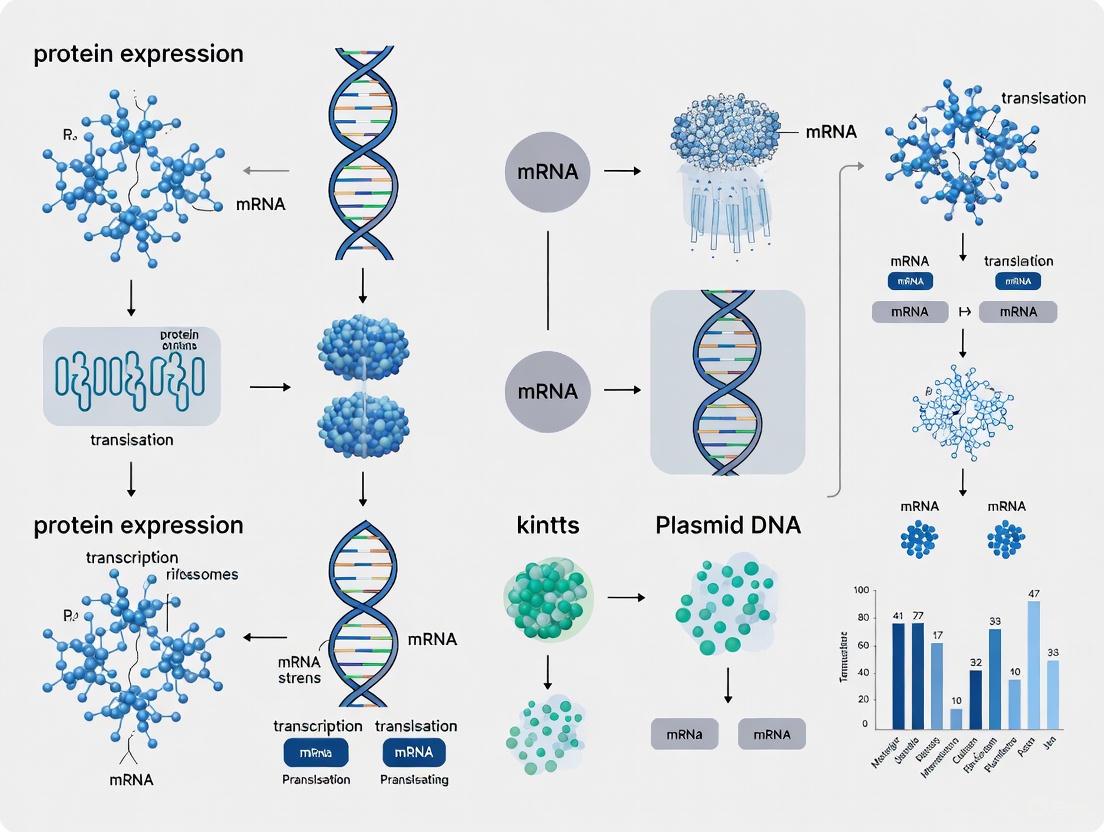
This article provides a comprehensive comparison of protein expression kinetics between mRNA and plasmid DNA (pDNA) technologies, tailored for researchers and drug development professionals.
mRNA vs. Plasmid DNA: A Comparative Analysis of Protein Expression Kinetics for Therapeutic Development
Abstract
This article provides a comprehensive comparison of protein expression kinetics between mRNA and plasmid DNA (pDNA) technologies, tailored for researchers and drug development professionals. It explores the foundational mechanisms that dictate the speed, magnitude, and duration of protein production, delving into methodological considerations for in vitro and in vivo applications. The content further addresses common challenges and optimization strategies for both platforms, including molecular engineering and advanced delivery systems. Finally, it offers a rigorous comparative analysis of key performance metrics to guide platform selection for vaccines, protein therapies, and gene editing, synthesizing the latest advances in this rapidly evolving field.
Core Mechanisms: How mRNA and pDNA Navigate the Cell to Produce Protein
The Central Dogma of molecular biology, describing the flow of genetic information from DNA to RNA to protein, provides the fundamental framework for nucleic acid-based therapeutics. This paradigm underpins the development of two powerful technological platforms: messenger RNA (mRNA) and plasmid DNA (pDNA) vaccines/therapeutics. While both platforms ultimately achieve protein expression to elicit immune responses or replace defective proteins, their molecular pathways, kinetics, and practical applications differ significantly. The choice between these platforms involves balancing factors such as expression kinetics, duration of protein production, immunogenicity, and stability profiles [1] [2].
Recent advances, particularly the successful deployment of mRNA vaccines during the COVID-19 pandemic, have intensified interest in optimizing these platforms. Meanwhile, DNA vaccines have re-emerged as a versatile and scalable platform thanks to advances in synthetic biology and delivery systems [1]. This review provides a systematic comparison of these platforms, focusing specifically on the kinetics of protein expression, with experimental data relevant to researchers and drug development professionals working in advanced therapies.
Molecular Pathways: From Administration to Protein Expression
The journey from administered nucleic acid to functional protein involves multiple critical steps, each with distinct characteristics for mRNA and pDNA platforms. The visualization below details these divergent pathways following intramuscular administration.
Figure 1. Comparative molecular pathways of LNP-delivered mRNA and plasmid DNA vaccines. The critical distinction lies in the subcellular site of initial processing: mRNA is directly translated in the cytoplasm, while pDNA requires nuclear entry for transcription before cytoplasmic translation. This fundamental difference underlies variations in expression kinetics and duration.
The divergent pathways illustrated above translate into significantly different expression kinetics profiles. mRNA platforms bypass the need for nuclear entry, enabling rapid onset of protein expression within hours of administration. In contrast, pDNA must navigate the additional barrier of nuclear entry, delaying the onset of protein expression but potentially extending its duration due to the relative stability of DNA compared to mRNA and the possibility of episomal persistence [1] [2].
Experimental Comparison: Direct Evaluation of Expression Kinetics and Immunogenicity
Methodology for Head-to-Head Comparison
A rigorous experimental approach is essential for direct comparison of these platforms. A 2023 study published in Vaccines provides a exemplary methodology for such comparative analysis [2]:
- Vector Design: Both mRNA and pDNA encoded firefly luciferase as the reporter gene, enabling quantitative measurement of protein expression through bioluminescence imaging.
- LNP Formulations: Three leading LNP formulations (SM-102, ALC-0315, and DLin-KC2-DMA) were used to encapsulate both nucleic acid types, maintaining identical lipid ratios and N/P (amine to phosphate) ratio of 6:1.
- In Vivo Model: Female BALB/c mice received intramuscular injections of equivalent nucleic acid doses.
- Expression Kinetics: Bioluminescence imaging was performed at the injection site and in the liver at multiple time points post-administration (4 hours to 14 days).
- Immunogenicity Assessment: Anti-luciferase IgG antibody titers were measured 14 days post-immunization as a surrogate for vaccine immunogenicity.
This controlled experimental design allows for direct comparison of the same antigen delivered by both platforms using identical delivery vehicles, providing particularly insightful data on kinetic differences.
Quantitative Comparison of Expression Kinetics and Performance
The experimental data reveals fundamental differences in the temporal expression profiles and functional characteristics of these platforms, summarized in the table below.
Table 1. Comparative performance of LNP-delivered mRNA versus plasmid DNA vaccines
| Parameter | mRNA-LNPs | Plasmid DNA-LNPs | Experimental Context |
|---|---|---|---|
| Onset of Expression | 4-8 hours | 24-48 hours | Intramuscular injection in mice [2] |
| Peak Expression | 8-24 hours | 48-96 hours | Intramuscular injection in mice [2] |
| Expression Duration | Short (days) | Extended (≥14 days) | Signal detection time course [2] |
| Thermal Stability | Limited (requires -20°C to -70°C) | High (stable at 2-8°C; can be lyophilized) | Storage condition requirements [1] |
| Relative Potency | Higher initial expression | Lower initial expression | Luminescence intensity at 24 hours [2] |
| Immunogenicity | Higher antibody titers | Lower antibody titers | Anti-luciferase IgG at 14 days [2] |
| Dosing Requirements | Lower doses effective | Potentially higher doses needed | Dose-response relationships [2] |
| Manufacturing Complexity | High (enzyme production) | Lower (bacterial fermentation) | Production process [1] |
The kinetic advantages of mRNA platforms for rapid protein production are clearly demonstrated in the experimental data, with mRNA-LNPs showing significantly earlier onset and higher peak expression levels. However, plasmid DNA platforms demonstrate advantages in expression duration and thermal stability, which present significant practical benefits for distribution and storage, particularly in resource-limited settings [1] [2].
The Scientist's Toolkit: Essential Research Reagents and Materials
Advancing nucleic acid-based therapeutics requires specialized reagents and materials optimized for each platform. The following table details essential components for researchers developing mRNA or pDNA-based expression systems.
Table 2. Essential research reagents and materials for nucleic acid-based expression systems
| Reagent/Material | Function | Platform | Specific Examples |
|---|---|---|---|
| Ionizable Lipids | Form LNPs for nucleic acid encapsulation and delivery | Both | SM-102, ALC-0315, DLin-KC2-DMA [2] |
| Structural Lipids | Provide structural integrity to nanoparticles | Both | DSPC, DOPC [2] |
| PEG-Lipids | Stabilize particles, prevent aggregation, modulate pharmacokinetics | Both | DMG-PEG 2000, ALC-0159 [2] |
| Specialized Plasmids | Serve as vectors for gene expression or as templates for in vitro transcription | Both | pVAX1 (clinical vector), pcDNA3 (research vector) [2] |
| In Vitro Transcription Kits | Produce high-quality mRNA from DNA templates | mRNA | TriLink Biotechnologies kits [2] |
| Electroporation Systems | Enhance cellular uptake of nucleic acids through electrical field application | DNA | CELLECTRA, TriGrid, DERMA VAX [1] |
| Nucleic Acid Purification Kits | Isolve high-purity nucleic acids for research or clinical applications | Both | EndoFree Plasmid Kits (pDNA), mRNA purification kits [2] |
| Nanoparticle Formulation Systems | Enable reproducible nanoparticle production through precise mixing | Both | NanoAssemblr systems [2] |
The selection of appropriate reagents is critical for optimizing both platform performance and practical implementation. For instance, the choice of ionizable lipid significantly impacts both the potency and the expression kinetics of LNP-delivered nucleic acids [2]. Similarly, delivery methods such as electroporation can dramatically enhance the immunogenicity of DNA vaccines by improving cellular uptake [1].
Current Landscape and Future Perspectives
Clinical and Commercial Applications
The current therapeutic landscape reflects the complementary strengths of both platforms. mRNA technology has demonstrated remarkable success in infectious disease vaccines and is now expanding into oncology applications. Recent clinical breakthroughs include mRNA-4157 combined with pembrolizumab in melanoma, which demonstrated a 44% reduction in recurrence risk compared to checkpoint inhibitor monotherapy [3]. Advancements in personalized cancer vaccines have shown promise even in challenging malignancies like pancreatic cancer, with vaccine-induced immune responses persisting for nearly four years in some patients [3].
DNA vaccine platforms, while historically considered less potent, have gained momentum with technological improvements. The 2021 approval of ZyCoV-D for COVID-19 marked a significant milestone, demonstrating the viability of DNA vaccines in humans [1]. Current innovations include self-amplifying DNA (saDNA), synthetic gene circuits, and DNA-encoded monoclonal antibodies (DMAbs), which enable programmable expression and robust immune activation [1]. These advances are particularly valuable for applications requiring repeated administration, such as in cancer immunotherapy, where DNA vaccines are typically less reactive than mRNA upon repeated dosing [1].
Manufacturing and Regulatory Considerations
Manufacturing considerations differ substantially between these platforms. mRNA production leverages in vitro transcription systems, enabling rapid production but requiring sophisticated enzyme systems and cold-chain logistics [1]. DNA vaccine manufacturing relies on bacterial fermentation for plasmid production, a more established and potentially lower-cost process [1]. The market for plasmid DNA manufacturing is experiencing dramatic growth, projected to expand from US$ 2.16 billion in 2025 to US$ 10.40 billion by 2033, achieving a CAGR of 21.71% [4].
Regulatory frameworks are evolving to accommodate these advanced platforms. The FDA's release of comprehensive guidance for therapeutic cancer vaccines in 2024 provides sponsors with detailed recommendations for Investigational New Drug applications [3]. Experts anticipate that the first commercial mRNA cancer vaccine could receive regulatory approval by 2029, marking a significant milestone in oncology [3].
The Central Dogma continues to provide the fundamental framework for understanding and engineering nucleic acid-based therapeutics. Both mRNA and plasmid DNA platforms offer distinct advantages rooted in their molecular biology: mRNA enables rapid, high-level protein expression ideal for situations requiring quick immune activation, while plasmid DNA provides extended expression duration and superior stability beneficial for applications requiring sustained protein production or deployment in resource-limited settings.
The choice between these platforms depends heavily on the specific therapeutic application, desired kinetic profile, and practical implementation requirements. Future developments in next-generation lipid nanoparticles, nucleic acid engineering, and manufacturing processes will likely further enhance both platforms, potentially expanding their applications across infectious diseases, oncology, genetic disorders, and beyond. As the field advances, the continued systematic comparison of these platforms will be essential for guiding therapeutic development and maximizing clinical impact.
The journey from genetic code to functional protein is a fundamental process in biology, governed by distinct cellular mechanisms with significant implications for research and therapeutic development. This pathway bifurcates at a critical juncture: nuclear transcription of DNA into messenger RNA (mRNA) versus direct cytoplasmic translation of exogenously delivered mRNA. Understanding the spatial separation and kinetic profiles of these processes is essential for designing effective genetic experiments and therapies. While endogenous gene expression requires nuclear transcription followed by cytoplasmic translation, emerging technologies utilizing in vitro transcribed (IVT) mRNA bypass the nuclear step entirely, enabling direct protein production in the cytoplasm [5] [6]. This distinction forms the basis for comparing plasmid DNA (pDNA) and mRNA as genetic tools, particularly within the context of protein expression kinetics—a crucial consideration for researchers and drug development professionals seeking optimal experimental outcomes.
Molecular Mechanisms and Cellular Geography
Nuclear Transcription: The DNA-Dependent Pathway
Nuclear transcription represents the initial phase of endogenous gene expression, occurring exclusively within the nuclear compartment. This complex process involves RNA polymerase II catalyzing the formation of a pre-mRNA molecule using DNA as a template [5]. The resulting transcript undergoes extensive processing—including 5' capping, splicing, and 3' polyadenylation—before achieving maturity [7]. A critical regulatory checkpoint occurs post-transcription, where mature mRNA must be exported from the nucleus to the cytoplasm through nuclear pore complexes (NPCs) [8]. Recent high-resolution studies reveal that this nucleo-cytoplasmic transport is not a passive bulk process but rather a highly regulated, gene-specific mechanism with kinetic parameters varying up to 100-fold between different transcripts [9]. The nuclear envelope thus constitutes a significant barrier, as pDNA-based expression requires not only plasma membrane and nuclear entry but also successful transcription before translation can commence [6].
Cytoplasmic Translation: The mRNA-Directed Pathway
Cytoplasmic translation represents the final common pathway for protein synthesis, where mature mRNA is decoded by ribosomes to assemble amino acid chains. This process occurs exclusively in the cytoplasm, where ribosomes reside as separate large and small subunits that join together on the mRNA molecule [5]. The translation machinery involves specialized RNA molecules—specifically ribosomal RNA (rRNA) and transfer RNA (tRNA)—that facilitate codon recognition and peptide bond formation [5]. Exogenously delivered mRNA bypasses nuclear dependency by leveraging this existing cytoplasmic machinery, translating immediately upon entering the cell [10] [6]. The efficiency of this process is significantly influenced by mRNA structural elements, including the 5' cap, untranslated regions (UTRs), open reading frame (ORF), and poly(A) tail, which collectively regulate ribosome recruitment, stability, and translational efficiency [10] [7].
Table 1: Key Characteristics of Nuclear Transcription vs. Cytoplasmic Translation
| Characteristic | Nuclear Transcription | Cytoplasmic Translation |
|---|---|---|
| Cellular Location | Nucleus | Cytoplasm |
| Template Molecule | DNA | mRNA |
| Primary Output | mRNA | Protein |
| Key Regulatory Steps | Transcription initiation, mRNA processing, nuclear export | Translation initiation, elongation, termination |
| Rate-Limiting Barriers | Nuclear envelope crossing | mRNA degradation, ribosome availability |
| Dependency on Cell Division | High (for pDNA) | None |
Visualizing the Cellular Journey of Genetic Information
The following diagram illustrates the distinct pathways for protein expression via nuclear transcription (pDNA) versus direct cytoplasmic translation (mRNA):
Kinetic Comparison: mRNA vs. Plasmid DNA
Temporal Dynamics of Protein Expression
The spatial separation of transcription and translation has profound implications for the kinetics of protein expression. mRNA-based delivery demonstrates significantly faster onset of protein production compared to pDNA approaches, primarily because it bypasses the rate-limiting nuclear barrier [6]. While pDNA must undergo nuclear import and transcription before translation commences—processes that can take hours to days—mRNA is immediately available for cytoplasmic translation upon cellular entry [11]. This temporal advantage is particularly valuable in applications requiring rapid protein production, such as vaccine development or transient gene editing. Quantitative studies reveal that mRNA can achieve detectable protein levels within hours post-delivery, whereas pDNA typically requires 24-48 hours to reach peak expression [11]. Furthermore, mRNA exhibits a linear dose-response relationship with protein output across five orders of magnitude, providing researchers with precise control over expression levels, unlike the amplification effect often observed with DNA due to its transcription-translation cascade [11].
Efficiency and Throughput Considerations
The efficiency of nuclear transport represents a major bottleneck for pDNA-based expression. Research indicates that the effective chromatin-to-cytoplasm export rate is highly gene-specific, varying up to 100-fold between different transcripts [9]. For some genes, less than 5% of synthesized transcripts successfully arrive in the cytoplasm as mature mRNAs, while others show high export efficiency [9]. This nuclear retention mechanism serves as a regulatory checkpoint to fine-tune mRNA translation in the cytoplasm [12]. In contrast, mRNA delivery completely circumvents this bottleneck, ensuring more predictable and consistent protein yields across different cell types [6]. The efficiency advantage of mRNA is particularly pronounced in non-dividing primary cells, where nuclear entry of pDNA is severely limited due to the intact nuclear envelope [10] [6]. Studies demonstrate that mRNA enables effective protein expression in difficult-to-transfect cell types such as dendritic cells, neurons, and stem cells, where pDNA approaches typically fail [6] [11].
Table 2: Kinetic Parameters of mRNA vs. pDNA Protein Expression
| Parameter | mRNA | pDNA |
|---|---|---|
| Time to Detectable Protein | 1-4 hours | 12-48 hours |
| Peak Expression Time | 4-24 hours | 24-72 hours |
| Expression Duration | Transient (hours to days) | Sustained (days to weeks) |
| Nuclear Dependency | None | Required |
| Cell Cycle Dependency | None | High |
| Dose-Protein Relationship | Linear | Amplified |
| Efficiency in Non-Dividing Cells | High | Low |
Experimental Evidence and Methodological Approaches
Subcellular Fractionation Studies
Advanced subcellular transcriptomics has provided compelling experimental evidence for the distinct localization patterns of RNA species. Research utilizing cellular fractionation followed by RNA sequencing demonstrates that protein-coding genes distribute differently between nuclear and cytosolic fractions, with specific functional categories enriched in each compartment [13] [12]. For instance, transcripts encoding nuclear-encoded mitochondrial proteins show significant enrichment in the cytosol compared to other protein-coding genes [12]. These studies employ meticulous fractionation protocols beginning with cell lysis using mild detergents, followed by differential centrifugation to separate nuclear and cytoplasmic components [12]. RNA integrity is carefully preserved throughout the process, and fraction purity is validated using marker genes with known localization patterns, such as MALAT1 (nuclear) and GAPDH (cytoplasmic) [12]. This methodological approach enables researchers to quantify compartment-specific transcript abundance and calculate nuclear export efficiencies on a genomic scale.
Mathematical Modeling of mRNA Export Kinetics
Sophisticated mathematical modeling approaches have been developed to parameterize the kinetic constants governing mRNA transport from chromatin to cytoplasm. Researchers have generated high spatio-temporal resolution RNA-seq data from stimulated cells and implemented computational models to infer export rates with statistical confidence intervals [9]. A typical workflow involves measuring mRNA abundance in chromatin-associated, nucleoplasmic, and cytoplasmic fractions across multiple time points, then fitting these data to a mechanistic model that describes the flux between compartments [9]. The model typically includes parameters for the fractional appearance rate of mRNA in the nucleoplasm (k1'), disappearance rate from the nucleoplasm (k2), nucleoplasm-to-cytoplasm transport rate (k2'), and cytoplasmic decay rate (kcyto_deg) [9]. This methodology has revealed that mRNA export rates vary approximately 100-fold among genes and that these rates complement the wide range of mRNA decay rates to ensure appropriate abundances of short- and long-lived mRNAs [9].
The following diagram illustrates the experimental workflow for quantifying mRNA export kinetics:
Practical Applications and Research Implications
Advantages for Specific Research Applications
The choice between mRNA and pDNA delivery systems carries significant practical implications for experimental design and outcome interpretation. mRNA offers distinct advantages for applications requiring rapid protein expression, precise temporal control, or work with hard-to-transfect cells [6] [11]. Its cytoplasmic activity makes it particularly suitable for primary cells, neurons, dendritic cells, and other non-dividing cell types that resist pDNA transfection [6]. Additionally, the transient nature of mRNA expression—typically lasting from hours to a few days—is ideal for studying proteins with potent or toxic effects, as the expression window is naturally limited [11]. In contrast, pDNA may be preferred for long-term stable expression, such as in the generation of stable cell lines or for proteins requiring sustained presence for functional analysis [6]. The non-integrating nature of mRNA also eliminates risks of insertional mutagenesis, making it safer for therapeutic applications [10] [7].
Implications for Drug Development and Therapeutics
The kinetic advantages of mRNA have profound implications for therapeutic development, particularly in vaccines and protein replacement therapies. mRNA-based vaccine platforms benefit from rapid antigen expression, which promotes timely immune activation [7]. The modifiable immunogenicity of mRNA allows researchers to either enhance immune responses for vaccination or minimize them for protein replacement applications [7]. Recent advances in nucleotide modification—such as incorporating pseudouridine or 5-methylcytidine—have significantly reduced innate immune recognition while enhancing translational efficiency and mRNA stability [10] [7]. Additionally, optimization of structural elements including 5' and 3' UTRs, codon usage, and poly(A) tail length has extended mRNA half-life from minutes to several hours, further improving its therapeutic potential [10]. These developments position mRNA as a versatile tool for diverse clinical applications, from cancer immunotherapy to treatment of monogenic diseases [7].
The Scientist's Toolkit: Essential Research Reagents
Table 3: Key Research Reagents for mRNA and pDNA Studies
| Reagent Category | Specific Examples | Research Function |
|---|---|---|
| mRNA Cap Analogs | Anti-reverse cap analogs (ARCA), CleanCap | Enhance translation initiation and mRNA stability [10] |
| Nucleotide Modifications | Pseudouridine (Ψ), 5-methylcytidine, N6-methyladenosine | Reduce immunogenicity, increase translation efficiency [10] [7] |
| In Vitro Transcription Kits | T7 polymerase-based systems | Produce high-quality mRNA with reduced double-stranded RNA contaminants [7] |
| Delivery Vehicles | Lipid nanoparticles (LNPs), cationic polymers | Facilitate cellular uptake and endosomal escape of nucleic acids [10] [7] |
| Subcellular Fractionation Kits | Cytoplasmic/nuclear separation kits | Isolate compartment-specific RNA for export studies [12] |
| pDNA Purification Systems | Miniprep, maxiprep kits | Produce high-quality, endotoxin-free plasmid DNA [6] |
The cellular journey and site of action fundamentally differentiate cytoplasmic translation from nuclear transcription, with significant consequences for the kinetics and efficiency of protein expression in research and therapeutic contexts. mRNA-based approaches offer distinct advantages in speed, predictability, and applicability to diverse cell types, while pDNA enables sustained expression valuable for long-term studies. The choice between these systems should be guided by experimental requirements, considering temporal parameters, target cell characteristics, and desired expression profiles. As nucleic acid technologies continue to evolve, understanding these fundamental biological pathways will remain essential for designing effective genetic research strategies and developing next-generation genetic medicines.
The choice between messenger RNA (mRNA) and plasmid DNA (pDNA) as a genetic vector is a fundamental decision in biological research and therapeutic development, with profound implications for experimental outcomes and therapeutic efficacy. A critical differentiator lies in their distinct kinetic profiles for protein expression—the timing of onset, the magnitude of peak expression, and the duration of protein production. This guide provides an objective, data-driven comparison of these kinetic parameters, equipping researchers with the evidence needed to select the optimal platform for their specific application, whether it requires rapid, transient expression or sustained, long-term production.
Direct Comparison of Kinetic Parameters
The table below summarizes the core kinetic characteristics of mRNA and pDNA, based on direct comparative studies and platform-specific data.
Table 1: Comparative Kinetic Profiles of mRNA and pDNA Platforms
| Kinetic Parameter | mRNA-Based Expression | Plasmid DNA (pDNA)-Based Expression |
|---|---|---|
| Onset of Expression | Rapid (hours post-transfection) [14] [6] | Delayed (requires nuclear entry) [14] [15] |
| Peak Expression | Short, high burst; typical peak protein expression at ~24 hours post-transfection [14] [16] | Slower accumulation; timing is cell-type and delivery dependent [15] |
| Duration of Expression | Transient (typically days) [14] [7] [16] | Sustained (can last weeks to months) [14] [15] |
| Cellular Site of Transcription/Translation | Cytoplasm [14] [6] | Nucleus (transcription) & Cytoplasm (translation) [14] |
| Key Regulatory Step | Endosomal escape & translation efficiency [14] [17] | Nuclear entry & transcription [14] [15] |
| Typical Expression Kinetics | Fast onset, sharp peak, rapid decline [14] | Slower onset, broader peak, prolonged tail [18] |
Underlying Mechanisms and Experimental Evidence
The divergent kinetic profiles of mRNA and pDNA are a direct consequence of their distinct journeys inside the cell. The following diagram illustrates the key pathways and bottlenecks for each platform.
Diagram 1: Intracellular pathways for mRNA and pDNA. The mRNA pathway (green) is direct and fast, while the pDNA pathway (red) has two major bottlenecks (yellow) leading to delayed onset but potential for sustained expression.
The mRNA Kinetic Profile: A Rapid, Transient Burst
The mRNA platform is characterized by a swift and transient kinetic profile. Upon delivery, typically via lipid nanoparticles (LNPs), the mRNA is released directly into the cytoplasm where it is immediately translated by ribosomes, bypassing the need for nuclear entry [14] [6]. This direct access to the translational machinery leads to a rapid onset of protein synthesis, often within a few hours.
Key Experimental Evidence:
- Imaging Studies: Research using Positron Emission Tomography (PET/CT) to monitor mRNA vaccine antigen expression in vivo has demonstrated detectable protein expression at the injection site and draining lymph nodes within 24 hours of intramuscular administration in mice. This expression was notably transient, returning to background levels within a few days [16].
- Expression Dynamics: A comparative biodistribution study highlighted a fundamental difference: while mRNA-LNPs show a sharp peak of luciferase expression that wanes to baseline, DNA-LNPs can exhibit a rebound in signal, with expression persisting in the muscle through 40 days post-immunization [18].
The pDNA Kinetic Profile: A Delayed but Sustained Output
In contrast, pDNA kinetics are defined by a delayed onset but a potentially much longer duration. The primary bottleneck is the requirement for the plasmid to traverse the cytoplasm and enter the nucleus for transcription [14] [15]. This nuclear import is inefficient and rate-limiting, particularly in non-dividing cells. However, once inside the nucleus, the plasmid can persist as an episomal element, providing a stable template for continuous transcription over an extended period.
Key Experimental Evidence:
- Long-Term Expression: The stability of plasmid DNA in vivo is a key advantage, with studies noting that DNA is known to be stable for over six months [14]. This inherent stability underpins the potential for sustained antigen expression, which is a valuable feature for certain therapeutic vaccines or gene therapy applications where long-term protein production is desired.
- Delivery Dependency: The efficiency and kinetics of pDNA expression are highly dependent on the delivery method. Advanced techniques like in vivo electroporation significantly enhance nuclear uptake, thereby improving the magnitude and consistency of the immune response [15]. Without such methods, protein yield can be low and variable.
Detailed Experimental Protocols
To ground this comparison in practical science, below are detailed methodologies for key experiments used to generate the kinetic data discussed.
Protocol: Longitudinal Monitoring of mRNA Expression In Vivo Using PET/CT
This protocol is adapted from a study that used a PET reporter gene to non-invasively track mRNA vaccine antigen expression over time [16].
Table 2: Key Research Reagents for PET/CT mRNA Tracking
| Item | Function in the Experiment |
|---|---|
| mRNA-LNP | Formulation containing mRNA encoding the antigen of interest (e.g., SARS-CoV-2 spike) fused to a PET reporter gene (e.g., eDHFR). |
| eDHFR PET Reporter | Mutant E. coli dihydrofolate reductase; a small, monomeric protein that binds tightly and specifically to the radiotracer [16]. |
| [[18F]FP-TMP Radiotracer | A positron-emitting small molecule that acts as the imaging agent by binding to the eDHFR reporter. |
| PET/CT Scanner | Instrumentation for obtaining 3D, quantitative images of radiotracer distribution in the whole body. |
Workflow:
- Genetic Construct Preparation: Genetically fuse the PET reporter gene (e.g., eDHFR) to the C-terminus of the target antigen cDNA within the plasmid template for IVT mRNA production.
- mRNA-LNP Formulation: Produce the mRNA encoding the fusion protein via in vitro transcription and encapsulate it into LNPs.
- Animal Vaccination: Administer the mRNA-LNPs to animal models (e.g., mice or non-human primates) via the intended route (e.g., intramuscular injection).
- PET/CT Imaging:
- At selected time points (e.g., Day 1, 3, 7 post-injection), inject the animal with the [[18F]FP-TMP] radiotracer.
- Perform whole-body PET/CT imaging under anesthesia.
- Draw 3D regions of interest (ROIs) over relevant tissues (injection site, draining lymph nodes) and quantify radiotracer uptake using the Standard Uptake Value (SUV).
- Data Analysis: Plot the SUV over time to generate a kinetic curve of antigen expression, defining the onset, peak, and duration.
Diagram 2: PET/CT workflow for mRNA expression tracking.
Protocol: Comparative Kinetic Analysis Using Bioluminescent Imaging
This protocol leverages luciferase reporters to directly compare the expression kinetics of mRNA and pDNA in live animals [18].
Table 3: Key Research Reagents for Bioluminescence Imaging
| Item | Function in the Experiment |
|---|---|
| Luciferase-Encoding Vectors | Both mRNA-LNPs and pDNA vectors containing the firefly luciferase (Luc) gene. |
| Bioluminescence Imager | An optical imaging system that detects low-light emissions from living tissues. |
| D-Luciferin Substrate | The injectable compound that is metabolized by the luciferase enzyme to produce light. |
Workflow:
- Vector Preparation: Prepare matched formulations of Luc-encoding mRNA-LNPs and pDNA. The pDNA may be delivered naked or with a transfection-enhancing agent.
- Animal Injection: Divide animals into groups and administer each vector formulation via the same route (e.g., intramuscular).
- Longitudinal Imaging:
- At multiple time points post-injection (e.g., 4h, 24h, 3d, 7d, 14d, 40d), inject animals with D-luciferin.
- Acquire bioluminescent images using the imager.
- Quantify the total photon flux within a standardized ROI at the injection site.
- Comparative Analysis: Plot the bioluminescence signal intensity for each vector group over time on the same graph. This visually and quantitatively reveals differences in the onset, peak magnitude, and duration of protein expression between the mRNA and pDNA platforms.
The Scientist's Toolkit
Successful investigation of protein expression kinetics relies on a suite of specialized reagents and technologies.
Table 4: Essential Research Reagent Solutions for Kinetic Studies
| Category / Item | Specific Examples / Formats | Critical Function |
|---|---|---|
| Delivery Vectors | Lipid Nanoparticles (LNPs), Cationic polymers, Electroporation systems | Protect nucleic acids and facilitate cellular uptake. Ionizable lipids in LNPs are critical for endosomal escape [14] [15]. |
| Reporters for Quantification | Firefly Luciferase, eDHFR, Fluorescent Proteins (eGFP, mCherry) | Enable sensitive detection and measurement of protein expression in real-time, both in vitro and in vivo. |
| Nucleotide Modifications | N1-methylpseudourine (m1Ψ), 5-methylcytidine | For mRNA: reduce innate immunogenicity and enhance translational efficiency [7]. |
| Advanced Plasmid Backbones | Nanoplasmid vectors, Self-amplifying DNA (saDNA) | For pDNA: improve nuclear entry, enhance expression levels, and prolong duration [15]. |
| In Vivo Imaging Systems | PET/CT, Bioluminescence/Xenogen Imagers | Allow non-invasive, longitudinal tracking of gene expression in live animal models [16]. |
The mammalian innate immune system serves as the first line of defense against pathogenic invasion, employing a sophisticated array of germ line-encoded pattern recognition receptors (PRRs) to detect conserved molecular structures known as pathogen-associated molecular patterns (PAMPs) [19]. In the context of nucleic acid-based technologies, including plasmid DNA (pDNA) and messenger RNA (mRNA) vaccines or therapeutics, these PRRs primarily recognize foreign nucleic acids that enter cells during administration [20]. The Toll-like receptor (TLR) and retinoic acid-inducible gene-I (RIG-I)-like receptor (RLR) families represent two major classes of PRRs that detect exogenous nucleic acids in different cellular compartments and activate specific signaling pathways to initiate immune responses [19] [21]. Understanding these recognition mechanisms is crucial for developing effective pDNA and mRNA-based applications, as the immunostimulatory properties of these nucleic acids can both enhance vaccine efficacy through adjuvant effects and hinder therapeutic protein expression by triggering antiviral responses [22] [23].
Table 1: Major Nucleic Acid-Sensing Pathways in Innate Immunity
| Receptor Family | Specific Receptors | Location | Ligands | Adaptor Proteins | Key Transcription Factors Activated |
|---|---|---|---|---|---|
| Toll-like Receptors (TLRs) | TLR3 | Endosome | Double-stranded RNA (dsRNA) | TRIF | IRF3, NF-κB |
| TLR7/TLR8 | Endosome | Single-stranded RNA (ssRNA) | MyD88 | IRF5/7, NF-κB | |
| TLR9 | Endosome | Unmethylated CpG DNA | MyD88 | IRF7, NF-κB | |
| RIG-I-like Receptors (RLRs) | RIG-I | Cytoplasm | Short dsRNA with 5'-triphosphate | MAVS (IPS-1) | IRF3, NF-κB |
| MDA5 | Cytoplasm | Long dsRNA | MAVS (IPS-1) | IRF3, NF-κB | |
| LGP2 | Cytoplasm | RNA (regulatory role) | - | - |
TLR Pathways: Endosomal Nucleic Acid Recognition
Toll-like receptors represent a class of transmembrane innate immune receptors that are evolutionarily conserved and localize to intracellular compartment membranes, particularly endosomes [20]. These receptors are characterized by three major domains: leucine-rich repeats (LRRs) in the ectodomain that mediate PAMP recognition, a transmembrane domain, and an intracellular Toll/IL-1 receptor (TIR) domain required for initiating downstream signaling [19]. The nucleic acid-sensing TLRs include TLR3, TLR7, TLR8, and TLR9, which recognize viral and bacterial cytosolic components including nonmethylated CpG DNA and single- and double-stranded RNA [20].
All nucleic acid-sensing TLRs are synthesized in the endoplasmic reticulum and transported to endosomes via the canonical secretory pathway, with Unc93B1 serving as an essential trafficking molecule for their differential transport [20]. The activation of these TLRs is restricted to endosomal compartments, providing a strategic mechanism for cells to recognize and sequester pathogens without risking infection [20]. Upon binding to their respective nucleic acid ligands, TLRs form homodimers or heterodimers, bringing their intracellular TIR domains into close proximity to activate downstream signal transduction pathways [19] [20].
TLR3 recognizes double-stranded RNAs (dsRNAs) larger than 40 bp that are released during RNA virus replication [20]. The TLR3-induced response intensity increases with dsRNA length, though the molecular mechanism behind this length dependency remains unclear [20]. Following ligand binding, TLR3 homodimers directly recruit the adaptor protein TRIF (TIR-domain-containing adapter-inducing interferon-β), leading to the activation of both NF-κB and IRF3 transcription factors and subsequent production of type I interferons and inflammatory cytokines [19].
TLR7 and TLR8 specifically recognize single-stranded RNA (ssRNA) in endosomes, with TLR7 preferentially binding guanosine-rich sequences and TLR8 showing preference for uridine-rich motifs [20]. TLR9 detects single-stranded DNA containing unmethylated CpG sequences commonly found in bacterial and viral DNA [20]. Unlike TLR3, TLR7, TLR8, and TLR9 signaling occurs through the adaptor protein MyD88 (myeloid differentiation primary response 88), which triggers signaling cascades leading to the activation of NF-κB and IRF7 transcription factors [19] [20].
Figure 1: TLR Pathways for Nucleic Acid Recognition. Nucleic acids (ssRNA, dsRNA, CpG DNA) are recognized in endosomes by specific TLRs (TLR7/8, TLR3, TLR9), which recruit adaptor proteins (MyD88, TRIF) to activate transcription factors (NF-κB, IRF3/7) that induce cytokine and type I interferon production.
RLR Pathways: Cytosolic RNA Sensing
The RIG-I-like receptor (RLR) family comprises cytosolic RNA sensors that include three members: RIG-I (retinoic acid-inducible gene I), MDA5 (melanoma differentiation-associated protein 5), and LGP2 (laboratory of genetics and physiology 2) [24]. All RLRs are located primarily in the cytosol and contain a central helicase domain and a carboxy-terminal domain (CTD), with RIG-I and MDA5 additionally harboring two N-terminal caspase activation and recruitment domains (CARDs) that mediate downstream signal transduction [24]. These sensors detect RNA species derived from viruses in the cytoplasm and coordinate anti-viral programs via type I interferon induction [19].
RIG-I plays essential roles in innate antiviral immunity by specifically detecting short double-stranded RNAs with specific molecular features, including 5'-diphosphate or 5'-triphosphate ends and lacking ribose 2'-O-methylation [24]. This specificity is primarily controlled by the CTD of RIG-I, which recognizes the 5'-pp/5'-ppp moiety, providing a strategic mechanism for self/nonself discrimination as 5'-ppp dsRNA is typically produced during viral replication but not present in host RNA, which features 5'-cap structures [24]. Upon binding to its RNA ligands, RIG-I undergoes conformational changes that enable its CARD domains to interact with the downstream adaptor protein MAVS (mitochondrial antiviral signaling protein, also known as IPS-1, Cardif, or VISA) [19] [24].
MDA5 differs from RIG-I in its ligand specificity, as it does not require triphosphate ends of RNA but instead preferentially senses longer dsRNAs (typically >500 bp in length) [24]. Similar to RIG-I, MDA5 activates the MAVS signaling pathway upon ligand binding. LGP2, which lacks CARD domains, is generally believed to function as a regulator of RIG-I and MDA5 rather than a direct signaling molecule [24].
Following RNA recognition and subsequent activation, both RIG-I and MDA5 interact with MAVS located on mitochondrial membranes, leading to MAVS oligomerization and the formation of functional prion-like aggregates [24]. This activated MAVS complex then recruits additional signaling proteins, including TRAF family members, which ultimately activate the IKK complex and TBK1/IKKε kinases [24]. These kinases phosphorylate and activate IRF3 and IRF7 transcription factors, as well as NF-κB, leading to the induction of type I interferons and proinflammatory cytokines [19] [24].
Figure 2: RLR Pathways for Cytosolic RNA Sensing. Short dsRNA with 5'-triphosphate activates RIG-I, while long dsRNA activates MDA5 in the cytosol. Both sensors signal through MAVS to activate TBK1/IKKε and IKK complexes, leading to IRF3/7 and NF-κB activation and subsequent type I interferon and cytokine production.
Comparative Recognition of pDNA and mRNA by Innate Immune Receptors
Plasmid DNA Recognition
Plasmid DNA (pDNA) contains unmethylated CpG motifs that are predominantly recognized by TLR9 in endosomal compartments [20]. Following cellular uptake, pDNA must reach the endosomal compartment where proteolytically processed TLR9 can detect these CpG motifs [20]. TLR9 activation triggers the MyD88-dependent signaling pathway, leading to the production of proinflammatory cytokines and type I interferons [19]. Additionally, cytosolic DNA sensors, including cGAS (cyclic GMP-AMP synthase), may detect pDNA that escapes into the cytoplasm, resulting in STING-dependent type I interferon production, though this pathway is less characterized for pDNA recognition compared to viral DNA sensing [20].
mRNA Recognition
In contrast to pDNA, mRNA is primarily recognized by TLR3, TLR7, and TLR8 in endosomal compartments, as well as RIG-I and MDA5 in the cytoplasm [19] [24]. The specific recognition depends on mRNA structure and localization. Double-stranded RNA contaminants or secondary structures in mRNA preparations can activate TLR3 in endosomes and MDA5 in the cytoplasm, while single-stranded mRNA is primarily detected by TLR7/TLR8 and RIG-I [19] [20] [24]. Importantly, RIG-I specifically recognizes RNA with 5'-triphosphate groups, which are present in in vitro transcribed (IVT) mRNA but typically absent from processed eukaryotic mRNA [24].
Table 2: Innate Immune Recognition Profiles of pDNA versus mRNA
| Feature | Plasmid DNA (pDNA) | In Vitro Transcribed mRNA |
|---|---|---|
| Primary TLR Sensors | TLR9 (endosomal) | TLR3 (dsRNA), TLR7/8 (ssRNA) |
| Primary Cytosolic Sensors | cGAS (potential) | RIG-I, MDA5 |
| Key Molecular Patterns | Unmethylated CpG motifs | 5'-triphosphate, dsRNA structures, single-stranded regions |
| Signaling Adaptors | MyD88 (TLR9) | MyD88 (TLR7/8), TRIF (TLR3), MAVS (RIG-I/MDA5) |
| Transcription Factors Activated | NF-κB, IRF7 | NF-κB, IRF3, IRF7 |
| Immune Output | Proinflammatory cytokines, type I IFN | Proinflammatory cytokines, type I/III IFN |
| Strategies to Reduce Recognition | CpG depletion | Nucleoside modification (e.g., pseudouridine, m1Ψ), HPLC purification to remove dsRNA |
Impact on Protein Expression Kinetics and Duration
The innate immune recognition of pDNA and mRNA significantly influences both the kinetics and duration of protein expression, which has profound implications for their therapeutic applications. Plasmid DNA typically demonstrates delayed but prolonged protein expression profiles. After cellular delivery, pDNA must traffic to the nucleus for transcription, creating an initial lag in protein production [22]. However, once established, pDNA can persist in a non-integrated form for extended periods, with studies demonstrating persistence in muscle tissue for up to six months, resulting in sustained protein expression [22]. This prolonged expression makes pDNA particularly suitable for applications requiring durable protein production, such as certain gene therapies and vaccination approaches where extended antigen presentation is desirable.
In contrast, mRNA exhibits rapid but transient protein expression characteristics. Since mRNA functions in the cytoplasm without requiring nuclear entry, protein translation can commence almost immediately after cellular delivery [22] [23]. However, the inherent instability of mRNA and its recognition by cytoplasmic RNA sensors limit its intracellular half-life, typically resulting in protein expression that peaks within 24-48 hours and diminishes rapidly thereafter [22] [23]. This transient expression profile is advantageous for vaccination strategies, as it provides sufficient antigen to prime immune responses while minimizing persistent antigen exposure that could lead to T cell exhaustion or tolerance [22].
The recognition of these nucleic acids by innate immune sensors directly impacts their expression kinetics. For pDNA, TLR9 activation can potentially inhibit transgene expression through the induction of inflammatory cytokines and interferons that create an antiviral state in target cells [19] [20]. Similarly, for mRNA, activation of TLR3, TLR7/8, and RLRs can suppress translation initiation and promote RNA degradation pathways, significantly reducing protein yield [23] [25]. These inhibitory effects present major challenges for nucleic acid-based therapies where high-level protein expression is desired, necessitating strategies to minimize innate immune recognition while maintaining biological activity.
Experimental Approaches for Studying Nucleic Acid Sensing
In Vitro Transfection Models
In vitro transfection systems provide controlled environments for studying innate immune responses to pDNA and mRNA. For investigating TLR-mediated recognition, human peripheral blood mononuclear cells (PBMCs) or specific immune cell types such as plasmacytoid dendritic cells (which highly express TLR7 and TLR9) can be transfected with pDNA or mRNA using lipid-based transfection reagents that facilitate endosomal delivery [20]. The subsequent production of cytokines (e.g., IFN-α, IL-6, TNF) can be quantified by ELISA or multiplex cytokine arrays to assess TLR activation [20]. To specifically study RLR signaling, immortalized cell lines such as HEK293T cells, which can be engineered to express RLR pathway components, are commonly transfected with mRNA using reagents that promote cytosolic delivery [24]. Readouts include luciferase reporter assays under the control of interferon-stimulated response elements (ISRE) or interferon-beta promoters, which provide sensitive measurements of RLR pathway activation [24].
In Vivo Delivery Methods and Immune Monitoring
Animal models, particularly C57BL/6 mice, are widely used to evaluate innate immune responses to pDNA and mRNA in physiologically relevant contexts [26]. Common administration routes include intramuscular injection and intradermal delivery, with the latter providing enhanced access to antigen-presenting cells in the skin [27]. For pDNA delivery, electroporation following injection significantly enhances cellular uptake and subsequent immune responses [27]. For mRNA, lipid nanoparticle (LNP) formulations represent the gold standard for in vivo delivery, protecting mRNA from degradation and promoting cellular uptake [25] [26].
Comprehensive immune monitoring following nucleic acid administration typically includes multiparametric flow cytometry of draining lymph nodes and spleen to assess immune cell activation (e.g., CD86 upregulation on dendritic cells), serum cytokine profiling, and quantification of antigen-specific T and B cell responses [26]. To delineate specific sensing pathways, knockout mouse models (e.g., TLR3/7/9-deficient, MAVS-deficient, or cGAS-deficient mice) provide powerful tools for determining the contributions of individual receptors to the overall immune response [26].
Table 3: Key Methodologies for Evaluating Innate Immune Recognition
| Methodology | Application | Key Readouts | Considerations |
|---|---|---|---|
| In Vitro PBMC Transfection | Screening TLR activation by nucleic acids | Cytokine production (IFN-α, TNF, IL-6) | Primary cells reflect human immunobiology; donor variability |
| Reporter Assays (ISRE-luciferase) | Quantifying RLR and TLR signaling pathways | Luciferase activity | Highly sensitive; amenable to high-throughput screening |
| Mouse Immunization Models | Evaluating integrated immune responses in vivo | Cell activation markers, cytokine production, germinal center formation | Physiological relevance; requires specialized facilities |
| Knockout Mouse Studies | Defining specific sensing pathways | Comparative immune responses in wildtype vs knockout mice | Mechanistic insights; possible compensatory pathways |
| Ribosome Profiling (Ribo-seq) | Assessing translational efficiency of modified mRNA | Reads per kilobase per million (RPKM) | Genome-wide translation measurement; complex data analysis |
The Scientist's Toolkit: Key Research Reagents
Table 4: Essential Research Tools for Nucleic Acid Sensing Studies
| Category | Specific Reagents | Research Application | Key Function |
|---|---|---|---|
| TLR Inhibitors | Chloroquine, ODN TTAGGG (TLR9 inhibitor), IRS954 (TLR7/9 inhibitor) | Inhibiting endosomal TLR signaling | Blocks acidification of endosomes or directly antagonizes TLRs |
| Cytokine Detection | ELISA kits (IFN-α, IFN-β, TNF, IL-6), Luminex multiplex arrays | Quantifying innate immune activation | Measures cytokine secretion following nucleic acid recognition |
| Reporter Systems | ISRE-luciferase, IFN-β-promoter-luciferase constructs | Monitoring pathway activation | Sensitive quantification of IFN pathway activation |
| Modified Nucleotides | N1-methylpseudouridine (m1Ψ), Pseudouridine (Ψ), 5-methylcytidine | Reducing mRNA immunogenicity | Decreases recognition by TLRs and RLRs while enhancing translation |
| Delivery Systems | Cationic liposomes, Lipid nanoparticles (LNPs), Electroporation systems | Efficient nucleic acid delivery | Enhances cellular uptake and targets specific compartments |
| Animal Models | TLR knockout mice, MAVS knockout mice, MYD88 knockout mice | Defining in vivo sensing pathways | Determines contribution of specific receptors to immune responses |
The innate immune recognition of pDNA and mRNA through TLR and RLR pathways represents a critical determinant of the efficacy, safety, and application suitability of nucleic acid-based technologies. pDNA is primarily sensed by TLR9 in endosomal compartments, triggering MyD88-dependent signaling that leads to type I interferon and inflammatory cytokine production. In contrast, mRNA is recognized by multiple receptors including TLR3, TLR7/8 in endosomes and RIG-I/MDA5 in the cytoplasm, activating both MyD88/TRIF and MAVS signaling pathways. These distinct recognition patterns contribute to characteristically different protein expression kinetics—prolonged for pDNA versus rapid but transient for mRNA. Understanding these pathways has enabled the development of strategic modifications, such as CpG depletion for pDNA and nucleoside modifications (e.g., N1-methylpseudouridine) for mRNA, which mitigate unwanted immune recognition while maintaining biological activity. As nucleic acid therapies continue to evolve, precise manipulation of these innate immune interactions will remain essential for optimizing their performance for specific applications ranging from prophylactic vaccines to therapeutic protein replacement.
From Bench to Bedside: Practical Applications and Delivery Workflows
For researchers developing nucleic acid-based vaccines or therapies, the choice between plasmid DNA (pDNA) and messenger RNA (mRNA) is fundamental. This guide provides an objective comparison of their performance, focusing on the critical differences in protein expression kinetics, stability, and immunogenicity to inform your experimental design.
The table below summarizes the core characteristics of each platform based on current literature.
Table 1: Fundamental Characteristics of pDNA and mRNA Platforms
| Feature | Plasmid DNA (pDNA) | Messenger RNA (mRNA) |
|---|---|---|
| Mechanism of Action | Requires nuclear entry for transcription into mRNA, then cytoplasmic translation into protein [1]. | Direct cytoplasmic translation into protein; no nuclear entry required [28] [1] [10]. |
| Onset of Protein Expression | Delayed onset [28]. | Rapid onset [28]. |
| Duration of Protein Expression | Longer-lasting (persists in muscle for months in a non-integrated form) [22] [28]. | Transient (half-life can be modulated from minutes to several hours) [1] [10]. |
| Delivery Target | Nucleus [1]. | Cytoplasm [28] [1]. |
| Stability & Storage | High intrinsic stability; typically stable at 2–8 °C; suitable for lyophilization [1]. | Lower inherent stability; often requires ultra-cold storage (e.g., -20°C to -70°C) [1]. |
| Primary Immune Response | Induces both cellular and humoral responses; often Th1-biased [1]. | Strong inducer of both humoral and cellular immunity [1]. |
| Innate Immune Stimulation | Can be engineered to include immunostimulatory sequences (e.g., CpG motifs) [22]. | Innately immunogenic; self-adjuvanting properties can be modulated with nucleoside modifications [22] [10]. |
| Risk of Genomic Integration | Very low risk with modern, non-integrating plasmid vectors [1]. | No risk of integration; mRNA is transient and degraded by normal cellular processes [1] [10]. |
Kinetic Profiles of Protein Expression: A Data-Driven Comparison
The temporal profile of antigen production is a critical differentiator. The experimental data below highlight the distinct kinetic behaviors of pDNA and mRNA, which directly influence their application in basic research and clinical development.
Table 2: Experimental Kinetic Data for pDNA and mRNA Protein Expression
| Parameter | pDNA | mRNA | Experimental Context & Implications |
|---|---|---|---|
| Expression Onset | ~6-24 hours post-transfection [29] | ~1-4 hours post-transfection [29] | mRNA's rapid onset is superior for applications requiring immediate but short-lived protein production. |
| Expression Half-Life | Can persist for months (non-integrated) [22] | Minutes to several hours (can be extended via modifications) [1] [10] | pDNA's longevity suits applications needing sustained antigen presentation, such as some vaccines. |
| Key Kinetic Model | -- | Two-step stochastic delivery model [29] | This model successfully predicts the dose-response relationship for mRNA, showing its predictable and generic delivery statistics. |
| Single-Cell Variability | High, cell-type and cell-cycle dependent [28] [29] | Lower, more generic and predictable [29] | mRNA transfects non-dividing cells with greater efficiency and more uniform expression across a cell population [10]. |
Mechanisms and Experimental Workflows
The fundamental difference in the location of activity within the cell dictates distinct experimental pathways for pDNA and mRNA, from design to protein expression.
Diagram 1: pDNA vs. mRNA Experimental Pathways
Key Mechanistic Insights
- pDNA's Nuclear Hurdle: The requirement for nuclear entry is a major bottleneck for pDNA transfection efficiency, particularly in non-dividing cells where the nuclear membrane is intact [28] [1]. Advanced delivery techniques like electroporation are often required to overcome this barrier and achieve robust protein expression [1].
- mRNA's Cytoplasmic Action and Innate Sensing: mRNA acts directly in the cytoplasm, enabling faster protein production. However, its inherent immunogenicity via sensors like TLRs and RIG-I can be a double-edged sword [22] [10]. For therapeutic protein replacement, nucleoside modifications (e.g., pseudouridine) are used to dampen this response. For vaccine applications, this innate immune activation can be harnessed as a self-adjuvanting property [22] [30].
Essential Research Reagent Solutions
The following table details key reagents and materials critical for conducting rigorous experiments with pDNA and mRNA.
Table 3: Research Reagent Solutions for Nucleic Acid-Based Experiments
| Reagent / Material | Function in Research | Application Notes |
|---|---|---|
| Ionizable Lipid Nanoparticles (LNPs) | Formulation vehicle for mRNA; enhances stability and cellular uptake by facilitating endosomal escape [28] [1]. | The success of COVID-19 vaccines established LNPs as the gold standard for in vivo mRNA delivery. Also being adapted for pDNA [1]. |
| Electroporation Systems (e.g., CELLECTRA, TriGrid) | Physical delivery method using electric pulses to transiently permeabilize cell membranes, dramatically enhancing pDNA uptake [1]. | Crucial for achieving high transfection efficiency with pDNA, especially in vivo. Can cause transient tissue discomfort [1]. |
| Modified Nucleosides (e.g., Pseudouridine, 5-Methylcytidine) | Incorporated into in vitro transcribed mRNA to reduce innate immune recognition and increase translational capacity [22] [10]. | Essential for applications where immunogenicity is undesirable. Their development was a key breakthrough for mRNA therapeutics [22]. |
| Codon-Optimized Gene Sequences | Gene sequence is altered to use host-cell-preferred codons, enhancing translational efficiency and mRNA stability for both pDNA and mRNA platforms [10] [31]. | A critical bioinformatics step to maximize protein yield. Ribosome traffic influenced by codon usage can affect mRNA turnover [10]. |
| Advanced Plasmid Vectors (Nanoplasmids, saDNA) | Engineered pDNA backbones with improved expression efficiency (e.g., higher copy number) or self-amplifying capabilities (saDNA) to enhance immunogenicity [1]. | These next-generation vectors are addressing historical limitations of low immunogenicity with first-generation pDNA vaccines [1]. |
The choice between pDNA and mRNA is not a matter of one being universally superior, but rather of selecting the right tool for the experimental goal.
- Choose pDNA when your protocol requires sustained, long-term protein expression without the need for rapid onset, and when your delivery system (e.g., electroporation) can overcome the nuclear barrier. Its superior stability and simpler storage logistics are significant advantages for resource-limited settings [1].
- Choose mRNA when your research demands rapid, high-level, but transient protein production, especially in non-dividing cells. Its simple cytoplasmic mechanism and high transfection efficiency make it ideal for vaccine development and transient protein replacement therapies [28] [10].
Future directions point toward hybrid approaches, such as the co-delivery of pDNA and mRNA on a single nanocarrier to leverage the rapid onset of mRNA and the tunable, prolonged expression of pDNA within a single experiment [28].
The selection of a genetic material is foundational to the success of any gene expression experiment or therapeutic development program. Within a broad thesis on the kinetics of protein expression, plasmid DNA (pDNA) and messenger RNA (mRNA) represent distinct pathways with characteristic kinetic profiles. mRNA transfections offer rapid, transient protein production because translation occurs directly in the cytoplasm. In contrast, pDNA must navigate the physical barrier of the nuclear envelope, a process that introduces a delay but can result in more sustained expression, which is particularly advantageous for long-term studies and stable cell line development [6].
This kinetic difference is not merely a matter of timing but also of mechanism. The journey of pDNA to the nucleus makes its transfection efficiency inherently dependent on the cell cycle. Research indicates that cell division events are crucial for promoting the dispersal of DNA from endosomes and its subsequent import into the nucleus, a bottleneck for efficient transgene expression [32]. This review provides a contemporary, data-driven comparison of optimized pDNA workflows, focusing on strategies that maximize efficiency in dividing cells, and positions these protocols within the broader landscape of nucleic acid delivery.
Comparative Protein Expression Kinetics: pDNA vs. mRNA
The fundamental difference in the cellular pathways of pDNA and mRNA leads to divergent kinetic profiles for protein expression. The table below summarizes key quantitative differences and applications based on recent research.
Table 1: Comparative Analysis of pDNA and mRNA for Protein Expression
| Feature | Plasmid DNA (pDNA) | mRNA |
|---|---|---|
| Onset of Expression | Delayed (hours to days); requires nuclear import [32] [6] | Rapid (hours); direct cytoplasmic translation [6] |
| Duration of Expression | Sustained (days to weeks); episomal or integrated [6] | Transient (typically 1-3 days); natural degradation [6] |
| Cellular Site of Activity | Nucleus (for transcription) | Cytoplasm (for translation) |
| Dependency on Cell Cycle | High; nuclear import is enhanced during mitosis [32] | Low; cell cycle-independent [6] |
| Genomic Integration Risk | Low, but possible (theoretical risk of insertional mutagenesis) [6] | None; non-integrative [6] |
| Ideal Application Context | Stable cell line generation, long-term protein production, gene therapy | Rapid protein production, vaccines, transient gene expression in non-dividing cells [6] |
Recent innovations further highlight these kinetic distinctions. For instance, one study demonstrated the use of deaminated DNA to hybridize with mRNA and intentionally delay its translation, creating a 20-fold slower expression with a 200-minute delay, thereby offering controlled, sequential protein expression [33]. This level of temporal control is a unique advantage of the mRNA platform, whereas pDNA workflows are optimized to overcome the inherent kinetic delay and maximize the longevity of expression.
Key Experimental Data and Optimization Strategies for pDNA Transfection
Optimizing Plasmid Delivery and Nuclear Import
A primary challenge in pDNA transfection is efficient nuclear delivery. Live confocal microscopy studies tracking rhodamine-tagged pDNA have shown a strong relationship between cell division and successful nuclear import and gene expression. This research found that cationic lipid-mediated transfection is more dependent on the cell cycle than electroporation. By synchronizing CHO and HEK cells at the G2 phase and then releasing them to maximize division events post-transfection, scientists achieved a 1.2 to 1.5-fold increase in transfection efficiency. This process boosted the production yields of a monoclonal antibody by 4.5-fold in HEK and 18-fold in CHO cells within the first 24 hours [32].
Table 2: Experimentally Validated Strategies for Enhancing pDNA Transfection
| Optimization Strategy | Experimental Approach | Key Outcome | Citation |
|---|---|---|---|
| Cell Cycle Synchronization | Synchronizing CHO & HEK cells at G2 phase followed by timely release post-transfection. | 1.2-1.5x increase in TE; 4.5-18x increase in mAb yield in 24h. | [32] |
| pDNA Precondensation | Pre-incubating pDNA with commercial condensing agent P3000-Reagent (PR) before LNP formulation. | Increased TE; reduced lysosomal colocalization; enhanced nuclear localization. | [34] |
| Reducing pDNA Amount | Tuning pDNA and PEI amounts in HEK 293F transfections. | Minimal cytotoxicity & optimum yield at 0.5 µg pDNA/mL and 1:3 DNA:PEI ratio. | [35] |
| NGS Plasmid QC | Applying Next-Generation Sequencing to pDNA used for stable cell line transfection. | Detected 2.1% sequence variant missed by Sanger sequencing; prevents mutant clone selection. | [36] |
Optimizing Transfection Reagents and pDNA Amounts
The formulation of the delivery vehicle and the quantity of pDNA used are critical for efficiency and cost-effectiveness. Incorporating DNA-condensing agents like the proprietary P3000-Reagent (PR) during lipid nanoparticle (LNP) formulation leads to more monodisperse particles, a size reduction of approximately 20-30 nm, and a significant increase in transfection efficiency, particularly in challenging applications like multiple administrations to T-cells [34].
Furthermore, a systematic study on reducing the economic costs of transient gene expression in HEK 293F cells demonstrated that carefully tuning pDNA and PEI amounts not only reduces costs but also improves productivity. The optimal condition identified was 0.5 µg pDNA/mL with a DNA-to-PEI ratio of 1:3, which minimized PEI cytotoxicity and resulted in higher recombinant protein yields compared to standard conditions using 1 µg pDNA/mL or more [35].
Ensuring Sequence Integrity with Advanced QC
The integrity of the pDNA sequence itself is paramount. A case study revealed that a specific point mutation (C to G) was present in approximately 2.1% of the pDNA population used for transfection, as detected by the highly sensitive Next-Generation Sequencing (NGS). This low-level variant, which was undetected by traditional Sanger sequencing, was subsequently inherited by 43% of the stable clones generated. Incorporating NGS into the plasmid quality control workflow provides a powerful strategy to prevent the selection of mutated clones during cell line development [36].
Essential Protocols for Optimized pDNA Workflows
Protocol: Cell Cycle Synchronization for Enhanced Transfection
This protocol is adapted from studies showing that synchronizing cells at the G2 phase maximizes transfection efficiency by aligning the process with nuclear envelope breakdown during mitosis [32].
- Cell Culture: Maintain CHO or HEK cells in appropriate suspension culture conditions (e.g., FreeStyle 293 Expression Medium for HEK 293-F cells) at 37°C with 8% CO₂ and shaking.
- Synchronization: Treat cells with a cell cycle-specific agent (e.g., a microtubule inhibitor) to arrest them at the G2 phase. The specific agent and concentration must be determined empirically for the cell line.
- Release and Transfection: Wash the cells to remove the arresting agent and resuspend them in fresh, pre-warmed medium. Perform the pDNA transfection immediately upon release, using the preferred method (e.g., PEI-mediated or electroporation).
- Analysis: Assay for transfection efficiency and protein production 24-48 hours post-transfection.
Protocol: pDNA Precondensation for LNP Formulations
This protocol, based on the methodology for using the P3000-Reagent, enhances LNP-based pDNA delivery [34].
- Complex Formation: Dilute the required amount of pDNA in a suitable buffer. Add the commercial condensing agent (e.g., P3000-Reagent) at the recommended ratio and mix thoroughly. Incubate at room temperature for 10-15 minutes to allow complex formation.
- LNP Formulation: Incorporate the precondensed pDNA complexes into the LNP formulation process using microfluidic mixing.
- Characterization: Characterize the final PR-LNPs for size, polydispersity index (PdI), and zeta potential using Dynamic Light Scattering (DLS). Expect a reduction in size and PdI, and a potential increase in zeta potential.
- Transfection: Use the formulated PR-LNPs to transfert the target cells. For difficult-to-transfect cells like Jurkat T-cells, consider a multiple administration protocol.
Protocol: NGS-Based Quality Control for pDNA
To ensure sequence integrity of the plasmid stock before initiating costly transfections [36].
- Sample Preparation: Isolate the pDNA of interest using a standard maxiprep or equivalent method from a single bacterial colony.
- Library Preparation: Prepare an NGS library for the plasmid. This can be done either by directly sequencing the plasmid or by performing PCR amplification of the gene of interest to enrich the target. Using both approaches can control for potential PCR errors.
- Sequencing and Analysis: Perform high-coverage NGS sequencing on the platform of choice. Analyze the resulting data with a bioinformatics pipeline designed to detect low-frequency sequence variants (e.g., with a sensitivity of 0.5% or better).
- Decision Point: Reject pDNA batches that show sequence variants above a pre-defined threshold (e.g., >0.1%) to prevent the development of mutant cell lines.
The Scientist's Toolkit: Key Research Reagent Solutions
Table 3: Essential Reagents for Optimized pDNA Workflows
| Reagent / Material | Function in the Workflow | Specific Example / Note |
|---|---|---|
| pDNA Vectors | Template for gene of interest; contains regulatory elements. | Vectors with optimized backbones (e.g., pVectOZ, pTriEx) for high expression in mammalian cells [6] [35]. |
| Condensing Agents (e.g., PR) | Pre-condenses pDNA into monodisperse cationic complexes for improved LNP encapsulation and delivery. | P3000-Reagent (from Lipofectamine 3000 kit) enhances TE and nuclear localization [34]. |
| Transfection Reagents | Facilitates pDNA delivery across the plasma membrane. | Polyethylenimine (PEI), Cationic Lipids (e.g., DOTAP, DC-Chol), commercial kits (e.g., Lipofectamine) [32] [35]. |
| Cell Cycle Synchronization Agents | Arrests cells at a specific phase (e.g., G2) to enhance nuclear import post-transfection. | Microtubule inhibitors; specific agents are cell-line dependent [32]. |
| NGS Kits & Platforms | High-sensitivity quality control to detect low-frequency sequence variants in pDNA preps. | Critical for ensuring sequence integrity of the starting material [36]. |
Visualizing Optimized pDNA Workflows
The pDNA Transfection Journey in a Dividing Cell
This diagram illustrates the critical pathway and key bottlenecks for pDNA delivery and expression, highlighting how cell division enhances the process.
Advanced pDNA Quality Control Workflow
This flowchart outlines the modern NGS-based QC protocol designed to prevent the use of mutated pDNA in cell line development.
Optimizing pDNA workflows from design to transfection requires a multifaceted strategy that acknowledges its unique kinetic profile. For dividing cells, key advancements include leveraging the cell cycle through synchronization, refining delivery vectors with precondensation techniques, implementing cost-effective and productive pDNA and PEI ratios, and ensuring the integrity of the starting material with sensitive NGS-based QC. While mRNA platforms offer distinct advantages in speed and simplicity for transient expression, optimized pDNA workflows remain the cornerstone for applications demanding sustained protein production, such as the generation of stable cell lines for biopharmaceutical manufacturing and advanced gene therapy research.
The study of protein expression kinetics fundamentally compares the temporal dynamics of protein production following the introduction of exogenous genetic material. Within this field, messenger RNA (mRNA) transfection has emerged as a transformative approach, offering distinct kinetic advantages and workflow benefits over traditional plasmid DNA (pDNA), particularly in hard-to-transfect and non-dividing primary cells [37] [38]. While plasmid DNA must navigate the nuclear envelope and undergo transcription before translation can begin, mRNA is translated immediately upon reaching the cytoplasm, bypassing the rate-limiting step of nuclear entry [6]. This mechanistic difference underpins a faster onset of expression, more uniform protein distribution across a cell population, and a transient, titratable expression profile that is ideal for many modern applications, including cellular reprogramming, gene editing, and therapeutic development [39] [38]. This guide provides a detailed comparison of mRNA and pDNA performance, alongside optimized protocols and key reagents, to empower researchers in leveraging mRNA for efficient protein expression in demanding cell models.
Kinetic and Practical Comparison: mRNA vs. Plasmid DNA
The cellular journey and resultant expression profile of mRNA are fundamentally different from those of plasmid DNA. The table below summarizes the core quantitative and qualitative differences that impact experimental design and outcomes [37] [38].
Table 1: Comparative characteristics of mRNA and plasmid DNA transfection
| Parameter | Plasmid DNA | mRNA |
|---|---|---|
| Onset of Expression | 12 - 24 hours [37] [38] | 2 - 6 hours [37] [38] |
| Duration of Expression | Days to weeks; can be stable [37] [38] | Hours to days; always transient [37] [38] |
| Cellular Location of Expression | Nucleus (transcription) followed by cytoplasm (translation) [6] | Cytoplasm (direct translation) [37] [6] |
| Dependence on Cell Division | High (requires nuclear envelope breakdown) [37] [38] | None (ideal for non-dividing cells) [37] [38] [40] |
| Expression Uniformity | Often mosaic or variable [37] [38] | More even across the cell population [37] [38] |
| Risk of Genomic Integration | Possible (risk of insertional mutagenesis) [37] [6] | None (inherently safer) [37] [38] [6] |
| Handling and Stability | Stable; easy to propagate and store [37] [38] | RNase-sensitive; requires careful storage at -80°C and RNase-free technique [37] [38] |
The following diagram illustrates the critical mechanistic pathways that lead to these differing expression kinetics.
Diagram 1: Comparative intracellular pathways of plasmid DNA and mRNA. mRNA bypasses the rate-limiting nuclear entry step, leading to faster protein detection.
Decision Framework: When to Use mRNA vs. DNA
Choosing the right nucleic acid format depends on the specific experimental goals and cell models. The following decision matrix outlines the ideal use cases for each.
Table 2: Use-case guidance for selecting between mRNA and DNA transfection [37] [38]
| Use Case | Choose mRNA if... | Use DNA if... |
|---|---|---|
| Cell Type | Working with primary, non-dividing, or hard-to-transfect cells [38] [40] [6] | Using immortalized, readily dividing cell lines [37] |
| Speed | You need protein expression within hours [37] [38] | You can wait 24 hours or more for results [37] |
| Expression Duration | You require short, controllable bursts of protein expression [37] [39] | You need sustained or stable long-term expression [37] |
| Safety & Precision | Avoiding genomic integration is critical (e.g., therapeutic applications) [37] [6] | Stable genomic integration is desired for creating engineered lines [37] |
| Workflow | You want a ready-to-use solution without complex cloning [37] | You have established plasmids and protocols [37] |
Optimized mRNA Workflow for Non-Dividing Cells
Critical Pre-Transfection: mRNA Handling and Stabilization
The single-stranded nature of mRNA makes it inherently susceptible to degradation by ribonucleases (RNases), which are ubiquitous in the environment. Meticulous handling is non-negotiable for success.
- RNase-Free Technique: Use gloves, RNase-free tubes, filter tips, and dedicated RNase-free reagents and work surfaces [37] [38].
- Storage: Aliquot mRNA and store it at -80°C. Avoid multiple freeze-thaw cycles [37] [38].
- mRNA Quality: Employ high-quality, stabilized mRNA transcripts. Key modifications include a 5' Cap 1 structure, a poly-A tail of sufficient length, and chemically modified bases (e.g., pseudouridine, 5-methylcytidine) to enhance stability, reduce immunogenicity, and improve translation efficiency [39] [38].
- Sequence Optimization: Leverage advanced algorithms to optimize the codon sequence of the mRNA. Modern deep learning frameworks like RiboDecode can design sequences that significantly enhance translation levels and therapeutic efficacy, as validated in both in vitro and in vivo models [41].
- UTR Engineering: The 3' untranslated region (3' UTR) is a key regulator of mRNA stability and translational efficiency. Cell-based selection processes have identified novel 3' UTRs that outperform traditionally used sequences (e.g., β-globin), leading to augmented and prolonged protein expression in applications such as cancer immunotherapy and cellular reprogramming [39].
Advanced Protocol: High-Efficiency mRNA Transfection Using Lipid Nanoparticles (LNPs)
While various transfection reagents are available, Lipid Nanoparticles (LNPs) represent a gold standard, especially for in vivo delivery and challenging in vitro models. The following protocol, adapted from a 2025 study, standardizes LNP transfection in complete media to overcome the inefficiency of serum-starved methods [42].
Title: Enhanced In Vitro Transfection of mRNA-LNPs in Complete Media
Graphical Workflow Overview:
Diagram 2: Experimental workflow for high-efficiency mRNA-LNP transfection in complete media.
Detailed Step-by-Step Protocol [42]:
Cell Culture Preparation:
- Culture cells (e.g., HEK293, Huh-7, HeLa, primary cells) according to standard conditions in complete growth media supplemented with 10% FBS.
- One day before transfection, seed cells in an appropriate multi-well plate to reach 60-80% confluence at the time of transfection. Critical: This protocol specifically uses complete media and omits the serum-starvation step, which is a key innovation for improving transfection efficiency across diverse cell types.
mRNA-LNP Preparation (For a single in vitro transfection):
- Calculate Lipids: Determine the amount of each lipid component based on the mass of mRNA and a target N/P ratio (moles of ionizable lipid nitrogen / moles of mRNA phosphate) of approximately 6. A standard lipid composition is SM-102 (ionizable lipid): DSPC: Cholesterol: DMG-PEG2000 = 50:10:38.5:1.5 (mol/mol).
- Form Lipid Film: Combine the calculated amounts of lipids in a glass vial. Dissolve in a methanol-chloroform (1:1 v/v) solvent mixture. Evaporate the solvent using a rotary evaporator at 40°C for ~5 minutes to form a thin, dry lipid film.
- Form LNPs via Thermo-Shaker: Re-dissolve the lipid film in 55 μL of pure ethanol. In a separate tube, dilute your mRNA (e.g., 5-20 μg) in 153 μL of citrate buffer (pH 4.0). Place 50 μL of the lipid solution in a tube on a thermo-shaker at 25°C and 1400 rpm. Quickly inject the mRNA solution into the lipid solution and shake for 15 seconds. This rapid mixing forms the LNPs.
- Solvent Exchange and Buffer Replacement: Transfer the LNP mixture to an Amicon Ultra Centrifugal Filter device. Add DPBS to fill the tube and centrifuge at 14,000 x g for 10 minutes. This step removes the ethanol and exchanges the buffer into a biologically compatible solution like DPBS. Recover the final mRNA-LNP solution from the filter.
Transfection:
- Add the prepared mRNA-LNP solution directly to the cells in complete media. Gently swirl the plate to ensure even distribution.
- Incubate the cells under standard conditions (37°C, 5% CO₂). There is no need to change the media after 4-6 hours, as the use of complete media reduces cytotoxicity.
Expression Analysis:
- Analyze protein expression as early as 4-6 hours post-transfection using flow cytometry (for fluorescent reporters), immunofluorescence, or Western blot.
Essential Reagents for mRNA Workflows
A successful mRNA transfection experiment relies on a suite of specialized reagents and materials. The following table catalogs key solutions for this workflow.
Table 3: Research Reagent Solutions for mRNA Transfection Workflows
| Reagent / Material | Function / Description | Examples / Notes |
|---|---|---|
| Stabilized mRNA | The transfected payload; contains modifications for stability and low immunogenicity. | Look for 5' Cap 1, poly-A tail, and base modifications (pseudouridine) [39] [38]. |
| mRNA Transfection Reagent | Facilitates cellular uptake of mRNA by complexing with and protecting it. | ViaScript mRNA Transfection Reagent [37] [38], jetMESSENGER [40], Lipofectamine MessengerMAX [40]. |
| Lipid Nanoparticles (LNPs) | Advanced delivery system, ideal for in vivo use and hard-to-transfect cells in vitro. | Composed of ionizable lipid (e.g., SM-102), phospholipid, cholesterol, and PEG-lipid [42]. |
| Ionizable Lipids | The functionally critical component of LNPs; enables encapsulation and endosomal escape. | SM-102 [42]. |
| RNase Inhibitors & DNase/RNase-Free Water | Creates an RNase-free environment for handling and diluting mRNA to prevent degradation. | Essential for resuspending mRNA and preparing buffers [37]. |
| Complete Cell Culture Media | Used during transfection to maintain cell health and improve efficiency, contrary to older serum-starvation protocols. | DMEM or RPMI-1640 supplemented with 10% FBS [42]. |
mRNA transfection represents a powerful and optimized workflow for achieving rapid, high-efficiency protein expression, with particular dominance in non-dividing and hard-to-transfect primary cells. Its kinetic profile—characterized by a fast onset and transient duration—complements rather than replaces the capabilities of plasmid DNA. By understanding the mechanistic basis for these differences, as outlined in this guide, researchers can make an informed choice between these two fundamental tools. The adoption of robust protocols, including the use of stabilized mRNA constructs and advanced delivery systems like LNPs in complete media, ensures that the inherent advantages of mRNA can be consistently realized. As the field of genetic medicine continues to evolve, the precision, safety, and flexibility of mRNA workflows firmly establish it as an indispensable technology for both basic research and therapeutic development.
The choice of genetic material is a critical decision in biomedical research and therapeutic development, influencing the kinetics, safety, and efficacy of the final product. For decades, plasmid DNA (pDNA) has served as a fundamental tool for introducing genetic material into cells. However, the emergence of messenger RNA (mRNA) as a versatile therapeutic platform has introduced a powerful alternative with distinct advantages and limitations. This guide provides an objective comparison of mRNA and pDNA performance across three key application areas: vaccines, protein replacement therapies, and gene editing, with a specific focus on the kinetics of protein expression.
The fundamental distinction lies in their mechanisms of action: pDNA must enter the nucleus for transcription into mRNA before protein synthesis can occur, while mRNA functions in the cytoplasm, bypassing the nuclear barrier and enabling direct translation into protein [6] [37]. This difference in cellular processing creates divergent profiles in terms of protein expression timing, duration, safety, and applicability.
Core Mechanisms and Kinetic Profiles of Protein Expression
Distinct Cellular Journeys and Their Experimental Implications
The cellular pathways for pDNA and mRNA are fundamentally different, leading to significant practical consequences for researchers.
Plasmid DNA is a circular double-stranded DNA molecule that requires delivery into the nucleus to serve as a template for transcription [6]. This nuclear dependency inherently results in a slower onset of gene expression compared to mRNA and introduces variables related to nuclear entry efficiency, particularly in non-dividing cells where the nuclear envelope remains intact [37].
Messenger RNA, in contrast, is a single-stranded nucleic acid that functions as a transient intermediary. Upon delivery to the cytoplasm, it is immediately accessible to the cellular translation machinery, bypassing both the nuclear barrier and the transcription step [6] [10]. This direct cytoplasmic expression enables rapid protein production independent of the cell cycle [11].
The following diagram illustrates these divergent pathways:
Quantitative Comparison of Expression Kinetics and Performance
The mechanistic differences between pDNA and mRNA translate into distinct kinetic profiles that can significantly impact experimental and therapeutic outcomes. The following table summarizes key performance characteristics:
Table 1: Comparative Performance of mRNA versus Plasmid DNA
| Parameter | mRNA | Plasmid DNA (pDNA) |
|---|---|---|
| Onset of Expression | 2-6 hours [37] | 12-24 hours [37] |
| Duration of Expression | Hours to days (transient) [37] | Days to weeks; can be stable [37] |
| Cellular Location of Activity | Cytoplasm [6] | Nucleus (requires import) [6] |
| Cell Cycle Dependence | Works in dividing and non-dividing cells [37] | Requires nuclear entry; best in dividing cells [37] |
| Dose-Response Relationship | Direct correlation (mRNA dose correlates linearly with protein expression) [11] | Indirect correlation (depends on promoter strength) [11] [37] |
| Genomic Integration Risk | None (non-integrative) [6] [37] | Possible (risk of insertional mutagenesis) [6] [37] |
| Expression Uniformity | More even across cells [37] | Often mosaic [37] |
| Suitability for Hard-to-Transfect Cells | High (primary cells, neurons, stem cells) [6] [11] [37] | Low (requires dividing cells for efficient nuclear entry) [6] [37] |
| Immunogenicity | Modifiable (can be reduced or exploited) [10] [7] | Constitutively immunogenic [10] |
Application-Specific Performance Analysis
Vaccine Development
The COVID-19 pandemic showcased the remarkable potential of mRNA-based vaccines, which demonstrated distinct advantages in development speed and immune activation.
mRNA Advantages:
- Rapid Development and Production: mRNA vaccines can be designed, synthesized, and manufactured in a matter of weeks, as demonstrated during the COVID-19 pandemic [11] [7]. The platform nature of mRNA technology allows for quick adaptation to new pathogens by simply changing the sequence of the antigen of interest.
- Potent Immune Activation: mRNA vaccines naturally stimulate both innate and adaptive immune responses. The intrinsic immunogenicity of exogenous mRNA acts as a self-adjuvant, promoting robust T-cell and antibody responses [10] [7]. Recent clinical evidence has shown that mRNA COVID vaccines can generate improved responses to immunotherapy, with cancer patients who received mRNA COVID vaccines within 100 days of starting immunotherapy being twice as likely to be alive three years after treatment [43].
- Versatile Antigen Presentation: mRNA can be engineered to encode full-length antigens with native conformation, multiple antigenic domains, or specific epitopes, enabling precise control over the immune response [7].
pDNA Considerations in Vaccination: While DNA vaccines have demonstrated efficacy in various animal models, their transition to human applications has been challenging due to lower immunogenicity and the need for specialized delivery methods to enhance cellular uptake and nuclear entry [10].
Protein Replacement Therapies
Protein replacement therapies aim to supplement or provide missing or deficient proteins, requiring precise control over expression levels and duration.
mRNA Advantages:
- Titratable Expression: mRNA offers unprecedented control over protein expression levels, with a linear correlation between mRNA dose and protein production over several orders of magnitude [11]. This enables fine-tuning of therapeutic protein levels to achieve efficacy while minimizing potential toxicity.
- Safety Profile for Transient Expression: The non-integrating nature of mRNA eliminates the risk of insertional mutagenesis, making it particularly suitable for conditions requiring temporary protein expression [6] [10]. The transient expression profile allows for dose adjustment or treatment discontinuation if adverse effects occur [11].
- Efficacy in Non-Dividing Cells: mRNA can efficiently transfert post-mitotic cells such as neurons and cardiomyocytes, expanding its potential application to diseases affecting non-dividing cell populations [37].
pDNA Considerations in Protein Replacement: Plasmid DNA can provide more sustained expression, which may be advantageous for chronic conditions requiring long-term protein production [6]. However, this benefit must be weighed against the risk of genomic integration and potential for gene silencing over time.
Gene Editing with CRISPR
The emergence of CRISPR-based gene editing has created new delivery challenges and considerations for genetic material selection.
mRNA Advantages:
- Precise Control of Nuclease Expression: The transient nature of mRNA expression is particularly advantageous for CRISPR applications, as it limits the duration of nuclease activity, potentially reducing off-target effects [37]. This precise temporal control allows the editing window to be confined to a specific timeframe.
- Reduced Immunological Risks: Compared to viral delivery methods often used for DNA-based editing components, mRNA delivery via lipid nanoparticles (LNPs) presents lower risks of immune reactions, enabling potential re-dosing [44]. Clinical trials have demonstrated the safety of multiple LNP doses for in vivo CRISPR therapies [44].
- Rapid Implementation: The ability to quickly produce mRNA sequences encoding novel CRISPR nucleases or editors accelerates the development timeline for new editing approaches. Recent advances in AI-assisted CRISPR design tools like CRISPR-GPT can further streamline this process [45].
Recent Clinical Validation: A landmark case in 2025 demonstrated the therapeutic potential of mRNA for gene editing, where a personalized in vivo CRISPR therapy was developed, approved by the FDA, and delivered to an infant with CPS1 deficiency in just six months [44]. The treatment, delivered by LNPs, was safely administered in multiple doses to increase editing efficiency, showcasing the flexibility of the mRNA-LNP platform.
pDNA Considerations in Gene Editing: While plasmid DNA can provide longer-lasting expression of editing components, which might be advantageous for certain applications, this sustained expression raises concerns about increased off-target effects and immune responses to bacterial sequences in the plasmid backbone.
Experimental Protocols and Methodologies
Key Experimental Workflow for mRNA-Based Approaches
The following diagram outlines a generalized workflow for developing mRNA-based therapeutics, highlighting critical optimization points:
Essential Research Reagents and Solutions
Successful implementation of mRNA-based approaches requires specialized reagents and careful handling. The following table details key components:
Table 2: Essential Research Reagents for mRNA Workflows
| Reagent/Solution | Function | Key Considerations |
|---|---|---|
| In Vitro Transcription Kit | Generates mRNA from DNA template | Should support modified nucleotides and capping analogs [10] |
| Cap Analogs (e.g., ARCA) | Enhances translation initiation and mRNA stability | Anti-reverse cap analogs prevent incorrect orientation [10] |
| Modified Nucleotides | Reduces immunogenicity and increases stability | Pseudouridine, 5-methylcytidine, 2'-O-methyl nucleotides [10] [7] |
| mRNA-Specific Transfection Reagent | Enables cellular delivery of mRNA | Lipid-based systems (e.g., LNPs) show high efficiency [37] |
| RNase Inhibitors | Prevents mRNA degradation during handling | Essential for all buffer preparations and procedures [37] |
| Poly(A) Tailing Kit | Adds poly(A) tail to 3' end of mRNA | Tail length (typically 100-250 adenosines) affects stability [10] |
| LNP Formulation Components | In vivo delivery vehicle | Ionizable lipids, phospholipids, cholesterol, PEG-lipids [44] |
Critical Experimental Design Considerations
mRNA Handling and Stability
The inherent instability of RNA molecules necessitates strict handling protocols:
- Maintain RNase-free conditions using dedicated equipment, filter tips, and RNase decontamination solutions [37].
- Aliquot mRNA to avoid repeated freeze-thaw cycles and store at -80°C for long-term preservation [37].
- Include proper controls such as non-coding mRNA and fluorescent reporter mRNAs (e.g., GFP mRNA) to optimize delivery and monitor transfection efficiency [11].
Optimization Strategies for Enhanced Performance
Multiple sequence and structural elements can be modified to improve mRNA stability and translational efficiency:
- 5' and 3' UTR Optimization: Incorporate UTR sequences from highly expressed endogenous genes (e.g., α- and β-globin) to enhance translation and stability [10].
- Codon Optimization: Modify the coding sequence to use synonymous codons preferred by the target cell type, which can improve ribosomal trafficking and protein yield [10].
- Immunogenicity Modulation: Balance immune activation through nucleotide modifications—reducing it for protein replacement therapies or exploiting it for vaccine applications [10] [7].
The choice between mRNA and pDNA should be guided by specific application requirements, weighing the distinct kinetic profiles and practical considerations of each platform.
Select mRNA when:
- Rapid protein expression is critical (hours rather than days)
- Working with hard-to-transfect or non-dividing cells (primary cells, neurons)
- Transient, titratable expression is desirable
- Avoiding genomic integration is a safety priority
- Development speed is essential
Consider pDNA when:
- Sustained, long-term expression is required
- Working with easily transfected, dividing cell lines
- Stable genomic integration is desired (e.g., for creating engineered cell lines)
- Existing protocols and infrastructure favor DNA transfection
The remarkable success of mRNA vaccines during the COVID-19 pandemic and the promising early results from mRNA-delivered CRISPR therapies have validated mRNA as a powerful therapeutic modality. As delivery technologies continue to improve and our understanding of mRNA biology deepens, the applications for mRNA-based approaches are likely to expand further, potentially transforming treatment strategies for genetic diseases, cancer, and infectious diseases.
For researchers, the decision between mRNA and pDNA ultimately depends on the specific experimental questions, desired expression kinetics, cell type limitations, and safety considerations. By understanding the fundamental differences outlined in this guide, scientists can make informed choices that optimize their experimental outcomes and therapeutic development strategies.
The success of genetic medicine hinges on the efficient delivery of nucleic acids to target cells. Two non-viral delivery platforms—lipid nanoparticles (LNPs) and polymeric vectors—have emerged as critical technologies in this field. Their performance is fundamentally characterized by the kinetics of protein expression they elicit, which varies significantly based on whether they deliver messenger RNA (mRNA) or plasmid DNA (pDNA). Understanding these differences is paramount for developing effective vaccines, protein replacement therapies, and gene editing applications. This guide provides an objective, data-driven comparison of LNP and polymer-based delivery systems, focusing on their critical role in modulating protein expression profiles from different nucleic acid payloads. We summarize quantitative experimental data, detail essential methodologies, and provide a toolkit of research reagents to inform rational platform selection for specific therapeutic applications.
Comparative Analysis of Expression Kinetics and Performance
The choice of nucleic acid payload—mRNA or pDNA—couples with the delivery vehicle to determine the overall profile of protein expression, including its magnitude, onset, and duration. The table below summarizes the key kinetic parameters and performance characteristics for these various combinations, based on recent experimental findings.
Table 1: Key Expression Kinetics and Performance Parameters for Nucleic Acid and Delivery Vehicle Combinations
| Nucleic Acid Modality | Delivery Vehicle | Time to Onset | Peak Expression | Expression Duration | Key Characteristics and Experimental Evidence |
|---|---|---|---|---|---|
| Conventional Linear mRNA (linRNA) | Lipid Nanoparticles (LNPs) | Rapid (1-4 hours) [46] | High [47] | Short-lived (48-96 hours) [47] [46] | ✓ High initial potency✓ LNPs significantly enhance expression over polymers for non-amplifying mRNA [47]✓ Rapid translation in cytosol, no nuclear entry needed |
| Conventional Linear mRNA (linRNA) | Polymer Vectors (e.g., pABOL) | Information Missing | Lower than LNP-delivered linRNA [47] | Information Missing | ✓ Lower transfection efficiency than LNPs for non-amplifying mRNA [47]✓ Can induce lower levels of acute inflammatory cytokines [47] |
| Self-Amplifying RNA (saRNA) | Lipid Nanoparticles (LNPs) | Information Missing | High (Superior potency; 0.5 µg saRNA > 5 µg linRNA) [47] | Extended (Can exceed 25 days) [47] | ✓ Low dose requirement due to intracellular amplification✓ New World alphavirus saRNAs (e.g., VEEV) expressed 2–6 times more protein than Old World saRNAs when delivered with LNPs [47] |
| Self-Amplifying RNA (saRNA) | Polymer Vectors (e.g., pABOL) | Information Missing | ~2-fold improvement over LNP delivery [47] | Information Missing | ✓ pABOL delivery can yield higher local protein expression than LNPs post-intramuscular injection [47]✓ Differences between alphavirus saRNAs are attenuated with pABOL vs. LNPs [47] |
| Circular RNA (circRNA) | Lipid Nanoparticles (LNPs) | Information Missing | Information Missing | Extended (~2.5x half-life of linRNA) [47] | ✓ Closed ring conformation protects from exonuclease degradation✓ Provides increased and consistent protein levels compared to linRNA [47] |
| Circular RNA (circRNA) | Polymer Vectors (e.g., pABOL) | Information Missing | Information Missing | Information Missing | ✓ Performance varies based on UTR elements and delivery method [47] |
| Plasmid DNA (pDNA) | Lipid Nanoparticles (LNPs) | Delayed (Requires nuclear entry) | Lower initial potency than mRNA-LNPs [2] | Prolonged (Weeks to months) [48] | ✓ Longest duration of signal from DNA-LNPs [2]✓ pDNA vaccines are more thermostable and less expensive to produce than mRNA [2]✓ Enables extended transgene expression for gene therapy [48] |
Beyond the nucleic acid modality, the specific composition of the delivery vehicle is a major determinant of its functionality and efficacy. The following table breaks down the core components of LNPs and polymer vectors and their roles in the delivery process.
Table 2: Core Components and Functions of Lipid and Polymer-Based Delivery Systems
| System Component | Example Materials | Function in Delivery System |
|---|---|---|
| Ionizable Lipid | SM-102, ALC-0315, DLin-MC3-DMA, CKK-E12 [2] [49] | ✓ Key driver of cellular uptake and endosomal escape✓ Positively charged at low pH to complex nucleic acids, neutral at physiological pH to reduce toxicity |
| Helper Lipid / Phospholipid | DSPC, DOPE [48] [49] | ✓ Stabilizes the LNP structure and bilayer formation✓ Can influence fusogenicity and enhance endosomal escape (e.g., DOPE) |
| Cholesterol | Cholesterol, Beta-Sitosterol [48] [49] | ✓ Integrates into the lipid bilayer to improve stability, rigidity, and packing✓ Enhances cellular uptake by mimicking lipid raft composition |
| PEGylated Lipid | DMG-PEG2000, ALC-0159 [2] [50] | ✓ Shields particle surface to reduce immune recognition, prevent aggregation, and prolong circulation half-life✓ Can be replaced with PCB-lipids to mitigate immunogenicity concerns [50] |
| Cationic Polymer | pABOL, PEI, Chitosan [47] [46] [51] | ✓ Condenses nucleic acids through electrostatic interactions to form polyplexes✓ Often includes bioreducible bonds (e.g., in pABOL) for degradation and cargo release in the cytoplasm [47] |
| Structural Polymer / Core | PLGA [46] [51] | ✓ Forms a biodegradable core nanoparticle for encapsulation✓ Provides a controlled-release profile as the polymer degrades via hydrolysis |
Experimental Protocols and Methodologies
Formulation and Characterization of Lipid Nanoparticles
A standard protocol for preparing LNPs via microfluidic mixing is widely used [2] [48]. The process involves two phases: an organic phase containing ionizable lipid, helper phospholipid, cholesterol, and PEG-lipid dissolved in ethanol, and an aqueous phase containing the nucleic acid payload (mRNA or pDNA) in an acidic buffer (e.g., 25 mM acetate buffer, pH 4.0). The two phases are rapidly mixed in a microfluidic device (e.g., NanoAssemblr) at a controlled flow rate and ratio (typically 3:1 aqueous-to-organic), leading to the instantaneous self-assembly of LNPs as the ethanol diffuses out. The formed LNPs are then dialyzed against a large volume of PBS to remove ethanol and adjust the buffer.
Critical quality control and characterization steps include [2] [48]:
- Size and Polydispersity: Measured via Dynamic Light Scattering (DLS) or Nanoparticle Tracking Analysis (NTA). Effective LNP formulations typically have a diameter of 50-150 nm with a low polydispersity index.
- Encapsulation Efficiency: Quantified using a dye exclusion assay (e.g., RiboGreen for RNA), which distinguishes between encapsulated and free nucleic acid. Efficiency should typically exceed 90%.
- Surface Charge: Zeta potential is measured via DLS to assess particle surface charge, which influences stability and cellular interactions.
In Vivo Evaluation of Expression Kinetics
A common methodology for directly comparing the kinetics of different nucleic acid and vehicle combinations involves in vivo bioluminescent imaging in mice [47] [2].
- Vector Construction: Nucleic acids (linRNA, circRNA, saRNA, pDNA) are engineered to encode a reporter protein, most commonly firefly luciferase (FLuc).
- Formulation & Administration: The nucleic acids are formulated into their respective delivery vehicles (LNPs or polymers). These formulations are administered to mice, typically via intramuscular or intravenous injection.
- Longitudinal Imaging: At predetermined time points post-injection (e.g., 4h, 24h, 48h, 7 days, 14 days), mice are injected with the luciferin substrate. The resulting bioluminescence signal is captured using an in vivo imaging system (IVIS). This non-invasive method allows for repeated measurements of protein expression intensity and location in the same animal over time.
- Data Analysis: Signal intensity at the injection site (e.g., muscle) and distal organs (e.g., liver) is quantified. This data is used to plot kinetic curves for each formulation, revealing differences in the onset, magnitude, and duration of protein expression [47] [2].
The workflow and key relationships in such a kinetic study are summarized in the diagram below.
The Scientist's Toolkit: Essential Research Reagents and Materials
The following table catalogs key reagents and materials essential for researching and developing advanced nucleic acid delivery systems.
Table 3: Key Research Reagent Solutions for Nucleic Acid Delivery
| Reagent / Material | Function / Application | Specific Examples |
|---|---|---|
| Ionizable Lipids | Core component of LNPs for nucleic acid complexation and endosomal escape. | SM-102 (Moderna vaccine), ALC-0315 (Pfizer-BioNTech vaccine), DLin-MC3-DMA (Onpattro), CKK-E12 [2] [49] |
| PEG-Lipid Alternatives | Provide stealth properties while mitigating anti-PEG immunogenicity concerns. | Poly(carboxybetaine) (PCB) lipids [50] |
| Helper Lipids | Structural components of LNPs that influence stability and fusogenicity. | DSPC, DOPE, DOPC [2] [48] |
| Cationic Polymers | Form polyplexes with nucleic acids for polymer-based delivery. | pABOL (bioreducible polymer), Polyethylenimine (PEI), Chitosan [47] [46] [51] |
| Reporter Constructs | Enable quantification of delivery efficiency and expression kinetics. | Firefly Luciferase (FLuc) mRNA/pDNA, mCherry mRNA/pDNA [47] [2] [48] |
| Microfluidic Instruments | Enable reproducible, scalable production of nanoparticles. | NanoAssemblr [2] |
| Characterization Instruments | Critical for quality control of nanoparticle formulations. | Dynamic Light Scattering (DLS) for size, Zetasizer for potential [2] [48] |
| In Vivo Imaging Systems | Non-invasive, longitudinal tracking of protein expression in live animals. | IVIS Spectrum for bioluminescence imaging [47] [2] |
The experimental data clearly demonstrates that no single delivery platform is superior for all applications. The strategic choice between LNP and polymer vectors, and between mRNA and pDNA payloads, must be guided by the therapeutic objective's requirement for the kinetics and duration of protein expression.
- LNPs are the established, high-efficiency platform for mRNA delivery, ideal for applications requiring rapid, high-level protein production over several days, such as vaccines. Recent advances with PCB-lipids show promise for enhancing efficacy and reducing immunogenicity [50].
- Polymers like pABOL offer a compelling alternative, particularly for saRNA, where they can facilitate higher and more localized expression with potentially lower inflammation, which may be advantageous for certain vaccine or therapeutic applications [47].
- pDNA delivered via optimized LNPs is the preferred strategy when the goal is sustained, long-term protein expression, as required for many gene therapy and protein replacement scenarios [48].
Future development will be accelerated by emerging technologies like artificial intelligence. AI models, such as the COMET transformer, can now integrate multi-component formulation data to predict LNP efficacy, dramatically speeding up the rational design of next-generation delivery systems [49]. By aligning the kinetic profile of the nucleic acid and vehicle with the therapeutic need, researchers can maximize the potential of genetic medicines.
Enhancing Performance: Strategies to Boost Expression and Overcome Limitations
The choice between plasmid DNA (pDNA) and messenger RNA (mRNA) for therapeutic protein production represents a fundamental trade-off between expression longevity and rapid onset. While mRNA therapeutics have demonstrated remarkable clinical success, particularly in vaccine applications, they typically produce transient protein expression lasting from hours to several days due to inherent mRNA instability [14]. In contrast, pDNA delivery can mediate prolonged transgene expression through the establishment of episomal DNA or genomic integration, making it particularly valuable for applications requiring sustained therapeutic protein levels, such as protein replacement therapies [48]. However, realizing the full potential of pDNA expression requires systematic optimization across multiple parameters, including promoter selection, codon optimization strategies, and prevention of aggregation phenomena such as inclusion body formation.
The kinetic profile of pDNA expression differs substantially from mRNA-based approaches. mRNA vaccines typically show peak protein expression within 24 hours post-immunization, followed by rapid decline [14]. pDNA expression, while slower to initiate due to the necessary nuclear translocation step, can persist for weeks to months through stable maintenance in target tissues [48]. This extended duration comes with unique challenges, including immune-mediated silencing of the transgene and the potential for cumulative cellular stress from high-level, sustained protein production [48].
Promoter Selection: Balancing Strength and Specificity
Promoter choice represents one of the most critical determinants of pDNA expression levels, duration, and specificity. Different promoters vary considerably in their transcriptional strength, induction profiles, and tissue preferences, making selective matching to application requirements essential.
Comparative Performance of Common Promoters
Table 1: Comparison of Promoter Characteristics and Performance
| Promoter | Strength | Applications | Key Features | Reported Performance |
|---|---|---|---|---|
| CMV | Very Strong | Broad-spectrum expression | Viral origin, high transcriptional activity | High initial expression, potential silencing over time |
| EF1α | Strong | Constitutive expression | Human origin, may reduce silencing | Sustained expression, lower initial burst than CMV |
| PGK | Moderate | Housekeeping functions | Conserved metabolic pathway | Reliable, moderate expression across cell types |
| Tissue-Specific | Variable | Targeted expression | Cell-type restricted activity | Reduced off-target expression, enhanced specificity |
Experimental data from promoter comparison studies demonstrate that the cytomegalovirus (CMV) promoter typically drives the highest initial expression levels, making it suitable for applications requiring strong, immediate protein production [52]. However, this high activity may come at the cost of long-term stability, as the CMV promoter appears susceptible to transcriptional silencing over time. In contrast, elongation factor-1 alpha (EF1α) and phosphoglycerate kinase (PGK) promoters, derived from cellular housekeeping genes, often provide more consistent long-term expression, though at potentially lower overall levels [52].
Experimental Protocol: Promoter Strength Assessment
To systematically evaluate promoter performance:
- Clone identical reporter genes (e.g., luciferase or eGFP) downstream of candidate promoters in otherwise identical plasmid backbones
- Transfect target cells using a consistent methodology (lipofection, electroporation, or nanoparticle delivery)
- Measure reporter expression at multiple time points (e.g., 24, 48, 72, 96 hours) using appropriate assays (luminescence, fluorescence, ELISA)
- Normalize data to account for variations in transfection efficiency using co-transfected controls
- Assess expression stability over extended periods (1-4 weeks) for stable transfection models
Recent evidence suggests that promoter performance can be context-dependent, varying with cell type, differentiation state, and environmental conditions [53]. Therefore, empirical testing in the relevant experimental system remains essential.
Codon Optimization: Beyond Simple Usage Bias
Codon optimization has evolved from simple codon usage matching to sophisticated algorithms that account for multiple translational parameters. The genetic code's degeneracy allows for numerous sequence variants encoding identical proteins, but these variants can differ dramatically in their expression efficiency.
Advanced Codon Optimization Strategies
Table 2: Codon Optimization Approaches and Outcomes
| Optimization Method | Key Principle | Advantages | Limitations | Reported Efficacy |
|---|---|---|---|---|
| Traditional CAI-based | Matches host codon usage bias | Simple, widely available | May not correlate with expression | Variable, sometimes reduces expression [54] |
| RiboDecode (Deep Learning) | Learns from ribosome profiling data | Context-aware, explores vast sequence space | Computational intensity | 10x stronger antibody responses in vivo [41] |
| tRNA Adaptation Index | Considers cellular tRNA abundance | Reflects translation kinetics | Requires tRNA pool data | Improved co-translational folding [55] |
| Regulatory Element Preservation | Avoids creating cryptic regulatory sites | Maintains natural regulation | Complex design constraints | Reduces unintended effects [54] |
The RiboDecode framework represents a significant advancement in codon optimization by directly learning from large-scale ribosome profiling data rather than relying on predefined rules like codon adaptation index (CAI) [41]. This deep learning approach captures the complex relationship between codon sequences and their translation levels, accounting for cellular context including mRNA abundance and tissue-specific factors. In vivo studies demonstrate that RiboDecode-optimized influenza hemagglutinin mRNAs induced approximately ten times stronger neutralizing antibody responses compared to unoptimized sequences, while optimized nerve growth factor mRNAs achieved equivalent neuroprotection at one-fifth the dose [41].
Unexpected Transcriptional Effects of Codon Optimization
Contrary to traditional understanding, codon optimization can significantly impact transcription through chromatin-level mechanisms. Studies in Pichia pastoris revealed that codon-optimized genes can experience severe mRNA reduction despite preserved amino acid sequences, accompanied by elevated nucleosome occupancy and reduced chromatin accessibility [54]. These transcriptional changes persisted across different promoters, indicating that the coding sequence itself influences chromatin structure independent of promoter elements.
This finding has profound implications for pDNA design: optimization approaches must consider potential effects on DNA-level regulation, not just translation efficiency. Systematic evaluation should include assessment of chromatin accessibility through DNase I hypersensitivity assays and nucleosome positioning via histone chromatin immunoprecipitation when developing pDNA therapeutics [54].
Experimental Protocol: Codon Optimization Validation
- Generate multiple sequence variants using different optimization algorithms
- Clone variants into identical vector backbones with standardized promoters and regulatory elements
- Transfert cells and harvest samples at multiple time points for transcript and protein analysis
- Measure mRNA levels using RT-qPCR to detect transcriptional differences
- Quantify protein expression using Western blot, ELISA, or functional assays
- Assess protein functionality through appropriate activity assays
- Evaluate long-term expression stability in persistent expression models
Inclusion Body Prevention: Strategic Optimization
The formation of inclusion bodies represents a significant challenge in recombinant protein production, resulting from protein aggregation when folding cannot keep pace with synthesis. For pDNA expression, several strategic approaches can mitigate this risk.
Optimization Strategies to Minimize Aggregation
Translation Rate Modulation: Strategic use of suboptimal codons at critical positions can slow translation elongation, allowing sufficient time for proper folding of complex domains [55]. This "codon harmonization" approach maintains overall optimization while introducing strategic pauses.
Temperature Reduction: Culturing host cells at reduced temperatures (20-30°C) can improve folding efficiency by reducing kinetic energy and favoring more stable folding intermediates.
Molecular Chaperone Co-expression: Co-expressing folding facilitators such as trigger factor, DnaK/DnaJ/GrpE, and GroEL/GroES can significantly improve soluble yield of complex proteins [55].
Fusion Tag Utilization: Tags such as maltose-binding protein (MBP) or glutathione S-transferase (GST) can enhance solubility and serve as purification handles, often removed after purification by specific proteases.
Experimental Protocol: Solubility Optimization
- Screen expression conditions including temperature, induction timing, and media composition
- Analyze soluble versus insoluble fractions using differential centrifugation and SDS-PAGE
- Test fusion tags and chaperone combinations to identify optimal folding conditions
- Monitor aggregation kinetics during expression time courses
- Characterize protein activity to ensure proper folding and function
Integrated pDNA Delivery and Expression Systems
Efficient pDNA delivery remains a critical challenge for both research and therapeutic applications. Lipid nanoparticles (LNPs) have emerged as promising vectors for pDNA delivery, with systematic formulation screening enabling identification of optimal compositions.
LNP Formulation Screening for pDNA Delivery
A multi-step screening platform evaluating over 1,000 LNP formulations identified key parameters influencing pDNA delivery efficiency [48]. Critical findings included:
- Helper lipid charge significantly impacts transfection efficiency, with cationic lipids (DOTAP, DDAB) often outperforming zwitterionic (DOPE, DSPC) or anionic (14PA, 18PG) helper lipids in certain contexts
- Component ratios dramatically influence performance, with the optimal DLin-MC3-DMA to helper lipid ratio ranging from 1 to 200 depending on the specific application
- Formulation size distribution correlates with efficiency, with particles <400 nm generally showing improved performance
- In vitro to in vivo correlation is imperfect, underscoring the necessity of in vivo validation for therapeutic development
pDNA/siRNA Co-delivery for Enhanced Duration
To address immune-mediated silencing of pDNA expression, a co-delivery strategy targeting key inflammatory pathways has demonstrated significant promise. Simultaneous delivery of pDNA with siRNAs targeting STAT and NF-κB transcription factors extended transgene expression duration by reducing inflammation-induced silencing [48]. This approach highlights the potential of combinatorial nucleic acid therapies to overcome limitations of individual modalities.
pDNA Expression and Optimization Workflow: This diagram illustrates the sequential process of pDNA expression from delivery to functional protein production, highlighting key optimization points that enhance efficiency and prevent aggregation.
Essential Research Reagents and Controls
Table 3: Research Reagent Solutions for pDNA Expression Studies
| Reagent/Category | Function | Examples/Specifications | Application Notes |
|---|---|---|---|
| Expression Vectors | pDNA backbone for gene expression | CMV, EF1α, PGK promoters; various resistance markers | Select based on host system and expression requirements |
| Reporter Genes | Expression level quantification | Luciferase, eGFP, mCherry | Enable rapid screening and normalization |
| Delivery Vehicles | Nucleic acid encapsulation and delivery | Lipid nanoparticles, polymer-based vectors | LNP formulations critically impact efficiency [48] |
| Negative Controls | Account for non-specific effects | eZ-stop peptide with triple stop codons | Superior to empty vectors; matches length and GC content [52] |
| Codon Optimization Tools | Sequence design for enhanced expression | RiboDecode, CAI-based algorithms, tRNA adaptation metrics | Deep learning approaches outperform traditional methods [41] |
| Analytical Assays | Expression characterization | RT-qPCR, Western blot, ELISA, flow cytometry | Multi-level assessment (transcript, protein, function) |
The eZ-stop peptide system represents a particularly advanced control strategy, incorporating a 27-nucleotide sequence encoding a hexapeptide followed by three in-frame stop codons (TAA, TAG, TGA) [52]. This approach provides a negative control that closely matches experimental plasmids in size, GC content, and cellular burden, addressing significant limitations of empty vector controls.
Optimizing pDNA expression requires a integrated approach addressing multiple hierarchical levels—from delivery vector design to protein folding. Key principles emerging from current research include:
- Promoter selection should balance strength with longevity requirements, with cellular promoters often providing more sustained expression than viral alternatives
- Codon optimization must evolve beyond simple usage matching to incorporate translational kinetics and even chromatin-level effects on transcription
- Inclusion body prevention benefits from translation rate modulation through strategic codon placement and chaperone co-expression
- Advanced delivery systems, particularly LNPs with optimized component ratios, dramatically enhance pDNA delivery efficiency
- Combinatorial approaches, such as pDNA/siRNA co-delivery, address multiple limitations simultaneously to enhance and prolong expression
The kinetic advantages of pDNA—extended duration of expression—come with distinct optimization challenges compared to mRNA platforms. By implementing the systematic optimization strategies outlined here, researchers can harness the full potential of pDNA for both basic research and therapeutic applications requiring sustained protein production.
The pursuit of efficient gene delivery has identified messenger RNA (mRNA) as a powerful alternative to plasmid DNA (pDNA) for therapeutic protein expression. While pDNA must overcome the significant barrier of nuclear entry before transcription can begin, mRNA functions in the cytoplasm, leading to immediate translation and a faster onset of protein production [10]. This fundamental difference provides mRNA with a distinct kinetic advantage, enabling rapid protein expression that is especially valuable for vaccine applications and rapid-response therapies [29]. Furthermore, mRNA eliminates the risk of genomic integration, a theoretical concern with pDNA that carries the potential for insertional mutagenesis [10]. The clinical success of mRNA vaccines during the COVID-19 pandemic has validated this platform and accelerated interest in optimizing its components—the 5' cap, poly(A) tail, untranslated regions (UTRs), and nucleotide modifications—to enhance protein yield, duration, and safety. This guide objectively compares optimization strategies for these key mRNA elements, providing experimental data to inform their selection for research and therapeutic development.
Comparative Analysis of mRNA Structural Components
The performance of synthetic mRNA is governed by its structural elements, each playing a critical role in stability, translational efficiency, and immunogenicity. The table below summarizes key optimization strategies and their documented impacts on protein expression.
Table 1: Optimization Strategies and Performance Impacts of mRNA Components
| mRNA Component | Optimization Strategy | Experimental Model | Key Performance Findings | Reference |
|---|---|---|---|---|
| 5' Cap | Anti-Reverse Cap Analog (ARCA) | In vitro translation | Prevents reverse incorporation; significantly improves translation efficiency. | [10] |
| Modified cap dinucleotides (2'-/3'-O-methylation) | Cultured cells & whole animals | Improves mRNA stability and translational efficiency, increasing protein amount and duration. | [56] | |
| Poly(A) Tail | A30-Linker-A70 (A30L70) | HeLa & Nor10 cell lines | Consistently high luminescence signal with minimal change over time. | [57] |
| A50-Linker-A50 with complementary linker (A50L50LO) | Multiple cell lines (HeLa, Nor10, A549, HepG2) & C57BL/6 mice | Superior and sustained luciferase & hEPO expression in vitro and in vivo vs. other tail structures. | [57] | |
| A120 (linear adenosine) | Multiple cell lines | Lower expression compared to structured tails (A50L50LO & A30L70). | [57] | |
| UTRs | Machine Learning (ML)-guided optimization | In silico and in vitro models | Significantly improved protein expression via systematic UTR sequence selection. | [57] |
| Replacement with stable mRNA-derived UTRs (e.g., globin) | Dendritic cells | Enhanced mRNA stability and extended protein expression half-life. | [10] | |
| Nucleotides | N1-methylpseudouridine (m1Ψ) substitution | Preclinical models & clinical trials (COVID-19 vaccines) | Evades innate immune recognition; markedly enhances translation efficiency. | [23] [57] |
| Pseudouridine (Ψ) substitution | Preclinical models | Reduces immunogenicity and improves protein expression compared to unmodified mRNA. | [23] |
Experimental Protocols for mRNA Performance Evaluation
Protocol for Evaluating Poly(A) Tail Structures
Objective: To compare the protein expression efficiency and stability of mRNAs with different poly(A) tail structures.
- mRNA Construct Preparation: Design and synthesize mRNA constructs encoding a reporter gene (e.g., firefly luciferase, F/L) with identical 5' cap, ORF, and UTRs, but varying poly(A) tail structures. Key test groups include:
- A50L50LO: A50-Linker-A50 with a complementary linker sequence that forms a small loop.
- A30L70: A30-Linker-A70 (a positive control).
- A50L50LX: A50-Linker-A50 with a non-complementary linker (linear control).
- A120: A linear tail of 120 adenosines.
- In Vitro Transfection: Transfect purified mRNAs (e.g., 500 ng/well) into various cell lines (e.g., HeLa, A549, HepG2). Harvest cells at multiple time points (e.g., 6, 24, 48 hours).
- Protein Expression Measurement: Lyse cells and measure luminescence signals using a luciferase assay. Normalize data to protein concentration or cell count.
- In Vivo Validation: Formulate mRNA constructs into Lipid Nanoparticles (LNPs) and administer intramuscularly or intravenously to mice (e.g., C57BL/6). Monitor protein expression over time using non-invasive imaging (e.g., IVIS) or ELISA on serum samples [57].
Protocol for Assessing Nucleotide Modification Effects
Objective: To determine the impact of nucleoside modifications on mRNA immunogenicity and translation efficiency.
- mRNA Synthesis: Perform in vitro transcription (IVT) to produce mRNAs encoding a target antigen. Use NTP pools where uridine is fully replaced with either pseudouridine (Ψ) or N1-methylpseudouridine (m1Ψ). Unmodified uridine mRNA serves as a control.
- Immune Activation Assay: Transfert the mRNAs into antigen-presenting cells (e.g., dendritic cells). After 24 hours, collect supernatant and measure secretion of immune markers like TNF-α or type I interferons using ELISA.
- Translation Efficiency Analysis: Co-transfect cells with a transfection control (e.g., Renilla luciferase) and normalize data. Measure target protein output via Western blot, flow cytometry (for intracellular antigens), or enzymatic assay.
- Frameshifting Analysis: For modifications like m1Ψ, perform ribosome profiling or mass spectrometry to detect potential aberrant protein products resulting from ribosomal frameshifting [23].
The Scientist's Toolkit: Key Research Reagent Solutions
The development and testing of engineered mRNAs rely on specialized reagents and kits. The following table details essential materials for mRNA research.
Table 2: Essential Research Reagents for mRNA Engineering and Production
| Reagent / Material | Function / Application | Key Characteristics | |
|---|---|---|---|
| Vaccinia Capping Enzyme | Enzymatic 5' capping of IVT mRNA | Adds a natural cap1 structure; crucial for high-efficiency translation and mRNA stability. | [58] |
| Modified Nucleotide Triphosphates (e.g., N1-methylpseudouridine-5'-triphosphate) | Substrate for IVT to produce modified mRNA | Reduces mRNA immunogenicity and can enhance translational efficiency. | [23] [58] |
| Anti-Reverse Cap Analogs (ARCA) | Co-transcriptional capping during IVT | Ensures incorporation in the correct orientation, preventing non-translatable reverse-capped mRNA. | [10] |
| Ionizable Lipids | Critical component of Lipid Nanoparticles (LNPs) for delivery | Enables encapsulation, cellular uptake, and endosomal escape of mRNA; pKa can be tuned for organ-specific delivery. | [58] [59] |
| Affinity & Ion Exchange Resins | Purification of IVT mRNA | Removes impurities like dsRNA, truncated transcripts, and excess NTPs, reducing immunogenicity and improving safety profile. | [58] |
| RNA Polymerases (T7, T3, SP6) | In vitro transcription from DNA templates | High-yield synthesis of mRNA; engineered mutants are available for reduced dsRNA byproduct formation. | [23] |
| Poly(A) Polymerase | Enzymatic addition of poly(A) tail post-IVT | Allows for precise control over the length of the poly(A) tail, a key factor in mRNA stability. | [10] |
Visualizing the Workflow for mRNA Engineering and Optimization
The following diagram illustrates the logical workflow and key decision points in the process of engineering a superior mRNA therapeutic, from component selection to performance validation.
Diagram 1: mRNA Engineering and Optimization Workflow. This chart outlines the key stages in developing optimized mRNA therapeutics, from initial component design to final performance validation against benchmarks like plasmid DNA.
The strategic engineering of mRNA components—5' capping, poly(A) tail architecture, UTR sequences, and nucleoside chemistry—is fundamental to developing effective therapeutics. As the data demonstrates, innovations like loop-structured poly(A) tails and machine-learning-guided sequence design are pushing the boundaries of protein expression levels and kinetics. When selecting an optimization strategy, researchers must consider the therapeutic context: vaccines may require high, rapid burst expression, while protein replacement therapies need sustained, durable production. The continued refinement of these elements, coupled with advanced delivery systems, is expanding the potential of mRNA technology beyond prophylactic vaccines into a broad spectrum of precision medicines, solidifying its role as a superior alternative to plasmid DNA for many therapeutic applications.
The landscape of nucleic acid therapeutics has been reshaped by the contrasting expression kinetics of messenger RNA (mRNA) and plasmid DNA (pDNA). While pDNA must navigate both the plasma and nuclear membranes to initiate transcription, mRNA requires only cytoplasmic delivery for immediate translation, enabling more rapid onset of protein production [11]. This fundamental difference establishes a critical trade-off: mRNA offers faster expression initiation and superior safety by avoiding genomic integration, while pDNA traditionally provides longer-lasting expression [60] [11]. However, the inherent instability of mRNA and its transient protein expression have historically limited its therapeutic applications. Recent advances in mRNA optimization are systematically addressing these limitations, narrowing the gap in expression duration while preserving mRNA's unique advantages. This guide compares the performance of emerging mRNA stabilization strategies against traditional pDNA approaches, providing researchers with experimental data and methodologies to inform platform selection for specific therapeutic applications.
Comparative Expression Kinetics: mRNA versus Plasmid DNA
Fundamental Kinetic Profiles
The expression kinetics of mRNA and pDNA diverge significantly in both onset and duration of protein production. mRNA transfections typically demonstrate rapid protein detection within hours post-delivery, peaking quickly then decaying exponentially [60] [29]. In contrast, pDNA transfections exhibit delayed onset due to the nuclear entry requirement, but sustain protein expression for longer periods [61].
Table 1: Direct Comparison of mRNA and Plasmid DNA Expression Kinetics
| Characteristic | mRNA | Plasmid DNA |
|---|---|---|
| Onset of Protein Expression | Rapid (peaks within 5-7 hours in vitro) [60] | Delayed (requires nuclear entry) |
| Expression Duration | Transient (apparent half-life 1.4-18 hours depending on delivery) [60] | Sustained (days to weeks) |
| Cellular Barriers | Plasma membrane only [11] | Plasma and nuclear membranes [11] |
| Risk of Genomic Integration | Nonexistent [23] [11] | Low but theoretically possible |
| Expression Control | Linear, dose-dependent over 5 orders of magnitude [11] | All-or-nothing, amplified transcription [11] |
| Optimal Cell Targets | Dividing and non-dividing cells [11] | Best in rapidly dividing cells |
Experimental Evidence from Direct Comparisons
Recent head-to-head studies using lipid nanoparticles (LNPs) to deliver both nucleic acid types provide quantitative insights. Research comparing LNP-formulated mRNA and pDNA encoding firefly luciferase found RNA-LNPs exhibited greater initial potency, with significantly higher peak expression levels following intramuscular injection in mice [61]. Conversely, DNA-LNPs demonstrated extended signal duration, maintaining detectable expression longer than their mRNA counterparts [61]. This expression persistence aligns with the fundamental biology of pDNA, which can form episomal structures in the nucleus, providing a more stable template for continued transcription.
Strategic Framework for Enhancing mRNA Stability
The instability of mRNA transcripts stems from their susceptibility to nuclease degradation and innate immune recognition. Strategic interventions target specific mRNA components to enhance stability while maintaining translational efficiency. The following diagram illustrates the key optimization targets within mRNA structure and their functional impacts:
Advanced mRNA Stabilization Strategies: Experimental Evidence
Poly(A) Tail Engineering
The poly(A) tail represents a critical determinant of mRNA stability and translational efficiency. While longer poly(A) tails generally enhance expression, recent innovations in tail structure have demonstrated remarkable improvements.
Table 2: Poly(A) Tail Modifications and Their Impact on mRNA Expression
| Tail Structure | Design Features | Expression Outcomes | Experimental Evidence |
|---|---|---|---|
| A50L50LO | 50A-linker-50A with complementary sequence forming loop | Highest luminescence signal in vitro and in vivo [57] | 2.5-fold increase in luciferase signal vs. controls [57] |
| A30L70 | 30A-linker-70A (BioNTech design) | Moderate, sustained expression [57] | Consistent performance across cell lines [57] |
| A120 | Linear 120 adenosine tail | Lower expression stability [57] | Rapid signal decline after 24 hours [57] |
The loop-structured poly(A) tail (A50L50LO) likely enhances stability by impeding deadenylation processes and potentially facilitating increased poly(A)-binding protein (PABP) interactions [57]. This structural innovation represents a significant advance beyond simple tail lengthening.
Experimental Protocol: Evaluating Poly(A) Tail Efficacy
- mRNA Construct Design: Clone firefly luciferase or human erythropoietin (hEPO) coding sequences into vectors enabling precise poly(A) tail engineering [57]
- In Vitro Transcription: Synthesize mRNA using standard IVT protocols with modified tail architectures [57]
- Cell Culture Transfection: Transfect multiple cell lines (HeLa, A549, HepG2) with 500 ng mRNA per well in 24-well plates [57]
- Expression Kinetics: Measure luminescence or protein levels at 6, 24, and 48 hours post-transfection [57]
- In Vivo Validation: Formulate top performers in LNPs, administer intramuscularly to C57BL/6 mice (5 μg dose), monitor expression via IVIS imaging [57]
Nucleoside Modifications and UTR Optimization
Chemical modification of nucleosides has proven fundamental to mRNA therapeutic success. Replacement of uridine with pseudouridine (Ψ) or N1-methylpseudouridine (m1Ψ) significantly reduces immunogenicity by evading pattern recognition receptors, thereby decreasing innate immune activation and enhancing translational efficiency [23]. These modifications were crucial to the efficacy of COVID-19 mRNA vaccines [23].
UTR optimization represents another powerful stabilization strategy. Incorporation of AU-rich elements (AREs) between the ORF and 3' UTR can enhance stability through interaction with cytoplasmic Human Antigen R (HuR), an RNA-binding protein that promotes mRNA stability and translation [62]. Engineered AREs containing specific "AUUUA" repeats can increase protein expression up to 5-fold across diverse coding sequences [62].
Experimental Protocol: UTR Optimization with AU-Rich Elements
- Element Insertion: Incorporate natural or engineered AREs between ORF and 3' UTR [62]
- HuR Binding Validation: Perform RNA pull-down assays to confirm ARE-HuR interaction [62]
- Functional Assessment: Conduct HuR knockdown experiments to confirm mechanism of action [62]
- Cross-Validation: Test ARE efficacy with multiple reporter proteins (luciferase, EGFP, mCherry, ovalbumin) [62]
Delivery-Dependent Expression Kinetics
The route of administration and delivery vehicle significantly influence mRNA expression profiles. Research demonstrates that naked mRNA performs optimally when administered subcutaneously, with an apparent half-life of approximately 18 hours and persistence for up to 6 days [60]. In contrast, mRNA nanoparticles excel in intravenous and intranasal delivery, though with shorter apparent half-lives (as brief as 1.4 hours for IV administration) [60]. Regardless of delivery format, protein expression typically follows exponential decay kinetics post-administration [60].
The following diagram illustrates how different mRNA design strategies influence the intracellular stability and translation efficiency, ultimately determining the protein expression kinetics:
Essential Research Reagents and Methodologies
Research Reagent Solutions
Table 3: Essential Reagents for mRNA Stability Research
| Reagent/Category | Specific Examples | Function/Application |
|---|---|---|
| Nucleoside Modifications | N1-methylpseudouridine, Pseudouridine [23] | Reduce immunogenicity, enhance translation efficiency |
| In Vitro Transcription Kits | NEB IVT kit, Trilink Biotech ARCA cap [60] | High-quality mRNA synthesis with optimized capping |
| Nanoparticle Delivery Systems | Stemfect transfection reagent, LNPs with SM-102, ALC-0315 lipids [60] [61] | Protect mRNA, enhance cellular uptake, improve biodistribution |
| Analytical Tools | NanoZS for size/zeta potential, IVIS imaging systems [60] | Characterize nanoparticles and monitor in vivo expression |
| Buffer Systems | Ringer's Lactate, sodium acetate buffer (pH 5) [60] | Enhance naked mRNA transfection efficiency and nanoparticle formulation |
Experimental Methodology for Kinetic Studies
Protocol: Comparative In Vivo Expression Kinetics
- mRNA Formulation: Prepare naked mRNA in Ringer's Lactate or encapsulate in LNPs using microfluidic mixing [60]
- Animal Administration: Utilize C57BL/6 or Balb/c mice (5-6 weeks old) with appropriate anesthesia [60]
- Dosing Regimens:
- Expression Monitoring: Utilize non-invasive imaging (IVIS) at 4, 8, 12, 24, and 36-144 hours post-injection [60]
- Data Analysis: Calculate apparent half-lives using exponential decay models from luminescence data [60]
The strategic optimization of mRNA stability through poly(A) tail engineering, nucleoside modifications, and UTR optimization has substantially enhanced the therapeutic potential of mRNA platforms. While pDNA continues to offer advantages in expression duration, advances in mRNA design have narrowed this gap while preserving mRNA's superior safety profile and rapid expression onset. The choice between mRNA and pDNA platforms ultimately depends on the specific therapeutic application: mRNA excels where rapid, controlled, and transient expression is desired, while pDNA remains valuable for sustained protein production. Future developments in circular RNA, self-amplifying RNA, and novel nanoparticle formulations promise to further blur these distinctions, expanding the toolkit for genetic medicine.
The choice of platform for delivering genetic information is fundamental to the kinetics, magnitude, and nature of the resulting protein expression and immune activation. Within this context, messenger RNA (mRNA) and plasmid DNA (pDNA) represent two distinct technological approaches. mRNA vaccines function by delivering a transcript that is directly translated into the target protein in the cytoplasm. In contrast, pDNA vaccines must first enter the nucleus to be transcribed into mRNA, which is then exported to the cytoplasm for translation [63] [6]. This fundamental difference has profound implications: mRNA offers faster onset of protein expression as it bypasses the nuclear barrier, and it poses no risk of genomic integration, enhancing its safety profile [10] [6]. However, a critical challenge for in vitro transcribed (IVT) mRNA is its intrinsic immunogenicity, as cellular pattern recognition receptors (PRRs) can recognize exogenous RNA and trigger potent innate immune responses [64] [10]. While this immunogenicity can be beneficial for vaccine applications, it can also suppress translation and limit protein yield. The strategic incorporation of modified nucleosides, such as N1-methylpseudouridine (m1ψ), has emerged as a primary method to fine-tune this balance, reducing unwanted immune activation while enhancing and prolonging therapeutic protein expression [65] [64] [10].
Fundamental Mechanisms of mRNA Immunogenicity and Its Modulation
In vitro transcribed mRNA is recognized by the innate immune system as a potential sign of viral infection. Key sensors include endosomal Toll-like receptors (TLR3, TLR7, TLR8) and cytosolic receptors (RIG-I, MDA-5) [64] [10]. Their activation initiates signaling cascades that lead to the production of type I interferons (IFN) and pro-inflammatory cytokines, which can: i) inhibit mRNA translation, ii) upregulate genes associated with antiviral states, and iii) contribute to reactogenicity (e.g., fever, fatigue) [65] [66].
Modified nucleosides, particularly m1ψ, are naturally occurring modifications that help distinguish self-RNA from non-self RNA. When incorporated into IVT mRNA, they act as stealth technologies by reducing the activation of these PRRs [65] [64] [67]. The molecular mechanisms underlying this stealth effect are illustrated in the signaling pathway below.
Beyond nucleoside modification, other mRNA structural elements are critical for its stability and translational efficiency, forming an integrated optimization strategy as shown in the workflow below.
Comparative Analysis: Key Experimental Data
The impact of nucleoside modification on critical parameters such as protein expression, innate immune activation, and immunogenicity has been rigorously tested in preclinical models. The following tables summarize quantitative findings from key studies.
Table 1: Impact of Nucleoside Modification on Protein Expression and Innate Immunity In Vitro
| Cell Type | mRNA Construct | LNP Ionizable Lipid | Key Finding on Protein Expression | Effect on Innate Immune Signature |
|---|---|---|---|---|
| Primary Human Myoblasts (HSKM) | Sing16 HA (UNR vs MNR) | OF-02, cKK-E10 | MNR conferred significantly higher HA protein expression vs UNR [65] | MNR showed 40-46% higher global translation levels vs UNR; UNR induced stronger translational repression [65] |
| Primary Human Myoblasts (HSKM) | Sing16 HA (UNR vs MNR) | SM-102 | UNR mRNA showed higher protein expression than MNR [65] | SM-102 LNP showed delayed antiviral signature (24h post-transfection) vs OF-02 (4h) [65] |
| Primary Human Dendritic Cells (hDCs) | Sing16 HA (UNR vs MNR) | SM-102 | MNR mRNA trended toward higher HA protein expression [65] | SM-102 LNP showed delayed antiviral signature (24h post-transfection) [65] |
| HSKM & hDCs | Multiple Influenza HA Strains | OF-02 | MNR increased expression for some strains (Wisconsin), others were comparable (Tasmania) [65] | Top 50 upregulated genes across LNPs showed a strong antiviral response signature (e.g., OAS, MX1, IFIT) [65] |
Table 2: Impact of Nucleoside Modification on Immune Responses In Vivo
| Animal Model | mRNA Construct / Antigen | LNP Ionizable Lipid | Impact on Functional Antibody Titers | Effect on Innate Cytokines/Cells |
|---|---|---|---|---|
| Mice & Macaques | Influenza HA (UNR vs MNR) | MC3, KC2 | MNR had a significant positive impact on functional antibody titers [64] | MNR significantly impacted induction of innate chemokines/cytokines [64] |
| Mice & Macaques | Influenza HA (UNR vs MNR) | L319 | MNR impacted titers only minimally [64] | LNP composition influenced the impact of nucleoside modification [64] |
| Rhesus Macaques | HIV-1 gag (UNR vs MNR) | Not Specified | Similar levels and kinetics of gag-specific antibody and T-cell responses [67] [68] | UNR induced higher IFN-α; MNR induced higher IL-6; both activated type I IFN signaling [67] [68] |
Detailed Experimental Protocols for Key Assays
To ensure reproducibility and provide a practical toolkit for researchers, this section outlines detailed methodologies for critical experiments cited in this guide.
Protocol: Assessing Protein Expression via Flow Cytometry
This protocol is adapted from studies comparing unmodified and nucleoside-modified mRNA in primary human cells [65].
- Cell Preparation: Culture primary human dendritic cells (hDCs) or other relevant cell lines in appropriate media.
- mRNA Transfection: Transfect cells with UNR or MNR mRNA (e.g., encoding influenza hemagglutinin) formulated in LNPs. Use a range of doses (e.g., 0.1-1 µg/mL) and include an untransfected control.
- Incubation: Incubate cells for 24 hours under standard conditions (37°C, 5% CO₂).
- Harvesting and Staining: Harvest cells, wash with PBS, and stain with a fluorescently-labeled antibody specific for the encoded antigen (e.g., anti-HA antibody).
- Data Acquisition and Analysis: Analyze cells using a flow cytometer. Quantify the percentage of antigen-positive cells and the mean fluorescence intensity (MFI), which correlates with the level of protein expression. Representative flow cytometry plots should be generated to visualize the differences between UNR and MNR conditions [65].
Protocol: Evaluating Global Translational Repression (Puromycin Assay)
This method measures the overall impact of mRNA transfection on cellular translation [65].
- Cell Transfection: Seed and transfect cells (e.g., HSKM) with UNR or MNR mRNA-LNPs across a dose range.
- Puromycin Labeling: At 20 hours post-transfection, treat cells with puromycin for a short duration (e.g., 30 minutes). Puromycin incorporates into actively translating polypeptide chains. Include controls: untreated cells (high translation) and cells treated with a translation inhibitor like cycloheximide (low translation).
- Protein Extraction and Western Blot: Lyse cells and separate proteins by SDS-PAGE. Transfer proteins to a membrane and immunoblot with an anti-puromycin antibody.
- Quantification: Measure the total incorporated puromycin signal. Normalize data to the untreated control to determine the percentage of global translational repression induced by each mRNA-LNP formulation [65].
Protocol: Profiling Innate Immune Activation (Transcriptomics)
This protocol describes how to assess the global transcriptional response to mRNA delivery [65].
- Treatment and RNA Extraction: Transfect cells with mRNA-LNPs and harvest cells at multiple time points (e.g., 1, 4, and 24 hours). Extract total RNA.
- RNA Sequencing: Prepare RNA-seq libraries and perform high-throughput sequencing.
- Bioinformatic Analysis:
- Differential Expression: Identify genes that are differentially expressed compared to buffer-treated controls.
- Gene Set Enrichment: Perform Gene Set Variation Analysis (GSVA) using databases like MSigDB (C5: Gene Ontology) to calculate enrichment scores for specific gene sets (e.g., "response to virus," "cytokine receptor binding").
- Pathway Analysis: Use principal component analysis (PCA) on GSVA scores to visualize how different mRNA-LNP formulations cluster based on innate immune and translational signatures [65].
The Synergistic Role of the Delivery System
A critical and often-overlooked factor is that the delivery vehicle can profoundly influence the effects of nucleoside modification. Lipid nanoparticles (LNPs) are not inert carriers; their ionizable lipid component can be immunogenic itself, activating PRRs and inducing inflammatory cytokines [65] [64] [66].
Research demonstrates a clear synergy between the mRNA molecule and the LNP. For instance, the impact of m1ψ on functional antibody titers in vivo was significant when MC3 or KC2 LNPs were used, but was minimal when an L319 LNP was the delivery system [64]. Similarly, the kinetic profile of antiviral gene induction (e.g., rapid with OF-02 LNP vs. delayed with SM-102 LNP) is dependent on the LNP composition, independent of the nucleoside modification [65]. This underscores that the LNP and nucleoside modification are interdependent tuning parameters in mRNA vaccine design.
The Scientist's Toolkit: Essential Research Reagents
Table 3: Key Reagents for Investigating Modified Nucleosides in mRNA
| Reagent / Technology | Function & Role in Research | Specific Examples |
|---|---|---|
| Modified Nucleotides | Primary tool for reducing immunogenicity and enhancing translation of IVT mRNA. | N1-methylpseudouridine (m1ψ), Pseudouridine (Ψ) [65] [64] [10] |
| Ionizable Lipids for LNPs | Critical LNP component for mRNA encapsulation, intracellular delivery, and endosomal escape; its composition influences immunogenicity. | SM-102, MC3, KC2, L319, OF-02, cKK-E10 [65] [64] |
| Cap Analogs | Enhance mRNA translational efficiency and stability by ensuring proper 5' capping. | Anti-reverse cap analog (ARCA) [10] |
| Optimized UTRs | Regulatory sequences that control mRNA stability, localization, and translational efficiency. | Sequences from human α-globin, Tobacco mosaic virus (TMV) [10] [47] |
| Pathway Reporter Systems | Tools to measure activation of innate immune signaling pathways in response to mRNA transfection. | Luciferase reporters for IFN-promoter activation, ELISA/Kits for cytokines (IFN-α, IL-6) [65] [67] |
The strategic use of modified nucleosides represents a cornerstone in the development of effective and tolerable mRNA-based therapeutics. The data consistently show that modifications like m1ψ can enhance protein expression and modulate immune activation. However, their effect is not absolute; it is significantly influenced by other factors, including the mRNA sequence itself, the LNP delivery system, and the target cell type.
Future optimization of mRNA platforms will require a holistic, systems-level approach that simultaneously engineers all these components. As the field advances beyond nucleoside modifications, new strategies are emerging, including the use of self-amplifying RNA (saRNA) and circular RNA (circRNA) to extend the duration of expression, and the development of novel polymeric delivery systems that may offer different immunogenicity profiles compared to LNPs [47]. Furthermore, the concept of "mRNA translation boosters"—small molecules or macromolecules that co-deliver with mRNA to further enhance translation by modulating host cell responses—is an exciting frontier for both therapeutic and vaccine applications [69]. The ongoing challenge and opportunity lie in precisely balancing immunogenicity and reactogenicity to tailor mRNA medicines for a wide array of clinical indications.
The development of nucleic acid-based therapeutics and recombinant protein production hinges on maximizing protein yield, a process governed by the fundamental kinetics of gene expression. While much research compares the overarching expression kinetics of mRNA versus plasmid DNA, a critical frontier lies in enhancing the translational efficiency of these modalities once they are inside the cell [14]. Plasmid DNA (pDNA) requires nuclear entry for transcription, leading to a delayed but potentially more sustained expression profile. In contrast, mRNA functions in the cytoplasm, offering rapid onset but transient protein production due to its inherent instability [47] [14]. Both platforms, however, are constrained by the finite translational resources of the host cell. This limitation has catalyzed the emergence of a novel class of additives known as translation boosters—small molecules and other agents designed to reprogram cellular processes and augment the protein output from delivered genetic templates. This guide provides a objective comparison of these technologies, focusing on small molecules, engineered tRNAs, and sequence-optimized mRNAs, framing their performance within the critical context of protein expression kinetics for research and therapeutic development.
Small Molecule Boosters: A Chemically Induced Surge in Protein Output
Core Concept and Key Experimental Findings
Rather than introducing new genetic elements, small molecule boosters transiently modulate host cell physiology to favor the production of exogenous proteins. The premise is that certain drugs can reallocate endogenous cellular resources, such as the translational machinery, toward the expression of a delivered transgene.
A groundbreaking study used a data-driven method called DECCODE (Drug Enhanced Cell COnversion using Differential Expression) to identify small molecules that mimic the transcriptomic signature of genetic circuits known to enhance protein production [70]. This approach bypassed traditional high-throughput screening by computationally matching drug-induced gene expression profiles from a large library (LINCS) against the profile of high-producing engineered cells. The research identified several FDA-approved drugs that enhanced transgene expression in various settings, including transient transfection and viral transduction [70]. The table below summarizes the performance of the top-performing small molecules from this study.
Table 1: Performance of Key Small Molecule Translation Boosters
| Small Molecule | Primary Known Target | Experimental Model | Reported Enhancement in Protein Expression | Key Notes |
|---|---|---|---|---|
| Filgotinib | JAK kinase | H1299 cells (co-transfection with EGFP/mKate plasmids) | ~10% increase in mKate fluorescence [70] | Also enhanced expression in AAV and lentivirus transduction; showed high variability. |
| Ruxolitinib | JAK kinase | H1299 cells (co-transfection with EGFP/mKate plasmids) | ~50% increase in fluorescence [70] | One of the most significant responses in the initial screen. |
| TWS119 | GSK-3 kinase | H1299 cells (co-transfection with EGFP/mKate plasmids) | ~30-50% increase in fluorescence [70] | Effective across different plasmid doses. |
| Tie2 Kinase Inhibitor | Tie2 kinase | H1299 cells (co-transfection with EGFP/mKate plasmids) | ~20% increase in fluorescence [70] | Confirmed FDA-approved status. |
Detailed Experimental Protocol for Small Molecule Screening
The following workflow details the key methodology from the cited research, which can be adapted for evaluating small molecule boosters [70].
1. Cell Transfection and Compound Treatment:
- Cell Line: Human H1299 non-small cell lung carcinoma cells were used as a model system.
- Genetic Payload: Cells were co-transfected with a bi-directional plasmid encoding two fluorescent reporter proteins, EGFP and mKate.
- Compound Addition: Selected small molecule compounds were added to the culture medium at a concentration of 10 µM, approximately 4 hours post-transfection. This timing was chosen to coincide with the initial cellular uptake of the plasmid DNA.
2. Analysis and Validation:
- Flow Cytometry: At 48 hours post-transfection, cells were analyzed using flow cytometry to quantify the fluorescence intensity of EGFP and mKate.
- Data Normalization: Fluorescence data from compound-treated cells were normalized to untreated control cells to calculate the fold-change in protein expression.
- Dose-Response and Scope: The effect of plasmid DNA dose (60-180 ng/10^4 cells) was tested. The protocol was also extended to other applications, including viral production (lentivirus, AAV) and transduction efficiency.
The diagram below illustrates the DECCODE screening workflow and the mechanism by which identified small molecules enhance protein output.
Comparative Analysis of Alternative Translation Enhancement Modalities
Engineered Transfer RNA (tRNA)
Core Concept: This strategy addresses a bottleneck in translation elongation by supplementing cells with specific tRNAs that correspond to codons deemed "non-optimal" in the target mRNA. This enhances the stability and translation efficiency of the mRNA [71].
Key Experimental Data:
- A study using the tRNA-plus strategy co-delivered specific tRNAs with SARS-CoV-2 Spike mRNA.
- Overexpression of optimal tRNAs, such as tRNAPheGAA-3-1 and tRNAAlaGGC-2-1, boosted Spike protein expression by 3.5 to 4.7-fold in HEK293T cells [71].
- Chemically synthesized tRNAs with site-specific modifications exhibited, on average, a ~4-fold higher decoding efficacy than unmodified tRNAs, also offering improved stability and reduced immunogenicity [71].
Protocol Overview: A library of 34 tRNA isodecoders was assembled based on the codon usage of the target Spike mRNA. Plasmids expressing the target protein and individual tRNAs were co-transfected into cells at a optimal ratio (e.g., 1:4 for Spike mRNA to tRNA). Protein expression was quantified via fluorescence or other assays [71].
mRNA Sequence Optimization
Core Concept: This pre-emptive approach uses deep learning to redesign the coding sequence of an mRNA, optimizing it for high translation efficiency and stability without altering the encoded protein [41].
Key Experimental Data:
- The RiboDecode algorithm was used to optimize sequences for antigens like influenza hemagglutinin (HA) and nerve growth factor (NGF).
- In vivo, the optimized HA mRNA induced a tenfold stronger neutralizing antibody response in mice compared to the unoptimized sequence.
- The optimized NGF mRNA achieved equivalent therapeutic efficacy (neuroprotection) at one-fifth the dose of the unoptimized mRNA in a mouse model [41].
Protocol Overview: RiboDecode trains a deep learning model on large-scale ribosome profiling (Ribo-seq) data to predict translation levels. The optimizer then uses gradient ascent to explore the vast sequence space and generate codon sequences that maximize the predicted fitness score, which can be tuned for translation, stability, or a combination of both [41].
Table 2: Comparison of Translation Enhancement Modalities
| Feature | Small Molecules | Engineered tRNA | mRNA Sequence Optimization |
|---|---|---|---|
| Mode of Action | Modulates host cell pathways & resource allocation | Supplements codon-specific translation machinery | Redesigns mRNA for optimal ribosome engagement & stability |
| Typical Enhancement | 10% - 50% [70] | 3.5 to 4.7-fold [71] | Up to 10-fold in vivo efficacy [41] |
| Kinetic Impact | Can be rapid and reversible | Impacts elongation rate; dependent on co-delivery efficiency | Designed into the molecule; affects entire expression profile |
| Key Advantages | Transient, non-genetic; applicable to various delivery methods (DNA, RNA, viral) | Directly addresses codon-specific ribosome stalling | "Set-and-forget"; no additional components needed post-synthesis |
| Key Challenges | Cell-type specific responses; potential off-target effects [70] | Requires co-delivery; cost of modified tRNA synthesis [71] | Optimization can be context-specific (cell type, mRNA format) [41] |
| Therapeutic Applicability | Ex vivo cell engineering; potential in vivo use | In vivo codelivery with mRNA (e.g., in LNPs) [71] | Directly integrated into mRNA therapeutic design |
The following diagram illustrates the distinct points of action for these three booster technologies within the central dogma of gene expression.
The Scientist's Toolkit: Essential Reagents for Translation Enhancement Research
Table 3: Key Research Reagent Solutions for Investigating Translation Boosters
| Reagent / Tool | Function in Research | Example Use-Case |
|---|---|---|
| Ionizable Lipid Nanoparticles (LNPs) | Delivery vehicle for in vivo or in vitro codelivery of mRNA and tRNA components [71] [47]. | Formulating mRNA-tRNA vaccines to enhance immunogenicity [71]. |
| pABOL Polymer | A bioreducible polymeric nanoparticle as an alternative to LNPs for RNA delivery; can alter expression kinetics and immune activation [47]. | Delivering self-amplifying RNA (saRNA) for potentially higher local protein expression with lower inflammation vs. LNPs [47]. |
| Dual-Fluorescence Reporter Plasmids | Enables high-throughput screening and normalization by co-expressing two fluorescent proteins (e.g., EGFP and mKate) [70]. | Quantifying the effect of small molecules on the expression of one reporter while using the other as an internal control. |
| CleanCap and Analogues | Co-transcriptional capping analogs for producing synthetic mRNA with high efficiency, crucial for ensuring proper translation initiation [72] [73]. | Manufacturing high-quality mRNA for therapeutics or for use as a baseline in optimization studies. |
| Ribo-seq Datasets | Genome-wide snapshots of ribosome positions; serves as training data for deep learning models like RiboDecode [41]. | Building predictive models of translation efficiency to guide mRNA sequence design. |
| DECCODE Algorithm | A computational method to match a target transcriptomic signature to drug-induced profiles, identifying small molecule candidates [70]. | Discovering novel small molecule translation enhancers without brute-force screening. |
Head-to-Head Comparison: Validating Key Metrics for Platform Selection
In the fields of molecular biology and therapeutic development, the time to detectable protein expression is a critical parameter influencing experimental design and clinical outcomes. The choice between messenger RNA (mRNA) and plasmid DNA (pDNA) as a vehicle for inducing protein production fundamentally shapes the kinetic profile of expression, with each technology offering distinct advantages and limitations. mRNA-based approaches enable direct cytoplasmic translation, bypassing the nuclear membrane and leading to a rapid onset of protein synthesis. In contrast, pDNA must first traverse the nuclear envelope to access the transcriptional machinery, inherently delaying the appearance of the encoded protein [6] [74]. This guide provides an objective, data-driven comparison of the speed and onset characteristics of these two platforms, synthesizing key experimental findings to inform researchers and drug development professionals.
The kinetic profile of a protein expression system affects more than just speed; it influences the duration of expression, the level of protein yield, and the subsequent nature of the immune response in vaccine or therapeutic applications. Understanding these temporal dynamics is essential for selecting the appropriate technological platform for applications ranging from rapid-response vaccine development to sustained protein replacement therapies. This analysis delves into the molecular mechanisms underpinning these kinetic differences and presents quantitative experimental data comparing the performance of mRNA and pDNA.
Theoretical Foundations: Molecular Mechanisms Governing Expression Speed
The disparity in time-to-detection between mRNA and pDNA transfection originates from fundamental differences in their cellular pathways. The journey of pDNA is a multi-step process that introduces significant delays. After cellular uptake, pDNA must escape the endosome, navigate the cytosol, and be imported into the nucleus—a process that is particularly inefficient in non-dividing cells where the nuclear envelope remains intact [6]. Once inside the nucleus, the plasmid must recruit the host cell's RNA polymerase and associated transcription factors to initiate mRNA synthesis. This transcribed mRNA is then exported to the cytoplasm, where translation finally commences. This entire sequence of events results in a characteristically slow onset of protein expression, often taking several hours to become detectable.
In contrast, mRNA delivery offers a more direct route to protein synthesis. Since mRNA functions as the immediate template for translation, it bypasses the need for nuclear entry and transcription. mRNA translation occurs directly in the cytoplasm, significantly shortening the path to protein production [6]. Furthermore, mRNA translation is promoter-independent, eliminating variability associated with the performance of specific promoter elements in different cell types [6]. This streamlined process enables a much faster onset of protein detection. The following diagram illustrates the distinct cellular pathways taken by pDNA and mRNA.
Experimental Data and Quantitative Comparisons
Direct experimental comparisons at the single-cell level have quantitatively confirmed the theoretical kinetic advantages of mRNA over pDNA. A pivotal study employing time-lapse microscopy and flow cytometry to track enhanced green fluorescent protein (eGFP) expression provided a detailed statistical framework for understanding these differences [29]. The research established that the single-cell expression time-courses for mRNA are distinct, generic, and predictable, in contrast to the more variable kinetics observed with pDNA transfection.
The data reveal that mRNA transfection results in a significantly shorter time to first detectable protein expression. This rapid onset is characterized by a more synchronized wave of protein production across a cell population. Furthermore, the study introduced a two-step stochastic delivery model that accurately reproduces the dose-response relationship for mRNA transfection, highlighting its predictable nature [29]. The following table summarizes the key kinetic parameters derived from single-cell analyses.
Table 1: Quantitative Comparison of Protein Expression Kinetics: mRNA vs. pDNA
| Kinetic Parameter | mRNA-Based Expression | Plasmid DNA (pDNA) Expression | Experimental Basis |
|---|---|---|---|
| Onset to First Detection | Faster (Several hours) | Slower (Several hours to days) | Single-cell time-lapse microscopy of eGFP expression [29] |
| Expression Duration | Transient (Hours to a few days) | More sustained (Days to weeks) | Plasmid DNA can persist in muscle in a non-integrated form for months [74] |
| Nuclear Import Required | No (Cytoplasmic translation) | Yes (Nuclear transcription required) | Bypassing the nuclear barrier enables rapid expression [6] |
| Cell Cycle Dependence | Independent (Effective in non-dividing cells) | Dependent (Less efficient in non-dividing cells) | Suitable for hard-to-transfect primary cells [6] |
| Kinetic Profile Predictability | High (Generic and predictable dynamics) | More variable | Statistical modeling of single-cell expression time-courses [29] |
Beyond the timing of initial detection, the overall temporal profile of expression differs substantially. mRNA-mediated expression is inherently transient, typically lasting from hours to a few days, as the nucleic acid is naturally degraded by cellular processes [6]. Conversely, pDNA can persist in an episomal state for extended periods, leading to more sustained protein production that can last for weeks [74]. In mouse muscle tissue, for example, pDNA has been shown to persist in a non-integrated form for up to six months [74]. This distinction makes mRNA preferable for applications requiring short-term protein activity, while pDNA may be better suited for scenarios demanding prolonged expression.
Analytical Techniques for Monitoring Expression Kinetics
Accurately capturing the kinetics of protein expression requires analytical methods capable of sensitive detection and, ideally, single-cell resolution. The following methodologies are central to characterizing the speed and onset of protein production.
Table 2: Key Experimental Methods for Kinetic Analysis of Protein Expression
| Method | Primary Function | Key Advantages for Kinetic Studies |
|---|---|---|
| Time-Lapse Fluorescence Microscopy | Tracks the appearance and accumulation of fluorescently-tagged proteins in live cells over time. | Provides single-cell resolution and direct visualization of expression onset and dynamics [29]. |
| Flow Cytometry | Measures the distribution of fluorescence intensity across a large population of cells at discrete time points. | Enables high-throughput, quantitative analysis of expression levels and heterogeneity in a population [29]. |
| Capillary Gel Electrophoresis (CGE) | Assesses the integrity and size distribution of mRNA molecules. | Critical for quality control; ensures that the input mRNA is full-length and intact, which is vital for fast and efficient translation [75]. |
| Liquid Chromatography-Mass Spectrometry (LC-MS/MS) | Identifies and quantifies specific proteins and their modifications. | Offers highly specific and absolute quantification of the expressed protein, independent of its function or fluorescence [75]. |
The workflow for a comprehensive kinetic study often integrates multiple techniques, as exemplified in the following experimental pathway.
The Scientist's Toolkit: Essential Research Reagents and Materials
To conduct rigorous experiments comparing the kinetics of mRNA and pDNA expression, researchers rely on a suite of specialized reagents and tools. The following table details key components of this experimental toolkit.
Table 3: Research Reagent Solutions for Protein Expression Kinetics Studies
| Research Reagent | Critical Function | Application in Kinetic Studies |
|---|---|---|
| In Vitro Transcribed (IVT) mRNA | A synthetic mRNA molecule engineered with a 5' cap, 5' and 3' UTRs, and a poly(A) tail to maximize stability and translational efficiency [75]. | The primary effector for mRNA-based kinetic studies; its integrity is paramount for fast onset. |
| Optimized Transfection Reagents | Chemical carriers (e.g., lipoplexes) that complex with and protect nucleic acids, facilitating their delivery into the cytoplasm of target cells [29]. | Essential for achieving high transfection efficiency, which directly impacts the synchrony and detectability of expression onset. |
| Fluorescent Reporter Constructs | Genes encoding proteins like eGFP, which serve as a directly detectable marker of successful expression without the need for secondary detection methods [29]. | Enables real-time, live-cell tracking of protein expression kinetics via microscopy and flow cytometry. |
| Reporter Plasmids | Circular DNA vectors containing a promoter sequence driving the expression of a reporter gene (e.g., GFP, Luciferase) [6]. | The standard comparator for pDNA-based expression kinetics. |
| Cell Line Models | Well-characterized cells (e.g., HEK293, HeLa) used for standardized transfection and expression assays. | Provide a reproducible and controlled system for initial method development and comparison. |
| Primary Cells | Cells isolated directly from living tissue (e.g., dendritic cells, mesenchymal stem cells) [6]. | Critical for validating kinetic performance in more physiologically relevant, but often harder-to-transfect, cell types. |
Implications for Research and Therapeutic Development
The faster kinetic profile of mRNA has profound implications for both basic research and clinical applications. In vaccine development, the rapid onset of antigen production enables a quick initiation of immune responses, which was a critical factor in the successful deployment of mRNA-based COVID-19 vaccines [75]. Furthermore, the transient nature of mRNA expression is ideal for programming cells for a short-term function, such as in cancer immunotherapies or regenerative medicine, without the long-term genetic alteration associated with some DNA-based therapies [6] [74].
For drug development professionals, the predictability of mRNA kinetics, as demonstrated by mathematical modeling of single-cell data, offers a more controllable and dependable platform for dose-response studies [29]. This predictability can streamline the preclinical development pipeline. However, the choice between mRNA and pDNA is not absolute. The decision must be guided by the specific requirements of the application: mRNA for speed and transient expression, pDNA for persistence and sustained production. As both technologies continue to evolve, with improvements in sequence optimization, delivery formulations, and manufacturing, their distinct kinetic profiles will remain a central consideration in their application.
The central challenge in molecular biology and biopharmaceutical development often revolves around the efficient production of a target protein. Two primary gene expression technologies—plasmid DNA (pDNA) and messenger RNA (mRNA)—enable the host's cellular machinery to become a protein factory. Within the broader thesis on the kinetics of protein expression, a critical question emerges: how do these platforms compare in terms of the magnitude of total protein output and the dose-potency relationship required to achieve it? Understanding this is crucial for selecting the right platform for applications ranging from recombinant protein production to vaccines and gene therapy.
Fundamentally, pDNA and mRNA differ in their site of action and prerequisites for expression. pDNA must be transported into the nucleus for transcription into mRNA before the mRNA is exported to the cytoplasm for translation. In contrast, mRNA functions entirely in the cytoplasm, requiring only translation to produce the protein [22] [63]. This distinction has profound implications for the kinetics of expression, the total protein yield over time, and the amount of nucleic acid (the "dose") needed to elicit a desired biological effect (the "potency").
Quantitative Comparison of Protein Output and Kinetics
Direct comparisons of pDNA and mRNA are complex, as performance is highly dependent on the delivery system, cell type, and encoded protein. However, aggregating data from multiple studies allows for a general comparison of key performance metrics.
Table 1: Comparative Protein Expression Profile of pDNA vs. mRNA
| Parameter | Plasmid DNA (pDNA) | mRNA |
|---|---|---|
| Onset of Expression | Delayed (hours to days) [63] | Rapid (a few hours) [63] |
| Duration of Expression | Weeks to months [22] [63] | Transient (days to a week) [22] [23] |
| Peak Protein Level | Can be high, but often lower than mRNA for non-replicating vectors [63] | Typically high peak, but declines rapidly [22] |
| Total Protein Yield (Area Under Curve) | Potentially high over a long duration [22] | Can be high for modified/amplifying mRNAs [23] |
| Dose Required for Equivalent Output | Often higher due to inefficiencies in nuclear entry [63] | Often lower due to direct translation in the cytoplasm [63] |
| Key Influencing Factor | Nuclear envelope, promoter strength [76] | Cytoplasmic stability, translation efficiency [23] |
The data in Table 1 highlights a fundamental trade-off. mRNA offers a fast-acting, high-peak expression profile, making it ideal for applications like vaccination where a rapid, potent burst of antigen is desirable. pDNA, while slower to initiate, can provide prolonged expression, which may be beneficial for protein replacement therapies. It is important to note that advanced mRNA platforms, such as self-amplifying RNA (saRNA), are engineered to blur these distinctions by substantially increasing the duration and total yield of protein expression [23].
Experimental Protocols for Direct Comparison
To objectively compare the protein output and dose-potency of pDNA and mRNA, controlled in vitro and in vivo experiments are essential. The following protocols outline a standardized methodology for a head-to-head assessment.
In Vitro Transfection and Kinetic Analysis
This protocol is designed to quantify the time-course of protein expression in a cell culture model.
- 1. Material Preparation: Prepare equimolar doses of purified pDNA (e.g., a CMV-driven expression plasmid) and in vitro transcribed (IVT) mRNA encoding the same reporter protein (e.g., firefly luciferase or GFP). The mRNA should incorporate stability-enhancing modifications such as N1-methylpseudouridine (m1Ψ) and a clean cap structure [23].
- 2. Cell Seeding and Transfection: Seed adherent cells (e.g., HEK293 or HeLa) in a 96-well plate at a consistent density. The following day, transfert cells in triplicate using a standardized delivery method. For pDNA, use a chemical transfection reagent (e.g., lipofectamine). For mRNA, use a parallel set of transfections with a reagent optimized for RNA delivery. Include untransfected and mock-transfected controls.
- 3. Time-Course Measurement: Begin measurements at 2-hour post-transfection for mRNA and 6-hour for pDNA.
- Luminescence/Kinetic Assay: For luciferase, lyse cells at each time point and measure luminescent signal, which is proportional to protein concentration [77].
- Viability Normalization: Use an assay like CellTiter-Glo to measure ATP levels as a proxy for cell viability, ensuring protein readings are not biased by cytotoxicity [77].
- 4. Data Analysis: Plot raw luminescence (Relative Light Units - RLU) over time for each dose and construct. Calculate the Area Under the Curve (AUC) for the expression kinetics to determine total protein output. Perform non-linear regression to fit the data to appropriate models (e.g., Hill function) for quantifying parameters like AC50 (concentration for 50% maximal response) [77].
In Vivo Dose-Potency and Expression Profiling
This protocol assesses performance in a live animal model, more closely mimicking therapeutic applications.
- 1. Formulation: Formulate pDNA in a balanced salt solution. Encapsulate mRNA in Lipid Nanoparticles (LNPs) to ensure efficient delivery and endosomal escape [63].
- 2. Dosing and Administration: Administer escalating doses of both pDNA and mRNA-LNPs to groups of mice (e.g., 6-8 animals per group) via the same route (e.g., intramuscular injection). Include a vehicle control group.
- 3. Longitudinal Monitoring: Use in vivo imaging if expressing a luciferase reporter to track the location and intensity of protein expression over time in live animals. Alternatively, sacrifice subsets of animals at predetermined time points (e.g., 6h, 24h, 3d, 7d, 14d) and analyze tissue extracts (e.g., from muscle at the injection site) for protein concentration via ELISA.
- 4. Immunogenicity Assessment: For vaccine studies, collect serum at later time points (e.g., 14 and 28 days) to measure antigen-specific antibody titers via ELISA, establishing a direct link between protein expression and a functional potency endpoint [63].
Mechanisms and Workflows of Expression
The differential kinetics and yield between pDNA and mRNA are a direct consequence of their distinct intracellular pathways. The following diagram illustrates the key steps that govern the efficiency and timing of protein production for each platform.
The critical difference is the nuclear import step required for pDNA. This step is a major kinetic bottleneck and a primary reason why pDNA often requires a higher dose to achieve potency comparable to mRNA. mRNA bypasses this hurdle, leading to a more direct and efficient initiation of protein synthesis [22] [63].
The Scientist's Toolkit: Essential Reagents and Materials
Successful comparison and application of these technologies rely on a suite of specialized reagents.
Table 2: Key Research Reagent Solutions for pDNA and mRNA Workflows
| Reagent / Material | Function / Description | Example Use Cases |
|---|---|---|
| Terrific Broth (TB) | A nutrient-rich bacterial growth medium containing high yeast extract (24 g/L). | Significantly enhances yields of low and single-copy number plasmid DNAs during bacterial culture [76]. |
| Lipid Nanoparticles (LNPs) | A delivery system comprising ionizable lipids, phospholipids, cholesterol, and PEG-lipids. | The gold-standard for in vivo mRNA delivery; protects mRNA and facilitates cellular uptake and endosomal escape [63]. |
| Modified Nucleotides | Natural nucleotides replaced with synthetic analogs (e.g., N1-methylpseudouridine - m1Ψ). | Incorporated into IVT mRNA to reduce immunogenicity and enhance stability and translational efficiency [23]. |
| BCA Protein Assay | A colorimetric, copper-chelation-based method for determining total protein concentration. | Ideal for quantifying protein in samples containing detergents; used to normalize expression data from lysates [78]. |
| Bradford Protein Assay | A colorimetric, Coomassie dye-binding method for determining total protein concentration. | Fast and compatible with reducing agents; an alternative to BCA for specific sample buffers [78]. |
The choice between plasmid DNA and mRNA is not a matter of one platform being universally superior, but rather of matching the technology's inherent kinetic and yield profile to the application's requirements. mRNA excels in delivering a rapid, high-amplitude burst of protein production, a characteristic that has proven invaluable for responsive vaccine development. pDNA provides a slower-onset but more persistent expression pattern, which may be advantageous for certain therapeutic proteins and applications where longevity is key.
Future developments will continue to optimize the dose-potency relationship. For pDNA, this involves engineering improved promoters and delivery vectors to enhance nuclear uptake. For mRNA, innovation is focused on optimizing nucleotide chemistry, self-amplifying designs, and novel LNP formulations to further extend duration and maximize therapeutic index while minimizing required doses [23] [63]. This ongoing refinement ensures that both pDNA and mRNA will remain powerful and complementary tools in the kinetic toolbox of protein expression.
The kinetics of protein expression—encompassing the onset, magnitude, and duration of protein production—is a fundamental determinant of success for nucleic acid-based technologies in research, therapeutics, and vaccine development. Within this landscape, messenger RNA (mRNA) and plasmid DNA (pDNA) represent two cornerstone technologies with distinct temporal expression profiles. mRNA transfections are renowned for their rapid onset and short-term, transient expression, making them ideal for applications requiring a quick pulse of protein. In contrast, pDNA transfections typically exhibit a delayed onset but can sustain protein production for longer durations, which is advantageous for prolonged studies or therapeutic effects. This guide provides a detailed, objective comparison of the expression kinetics between mRNA and pDNA, framed within the broader context of protein expression kinetics research. It is designed to equip scientists with the experimental data and methodological knowledge necessary to select the optimal nucleic acid platform for their specific application.
Molecular Mechanisms Underlying Kinetic Profiles
The distinct temporal profiles of mRNA and pDNA are a direct consequence of their different mechanisms of action within the cell, from delivery to degradation.
mRNA Transfection: A Cytosolic Process
mRNA transfection bypasses the nucleus entirely. Synthetic or in vitro-transcribed mRNA is delivered directly to the cytoplasm, where it is immediately accessible to ribosomes for translation into protein. This direct cytoplasmic access results in a rapid onset of protein expression, often within 2 to 6 hours post-transfection [37]. However, mRNA is a transient molecule, susceptible to degradation by cytosolic nucleases. Its expression is typically short-lived, lasting from hours to a few days, before being degraded by normal cellular processes [37] [1].
pDNA Transfection: A Nuclear Hurdle
pDNA transfection involves a more complex pathway. The delivered plasmid must first traverse the plasma membrane and then the nuclear envelope to reach the nucleus. In non-dividing cells, nuclear entry is a significant rate-limiting step, contributing to a delayed onset of expression, typically beginning 12 to 24 hours post-transfection [37]. Once inside the nucleus, the pDNA is transcribed into mRNA, which is then exported to the cytoplasm for translation. The persistence of the episomal pDNA in the nucleus allows for sustained protein production, which can last for days to weeks, even in the absence of genomic integration [37].
The diagram below illustrates the key steps and cellular compartments involved in the expression kinetics of mRNA and pDNA.
Diagram 1: Intracellular Pathways of mRNA and pDNA. The mRNA pathway is direct and cytosolic, leading to rapid but short-lived expression. The pDNA pathway requires nuclear entry, creating a delay but enabling sustained production from the persistent episomal template.
Comparative Kinetic Data and Delivery System Impact
The theoretical kinetic profiles are borne out and modulated by empirical data, particularly by the delivery platform used. Lipid nanoparticles (LNPs) have emerged as a critical delivery system that influences not just efficiency but also the kinetic profile of both mRNA and pDNA.
Direct Comparative Studies
A direct comparison of LNP-formulated mRNA and pDNA in mice revealed clear kinetic differences. mRNA-LNPs demonstrated higher initial potency, producing a stronger early signal. In contrast, DNA-LNPs formulated with the same ionizable lipids (SM-102 or ALC-0315) exhibited a longer signal duration, confirming the sustained expression profile of pDNA [2].
Beyond conventional platforms, self-amplifying RNA (saRNA) represents a significant advancement for extending duration. Venezuelan equine encephalitis virus (VEEV)-based saRNA delivered via LNPs or pABOL polymer resulted in higher total protein expression from a 0.5 µg dose than a 5 µg dose of linear or circular mRNA [47]. Furthermore, saRNA derived from specific alphaviruses has demonstrated reporter protein expression for over 25 days in mouse models, blurring the line between transient and sustained expression [47].
Table 1: Direct Comparison of mRNA and pDNA Expression Kinetics
| Parameter | mRNA | Plasmid DNA (pDNA) | Experimental Context |
|---|---|---|---|
| Onset of Expression | 2–6 hours [37] | 12–24 hours [37] | General transfection in vitro. |
| Duration of Expression | Hours to a few days [37] [1] | Days to weeks [37] | General transfection in vitro. |
| Dose Efficiency | ~10x higher dose required for comparable total expression to saRNA [47] | N/A | saRNA vs. linear mRNA in vivo. |
| Signal Persistence | Higher initial potency, faster decline [2] | Longer signal duration from LNP delivery [2] | LNP delivery in mice. |
| Stability & Storage | Requires -80°C storage; RNase-sensitive [37] [1] | Stable at 2–8°C; can be lyophilized [1] | Material handling and storage. |
Impact of Delivery Platform on Kinetics
The delivery vehicle is not a passive carrier but an active determinant of kinetic profiles. Systematic evaluation of saRNA, linear mRNA (linRNA), and circular mRNA (circRNA) delivered via LNPs or the bioreducible polymer pABOL revealed significant interactions. For instance, LNPs significantly enhanced the expression of non-amplifying mRNAs (linRNA, circRNA) compared to pABOL. Conversely, pABOL delivery of saRNA yielded a ~2-fold improvement over LNP delivery for the same RNA [47]. Differences in saRNA performance based on alphavirus genotype were also enhanced by LNPs but attenuated with pABOL, highlighting a complex interplay between the payload, vehicle, and resulting expression kinetics [47].
Table 2: Impact of Delivery Platform on Expression Kinetics
| Delivery Platform | Effect on mRNA Kinetics | Effect on DNA/saRNA Kinetics | Key Experimental Findings |
|---|---|---|---|
| Lipid Nanoparticles (LNPs) | Enhances expression of non-amplifying mRNAs (linRNA, circRNA) [47]. | Modulates saRNA performance based on genotype; extends pDNA expression duration [47] [2]. | SM-102 and ALC-0315 LNPs produce most potent mRNA response and longest pDNA duration in mice [2]. |
| pABOL Polymer | Lower transfection efficiency for non-amplifying mRNAs vs. LNPs [47]. | ~2-fold improvement in saRNA expression over LNP delivery [47]. | pABOL-saRNA elicits higher local protein expression and lower inflammatory cytokines than LNP-saRNA [47]. |
| Electroporation (EP) | Less commonly used for mRNA. | Dramatically enhances pDNA uptake and immunogenicity; >98% transfection efficiency in primary cells [1]. | Induces local inflammation acting as a natural adjuvant. Platforms include CELLECTRA and TriGrid [1]. |
Experimental Protocols for Kinetic Profiling
To generate robust kinetic data, standardized and well-characterized experimental protocols are essential. Below is a detailed methodology for a direct comparative study of mRNA and pDNA expression kinetics in vivo, based on published approaches [2].
Detailed Methodology: Comparative In Vivo Kinetic Analysis
Objective: To quantitatively compare the intensity, onset, and duration of firefly luciferase expression following intramuscular administration of LNP-formulated mRNA and pDNA in a murine model.
Materials and Reagents:
- Nucleic Acids: pDNA-encoding firefly luciferase (e.g., pVAX1-Luc) and mRNA-encoding firefly luciferase (e.g., N1-methylpseudouridine-modified mRNA).
- Lipids: Ionizable lipids (e.g., SM-102, ALC-0315, DLin-KC2-DMA), phospholipid (e.g., DSPC), cholesterol, and PEG-lipid (e.g., DMG-PEG 2000).
- Equipment: NanoAssemblr BT (Precision Nanosystems) for microfluidic mixing, dialysis cassettes (10k MWCO), Amicon Ultra centrifugal concentrators (10k MWCO).
- Animals: Female C57BL/6 mice (6-8 weeks old).
- Imaging System: In vivo imaging system (IVIS) for bioluminescence.
Workflow Diagram:
Diagram 2: Experimental Workflow for Kinetic Profiling. The process involves formulating and characterizing LNPs, administering them to animals, and longitudinally tracking protein expression using bioluminescence imaging.
Procedure:
- LNP Formulation:
- Prepare the aqueous phase: 25 mM acetate buffer (pH 4.0) for pDNA or 50 mM citrate buffer (pH 4.0) for mRNA.
- Prepare the organic phase: Ethanol containing ionizable lipid, phospholipid, cholesterol, and PEG-lipid at a molar ratio of, for example, 50:10:38.5:1.5 (15 mM total lipid).
- Use a NanoAssemblr BT to rapidly mix the two phases at a fixed flow rate to form LNPs with an N/P ratio of 6:1.
- Dialyze the formed LNPs against a 1000-fold volume of PBS at 4°C for 18 hours using a 10k MWCO cassette.
- Concentrate the LNPs using Amicon Ultra centrifugal concentrators and sterilize by 0.22 µm filtration.
LNP Characterization:
- Size and Polydispersity: Determine particle size using Nanoparticle Tracking Analysis (NTA) or Dynamic Light Scattering (DLS).
- Encapsulation Efficiency: Use a fluorescent nucleic acid dye (e.g., SYBR Gold) to measure the percentage of nucleic acid encapsulated within the LNPs versus free in solution.
In Vivo Administration and Imaging:
- Randomly divide mice into experimental groups (e.g., mRNA-LNPs, DNA-LNPs, buffer control), with n ≥ 5 per group.
- Administer a fixed dose (e.g., 0.5 µg mRNA or 10 µg pDNA) via intramuscular injection into the hind leg.
- At predetermined time points post-injection (e.g., 4h, 24h, 48h, 72h, 7d, 14d, 21d), inject mice with D-luciferin substrate intraperitoneally.
- Anesthetize mice and image using an IVIS system to capture bioluminescence signals.
- Quantify the total flux (photons/second) at the injection site and in distal organs like the liver.
This section details key materials and tools used in the cited kinetic studies and for general work in this field.
Table 3: Research Reagent Solutions for Kinetic Studies
| Reagent / Resource | Function / Description | Example Use in Kinetic Studies |
|---|---|---|
| Ionizable Lipids | Critical LNP component for nucleic acid encapsulation and endosomal release. | SM-102, ALC-0315 (in COVID-19 vaccines), and DLin-KC2-DMA (KC2) are widely compared for mRNA and pDNA delivery [2]. |
| pABOL Polymer | Bioreducible, cationic polymer for nucleic acid delivery. | Used as an alternative to LNPs, particularly for saRNA, showing improved expression and reduced inflammation in some contexts [47]. |
| N1-Methylpseudouridine (m1Ψ) | Chemically modified nucleoside. | Incorporated into mRNA to reduce innate immune sensing and enhance translational efficiency, impacting protein yield and kinetics [65]. |
| NanoAssemblr | Microfluidic mixer. | Enables reproducible, scalable production of uniform LNPs with high encapsulation efficiency, critical for consistent kinetic data [2]. |
| Electroporation Devices | Application of electrical pulses to permeabilize cell membranes. | A highly efficient method for pDNA delivery in vivo (e.g., CELLECTRA), enhancing immune responses but requiring specialized equipment [1]. |
| STRING Database | Protein-protein association network analysis. | Used to interpret proteomic data from kinetic studies, identifying functional modules and pathways affected by sustained vs. transient expression [79]. |
The choice between mRNA and pDNA technologies is not a matter of superiority but of strategic alignment with experimental or therapeutic goals. mRNA offers a swift, potent, and transient protein pulse, ideal for vaccination, transient gene editing, or rapid screening. pDNA provides a delayed but sustained expression profile, suited for long-term in vitro studies or therapeutic applications requiring durable protein production. The emerging data on delivery platforms like LNPs and pABOL show that kinetics are not solely determined by the nucleic acid itself but can be actively engineered and optimized through vector design and formulation. As the field advances, the understanding of these kinetic principles will continue to drive the rational design of next-generation nucleic acid therapeutics and research tools.
The development of gene therapies and nucleic acid-based vaccines represents a monumental shift in modern medicine. Central to the success of these advanced therapeutic modalities is the safe and efficient delivery of genetic material into target cells. The choice of delivery platform—whether viral vectors, plasmid DNA (pDNA), or messenger RNA (mRNA)—carries distinct implications for genomic integration and the consequent risk of insertional mutagenesis, a process where foreign DNA integrates into the host genome and disrupts normal gene function, potentially leading to oncogenesis [80] [81].
This risk assessment is particularly crucial within the broader context of protein expression kinetics, which varies significantly between pDNA and mRNA delivery. mRNA transfection offers transient, cytoplasmic expression without nuclear entry, thereby presenting a fundamentally different safety profile compared to pDNA-based approaches that require nuclear localization and carry a inherent, albeit variable, risk of genomic integration [29]. This guide objectively compares the safety and genotoxicity profiles of leading gene delivery platforms, providing researchers and drug development professionals with experimental data and methodologies critical for therapeutic design.
Vector Safety and Genotoxicity: A Clinical Perspective
Integrating viral vectors have demonstrated remarkable therapeutic success but also revealed significant safety concerns in clinical settings, particularly with early-generation gamma-retroviral vectors (γRVs).
Clinical Adverse Events from Integrating Vectors
- Gamma-Retroviral Vectors (γRVs): Clinical trials for X-SCID, CGD, and Wiskott-Aldrich Syndrome (WAS) witnessed several cases of leukemogenesis directly linked to vector integration. A meta-analysis documented 21 genotoxicity events across seven primary immunodeficiency trials [82]. The predominant mechanism was insertional activation of proto-oncogenes like
LMO2(9 patients) and theMDS-EVI1complex (6 patients) driven by strong viral promoter/enhancer elements in the vector long terminal repeats (LTRs) [83] [82]. - Lentiviral Vectors (LVs): Self-inactivating (SIN) lentiviral vectors, with deleted viral promoter/enhancer sequences, exhibit a safer profile. However, recent long-term follow-up has reported cases of clonal expansion and myeloid malignancies. In a trial for X-ALD using elivaldogene autotemcel, 7 patients developed myelodysplastic syndrome (MDS) or acute myeloid leukemia (AML), with investigations revealing vector integration into proto-oncogenes like
MECOM[82]. Clonal dominance without immediate malignancy has also been observed in SIN-LV trials for β-thalassemia, driven by integration and altered expression of theHMGA2gene [83] [82].
Table 1: Documented Genotoxicity Events in Human HSC Gene Therapy Trials
| Disease | Vector Type | Patients with Adverse Events | Key Insertion Sites / Proto-oncogenes | Clinical Outcome |
|---|---|---|---|---|
| SCID-X1 | γ-retroviral | 5 of 20 | LMO2, CCND2, BMI1 |
T-cell acute lymphoblastic leukemia (T-ALL) [83] |
| X-CGD | γ-retroviral | 2 of 2 | MDS1/EVI1, PRDM16, SETBP1 |
Myelodysplastic syndrome (MDS) [83] |
| WAS | γ-retroviral | 7 of 10 | LMO2, MDS1/EVI1 |
T-ALL and Acute Myeloid Leukemia (AML) [82] |
| X-ALD | Lentiviral (SIN) | 7 of ~?* | MECOM |
MDS and AML [82] |
| β-thalassemia | Lentiviral (SIN) | 1 (Clonal expansion) | HMGA2 |
Clonal dominance, transfusion independence [83] |
*Exact patient number from the specific trial not fully detailed in the provided results.
Mechanisms of Insertional Mutagenesis
The integration of foreign DNA can lead to mutagenesis through several well-characterized mechanisms [84]:
- Gene Activation by Enhancer Insertion: A vector's enhancer element activates a nearby host gene.
- Gene Activation by Promoter Insertion: A vector's promoter drives transcription of a host gene.
- Gene Inactivation by Insertional Disruption: Integration into a gene's coding sequence disrupts and inactivates it.
- mRNA 3' End Substitution: Integration leads to the formation of chimeric transcripts that alter gene regulation and stability.
Diagram 1: Pathways of Insertional Mutagenesis. Vector integration can lead to oncogenesis via multiple mechanisms.
Non-Viral Delivery: Kinetic and Safety Comparisons of pDNA and mRNA
Non-viral delivery platforms, particularly lipid nanoparticles (LNPs), offer a promising alternative to viral vectors. The core difference in the cellular processing of pDNA and mRNA translates directly to their kinetic profiles and genotoxic risk.
Fundamental Differences in Expression Kinetics
pDNA must be delivered into the nucleus for transcription into mRNA, a rate-limiting and inefficient step. The resulting protein expression is typically delayed but can be long-lasting. In contrast, mRNA only requires cytoplasmic delivery and is immediately translated by ribosomes, leading to rapid but transient protein expression, as it does not require nuclear entry and is inherently unstable [29] [5].
Table 2: Kinetic and Safety Profile of mRNA vs. Plasmid DNA (pDNA)
| Parameter | mRNA | Plasmid DNA (pDNA) |
|---|---|---|
| Cellular Location of Activity | Cytoplasm | Nucleus |
| Onset of Expression | Rapid (Hours) [29] | Delayed (Hours to Days) |
| Duration of Expression | Transient (Days) [29] | Can be prolonged (Days to Weeks) |
| Risk of Genomic Integration | Very Low / Nonexistent [29] | Low, but possible [61] |
| Primary Safety Concern | Immunogenicity | Insertional Mutagenesis |
| Stability at 37°C | Lower (requires cold chain) | Higher (maintains potency for 1 week at 37°C) [61] |
Experimental Data on LNP-Formulated Nucleic Acids
A 2023 study directly compared LNP formulations for pDNA and mRNA delivery, providing critical quantitative data on their performance [61].
- Potency and Immunogenicity: LNPs formulated with SM-102 or ALC-0315 lipids and encapsulating mRNA (RNA-LNPs) were the most potent and immunogenic following intramuscular injection in mice (all p-values < 0.01 for potency; < 0.05 for immunogenicity) [61].
- Expression Longevity: In contrast, the same LNP formulations (SM-102, ALC-0315) encapsulating pDNA (DNA-LNPs) demonstrated the longest duration of signal in vivo [61].
- Biodistribution: All LNP formulations induced expression in the liver that was proportional to the signal at the injection site, indicating systemic distribution (SM102: r = 0.8787, p < 0.0001; ALC0315: r = 0.9012, p < 0.0001; KC2: r = 0.9343, p < 0.0001) [61].
Detailed Experimental Protocols for Safety Assessment
To standardize safety evaluations, below are detailed protocols for key experiments cited in this guide.
Protocol: Assessing Expression Kinetics of DNA-LNPs vs. RNA-LNPs
This protocol is adapted from the study that generated the comparative data in Table 2 [61].
- Objective: To quantitatively compare the intensity, duration, and biodistribution of protein expression after intramuscular administration of LNP-formulated pDNA and mRNA.
- Materials:
- pVAX1-Luc: Plasmid DNA encoding firefly luciferase, purified using an EndoFree Plasmid Giga Kit.
- mRNA-Luc: Modified mRNA encoding firefly luciferase (e.g., N1-Methylpseudouridine-substituted).
- Lipids: Ionizable lipids (SM-102, ALC-0315, KC2), DSPC, Cholesterol, PEG-lipids (DMG-PEG 2000, ALC-0159).
- Equipment: NanoAssemblr BT microfluidic mixer, Amicon Ultra centrifugal concentrators, In vivo imaging system (IVIS).
- Methodology:
- LNP Formulation: Combine an aqueous phase (25 mM acetate buffer for pDNA; 50 mM citrate buffer for mRNA) containing the nucleic acid with an organic ethanol phase containing lipids at a total lipid concentration of 15 mM and a N/P ratio of 6:1, using rapid microfluidic mixing.
- LNP Processing: Dialyze the formed LNPs against PBS, 0.22 μm filter, and concentrate.
- Animal Study: Intramuscularly inject mice with a standardized dose of each LNP formulation.
- Longitudinal Imaging: Administer D-luciferin substrate and image mice at regular intervals (e.g., 4, 8, 24, 48, 72 hours, 1 week) post-injection to quantify luminescence at the injection site and in distal organs like the liver.
- Immunogenicity Assay: Several weeks post-injection, measure serum anti-luciferase antibody titers using an ELISA.
Protocol: Mapping Viral Vector Integration Sites
This is a standard method for monitoring the genotoxic risk of integrating vectors in clinical trials and preclinical models [83] [82].
- Objective: To identify the genomic locations of viral vector integrations in transduced cells and track clonal abundance over time.
- Materials: Genomic DNA from peripheral blood or sorted hematopoietic cells, restriction enzymes, linkers, primers specific to the vector LTR and the linker, high-fidelity DNA polymerase for PCR, next-generation sequencing platform.
- Methodology:
- DNA Extraction & Digestion: Extract high-molecular-weight genomic DNA and digest with a frequent-cutting restriction enzyme that does not cut within the vector.
- Linker Ligation: Ligate a known double-stranded DNA linker to the sticky ends of the digested genomic DNA.
- Nested PCR: Perform two rounds of PCR. The first uses a primer binding to the vector LTR and a primer binding to the linker. The second (nested) PCR uses internal primers to increase specificity.
- Sequencing & Analysis: Purify the PCR products and subject them to next-generation sequencing. Map the resulting sequences to the reference human genome to identify the unique integration sites.
- Clonal Tracking: Quantify the relative abundance of each integration site by counting sequence reads. Track changes in the abundance of specific clones (e.g., those near oncogenes like
LMO2orMECOM) over months and years to identify potentially genotoxic clonal expansions.
Diagram 2: Workflow for Mapping Vector Integration Sites. Key technique for assessing genotoxicity risk.
The Scientist's Toolkit: Essential Reagents and Materials
Table 3: Key Research Reagent Solutions for Nucleic Acid Delivery and Safety Studies
| Reagent / Material | Function | Example / Note |
|---|---|---|
| Ionizable Lipids | Key component of LNPs for encapsulating and delivering nucleic acids; positive charge at low pH enables endosomal escape. | SM-102, ALC-0315, DLin-KC2-DMA [61] |
| SIN Lentiviral Vector | Self-inactivating vector with deleted viral promoter/enhancer in the LTR; reduces risk of insertional oncogenesis. | Basis for many advanced clinical vectors (e.g., for β-thalassemia, X-ALD) [84] [82] |
| pVAX1 Vector | A plasmid vector designed for vaccine development that can be used for DNA-LNP studies. | Used in the pDNA-LNP kinetics study [61] |
| Modified mRNA | mRNA with nucleoside modifications (e.g., N1-Methylpseudouridine) to reduce immunogenicity and increase translational efficiency. | Critical for effective RNA-LNP therapeutics [61] |
| NanoAssemblr | Microfluidic mixer for reproducible, scalable production of uniform LNPs. | Enables standardized LNP formulation for research [61] |
| In Vivo Imaging System | Non-invasive longitudinal monitoring of reporter gene expression (e.g., luciferase) in live animals. | Essential for kinetic studies [61] |
The assessment of insertional mutagenesis is a cornerstone of developing safe genetic medicines. The choice between delivery platforms involves a direct trade-off between the duration of expression and the risk of genotoxicity. Viral vectors, particularly SIN lentiviral vectors, enable long-term therapeutic correction for monogenic diseases but require meticulous, long-term monitoring for clonal expansions. Non-viral delivery of pDNA presents a lower, but non-zero, integration risk and offers longer expression than mRNA. mRNA-based approaches, with their rapid, transient, and cytoplasmic expression, present a minimal risk of genotoxicity, making them particularly attractive for vaccine and short-term protein replacement applications. The decision framework must therefore be guided by the therapeutic objective: the need for durable versus transient expression, and the acceptable level of genotoxicity risk for the target patient population. As illustrated by the clinical data and experimental comparisons, there is no universally superior platform; rather, the context of the disease dictates the optimal technology.
The development of nucleic acid vaccines represents a transformative advance in immunology and therapeutic medicine. These platforms, primarily utilizing messenger RNA (mRNA) or plasmid DNA (pDNA), instruct host cells to produce specific antigens that elicit protective immune responses. While both technologies achieved global recognition during the COVID-19 pandemic, they possess distinct biological mechanisms and performance characteristics that determine their suitability for various applications. This case study provides a comparative analysis of mRNA and pDNA vaccines, focusing on their protein expression kinetics, immunogenicity, and therapeutic efficacy. The analysis is framed within the context of a broader thesis on the kinetics of protein expression from mRNA versus plasmid DNA, providing researchers and drug development professionals with critical insights for platform selection.
The fundamental distinction between these platforms lies in their site of action and subsequent protein expression kinetics. mRNA vaccines function in the cytoplasm, where they are directly translated into protein, while pDNA vaccines must first enter the nucleus for transcription before translation can occur [14]. This fundamental difference creates a cascade of effects on expression timing, duration, magnitude, and the resulting immune response profile. Recent technological advancements, including novel delivery systems and molecular optimizations, have further amplified these inherent differences, making comparative analysis essential for strategic therapeutic development.
Comparative Performance Data: mRNA vs. pDNA Vaccines
Direct comparative studies and platform-specific research reveal distinct profiles for mRNA and pDNA vaccines across critical performance parameters. The table below summarizes these key differences based on current literature and experimental data.
Table 1: Comparative performance characteristics of mRNA and pDNA vaccines
| Feature | DNA Vaccines | mRNA Vaccines |
|---|---|---|
| Stability & Storage | Stable at 2–8 °C for months; can be lyophilized [1] | Requires ultra-cold storage (−20 °C to −70 °C) [1] |
| Delivery Target | Requires nuclear entry for transcription [1] [14] | Cytoplasmic delivery for direct translation [1] [14] |
| Expression Kinetics | Delayed onset, longer duration [2] | Rapid onset (hours), shorter duration [14] [2] |
| Transfection Efficiency | Variable; lower in non-dividing cells [14] | High in both dividing and non-dividing cells [11] |
| Immune Response | Induces both cellular (Th1-biased) and humoral responses [1] | Strong inducer of humoral and cellular immunity, particularly CD8+ T cells [1] |
| Adjuvant Requirement | Often requires adjuvants or electroporation [1] | Innate immunostimulatory properties of RNA and LNPs often suffice [1] |
| Manufacturing & Cost | Relatively inexpensive, scalable with bacterial fermentation [1] | Initially higher cost, but increasingly optimized for scale [1] |
| Safety Profile | Very low risk of genomic integration with modern vectors [1] | No integration risk; mRNA is transient and degraded [1] [10] |
A critical differentiator is the thermal stability and associated logistics. DNA vaccines are notably more stable than mRNA vaccines, which is a significant advantage for deployment in resource-limited settings. DNA can be stored at refrigerator temperatures (2–8 °C) for extended periods and even lyophilized for easier transport, while most mRNA vaccines require frozen storage to maintain integrity [1]. This stability is attributed to the double-stranded structure of DNA being more resistant to degradation than single-stranded RNA [1].
Furthermore, the mechanism of action dictates distinct cellular handling. pDNA vaccines must overcome a significant biological barrier: the nuclear membrane. After cellular uptake, typically via endocytosis, the DNA plasmid must be transported to the nucleus for transcription into mRNA [14]. This requirement makes transfection efficiency particularly low in non-dividing cells, where nuclear access is limited [11]. In contrast, mRNA vaccines are active in the cytoplasm. Once delivered, they are immediately available for translation by ribosomes, enabling efficient protein expression even in terminally differentiated cells [11].
Protein Expression Kinetics and Immunogenicity
The kinetic profile of antigen expression is a pivotal factor influencing the strength and type of immune response. Experimental data from head-to-head comparisons in animal models provides clear evidence of the temporal differences between these platforms.
Table 2: Experimental data on expression kinetics and immunogenicity from comparative studies
| Parameter | DNA-LNPs | mRNA-LNPs | Experimental Context |
|---|---|---|---|
| Onset of Expression | Delayed | Detectable within hours [14] | LNPs delivering luciferase-encoding nucleic acids in mice [2] |
| Peak Expression | Later peak | Peak protein expression at ~24 hours [14] | LNPs delivering luciferase-encoding nucleic acids in mice [2] |
| Duration of Expression | Longer duration [2] | Short burst, rapid degradation [14] | LNPs delivering luciferase-encoding nucleic acids in mice [2] |
| Immunogenicity (Antibody Response) | Varies; improved with HD-MAP [85] | Generally potent [2] | Influenza DNA vaccine in mice [85]; LNP study in mice [2] |
| Protective Efficacy | 100% protection with HD-MAP vs. 50% with IM injection [85] | High, as demonstrated in COVID-19 vaccines [86] | Challenge with H1N1 virus in mice [85] |
A study directly comparing LNP-formulated pDNA and mRNA encoding firefly luciferase in mice demonstrated that while RNA-LNPs were more potent and immunogenic, DNA-LNPs exhibited a significantly longer duration of signal [2]. This prolonged antigen expression from pDNA vaccines can be beneficial for establishing durable immune memory without requiring frequent booster shots.
The route and method of delivery can dramatically alter the performance of pDNA vaccines. Conventional intramuscular (IM) injection often results in poor immunogenicity due to inefficient cellular uptake. However, novel delivery strategies can overcome this limitation. For instance, delivery of an influenza DNA vaccine via a high-density microarray patch (HD-MAP) resulted in significantly higher IgG responses compared to standard IM injection in mice [85]. This enhanced immunogenicity translated to complete protection from a homologous viral challenge, whereas only 50% of the intramuscularly vaccinated mice were protected [85]. The HD-MAP delivers the vaccine directly to the immune-rich layers of the skin, facilitating better uptake and presentation by antigen-presenting cells.
Experimental Approaches and Methodologies
In Vivo Kinetics and Biodistribution Study
Objective: To compare the potency, expression kinetics, and biodistribution of LNP-formulated pDNA and mRNA.
Methodology:
- Plasmid and mRNA Constructs: A pDNA vector (e.g., pVAX1) and an mRNA sequence both encoding a reporter gene (e.g., firefly luciferase) are prepared. The mRNA should include a 5' cap structure (e.g., ARCA), optimized 5' and 3' UTRs, and a poly(A) tail to enhance stability and translation [10].
- LNP Formulation: Nucleic acids are encapsulated in LNPs using microfluidic mixing. Formulations should use clinically relevant ionizable lipids (e.g., SM-102, ALC-0315, DLin-KC2-DMA) at a fixed molar ratio with phospholipid, cholesterol, and PEG-lipid [2].
- In Vivo Imaging: Mice are intramuscularly injected with DNA-LNPs or mRNA-LNPs. Using an in vivo imaging system (IVIS), luminescence is measured at the injection site and in distal organs (e.g., liver) over several days to track the location, intensity, and duration of protein expression [2].
- Immunogenicity Assessment: Serum is collected from immunized mice several weeks post-injection. Antigen-specific antibody titers (e.g., IgG) are quantified using enzyme-linked immunosorbent assay (ELISA) to serve as a surrogate for vaccine immunogenicity [2].
Microarray Patch Delivery for Enhanced DNA Vaccination
Objective: To evaluate the immunogenicity and protective efficacy of a pDNA vaccine delivered via HD-MAP versus conventional IM injection.
Methodology:
- Vaccine Construction: The gene encoding the target antigen (e.g., influenza haemagglutinin, HA) is cloned into a pDNA vector (e.g., pVAX1) [85].
- HD-MAP Coating and Delivery: HD-MAPs (1 cm² arrays with ~5,000 microprojections) are plasma-treated and coated with a formulation containing pDNA and a stabilizing matrix like methylcellulose. Coated patches are applied to the skin of mice using a spring-loaded applicator. The dose is calculated based on delivery efficiency studies [85].
- Immunization and Challenge: Mice receive one or two doses of the vaccine via HD-MAP or IM injection. Serum is collected to measure HA-specific IgG by ELISA. Vaccinated mice are later challenged with a live virus (e.g., H1N1), and protection is assessed by monitoring weight loss and survival [85].
Cellular Mechanisms and Signaling Pathways
The journey of a nucleic acid vaccine from injection to immune activation involves a series of intricate cellular steps, with significant divergences between the pDNA and mRNA pathways. The following diagram illustrates the key mechanistic differences in cellular uptake, processing, and immune activation.
Diagram 1: Comparative intracellular pathways of mRNA and pDNA vaccines. The mRNA pathway (red) is direct and cytoplasmic, while the pDNA pathway (blue) requires nuclear entry for transcription, creating a kinetic delay. Both pathways can trigger innate immune sensing (black).
The diagram highlights the fundamental divergence after endosomal escape. The mRNA pathway is direct and cytoplasmic, leading to rapid antigen production. In contrast, the pDNA pathway involves multiple additional steps, including nuclear import, transcription, and mRNA export, which explains its delayed onset and potential for longer duration if the plasmid is maintained episomally.
Another critical distinction lies in innate immune recognition. Cells are equipped with numerous pattern recognition receptors (PRRs) that detect foreign nucleic acids. mRNA vaccines are primarily sensed by endosomal Toll-like receptors (TLR3, TLR7/8) and cytosolic sensors like RIG-I and MDA5 [14]. pDNA vaccines are detected by endosomal TLR9 and a broader array of cytosolic sensors, including cGAS/STING, AIM2, and others [14]. Activation of these pathways triggers a Type I interferon response, which can act as a natural adjuvant but may also lead to the degradation of the nucleic acid and inhibition of protein expression. Modern mRNA vaccines often use nucleoside modifications (e.g., pseudouridine) to evade excessive immune detection, thereby enhancing protein expression [10].
The Scientist's Toolkit: Key Research Reagents and Materials
Successful experimental analysis of these vaccine platforms relies on a specific set of reagents and instruments. The following table catalogues essential materials and their functions based on the methodologies cited in this study.
Table 3: Essential research reagents and materials for nucleic acid vaccine development
| Item | Function/Application | Specific Examples / Notes |
|---|---|---|
| pDNA Vector | Backbone for gene cloning and antigen expression. | pVAX1 [85]; Designed for compliance with FDA regulations for human use. |
| In Vitro Transcription (IVT) Kit | Synthesis of synthetic mRNA from a DNA template. | Kits typically include RNA polymerase, cap analog, and nucleotides [10]. |
| Ionizable Lipids | Key component of LNPs for encapsulation and endosomal escape. | SM-102, ALC-0315, DLin-KC2-DMA [2]. |
| Microfluidic Mixer | Precise and reproducible formation of LNPs. | NanoAssemblr [2]. |
| Electroporation Device | Enhances DNA vaccine uptake by applying electrical pulses. | CELLECTRA, TriGrid [1]; Can cause injection site discomfort. |
| High-Density Microarray Patch (HD-MAP) | Needle-free intradermal delivery; enhances DNA vaccine immunogenicity. | 1 cm² array with ~5,000 microprojections [85]; Enables self-administration. |
| Reporter Gene System | Non-invasive tracking of protein expression kinetics and biodistribution. | Firefly luciferase for in vivo imaging (IVIS) [2]. |
| Modified Nucleosides | Reduces innate immune recognition and increases stability of mRNA. | N1-Methylpseudouridine, 2'-O-Methyl nucleosides [10]. |
This comparative analysis demonstrates that the choice between mRNA and pDNA vaccine platforms is not a matter of superiority but of strategic alignment with therapeutic goals. The decision matrix is heavily influenced by the required kinetics of antigen expression and the context of application.
mRNA vaccines offer a compelling profile for scenarios requiring rapid immune induction, high potency, and applications in non-dividing cells. Their rapid development cycle and cytoplasmic activity make them ideal for responsive pandemic control [87] and cancer immunotherapy, as evidenced by their ability to enhance responses to immune checkpoint inhibitors [43]. However, their logistical constraints, namely cold-chain requirements, and transient expression nature may be limiting factors.
Conversely, pDNA vaccines excel with their superior stability, potential for longer-lasting antigen expression, and lower manufacturing costs, presenting a robust solution for widespread global vaccination campaigns [1]. The necessity for nuclear delivery has historically hampered their efficacy, but innovative delivery technologies like HD-MAPs [85] and improved LNP formulations [2] are effectively overcoming this barrier, revitalizing pDNA as a versatile and powerful platform for the post-mRNA era.
Future research will likely focus on hybrid approaches and further engineering to blend the advantages of both platforms. For researchers and drug developers, the findings underscore that a deep understanding of the kinetic and mechanistic principles underlying each platform is fundamental to designing next-generation vaccines for infectious diseases, cancer, and beyond.
Conclusion
The choice between mRNA and plasmid DNA is not a matter of one being universally superior, but rather hinges on the specific requirements of the therapeutic or experimental application. mRNA offers distinct advantages in speed, safety from genomic integration, and efficacy in non-dividing cells, making it ideal for vaccines and transient protein expression. pDNA can provide longer-lasting expression, which may be beneficial for certain protein therapies. The emergence of novel delivery systems like LNPs and sophisticated molecular engineering—such as self-amplifying RNA and circular RNA—is continually blurring the lines and expanding the capabilities of both platforms. Future directions will focus on further refining control over expression kinetics, minimizing off-target effects, and developing next-generation vectors for a new era of precise and powerful genetic medicines.
References
- 1. DNA Vaccines in the Post-mRNA Era - PubMed Central - NIH [https://pmc.ncbi.nlm.nih.gov/articles/PMC12429263/]
- 2. The Expression Kinetics and Immunogenicity of Lipid ... [https://www.mdpi.com/2076-393X/11/10/1580]
- 3. Current Progress and Future Perspectives of RNA-Based ... [https://pmc.ncbi.nlm.nih.gov/articles/PMC12153701/]
- 4. Global Plasmid DNA Manufacturing Market Enters High ... [https://www.pharmiweb.com/press-release/2025-10-16/global-plasmid-dna-manufacturing-market-enters-high-growth-era-as-biotech-innovations-accelerate]
- 5. Translation: DNA to mRNA to Protein [https://www.nature.com/scitable/topicpage/translation-dna-to-mrna-to-protein-393/]
- 6. Why choose mRNAs over pDNA? [https://ozbiosciences.com/blog/why-choose-mrnas-over-pdna-n112]
- 7. Progress and prospects of mRNA-based drugs in pre- ... [https://www.nature.com/articles/s41392-024-02002-z]
- 8. Dynamics and kinetics of nucleo-cytoplasmic mRNA export [https://pubmed.ncbi.nlm.nih.gov/21956938/]
- 9. Kinetics of mRNA nuclear export regulate innate immune ... [https://www.nature.com/articles/s41467-022-34635-5]
- 10. Modified mRNA as an alternative to plasmid DNA (pDNA ... [https://pmc.ncbi.nlm.nih.gov/articles/PMC4696419/]
- 11. Top 10 reasons to use mRNA instead of DNA plasmids [https://ribopro.eu/rp-article/riboblog-1-top-10-reasons-to-use-mrna-instead-of-dna-plasmids/]
- 12. Characterization of the nuclear and cytosolic ... [https://www.nature.com/articles/s41598-021-83541-1]
- 13. Comparison of the contributions of the nuclear and ... [https://pmc.ncbi.nlm.nih.gov/articles/PMC2048942/]
- 14. Messenger RNA and Plasmid DNA Vaccines for the ... [https://www.mdpi.com/2076-393X/13/9/976]
- 15. DNA Vaccines in the Post-mRNA Era: Engineering, ... [https://www.mdpi.com/1422-0067/26/17/8716]
- 16. Monitoring mRNA vaccine antigen expression in vivo using ... [https://www.nature.com/articles/s41467-025-57446-w]
- 17. Deciphering the biological fate of mRNA-LNP-based ... [https://www.sciencedirect.com/science/article/pii/S2211383525007737]
- 18. Modulation of lipid nanoparticle-formulated plasmid DNA ... [https://pmc.ncbi.nlm.nih.gov/articles/PMC12047470/]
- 19. The roles of TLRs, RLRs and NLRs in pathogen recognition [https://pmc.ncbi.nlm.nih.gov/articles/PMC2721684/]
- 20. Understanding nucleic acid sensing and its therapeutic ... [https://www.nature.com/articles/s12276-023-01118-6]
- 21. The role of pattern-recognition receptors in innate immunity [https://www.nature.com/articles/ni.1863]
- 22. A Comparison of Plasmid DNA and mRNA as Vaccine ... [https://pmc.ncbi.nlm.nih.gov/articles/PMC6631684/]
- 23. mRNA medicine: Recent progresses in chemical ... [https://pmc.ncbi.nlm.nih.gov/articles/PMC12311907/]
- 24. Innate immune responses to RNA: sensing and signaling [https://www.frontiersin.org/journals/immunology/articles/10.3389/fimmu.2024.1287940/full]
- 25. Innate immune mechanisms of mRNA vaccines - PMC [https://pmc.ncbi.nlm.nih.gov/articles/PMC9641982/]
- 26. Mechanisms of innate and adaptive immunity to the Pfizer ... [https://www.nature.com/articles/s41590-022-01163-9]
- 27. Expression Kinetics and Innate Immune Response after ... [https://www.sciencedirect.com/science/article/pii/S2162253119302112]
- 28. Co-Delivery of mRNA and pDNA Using Thermally ... [https://pmc.ncbi.nlm.nih.gov/articles/PMC8619316/]
- 29. Single-cell mRNA transfection studies: Delivery, kinetics ... [https://www.sciencedirect.com/science/article/pii/S1549963413006734]
- 30. Comparing Moderna's mRNA-1083 and Pfizer's dual-target ... [https://www.nature.com/articles/s41541-025-01145-6]
- 31. Predicting synthetic mRNA stability using massively ... [https://www.nature.com/articles/s41467-024-54059-7]
- 32. Mapping cellular processes that determine delivery of plasmid ... [https://pmc.ncbi.nlm.nih.gov/articles/PMC11969153/]
- 33. Harnessing Deaminated DNA to Modulate mRNA ... [https://pubmed.ncbi.nlm.nih.gov/41195980/]
- 34. Precondensed Plasmid DNA Enhances CAR‑T Cell ... [https://pmc.ncbi.nlm.nih.gov/articles/PMC12268738/]
- 35. Tuning plasmid DNA amounts for cost-effective ... [https://link.springer.com/article/10.1007/s00253-024-13003-x]
- 36. Next-Generation Sequencing of Plasmid DNA for Stable ... [https://www.bioprocessintl.com/cell-line-development/a-strategy-for-sequence-variant-control-leveraging-next-generation-sequencing-of-plasmid-dna-used-for-stable-cell-line-transfection]
- 37. Why mRNA Transfection Is Transforming Transient ... [https://www.promegaconnections.com/why-mrna-transfection-is-transforming-transient-expression-workflows/]
- 38. mRNA vs DNA transient transfection [https://bitesizebio.com/86132/mrna-vs-dna-transient-transfection/]
- 39. Improving mRNA-Based Therapeutic Gene Delivery by ... [https://pmc.ncbi.nlm.nih.gov/articles/PMC6453560/]
- 40. How to end transfection difficulties when you can use mRNA [https://westburg.eu/knowledge/cell_culture/fix_transfection_difficulties]
- 41. Deep generative optimization of mRNA codon sequences ... [https://www.nature.com/articles/s41467-025-64894-x]
- 42. Protocol for in vitro transfection of mRNA-encapsulated ... [https://pmc.ncbi.nlm.nih.gov/articles/PMC12597280/]
- 43. ESMO 2025: mRNA-based COVID vaccines generate ... [https://www.mdanderson.org/newsroom/research-newsroom/-esmo-2025--mrna-based-covid-vaccines-generate-improved-response.h00-159780390.html]
- 44. CRISPR Clinical Trials: A 2025 Update [https://innovativegenomics.org/news/crispr-clinical-trials-2025/]
- 45. AI-powered CRISPR could lead to faster gene therapies ... [https://med.stanford.edu/news/all-news/2025/09/ai-crispr-gene-therapy.html]
- 46. Kinetics of mRNA delivery and protein translation in dendritic ... [https://jnanobiotechnology.biomedcentral.com/articles/10.1186/s12951-018-0401-y]
- 47. Divergent Delivery and Expression Kinetics of Lipid and ... [https://pmc.ncbi.nlm.nih.gov/articles/PMC12520532/]
- 48. Multi-step screening of DNA/lipid nanoparticles and co- ... [https://www.nature.com/articles/s41467-022-31993-y]
- 49. Designing lipid nanoparticles using a transformer-based ... [https://www.nature.com/articles/s41565-025-01975-4]
- 50. Poly(carboxybetaine) lipids enhance mRNA therapeutics ... [https://pmc.ncbi.nlm.nih.gov/articles/PMC12354250/]
- 51. Enhancing nucleic acid delivery by the integration of ... [https://www.frontiersin.org/journals/medical-technology/articles/10.3389/fmedt.2025.1591119/full]
- 52. Best Practices for Selecting Controls in Gene Expression ... [https://www.polyplus-sartorius.com/ezstop-gene-expression-experiments]
- 53. Rewriting regulatory DNA to dissect and reprogram gene ... [https://www.sciencedirect.com/science/article/abs/pii/S0092867425003526]
- 54. DNA Sequence Changes Resulting from Codon ... [https://pmc.ncbi.nlm.nih.gov/articles/PMC12029099/]
- 55. Codon-optimization in gene therapy: promises, prospects ... [https://www.frontiersin.org/journals/bioengineering-and-biotechnology/articles/10.3389/fbioe.2024.1371596/full]
- 56. Synthetic mRNAs with superior translation and stability ... [https://pubmed.ncbi.nlm.nih.gov/23296927/]
- 57. Loop structure in poly(A) tail of mRNA vaccine enhances ... [https://www.nature.com/articles/s41541-025-01287-7]
- 58. MRNA Vaccine Raw Materials Market [https://finance.yahoo.com/news/mrna-vaccine-raw-materials-market-152600432.html]
- 59. mRNA Delivery Systems 2.0: Engineering Extrahepatic ... [https://www.sciencedirect.com/science/article/pii/S259000642501155X]
- 60. Transfection Efficiency and Transgene Expression Kinetics ... [https://pmc.ncbi.nlm.nih.gov/articles/PMC3594075/]
- 61. The Expression Kinetics and Immunogenicity of Lipid ... [https://pmc.ncbi.nlm.nih.gov/articles/PMC10610642/]
- 62. Enhancing mRNA translation efficiency by introducing ... [https://www.sciencedirect.com/science/article/pii/S2162253125000393]
- 63. A comprehensive comparison of DNA and RNA vaccines [https://www.sciencedirect.com/science/article/abs/pii/S0169409X24001625]
- 64. The impact of nucleoside base modification in mRNA vaccine ... [https://pmc.ncbi.nlm.nih.gov/articles/PMC10280092/]
- 65. Synergistic effect of nucleoside modification and ionizable ... [https://www.nature.com/articles/s41541-025-01263-1]
- 66. Knife's edge: Balancing immunogenicity and reactogenicity ... [https://www.nature.com/articles/s12276-023-00999-x]
- 67. Immunogenicity and innate immunity to high-dose ... [https://pubmed.ncbi.nlm.nih.gov/40612710/]
- 68. Immunogenicity and innate immunity to high-dose and ... [https://www.sciencedirect.com/science/article/pii/S2162253125001428]
- 69. The Strategies and Advances of mRNA Translation Booster [https://www.sciencedirect.com/science/article/pii/S1818087625000741]
- 70. Computational identification of small molecules for ... [https://www.nature.com/articles/s41467-025-62529-9]
- 71. Chemically modified tRNA enhances the translation ... [https://www.nature.com/articles/s41467-025-62981-7]
- 72. New approach may yield modified messenger RNAs for ... [https://www.broadinstitute.org/news/multi-capped-messenger-rna-could-be-used-treat-wide-range-conditions-new-framework]
- 73. Enhancing cap-independent translation of linear mRNA [https://www.nature.com/articles/s41467-025-64257-6]
- 74. A Comparison of Plasmid DNA and mRNA as Vaccine ... [https://www.mdpi.com/2076-393X/7/2/37]
- 75. Current Analytical Strategies for mRNA-Based Therapeutics [https://pmc.ncbi.nlm.nih.gov/articles/PMC11990077/]
- 76. Enhancing yields of low and single copy number plasmid ... [https://pmc.ncbi.nlm.nih.gov/articles/PMC5286560/]
- 77. Dose-Response Modeling of High-Throughput Screening ... [https://pmc.ncbi.nlm.nih.gov/articles/PMC3471146/]
- 78. Overview of Protein Assays Methods [https://www.thermofisher.com/jp/en/home/life-science/protein-biology/protein-biology-learning-center/protein-biology-resource-library/pierce-protein-methods/overview-protein-assays.html]
- 79. The STRING database in 2025: protein networks with ... [https://pmc.ncbi.nlm.nih.gov/articles/PMC11701646/]
- 80. Genetics, Mutagenesis - StatPearls - NCBI Bookshelf [https://www.ncbi.nlm.nih.gov/books/NBK560519/]
- 81. Insertional mutagenesis [https://en.wikipedia.org/wiki/Insertional_mutagenesis]
- 82. Current landscape of vector safety and genotoxicity after ... [https://www.nature.com/articles/s41375-025-02585-8]
- 83. Stem cell gene therapy: the risks of insertional ... [https://pmc.ncbi.nlm.nih.gov/articles/PMC3508510/]
- 84. Non-clinical safety assessment of novel drug modalities ... [https://www.sciencedirect.com/science/article/abs/pii/S1383571824000433]
- 85. Improved efficacy of an influenza DNA vaccine through ... [https://pmc.ncbi.nlm.nih.gov/articles/PMC12617852/]
- 86. Pfizer and BioNTech Announce Topline Data ... [https://www.pfizer.com/news/press-release/press-release-detail/pfizer-and-biontech-announce-topline-data-demonstrating]
- 87. mRNA Vaccines: Current Applications and Future Directions [https://pmc.ncbi.nlm.nih.gov/articles/PMC12572956/]