Overcoming T Cell Exhaustion in Autologous Cell Therapies: Mechanisms, Strategies, and Clinical Translation
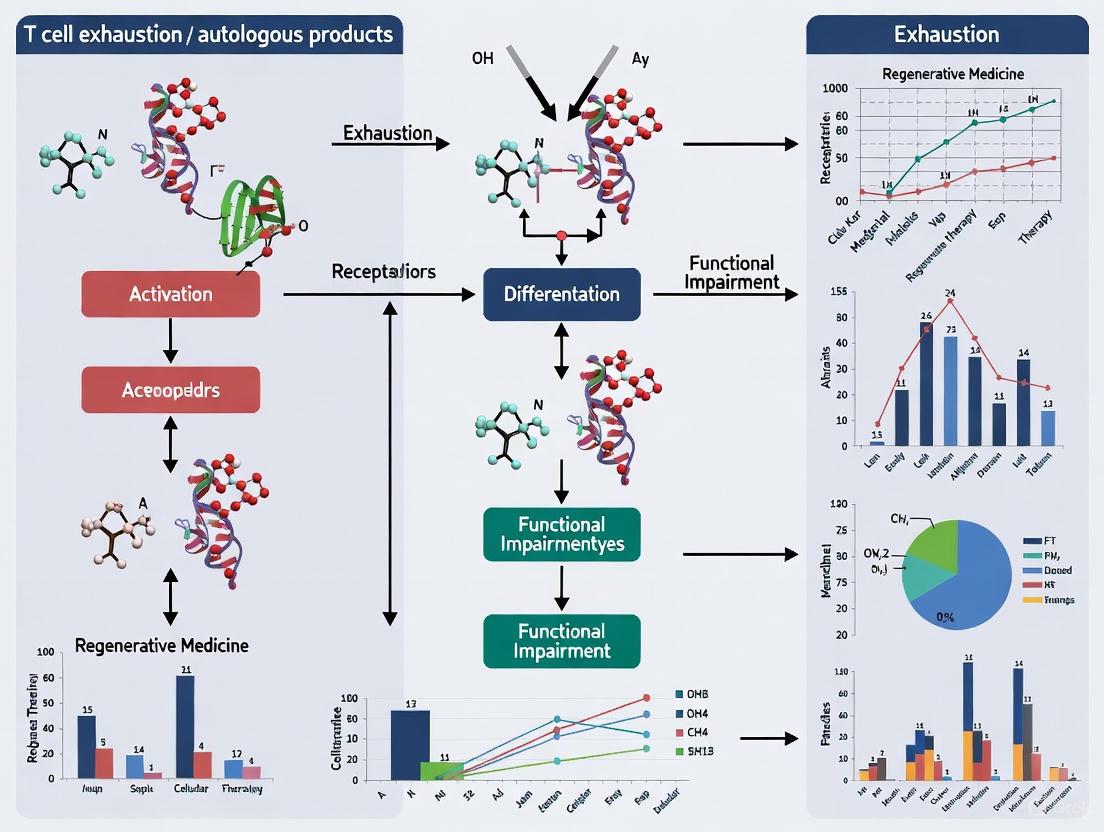
This comprehensive review addresses the critical challenge of T cell exhaustion in autologous cell therapy products, which significantly limits treatment efficacy in cancer immunotherapy.
Overcoming T Cell Exhaustion in Autologous Cell Therapies: Mechanisms, Strategies, and Clinical Translation
Abstract
This comprehensive review addresses the critical challenge of T cell exhaustion in autologous cell therapy products, which significantly limits treatment efficacy in cancer immunotherapy. We explore the fundamental molecular mechanisms driving T cell dysfunction, including novel pathways like CD47-thrombospondin-1 interaction and epigenetic reprogramming. The article details advanced engineering strategies to prevent or reverse exhaustion, from next-generation CAR designs to combination therapies. We further examine cutting-edge monitoring technologies and validation approaches, providing researchers and drug development professionals with actionable insights to enhance therapeutic persistence and clinical outcomes.
Decoding T Cell Exhaustion: Molecular Mechanisms and Clinical Impact in Autologous Products
Frequently Asked Questions (FAQs)
Q1: What are the defining functional characteristics of an exhausted T cell (Tex) compared to an effectively activated one? Exhausted T cells undergo a hierarchical loss of effector functions. This is characterized by an early loss of interleukin (IL)-2 production and T cell proliferative capacity, followed by impaired production of tumor necrosis factor (TNF), and ultimately, a loss of interferon (IFN)-γ production and cytotoxic activity [1]. This is distinct from anergized or senescent T cells and is driven by persistent antigen exposure in chronic environments like tumors or long-term infections [1] [2] [3].
Q2: My in vitro exhausted T cells do not fully recapitulate the phenotype of tumor-infiltrating lymphocytes (TILs). What are the key markers I should check? A robust in vitro model can recapitulate key exhaustion hallmarks. Beyond high PD-1 expression, you should confirm the co-expression of multiple other inhibitory receptors. A 2025 study recommends checking for high levels of TIM-3, CD39, and 2B4 (CD244), as these were particularly discriminative between exhausted and activated T cells, whereas markers like LAG-3 and CTLA-4 were also highly expressed in activated cells [4]. Furthermore, your model should show reduced polyfunctionality (simultaneous production of cytokines like IFN-γ and TNF-α), altered metabolism, and increased mitochondrial mass [4].
Q3: What are the emerging signaling pathways beyond PD-1 that contribute to T cell exhaustion? Recent research has identified several critical pathways. A November 2025 study revealed that the interaction between the protein Thrombospondin-1 (TSP-1) and CD47 on T cells is a key driver of exhaustion. Disrupting this interaction with a peptide like TAX2 preserved T cell function and synergized with PD-1 blockade in mouse models [5] [6] [7]. Additionally, persistent AKT signaling has been mechanistically linked to a proteotoxic stress response in Tex cells, characterized by protein aggregation and increased chaperone activity, which drives the exhaustion state [8].
Q4: How does T cell exhaustion limit the efficacy of Chimeric Antigen Receptor (CAR) T cell therapies, particularly for solid tumors? CAR T cells are highly susceptible to exhaustion, especially in the solid tumor microenvironment. A major cause is "tonic signaling," where the CAR construct itself generates a ligand-independent signal due to self-aggregation. This chronic activation prior to even encountering the tumor leads to upregulation of checkpoint molecules like PD-1, TIM-3, and LAG-3, resulting in impaired persistence, reduced cytokine production, and poor in vivo efficacy [9].
Q5: Are there distinct subpopulations within the exhausted T cell pool with different therapeutic implications? Yes, exhausted T cells are not a uniform population. They exist in a differentiation continuum, primarily consisting of:
- Progenitor exhausted T cells (Tprog): These cells retain stem-like properties, express TCF1, and are capable of self-renewal and responding to immune checkpoint blockade.
- Terminally exhausted T cells (Tterm): These cells have severely limited effector function, high expression of multiple inhibitory receptors, and do not respond well to therapy [2] [8]. Preserving the Tprog population is critical for effective immunotherapy.
Troubleshooting Guides
Issue: Low T Cell Cytotoxicity and Cytokine Production in Exhaustion Models
Potential Causes and Solutions:
Cause: Over-stimulation during in vitro model generation.
- Solution: Optimize the chronic stimulation protocol. A referenced method uses OT-I transgenic CD8+ T cells stimulated with their cognate antigen (SIINFEKL) every 48 hours in the presence of IL-2, with IL-15 added after the second re-stimulation. Phenotypic exhaustion is typically observed after seven stimulations [4].
Cause: Dominant terminal exhaustion program.
- Solution: Analyze and isolate T cell subpopulations. Focus on identifying and expanding the progenitor exhausted T cell (Tprog) subset, which is characterized by the expression of surface markers like SLAMF6 and the transcription factor TCF1 [8]. This subset is more responsive to reinvigoration.
Cause: Signaling through novel inhibitory pathways.
- Solution: Target the newly identified TSP-1:CD47 pathway. In preclinical models, using the TAX2 peptide to disrupt this interaction successfully preserved T cell function, enhanced cytokine production, and improved tumor infiltration [5] [7]. Consider combining this approach with PD-1 pathway blockade.
Issue: Poor Persistence and Rapid Decline of CAR T Cell Function
Potential Causes and Solutions:
Cause: Tonic signaling from the CAR construct.
- Solution: Redesign the CAR to minimize ligand-independent signaling. This can be achieved by modifying the extracellular spacer domain (e.g., using a CH3-only spacer instead of CH2-CH3) or altering the framework region of the scFv to prevent self-aggregation [9].
Cause: Proteotoxic stress from persistent signaling.
- Solution: Modulate the proteotoxic stress response (Tex-PSR). A 2025 study found that disrupting specific chaperone proteins like gp96 (GRP94) or BiP, which are upregulated in Tex cells, can improve T cell function and enhance immunotherapy outcomes in models [8].
Quantitative Hallmarks of T Cell Exhaustion
Table 1: Key phenotypic and functional metrics to validate T cell exhaustion models. Data synthesized from multiple studies [1] [4] [2].
| Category | Parameter | Activated T Cell | Exhausted T Cell |
|---|---|---|---|
| Phenotype | PD-1 Expression | Intermediate/High | Sustained High |
| Co-expression of Multiple IRs (e.g., TIM-3, CD39) | Low | High | |
| TCF1 Expression (in subset) | Variable | High in Tprog subset | |
| Function | IL-2 Production | High | Lost (earliest sign) |
| TNF-α Production | High | Impaired | |
| IFN-γ Production | High | Impaired/Resilient | |
| Proliferative Capacity (EdU+ S phase) | High | Significantly Reduced | |
| Metabolism | Spare Respiratory Capacity (SRC) | High | Low |
| Mitochondrial Mass | Lower | Increased | |
| Reactive Oxygen Species (ROS) | Lower | Higher |
Experimental Protocol: Generating anIn VitroModel of T Cell Exhaustion
This protocol is adapted from a 2025 study that established a reproducible model validated against in vivo TILs [4].
T Cell Isolation:
- Isplicate naive CD8+ T cells from the spleens of C57BL/6 mice, preferably using a transgenic model like OT-I (which has a TCR specific for the H-2Kb/SIINFEKL epitope).
Chronic Stimulation:
- Culture Medium: Use complete T cell media supplemented with IL-2 (e.g., 50 U/mL).
- Stimulation: Stimulate cells with their cognate antigenic peptide (e.g., SIINFEKL at 1-10 nM) presented by antigen-presenting cells, or using plate-bound anti-CD3/anti-CD28 antibodies.
- Schedule: Re-stimulate the T cells every 48 hours with fresh antigen and cytokines.
- Cytokine Adjustment: After the second re-stimulation, supplement the media with IL-15 (e.g., 10 ng/mL) in addition to IL-2 to promote survival.
Harvest and Validation:
- After approximately seven rounds of stimulation, harvest the cells.
- Validate the exhausted phenotype by flow cytometry (check for high PD-1, TIM-3, CD39), functional assays (see Table 1), and metabolic profiling (e.g., reduced SRC).
Signaling Pathways in T Cell Exhaustion
Diagram 1: Signaling pathways driving T cell exhaustion. Key drivers include chronic TCR/AKT signaling and the TSP-1:CD47 interaction, leading to transcriptional, metabolic, and proteostatic changes.
Research Reagent Solutions
Table 2: Key reagents for studying and targeting T cell exhaustion, as cited in recent literature.
| Reagent / Tool | Function / Target | Application in Research |
|---|---|---|
| TAX2 Peptide [5] [7] | Selectively disrupts CD47 interaction with Thrombospondin-1 | Proof-of-concept molecule to prevent exhaustion; synergizes with anti-PD-1. |
| Anti-PD-1 / PD-L1 Antibodies [1] | Blockade of PD-1 inhibitory pathway | Standard immune checkpoint blockade; used to reinvigorate exhausted T cells. |
| OT-I Transgenic Mouse Model [4] | CD8+ T cells with defined TCR for SIINFEKL antigen | Foundational model for generating antigen-specific exhausted T cells in vitro and in vivo. |
| Chaperone Inhibitors (e.g., targeting gp96/GRP94) [8] | Disrupts the Proteotoxic Stress Response (Tex-PSR) | Emerging strategy to reverse the protein aggregation-driven exhaustion state. |
| CAR constructs with optimized spacers [9] | Minimizes tonic signaling | Engineering strategy to generate exhaustion-resistant CAR T cells for therapy. |
FAQs: Understanding T Cell Exhaustion
What is T cell exhaustion and why is it a problem in immunotherapy? T cell exhaustion is a state of T cell dysfunction that occurs in environments of chronic antigen exposure, such as cancer or persistent viral infections. It is characterized by a progressive loss of key T cell functions, including the ability to produce effector cytokines like IL-2, TNF-α, and IFN-γ, and reduced cytolytic activity, leading to a failure to eliminate target cells [10] [11]. For immunotherapy, this is a major hurdle because exhausted T cells in the tumor microenvironment are unable to effectively kill cancer cells. This state is associated with poor patient survival across multiple cancer types and is considered a primary pathway of resistance for cellular immunotherapies like CAR-T cells [12] [13].
How is T cell exhaustion different from other T cell hypofunctional states like anergy? While several mechanisms can result in T cell hypofunction, exhaustion is distinct from ignorance, anergy, and tolerance. The key differentiator is that exhausted T cells have undergone productive initial activation by antigen-presenting cells in secondary lymphoid organs but become dysfunctional upon chronic antigen re-encounter in the tumor microenvironment. In contrast, anergic T cells receive T cell receptor stimulation in the absence of co-stimulatory signals, and tolerant T cells are inactivated due to self-reactivity [12]. Exhausted T cells are defined by their progressive loss of function and sustained expression of multiple inhibitory receptors, such as PD-1, CTLA-4, and LAG-3 [10] [12].
What is the role of PD-1 as a key driver of T cell exhaustion? Programmed cell death-1 (PD-1) is a major inhibitory receptor and a central regulator of T cell exhaustion [10] [11]. Its expression is induced upon T cell activation. In chronic settings, persistent antigen exposure leads to sustained high levels of PD-1 on antigen-specific T cells. When PD-1 on T cells engages with its ligands (PD-L1 or PD-L2) often presented on tumor cells or other cells in the microenvironment, it initiates an intracellular signaling cascade that inhibits T cell activation. This occurs through the recruitment of phosphatases SHP-1 and SHP-2 to the PD-1 cytoplasmic domain, which in turn dephosphorylates key signaling molecules like ZAP70 and PI3K, effectively attenuating T cell receptor (TCR) and CD28-mediated signaling [11]. This interaction acts as a "brake" on T cell function, protecting the tumor from immune attack [11].
Troubleshooting Guide: Overcoming Exhaustion in Autologous Products
Challenge: My CAR-T cell product shows poor persistence and expansion in vivo.
- Potential Cause: The final CAR-T product is dominated by terminally differentiated or exhausted T cells, which have limited proliferative capacity, rather than T cells with memory-like, stem cell properties [13].
- Solution:
- Modify Manufacturing Process: Shorten the ex vivo manufacturing process. A CD19-directed CAR-T product (YTB323) manufactured in less than 2 days showed favorable efficacy at a much lower dose, suggesting better preservation of stem-like qualities [13].
- Select for Favorable Subsets: Although results have been mixed, consider starting material enrichment for less-differentiated T cell populations. The correlation between classic memory markers (CD62L, CCR7) and clinical response is not absolute, but CD27 co-expression with CD45RO or CCR7 has shown promise as a better predictive marker for persistence and response [13].
- Utilize Transcriptomic Analysis: Use transcriptomic signatures rather than just surface marker phenotyping to characterize your product. Gene signatures associated with memory function and low exhaustion are strong predictors of clinical response and favorable pharmacokinetics (Cmax and AUC) [13].
Challenge: Blockade of the PD-1 pathway alone fails to fully restore T cell function.
- Potential Cause: T cell exhaustion is a multi-factorial process mediated by the co-expression of numerous inhibitory receptors beyond PD-1. The pattern of co-expression determines the severity of exhaustion [10].
- Solution: Implement Combinatorial Blockade.
- Target TIM-3 or LAG-3 in conjunction with PD-1. In tumor models, CD8+ T cells co-expressing PD-1 and TIM-3 or PD-1 and LAG-3 are more severely exhausted than those expressing only PD-1. Dual blockade of PD-1 with either TIM-3 or LAG-3 has been shown to synergistically restore T cell function and mediate tumor regression [10].
- Consider other receptors such as TIGIT and BTLA. TIGIT+ CD8+ T cells often co-express PD-1, and co-blockade of TIGIT and PD-L1 can specifically boost CD8+ T cell effector function [10]. Similarly, in melanoma, combined blockade of BTLA, PD-1, and TIM-3 enhanced the proliferation and function of tumor-specific CD8+ T cells [10].
Quantitative Data: Inhibitory Receptors in Exhaustion
Table 1: Key Inhibitory Receptors and Their Role in T Cell Exhaustion
| Receptor | Ligand(s) | Functional Impact of Co-Expression with PD-1 | Therapeutic Blockade Outcome |
|---|---|---|---|
| PD-1 | PD-L1, PD-L2 | Major regulator of exhaustion; defines the baseline exhausted phenotype [11]. | Single-agent blockade can reinvigorate T cell function and is a validated cancer therapy [11]. |
| TIM-3 | Galectin-9, CEACAM-1, others | TIM-3+PD-1+ CD8+ TILs are the most dysfunctional subset, with failure to proliferate and produce cytokines [10]. | Dual blockade with PD-1 restores anti-tumor function more effectively than PD-1 blockade alone [10]. |
| LAG-3 | MHC Class II | LAG-3+PD-1+ T cells are more dysfunctional than single-positive subsets in human ovarian cancer [10]. | Combined blockade of PD-1 and LAG-3 results in synergistic tumor regression in animal models [10]. |
| TIGIT | CD155 (PVR), CD112 | TIGIT competes with costimulatory CD226 for the same ligands. TIGIT+ CD8+ T cells often co-express PD-1 [10]. | Antibody co-blockade of TIGIT and PD-L1 synergistically boosts CD8+ T cell effector function and tumor clearance [10]. |
| CTLA-4 | CD80, CD86 | PD-1+CTLA-4+ CD8+ TILs are more severely exhausted in proliferation and cytokine production [10]. | Dual blockade enhances T-cell function in cancer; combination therapy is an approved regimen [10]. |
Experimental Protocols
Protocol 1: Assessing Exhaustion Phenotype via Flow Cytometry
Objective: To identify and characterize exhausted T cells within a tumor-infiltrating lymphocyte (TIL) population or an in vitro stimulated T cell culture.
Materials:
- Research Reagent Solutions:
- Single-cell suspension from tumor tissue or cultured T cells.
- Fluorochrome-conjugated antibodies against: CD3, CD8, CD4, PD-1, TIM-3, LAG-3, CTLA-4, TIGIT.
- Intracellular cytokine staining (ICS) kit: Including cell activation cocktail (e.g., PMA/Ionomycin with protein transport inhibitors), fixation/permeabilization buffer, and antibodies against IFN-γ, TNF-α, IL-2.
- Flow cytometry buffer (e.g., PBS with 1-2% FBS).
- Viability dye.
Methodology:
- Cell Preparation: Generate a single-cell suspension from your tumor sample or harvest cultured T cells. Count and assess viability.
- Surface Staining:
- Aliquot up to 1x10^6 cells per flow tube.
- Wash cells with flow buffer.
- Resuspend cell pellet in 100 µL of flow buffer containing a pre-titrated cocktail of surface marker antibodies (e.g., anti-CD3, CD8, PD-1, TIM-3, LAG-3) and viability dye.
- Incubate for 20-30 minutes at 4°C in the dark.
- Wash cells twice with flow buffer to remove unbound antibody.
- Intracellular Cytokine Staining (Optional, for functional assessment):
- Stimulate: Resuspend cells in complete media and stimulate with cell activation cocktail for 4-6 hours at 37°C.
- Fix and Permeabilize: Follow the instructions of your ICS kit. Typically, cells are fixed and then permeabilized.
- Stain Intracellularly: Add antibodies against intracellular targets (e.g., cytokines like IFN-γ, TNF-α, or transcription factors) in permeabilization buffer. Incubate 30-60 minutes at 4°C in the dark.
- Wash twice with perm buffer, then resuspend in flow buffer for acquisition.
- Data Acquisition and Analysis:
- Acquire data on a flow cytometer.
- Gate on live, single CD3+CD8+ (or CD4+) T cells.
- Analyze the co-expression patterns of inhibitory receptors (PD-1, TIM-3, LAG-3). The PD-1+TIM-3+LAG-3+ population typically represents the most severely exhausted subset [10].
- Correlate receptor expression with the capacity to produce effector cytokines upon stimulation.
Protocol 2:In VitroReinvigoration via Immune Checkpoint Blockade
Objective: To test the functional restoration of exhausted T cells using blocking antibodies against inhibitory receptors.
Materials:
- Research Reagent Solutions:
- Exhausted T cells (e.g., TILs or in vitro repeatedly stimulated T cells).
- Target cells expressing the cognate antigen (e.g., cancer cell lines).
- Neutralizing antibodies: Anti-PD-1, anti-TIM-3, anti-LAG-3, etc., and corresponding isotype control antibodies.
- Cell culture plates.
- ELISA or Luminex kits for detecting human IFN-γ, TNF-α.
Methodology:
- Co-culture Setup:
- Plate exhausted T cells with target cells at a suitable effector-to-target (E:T) ratio in a culture plate. Include wells with T cells alone and target cells alone as controls.
- Add neutralizing antibodies (e.g., 5-10 µg/mL of anti-PD-1, anti-TIM-3, or combination) or isotype controls to the designated wells [10].
- Incubation:
- Incubate the co-culture for 18-24 hours at 37°C for cytokine measurement, or longer for proliferation assays.
- Functional Readouts:
- Cytokine Production: Collect cell-free supernatant and quantify the levels of released IFN-γ and TNF-α using an ELISA or Luminex multiplex assay. Successful reinvigoration will show a significant increase in cytokine production in antibody-blocked wells compared to isotype control [10] [11].
- Proliferation: Use a CFSE dilution assay or similar to assess if checkpoint blockade restores the proliferative capacity of the exhausted T cells.
- Cytotoxicity: Use a real-time cell killing assay (e.g., xCelligence) or a classic ^51Cr-release assay to measure the restored ability to kill target cells.
Signaling Pathways and Molecular Mechanisms
PD-1 Signaling Pathway
Hierarchy of T Cell Exhaustion
The Scientist's Toolkit: Research Reagent Solutions
Table 2: Essential Reagents for Studying T Cell Exhaustion
| Reagent / Tool | Function / Application | Example Use |
|---|---|---|
| Neutralizing Antibodies (anti-PD-1, anti-LAG-3, anti-TIM-3) | Block the interaction between an inhibitory receptor and its ligand to test functional reinvigoration of exhausted T cells in vitro and in vivo [10] [11]. | Used in the In Vitro Reinvigoration Protocol (Protocol 2) to restore cytokine production and cytotoxicity. |
| CRISPR/Cas9 Gene Editing System | A targeted gene editing technology to knock out genes of interest (e.g., exhaustion-associated genes like PDCD1) in primary human T cells to study their functional role [14]. | Creating engineered T cell products with disrupted inhibitory pathways to enhance persistence. |
| Zinc-Finger Nuclease (ZFN) / TALEN Proteins | Alternative site-specific DNA endonucleases for gene editing; can be directly delivered into primary immune cells without viral vectors [14]. | Knocking out specific genes in T cells to modulate differentiation and exhaustion fates. |
| Fluorochrome-conjugated Antibody Panels | Multiparameter flow cytometry to identify and characterize exhausted T cell populations based on surface and intracellular protein expression [10]. | Used in Protocol 1 to identify PD-1+TIM-3+ double-positive exhausted T cells within a heterogeneous population. |
| Cell-Penetrating Peptides | Facilitate the delivery of proteins (e.g., TALENs) into primary cells for genetic manipulation [14]. | Enabling efficient gene editing in hard-to-transfect primary T cells. |
| Chimeric Antigen Receptor (CAR) Constructs | Synthetic receptors that redirect T cells to specific tumor antigens; the design (e.g., costimulatory domains) can influence the propensity for exhaustion [15] [13]. | Engineering autologous T cell products for therapy; next-gen CARs incorporate logic gates to mitigate exhaustion. |
The CD47-Thrombospondin-1 (TSP-1) axis represents a crucial immune checkpoint pathway that cancer cells exploit to evade immune surveillance. Unlike the well-characterized PD-1/PD-L1 pathway, this axis operates through distinct mechanisms that directly impair T cell function and promote exhaustion. CD47, widely expressed on cancer cells, interacts with its ligand TSP-1 to deliver inhibitory signals that suppress T cell activation, proliferation, and metabolic fitness within the tumor microenvironment (TME). Recent evidence establishes this pathway as a key driver of T cell exhaustion, presenting a significant barrier to current immunotherapies and a promising target for novel therapeutic interventions [16] [17] [18].
Key Signaling Pathways and Molecular Mechanisms
Core Pathway Diagram
The following diagram illustrates the primary signaling events through which the CD47-TSP-1 axis induces T cell dysfunction.
Key Mechanisms of Immune Evasion
The CD47-TSP-1 axis promotes immune evasion through multiple interconnected mechanisms:
Direct T Cell Suppression: TSP-1 binding to CD47 on T cells activates calcineurin-NFAT signaling, leading to upregulation of the exhaustion transcription factor TOX. This programs T cells toward an exhausted state characterized by increased expression of multiple inhibitory receptors including PD-1, TIM-3, and LAG-3 [18].
Metabolic Reprogramming: CD47-TSP-1 interaction impairs glycolytic metabolism in CD8+ T cells, reducing their ability to perform effector functions. Targeting this axis restores glucose metabolism and enhances T cell bioenergetics [17].
Phagocytosis Evasion: CD47 engagement of SIRPα on macrophages transmits a "don't eat me" signal, protecting cancer cells from phagocytosis. This mechanism works in parallel to the direct T cell inhibitory effects of the CD47-TSP-1 interaction [19] [20].
Troubleshooting Common Experimental Challenges
Frequently Asked Questions
Q1: Why do my CD47-blocking experiments show inconsistent results in restoring T cell function?
Inconsistent results often stem from variable TSP-1 expression in your experimental system. Check TSP-1 levels in your culture conditions or tumor models, as high TSP-1 can dominate the inhibitory signaling. Consider using standardized recombinant TSP-1 and validate blocking antibody efficacy through competitive binding assays [17] [21].
Q2: How can I distinguish between CD47-SIRPα and CD47-TSP-1 mediated effects in my phagocytosis assays?
Use specific antagonists for each pathway: TAX2 peptide selectively blocks CD47-TSP-1 interaction without affecting CD47-SIRPα binding, while SIRPα-Fc fusion proteins specifically target the CD47-SIRPα axis. Combining these tools allows precise dissection of each pathway's contribution [16] [19].
Q3: My CAR-T cells show poor persistence in solid tumor models – could the CD47-TSP-1 axis be involved?
Yes, solid tumors frequently upregulate both CD47 and TSP-1, creating a highly immunosuppressive environment. Engineered CD47 overexpression or CD47 variants (e.g., CD47(Q31P)/47E) in CAR-T cells can protect them from macrophage-mediated clearance while maintaining antitumor efficacy [19].
Q4: What are the best biomarkers to monitor CD47-TSP-1 axis activity in patient samples?
Combined measurement of soluble TSP-1 in plasma and CD47 expression on tumor-infiltrating T cells provides strong predictive value. High levels of both correlate with poor response to anti-PD-1 therapy and more severe T cell exhaustion phenotypes [17] [18].
Q5: How does CD47-TSP-1 signaling contribute to resistance against PARP inhibitors in ovarian cancer?
In ovarian cancer, CD47 expression increases following PARP inhibitor treatment, and TSP-1 plasma levels correlate with worse prognosis. The CD47-TSP-1 axis drives this resistance through immune-independent mechanisms, making it a promising target for combination therapy [16].
Table 1: Key Experimental Findings on CD47-TSP-1 Axis Modulation
| Parameter Measured | Experimental System | Effect of CD47-TSP-1 Inhibition | Citation |
|---|---|---|---|
| Tumor volume | B16 melanoma model | Significant reduction vs control | [17] |
| CD8+ T cell infiltration | Ovarian cancer models | Increased granzyme B+ T cells | [16] |
| T cell glycolysis | Pmel-1 transgenic mice | Restored metabolic function | [17] |
| Survival benefit | PARPi-resistant OC model | Significant prolongation | [16] |
| Exhaustion markers | Human melanoma TILs | Reduced PD-1, TIM-3, LAG-3 | [18] |
Table 2: Association of CD47-TSP-1 with Clinical Outcomes
| Biomarker | Measurement Context | Prognostic Value | Clinical Correlation |
|---|---|---|---|
| CD47 expression | Ovarian cancer post-NACT | Favorable | Associated with greater CD4+/CD8+ T-cell influx [16] |
| Plasma TSP-1 levels | Melanoma anti-PD-1 therapy | Negative | Higher in non-responders [17] |
| CD47+ T cells | Tumor-infiltrating lymphocytes | Negative | Correlates with exhaustion [18] |
| SIRPα+ TAMs | NSCLC microenvironment | Negative | Linked with poor prognosis [22] |
Essential Experimental Protocols
Workflow for Evaluating CD47-TSP-1 Axis in T Cell Exhaustion
Detailed Methodologies
Protocol 1: Assessing T Cell Exhaustion in CD47-TSP-1 Rich Environments
Materials:
- Recombinant human TSP-1 (100-500 ng/mL)
- Anti-CD47 blocking antibodies (e.g., B6H12) or TAX2 peptide (5-20 μM)
- Human or murine T cells activated with anti-CD3/CD28 beads
- Target tumor cells expressing CD47
Procedure:
- Activate T cells for 48 hours with anti-CD3/CD28 beads
- Co-culture activated T cells with irradiated tumor cells at 1:1 ratio
- Add recombinant TSP-1 and/or CD47 blocking agents
- After 72 hours, analyze exhaustion markers by flow cytometry (PD-1, TIM-3, LAG-3)
- Measure cytokine production after restimulation with PMA/ionomycin
- Assess metabolic function using Seahorse analyzer for glycolytic capacity
Troubleshooting Tip: Include control for non-specific T cell death by measuring viability with Annexin V/7-AAD staining [17] [18].
Protocol 2: Evaluating Metabolic Consequences of CD47-TSP-1 Signaling
Materials:
- CD8+ T cells from Pmel-1 transgenic mice
- Extracellular flux analyzer
- Glucose uptake assay kit
- TSP-1 (100 ng/mL) and TAX2 peptide (10 μM)
Procedure:
- Isolate CD8+ T cells and activate with hGP100 peptide
- Treat with TSP-1 ± TAX2 peptide for 24 hours
- Measure glycolytic function via extracellular acidification rate (ECAR)
- Assess oxidative phosphorylation via oxygen consumption rate (OCR)
- Perform glucose uptake assay using fluorescent glucose analog
- Analyze expression of glycolytic enzymes (HK2, PKM2) by Western blot
Expected Results: TSP-1 treatment should suppress both glycolytic and oxidative metabolic pathways, reversible with TAX2 peptide [17].
The Scientist's Toolkit: Essential Research Reagents
Table 3: Key Reagents for CD47-TSP-1 Axis Research
| Reagent | Type | Key Function | Application Notes |
|---|---|---|---|
| TAX2 peptide | Cyclic peptide | Selective CD47-TSP-1 antagonist | Use at 5-20 μM; spares CD47-SIRPα interaction [16] |
| B6H12 antibody | Anti-CD47 mAb | Blocks both TSP-1 and SIRPα binding | Causes rapid macrophage-mediated T cell clearance [19] |
| Recombinant TSP-1 | Protein | CD47 receptor engagement | Titrate 100-500 ng/mL; batch variability exists [17] |
| CD47(Q31P)/47E | Engineered CD47 variant | Resists anti-CD47 mediated phagocytosis | For CAR-T cell engineering [19] |
| AVR2 | TSP-1 derived peptide | CD47 agonist | Induces T cell exhaustion at 10-50 μM [18] |
Advanced Technical Applications
Engineering CD47-Enhanced T Cell Products
The paradoxical role of CD47 in both protecting T cells from phagocytosis and transmitting inhibitory signals presents unique challenges for cell therapy engineering. Recent approaches include:
CD47 Variant Expression: Engineering T cells to express CD47(Q31P)/47E provides a "don't eat me" signal that is not blocked by therapeutic anti-CD47 antibodies, enhancing persistence in vivo while maintaining antitumor efficacy [19].
Conditional CD47 Modulation: Inducible expression systems that modulate CD47 levels in response to specific triggers can help balance the protective and inhibitory functions of CD47 in adoptive cell therapies.
Combination with Metabolic Support: Engineering T cells with enhanced glycolytic capacity alongside CD47 modulation helps counteract the metabolic suppression mediated by TSP-1 in the TME [17].
Integrating CD47-TSP-1 Targeting with Standard Care
For translational applications, consider these combination approaches:
Sequential PARPi and CD47-TSP-1 Targeting: In ovarian cancer models, administering TAX2 peptide after olaparib treatment significantly reduced tumor burden and overcome PARPi resistance [16].
Anti-PD-1 Refractory Melanoma: Non-responders to anti-PD-1 therapy showed elevated CD47+ T cells and circulating TSP-1, suggesting this population may benefit from CD47-TSP-1 axis blockade [17].
Radiotherapy Combinations: CD47 signaling regulates resistance to ionizing radiation, supporting combination of CD47-TSP-1 targeting with radiotherapy for enhanced antitumor immunity [21].
This technical support center is designed for researchers investigating T cell exhaustion, a major barrier in autologous cell therapies like CAR T-cell treatments. A key player in establishing this dysfunctional state is the epigenetic modifier DNA methyltransferase 3A (DNMT3A). This guide provides targeted troubleshooting and FAQs to help you dissect the role of DNMT3A in driving the stable epigenetic reprogramming that underlies T cell exhaustion, offering protocols and strategies to overcome this challenge in your experiments.
FAQs & Troubleshooting Guides
What is the fundamental role of DNMT3A in T cell exhaustion?
DNMT3A is a de novo DNA methyltransferase that establishes long-lasting epigenetic programs during chronic antigen stimulation. In exhausted T cells (TEX), DNMT3A activity silences genes critical for T cell memory and effector function, thereby promoting a stable dysfunctional state.
- Underlying Mechanism: During persistent activation, as seen in chronic infections or the tumor microenvironment, DNMT3A is recruited to specific genomic loci. It adds methyl groups to CpG islands in the promoters or enhancers of genes, leading to their transcriptional repression.
- Key Genes Targeted: DNMT3A-mediated methylation represses a network of transcription factors and receptors that maintain T cell "stemness" and functionality, including
TCF7,LEF1,CCR7, andCD28[23] [24]. - Troubleshooting Tip: If you are observing rapid functional decline in your T cell cultures, profile the methylation status of these key memory/stemness genes. Hypermethylation suggests a DNMT3A-driven exhaustion pathway.
How can I experimentally prevent DNMT3A-mediated exhaustion in my T cell products?
Two primary epigenetic intervention strategies have proven successful in preclinical models: genetic knockout (KO) of DNMT3A and pharmacological inhibition of DNA methylation.
The table below summarizes the core differences between these two approaches.
| Feature | DNMT3A Knockout (KO) | Decitabine (DAC) Priming |
|---|---|---|
| Mechanism | Complete and permanent removal of the DNMT3A gene using CRISPR-Cas9 [23]. | Pharmacological inhibition of DNA methyltransferases, leading to their degradation and genome-wide demethylation [24]. |
| Key Outcome | Preserved proliferative capacity and effector function during chronic stimulation; prevents acquisition of exhaustion signatures [23]. | Enhances antitumor activity, cytokine production, and proliferation; promotes a memory-like phenotype (increased Tcm cells) [24]. |
| Advantages | Permanent effect; clean genetic model for establishing causality. | Clinically applicable (DAC is FDA-approved); can be applied as a simple pre-conditioning step. |
| Disadvantages | Requires genetic manipulation; potential for off-target effects with CRISPR. | Transient effect; requires optimization of dose and timing to avoid toxicity. |
My DNMT3A-KO T cells are not showing improved persistence. What could be wrong?
Even with successful knockout, several experimental factors can affect the outcome.
Problem: Inadequate Antigen Stimulation.
- Cause: The benefits of DNMT3A-KO are antigen-dependent. The exhaustion-resistant phenotype only manifests under conditions of prolonged or repeated antigen exposure [23].
- Solution: Ensure your assay uses chronic stimulation. Implement a repeat stimulation assay where T cells are re-exposed to fresh tumor cells or antigen-pulsed cells every 5-7 days over several weeks.
Problem: Incorrect T Cell Phenotyping.
- Cause: The positive effects may be masked if you are only looking at terminal effector markers.
- Solution: Analyze your cells for the correct phenotypic signatures. DNMT3A-KO and decitabine-primed cells show:
Are there non-canonical, methylation-independent functions of DNMT3A I should consider?
Emerging research indicates that DNMT3A has functions beyond its methyltransferase activity, which could confound experiments based solely on methylation-centric models.
- Recent Finding: A 2025 study revealed that DNMT3A can influence blood stem cell biology and cancer risk through methylation-independent pathways, including regulating telomere length and the DNA damage response [25].
- Troubleshooting Implication: If you observe phenotypic changes in your DNMT3A-KO T cells that do not correlate with expected DNA methylation changes, investigate alternative pathways. Consider performing RNA-seq and functional assays for telomere maintenance and DNA damage (e.g., γH2AX staining) in your models.
Experimental Protocols
Protocol 1: Generating Exhaustion-Resistant T Cells via DNMT3A Knockout
This protocol uses CRISPR-Cas9 to create a stable DNMT3A knockout in human T cells prior to CAR transduction [23].
Workflow:
Step-by-Step Methodology:
- T Cell Activation: Isolate PBMCs from a leukapheresis product and activate them with anti-CD3/CD28 beads.
- CRISPR Electroporation: On day 2 post-activation, electroporate T cells with Cas9 protein complexed with a synthetic sgRNA targeting exon 19 of DNMT3A (catalytic domain).
- Recommended Control: Use a non-targeting sgRNA (e.g., targeting mCherry).
- CAR Transduction: 24 hours post-electroporation, transduce the T cells with a retroviral or lentiviral vector encoding your CAR of interest.
- Cell Expansion: Culture cells in complete media supplemented with IL-2 (e.g., 100 IU/mL) for 10-14 days.
- Validation:
- Knockout Efficiency: Assess by western blot for DNMT3A protein and/or by T7E1 assay or next-generation sequencing of the target locus.
- CAR Expression: Confirm by flow cytometry for the CAR construct.
- Functional Assay - Repeat Stimulation:
- Co-culture Ctrl and DNMT3A-KO CAR T cells with tumor cells at an E:T ratio of 2:1.
- Every 7 days, count the viable T cells, re-stimulate with fresh tumor cells, and add IL-15.
- Monitor expansion over 3-4 cycles. DNMT3A-KO cells should show significantly higher cumulative expansion [23].
Protocol 2: Low-Dose Decitabine Priming to Modulate Exhaustion
This protocol uses a DNA methyltransferase inhibitor to epigenetically reprogram T cells without genetic manipulation [24].
Workflow:
Step-by-Step Methodology:
- CAR T Cell Generation: Activate PBMCs and transduce with your CAR vector as per your standard protocol.
- Decitabine Treatment: On day 3 of the culture, add a low dose (10 nM) of decitabine to the media.
- Critical: Titrate the dose for your specific system (test 10-100 nM). High doses can be toxic.
- Continued Culture: Culture the "dCAR T" cells with decitabine for a total of 7 days (until ~day 10).
- Drug Wash-Out: Wash the cells to remove decitabine before using them in functional assays or in vivo experiments.
- Validation:
- Phenotyping: Check for an increased central memory (Tcm, CD45RO+CD62L+) population via flow cytometry.
- Molecular Profiling: Perform RNA-seq or qPCR to confirm upregulation of memory genes (
TCF7,LEF1) and downregulation of exhaustion genes (EOMES,LAG3).
Functional Outcomes of Epigenetic Interventions
The table below consolidates key quantitative data from seminal studies, providing benchmarks for your own experiments.
| Intervention | CAR Construct | Key Functional Improvement | Experimental Readout |
|---|---|---|---|
| DNMT3A KO [23] | HER2.CD28ζ, IL13Rα2.CD28ζ | 22.6-fold greater expansion than Ctrl after 4th stimulation. | Cumulative cell count in repeat stimulation assay. |
| DNMT3A KO [23] | Various (HER2, IL13Rα2, EphA2) | Preserved cytokine production (IFN-γ, TNF-α, IL-2) upon chronic antigen exposure. | Cytokine bead array / ELISA after tumor co-culture. |
| Decitabine (10 nM) [24] | CD19-BBζ | Enhanced in vivo tumor eradication at low T cell dose. | Tumor volume measurement in xenograft models. |
| Decitabine (10 nM) [24] | CD19-BBζ | Increased cytolytic activity and degranulation. | ~2-fold higher CD107a expression after 1h co-culture with tumor cells. |
The Scientist's Toolkit: Research Reagent Solutions
| Reagent / Tool | Function / Explanation | Example Use |
|---|---|---|
| CRISPR-Cas9 sgRNA (DNMT3A-targeting) | Directs Cas9 nuclease to create double-strand breaks in the DNMT3A gene, leading to knockout. | Generating genetically stable, exhaustion-resistant T cell lines for mechanistic studies [23]. |
| Decitabine (DAC) | A DNMT inhibitor that incorporates into DNA and traps methyltransferases, leading to their degradation and global DNA hypomethylation. | Clinically translatable priming of CAR T cells to enhance persistence and stemness [24]. |
| IL-15 | Cytokine that promotes T cell survival and mitochondrial biogenesis. | Used in chronic stimulation assays to support T cell survival and model the cytokine milieu [26] [23]. |
| Anti-PD-1 / Checkpoint Antibodies | Antibodies that block inhibitory receptors on T cells to temporarily reverse exhaustion. | Used in combination with epigenetic interventions to achieve synergistic reinvigoration of T cells [26] [27]. |
T cell exhaustion presents a major barrier to effective, long-lasting immunity in chronic infections and cancer, and is a significant challenge in adoptive cell therapies, including autologous CAR-T products. This hyporesponsive state is not a passive failure but an actively regulated differentiation pathway governed by a core transcriptional network. Key transcription factors, including Nuclear Factor of Activated T-cells (NFAT), Thymocyte selection-associated HMG Box (TOX), and Basic Leucine Zipper ATF-Like Transcription Factor (BATF), form a hierarchical network that initiates, establishes, and stabilizes the exhausted T cell (Tex) fate. Understanding and troubleshooting experiments related to this network is critical for developing strategies to modulate T cell fate and improve therapeutic outcomes.
Frequently Asked Questions (FAQs) & Troubleshooting Guides
FAQ 1: What are the key transcription factors in the T cell exhaustion network, and what are their primary roles?
- Answer: The exhaustion program is coordinated by a series of transcription factors that act in a hierarchical manner. Their primary roles and relationships are summarized in the table below.
| Transcription Factor | Primary Role in Exhaustion Network | Key Regulatory Relationships |
|---|---|---|
| NFAT | Initiator: Drives early exhaustion gene expression in response to persistent TCR signaling [28] [29] [30]. | Upstream activator of TOX and BATF expression [29]. |
| BATF | Pioneer Factor: Acts as a pioneer factor with IRF4 to remodel chromatin and facilitate access for other TFs [29]. | Collaborates with IRF4; works upstream of TOX [29]. |
| TOX | Central Enforcer: Essential for establishing and maintaining the exhausted state through epigenetic reprogramming [29] [31] [30]. | Directly induced by NFAT and BATF; reinforces the exhaustion epigenetic landscape [28] [29]. |
| TCF-1 (TCF7) | Progenitor Identity: Critical for the self-renewing capacity of the stem-like progenitor exhausted T (Tpex) cell pool [28] [30] [13]. | Expressed in Tpex; its expression is lost upon terminal differentiation [29] [30]. |
| NR4A | Co-initiator: Co-operated with NFAT in response to chronic stimulation to promote exhaustion [28] [30]. | Also induced by persistent TCR signaling; contributes to the initial activation of exhaustion genes [28]. |
Troubleshooting Guide: Interpreting Conflicting Literature on TCF-1's Role
- Problem: Some studies label TCF-1 as a memory-associated factor, while others identify it as a key marker for progenitor exhausted T cells. This can cause confusion in data interpretation.
- Solution: The context is critical. TCF-1+ cells in chronic stimulation environments are considered progenitor exhausted T (Tpex) cells, not canonical memory cells. While they share the stem-like property of self-renewal, their epigenetic and transcriptional landscape is primed for exhaustion. Always characterize TCF-1+ cells with additional exhaustion markers (e.g., PD-1) and assess their functional capacity upon re-stimulation [29] [30].
FAQ 2: My ChIP-seq for TOX shows widespread binding, but how do I determine its functional targets?
- Answer: TOX is a master regulator that binds broadly to genomic loci to enforce the exhausted state. Its functional targets can be categorized as follows [29] [31]:
- Inhibitory Receptor Genes: TOX binding promotes the sustained expression of multiple inhibitory receptors like PD-1, LAG-3, and TIM-3.
- Effector Function Genes: TOX contributes to the suppression of classic effector cytokines like IL-2, TNF, and IFN-γ.
- Epigenetic Modifiers: TOX can recruit or influence the expression of enzymes that lock in the exhaustion-associated epigenetic state.
- Experimental Protocol: Validating Functional TOX Targets
- Step 1: Chromatin Immunoprecipitation (ChIP). Perform TOX ChIP-seq under chronic stimulation conditions to identify genome-wide binding sites.
- Step 2: Integrative Genomics. Overlap ChIP-seq peaks with RNA-seq data from TOX-deficient and TOX-sufficient T cells. Functional targets will show both TOX binding and significant changes in gene expression upon TOX depletion.
- Step 3: Functional Validation. Use CRISPR/Cas9 to delete TOX binding sites near candidate genes in a reporter cell line and assess the impact on gene expression. Alternatively, perform knockdown/knockout of TOX and measure changes in protein expression and function via flow cytometry and cytokine assays.
Troubleshooting Guide: Poor Signal in TOX ChIP-seq
- Problem: Weak or no enrichment in TOX ChIP-seq experiments.
- Solution:
- Antibody Validation: Ensure the anti-TOX antibody is validated for ChIP application. Check publications for cited antibodies.
- Cross-linking Optimization: Titrate formaldehyde concentration and cross-linking time. Over-crosslinking can mask epitopes.
- Cell Input: Use a sufficient number of cells (typically 1-10 million per IP) to ensure adequate starting material.
- Positive Control: Include a positive control primer set for a known TOX target gene (e.g., the Pdcd1 locus) in your qPCR validation.
FAQ 3: How can I experimentally model the progression of T cell exhaustion in vitro?
- Answer: A robust in vitro model is essential for studying the dynamics of the transcriptional network. The most common method involves using repeated stimulation with antigen-presenting cells.
- Experimental Protocol: In Vitro Exhaustion Model
- Materials:
- Isolated naïve CD8+ T cells from mouse or human.
- Plate-bound anti-CD3 and anti-CD28 antibodies.
- Recombinant IL-2.
- Tissue culture plates and complete T cell media.
- Procedure:
- Day 0: Isolate and activate naïve CD8+ T cells using plate-bound anti-CD3 (e.g., 5 µg/mL) and anti-CD28 (e.g., 2 µg/mL) in the presence of IL-2 (e.g., 100 U/mL).
- Day 3: Split cells and resuspend in fresh media with IL-2.
- Day 7 (First Restimulation): Re-isolate T cells and re-stimulate with fresh plate-bound anti-CD3/anti-CD28 at the same concentrations. Return to culture with IL-2.
- Repeat: Continue this cycle of restimulation every 5-7 days for 3-4 rounds.
- Monitoring Exhaustion: At each restimulation, analyze cells for:
- Surface Markers: PD-1, LAG-3, TIM-3 upregulation via flow cytometry [32].
- Function: Reduced production of IFN-γ, TNF, and IL-2 upon PMA/ionomycin re-stimulation.
- Transcriptional Analysis: qPCR or RNA-seq for TOX, NFATc1, BATF, and TCF7 expression.
- Materials:
Troubleshooting Guide: Inconsistent Exhaustion Phenotype Across Replicates
- Problem: High variability in marker expression between technical or biological replicates.
- Solution:
- Standardize Cell Density: Maintain a consistent cell density (e.g., 0.5-1 x 10^6 cells/mL) at each feeding and restimulation to ensure uniform exposure to cytokines and metabolites.
- Antibody Coating Consistency: Ensure uniform coating of anti-CD3/CD28 antibodies across all wells and plates.
- Naïve T Cell Purity: Use stringent sorting or magnetic isolation (e.g., CD62L+CD44- for mouse) to obtain a highly pure naïve T cell population at the start. Contamination with memory T cells will skew results.
Key Signaling Pathways and Molecular Relationships
The following diagram illustrates the hierarchical relationship and core regulatory interactions between NFAT, BATF, and TOX in establishing T cell exhaustion.
Research Reagent Solutions
The table below lists essential reagents for studying the NFAT-TOX-BATF transcriptional network, based on methodologies from cited literature.
| Research Reagent | Specific Example / Catalog Number (if provided) | Function/Application in Research |
|---|---|---|
| Anti-CD3/Anti-CD28 Antibodies | Plate-bound or soluble, various vendors | To provide T cell receptor (TCR) and costimulatory signals for T cell activation and chronic stimulation models [33] [13]. |
| Recombinant Human/Mouse IL-2 | PeproTech, R&D Systems | A key cytokine for T cell survival and proliferation during in vitro culture and exhaustion models [33]. |
| Flow Cytometry Antibodies | Anti-PD-1, Anti-LAG-3, Anti-TIM-3, Anti-TCF-1 (TCF7) | To phenotype and characterize exhausted T cell populations and their progenitor subsets via surface and intracellular staining [33] [32] [30]. |
| ChIP-grade Antibodies | Anti-TOX, Anti-NFAT, Anti-BATF | For chromatin immunoprecipitation experiments to identify genome-wide binding sites of key transcription factors [29]. |
| CRISPR/Cas9 Systems | Lentiviral or synthetic gRNAs for TOX, NFATc1, BATF | For genetic knockout or knockdown to determine the functional necessity of these factors in the exhaustion pathway [32]. |
| Digital PCR (dPCR) Systems | QuantStudio Absolute Q Digital PCR System | For highly sensitive and precise quantification of low-abundance targets, such as CAR transgene persistence in patient samples [33]. |
FAQs: Understanding Tonic CAR Signaling
What is tonic signaling in the context of CAR-T cells? Tonic signaling refers to ligand-independent, constitutive signaling from the chimeric antigen receptor (CAR) even in the absence of the target tumor antigen. It is characterized by a low-level, spontaneous activation of the CAR-T cell, which can be measured by the upregulation of early activation markers like CD69 and the secretion of pro-inflammatory cytokines [34].
What are the primary structural causes of tonic signaling? The primary structural causes are related to the antigen-binding domain (scFv) of the CAR. Key factors include:
- Positively Charged Patches (PCPs): The presence of positively charged residues on the surface of the scFv can lead to electrostatic interaction-mediated CAR clustering on the T cell surface, initiating spontaneous signaling [34].
- Hydrophobic Interactions: Increased hydrophobicity within the scFv, particularly in the framework regions, can promote antigen-unrelated binding and spontaneous CAR clustering [35].
- ScFv Instability and Aggregation: Some scFvs have an inherent propensity to aggregate due to protein instability, which can cause ligand-independent activation [36] [9].
How does tonic signaling lead to T cell exhaustion? Sustained tonic signaling acts as a chronic stimulus for the CAR-T cell. This persistent activation drives a differentiation program toward functional exhaustion, characterized by [37] [36] [38]:
- Upregulation of multiple inhibitory receptors (e.g., PD-1, TIM-3, LAG-3).
- Epigenetic remodeling that locks the T cell into an exhausted state.
- Impaired effector functions, including reduced cytokine production (IL-2, IFN-γ, TNF-α) and cytotoxic potential.
- Reduced in vivo persistence and proliferative capacity, ultimately undermining the long-term efficacy of the therapy.
Which CAR co-stimulatory domains are associated with exacerbating tonic signaling? The choice of co-stimulatory domain significantly influences the propensity for exhaustion. CARs with a CD28 co-stimulatory domain have been shown to enhance tonic signaling and accelerate exhaustion. In contrast, CARs with a 4-1BB domain tend to reduce tonic signaling and are associated with a less exhausted phenotype and better persistence [36] [38] [9].
Can tonic signaling ever be beneficial? Yes, the relationship between tonic signaling and CAR-T cell function is complex. While strong tonic signaling is detrimental, completely absent or very weak tonic signaling can also lead to suboptimal performance. Some studies suggest that a low, baseline level of tonic signaling can promote T cell fitness, improve expansion, and contribute to sustained anti-tumor activity, indicating that the strength of tonic signaling needs to be carefully tuned rather than completely eliminated [35] [34].
Troubleshooting Guides
Diagnosing Tonic Signaling in Your CAR-T Product
Problem: CAR-T cells show poor persistence and impaired tumor killing in vivo, suspected to be due to pre-exhaustion.
Objective: Confirm the presence and strength of antigen-independent tonic signaling in your CAR-T product.
Table 1: Key Assays for Detecting Tonic Signaling
| Assay | Methodology | Key Readouts | Interpretation |
|---|---|---|---|
| Surface Activation Marker | Culture CAR-T cells without antigen stimulation for 24-48 hours. Analyze by flow cytometry. | CD69 upregulation. Normalize to CAR expression level (e.g., via GFP if using a reporter) to calculate a "Tonic Signaling Index" [34]. | A high Tonic Signaling Index indicates strong ligand-independent activation. |
| Cytokine Secretion | Culture CAR-T cells without antigen stimulation for 24-48 hours. Measure cytokine levels in supernatant via ELISA or multiplex assay. | Detection of IL-2, IFN-γ, TNF-α [36] [9]. | Constitutive cytokine release is a hallmark of tonic signaling. |
| Exhaustion Marker Profiling | Culture CAR-T cells without antigen stimulation for several days. Analyze by flow cytometry. | Co-expression of PD-1, TIM-3, LAG-3 [36] [34]. | Upregulation of multiple inhibitory receptors indicates progression toward exhaustion. |
| In Vitro Proliferation | Culture CAR-T cells in the absence of exogenous antigen or cytokines for 5-7 days. Count cells. | "Continuous" proliferation (for some CARs) or poor proliferation (for others) [36] [9]. | Ligand-independent proliferation or early growth arrest can both be consequences of tonic signaling. |
Diagram 1: Pathway from CAR structural features to T cell exhaustion.
Mitigating Tonic Signaling Through CAR Design
Problem: Your current CAR construct exhibits high tonic signaling, leading to an exhausted phenotype.
Objective: Re-design the CAR molecule to minimize detrimental tonic signaling while preserving antigen-driven efficacy.
Table 2: CAR Design Modifications to Reduce Tonic Signaling
| Target Domain | Problematic Feature | Proposed Solution | Expected Outcome |
|---|---|---|---|
| scFv (Binding Domain) | High surface positive charge density (PCPs) [34]. | Mutate surface-exposed lysine/arginine residues to neutral or negatively charged amino acids. | Reduced electrostatic-driven clustering and tonic signaling. |
| scFv (Binding Domain) | Hydrophobic framework regions promoting aggregation [36] [35]. | Introduce solubilizing mutations in the scFv framework to improve stability. | Reduced aggregation-dependent tonic signaling. |
| Linker | Short linker ((G4S)₁) promoting scFv dimerization and "diabody" formation [39]. | Use a standard-length linker (e.g., (G4S)₃ or Whitlow linker). | Reduced antigen-independent clustering and baseline signaling. |
| Co-stimulatory Domain | CD28 domain exacerbating tonic signaling [38] [9]. | Switch to a 4-1BB co-stimulatory domain. | Reduced exhaustion phenotype and improved persistence. |
| Promoter/CAR Regulation | Constitutive high CAR expression [38]. | Use an inducible or antigen-dependent promoter (e.g., synthetic NF-κB/AP1 promoter, synNotch system). | CAR expression only upon activation, eliminating basal tonic signaling. |
| Overall Architecture | Single-chain design prone to misfiring. | Adopt a modular design (MARC) with separate ligand-binding and signaling chains [37]. | Surface expression only upon correct assembly, mimicking native receptors and eliminating tonic signaling. |
Experimental Protocol: Evaluating scFv Charge-Modified CARs
This protocol is adapted from studies that successfully reduced tonic signaling by mutating positively charged patches on the scFv [34].
In Silico Analysis:
- Generate a 3D homology model of your CAR's scFv using tools like SWISS-Model or AlphaFold2.
- Calculate the surface electrostatic potential using software like APBS and visualize it in UCSF Chimera or PyMOL.
- Identify clusters of positively charged residues (Lysine/K, Arginine/R) on the scFv surface that are distant from the antigen-binding site (CDRs).
Site-Directed Mutagenesis:
- Design mutations to replace identified surface-positive residues with neutral (e.g., Glutamine/Q, Asparagine/N) or negatively charged (e.g., Glutamic acid/E) amino acids.
- Generate the mutant CAR constructs via site-directed mutagenesis.
Functional Validation:
- Transduce Jurkat NFAT Reporter cells with WT and mutant CARs. Culture without antigen and measure NFAT-driven luminescence after 20 hours to quantify tonic signaling [35].
- Transduce primary human T cells. After expansion without antigen, stain for CD69 and PD-1 and analyze by flow cytometry to calculate the Tonic Signaling Index and exhaustion marker expression [34].
- Confirm that the mutations do not compromise antigen-specific function by co-culturing CAR-T cells with antigen-positive target cells and measuring cytokine release and cytotoxicity.
Diagram 2: Experimental workflow for mitigating tonic signaling via scFv charge tuning.
The Scientist's Toolkit: Research Reagent Solutions
Table 3: Essential Reagents for Studying Tonic CAR Signaling
| Reagent / Tool | Function / Application | Key Considerations |
|---|---|---|
| NFAT Reporter Jurkat Cell Line | Quantifying the strength of CAR signaling (both tonic and antigen-induced) via luminescence or fluorescence [35] [34]. | Provides a sensitive and high-throughput method for initial CAR construct screening. |
| Anti-CD69 Antibody | Flow cytometry-based detection of early T cell activation as a direct readout for tonic signaling [34]. | A standard marker; results should be normalized to CAR expression levels for accurate interpretation. |
| Panel of Exhaustion Markers (Anti-PD-1, TIM-3, LAG-3) | Phenotypic characterization of the exhausted state induced by chronic tonic signaling [36] [34]. | Co-expression of multiple markers is indicative of a deeply exhausted state. |
| Cytokine Detection Kits (ELISA/MSD for IL-2, IFN-γ) | Measuring constitutive cytokine secretion in the absence of antigen [36] [9]. | Confirms functional consequences of tonic signaling. |
| Molecular Modeling Software (e.g., PyMOL, Chimera, AlphaFold2) | Visualizing scFv structure and calculating surface electrostatic potential to identify PCPs for rational design [34]. | Critical for the targeted engineering approach to reduce tonic signaling. |
| Modular CAR System (MARC) | A novel research tool that physically separates the binding and signaling domains, mimicking native receptor topology to prevent tonic signaling by design [37]. | Useful as a benchmark or alternative strategy when conventional single-chain CARs fail. |
T cell exhaustion is a state of T cell dysfunction that arises during chronic infections and in cancer, characterized by a progressive loss of effector functions, reduced cytokine production, and the sustained expression of multiple inhibitory receptors [40] [41]. In the context of autologous cell products, such as those used in adoptive T cell therapies, this phenomenon poses a significant barrier to long-term therapeutic success. The persistence, functional capacity, and ultimate clinical response of these therapeutic cells are inextricably linked to their differentiation status and susceptibility to exhaustion [42]. This technical support center provides troubleshooting guides and FAQs to help researchers identify and overcome the specific challenges related to T cell exhaustion in their experimental models and therapeutic development pipelines.
FAQs: Core Concepts of T Cell Exhaustion
1. What is T cell exhaustion and how is it distinct from other T cell dysfunctional states?
T cell exhaustion is a state of dysfunction that occurs under conditions of persistent antigen exposure, such as chronic infections or cancer [41]. It is a distinct differentiation state, separate from functional effector and memory T cells, as well as from T cell senescence [2]. Exhausted T cells (TEX) are not terminally dysfunctional and can be partially reinvigorated [41]. Key distinguishing features include the stepwise and progressive loss of effector functions (often beginning with IL-2 production and proliferative capacity, followed by TNF-α and then IFN-γ), sustained high expression of multiple inhibitory receptors (e.g., PD-1, TIM-3, LAG-3), and an altered transcriptional and epigenetic landscape [40] [41] [43].
2. Why is T cell persistence a critical factor for clinical efficacy in autologous therapies?
Long-term persistence of functional autologous T cells is strongly associated with sustained clinical remission and survival in patients receiving therapies like CAR-T cells [42] [44]. Persistent cells can provide ongoing surveillance and tumor control. For CD19-directed CAR-T cell therapies, a key indicator of persistence is B-cell aplasia, which demonstrates that the engineered cells remain functionally active in depleting CD19+ B cells [42]. Factors linked to better persistence include a less differentiated T cell phenotype (such as naive, stem cell memory, or central memory) in the infusion product and higher peak circulating CAR-T cell levels post-infusion [42] [44].
3. What are the key inhibitory receptors and signaling pathways involved in T cell exhaustion?
The PD-1 pathway is a central regulator of T cell exhaustion [41]. The table below summarizes major inhibitory receptors and their roles.
Table 1: Key Inhibitory Receptors in T Cell Exhaustion
| Receptor | Primary Ligand(s) | Known Mechanisms and Impacts |
|---|---|---|
| PD-1 | PD-L1, PD-L2 | Antagonizes TCR signaling; modulates PI3K/AKT/mTOR and Ras pathways; influences T cell motility [41]. |
| TIM-3 | Galectin-9, CEACAM-1 | Co-expressed with PD-1; associated with a severely exhausted state [41] [43]. |
| LAG-3 | MHC Class II | Co-expressed with PD-1; contributes to impaired T cell function [41] [43]. |
| TIGIT | CD155, CD112 | Co-expressed with other inhibitory receptors; dampens T cell activation [41] [43]. |
4. How does the T cell differentiation stage at the time of infusion impact therapeutic potential?
The differentiation stage of T cells used to manufacture autologous products is a critical determinant of their in vivo expansion, longevity, and antitumor activity [42]. Less differentiated subsets possess superior proliferative capacity and self-renewal ability.
Table 2: T Cell Subsets and Their Therapeutic Potential
| T Cell Subset | Key Phenotypic Markers | Therapeutic Properties |
|---|---|---|
| Stem Cell Memory (TSCM) | CD45RA+, CCR7+, CD95+ [42] | Self-renewing, long-lived, can reconstitute entire spectrum of memory/effector cells; associated with better persistence [42]. |
| Naive (TN) | CD45RA+, CCR7+, CD62L+ [42] | High proliferative potential; associated with sustained in vivo persistence and antitumor activity [42]. |
| Central Memory (TCM) | CD45RO+, CCR7+, CD62L+ [42] | Strong proliferative potential and persistence; better antitumor potency than effector memory cells [42]. |
| Effector Memory (TEM) | CD45RO+, CCR7-, CD62L- [42] | Reduced proliferative ability and shorter persistence in vivo [42]. |
| Terminally Differentiated Effector | CD45RA+, CCR7-, CD62L- | Potent immediate cytotoxicity but low self-renewal and prone to exhaustion [42]. |
Troubleshooting Guides
Problem 1: Poor In Vivo Persistence of Autologous T Cell Products
Potential Causes and Solutions:
Cause: Starting cell population is overly differentiated.
- Solution: Optimize the manufacturing process to enrich or preserve less differentiated T cell subsets (TN, TSCM, TCM). This can involve:
- Cell Selection: Using specific surface markers (e.g., CD62L, CCR7) to isolate naive and memory populations prior to activation and expansion [42].
- Culture Optimization: Incorporating common gamma-chain cytokines like IL-7 and IL-15, which support memory cell homeostasis. The use of IL-21 during expansion has been shown to help sustain T cell responses during chronic stimulation and prevent severe exhaustion [40] [42].
- Gentle Activation: Employing activation methods that reduce overstimulation and exhaustion. For example, using gentle microbubble-based activation technologies has been shown to limit exhaustion while allowing for robust proliferation [45].
- Solution: Optimize the manufacturing process to enrich or preserve less differentiated T cell subsets (TN, TSCM, TCM). This can involve:
Cause: Persistent antigenic stimulation leading to exhaustion and deletion.
- Solution: Implement strategies to reinvigorate exhausted T cells or prevent exhaustion.
- Checkpoint Blockade: Use inhibitory receptor blockade (e.g., anti-PD-1, anti-LAG-3) during ex vivo culture or co-administer with cell therapy in vivo to reverse the exhausted phenotype [41] [45].
- Novel Targets: Explore emerging pathways, such as the CD47-thrombospondin-1 (TSP-1) interaction. Recent research shows blocking this pathway can prevent T cell exhaustion and synergize with PD-1 inhibition [46].
- Solution: Implement strategies to reinvigorate exhausted T cells or prevent exhaustion.
Problem 2: Functional Impairment of T Cells (Loss of Cytokine Production/Cytotoxicity)
Potential Causes and Solutions:
Cause: High and co-expression of multiple inhibitory receptors.
- Solution:
- Phenotypic Monitoring: Routinely assess the expression of a panel of inhibitory receptors (PD-1, TIM-3, LAG-3) on your T cell products, especially after prolonged ex vivo culture or upon isolation from the tumor microenvironment.
- Combination Blockade: In vitro and in vivo studies suggest that blocking multiple inhibitory pathways simultaneously (e.g., PD-1 alongside TIM-3 or LAG-3) can be more effective at restoring function than single-agent blockade [41] [43].
- Solution:
Cause: Suppressive cytokine microenvironment (e.g., IL-10, TGF-β).
- Solution: Monitor the culture or tumor microenvironment for suppressive cytokines. The immunosuppressive cytokine IL-10 is often elevated in chronic infections and can dampen T cell responses [40]. Strategies to neutralize these cytokines or engineer T cells to be resistant to their effects may preserve function.
Problem 3: Failure in Clinical Translation Despite Robust In Vitro Activity
Potential Causes and Solutions:
Cause: Inadequate T cell homing to the tumor site.
- Solution: PD-1 signaling has been implicated in modulating T cell motility [41]. Checkpoint blockade may improve T cell migration and infiltration into tumors. Research is also focused on engineering T cells to express homing receptors specific to the target tissue.
Cause: Suboptimal lymphodepleting conditioning regimen.
- Solution: Ensure proper lymphodepleting chemotherapy is administered prior to cell infusion. Lymphodepletion enhances the homeostatic expansion and persistence of infused T cells by eliminating endogenous regulatory cells and making available cytokines like IL-7 and IL-15 [44]. The timing and intensity of the regimen should be optimized.
The Scientist's Toolkit: Key Research Reagents & Experimental Protocols
Essential Research Reagents
Table 3: Key Reagents for Investigating T Cell Exhaustion
| Reagent Category | Specific Examples | Primary Function in Experiments |
|---|---|---|
| Inhibitory Receptor Blocking Antibodies | Anti-PD-1, Anti-TIM-3, Anti-LAG-3 [41] [43] | To reverse exhaustion and reinvigorate T cell function in vitro and in vivo. |
| Recombinant Cytokines | IL-2, IL-7, IL-15, IL-21 [40] [42] | To promote T cell survival, expansion, and prevent/delay exhaustion during culture. |
| Phenotypic Antibody Panels | Anti-CD62L, Anti-CCR7, Anti-CD45RA, Anti-CD45RO [42] | To define T cell differentiation subsets by flow cytometry. |
| Functional Assay Kits | IFN-γ, TNF-α ELISpot or Cytokine Bead Array [40] [47] | To quantify the polyfunctional capacity of T cells upon antigen resimulation. |
| T Cell Activation Kits | Anti-CD3/CD28 Microbubbles [45] | To provide gentle, controlled activation during manufacturing, reducing exhaustion risk. |
Core Experimental Protocols
Protocol 1: Assessing T Cell Exhaustion Phenotype and Function
- Cell Isolation: Isate T cells from your model system (e.g., tumor digests, PBMCs from chronic infection models, or in vitro exhaustion cultures).
- Surface Staining: Stain cells with a fluorescent antibody panel to identify T cell subsets (CD3, CD8, CD4, CD62L, CCR7) and key inhibitory receptors (PD-1, TIM-3, LAG-3). Analyze by flow cytometry [42] [43].
- Functional Assay: Stimulate cells with PMA/Ionomycin or specific antigen for 4-6 hours in the presence of brefeldin A/monensin. Perform intracellular staining for cytokines (IFN-γ, TNF-α, IL-2) and analyze by flow cytometry. The hierarchical loss of these cytokines is a hallmark of exhaustion [40] [41] [47].
- Proliferation Assay: Label cells with CFSE or a similar dye and track dilution upon antigenic stimulation to assess proliferative capacity, one of the first functions lost in exhaustion [41].
Protocol 2: Reinvigorating Exhausted T Cells via Checkpoint Blockade
- Establish Exhaustion Model: Co-culture T cells with chronic antigen-presenting cells or tumor spheroids for several days to induce exhaustion.
- Apply Blockade: Add blocking antibodies against selected inhibitory receptors (e.g., αPD-1, αTIM-3) to the culture medium. Use isotype antibodies as a control.
- Measure Outcomes: After 24-72 hours, re-stimulate T cells and assess for functional improvement via the assays in Protocol 1 (cytokine production, proliferation) [41] [45]. In vivo, administer checkpoint blockers to tumor-bearing mice and monitor for changes in tumor growth and T cell functionality within the tumor [46].
Signaling Pathways and Experimental Workflows
Diagram: Core PD-1 Signaling Pathway in T Cell Exhaustion
Diagram: Workflow for Manufacturing & Analyzing T Cell Products
Engineering Solutions: Designing Exhaustion-Resistant Autologous Cell Products
Frequently Asked Questions (FAQs)
FAQ 1: What are the core functional differences I should expect when using CD28 versus 4-1BB in my CAR construct?
The choice between CD28 and 4-1BB co-stimulatory domains significantly impacts the phenotype, function, and persistence of your CAR-T cells. The table below summarizes the key comparative characteristics.
Table 1: Core Functional Differences between CD28 and 4-1BB Co-stimulatory Domains
| Feature | CD28-based CAR-T | 4-1BB-based CAR-T |
|---|---|---|
| Phenotype & Differentiation | Promotes effector/effector memory differentiation [48] [49] | Favors central memory differentiation, enhancing long-term persistence [50] [48] |
| Metabolic Profile | Glycolysis-biased metabolism; increased glucose uptake and glycolytic activity [48] [49] | Enhanced mitochondrial fitness and oxidative phosphorylation [48] |
| Cytokine Production & Toxicity | Potent, rapid cytokine release; associated with higher incidence of severe CRS and ICANS [49] | Milder cytokine profile; generally associated with lower severity of toxicities [49] |
| In Vivo Persistence | Shorter persistence (often less than 3 months in patients) [49] | Long-term persistence (can last years) [51] |
| Signaling Pathway | Strong PI3K/AKT and LCK recruitment [50] [49] | 4-1BB co-stimulation is associated with NF-κB signaling [50] |
FAQ 2: My CD28-based CAR-T cells show potent initial cytotoxicity but fail to persist in our in vivo models. What are the potential causes and solutions?
This is a commonly reported issue rooted in the biology of CD28 signaling. The problem and potential solutions are detailed below.
Potential Causes:
- Metabolic Reprogramming: CD28 signaling activates the PI3K-AKT pathway, driving a metabolic shift towards glycolysis. This promotes a short-lived, terminal effector phenotype at the expense of long-lived memory cells [49].
- Tonic Signaling & Exhaustion: Certain CAR designs, particularly those with CD28 domains, can exhibit "tonic signaling" or ligand-independent activation. This chronic stimulation leads to T cell exhaustion, characterized by upregulation of inhibitory receptors (e.g., PD-1, TIM-3, LAG-3) and impaired function [9].
- Activation-Induced Cell Death: The potent and rapid activation driven by CD28 can lead to activation-induced cell death upon repeated antigen exposure.
Troubleshooting Solutions:
- Optimize the CD28 Signaling Motif: Consider mutating key motifs in the CD28 endodomain. For example, mutating the YMNM motif to YMFM reduces binding to GRB2, which can decrease exhaustion and improve persistence in preclinical models [49].
- Combine with 4-1BB: Develop a third-generation CAR that incorporates both CD28 and 4-1BB co-stimulatory domains. Research shows that combining an optimized CD28 domain (e.g., mut06) with 4-1BB can yield CAR-T cells with increased central memory phenotype, enhanced expansion, and improved resistance to exhaustion [50].
- Modulate Culture Conditions: During the in vitro expansion phase, using pharmacological inhibitors of PI3K or modulating the cytokine milieu can help delay terminal differentiation and enrich for memory-like subsets [49].
FAQ 3: The CAR-T products in our lab induce severe cytokine release syndrome (CRS) in preclinical models. How is this related to co-stimulation and how can we mitigate it?
The co-stimulatory domain is a critical factor influencing CRS risk. CD28-based CARs are frequently associated with robust cytokine production and higher-grade CRS [49]. Recent research provides new insights and mitigation strategies.
Mechanism: A study analyzing patient-derived CAR-T products found that high-grade CRS was correlated with a specific signaling module enriched for interactions among CD28, FYB, and the SRC family kinases LCK and FYN. This "CRS-associated module" suggests that endogenous CD28 signaling is a key contributor to toxicity risk, even in 4-1BB-based CARs [52].
Mitigation Strategies:
- Switch Co-stimulatory Domain: If using a CD28-based CAR, switching to a 4-1BB domain may result in a milder cytokine profile [49].
- Implement Safety Switches: Incorporate suicide genes (e.g., inducible Caspase 9/iCasp9) into your CAR construct. Administering a small-molecule drug (e.g., rimiducid) can rapidly eliminate CAR-T cells in case of severe toxicity, acting as an "off-switch" [53].
- Tune CAR Affinity: Reduce the affinity of your scFv for its target antigen. CARs with lower affinity can selectively kill target cells with high antigen density (tumor cells) while sparing normal cells with low antigen density, thereby reducing on-target/off-tumor toxicity and potentially mitigating CRS [53].
- Use Logic-Gated Control: Design "ON-switch" CARs that require a secondary signal for full activation. For example, HypoxiCARs are designed to be active only in the hypoxic tumor microenvironment (TME), restricting off-tumor activation and subsequent systemic toxicity [53].
The Scientist's Toolkit: Research Reagent Solutions
Table 2: Essential Reagents for Investigating CAR Co-stimulation
| Reagent / Tool | Function / Explanation |
|---|---|
| Mutated CD28 Domains (e.g., mut06) | An optimized CD28 domain where YMNM and PRRP motifs are replaced with FMNM and ARRA. Used to reduce exhaustion and improve persistence, often combined with 4-1BB in third-generation CARs [50]. |
| Inducible Caspase 9 (iCasp9) | A suicide gene safety switch. The small molecule drug rimiducid induces dimerization of iCasp9, triggering apoptosis of CAR-T cells for rapid control of toxicity [53]. |
| Quantitative Multiplex Co-immunoprecipitation (QMI) | A proteomic assay used to profile ~200 binary interactions among key signaling proteins. Useful for identifying correlation networks and signaling "biosignatures" associated with clinical outcomes like CRS [52]. |
| Metabolic Tracers (e.g., for Glycolysis & OXPHOS) | Chemical probes (e.g., fluorescent glucose analogs, mitochondrial membrane potential dyes) to assess the metabolic phenotype of CAR-T cells, a key differential between CD28 (glycolytic) and 4-1BB (mitochondrial) products [48]. |
| Inhibitory Receptor Antibodies (anti-PD-1, anti-LAG-3, etc.) | Antibodies for flow cytometry to monitor the expression of exhaustion markers on CAR-T cells following repeated antigen stimulation in vitro or in vivo [9]. |
Experimental Protocols
Protocol 1: Profiling CAR-T Cell Exhaustion via Repeated Antigen Stimulation In Vitro
Objective: To assess the susceptibility of your CD28- vs. 4-1BB-based CAR-T cells to functional exhaustion.
- CAR-T Cell Generation: Generate your second-generation (CD28 or 4-1BB) CAR-T cells using your standard retroviral or lentiviral transduction protocol and expand them in vitro [50].
- Stimulation Co-culture: Co-culture CAR-T cells with γ-irradiated CD19+ target cells (e.g., Nalm6 or Raji cells) at a predetermined effector-to-target ratio (e.g., 1:1). Use cells expressing GFP-firefly luciferase (FFluc) for easy quantification later [50].
- Restimulation Cycle: Every 3-4 days, re-stimulate the CAR-T cells with fresh target cells. Continue this process for 3-4 cycles.
- Analysis Points (at each cycle):
- Expansion: Count viable CAR-T cells using trypan blue exclusion.
- Phenotype: Analyze cells by flow cytometry for:
- Memory/Exhaustion Markers: CD45RO, CCR7, CD62L.
- Inhibitory Receptors: PD-1, TIM-3, LAG-3 [9].
- Function: Re-stimulate an aliquot of cells with fresh targets and measure cytokine (IFN-γ, TNF-α, IL-2) production via ELISA or intracellular cytokine staining.
Expected Outcome: CD28-based CAR-T cells typically show higher initial expansion but may accumulate higher levels of inhibitory receptors and lose polyfunctionality (e.g., IL-2 production) more rapidly than 4-1BB-based CAR-T cells over multiple stimulations [9].
Protocol 2: Evaluating CAR-T Cell Metabolism
Objective: To characterize the distinct metabolic programs of CAR-T cells with different co-stimulatory domains.
- Cell Preparation: Generate and expand your CD28- and 4-1BB-CAR-T cells. Rest the cells for 24 hours in low-cytokine media before the assay.
- Seahorse XF Analyzer Assay:
- Glycolysis Stress Test: Measures the extracellular acidification rate (ECAR). This directly quantifies glycolytic flux. Plate CAR-T cells and sequentially inject glucose, oligomycin (ATP synthase inhibitor), and 2-DG (glycolysis inhibitor). CD28-based CAR-T are expected to show higher basal and maximal glycolytic capacity [48].
- Mito Stress Test: Measures the oxygen consumption rate (OCR). This assesses mitochondrial function. Plate CAR-T cells and sequentially inject oligomycin, FCCP (mitochondrial uncoupler), and rotenone/antimycin A (Complex I/III inhibitors). 4-1BB-based CAR-T cells are expected to demonstrate higher basal and maximal respiration, indicating superior mitochondrial fitness [48].
- Flow Cytometric Analysis:
- Mitochondrial Mass/Function: Stain cells with dyes like MitoTracker Deep Red (mass) and Tetramethylrhodamine (TMRM) for membrane potential.
- Glucose Uptake: Use a fluorescent glucose analog (e.g., 2-NBDG) to measure glucose import.
Signaling Pathway Diagrams
Technical Troubleshooting Guide: Common Experimental Challenges
Q1: My CAR-T cells show poor expansion and persistence in vitro and in vivo. What could be the cause and how can I address it?
Potential Cause: T cell exhaustion driven by persistent antigen stimulation and tonic CAR signaling. Certain CAR constructs, particularly those with specific scFv domains or spacer regions, can exhibit ligand-independent signaling that promotes premature differentiation and exhaustion [9].
Solutions:
- Optimize CAR Design: If using a CAR with an IgG-derived spacer (e.g., IgG1 CH2-CH3), consider switching to a shorter, non-FcR-binding spacer (e.g., CD8-derived) to reduce antigen-independent clustering and tonic signaling [9].
- Modify Culture Conditions: Incorporate cytokines that support a less-differentiated phenotype during manufacturing. Using IL-7 and IL-15, instead of or in addition to IL-2, can help promote stem cell memory (Tscm) or central memory (Tcm) phenotypes, which are associated with better persistence [54].
- Select for Favorable Subsets: Isolate and engineer naïve (Tn) or Tscm subsets for CAR transduction, as they possess greater developmental plasticity and proliferative capacity compared to more terminally differentiated effector T cells [54].
Q2: My combined PD-1 blockade and CAR-T therapy is not yielding expected synergistic effects in my solid tumor model. What are potential barriers?
Potential Cause: The timing of PD-1 blockade administration may be incorrect. Checkpoint inhibition is most effective on T cells that are not terminally exhausted and still possess some functional capacity [54].
Solutions:
- Optimize Treatment Schedule: Administer anti-PD-1 therapy after CAR-T cell infusion, during the initial expansion phase, rather than concurrently. This can help "rescue" the CAR-T cells as they first encounter the immunosuppressive tumor microenvironment (TME) [55].
- Characterize the TME: Analyze your tumor model for the presence of other immunosuppressive cells (e.g., Tregs, MDSCs) and soluble factors (e.g., adenosine, TGF-β). PD-1 blockade alone may be insufficient in a highly suppressive TME, and combination with other agents targeting these pathways may be necessary [56].
- Analyze CAR-T Cell Differentiation Status: Confirm that your CAR-T product contains a population of precursor exhausted (Tpex) or stem-like cells (characterized by TCF1/TCF7 expression) that are capable of responding to PD-1 blockade [54].
Q3: How can I experimentally determine if my CAR-T cells are exhausted?
Experimental Assessment: A combination of phenotypic, functional, and transcriptional analyses can confirm an exhausted state.
- Flow Cytometry:
- Functional Assays:
- Stimulation Assay: Re-stimulate CAR-T cells with antigen-positive tumor cells and measure cytokine production (e.g., IL-2, IFN-γ, TNF-α) via ELISA or intracellular cytokine staining. Exhausted cells show a defect in polyfunctionality and produce fewer cytokines [9].
- Cytotoxic Killing Assay: Perform a long-term or repetitive killing assay against target cells. Exhausted CAR-T cells will show diminished cytotoxic capacity over time.
- Transcriptional Analysis:
- RNA Sequencing: Look for an exhaustion gene signature, which includes upregulation of inhibitory receptors, loss of memory-associated genes (e.g., TCF7, LEF1), and enrichment of transcription factors like EOMES [9].
Frequently Asked Questions (FAQs)
Q1: What is the fundamental rationale for combining checkpoint inhibitors with CAR-T cell therapy?
The combination addresses the major limitation of T cell exhaustion. CAR-T cells, especially in solid tumors or under conditions of high antigen burden, often upregulate checkpoint receptors like PD-1. The tumor microenvironment exploits this by expressing corresponding ligands (PD-L1/PD-L2), leading to CAR-T cell functional suppression. PD-1/PD-L1 blockade acts to disrupt this inhibitory axis, thereby "releasing the brakes" on exhausted CAR-T cells, reinvigorating their cytotoxic function, and enhancing their persistence [55].
Q2: Are there safety concerns specific to this combination therapy?
Yes. Combining these potent immunotherapies can amplify immune-related adverse events (irAEs). Both CAR-T cell therapy and checkpoint inhibitors can independently cause cytokine release syndrome (CRS) and immune effector cell-associated neurotoxicity syndrome (ICANS). Their combination may increase the incidence or severity of these toxicities. Furthermore, checkpoint blockade can potentially exacerbate on-target, off-tumor toxicity by enhancing the activity of CAR-T cells against normal tissues expressing low levels of the target antigen. Rigorous safety monitoring in pre-clinical models and clinical trials is essential [57].
Q3: What are the key considerations for designing a next-generation CAR-T cell product resistant to exhaustion?
Key strategies include:
- Intrinsic Armoring: Engineering CAR-T cells to secrete immunostimulatory cytokines (e.g., IL-12, IL-15) or express dominant-negative receptors for inhibitory factors (e.g., TGF-β) to resist the TME [58] [56].
- Gene Editing: Using CRISPR/Cas9 to knock out exhaustion-associated genes (e.g., PDCD1 which encodes PD-1) or epigenetic regulators (e.g., DNMT3A) to prevent or delay the exhausted epigenetic landscape [54] [56].
- CAR Structure Engineering: Designing "armored" CARs that co-express stimulatory molecules (e.g., 4-1BBL, CD40L) or using CAR constructs that are less prone to tonic signaling [9].
Experimental Protocols for Validating Combination Efficacy
Protocol 1: In Vivo Assessment of CAR-T Cell Reinvigoration by PD-1 Blockade
Objective: To evaluate the synergistic effect of anti-PD-1 antibody on the anti-tumor activity and persistence of CAR-T cells in an immunocompetent mouse model.
Materials:
- Tumor-bearing mice (syngeneic model with confirmed PD-L1 expression).
- CAR-T cells (targeting a relevant tumor antigen).
- Isotype control antibody.
- Anti-PD-1 antibody (e.g., clone RMP1-14 for C57BL/6 mice).
- Flow cytometer.
Method:
- Tumor Implantation: Implant tumor cells subcutaneously into mice and allow tumors to establish (~50-100 mm³).
- Group Randomization: Randomize mice into four groups (n≥5):
- Group 1: Untreated control.
- Group 2: Anti-PD-1 antibody alone.
- Group 3: CAR-T cells alone.
- Group 4: CAR-T cells + anti-PD-1 antibody.
- Dosing:
- Administer a single intravenous injection of CAR-T cells to Groups 3 and 4.
- Initiate intraperitoneal injections of anti-PD-1 antibody (e.g., 200 µg/dose) for Groups 2 and 4, starting 3-5 days post CAR-T infusion and continuing for 2-4 doses every 3-4 days.
- Monitoring:
- Measure tumor dimensions 2-3 times per week with calipers.
- Monitor mouse body weight and signs of toxicity (e.g., ruffled fur, lethargy).
- Endpoint Analysis:
- Tumor Volume: Calculate and compare tumor growth curves and survival between groups.
- CAR-T Cell Analysis: At endpoint, harvest tumors and spleens. Process into single-cell suspensions and analyze by flow cytometry for:
- CAR-T cell infiltration (via CAR detection or reporter tag).
- Phenotype: Co-staining for PD-1, TIM-3, LAG-3, and TCF1.
- Activation: Ki-67, CD69.
Expected Outcome: The combination group (CAR-T + αPD-1) should show superior tumor control, increased CAR-T cell persistence in the tumor, and a lower frequency of highly exhausted (PD-1+TIM-3+) CAR-T cells compared to the CAR-T alone group.
Research Reagent Solutions
Table 1: Essential Reagents for Investigating CAR-T Exhaustion and Checkpoint Inhibition
| Reagent / Tool | Primary Function | Example Application |
|---|---|---|
| Anti-PD-1 Antibody | Blocks PD-1/PD-L1 interaction to reverse T cell exhaustion. | Administer in vivo to test combinatorial efficacy with CAR-T cells; use in vitro to reinvigorate exhausted T cells in re-stimulation assays [55]. |
| Recombinant IL-7 & IL-15 | Cytokines that promote memory T cell development and homeostasis. | Use during CAR-T cell manufacturing to generate products enriched with Tscm/Tcm phenotypes for improved persistence [54]. |
| Cell Sorting & Isolation Kits | Enrich specific T cell subsets (e.g., Naïve, Tscm) prior to CAR transduction. | Isolate Tn (CD45RA+CCR7+) or Tscm populations to create a more potent and persistent CAR-T product [54]. |
| Epigenetic Modulators | Small molecules (e.g., DNMT inhibitors) to alter T cell differentiation. | Pre-treat CAR-T cells to modulate epigenetic programming and delay exhaustion commitment in research settings [54]. |
| Exhaustion Marker Antibody Panel | Detect exhausted T cell phenotype via flow cytometry. | Analyze CAR-T cells for co-expression of PD-1, TIM-3, LAG-3 to quantify the degree of exhaustion [9]. |
Signaling Pathways and Workflows
Diagram 1: Mechanism of CAR-T Exhaustion and PD-1 Blockade
Diagram 2: Workflow for Testing Checkpoint Inhibitors on CAR-T Cells
Table 2: Clinical Response Data from Selected Studies on CAR-T and PD-1 Blockade Combination
| Cancer Type / Model | Target Antigen(s) | Therapy Combination | Key Efficacy Findings | Reference / Context |
|---|---|---|---|---|
| Lymphoma (Preclinical) | CD19 | CD19-CAR-T + αPD-1 | Enhanced tumor inhibition and prolonged survival vs. monotherapies. Reduced levels of exhausted PD-1+TIM-3+ CAR-T cells in tumor. | [55] |
| Solid Tumors (e.g., Mesothelioma) | Mesothelin | Mesothelin-CAR-T + αPD-1 | Combination reversed CAR-T cell dysfunction, increased T-cell activation, and improved tumor infiltration. | [55] |
| Solid Tumors (General) | Various (e.g., GD2, CD133) | CAR-T + αPD-1 | Improved progression-free survival and overall survival in patient case studies. Highlighted importance of antigen selection. | [55] |
| Chronic Lymphocytic Leukemia (CLL) | CD19 | CD19-CAR-T | Non-responders showed pre-infusion CAR-T products with enriched exhaustion signatures, underscoring exhaustion as a primary barrier. | [9] |
The CD47-thrombospondin-1 (TSP-1) signaling axis represents a recently identified pathway that tumors exploit to induce T cell exhaustion, a major barrier to effective cancer immunotherapy [59] [60]. CD47 is upregulated on tumor-infiltrating exhausted CD8+ T cells in both human and murine tumors, and its interaction with the extracellular matrix protein TSP-1 promotes T cell dysfunction through activation of the calcineurin-NFAT signaling pathway, inducing upregulation of TOX and expression of inhibitory receptors while impairing effector function [18] [59].
TAX2, a cyclic peptide derived from CD47, has emerged as a promising therapeutic agent that selectively disrupts the interaction between CD47 and TSP-1 [16] [60]. Proof-of-concept studies in mouse tumor models have demonstrated that TAX2 preserves T-cell function, slows tumor progression, and works synergistically with PD-1 immunotherapy [60].
Key Experimental Findings and Quantitative Data
Table 1: Summary of Key Experimental Findings on TAX2 and CD47-TSP-1 Axis
| Experimental Model | Key Intervention | Primary Outcomes | Reference |
|---|---|---|---|
| Melanoma mouse model | TAX2 peptide disrupting CD47-TSP-1 | Preserved T-cell function, slowed tumor progression, increased tumor-infiltrating T cells | [60] |
| Colorectal tumor model | TAX2 + anti-PD-1 therapy | Synergistic tumor control, enhanced T cell infiltration and cytokine production | [60] |
| Ovarian cancer preclinical model | TAX2 post-olaparib (PARPi) | Significant reduction in tumor burden, prolonged survival, overcame PARPi resistance | [16] |
| B16 mouse melanoma model | CD47 blockade + anti-PD-1 | Further decreased tumor burden compared to monotherapy, increased granzyme B+ CD8+ T cells | [61] |
| HIV infection study | Analysis of CD47/TSP-1 axis | Suppressed NK-cell IFN-γ production via JAK/STAT3 pathway | [62] |
Table 2: Effects of CD47-TSP-1 Disruption on T Cell Function and Metabolism
| Parameter | Effect of TSP-1 Exposure | Recovery with CD47 Blockade |
|---|---|---|
| T cell activation | Reduced activation markers (CD69) | Restored activation |
| Proliferation | Decreased proliferation (Ki-67) | Improved proliferation |
| Effector function | Impaired cytotoxicity and IFN-γ production | Enhanced tumor cell killing and cytokine production |
| Metabolic reprogramming | Decreased glycolytic rate | Restored glycolysis |
| Transcriptional programming | Increased TOX and inhibitory receptors | Reduced exhaustion markers |
Detailed Experimental Protocols
Protocol 1: In Vitro Assessment of T Cell Function After TSP-1 Exposure
Purpose: To evaluate the effects of TSP-1-mediated CD47 signaling on T cell activation, proliferation, and effector function, and to test the efficacy of TAX2 in reversing these effects.
Materials:
- Primary CD8+ T cells from Pmel-1 transgenic mice or human donors
- Recombinant TSP-1 protein (250-1000 ng/mL)
- TAX2 peptide (concentration to be optimized based on batch)
- Anti-CD3 and anti-CD28 antibodies for activation
- Flow cytometry antibodies for CD69, Ki-67, IFN-γ, granzyme B
- IL-2 ELISA kit
Methodology:
- Isolate CD8+ T cells using magnetic bead separation kits
- Pre-treat cells with TSP-1 (250-1000 ng/mL) for 1 hour at 37°C
- Add TAX2 peptide at varying concentrations (dose-response recommended)
- Activate T cells with plate-bound anti-CD3 (1-5 μg/mL) and soluble anti-CD28 (1-2 μg/mL)
- Assess activation markers (CD69) at 24 hours by flow cytometry
- Measure proliferation (Ki-67) at 48-72 hours by intracellular staining
- Quantify effector function (IFN-γ, granzyme B) after 6 hours of restimulation with PMA/ionomycin or specific antigen
- Collect supernatants for IL-2 measurement by ELISA at 24-48 hours
Expected Results: TSP-1 exposure should suppress T cell activation, proliferation, and effector function in a dose-dependent manner, which should be reversed by TAX2 treatment.
Protocol 2: Metabolic Analysis of T Cells Following CD47 Ligation
Purpose: To examine how TSP-1-CD47 signaling impacts T cell bioenergetics and whether TAX2 can prevent metabolic dysfunction.
Materials:
- Extracellular Flux Analyzer (Seahorse)
- Primary CD8+ T cells
- TSP-1 recombinant protein
- TAX2 peptide
- XF Glycolysis Stress Test Kit
- XF Mito Stress Test Kit
Methodology:
- Isolate and activate CD8+ T cells as described in Protocol 1
- Treat with TSP-1 (500 ng/mL) ± TAX2 for 24 hours
- Seed 2×10^5 cells per well in Seahorse plates
- For glycolytic function: Measure extracellular acidification rate (ECAR) after sequential injection of glucose, oligomycin, and 2-DG
- For mitochondrial function: Measure oxygen consumption rate (OCR) after sequential injection of oligomycin, FCCP, and rotenone/antimycin A
- Calculate key parameters: glycolytic capacity, glycolytic reserve, basal respiration, ATP production, maximal respiration, and spare respiratory capacity
Expected Results: TSP-1 exposed T cells should show decreased glycolytic rate and mitochondrial function, which should be restored with TAX2 treatment.
Protocol 3: In Vivo Evaluation of TAX2 in Tumor Models
Purpose: To assess the efficacy of TAX2 in controlling tumor growth and preventing T cell exhaustion in preclinical models.
Materials:
- B16.F10 melanoma cells or other syngeneic tumor models
- C57BL/6 mice (6-8 weeks old)
- TAX2 peptide (sterile, for in vivo administration)
- Anti-PD-1 antibody (for combination studies)
- Flow cytometry reagents for tumor-infiltrating lymphocyte analysis
Methodology:
- Implant 5×10^5 B16.F10 cells subcutaneously into mice
- Randomize mice into treatment groups when tumors reach 50-100 mm³:
- Vehicle control
- TAX2 alone (e.g., 10 mg/kg, every other day)
- Anti-PD-1 alone (200 μg, every 3-4 days)
- TAX2 + anti-PD-1 combination
- Monitor tumor growth by caliper measurements 3 times weekly
- Harvest tumors at endpoint for flow cytometry analysis of tumor-infiltrating lymphocytes
- Stain for CD45, CD3, CD8, CD4, PD-1, TIM-3, LAG-3, TOX, and intracellular cytokines
- Perform immunohistochemistry for CD8, granzyme B, and CA9 (hypoxia marker)
Expected Results: TAX2 should delay tumor growth, enhance infiltration of functional CD8+ T cells, reduce exhaustion markers, and synergize with anti-PD-1 therapy.
Signaling Pathway Visualization
Diagram 1: The CD47-TSP-1 Signaling Axis and TAX2 Intervention Point. This diagram illustrates how TSP-1 binding to CD47 on T cells triggers a signaling cascade through calcineurin and NFAT, leading to TOX upregulation and T cell exhaustion. The TAX2 peptide acts by blocking the initial TSP-1-CD47 interaction.
Troubleshooting Guides and FAQs
Common Experimental Challenges and Solutions
Table 3: Troubleshooting Guide for TAX2 Experiments
| Problem | Potential Causes | Solutions | Preventive Measures |
|---|---|---|---|
| No rescue of T cell function with TAX2 | Incorrect TAX2 concentration; Peptide degradation; Insufficient TSP-1 concentration | Perform dose-response curve (0.1-100 μM); Check peptide solubility and storage conditions; Verify TSP-1 activity with positive controls | Aliquot TAX2 in PBS, store at -80°C; Use fresh TSP1 aliquots; Include controls with CD47-blocking antibody |
| High background T cell activation | Serum components in media; Non-specific T cell activation | Use serum-free media or charcoal-stripped FBS; Include vehicle-only controls; Check endotoxin levels in reagents | Use defined, low-protein media; Implement adequate wash steps after T cell activation |
| Inconsistent in vivo tumor responses | Variable tumor engraftment; Suboptimal TAX2 dosing schedule; Immune cell heterogeneity | Standardize tumor cell preparation; Test multiple dosing regimens (qD, q2D, qW); Increase sample size; Profile TILs by flow cytometry | Use early passage tumor cells; Pre-establish tumor growth kinetics; Randomize properly based on initial tumor size |
| Poor T cell metabolic function in controls | Over-activation induced exhaustion; Suboptimal assay conditions | Titrate activation stimuli; Optimize cell density for metabolic assays; Include metabolic positive controls | Use shorter activation periods; Validate assay with known glycolytic inhibitors |
Frequently Asked Questions
Q1: What is the evidence that CD47-TSP-1 signaling directly causes T cell exhaustion rather than just correlating with it? A: Multiple lines of evidence establish causality: (1) Genetic deletion of CD47 or TSP-1 in mice results in reduced T cell exhaustion and improved tumor control [59] [60]; (2) TAX2-mediated disruption of CD47-TSP-1 interaction prevents exhaustion markers and preserves T cell function [60]; (3) TSP-1 exposure directly induces exhaustion-associated signaling through calcineurin-NFAT-TOX pathway [18] [59].
Q2: How does TAX2 differ from other CD47-targeting approaches like anti-CD47 antibodies? A: TAX2 specifically disrupts the interaction between CD47 and TSP-1 while leaving the CD47-SIRPα interaction relatively intact [16]. This is advantageous because it avoids the anemia and thrombocytopenia associated with systemic CD47-SIRPα blockade [63]. Anti-CD47 antibodies typically block both TSP-1 and SIRPα interactions, leading to broader effects and potentially more toxicity.
Q3: In what tumor types is the CD47-TSP-1 axis most relevant? A: Current evidence demonstrates relevance across multiple tumor types:
- Melanoma: CD47 and TSP-1 expression correlate with malignancy and anti-PD-1 resistance [61]
- Ovarian cancer: High CD47/TSP-1 associated with poor prognosis and PARPi resistance [16]
- Colorectal cancer: TAX2 synergizes with anti-PD-1 in preclinical models [60]
- Hematologic malignancies: CD47 upregulated on circulating leukemia cells [64]
Q4: What are the optimal conditions for using TAX2 in combination with other immunotherapies? A: Based on preclinical data:
- Sequence matters: TAX2 shows efficacy both before and after PARPi therapy in ovarian models [16]
- Synergy with PD-1 blockade: Simultaneous administration works well in colorectal models [60]
- Dosing schedule: In vivo studies typically use 10 mg/kg every other day or twice weekly [16] [60]
Q5: How does CD47-TSP-1 signaling integrate with known exhaustion pathways like PD-1? A: The CD47-TSP-1 axis represents a parallel pathway to PD-1 that converges on similar downstream effects. While PD-1 signaling primarily affects TCR proximal events, CD47-TSP-1 signaling activates calcineurin-NFAT-TOX programming [59]. This non-redundancy explains why combined blockade shows synergistic effects [61] [60].
The Scientist's Toolkit: Essential Research Reagents
Table 4: Key Research Reagents for Studying CD47-TSP-1 Axis and TAX2
| Reagent | Specific Function | Example Applications | Commercial Sources |
|---|---|---|---|
| TAX2 peptide | Selectively disrupts CD47-TSP-1 interaction | In vitro T cell rescue assays; In vivo tumor therapy studies | Custom synthesis (e.g., PolyPeptide Laboratories) [16] |
| Recombinant TSP-1 | Ligand for CD47 receptor | T cell suppression assays; Exhaustion induction in vitro | R&D Systems, Santa Cruz Biotechnology [65] [62] |
| Anti-CD47 antibodies (B6H12) | Block CD47 interactions with TSP-1 and SIRPα | Positive control for TAX2 experiments; Flow cytometry | Multiple vendors (e.g., eBioscience) [63] [61] |
| CD47 null mice | Genetic model of CD47 deficiency | Mechanistic studies; Tumor models | Jackson Laboratory [59] |
| TSP-1 ELISA kits | Quantify soluble TSP-1 in plasma/supernatants | Biomarker analysis; Patient stratification | R&D Systems Quantikine ELISA [62] [16] |
| Phospho-STAT3/NFAT antibodies | Detect signaling pathway activation | Flow cytometry, Western blot of downstream signaling | CST, BioLegend [62] |
| TOX antibodies | Detect exhaustion-associated nuclear factor | Immunohistochemistry; Flow cytometry of exhausted T cells | Multiple commercial sources [59] |
Experimental Workflow Visualization
Diagram 2: Comprehensive Experimental Workflow for TAX2 Research. This diagram outlines the key steps in evaluating TAX2 efficacy, from initial in vitro validation through mechanism elucidation to in vivo efficacy studies and comprehensive immune monitoring.
Frequently Asked Questions (FAQs)
What is the functional relationship between SUV39H1 and DNMT3A in T cell exhaustion?
SUV39H1 and DNMT3A operate in a coordinated epigenetic axis that drives T cells toward exhaustion. SUV39H1, a histone methyltransferase, first deposits the repressive H3K9me3 mark at the DNMT3A promoter region. This action upregulates DNMT3A expression [66]. Subsequently, DNMT3A, a de novo DNA methyltransferase, is recruited to the promoter regions of key effector genes, where it mediates DNA methylation, leading to their transcriptional silencing [66] [67]. This collaborative repression establishes a stable exhausted state, and inhibiting either molecule can disrupt this axis and enhance T cell plasticity and anti-tumor function [68].
What is the evidence that targeting SUV39H1 improves T cell function in cancer models?
Genetic and pharmacological inhibition of SUV39H1 has been shown to delay tumor growth and synergize with anti-PD-1 therapy to promote tumor rejection. The key evidence from preclinical models includes [68]:
- Synergy with Checkpoint Blockade: In a melanoma model resistant to anti-PD-1 alone, combining anti-PD-1 treatment with Suv39h1 deficiency led to complete tumor rejection in almost one-third of mice.
- Enhanced Effector Program: Single-cell RNA sequencing revealed that Suv39h1-deficient tumor-infiltrating CD8+ T cells express a strong interferon and Granzyme B effector signature, despite also expressing inhibitory receptors.
- Epigenetic Reprogramming: Chromatin accessibility analysis demonstrated that Suv39h1-deficient CD8+ T cells have broader chromatin accessibility around genes linked to effector functions upon anti-PD-1 treatment.
What are the primary experimental approaches for modulating the SUV39H1-DNMT3A axis?
Researchers can target this axis using several well-established methods, summarized in the table below.
Table 1: Key Experimental Approaches for Modulating the SUV39H1-DNMT3A Axis
| Target | Approach | Tool/Reagent | Key Experimental Readout |
|---|---|---|---|
| SUV39H1 | Genetic Knockout/Knockdown | siRNA, shRNA, or CRISPR/Cas9 in T cells [66] [68] | Increased effector cytokine production (IFN-γ, IL-2); enhanced resistance to exhaustion [68] |
| Pharmacological Inhibition | Small molecule inhibitors (research compounds) [68] | Delayed tumor growth; potentiated response to anti-PD-1 [68] | |
| DNMT3A | Genetic Knockdown | siRNA or shRNA in T cells [66] | Reduced DNA methylation at target gene promoters (e.g., HAVCR2); increased gene expression [66] |
| Pharmacological Inhibition | DNMT inhibitors (e.g., Decitabine) [67] | Global DNA hypomethylation; reactivation of silenced genes [67] | |
| Functional Analysis | Target Validation | Chromatin Immunoprecipitation (ChIP) [66] | Confirmation of H3K9me3 enrichment and DNMT3A binding at specific gene promoters [66] |
| Phenotypic Screening | Flow cytometry for exhaustion markers (PD-1, Tim-3) and cytokines [68] | Quantification of T cell exhaustion reversal and functional reinvigoration [68] |
We observe inconsistent results when using DNMT inhibitors. What could be the cause?
Inconsistencies with DNMT inhibitors like Decitabine are common and often stem from the complex crosstalk between DNA and histone methylation. A key mechanism involves a compensatory feedback loop. DNMT1 inhibition and the resulting DNA hypomethylation can lead to the recruitment of UHRF1 and increased H3K18 ubiquitination (H3K18ub). This histone mark, in turn, stimulates SUV39H1/H2 activity, leading to increased repressive H3K9me3, which can counteract the effects of DNA hypomethylation and maintain gene silencing [69]. Therefore, your results may improve by combining DNMT inhibitors with SUV39H1/2 inhibitors to block this compensatory pathway [69].
Troubleshooting Guides
Problem: Low Efficiency of Epigenetic Editing in Primary Human T Cells
Potential Causes and Solutions:
- Cause 1: Inefficient delivery of genetic tools.
- Solution: Optimize delivery methods for siRNA or CRISPR components. Compare nucleofection versus viral transduction (lentivirus/retrovirus) for your specific T cell subset and activation state. Using a lentiviral vector system with a Plenti-CMV-puro-Dest construct has been successfully used to overexpress SUV39H1 in cervical cancer cell lines, a strategy that can be adapted for T cells [66].
- Cause 2: The timing of intervention is suboptimal.
- Solution: The differentiation state of T cells impacts their epigenetic landscape. Perform interventions at different time points during T cell activation and exhaustion protocols. Evidence suggests that epigenetic programs become stabilized over time, so earlier interventions may be more effective at preventing exhaustion [68] [13].
Problem: Off-Target Effects of Pharmacological Epigenetic Inhibitors
Potential Causes and Solutions:
- Cause 1: Lack of specificity of the inhibitor compound.
- Cause 2: Global epigenetic disruption leading to cellular toxicity or aberrant activation.
- Solution: Titrate the inhibitor to the lowest effective dose. Monitor cell viability and proliferation closely. Use targeted assays like RNA-seq or ChIP-qPCR to confirm specific on-target epigenetic changes (e.g., reduced H3K9me3 at the DNMT3A promoter) rather than relying solely on phenotypic readouts [66] [70].
The Scientist's Toolkit: Research Reagent Solutions
Table 2: Essential Reagents for Investigating the SUV39H1-DNMT3A Axis
| Reagent/Category | Specific Examples | Function/Application |
|---|---|---|
| Genetic Modulation | SUV39H1-siRNA, DNMT3A-siRNA, CRISPR/Cas9 kits [66] | Targeted knockout or knockdown of genes of interest to establish causal relationships. |
| Pharmacological Inhibitors | DNMTi (Decitabine), SUV39H1 inhibitors (research compounds) [67] [68] | Rapid, reversible modulation of enzyme activity for functional and mechanistic studies. |
| Antibodies for Detection | Anti-H3K9me3, Anti-DNMT3A, Anti-SUV39H1 [66] [70] | Detection of protein expression and epigenetic marks via Western Blot, Flow Cytometry, or Immunofluorescence. |
| ChIP-Grade Antibodies | Anti-H3K9me3, Anti-DNMT3A [66] | Mapping the enrichment of histone modifications and transcription factors at specific genomic loci. |
| Cell Culture & Assays | T cell activation/expansion kits, Exhaustion induction protocols (chronic antigen stimulation), Cytokine ELISA kits [68] [13] | Maintaining and modeling T cell states in vitro and assessing functional outcomes like proliferation and cytokine secretion. |
Experimental Workflow & Signaling Pathways
SUV39H1-DNMT3A Epigenetic Regulatory Axis
The following diagram illustrates the core mechanistic pathway and the experimental strategy for its modulation.
Experimental Workflow for Target Validation
This workflow outlines the key steps for confirming the function of the SUV39H1-DNMT3A axis in your T cell model.
FAQ: Understanding Tonic Signaling in CAR-T Cells
What is tonic signaling and why is it a critical problem in CAR-T cell therapy?
Tonic signaling refers to ligand-independent, constitutive signaling from the chimeric antigen receptor (CAR) itself, even in the absence of the target antigen. This phenomenon occurs due to spontaneous clustering of CAR molecules on the T cell surface, leading to chronic activation that drives T cells toward exhaustion and dysfunction [9].
The major concern is that tonic signaling causes premature T cell differentiation into effector states, reduces persistence in vivo, and upregulates inhibitory receptors like PD-1, TIM-3, and LAG-3. This significantly compromises the antitumor efficacy of CAR-T cell products, particularly their ability to generate long-lasting memory responses essential for durable cancer remission [9].
Which structural components of CARs primarily contribute to tonic signaling?
The primary structural components implicated in tonic signaling are:
- scFv domain: Specific framework regions that promote self-aggregation
- Spacer/hinge domain: Length and composition affecting receptor clustering
- Transmembrane domain: Influences stability and interactions with endogenous signaling complexes [71] [9]
How does tonic signaling differ from legitimate antigen-induced activation?
Tonic signaling represents chronic, low-level activation without antigen engagement, whereas legitimate activation involves transient, high-intensity signaling following specific antigen recognition. Tonic signaling leads to progressive dysfunction, while proper activation results in controlled expansion and effector functions [9].
Troubleshooting Guide: Identifying Tonic Signaling in Your CAR-T Products
Problem: Unexpected T cell exhaustion in CAR-T cell cultures without antigen stimulation.
Diagnostic Steps:
- Monitor baseline activation markers: Check for elevated expression of CD25, CD69, and PD-1 without antigen exposure [9] [72]
- Measure cytokine production: Assess IL-2 and IFN-γ secretion in unstimulated cultures [9]
- Evaluate proliferation: Document ligand-independent cell expansion [9]
- Analyze differentiation status: Monitor for skewed differentiation toward effector phenotypes at the expense of memory subsets [9]
Experimental Validation Protocol:
Interpretation of Results: Significant elevation of activation markers, cytokine production, and effector differentiation in CAR-T cells compared to non-transduced controls indicates problematic tonic signaling that requires structural intervention.
Engineering Solutions: Spacer Domain Optimization
How does spacer length influence tonic signaling and CAR functionality?
Spacer length critically determines epitope accessibility and intermembrane distance, directly impacting both efficacy and tonic signaling. The optimal spacer must be tailored to the target epitope's position relative to the target cell membrane [73] [74].
Experimental Evidence: Spacer Length Optimization
A systematic study comparing VEGFR2-targeting CARs with different spacer lengths demonstrated significant functional differences:
Table 1: Functional Comparison of Short vs. Long Spacer CAR-T Cells Targeting VEGFR2
| Functional Parameter | Short Spacer (12 aa) | Long Spacer (229 aa) | Significance |
|---|---|---|---|
| IFN-γ secretion | 369 ± 25.5 pg/ml | 879 ± 18.5 pg/ml | p < 0.001 |
| IL-2 secretion | 510 ± 17.6 pg/ml | 1924 ± 18.4 pg/ml | p < 0.001 |
| CD69 activation | 50 ± 2.4% | 62 ± 6.5% | Significant |
| CD25 activation | 44 ± 4.1% | 61 ± 3.3% | Significant |
| CD107a degranulation | 40.5 ± 3.3% | 64.4 ± 3.8% | Significant |
| Target cell lysis (3:1 E:T) | 21.5 ± 2.4% | 35 ± 3.2% | Significant |
Data adapted from VEGFR2-CAR study [74] [72]
Key Engineering Principles for Spacer Design:
- Membrane-distal epitopes: Require shorter spacers for optimal access [73]
- Membrane-proximal epitopes: Need longer spacers to overcome steric hindrance [73]
- Fc receptor interactions: IgG-derived spacers can bind FcγR on immune cells, causing off-target activation and fratricide [71] [75]
- Novel spacer domains: Non-IgG derived spacers from CD8α, CD28, OX40, or 4-1BB can minimize unintended interactions [75] [76]
Protocol: Systematic Spacer Screening
Materials Required:
- Spacer domain sequences (CD8α, CD28, mutFc, OX40, 4-1BB)
- CAR backbone vector
- Primary human T cells
- Activation assay reagents
Engineering Solutions: scFv Domain Optimization
How do scFv properties influence tonic signaling?
The scFv domain is a major determinant of tonic signaling through several mechanisms:
- Self-aggregation propensity: Framework regions that promote clustering
- Affinity maturation: Excessively high affinity can increase ligand-independent signaling
- Structural stability: Unstable scFvs may expose hydrophobic patches that drive aggregation [73] [9]
Case Study: GD2-CAR Tonic Signaling
Research on GD2-targeting CAR (GD2.28z) revealed that tonic signaling originated primarily from the scFv framework regions rather than complementarity-determining regions (CDRs). This led to:
- Poor proliferation in vitro and in vivo
- Upregulation of PD-1, TIM-3, and LAG-3
- Severely compromised antitumor activity despite strong in vitro cytotoxicity [9]
scFv Engineering Strategies to Reduce Tonic Signaling:
Table 2: scFv Optimization Strategies to Mitigate Tonic Signaling
| Strategy | Mechanism | Experimental Evidence |
|---|---|---|
| Affinity tuning | Reduce excessive binding strength while maintaining specificity | Trastuzumab-based CAR with reduced affinity showed discrimination between tumor and normal HER2 expression [73] |
| Framework humanization | Replace aggregation-prone murine frameworks with stable human versions | Humanized HRS-3 scFv combined with 4-1BB spacer showed improved safety profile [75] |
| Linker optimization | Adjust (Gly4Ser)n linker length to prevent scFv self-association | TAG72-specific scFv showed decreased clustering with longer linkers [73] |
| VH-VL orientation | Test both VH-VL and VL-VH configurations for optimal folding | Orientation affects surface expression and signaling in epitope-dependent manner [73] |
Protocol: scFv Affinity Tuning
- Generate affinity mutants using site-directed mutagenesis of CDR regions
- Express mutant scFvs as soluble proteins for affinity measurement
- Construct CAR variants with different affinity thresholds
- Test functional avidity using antigen-positive and antigen-low cells
- Validate tumor vs. normal cell discrimination [73]
Integrated Engineering Approach
How do spacer and scFv domains interact functionally?
The spacer and scFv domains work cooperatively to determine both antigen recognition efficiency and tonic signaling propensity. An optimized combination must balance:
- Sufficient antigen sensitivity for tumor recognition
- Minimal self-aggregation in absence of antigen
- Appropriate intercellular distance for immune synapse formation [73] [74] [76]
Case Study: Integrated Structural Optimization
A study targeting HLA-restricted neoantigens systematically evaluated four different hinge domains combined with TCR-mimic scFvs:
- CD8α hinge
- Short CD28 hinge (CD28s)
- Long CD28 hinge (CD28l)
- Mutated Fc hinge (mutFc) with abolished FcγR binding [76]
The CD8α hinge demonstrated superior performance across multiple targets, providing the highest signal-to-noise ratio for neoantigen recognition while minimizing off-target reactivity [76].
Comprehensive CAR Optimization Workflow:
The Scientist's Toolkit: Research Reagent Solutions
Table 3: Essential Reagents for CAR Structural Optimization
| Reagent/Category | Specific Examples | Function/Application |
|---|---|---|
| Spacer Domains | CD8α, CD28, mutFc, OX40, 4-1BB derived | Provide structural flexibility and determine optimal binding distance |
| scFv Sources | Murine hybridomas, human phage libraries, camelid VHH | Determine antigen specificity and influence self-aggregation potential |
| Signaling Domains | CD3ζ, CD28, 4-1BB, OX40 | Transmit activation and costimulatory signals; influence metabolic programming |
| Vector Systems | Lentiviral, retroviral, mRNA, transposon | Enable CAR gene delivery with varying persistence and safety profiles |
| Analytical Tools | Flow cytometry, cytokine ELISA, cytotoxicity assays | Quantify CAR expression, function, and exhaustion markers |
Advanced Considerations and Future Directions
What emerging strategies show promise for further reducing tonic signaling?
Fourth-generation CARs (TRUCKs) incorporate inducible cytokine expression systems that can be activated only upon legitimate antigen encounter, potentially bypassing exhaustion driven by tonic signaling [58].
Fifth-generation CARs integrate membrane-bound cytokine receptors that provide context-dependent costimulation, potentially counteracting exhaustion pathways while enhancing antitumor efficacy [58].
Gene editing approaches using CRISPR/Cas9 to target CAR integration to specific genomic loci (such as TRAC or PDCD1) have demonstrated reduced exhaustion and improved persistence by leveraging endogenous regulatory mechanisms [58].
The field continues to evolve toward more sophisticated engineering approaches that recognize the intricate balance between sufficient activation for efficacy and minimal baseline signaling for persistence. As structural understanding deepens, computational design approaches may enable de novo development of CARs with optimized signaling properties tailored to specific therapeutic contexts.
Core Concepts: Rationale and Mechanism of Action
FAQ: What is the fundamental rationale behind engineering TRUCK cells to secrete IL-12 and IL-15?
The engineering of T cells redirected for universal cytokine-mediated killing (TRUCKs) to secrete IL-12 and IL-15 is a strategy designed to overcome a major limitation of adoptive cell therapy: the immunosuppressive tumor microenvironment (TME). This approach creates a localized, sustained cytokine milieu that directly counteracts T cell exhaustion and enhances anti-tumor immunity.
- Sustaining T Cell Function: IL-15 is a critical homeostatic cytokine for the survival, expansion, and functional maintenance of T and Natural Killer (NK) cells. In the TME, IL-15 levels are often insufficient. By engineering T cells to provide their own IL-15, TRUCK cells can promote their own persistence and prevent functional decline or activation-induced cell death [77] [78].
- Reversing Exhaustion and Enhancing Potency: IL-12 is a potent immunostimulatory cytokine that drives the generation of highly functional, mature effector cells. It enhances cytolytic activity and interferon-gamma (IFNγ) production, which is crucial for anti-tumor responses. Combining IL-12 with IL-15 has been shown to generate more mature NK cells with superior cytotoxicity against cancer cells, a principle applied here to T cells [77].
- Reprogramming the Microenvironment: Secreted IL-12 and IL-15 act in a paracrine fashion, not only on the TRUCK cells themselves but also on other immune cells in the vicinity. This can help recruit and activate endogenous immune cells, effectively shifting the TME from an immunosuppressive ("cold") state to an immunostimulatory ("hot") state [79].
The following diagram illustrates the core engineering concept and mechanistic logic of IL-12/IL-15 secreting TRUCK cells.
FAQ: How do IL-12 and IL-15 work together to combat T cell exhaustion?
IL-12 and IL-15 target different aspects of the T cell exhaustion pathway, creating a synergistic effect.
IL-15's Role: Pro-survival and Homeostatic Maintenance
- Targets Progenitor Exhausted T Cells: PD-1+ T cells with a progenitor exhausted (Tpex/stem-like) phenotype, which are crucial for long-term response to immunotherapy, are dependent on IL-15 for survival and maintenance [80] [27].
- Prevents Apoptosis: IL-15 signaling through the IL-2/15Rβγ receptor promotes the expression of anti-apoptotic proteins like Bcl-2, enhancing T cell survival in the harsh TME.
- Maintains Polyfunctionality: By supporting Tpex cells, IL-15 helps preserve the capacity of the T cell population to produce multiple cytokines like IFNγ, TNF, and IL-2, a key feature lost in terminal exhaustion [80].
IL-12's Role: Functional Potentiation and Maturation
- Drives Effector Differentiation: IL-12 signaling promotes the differentiation of naive or progenitor T cells into potent effector cells.
- Enhances Cytotoxicity: It upregulates the expression of perforin and granzyme B, directly boosting the killing machinery of the T cell [77].
- Potent IFNγ Induction: IL-12 is a strong inducer of IFNγ, which has multiple anti-tumor effects, including upregulation of MHC molecules on tumor cells (enhancing antigen presentation) and activation of macrophages [77].
The combination ensures that TRUCK cells not only survive (via IL-15) but also remain potent, functional killers (via IL-12), effectively delaying or reversing the transition from a progenitor exhausted state to a terminally exhausted state.
Troubleshooting Common Experimental Issues
Issue 1: Suboptimal Cytokine Secretion or Unstable Transgene Expression
Q: My engineered T cells show low or diminishing levels of IL-12/IL-15 secretion in vitro. What could be the cause?
A: This is a common challenge often related to the gene expression system and the inherent properties of the cytokines.
Potential Cause 1: Inefficient Transgene Integration or Promoter Silencing.
- Solution: Validate your vector system. Consider using a different promoter (e.g., EF-1α, PGK) that is less prone to silencing in T cells. For viral transduction, ensure high titer and purity. For non-viral methods like transposons, optimize the electroporation conditions. Always include a rigorous QC step using flow cytometry or qPCR to confirm transduction efficiency and copy number.
Potential Cause 2: Cytokine-Induced Toxicity or Activation-Induced Cell Death (AICD).
- Solution: IL-12 is a potent cytokine, and constitutive overexpression can be toxic to T cells themselves. Implement an inducible expression system. The most common strategy is to place the cytokine gene under a nuclear factor of activated T cells (NFAT)-responsive promoter. This ensures cytokine secretion is only triggered upon CAR engagement with its target antigen, localizing the effect and improving safety [81].
Potential Cause 3: Protein Misfolding or Secretion Block.
- Solution: IL-12 is a heterodimeric protein (p35 and p40 subunits), which adds complexity. Ensure your genetic construct is designed for efficient pairing and secretion. This often involves using a self-cleaving P2A or T2A peptide linker to express both subunits from a single transcript. Validate secretion functionality with a specific ELISA for the bioactive heterodimer.
Issue 2: Poor In Vivo Persistence Despite Cytokine Engineering
Q: My IL-12/IL-15 TRUCK cells show excellent in vitro function but fail to persist in my mouse model. Why?
A: In vivo persistence is a multi-faceted problem. The cytokine engine is crucial but may not be sufficient alone.
Potential Cause 1: Over-differentiation and Replicative Senescence.
- Solution: The culture conditions during expansion matter. Using high levels of IL-2 can drive T cells toward a terminal effector phenotype with limited replicative capacity. Instead, use IL-15 and IL-21 during the ex vivo expansion phase to promote a less differentiated, stem-like memory (TSCM) or central memory (TCM) phenotype. These subsets have superior engraftment and persistence potential in vivo.
Potential Cause 2: Host Rejection (Allogeneic Models).
- Solution: If using human T cells in immunocompetent mice, host rejection is inevitable. Utilize highly immunodeficient models like NSG or NOG. For "off-the-shelf" allogeneic TRUCK products, employ gene editing (e.g., CRISPR/Cas9) to knockout the T-cell receptor (TCR) to prevent graft-versus-host disease and β2-microglobulin (B2M) to reduce host rejection [81].
Potential Cause 3: Powerful Intrinsic Checkpoints.
- Solution: Cytokine signaling alone may not fully overcome inhibitory receptor signaling. Consider combining your TRUCK cells with systemic immune checkpoint inhibitors (e.g., anti-PD-1, anti-TIM-3) or engineer the cells to express dominant-negative receptors for PD-1 [27].
Issue 3: On-Target, Off-Tumor Toxicity Exacerbated by Cytokine Secretion
Q: I am concerned that local cytokine secretion could amplify damage to healthy tissues expressing the target antigen.
A: This is a critical safety consideration for TRUCK cells. The "remote control" of the cytokine release is key to managing this risk.
Mitigation Strategy 1: Strictly Inducible Cytokine Expression.
- Solution: As mentioned in Issue 1, an inducible promoter is non-negotiable for clinical translation. An NFAT-promoter ensures that the "drug" (IL-12/IL-15) is only produced at the "disease site" (where the tumor antigen is present). This confines the potent immune stimulation to the tumor bed and minimizes systemic exposure.
Mitigation Strategy 2: Implementing a Safety Switch.
- Solution: Incorporate a co-expressed suicide gene, such as inducible caspase 9 (iCasp9). If uncontrolled toxicity occurs, administration of a small-molecule drug (e.g., AP1903 for iCasp9) will trigger rapid apoptosis of the entire TRUCK cell population, providing a crucial safety net [81].
Mitigation Strategy 3: Preclinical Model Selection.
- Solution: Use animal models that accurately recapitulate the expression pattern of the target antigen in humans, including expression on non-malignant tissues. This is essential for evaluating the true risk of on-target, off-tumor effects in the context of constitutive or induced cytokine secretion.
Detailed Experimental Protocols & Workflows
Protocol 1: Engineering a Second-Generation CAR with an Inducible IL-12/IL-15 Expression Cassette
This protocol details the construction of a lentiviral vector for generating TRUCK cells.
1. Vector Design and Cloning:
- CAR Construct: Assemble a second-generation CAR targeting your antigen of interest (e.g., CD19, BCMA) with a CD28 or 4-1BB costimulatory domain and CD3ζ signaling domain.
- Cytokine Cassette: Design the inducible cytokine transgene. A recommended structure is: NFAT-responsive promoter → (IL-12 p35 → P2A → IL-12 p40) → T2A → IL-15.
- Cloning: Clone the CAR expression cassette (under a constitutive promoter like EF-1α) and the inducible cytokine cassette into a single lentiviral transfer plasmid, separated by an internal ribosome entry site (IRES) or a P2A sequence. A diagram of this workflow is provided below.
2. Lentivirus Production:
- Use a third-generation, split-packaging system for safety.
- Co-transfect HEK-293T cells with the transfer plasmid and packaging plasmids (psPAX2, pMD2.G) using a transfection reagent like polyethyleneimine (PEI).
- Harvest viral supernatant at 48 and 72 hours post-transfection, concentrate by ultracentrifugation, and titrate using qPCR or functional assays on permissive cells.
3. T Cell Transduction and Expansion:
- Isolate PBMCs from a leukapheresis sample using Ficoll density gradient centrifugation.
- Activate T cells with anti-CD3/CD28 magnetic beads.
- 24 hours post-activation, transduce T cells with the lentiviral vector in the presence of a transduction enhancer like Polybrene.
- Expand cells in culture medium supplemented with IL-15 (10-50 ng/mL) to promote growth without driving terminal differentiation.
- Remove beads and perform a "rest" phase in lower levels of IL-15 (5-10 ng/mL) before cryopreservation or functional assays.
Protocol 2: Validating Inducible Cytokine Secretion and Functionality
1. Antigen-Specific Stimulation Assay:
- Setup: Co-culture engineered TRUCK cells with target cells that either express or lack the CAR antigen. Include controls (T cells alone, target cells alone).
- Conditions:
- Experimental: TRUCK cells + Antigen-positive target cells.
- Negative Control 1: TRUCK cells + Antigen-negative target cells.
- Negative Control 2: Non-transduced T cells + Antigen-positive target cells.
- Duration: 18-24 hours.
2. Readouts and Analysis:
- Supernatant Analysis: Collect culture supernatant and measure cytokine concentrations using specific ELISA kits for IL-12 p70 (the active heterodimer) and IL-15. A significant increase in cytokine levels should be detected only in the experimental condition.
- Flow Cytometry: Harvest cells after co-culture.
- Surface Staining: Check for activation markers (CD69, CD25) and exhaustion markers (PD-1, TIM-3) on TRUCK cells.
- Intracellular Cytokine Staining: Re-stimulate cells briefly with PMA/ionomycin in the presence of brefeldin A, then stain for IFNγ, TNFα, and granzyme B. TRUCK cells from the experimental condition should show a polyfunctional profile.
- Cytotoxicity Assay: In a parallel 4-hour co-culture, use a real-time cell analyzer (e.g., xCelligence) or a flow-based killing assay (CFSE/7-AAD) to demonstrate enhanced and specific lysis of target cells.
The Scientist's Toolkit: Key Research Reagent Solutions
Table 1: Essential Reagents for Developing IL-12/IL-15 TRUCK Cells.
| Reagent Category | Specific Example | Function and Application Notes |
|---|---|---|
| Vector Systems | Lentiviral transfer plasmid (e.g., pLVX), NFAT-promoter module, Transposon system (e.g., PiggyBac) | Provides the genetic backbone for stable integration of the CAR and inducible cytokine genes. NFAT promoter is critical for safety. |
| Cytokines & Antibodies | Recombinant human IL-15, Anti-CD3/CD28 activation beads, ELISA kits for IL-12 p70 & IL-15 | IL-15 is used for ex vivo culture to preserve memory phenotype. Beads for T cell activation. ELISA for functional validation of secretion. |
| Cell Culture & Assay | X-VIVO 15 serum-free media, Ficoll-Paque PLUS, CFSE Cell Division Tracker, 7-AAD viability dye | Defined media for T cell expansion. Ficoll for PBMC isolation. CFSE and 7-AAD for proliferation and cytotoxicity assays, respectively. |
| Analysis Reagents | Flow cytometry antibodies (CD3, CD8, CD45RO, CD62L, PD-1, TIM-3, CD69, IFNγ, Granzyme B) | Used for immunophenotyping (memory/exhaustion status) and intracellular cytokine staining to assess functionality. |
| Gene Editing | CRISPR-Cas9 ribonucleoprotein (RNP) complexes targeting TRAC and B2M | For creating universal allogeneic TRUCK cells by knocking out the endogenous TCR and reducing host rejection. |
Table 2: Summary of Key Functional Outcomes from Cytokine-Engineered Cell Therapies. Data based on pre-clinical studies, including findings from HPC-NK cells [77], which provide strong rationale for T cell application.
| Functional Parameter | IL-15/IL-2 Combination | IL-15/IL-12 Combination | Experimental Notes & Context |
|---|---|---|---|
| Cytolytic Activity | High against NK-sensitive lines (K562) | Enhanced against MHC-I+ AML lines (THP-1, KG-1a) and primary patient AML cells [77] | Superior targeting of resistant and primary cancer cells is a key advantage. |
| IFNγ Production | Low/Moderate | Significantly Increased (both at population and single-cell level) [77] | High IFNγ is correlated with improved anti-tumor immunity and microenvironment reprogramming. |
| Phenotype & Maturation | Standard maturation | Higher frequency of CD16+ and KIR+ NK cells; rapid in vivo maturation post-infusion (>70% positivity in 2 weeks) [77] | Indicates generation of a more mature, potentially more alloreactive cell product. |
| Key Receptor Expression | Baseline levels of NKG2A, KIR | Increased NKG2A and KIR expression [77] | Suggests improved education and tuning of the effector cells, potentially leading to better specificity. |
Frequently Asked Questions (FAQs)
FAQ 1: Why is enriching T stem cell memory (TSCM) and T central memory (TCM) populations a critical goal in autologous T cell product development? Enriching TSCM and TCM populations is crucial because these cell subtypes are associated with enhanced longevity and persistence after infusion. Unlike more differentiated effector T cells, which may become exhausted quickly, memory T cells possess superior self-renewal capacity and can mount sustained anti-tumor responses. In the context of T cell exhaustion research, a product rich in memory phenotypes is more likely to resist dysfunction in the immunosuppressive tumor microenvironment, leading to more durable clinical responses [9] [27].
FAQ 2: What are the key manufacturing challenges in maintaining TSCM and TCM populations during ex vivo expansion? A primary challenge is the inherent tendency of T cells to differentiate towards effector phenotypes during the activation and expansion process, which can deplete the desirable memory populations. This differentiation is often driven by suboptimal culture conditions, such as:
- Excessive Tonic Signaling: Certain CAR constructs can generate ligand-independent (tonic) signals, which drive T cells towards an exhausted state, characterized by upregulated inhibitory receptors (e.g., PD-1, TIM-3) and downregulated memory genes [9].
- Inflammatory Cytokine Milieu: A culture environment dominated by inflammatory cytokines can promote terminal differentiation.
- Process Inconsistency: Manual manufacturing processes are prone to variability, which can negatively impact the reproducibility of T cell product phenotypes [82].
FAQ 3: How can genetic engineering strategies be used to combat exhaustion and promote memory phenotypes? CRISPR/Cas9 and other gene-editing technologies allow for precise genome perturbations to enhance T cell function. Key strategies include:
- Knockout of Exhaustion-Associated Genes: Deleting genes like programmed cell death protein 1 (PD-1) can help prevent one pathway of exhaustion [83] [84].
- Modulation of T Cell Differentiation Pathways: Introducing genetic modifications that favor a memory transcriptional signature. For instance, overexpression of specific transcription factors or using CRISPR screens to knock out genes that drive terminal differentiation can enrich for TSCM and TCM populations [84].
- Optimizing CAR Design: The structure of the CAR itself, particularly the costimulatory domain (e.g., 4-1BB vs. CD28), can influence the metabolic and differentiation state of the T cells, with some domains being more favorable for memory persistence [9].
FAQ 4: What role does process automation play in improving T cell product quality? Transitioning from manual to automated manufacturing systems directly addresses challenges in consistency and scalability. Automated platforms, like the Bioreactor with Expandable Culture Area (BECA), ensure stringent process control by maintaining critical parameters such as temperature, gas levels, and feeding schedules with minimal deviation. This reduces operator-induced variability and contamination risk, creating a more predictable environment that can be optimized to support the growth of TSCM and TCM populations [82].
Troubleshooting Guides
Problem 1: Low Percentage of TCM and TSCM Populations in Final Product
| Symptom | Potential Cause | Solution / Experiment to Run |
|---|---|---|
| Low expression of memory-associated genes (e.g., TCF7, LEF1, IL7R, KLF2) and high expression of exhaustion markers [9]. | Over-stimulation during culture. Chronic antigen exposure or strong tonic signaling from the CAR construct. | Optimize activation conditions: Titrate the concentration of activating agents (e.g., anti-CD3/CD28 beads). Implement a "rest" phase in culture with low levels of homeostatic cytokines (IL-7, IL-15) to promote memory formation [27]. |
| Downregulation of CD62L and CD45RA on a significant portion of the T cell product. | Inflammatory culture conditions. The cytokine milieu may be pushing cells toward effector differentiation. | Modulate cytokine cocktail: Supplement culture media with IL-7 and IL-15, which are known to support memory T cell survival and proliferation, rather than relying solely on IL-2 [27]. |
| High co-expression of inhibitory receptors (PD-1, TIM-3, LAG-3). | Suboptimal CAR design leading to tonic signaling. | Re-evaluate CAR construct: If possible, test CARs with different costimulatory domains (e.g., 4-1BB may be more favorable for persistence than CD28) or modify the spacer/transmembrane domains to reduce ligand-independent aggregation [9]. |
Problem 2: Poor In Vivo Persistence and Efficacy of T Cell Product
| Symptom | Potential Cause | Solution / Experiment to Run |
|---|---|---|
| Robust in vitro cytotoxicity but limited expansion and rapid contraction in vivo. | T cell product is functionally exhausted prior to infusion. The product may lack a durable, self-renewing population. | Profile T cell subtypes pre-infusion: Implement a method like T Cell Subtype Profiling (TCSP) to quantify the abundance of naïve, activated, exhausted, effector memory, and central memory T cells from RNA-seq data. This can serve as a potency release assay [85]. |
| Inability to control tumor growth long-term. | Dominance of terminally differentiated effector T cells with limited replicative potential. | Employ small molecule inhibitors: Incorporate selective inhibitors of signaling pathways that drive exhaustion (e.g., using a PI3K inhibitor) during the manufacturing process to preserve a less differentiated state. |
Detailed Experimental Protocols
Protocol 1: T Cell Subtype Profiling (TCSP) for Product Potency Assessment
Purpose: To accurately characterize the functional composition of a T cell therapy product by estimating the abundance of five key T cell subtypes (TCSs): Naïve, Activated, Exhausted, Effector Memory (EM), and Central Memory (CM) using RNA sequencing data [85].
Methodology:
- RNA Extraction and Sequencing: Isolate total RNA from the T cell product (e.g., from cell pellet or FFPE-simulated samples). Process for whole transcriptome or targeted RNA sequencing.
- Data Input: Use the normalized gene expression data (e.g., TPM or FPKM) for the sample.
- Apply Subtype Health Expression Models (sHEMs): The sHEMs are pre-defined gene signature models, each composed of 46 genes that are highly specific to one of the five TCSs and have low expression in tumor cell lines.
- Estimate Abundance: Solve a linear equation using the sHEMs and the sample's gene expression data. The output is an estimate of what ratio of RNA in the sample is derived from each TCS, reported as a number between 0 and 100.
- Interpretation: A product with a high normalized estimate for CM and Naïve subtypes (and low for Exhausted) is predicted to have superior in vivo persistence and resistance to exhaustion. This profile can be used as a biomarker for predicting response to therapy [85].
Logical Workflow of TCSP:
Protocol 2: Automated Manufacturing for Enhanced Process Control
Purpose: To transition a manual, research-scale T cell culture process to an automated, closed system to improve consistency, reduce contamination risk, and create an environment conducive to TSCM/TCM enrichment [82].
Methodology (Using the BECA Platform):
- Process Development with BECA-S:
- Use the manual, single-chamber BECA-S vessel to develop the initial culture process within a biosafety cabinet (BSC).
- The BECA-S features an internal movable wall to dynamically expand the culture area from 19 cm² to 102.4 cm² as cells proliferate.
- Optimize parameters like seeding density, media exchange schedule, and cytokine concentrations (e.g., IL-7/IL-15) for memory cell output.
- Direct Process Transfer to BECA-Auto:
- Assemble the pre-sterilized single-use kits of the BECA-Auto system, which uses a modified, closed version of the BECA-S vessel.
- Install the kits onto the Actuation Platform and connect to the fluidic (CIFC) and sampling (DAAS) control units.
- Close the enclosure. The Climate Control unit automatically establishes and maintains the culture environment at 37°C, 90% relative humidity, 5% CO₂, and 20% O₂.
- Automated Culture:
- The system executes pre-programmed protocols for seeding, media exchange, and sampling.
- The Actuation Platform rocks the vessel for mixing and tilts it for media consolidation and harvest.
- The DAAS unit allows for frequent, aseptic sampling for off-line monitoring (e.g., cell count, phenotyping).
- Validation:
- Compare the final T cell product from the BECA-Auto run with the product from the manual BECA-S process. Key metrics include cell number, viability, and most importantly, the immunophenotype (percentage of CD62L⁺CD45RA⁺ TSCM and CD62L⁺CD45RA⁻ TCM cells) [82].
BECA-Auto System Workflow:
The Scientist's Toolkit: Research Reagent Solutions
| Item | Function / Application in T Cell Manufacturing |
|---|---|
| IL-7 and IL-15 Cytokines | Key cytokines used in culture media to promote the development and maintenance of T memory stem cell (TSCM) and central memory (TCM) populations, rather than driving terminal effector differentiation [27]. |
| CRISPR/Cas9 System | A versatile gene-editing tool used to perform high-throughput screens to identify genes that enhance T cell function and to create specific genetic perturbations (e.g., PD-1 knockout) to reduce exhaustion and improve persistence [83] [84]. |
| Anti-CD3/CD28 Activation Beads | A common method for polyclonal T cell activation and expansion. The bead-to-cell ratio must be carefully optimized to provide sufficient activation without causing over-stimulation that leads to exhaustion. |
| T Cell Subtype Profiling (TCSP) | An RNA-based biomarker platform that uses Subtype Health Expression Models (sHEMs) to quantify Naïve, Activated, Exhausted, Effector Memory, and Central Memory T cells from RNA-seq data, useful as a potency assay [85]. |
| BECA-S / BECA-Auto System | A flexible bioreactor platform that enables seamless transition from manual (BECA-S) to automated (BECA-Auto) T cell culture, using the same vessel design to maintain process consistency and control critical parameters for memory cell enrichment [82]. |
Overcoming Manufacturing and Functional Hurdles in Exhaustion-Prone Products
Identifying and Mitigating Tonic Signaling in CAR Constructs
Frequently Asked Questions (FAQs)
What is CAR tonic signaling and why is it a problem? CAR tonic signaling is a form of ligand-independent, constitutive signaling that occurs spontaneously in the absence of tumor antigen stimulation [34] [86]. This phenomenon is problematic because sustained tonic signaling induces CAR-T cell exhaustion, characterized by impaired proliferative capacity, reduced effector function, poor in vivo persistence, and upregulation of inhibitory receptors like PD-1, TIM-3, and LAG-3 [34] [87] [9]. This exhaustion ultimately compromises antitumor efficacy and can lead to treatment failure.
Which CAR components influence tonic signaling? Multiple CAR structural components contribute to tonic signaling generation:
- scFv Domain: Positively charged patches (PCPs) or hydrophobic interactions on the scFv surface mediate spontaneous CAR clustering [34] [88]. The framework region (FR) rather than complementarity-determining region (CDR) can drive this aggregation [9].
- Costimulatory Domains: CD28-costimulatory domains tend to enhance tonic signaling and exhaustion compared to 4-1BB domains [87] [9].
- Spacer/Hinge Region: CARs with IgG1 CH2-CH3 spacers generate stronger tonic signals than those with CH3 only [9].
- Expression Level: High CAR expression levels act as inducers of tonic signaling [87].
How can I experimentally detect tonic signaling in my CAR constructs? Tonic signaling can be identified during primary T cell expansion through specific phenotypic and functional assays [86]. Key readouts include:
- Increased surface expression of early activation marker CD69 in the absence of antigen [34].
- Upregulation of exhaustion markers (PD-1, TIM-3, LAG-3) [34] [87].
- Accelerated T cell differentiation and impaired long-term expansion [86] [9].
- Ligand-independent phosphorylation of downstream signaling molecules [9].
Can tonic signaling ever be beneficial? Emerging evidence suggests a "Goldilocks" principle applies to tonic signaling - both excessively strong and insufficient signaling are detrimental. The "Peak Theory" proposes an optimal level exists where weak tonic signaling may improve in vivo persistence and function for some CARs [89]. CD19.CAR exhibits beneficial weak tonic signaling, while introducing moderate PCPs can improve its in vivo persistence and antitumor function [34].
Troubleshooting Guides
Problem: CAR-T Cells Show Exhaustion During Manufacturing
Potential Causes and Solutions:
Table: Strategies to Mitigate Tonic Signaling During CAR-T Cell Manufacturing
| Issue | Root Cause | Corrective Action | Expected Outcome |
|---|---|---|---|
| Rapid differentiation in culture | Strong tonic signaling from scFv | Reduce PCPs on CAR scFv surface; optimize spacer domain [34] [9] | Improved T cell fitness and reduced exhaustion markers [34] |
| High exhaustion marker expression | Excessive CAR expression | Implement inducible promoters (AP1-NFκB) or synthetic Notch systems [87] | Dynamic CAR regulation; reduced ligand-independent signaling [87] |
| Poor persistence in vivo | Inappropriate costimulation | Switch from CD28 to 4-1BB or ICOS costimulatory domains [87] [9] | Enhanced persistence and reduced exhaustion [87] |
| Cytokine-driven exhaustion | Suboptimal culture cytokines | Replace IL-2 with IL-15, IL-7, or IL-21 during expansion [87] | Maintenance of less differentiated, stem-like phenotype [87] |
Experimental Protocol: Evaluating Tonic Signaling During Expansion
- Transduce primary human T cells with test CAR and control constructs
- Culture transduced cells without antigen stimulation for 7-14 days
- Monitor growth characteristics and expansion rates daily
- Analyze surface markers via flow cytometry at day 5-7:
- Measure CD69 expression for early activation
- Quantify PD-1, TIM-3, LAG-3 for exhaustion assessment
- Calculate "tonic signaling index" by normalizing CD69 expression to CAR expression levels [34]
- Perform functional assays including cytokine production upon antigen stimulation
Problem: Poor In Vivo Performance Despite Strong In Vitro Cytotoxicity
Potential Causes and Solutions:
Table: Optimization Strategies for CAR Constructs with Excessive Tonic Signaling
| Parameter | High-Tonic Signaling Design | Optimized Design | Rationale |
|---|---|---|---|
| scFv Surface Charge | High positively charged patches (PCPs) | Reduced PCPs through mutation | Minimizes spontaneous CAR clustering [34] |
| scFv Hydrophobicity | High hydrophobic interaction surfaces | Moderate hydrophobicity | Reduces non-specific binding and self-aggregation [88] |
| Spacer Domain | IgG1 CH2-CH3 | CH3 only or alternative spacers | Decreases ligand-independent signaling [9] |
| Costimulatory Domain | CD28 | 4-1BB or modified CD28 (N→F mutation) | Reduces exhaustion propensity [87] [9] |
| ITAM Domains | Three CD3ζ ITAMs | Single membrane-proximal ITAM | Attenuates signaling strength; reduces exhaustion [87] |
| Expression Control | Constitutive strong promoter | Inducible or regulated promoter | Prevents excessive CAR expression at rest [87] |
Experimental Protocol: Modifying scFv Charge to Optimize Tonic Signaling
- Model 3D structure of CAR scFv using SWISS homology modeler [34]
- Calculate surface electrostatic profiles using APBS software [34]
- Identify clusters of positively charged residues on scFv surface
- Design mutations to replace positively charged residues with neutral or negatively charged amino acids in framework regions
- Verify that mutations maintain antigen-binding affinity and specificity [34]
- Test mutated CARs in functional assays comparing to wild-type:
- Measure ligand-independent CD69 upregulation
- Assess exhaustion marker expression after prolonged culture
- Evaluate in vivo persistence and antitumor efficacy in animal models
The Scientist's Toolkit
Research Reagent Solutions
Table: Essential Reagents for Tonic Signaling Research
| Reagent/Category | Specific Examples | Function/Application | Key Considerations |
|---|---|---|---|
| Tonic Signaling Reporters | CD69 activation marker, NFAT reporter Jurkat cells | Quantification of ligand-independent signaling [34] [9] | Normalize to CAR expression levels for accurate interpretation [34] |
| Exhaustion Marker Panels | Anti-PD-1, anti-TIM-3, anti-LAG-3 antibodies | Assessment of T cell exhaustion phenotype [34] [87] | Multi-color flow cytometry panels enable comprehensive profiling [34] |
| Cytokine Formulations | IL-15, IL-7, IL-21 (vs. IL-2) | Maintenance of less differentiated T cell states during expansion [87] | Reduces culture-induced exhaustion; enhances persistence [87] |
| Signaling Inhibitors | Dasatinib | Reversible inhibition of CAR signaling; research tool for exhaustion reversal [87] | Provides pharmacologic control over CAR activation [87] |
| Structural Biology Tools | SWISS homology modeler, APBS electrostatic profiling | Prediction of PCPs and hydrophobic interaction surfaces [34] [88] | Guides rational CAR design to minimize spontaneous clustering [34] |
Signaling Pathway Visualization
Experimental Workflow Diagram
What is T cell fitness and why is it critical for autologous CAR T cell therapy?
T cell fitness refers to the inherent functional capacity of a patient's T cells to generate a robust, persistent, and effective immune response after being engineered into a CAR T cell product. Fit T cells are characterized by their ability to undergo robust expansion, maintain cytotoxic effector functions, and persist long-term in the patient to provide durable protection against malignant cells [90].
The selection of a fit starting material is critical because T cell dysfunction in the autologous starting material is a major determinant of poor clinical outcomes. Clinical studies have consistently shown that patients whose leukapheresis material contains a higher frequency of less-differentiated, memory-like T cells achieve significantly better complete response rates following CAR T cell therapy [90] [38]. Conversely, T cells that are already exhausted or senescent before manufacturing often lead to a final product with limited expansion potential, poor persistence, and reduced tumor-killing capacity [90] [91].
What are the key biomarkers of T cell fitness in the leukapheresis starting material?
The following table summarizes the key cellular biomarkers and phenotypes associated with T cell fitness that can be assessed in the pre-manufacturing leukapheresis product or patient PBMCs.
Table 1: Key Biomarkers of T Cell Fitness in Starting Material
| Biomarker / Phenotype | Association with T Cell Fitness | Prognostic Value |
|---|---|---|
| CD8+ CD45RO- CD27+ cells [90] | Less differentiated T cell population; enriched for stem cell and memory subsets | A frequency >26.5% can discriminate patients achieving complete/partial response [90]. |
| Naïve (TN) and Stem Cell Memory (TSCM) [90] | High proliferative capacity and potential for long-term persistence | Correlate with superior CAR T cell expansion and durable responses [90]. |
| Central Memory (TCM) [90] | Strong expansion potential upon antigen re-encounter | Associated with favorable CTT outcomes [90]. |
| Exhausted T cells (TEX) [92] [91] | Progressive loss of effector functions, high co-inhibitory receptor expression | Predicts poor response and relapse; contributes to product dysfunction [91] [38]. |
| Terminally Differentiated Effector (TEFF) [90] | High immediate cytotoxicity but limited proliferative capacity | A predominance may indicate reduced fitness and replicative potential [90]. |
What factors in a patient's medical history can compromise T cell fitness?
A patient's clinical history significantly impacts the quality of their T cells. The table below outlines common factors that can negatively affect T cell fitness.
Table 2: Patient Factors Impacting T Cell Fitness
| Factor | Impact on T Cell Fitness | Mechanisms & Evidence |
|---|---|---|
| Advanced Age [90] | Reduced T cell fitness | Age-related immunosenescence leads to a decline in naïve T cells and increased differentiation/exhaustion [90]. |
| High Disease Burden [90] [92] | Increased T cell exhaustion | Persistent antigen exposure drives transcriptional and epigenetic reprogramming toward dysfunction [92] [93]. |
| Heavy Pre-Treatment [90] | Cumulative negative impact | Certain chemotherapies can deplete T cells or compromise their function, reducing the reservoir of fit T cells [90]. |
| Chronic Viral Infection [90] [92] | Exhaustion and differentiation | Models of chronic infection (e.g., LCMV, HIV) show that persistent antigen causes T cell exhaustion [92]. |
What experimental protocols can I use to assess T cell fitness?
Protocol 1: Flow Cytometry for T Cell Subset Phenotyping
This protocol is used to quantify the proportions of naïve, memory, and exhausted T cell subsets in leukapheresis material.
- Objective: To immunophenotype T cell subsets in starting material to predict CAR T cell product quality.
- Key Reagents:
- Fresh or viably frozen PBMCs from leukapheresis.
- Fluorescently-labeled antibodies: CD3, CD8, CD45RA, CD62L, CD27, CCR7, PD-1, TIM-3, LAG-3.
- Flow cytometry staining buffer.
- Methodology:
- Thaw and rest PBMCs if frozen.
- Stain cells with surface antibody cocktails for 30 minutes at 4°C in the dark.
- Wash cells and resuspend in flow buffer for acquisition.
- Use fluorescence-minus-one (FMO) controls to set positive gates accurately.
- Data Analysis: Identify T cell subsets based on standard marker profiles [90]:
- TSCM: CD45RA+, CD62L+, CD95+, CD122+
- TN: CD45RA+, CD62L+, CD95-
- TCM: CD45RA-, CD62L+
- TEM: CD45RA-, CD62L-
- Exhausted T cells: PD-1hi, TIM-3+, LAG-3+
Protocol 2: In Vitro Functional Potency Assay
This assay measures the functional capacity of T cells before manufacturing, simulating antigen-specific activation.
- Objective: To evaluate the cytokine production and proliferative capacity of T cells upon stimulation.
- Key Reagents:
- Patient PBMCs.
- Anti-CD3/CD28 activation beads or target cells expressing the tumor antigen.
- Brefeldin A/Monensin.
- Intracellular cytokine staining (ICS) antibodies: IFN-γ, TNF-α, IL-2.
- CFSE or Cell Trace Violet proliferation dye.
- Methodology:
- Label PBMCs with CFSE.
- Stimulate with antigen-positive target cells or beads for 12-16 hours (for ICS) or 4-5 days (for proliferation).
- For ICS, add protein transport inhibitors after 1 hour of stimulation. After stimulation, perform surface staining, then fix/permeabilize cells, and stain for intracellular cytokines.
- For proliferation, analyze CFSE dilution by flow cytometry after culture.
- Data Analysis: Fit T cells from responders show robust production of multiple cytokines (IFN-γ, TNF-α, IL-2) and undergo multiple rounds of division [90] [38].
Diagram: A Multi-Parameter Workflow for Assessing T Cell Fitness in Starting Material. A comprehensive assessment integrating phenotypic, functional, and molecular data provides a robust fitness score to guide manufacturing.
How does poor starting material fitness lead to CAR T cell product failure?
The detrimental impact of unfit starting material propagates through the entire CAR T cell therapy lifecycle, as illustrated in the pathway below.
Diagram: Pathway from Unfit Starting Material to Clinical Failure. Pre-existing T cell dysfunction in the patient's sample leads to manufacturing of a CAR T product that cannot effectively expand or persist to kill tumors.
The mechanisms underlying this failure pathway involve deep transcriptional and epigenetic reprogramming. Exhausted T cells exhibit sustained expression of multiple inhibitory receptors (e.g., PD-1, TIM-3, LAG-3) [92] [93], metabolic derangements [92], and a distinct epigenetic landscape that locks them into a dysfunctional state [91]. Recent research has also identified a proteotoxic stress response (Tex-PSR) as a hallmark of exhaustion, characterized by increased global protein synthesis, accumulation of protein aggregates, and upregulation of specific chaperones, further contributing to T cell dysfunction [8].
What strategies can be used to "rescue" a product from suboptimal starting material?
When starting material is suboptimal, researchers and clinicians can employ several strategies to improve the quality of the final CAR T cell product.
Table 3: Strategies to Counteract Poor T Cell Fitness
| Strategy | Approach | Mechanism of Action |
|---|---|---|
| CAR Design Optimization [91] [38] | Incorporating 4-1BB vs. CD28 costimulatory domains; reducing CAR tonic signaling. | 4-1BB signaling promotes a less exhausted, more memory-like phenotype and improves persistence compared to CD28 [91] [38]. |
| Targeting Inhibitory Receptors [93] | Combining CAR T cells with PD-1/PD-L1 checkpoint blockade. | Reverses the exhausted state in a subset of T cells, reinvigorating their effector function [92] [93]. |
| Cytokine Modulation [38] | Using cytokines like IL-7, IL-15, or IL-21 during manufacturing instead of IL-2. | Promotes the expansion and maintenance of less-differentiated TSCM and TCM subsets [38]. |
| Epigenetic & Metabolic Modulation [93] | Using small molecules to target exhaustion-associated epigenetic enzymes or metabolic pathways. | Reprograms the transcriptional network of T cells away from exhaustion and toward a more functional state [93]. |
| Rapid Manufacturing [94] | Shortening the ex vivo culture time (e.g., to <48 hours). | Minimizes time-induced T cell differentiation and exhaustion, preserving a naïve/stem cell memory phenotype [94]. |
| Selective Expansion of Fit Subsets [90] | Using surface markers (e.g., CD62L, CD27) to enrich for specific T cell populations pre-manufacturing. | Ensures the starting culture is enriched with T cells possessing high fitness and proliferative potential [90]. |
The Scientist's Toolkit: Key Research Reagent Solutions
Table 4: Essential Reagents for T Cell Fitness Research
| Reagent / Tool Category | Specific Examples | Primary Function in Fitness Research |
|---|---|---|
| Flow Cytometry Panels | Antibodies against: CD3, CD4, CD8, CD45RA, CD62L, CD27, CCR7, PD-1, TIM-3, LAG-3, TIGIT | Immunophenotyping of T cell differentiation and exhaustion states in starting material and final product. |
| Functional Assay Kits | Intracellular cytokine staining (ICS) kits, CFSE/CellTrace Violet proliferation dyes, Cytometric Bead Array (CBA) | Quantification of T cell polyfunctionality (IFN-γ, TNF-α, IL-2) and proliferative capacity upon activation. |
| Cell Culture Supplements | Recombinant human IL-2, IL-7, IL-15, IL-21 | Cytokine conditioning during manufacturing to steer T cell differentiation toward favorable memory phenotypes. |
| Activation/Stimulation Reagents | Anti-CD3/CD28 beads, Artificial Antigen Presenting Cells (aAPCs), Target cell lines expressing tumor antigen | In vitro stimulation to model antigen exposure and assess T cell response dynamics. |
| Molecular Profiling Tools | scRNA-seq kits, ATAC-seq kits, Proteomics by Mass Spectrometry | Deep profiling of transcriptional, epigenetic, and proteomic landscapes associated with T cell fitness and exhaustion. |
Troubleshooting Guides
Guide 1: Investigating an Out-of-Specification (OOS) Result
Problem: A quality control test result for an autologous T-cell product falls outside the approved acceptance criteria.
Investigation Flow: The investigation must be a structured, two-phase process to determine if the OOS result is due to a laboratory error or a product failure [95] [96].
Phase I Investigation: Initial Laboratory Assessment The objective is to identify an assignable cause for the OOS result within the laboratory [96]. The investigation should include [95]:
- Review of Analytical Records: Examine raw data and laboratory notebooks for inaccuracies.
- Analyst & Method Review: Verify analyst training and confirm the Standard Testing Procedure (STP) was followed correctly.
- Instrument Calibration: Check the calibration and maintenance records of equipment used.
- Sample Integrity: Assess sample preparation, handling, and storage conditions.
- Testing Environment: Ensure no environmental factors compromised the test.
If an assignable laboratory cause is confirmed, the initial OOS result is invalidated. The test should be repeated with a predefined number of replicates (e.g., NLT 6) by two different analysts to obtain a valid result [96].
Phase II Investigation: Formal Investigation If no laboratory error is found, a full-scale, cross-functional investigation is initiated [95] [96]. This phase expands the review to manufacturing and sampling processes.
- Manufacturing Process Review: Investigate batch documentation for errors in component addition, equipment malfunction, or deviations from procedures [95].
- Sampling & Resampling: Assess the sampling method to ensure the original sample was representative of the batch [96].
- Additional Laboratory Testing: Conduct further testing to pinpoint the root cause.
- Root Cause Identification & CAPA: Determine the underlying cause and initiate Corrective and Preventive Actions (CAPA) [96].
The following workflow summarizes the OOS investigation process:
Guide 2: Managing an OOS Autologous Product for Patient Administration
Problem: A patient-specific, autologous cell therapy product (e.g., CAR-T or TCR-T) fails to meet one or more release specifications, and the patient has no other treatment options.
Decision Flow: The use of an OOS autologous product is considered under exceptional circumstances, following a rigorous risk-benefit analysis [97].
Key Considerations:
- Patient Consent: The patient must be fully informed that the product is OOS and must provide explicit consent [97].
- Risk Assessment: The Marketing Authorisation Holder (MAH) must perform a detailed risk assessment and provide the findings to the treating physician [97].
- Regulatory Framework: Administration typically falls under compassionate use programs (like the Expanded Access Program in the US) or as a commercial product with specific notifications to regulatory bodies in Europe [97].
- Physician Decision: The final decision to administer an OOS product rests solely with the treating physician, who must judge that the benefits outweigh the risks for the patient [97].
The decision-making process for compassionate use of an OOS product is outlined below:
Guide 3: Linking OOS Events to T-Cell Exhaustion Phenotypes
Problem: A product meets release specifications but shows reduced potency in functional assays, potentially indicating early T-cell exhaustion not captured by standard quality controls.
Analysis Flow: Investigate transcriptional and cell surface markers associated with T-cell exhaustion to understand the product's functional state [98] [99] [100].
Key Exhaustion Markers and Mechanisms:
- Surface Inhibitory Receptors: Check for high co-expression of PD-1, TIM-3, and LAG-3 [100].
- Transcriptional Regulation: Analyze the expression and nuclear ratios of key transcription factors like TOX, T-bet (TBX21), and EOMES. High TOX and a high EOMES-to-T-bet ratio are indicative of exhaustion [98].
- Epigenetic Status: Exhausted T-cells undergo stable epigenetic reprogramming that enforces the dysfunctional state, making it difficult to reverse [99] [100].
- Metabolic Dysregulation: Assess metabolic pathways; exhausted T-cells often have impaired mitochondrial oxidative phosphorylation [100].
The molecular drivers of T-cell exhaustion are complex and involve multiple layers of regulation, as shown in the following pathway:
Frequently Asked Questions (FAQs)
Q1: What is the fundamental difference between an Out-of-Specification (OOS) result and an Out-of-Trend (OOT) result?
An OOS result is a test result that falls outside the established acceptance criteria or specifications [95]. It is a clear failure to meet a predefined quality standard. An OOT result, however, falls within the specification limits but is atypical when compared to historical data from previous batches. OOT results act as an early warning that a process may be drifting and might lead to an OOS result in the future [95].
Q2: Under what circumstances can an OOS autologous product be administered to a patient?
An OOS autologous product may be administered under compassionate use circumstances when [97]:
- There are no alternative treatment options available.
- Withholding the product poses a serious or life-threatening risk to the patient.
- A comprehensive risk-benefit assessment conducted by the Marketing Authorisation Holder (MAH) and the treating physician concludes that the potential benefit outweighs the risk.
- The patient provides fully informed consent.
- The administration follows specific regulatory pathways, such as the Expanded Access Program (EAP) in the US or similar frameworks in Europe and Japan [97].
Q3: What is the clinical evidence for using OOS autologous CAR-T products?
Available clinical data, primarily from compassionate use cases, suggests that OOS CAR-T products can provide clinical benefit with a manageable safety profile. The table below summarizes comparative data from real-world use.
Table 1: Clinical Outcomes with Commercial vs. OOS CAR-T Products
| Clinical Outcome | OOS Products | Commercial Products | Patient Population |
|---|---|---|---|
| Grade 3-4 CRS Incidence | 0% - 21% [97] | 3% - 15% [97] | Paediatric ALL & LBCL |
| Grade 3-4 ICANS Incidence | 3% - 19% [97] | 8% - 36% [97] | Paediatric ALL & LBCL |
| Best Overall/Complete Response | 94% [97] | 84% [97] | Paediatric ALL |
| 1-Year Progression Free Survival | 45.5% [97] | 36.4% [97] | DLBCL |
Q4: How can I test my autologous T-cell product for signs of T-cell exhaustion?
A combination of assays can be used to assess the exhaustion state of a T-cell product:
- Surface Marker Analysis: Use flow cytometry to quantify the co-expression of multiple inhibitory receptors like PD-1, TIM-3, and LAG-3 [100].
- Functional Assays: Measure the production of effector cytokines (IL-2, TNF-α, IFN-γ) upon stimulation. Exhausted T-cells have impaired cytokine production [98].
- Transcriptional Analysis: Perform single-cell RNA sequencing (scRNA-seq) or qPCR to analyze the expression of exhaustion-associated transcription factors like TOX, NR4A1, and TCF7 [98].
- Epigenetic Profiling: Assess the epigenetic landscape through assays like ATAC-seq to identify the stable, exhaustion-associated gene regulatory programs [99].
Q5: What are the primary transcriptional drivers of T-cell exhaustion?
The exhaustion program is controlled by a network of transcription factors. Key drivers include [98]:
- TOX: A master regulator required for the development of exhaustion, driving epigenetic remodeling and the expression of inhibitory receptors.
- NFAT: Under chronic stimulation, NFAT promotes exhaustion by forming homodimers that bind to exhaustion-associated genes.
- NR4A: This transcription factor contributes to T-cell dysfunction and limits CAR T-cell function in solid tumors.
- EOMES and T-bet: The ratio of these factors is critical; a high nuclear EOMES-to-T-bet ratio is associated with the exhausted state.
Table 2: Key Transcriptional Regulators of T-Cell Exhaustion
| Transcription Factor | Role in Healthy T-Cells | Role in Exhausted T-Cells |
|---|---|---|
| TOX | Not prominently expressed | Master regulator; drives epigenetic and transcriptional exhaustion program [98] |
| NFAT | Activation (with AP-1) | Promotes exhaustion (as homodimers); induces inhibitory receptors [98] |
| T-bet | Effector differentiation & function | Expression is repressed; represses PD-1 expression [98] |
| EOMES | Memory formation | Expression is upregulated; part of the exhaustion network [98] |
| TCF-1 (encoded by TCF7) | Memory cell production & maintenance | Maintains stem-like progenitors within the exhausted population [98] |
The Scientist's Toolkit: Research Reagent Solutions
Table 3: Essential Reagents for T-Cell Exhaustion Research and Manufacturing
| Reagent / Solution | Function | Application Example |
|---|---|---|
| Advanced DMEM/F12 | Basal medium for cell culture and tissue transport | Used as a transport medium for patient-derived tissues [101]. |
| Recombinant Human IL-2 | T-cell growth and survival cytokine | Critical for the ex vivo expansion of T-cells during manufacturing [102]. |
| CRISPR/Cas9 Systems | Gene editing tool | Used in genetic screens to identify regulators of exhaustion or to engineer exhaustion-resistant CAR-T cells (e.g., targeting PD-1) [98] [100]. |
| Anti-PD-1 / Anti-CTLA-4 Antibodies | Immune checkpoint inhibitors | Used in research to reverse exhaustion in vitro; key therapeutic agents in the clinic [100]. |
| Matrigel | Extracellular matrix mimic | Provides a 3D scaffold for generating patient-derived organoids for co-culture and drug testing [101]. |
| Wnt3a, R-spondin, Noggin Conditioned Media | Stem cell niche factors | Essential for establishing and maintaining intestinal organoid cultures used as disease models [101]. |
| Gibco CTS Dynacellect Magnetic Beads | Closed, automated cell isolation | GMP-compliant isolation of specific cell types (e.g., T-cells) from leukapheresis material [102]. |
| Gibco CTS Xenon Electroporation System | Non-viral cell transfection | GMP-compliant platform for genetically engineering T-cells (e.g., with CAR or TCR constructs) [102]. |
Within the context of autologous T cell product research, combating T cell exhaustion is a central challenge that limits the efficacy of advanced therapies like Chimeric Antigen Receptor (CAR)-T cells. Combinatorial approaches, particularly dual-targeting strategies and synergistic pathway inhibition, have emerged as promising solutions to overcome this hurdle. This technical support center provides troubleshooting guides and detailed methodologies to help researchers effectively implement these strategies to rejuvenate exhausted T cells and enhance therapeutic outcomes.
FAQs: Core Concepts for Researchers
1. What is the rationale behind using combinatorial approaches to target T cell exhaustion?
Combinatorial approaches are essential because T cell exhaustion is a multifactorial process driven by simultaneous activation of multiple inhibitory pathways within the tumor microenvironment (TME). Targeting a single pathway, such as PD-1, often leads to compensatory mechanisms and acquired resistance. Dual-inhibition strategies, such as simultaneously blocking PD-1 and other checkpoints like TIM-3 or LAG-3, can produce synergistic effects by addressing the complex biology of exhaustion more comprehensively [103] [104]. This is crucial for improving the durability of responses in autologous T cell therapies.
2. How can we strategically select targets for combination therapy?
Target selection should be guided by the principle of non-redundant pathway inhibition. Ideal combinations target distinct, complementary mechanisms that collectively sustain the exhausted T cell phenotype. For instance:
- Immune Checkpoints: Combine inhibitors of PD-1 with others against LAG-3 or TIM-3, which are often co-expressed on exhausted T cells [103] [104].
- Metabolic and Signaling Pathways: Simultaneously inhibit the MAPK pathway and the PI3K-AKT-mTOR axis, as these are frequently hyperactive in tumors and contribute to T cell dysfunction [105].
- Epigenetic Modulators: Pair checkpoint blockers with drugs that reverse epigenetic marks associated with exhaustion, such as DNMT or HDAC inhibitors [103].
3. What are the key considerations for developing a dual-targeting drug versus a drug combination?
The choice between a single dual-targeting drug and a drug combination involves a trade-off between developmental complexity and clinical flexibility.
- Drug Combinations: These involve administering two or more separate drugs. They offer flexibility in dosing and are often faster to develop, as they can utilize existing, characterized agents. However, they face challenges in ensuring compatible pharmacokinetics (PK) and pharmacodynamics (PD) between the drugs [106].
- Dual-Target Drugs: These are single molecules designed to inhibit two distinct targets. They simplify clinical development by ensuring a fixed ratio of target engagement and unified PK/PD profiles. The main challenge lies in the complex chemistry required to achieve balanced potency against both targets without compromising pharmaceutical properties [106].
4. What are common pitfalls when testing synergistic combinations in preclinical models?
A frequent pitfall is the misinterpretation of additive effects as true synergy. Researchers must use validated statistical models (e.g., the Bliss independence or Chou-Talalay methods) to quantify synergy. Other common issues include:
- Inadequate Dosing: Using supra-physiological drug concentrations that are not clinically relevant.
- Model Limitations: Relying solely on 2D cell cultures that do not recapitulate the TME. Validation in 3D spheroids, organoids, or patient-derived xenografts is crucial [107].
- Off-Target Effects: Failing to account for unidentified off-target activities that may be responsible for the observed effect, as was initially the case with the IDO1 inhibitor BMS-986205, which was later found to also inhibit mitochondrial complex I [107].
Troubleshooting Guides
Issue 1: Lack of Synergistic Effect in T Cell Reinvigoration Assays
Potential Causes and Solutions:
- Cause: Suboptimal Drug Concentration or Ratio.
- Solution: Perform a full matrix dose-response assay. Systematically vary the concentrations of both drugs to identify the optimal synergistic ratio. Tools like the Combenefit software can help visualize and calculate synergy scores.
- Cause: Inadequate T Cell Exhaustion Model.
- Solution: Ensure your in vitro exhaustion model is robust. Chronic stimulation with high levels of antigen or cytokines like IL-2 over 2-3 weeks can induce a more profound exhaustion phenotype, characterized by high and sustained expression of multiple checkpoint receptors (PD-1, LAG-3, TIM-3) [108] [109]. Validate the model by assessing functional deficits (e.g., reduced cytokine production and cytotoxicity).
- Cause: Targeting Redundant Pathways.
- Solution: Conduct transcriptomic and proteomic analyses on your exhausted T cell population to identify the most prominently co-upregulated inhibitory pathways. Focus combinations on non-redundant mechanisms, such as pairing a metabolic intervention with an epigenetic modulator.
Issue 2: High Toxicity in Combination Treatment
Potential Causes and Solutions:
- Cause: On-Target, Off-Tumor Toxicity.
- Solution: Explore the use of targeting moieties to improve specificity. For example, biomimetic nanoparticles (NExT) coated with membranes from autologous exhausted T-cells can naturally home to tumors by engaging checkpoint ligands (e.g., PDL1) on cancer cells, thereby concentrating the therapeutic payload and reducing systemic exposure [108].
- Cause: Immune-Related Adverse Events (irAEs) from Over-Activation.
- Solution: Implement a staggered dosing schedule instead of concurrent administration. This can help mitigate cytokine release syndrome (CRS) and other irAEs. Starting with lower doses of each agent and gradually escalating can also help manage toxicity.
Issue 3: Inconsistent Results Between 2D and 3D Models
Potential Causes and Solutions:
- Cause: Poor Drug Penetration in 3D Structures.
- Solution: Assess drug penetration using fluorescently labeled analogs. If penetration is an issue, consider using smaller molecule inhibitors or nanoparticle-based delivery systems to improve diffusion into the core of spheroids or organoids.
- Cause: The 3D Model Lacks Critical Components of the TME.
- Solution: Develop more complex co-culture models that include stromal cells, tumor-associated macrophages, and other immune cells to better mimic the in vivo immunosuppressive landscape that drives T cell exhaustion.
Experimental Protocols
Protocol 1: In Vitro T Cell Exhaustion and Reinvigoration Assay
Purpose: To generate exhausted T cells and test the efficacy of combinatorial drugs in restoring their function.
Materials:
- Source: Isolated human PBMCs or purified T cells from patient blood [108].
- Culture Media: RPMI-1640 supplemented with 10% human AB serum, 1% Penicillin-Streptomycin, and 100 U/mL IL-2 [108].
- Activation/Exhaustion: T Cell TransAct (anti-CD3/CD28 nanomatrix) or plate-bound anti-CD3/CD28 antibodies.
- Drugs: Inhibitors of interest (e.g., PD-1 inhibitor, LAG-3 inhibitor, metabolic inhibitors).
Methodology:
- T Cell Activation and Expansion: Isolate PBMCs and culture them in complete media with T Cell TransAct (10 µl/ml) for 3 weeks, refreshing media and cytokines every 48-72 hours [108].
- Exhaustion Validation: After 3 weeks, analyze cells by flow cytometry for exhaustion markers (PD-1, LAG-3, TIM-3). Functionally validate by stimulating with PMA/ionomycin and measuring IFN-γ, TNF-α, and IL-2 production via ELISA or intracellular staining. Exhausted T cells will show high checkpoint receptor expression and low cytokine production.
- Drug Treatment: Seed exhausted T cells in a 96-well plate. Treat with single agents or combinations at pre-optimized concentrations. Include a DMSO vehicle control.
- Functional Assay: After 48-72 hours of drug treatment, re-stimulate T cells and assess function:
- Cytotoxicity: Co-culture with CFSE-labeled target tumor cells and measure specific lysis by flow cytometry.
- Cytokine Production: Collect supernatant for multiplex cytokine ELISA.
- Proliferation: Label T cells with CFSE or CellTrace Violet before treatment and track division by flow cytometry.
Protocol 2: Assessing Synergy in a 3D Tumor Spheroid Co-Culture Model
Purpose: To evaluate the synergistic effect of drug combinations on T cell-mediated tumor killing in a physiologically relevant 3D environment.
Materials:
- Tumor cell line of interest (e.g., triple-negative breast cancer line like MDA-MB-231).
- Autologous or allogeneic exhausted T cells (generated via Protocol 1).
- Low-attachment 96-well plates for spheroid formation.
- Drug inhibitors.
Methodology:
- Spheroid Formation: Seed 500-1000 tumor cells per well in a low-attachment plate. Centrifuge the plate briefly and culture for 3-5 days to allow for compact spheroid formation.
- Co-Culture Establishment: Gently add pre-stimulated exhausted T cells (at a desired effector-to-target ratio, e.g., 5:1) to the wells containing pre-formed spheroids.
- Drug Treatment: Immediately add the drug combinations to the co-culture.
- Viability and Growth Monitoring: Monitor spheroid size and health over time using brightfield microscopy. After 4-7 days, quantify viability using assays like ATP-based luminescence (CellTiter-Glo 3D). Normalize luminescence readings to the T-cell only and tumor-only control wells to calculate specific killing.
- Endpoint Analysis: For deeper analysis, spheroids can be harvested, dissociated, and analyzed by flow cytometry to assess T cell infiltration, activation status, and tumor cell death.
Data Presentation: Quantitative Synergy Analysis
The table below summarizes examples of synergistic combinations targeting T cell exhaustion, their mechanisms, and measured outcomes.
Table 1: Synergistic Combinations for Targeting T Cell Exhaustion
| Combination Target 1 | Combination Target 2 | Proposed Synergistic Mechanism | Experimental Model | Key Metric Outcome | Reference |
|---|---|---|---|---|---|
| PD-1 Immune Checkpoint | CTLA-4 Immune Checkpoint | Blocks complementary inhibitory pathways in central (CTLA-4) and peripheral (PD-1) immunity | Melanoma clinical trials | Increased objective response rates vs. monotherapy | [103] [104] |
| LDHA/B (Glycolysis) | Mitochondrial Complex I (OXPHOS) | Simultaneously disrupts glycolysis and oxidative phosphorylation, causing an "energetic catastrophe" in tumor cells | Ovarian cancer cell lines, colorectal cancer organoids | Induction of tumor cell senescence or death; high synergy in 1/3 of DepMap cell lines | [107] |
| CD47-Thrombospondin | PD-1 Immune Checkpoint | Disrupts a novel T cell exhaustion pathway while relieving PD-1-mediated inhibition | Mouse melanoma and colorectal tumor models | Preserved T cell function, increased tumor infiltration, and slowed tumor progression | [5] |
| BET/BRD4 (Epigenetic) | PLK1 (Kinase) | Dual inhibition of transcriptional regulation and cell cycle progression in tumor cells | Preclinical models of pediatric solid tumors | Enhanced antitumor activity | [106] |
| HDAC (Epigenetic) | PI3K (Signaling) | Alters epigenetic landscape and inhibits key survival signaling pathway | MYC-driven medulloblastoma models | Cooperative inhibition of tumor growth | [106] |
Signaling Pathways and Experimental Workflows
T Cell Exhaustion and Combinatorial Inhibition Pathways
This diagram illustrates key pathways involved in T cell exhaustion and potential nodes for combinatorial intervention.
Diagram Title: Key Pathways in T Cell Exhaustion and Intervention
Workflow for Testing Combinatorial Drugs on Autologous T Cells
This diagram outlines a standardized experimental workflow from patient sample to data analysis.
Diagram Title: Workflow for Testing Combinatorial Drugs
The Scientist's Toolkit: Research Reagent Solutions
Table 2: Essential Reagents for Investigating T Cell Exhaustion and Combination Therapy
| Reagent / Material | Function / Application | Example(s) |
|---|---|---|
| T Cell TransAct | Synthetic nanomatrix for robust T cell activation and expansion, used to generate exhausted T cell populations in vitro. | Miltenyi Biotec, Gibco [108] |
| Checkpoint Inhibitor Antibodies | Blockade of specific exhaustion pathways (PD-1, CTLA-4, LAG-3, TIM-3) in functional assays. | Anti-PD-1 (Nivolumab, Pembrolizumab), Anti-CTLA-4 (Ipilimumab) [103] [104] |
| Metabolic Inhibitors | Targeting tumor and T cell metabolism to disrupt energy sources and reverse dysfunction. | (R)-GNE-140 (LDH-A/B inhibitor), BMS-986205 (Complex I inhibitor), Metformin [107] |
| Epigenetic Modulators | Reverse exhaustion-associated epigenetic marks to promote T cell plasticity and reinvigoration. | DNMT inhibitors (Azacitidine), HDAC inhibitors (Vorinostat, Entinostat) [103] [106] |
| Biomimetic Nanoparticles (NExT) | Autologous T-cell membrane-coated nanoparticles for targeted drug delivery to tumors, exploiting immune evasion mechanisms. | PLGA nanoparticles coated with exhausted T-cell membranes [108] |
| Flow Cytometry Antibodies | Phenotypic characterization of exhausted T cells (detection of PD-1, LAG-3, TIM-3, CD39, TOX). | Anti-human PD-1, LAG-3, TIM-3 clones from various suppliers (e.g., BioLegend, BD Biosciences) [108] [109] |
Troubleshooting Guides and FAQs
What are the critical timing checkpoints for preventing T cell exhaustion during expansion?
The commitment to exhaustion is not instantaneous but a progressive process. Interventions must be applied before the "point of no return" characterized by stable epigenetic repression [54].
- Early-stage (Days 0-3): This window is critical for directing T cells away from exhaustion. Key transcription factors like TOX begin driving the exhaustion program. Introduce low-affinity TCR stimulation and optimize cytokine cocktails (e.g., with IL-3 or TNFα) during this phase to promote a more favorable transcriptional and epigenetic state [98] [110].
- Mid-stage (Proliferative Phase): Monitor for the emergence of precursor exhausted T cells (Tpex), identified by markers like TCF1 (encoded by TCF7). These cells retain proliferative capacity and are essential for a sustained response. The ratio of transcription factors like T-bet and EOMES can serve as an indicator; a higher EOMES to T-bet ratio is associated with a more exhausted phenotype [98] [54].
- Late-stage (Pre-infusion): Avoid over-expansion. Persistently high antigen load and repeated stimulation lead to terminal exhaustion, characterized by upregulation of multiple inhibitory receptors (e.g., PD-1, TIM-3, LAG-3) and loss of function. Cells at this stage are proliferation-incompetent and cannot be effectively rescued by standard immunotherapies [98] [111].
How does dosing of antigenic stimulation influence T cell exhaustion?
The strength, affinity, and duration of TCR signaling are primary drivers of exhaustion. The goal is to achieve sufficient expansion and effector function without inducing terminal dysfunction [112].
- Problem: Chronic, high-dose antigen stimulation leads to sustained high levels of intracellular NFAT. This promotes the formation of NFAT homodimers that drive the expression of exhaustion-associated genes like PDCD1 (PD-1) and HAVCR2 (TIM-3), instead of the pro-effector NFAT:AP-1 heterodimers [98].
- Solution: Implement stimulation protocols that mimic physiological conditions more closely. This includes:
- Using lower-affinity TCR ligands where possible.
- Pulsing antigen exposure rather than continuous stimulation.
- Limiting the total number of stimulation cycles during the manufacturing process. Adoptive transfer studies show that resting exhausted T cells in an antigen-free environment does not reverse the exhaustion fate, highlighting the need for preventive strategies [54].
Which cytokines should be optimized in the culture medium to prevent exhaustion?
The cytokine milieu during expansion profoundly shapes T cell differentiation and longevity [110].
- IL-3 and TNFα: A multi-stage optimization study identified IL-3 and TNFα as stage-specific enhancers. TNFα, in particular, was found to accelerate early T-lineage specification and enhance T-cell potential when added during the initial phases of differentiation. It interacts with the Notch1 signaling pathway to upregulate key T-lineage specification genes like GATA3 and TCF7 (TCF-1) [110].
- Homeostatic Cytokines (IL-7, IL-15): Exhausted T cells fundamentally differ from functional memory T cells. Unlike memory cells, exhausted T cells do not undergo self-renewal in response to the homeostatic cytokines IL-7 and IL-15; they instead require antigen for maintenance. This underscores that cytokine supplementation cannot fully reverse an established exhausted state [54].
- Inflammatory Cytokines (Type I IFN, IL-2): Be cautious with inflammatory cytokines. While essential for activation, their overabundance can mimic the inflammatory TME and drive terminal differentiation and exhaustion. Step-up dosing regimens, which gradually increase exposure, can help mitigate the overstimulation caused by high cytokine levels [112] [111].
Table 1: Exhaustion-Associated Transcription Factors and Their Roles
| Transcription Factor | Role in Exhaustion | Potential as a Intervention Point |
|---|---|---|
| TOX | Master regulator required for exhaustion; drives epigenetic remodeling and upregulates PD-1, TIM-3, LAG-3 [98]. | High; knocking out TOX impairs exhaustion development. |
| NFAT | Sustained high levels lead to homodimers that promote inhibitory receptor genes [98]. | High; modulating calcium/NFAT signaling can prevent exhaustion. |
| TCF-1 (TCF7) | Marks stem-like precursor exhausted T cells (Tpex) that are essential for response to ICB and long-term persistence [98] [54]. | High; enriching for or preserving TCF-1+ populations is a key goal. |
| EOMES | Upregulated in exhausted cells; a high nuclear EOMES to T-bet ratio is associated with the exhaustion lineage [98]. | Medium; its context-specific networks can be targeted. |
| BATF/IRF4/NR4A | TCR-responsive factors that contribute to exhaustion by constraining effector function [98] [54]. | Medium; their activity is linked to chronic TCR stimulation. |
Table 2: Cytokine Effects on T Cell Expansion and Differentiation
| Cytokine | Effect on Expansion | Effect on Differentiation/Exhaustion | Suggested Timing |
|---|---|---|---|
| TNFα | Moderate positive effect on total cell number [110]. | Enhancer: Accelerates early T-lineage specification and proT2 phenotype; upregulates GATA3 and TCF7 [110]. | Early stages (Days 0-7) |
| IL-3 | Strong positive effect on total cell number, though may affect non-lymphoid fraction [110]. | Enhancer: Promotes proliferation; combined with TNFα can significantly expand proT-cells [110]. | Early to mid stages |
| IL-7 | Small effect early; greater effect on expansion from day 7-14 [110]. | Supportive: Critical for T-cell survival and development; but exhausted cells do not respond to it for homeostatic renewal [54] [110]. | Throughout |
| IL-10 / TGF-β / IL-35 | Not typically added. | Inducers: In the TME, these immunosuppressive cytokines (from Tregs, MDSCs) directly promote CD8+ Tex [111]. | Avoid |
Detailed Experimental Protocols
Protocol 1: Multi-Stage Cytokine Optimization for T-Cell Development
This protocol, adapted from a study using a defined engineered thymic niche (ETN), outlines a systematic approach to identify cytokines that enhance T-lineage yield while minimizing exhaustion [110].
- Initial Setup: Use a defined culture system such as plate-bound DL4-Fc and VCAM-1-Fc to deliver essential Notch signals in a serum-free medium.
- Baseline Cytokines: Include a foundation of SCF, Flt3L, TPO, and IL-7 (4F cocktail) at 100 ng/ml each.
- Two-Phase Screening:
- Phase 1 (Day 0-7): Screen candidate cytokines (e.g., IL-3, TNFα, IL-6, IFNγ) added to the 4F base. Measure outcomes on total cell expansion, CD7+ lymphocyte expansion, and CD7+CD5+ proT-cell expansion.
- Phase 2 (Day 7-14): Re-test the most promising cytokines from Phase 1 to identify stage-specific effects.
- Dose-Response Confirmation: Perform a follow-up experiment with the top candidates (e.g., IL-3 and TNFα) across a higher range of concentrations (e.g., 1-50 ng/ml) to determine optimal working concentrations.
- Mechanistic Validation:
- Use CFSE dye to track proliferation in different cell fractions.
- Analyze the expression of key T-lineage specification and commitment genes (e.g., GATA3, TCF7, BCL11B) via qRT-PCR to confirm the molecular impact of the optimized conditions.
Protocol 2: Identifying and Monitoring Precursor Exhausted T Cells (Tpex)
This protocol is critical for ensuring the final T-cell product retains regenerative capacity and responsiveness to immunotherapy [98] [54] [113].
- Cell Sampling: Periodically sample cells during the expansion process (e.g., at mid-point and pre-harvest).
- Flow Cytometry Staining: Stain cells for surface and intracellular markers.
- Key Marker: TCF1 (TCF7) – a nuclear transcription factor. Use intracellular staining.
- Co-staining: Include CD8, PD-1, and CD39. Tpex are typically TCF1+ PD-1+ but may have low expression of terminal differentiation markers like CD39 [98].
- Transcription Factor Ratio: Assess the relative expression levels of T-bet and EOMES, as a low T-bet to EOMES ratio can indicate progression towards exhaustion [98].
- Functional Assessment:
- Proliferation Assay: Sort TCF1+ and TCF1- populations and assess their proliferative capacity upon re-stimulation. Tpex should have superior expansion potential.
- Cytokine Production: Upon stimulation, Tpex may produce IL-2, whereas terminally exhausted cells lose this capacity, primarily secreting IFN-γ upon strong stimulation [98].
- Epigenetic Analysis (Advanced): Perform assays for DNA methylation (e.g., analysis of Dnmt3a-mediated methylation) or histone modifications at exhaustion-associated gene loci (e.g., PDCD1). These epigenetic marks provide a stable "memory" of the exhaustion state and are a strong indicator of irreversible commitment [54].
Signaling Pathways and Logical Workflows
T Cell Exhaustion Signaling Pathway
Experimental Optimization Workflow
The Scientist's Toolkit: Research Reagent Solutions
Table 3: Essential Reagents for Studying and Preventing T Cell Exhaustion
| Reagent / Tool | Function / Application | Key Considerations |
|---|---|---|
| Recombinant Human Cytokines (IL-3, TNFα) | To optimize culture medium for enhancing T-lineage differentiation and expansion during specific stages [110]. | Use in a stage-specific manner. TNFα is most effective early, while IL-3 can be used for robust expansion. |
| Anti-Human Antibodies for Flow Cytometry | To identify and sort T cell subsets based on exhaustion-associated markers. | Key targets: TCF1 (TCF7), PD-1, TIM-3, LAG-3, CD39, T-bet, EOMES [98] [114] [113]. |
| DL4-Fc and VCAM-1-Fc Fusion Proteins | To create a defined engineered thymic niche (ETN) for T-cell differentiation from HSPCs, mimicking physiological Notch signaling [110]. | Prefer over stromal co-cultures for a more controlled and defined system. |
| CRISPR-Cas9 System | For gene editing to knock out exhaustion-driving factors (e.g., TOX, DNMT3A) or to knock in CAR/TCR constructs [98] [54] [115]. | Knocking out DNMT3A can preserve T cell responsiveness to ICB by preventing repressive DNA methylation [54]. |
| Small Molecule Inhibitors | To target key signaling pathways involved in exhaustion. | Examples: NFAT inhibitors (to prevent homodimer formation), epigenetic drugs (targeting DNMTs, HDACs) [98] [54]. |
| Single-Cell RNA-Seq Kits | For deep profiling of the transcriptional landscape of expanded T cells to comprehensively assess exhaustion states and heterogeneity [98] [114]. | Identifies distinct populations (Tpex, terminally exhausted) and their associated gene signatures. |
Frequently Asked Questions (FAQs)
Q1: Why is mitochondrial fitness critical for the persistence of therapeutic T cells, such as those used in CAR-T therapy?
Mitochondrial fitness is a fundamental determinant of T cell longevity and function. Memory T cells and therapeutic T cells with high mitochondrial fitness possess a greater spare respiratory capacity (SRC), which is the ability to generate extra energy in response to activation or stress [116]. This SRC, supported by mitochondrial oxidative phosphorylation (OXPHOS) and fatty acid oxidation (FAO), is essential for the long-term persistence and rapid recall response required for effective cancer immunotherapy [116] [117]. In clinical settings, CAR-T products with gene signatures associated with memory and mitochondrial metabolism are consistently linked with better patient outcomes [13].
Q2: What are the common metabolic characteristics of "exhausted" T cells in the tumor microenvironment?
Exhausted T cells (TEX) display a dysfunctional metabolic profile characterized by:
- Elevated glycolytic metabolism: A high basal level of glycolysis, often driven by persistent mTOR signaling [116].
- Impaired mitochondrial function: This includes reduced mitochondrial biogenesis and quality, leading to decreased oxidative capacity [26] [118].
- Metabolic inflexibility: An inability to adapt to nutrient-low conditions in the tumor microenvironment (TME), making them susceptible to death upon activation [119].
Q3: How does the metabolic program of in vitro-expanded T cells differ from that of T cells expanded in vivo, and what are the consequences?
T cells expanded in traditional laboratory cultures (in vitro) are often grown in glucose-rich media, which promotes a state of glycolytic dependency [119]. In contrast, T cells that expand naturally within the body (in vivo) in response to infection or tumors develop superior mitochondrial function, allowing them to utilize diverse fuel sources [119]. This creates a "metabolic mismatch," where infused therapeutic T cells are poorly equipped to survive in the glucose-depleted tumor microenvironment, leading to their rapid demise and limited therapeutic efficacy [119].
Q4: What signaling pathways are key regulators of mitochondrial metabolism in T cells?
Several interconnected signaling pathways govern mitochondrial fitness:
- AMPK (AMP-activated Protein Kinase): Activates PGC-1α to promote mitochondrial biogenesis and OXPHOS, supporting memory T cell formation [120].
- mTOR (mammalian Target of Rapamycin): A critical lifespan regulator; its chronic activation promotes glycolysis and can limit T cell longevity. Inhibition of mTOR favors a metabolic shift toward OXPHOS and memory formation [116] [121].
- PI3K-Akt: This pathway, downstream of the T cell receptor (TCR) and costimulatory molecules, drives glycolytic metabolism and can suppress mitochondrial function when overactive [117].
The diagram below illustrates the key signaling pathways and their roles in regulating T cell metabolic states.
Q5: What experimental strategies can be used to enhance mitochondrial fitness in therapeutic T cells during the manufacturing process?
Key strategies include:
- Pharmacologic inhibition of glycolysis: Using compounds like dichloroacetate (DCA) to inhibit pyruvate dehydrogenase kinase (PDHK1), shunting pyruvate into the mitochondria and promoting OXPHOS [119].
- Using cytokines that promote mitochondrial metabolism: Culture with IL-15 and IL-21 has been shown to enhance mitochondrial biogenesis and spare respiratory capacity [26] [121].
- Modulating nutrient media: Reducing glucose and increasing sources for fatty acid oxidation (e.g., lipids) during manufacturing can force T cells to adapt a more oxidative metabolic phenotype [117].
- Activation of AMPK: Pharmacologic activation of AMPK with agents like metformin can inhibit Teff cell glycolysis and promote Treg cell function via OXPHOS [121] [120].
Troubleshooting Guides
Problem: Poor In Vivo Persistence of Adoptively Transferred T Cells
| Observation | Potential Cause | Solution / Experiment to Run |
|---|---|---|
| Rapid contraction of T cell population post-infusion. | Metabolic exhaustion from glycolytic dependency; low SRC [119]. | Implement DCA conditioning: Add 1-10mM DCA during the final 24-72 hours of in vitro culture to rewire metabolism toward OXPHOS [119]. |
| T cells fail to control tumor growth long-term. | Impaired mitochondrial function and biogenesis [116] [26]. | Supplement with IL-15: Add 10-50 ng/mL IL-15 during the culture process to enhance mitochondrial biogenesis and quality [26]. |
| T cells express high levels of exhaustion markers (e.g., PD-1, TIM-3). | Persistent mTOR activation and epigenetic instability [116] [13]. | Transient mTOR inhibition: Treat cells with a low dose of rapamycin (e.g., 10-100 nM) for 24 hours to promote a memory-like phenotype and reduce exhaustion [116]. |
Problem: Inconsistent Mitochondrial Function Measurements in Cultured T Cells
| Observation | Potential Cause | Solution / Experiment to Run |
|---|---|---|
| High variability in OCR (Oxygen Consumption Rate) measurements from a Seahorse Analyzer. | Inconsistent cell counting/plating; overgrowth leading to nutrient depletion before assay. | Standardize protocol: Use a validated cell counting method (e.g., automated cell counter). Ensure cultures are split to maintain optimal density and assay during logarithmic growth phase. |
| Low baseline OCR and minimal response to FCCP. | Compromised cell viability or over-trypsinization during harvest. | Optimize harvest: Use gentle dissociation reagents instead of trypsin. Confirm viability is >90% before assaying. Pre-coat assay plates with Cell-Tak or poly-D-lysine to improve cell attachment. |
| Reduced ATP-linked respiration and SRC. | Culture media promoting glycolytic metabolism; lack of metabolic stressors during expansion. | Condition with low glucose: Culture T cells for 24-48 hours in media containing 1-5 mM glucose (vs. standard 10-25 mM) to stimulate mitochondrial adaptation. Re-measure OCR. |
Experimental Protocols
Protocol 1: Metabolic Reprogramming of Human T Cells with Dichloroacetate (DCA)
Purpose: To enhance mitochondrial oxidative metabolism and in vivo persistence of therapeutic T cells by inhibiting PDHK1 [119].
Methodology:
- T Cell Activation and Culture: Isolate human PBMCs and activate CD3+ T cells using anti-CD3/CD28 dynabeads (1:1 bead-to-cell ratio) in RPMI-1640 media supplemented with 10% FBS and 100 IU/mL IL-2.
- DCA Conditioning: 3-4 days post-activation, supplement the culture media with 1-10 mM sodium dichloroacetate (DCA). Maintain cells in DCA-containing media for the final 24-72 hours of the expansion period.
- Control Group: Maintain a parallel culture in identical media without DCA.
- Harvest and Analysis: On the day of harvest, perform the following analyses on both DCA-conditioned and control T cells:
- Metabolic Phenotyping: Use a Seahorse XF Analyzer to measure ECAR (glycolysis) and OCR (mitochondrial respiration). Calculate the spare respiratory capacity.
- Flow Cytometry: Stain for surface markers of memory (CD62L, CD45RO, CD27) and exhaustion (PD-1, TIM-3).
- In Vivo Persistence Assay: Label T cells with a fluorescent dye (e.g., CTV) and adoptively transfer them into immunodeficient mice. Track circulating T cell numbers weekly via flow cytometry of blood samples.
Protocol 2: Assessing Mitochondrial Fitness via Seahorse XF Cell Mito Stress Test
Purpose: To quantitatively evaluate key parameters of mitochondrial function in therapeutic T cell products.
Methodology:
- Cell Seeding:
- Harvest T cells and resuspend in Seahorse XF RPMI medium (pH 7.4) supplemented with 1 mM pyruvate, 2 mM glutamine, and 10 mM glucose.
- Seed 200,000 – 300,000 cells per well in a Seahorse XF96 cell culture microplate coated with poly-D-lysine to ensure adhesion.
- Centrifuge the plate at 200 x g for 1 minute and incubate at 37°C without CO₂ for 45-60 minutes.
- Sensor Cartridge Loading: Hydrate the Seahorse sensor cartridge in a CO₂-free incubator overnight. On the day of the assay, load the ports with the following compounds to achieve the final in-well concentrations:
- Port A: 1.5 µM Oligomycin (ATP synthase inhibitor)
- Port B: 1.0 µM FCCP (Mitochondrial uncoupler)
- Port C: 0.5 µM Rotenone/Antimycin A (Complex I/III inhibitors)
- Run the Assay: Calibrate the instrument and run the standard Mito Stress Test program. The resulting data will yield measurements for:
- Basal Respiration
- ATP-linked Respiration
- Proton Leak
- Maximal Respiration
- Spare Respiratory Capacity (SRC) = Maximal Respiration - Basal Respiration
- Non-Mitochondrial Respiration
Key Signaling Pathways and Metabolic Interventions
The following diagram details the molecular mechanism by which DCA reprograms T cell metabolism to enhance mitochondrial fitness.
Research Reagent Solutions
The table below lists essential reagents and tools for studying and enhancing mitochondrial fitness in T cells.
| Research Reagent | Function / Application in Metabolic Reprogramming |
|---|---|
| Dichloroacetate (DCA) | Small molecule inhibitor of PDHK1. Shunts pyruvate into mitochondria, promoting OXPHOS over lactate production, and enhances epigenetic memory programming [119]. |
| Recombinant Human IL-15 | Cytokine that promotes mitochondrial biogenesis and enhances spare respiratory capacity, favoring the development of long-lived memory T cells [26] [121]. |
| Rapamycin (mTOR inhibitor) | Inhibits the mTORC1 complex. Shifts T cell metabolism from glycolysis to OXPHOS/FAO, reducing terminal differentiation and promoting a memory-like phenotype [116] [121]. |
| Metformin (AMPK activator) | Activates AMPK, a key regulator of cellular energy homeostasis. Promotes oxidative metabolism and can inhibit Teff cell function while supporting Tregs [121] [120]. |
| Seahorse XF Analyzer | Instrument platform for real-time, live-cell analysis of metabolic function. The Cell Mito Stress Test is the gold standard for measuring OCR and key parameters like SRC [116] [119]. |
| Etomoxir (CPT1a inhibitor) | Inhibits carnitine palmitoyltransferase 1A (CPT1a), the rate-limiting enzyme for FAO. Used experimentally to block and study the role of fatty acid oxidation in T cell subsets [121] [122]. |
| 2-Deoxy-D-Glucose (2-DG) | Competitive inhibitor of hexokinase and glycolysis. Used in research to force T cells to rely on mitochondrial metabolism and study metabolic plasticity [121] [118]. |
Key quantitative findings from the literature on metabolic interventions are consolidated in the table below for easy comparison.
| Metabolic Intervention / Observation | Quantitative Impact on T Cells | Experimental Model | Citation |
|---|---|---|---|
| DCA Conditioning | >5% of infused T cells persisted nearly a year post-transfer (vs. disappearance in weeks for controls). Significant improvement in tumor control and survival. | Mouse melanoma model, human T cells | [119] |
| Spare Respiratory Capacity (SRC) | High SRC is a defining feature of memory T cells, providing extra energy for rapid recall response. | Pre-clinical T cell differentiation studies | [116] [117] |
| IL-15 Treatment | Enhances mitochondrial biogenesis and promotes functional restoration of exhausted T cells when combined with ROS scavengers. | HIV-specific T cell model | [26] |
| Glycolysis Inhibition (2-DG) | Impairs differentiation and effector function of Th1, Th2, and Th17 cells. | In vitro T helper cell polarization | [121] [118] |
| AMPK Activation (Metformin) | Inhibits Teff cell function and promotes Treg cell function in vivo. | Mouse models of immunity | [121] |
Frequently Asked Questions
Q1: Why is it critical to include T cell exhaustion markers in the release criteria for autologous T cell products?
Including exhaustion markers in release criteria is critical because the presence of exhausted T cells in the infused product is a key predictor of poor clinical outcomes. Exhausted T cells exhibit progressive loss of effector functions, reduced proliferative capacity, and impaired persistence in vivo [123]. Clinical evidence demonstrates that patients achieving durable remissions have infused CAR-T cells with significantly lower expression of exhaustion markers like LAG-3 and TIM-3 compared to those who relapse early [123]. For example, in pediatric ALL and large B-cell lymphoma, products with higher fractions of exhausted CD8+ CAR-T cells characterized by co-expression of LAG-3 and TIM-3 failed to achieve early molecular remission [123]. Since exhaustion begins during the disease course and can be reinforced during manufacturing, measuring it in the final product provides a crucial quality attribute predicting therapeutic efficacy.
Q2: Which specific exhaustion markers provide the most prognostic value for release criteria?
While PD-1 is a well-known exhaustion marker, combinatorial profiling of multiple markers provides superior prognostic discrimination. The most informative markers include:
- LAG-3 and TIM-3: These consistently show significant differences between responders and non-responders across multiple clinical studies [123].
- Co-expression patterns: Persistent high co-expression of multiple checkpoints (e.g., PD-1+LAG-3+TIM-3+) defines a severely exhausted subset more accurately than any single marker [123].
- CD39 and CD38: Emerging markers associated with exhausted T cell states in tumor microenvironments [123].
- TIGIT: An inhibitory receptor that is increasingly recognized as a key player in T cell exhaustion, particularly in solid tumors [124].
Transient expression of PD-1 alone on recently activated T cells may be normal, but when combined with other markers like LAG-3, it indicates a more dysfunctional state [123].
Q3: What are the optimal methodological approaches for quantifying exhaustion markers in cell products?
Multiparametric flow cytometry represents the gold standard for exhaustion marker quantification in release criteria due to its ability to detect co-expression patterns on specific cell subsets. Key methodological considerations include:
- Panel design: Include markers for T cell subset identification (CD3, CD4, CD8) combined with multiple exhaustion markers (PD-1, LAG-3, TIM-3, TIGIT) to enable precise population analysis [123].
- Standardized protocols: Implement consistent staining procedures, instrument calibration, and compensation controls to ensure reproducibility across batches.
- Viability assessment: Include viability dyes to exclude dead cells from analysis, as they can cause nonspecific antibody binding.
- Absolute quantification: Report both percentage of positive cells and mean fluorescence intensity for comprehensive profiling.
- Reference standards: Establish internal reference materials or control cells for assay validation and performance monitoring.
For deeper molecular characterization, techniques like single-cell RNA sequencing can identify exhaustion-associated transcriptional profiles (e.g., TOX, NFAT, NR4A) but are typically used in process development rather than routine release testing [98].
Q4: How should acceptance criteria for exhaustion markers be established?
Establishing acceptance criteria requires a data-driven approach that correlates marker levels with product performance:
- Historical data analysis: Review exhaustion marker expression across multiple manufacturing runs to understand normal variability.
- Functional correlations: Correlate marker expression with functional assays such as cytokine production, cytotoxicity, and expansion capacity.
- Clinical outcomes: When available, link marker levels to clinical response data from early-phase trials to define thresholds predictive of efficacy.
- Risk-based approach: Set tighter criteria for markers with stronger clinical correlations (e.g., LAG-3/TIM-3 co-expression) and wider ranges for less validated markers.
- Process capability: Consider manufacturing process capabilities when setting specifications to ensure they are achievable and meaningful.
For example, evidence suggests establishing a maximum threshold for LAG-3+TIM-3+ CD8+ T cells based on data showing inferior outcomes when this population exceeds defined levels [123].
Troubleshooting Guides
Problem: High Exhaustion Marker Expression in Final Cell Product
Potential Causes and Solutions:
Cause 1: Excessive tonic signaling during manufacturing
Cause 2: Starting material with pre-existing exhaustion
Cause 3: Over-activation during manufacturing process
Problem: Inconsistent Exhaustion Marker Measurements Between Batches
Potential Causes and Solutions:
Cause 1: Assay variability
- Solution: Implement rigorous assay standardization with qualified controls and standardized protocols.
- Solution: Establish clear gating strategies and provide training to multiple operators.
Cause 2: Process parameter drift
- Solution: Monitor critical process parameters (CPPs) such as activation duration, transduction efficiency, and culture density that may impact exhaustion.
- Solution: Implement in-process controls to detect exhaustion signatures earlier in manufacturing.
Cause 3: Reagent variability
- Solution: Quality antibody lots for consistent performance before implementation in release testing.
- Solution: Establish reagent qualification protocols and maintain adequate inventory of qualified reagents.
Exhaustion Marker Panels for Quality Control
Table 1: Core Exhaustion Markers for Release Criteria
| Marker | Biological Function | Clinical Correlation | Considerations for Release Criteria |
|---|---|---|---|
| PD-1 | Inhibitory receptor that dampens effector T cell functions [124] | Limited prognostic value alone; more informative in combination with other markers [123] | Transient expression may be normal; persistent high expression concerning |
| LAG-3 | Inhibitory receptor regulating CD8+ T cell accumulation and effector function [124] | Strong correlation with early relapse in ALL and LBCL [123] | High prognostic value; should be included in core panel |
| TIM-3 | Inhibitory receptor associated with severe exhaustion [124] | Co-expression with LAG-3 predicts poor response in hematologic malignancies [123] | Most informative when measured with other markers |
| TIGIT | Inhibitory receptor competing with costimulatory CD226 [124] | Emerging marker; implicated in solid tumor resistance [124] | Consider including in expanded panels for solid tumor products |
| CD39 | Ectoenzyme generating immunosuppressive adenosine [123] | Associated with exhausted T cells in tumor microenvironments [123] | Emerging marker with potential utility |
Table 2: Established Exhaustion Marker Correlations with Clinical Outcomes
| Clinical Context | Marker Profile | Outcome Correlation | Supporting Evidence |
|---|---|---|---|
| Pediatric ALL | High LAG-3+TIM-3+ | Early relapse or MRD-positive | Finney et al. [123] |
| Large B-cell lymphoma | LAG-3+TIM-3+ CD8+ CAR-T cells | Failure to achieve early molecular remission | Tao et al. [123] |
| Multiple Malignancies | PD-1+LAG-3+ | Inferior persistence and expansion | Multiple studies [123] |
| Chronic Lymphocytic Leukemia | High exhaustion signature | Primary non-response | Fraietta et al. [123] |
The Scientist's Toolkit: Research Reagent Solutions
Table 3: Essential Reagents for Exhaustion Marker Analysis
| Reagent Category | Specific Examples | Application/Function | Technical Considerations |
|---|---|---|---|
| Flow Cytometry Antibodies | Anti-PD-1, LAG-3, TIM-3, TIGIT, CD39 | Quantification of surface exhaustion markers | Validate clone compatibility for multicolor panels; titrate for optimal signal-to-noise |
| Cell Separation Tools | CD4/CD8 isolation kits, Naive T cell enrichment | Selection of specific T cell subsets | Consider negative selection to avoid activation; assess purity and recovery |
| Activation Reagents | Anti-CD3/CD28 beads, Recombinant cytokines | Controlled T cell activation | Optimize bead-to-cell ratio; test cytokine concentrations for desired differentiation |
| Molecular Analysis Kits | scRNA-seq kits, RNA isolation reagents | Transcriptional profiling of exhaustion | Ensure compatibility with low cell numbers; include quality control steps |
| Functional Assay Reagents | Cytokine detection kits, Cytotoxicity assays | Assessment of T cell effector functions | Implement alongside phenotypic characterization for comprehensive evaluation |
Experimental Protocols
Protocol 1: Multicolor Flow Cytometry for Exhaustion Marker Profiling
This protocol enables comprehensive quantification of T cell exhaustion markers in final cell products.
Sample Preparation:
- Harvest cells and wash with PBS containing 2% FBS.
- Count viable cells using trypan exclusion or automated counters.
- Aliquot 0.5-1×10^6 cells per staining condition.
Surface Staining:
- Prepare antibody cocktail in staining buffer containing fluorochrome-conjugated antibodies against CD3, CD4, CD8, and exhaustion markers (PD-1, LAG-3, TIM-3, TIGIT).
- Incubate cells with antibody cocktail for 30 minutes at 4°C in the dark.
- Wash twice with staining buffer and resuspend in fixation buffer.
Data Acquisition:
- Acquire data on a flow cytometer configured for multicolor analysis.
- Collect a minimum of 50,000 events in the lymphocyte gate.
- Include fluorescence minus one (FMO) controls for proper gating.
Analysis:
- Identify T cell populations using CD3, CD4, and CD8 staining.
- Analyze exhaustion marker expression on relevant subsets.
- Report both percentage positive and geometric mean fluorescence intensity.
Protocol 2: Functional Validation of Exhausted T Cells
This protocol assesses the functional capacity of T cells with different exhaustion marker profiles.
Cell Sorting:
- Sort T cell populations based on exhaustion marker expression (e.g., PD-1+LAG-3+ vs. PD-1-LAG-3-).
- Use high-speed cell sorter with appropriate sterilization protocols.
Cytokine Production Assay:
- Stimulate sorted populations with PMA/ionomycin or antigen-presenting cells.
- Add protein transport inhibitor during the final 4-6 hours of stimulation.
- Stain for intracellular cytokines (IFN-γ, TNF-α, IL-2) using standard intracellular staining protocols.
Proliferation Assay:
- Label cells with cell proliferation dyes (e.g., CFSE, CellTrace Violet).
- Culture under stimulating conditions for 3-5 days.
- Analyze dye dilution by flow cytometry to assess division history.
Cytotoxic Activity:
- Co-culture sorted T cells with target cells expressing relevant antigen.
- Measure specific lysis using real-time cytotoxicity assays or standard chromium release.
Exhaustion Signaling Pathways in T Cells
T Cell Exhaustion Signaling Cascade
Experimental Workflow for Exhaustion Marker Implementation
Exhaustion Marker Implementation Workflow
Advanced Monitoring and Biomarker Development for Exhaustion Assessment
Troubleshooting Guide: Common CyTOF Experimental Challenges
This section addresses specific technical issues you may encounter during your CyTOF experiments focused on T cell exhaustion.
Table 1: Troubleshooting Common CyTOF Experimental Issues
| Problem Area | Specific Issue | Potential Causes | Recommended Solutions |
|---|---|---|---|
| Sample Preparation | Low cell viability after tissue digestion | Over-digestion with enzymes; harsh mechanical dissociation. | Optimize digestion time/temperature; use gentle dissociation methods; include a viability stain (e.g., cisplatin) for dead cell exclusion [126]. |
| High background noise | Non-specific antibody binding; incomplete blocking. | Perform Fc receptor blocking; titrate antibodies for optimal concentration; increase wash steps [126]. | |
| Data Acquisition | Low ion signal/ poor data quality | Clogged nebulizer; instrument calibration drift. | Perform daily startup and cleaning procedures per manufacturer's protocols; check and unclog nebulizer; ensure proper tuning with EQ Four Element Calibration Beads [126] [127]. |
| Low event rate | Partially clogged sample line; low cell concentration. | Check and clean sample line; confirm cell concentration is within optimal range (e.g., 1-3 million cells/mL) [127]. | |
| Data Analysis | Poor population clustering in t-SNE/UMAP | Incorrect data normalization; too many/too few markers used. | Normalize data using bead-based normalization [126]; review your panel design to ensure it includes key lineage and functional markers. |
| Inability to resolve exhausted T cell subsets | Panel lacks critical exhaustion markers. | Include a comprehensive set of markers: PD-1, TIM-3, TIGIT, LAG-3, TOX, TCF1 [128] [129]. |
Frequently Asked Questions (FAQs)
Q1: What is the critical advantage of using CyTOF over conventional flow cytometry for studying T cell exhaustion?
A1: CyTOF (Cytometry by Time of Flight) uses metal-tagged antibodies detected by mass spectrometry, which virtually eliminates spectral overlap. This allows for the simultaneous measurement of 40+ protein markers on a single-cell level. For T cell exhaustion, this high-dimensionality is crucial because the exhausted state is defined by the co-expression of multiple inhibitory receptors (e.g., PD-1, TIM-3, LAG-3) and a distinct transcriptional and epigenetic program driven by factors like TOX [128] [129]. CyTOF enables you to capture this complex phenotype in one assay, identifying nuanced subsets like progenitor exhausted (TCF1+) and terminally exhausted (TCF1-) T cells within a heterogeneous sample [129].
Q2: How can pseudotime analysis infer the trajectory of T cell exhaustion from my CyTOF data?
A2: Pseudotime analysis algorithms (such as DPT or those in cytofWorkflow) model a trajectory of progression through a biological process based on single-cell data [126]. In the context of T cell exhaustion, you can apply these tools to your high-dimensional CyTOF data. The algorithm will order individual T cells along a continuum (a "pseudotime") from a less exhausted state (e.g., TCF1+ PD-1lo) to a more severely exhausted state (e.g., TCF1- PD-1hi TIM-3hi) [126] [130]. This computational model helps you understand the continuous nature of exhaustion, identify key branching points (like commitment to terminal exhaustion), and discover which signaling pathways are activated at different stages of this differentiation path [126].
Q3: Our analysis reveals a subpopulation of TCF1+ PD-1+ T cells. What is their biological significance?
A3: This population is identified as the stem-like or progenitor exhausted T cells. They are critical for the response to immunotherapy, particularly PD-1 blockade [128] [129]. Unlike terminally exhausted T cells, this subset retains the capacity for self-renewal and can differentiate into effector-like cells upon antigen re-encounter. Their presence indicates a potential for T cell reinvigoration. In autologous products, the frequency of these progenitor T cells may be a key predictive biomarker for treatment success [129].
Q4: We detected an upregulation of JAK-STAT signaling alongside AXL in our cancer model. Is this a common resistance mechanism?
A4: Yes, signaling crosstalk and redundant pathway activation are common resistance mechanisms. Research using CyTOF profiling has shown that inhibition of one pathway (e.g., AXL) can lead to the compensatory upregulation of another (e.g., JAK1-STAT3) to maintain survival and proliferation [126] [131]. This suggests that tumors with high co-expression of AXL and JAK1 may be primed for resistance to monotherapy. Therefore, your finding supports the exploration of combination therapies (e.g., an AXL inhibitor plus a JAK inhibitor) to more effectively target the cancer cells and modulate the immune environment [126].
Detailed Experimental Protocols
Protocol: CyTOF Staining for T Cell Exhaustion Profiling
This protocol outlines the steps for staining a single-cell suspension for CyTOF analysis to profile T cell exhaustion.
Key Materials:
- Viability Stain: Cell-ID Cisplatin (Fluidigm)
- Antibodies: Metal-conjugated antibodies for surface and intracellular targets (See Table 3 for panel design)
- Fixation and Permeabilization Buffers: e.g., FoxP3 / Transcription Factor Staining Buffer Set
- Cell Staining Buffer: PBS with protein stabilizer and sodium azide
- DNA Intercalator: Cell-ID Intercalator-Ir (Fluidigm) [126]
Staining Procedure:
- Viability Staining: Resuspend up to 3 million cells in 1 mL of Cell-ID Cisplatin solution. Incubate for 5 minutes at room temperature. Quench the reaction with a 5-fold volume of cell staining buffer and pellet the cells by centrifugation [126].
- Surface Staining: Resuspend the cell pellet in cell staining buffer containing the preconjugated metal-tagged surface antibodies. Incubate for 30 minutes at room temperature.
- Fixation and Permeabilization: Wash cells with cell staining buffer, then fix and permeabilize cells using a commercial fixation/permeabilization buffer kit according to the manufacturer's instructions.
- Intracellular Staining: Resuspend the fixed/permeabilized cells in permeabilization buffer containing the metal-tagged intracellular antibodies (e.g., for transcription factors like TOX, TCF1). Incubate for 30 minutes at room temperature.
- DNA Staining: Wash cells and resuspend in PBS containing the Cell-ID Intercalator-I. Incubate for a minimum of 20 minutes at room temperature or overnight at 4°C.
- Data Acquisition: Wash cells and resuspend in water or a dilute nitric acid solution for acquisition on the CyTOF instrument. Filter cells through a mesh prior to acquisition to avoid clogging [126].
Protocol: Pseudotime Analysis of T Cell Exhaustion
This protocol describes a workflow for performing pseudotime analysis on CyTOF data to model T cell exhaustion trajectories.
Key Materials:
- Software: R environment with necessary packages (
cytofWorkflow,destinyfor DPT) or Python (Sceptic) [132] [130]. - Input Data: Normalized and arcsinh-transformed expression matrix from your CyTOF experiment.
Computational Procedure:
- Data Preprocessing: Start with the single-cell expression data. Ensure data normalization has been applied. Use
cytofWorkflowin Bioconductor for standard steps including clustering and visualization [132]. - Cell Subsetting: Isolate the T cell population based on lineage markers (e.g., CD3+, CD8+) for downstream analysis.
- Feature Selection: Select the relevant markers that define T cell exhaustion and differentiation (e.g., PD-1, TIM-3, TIGIT, CD39, CD101, TCF1, TOX) to build the trajectory.
- Trajectory Inference:
- Using Diffusion Map Pseudotime (DPT): With the R
destinypackage, create a diffusion map from the selected markers. The DPT algorithm will then order cells along the main diffusion components, providing a pseudotime value for each cell [126]. - Using Sceptic (for time-series data): If you have data from multiple time points, the Sceptic package uses a support vector machine (SVM) framework to assign pseudotime by learning from the observed time labels, which can improve accuracy [130].
- Using Diffusion Map Pseudotime (DPT): With the R
- Visualization and Interpretation: Plot the cells in reduced dimensions (e.g., t-SNE or UMAP) colored by their assigned pseudotime. This will show the continuum of T cell states. Overlay marker expression to interpret the trajectory, for example, confirming that high pseudotime correlates with high expression of terminal exhaustion markers [126] [132].
The Scientist's Toolkit: Research Reagent Solutions
Table 2: Essential Research Reagents for CyTOF-based T Cell Exhaustion Studies
| Reagent / Resource | Function / Target | Example Use in T Cell Exhaustion Research |
|---|---|---|
| Metal-labeled Antibodies | Specific detection of cell surface and intracellular proteins. | Profiling inhibitory receptors (PD-1, TIM-3), transcription factors (TOX, TCF1), and signaling molecules (pSTATs) [126]. |
| Cell-ID Cisplatin | Viability staining. | Distinguishing live cells from dead cells during data acquisition and analysis, improving data quality [126]. |
| Cell-ID Intercalator-Ir | DNA labeling. | Identifying nucleated cells for event discrimination [126]. |
| EQ Four Element Calibration Beads | Instrument calibration and signal normalization. | Ensuring consistent signal detection across different acquisition runs, which is critical for data reproducibility [126] [127]. |
| Maxpar Antibody Labeling Kits | Custom conjugation of antibodies to rare-earth metals. | Allowing researchers to build flexible, custom antibody panels tailored to their specific hypotheses [126]. |
| cytofWorkflow (R Bioconductor) | Computational analysis pipeline for HDCyto data. | Provides a comprehensive, reproducible workflow for differential discovery analysis, including clustering and differential abundance testing [132]. |
| Sceptic (Python) | Supervised pseudotime analysis for time-series data. | Accurately infers pseudotime trajectories by leveraging time-point labels, potentially offering higher prediction power [130]. |
Signaling Pathway and Experimental Workflow Visualizations
T Cell Exhaustion Signaling Network
This diagram illustrates the key signaling pathways and regulatory relationships involved in T cell exhaustion, integrating findings from chronic infection and cancer studies.
Integrated CyTOF and Pseudotime Analysis Workflow
This diagram outlines the complete end-to-end experimental and computational workflow for profiling T cell exhaustion using CyTOF and pseudotime analysis.
Troubleshooting Guides & FAQs
TCF1 Assessment and Function
Q1: Our data shows inconsistent TCF1 expression in CD8+ T cells across different tumor models. What could be driving this variability?
A1: Tumor immunogenicity is a key factor dictating TCF1 dependence. The variability you observe is likely biologically significant and not experimental artifact.
- Primary Cause: The reliance of CD8+ T cells on TCF1 for an effective response to immunotherapy is directly shaped by the immunogenicity of the tumor. TCF1 is more critical for anti-tumor responses in weakly immunogenic tumors [133].
- Troubleshooting Steps:
- Benchmark Tumor Models: Characterize your tumor models for known immunogenicity markers (e.g., mutational burden, neoantigen load).
- Correlate with Response: Analyze TCF1+ CD8+ T cell frequency in the context of treatment outcomes. A lack of correlation in a highly immunogenic model may be expected.
- Assess Developmental Origin: Confirm that you are analyzing the correct T cell population. TCF1 is essential for early T cell development and is a key regulator of stem-like CD8+ T cells generated in response to viral or tumor antigens [134].
Q2: What is the functional significance of TCF1 beyond being a mere marker?
A2: TCF1 is not a passive marker but a master regulator with multifaceted functions.
- Mechanistic Insight: TCF1 is a transcription factor that can directly modify histone acetylation, bridging transcriptional and epigenetic regulation to enforce a stem-like lineage program in T cells [134].
- Key Roles:
- Self-Renewal: It is required for the maintenance and self-renewal of stem-like CD8+ T cell populations [134].
- Checkpoint Blockade Response: It is crucial for preserving heightened responses to immunotherapy [134].
- Dysfunction in Absence: Loss of TCF1 (and its homologue LEF1) can lead to excessive proliferation and the acquisition of an exhausted phenotype, as demonstrated in B-1a cells [135].
PTPRD/PTPRT Mutation Analysis
Q3: We are validating PTPRD/PTPRT as a biomarker for ICB response. What clinical data supports its use, and what associated features should we measure?
A3: Pan-cancer evidence supports PTPRD/PTPRT mutations as a predictive biomarker for improved response to Immune Checkpoint Blockade (ICB).
Supporting Clinical Evidence:
Cohort Patient Population Key Finding on Overall Survival (OS) Hazard Ratio (HR) P-value Samstein et al. Pan-cancer (n=1,556) mOS: 40.0 vs 16.0 months (Mutant vs Wild-type) HR = 0.570 P < 0.0001 [136] [137] Validation Cohort Multiple cancers (n=277) mOS: 31.32 vs 15.53 months (Mutant vs Wild-type) HR = 0.658 P = 0.0292 [136] [137] mOS: median Overall Survival
Associated Features to Validate:
- Tumor Mutational Burden (TMB): PTPRD/PTPRT mutations are significantly associated with a higher TMB [136] [137].
- Microsatellite Instability (MSI): Check for an elevated MSI score in mutant samples [136] [137].
- Immune Signatures: Use RNA-seq data to perform ssGSEA. Mutant cancers show enhanced immune signatures and immune cell infiltration [136] [137].
Q4: What is the biological rationale behind PTPRD/PTPRT mutations predicting a better ICB outcome?
A4: The rationale lies in their role in a critical immune signaling pathway.
- Core Mechanism: PTPRD and PTPRT are phosphatases that dephosphorylate and regulate the JAK-STAT signaling pathway. Mutations in these genes are typically loss-of-function [137].
- Downstream Effect: Loss-of-function mutations lead to dysregulated, enhanced JAK-STAT signaling. Since the JAK-STAT pathway is a cornerstone of anti-cancer immunity, its potentiation creates a more favorable tumor immune microenvironment, making the tumor more susceptible to ICB [137].
T Cell Exhaustion Signature Validation
Q5: We are building a T-cell exhaustion (TEX) gene signature from single-cell and bulk RNA-seq data for pancreatic cancer. What is a robust workflow to ensure prognostic value?
A5: An integrated analysis of single-cell and bulk sequencing data is a powerful method for developing a prognostic TEX signature.
- Detailed Experimental Protocol:
- Data Acquisition & Processing:
- Signature Generation:
- From scRNA-seq data, identify differentially expressed genes (DEGs) in exhausted CD8+ T cells compared to other T cell states.
- Cross-reference these TEX-related genes (TEXGs) with DEGs from bulk tumor vs. normal tissue.
- Perform univariate Cox regression on the overlapping genes to identify those with prognostic significance.
- Apply LASSO regression followed by multivariate Cox regression to construct a parsimonious multi-gene risk model (e.g., a 6-gene signature including SPOCK2, MT1X) [138].
- Validation:
- Calculate a risk score (Exhaustion-Related Gene Score, ERGS) for each patient in your training cohort (e.g., TCGA) and independent validation cohorts (e.g., ICGC, GEO) [138] [139].
- Stratify patients into high- and low-risk groups based on the median ERGS. Validate that high ERGS correlates with shorter overall survival [138].
Q6: Our exhaustion signature is built, but how do we functionally validate its link to an immunosuppressive microenvironment?
A6: Correlate your exhaustion signature with comprehensive tumor microenvironment (TME) analysis.
- In Silico Deconvolution: Use algorithms like CIBERSORT on your bulk RNA-seq data to estimate the abundance of 22 immune cell types. A high-risk exhaustion score should correlate with increased M2 macrophage infiltration and Treg abundance [138] [139].
- Pathway Analysis: Perform Gene Set Variation Analysis (GSVA) on your risk groups. The high-risk group will likely show enrichment for immunosuppressive pathways and dampened T cell activation pathways [139].
- Spatial Context (Advanced): If tissue is available, use multiplex immunohistochemistry (IHC) or spatial transcriptomics to confirm the co-localization of cells expressing your signature genes (e.g., SPOCK2) with exhausted T cells (PD-1+, TIM-3+) and immunosuppressive macrophages within the TME [138] [140].
Key Signaling Pathways & Experimental Workflows
TCF1 in CD8+ T Cell Differentiation and Exhaustion
This diagram illustrates the central role of TCF1 in maintaining stem-like T cells and how its loss leads to exhaustion, a key consideration for autologous product research.
PTPRD/PTPRT Mutation in JAK-STAT Signaling and ICB Response
This diagram shows the mechanism by which PTPRD/PTPRT mutations lead to a tumor microenvironment more responsive to immune checkpoint blockade.
Exhaustion Signature Validation Workflow
This flowchart outlines a robust integrated bioinformatics pipeline for deriving and validating a T-cell exhaustion signature from sequencing data.
The Scientist's Toolkit: Research Reagent Solutions
| Research Goal | Essential Reagents & Tools | Function & Application Notes |
|---|---|---|
| TCF1/LEF1 Functional Studies | TCF1/LEF1 Antibodies (for flow cytometry, IHC, ChIP), Tcf7-floxed & Lef1-floxed mice, Cd79a- or Cd4-Cre drivers [134] [135] |
To quantify protein expression, isolate cell populations, and perform lineage-specific genetic deletion to study loss-of-function phenotypes. |
| PTPRD/PTPRT Genotyping | Targeted NGS Panels, Sanger Sequencing Primers, TCGA/cBioPortal Datasets [136] [137] | To detect loss-of-function mutations and correlate with patient clinical outcomes and immune profiling data. |
| T Cell Exhaustion Profiling | Anti-PD-1, TIM-3, LAG-3 Antibodies, scRNA-Seq Kits (10x Genomics), Functional Assays (cytokine secretion, proliferation) [138] [36] [139] | To phenotype exhausted T cells by surface markers, transcriptome, and functional capacity at single-cell resolution. |
| TME Deconvolution & Analysis | CIBERSORT, ssGSEA, MCP-counter, Spatial Transcriptomics Platforms (Visium, GeoMx), Multiplex IHC [138] [140] [139] | To quantify immune cell infiltration from bulk data and visualize spatial relationships of exhaustion markers in the tumor. |
| Advanced Functional Models | Humanized Mouse Models, Patient-Derived Organoids, CAR-T/TCR-T Constructs [140] [36] [141] | To validate biomarker function and test therapeutic strategies in a context that mimics human tumor-immune interactions. |
Frequently Asked Questions (FAQs)
Q1: What are the fundamental biological differences in T cell exhaustion between hematological and solid tumor microenvironments?
The tumor microenvironment (TME) differs substantially between hematological and solid malignancies, driving distinct exhaustion profiles. In solid tumors, the TME is a complex mix of tumor cells, immune cells, stromal cells, fibroblasts, and extracellular matrix, creating strong physical and biochemical barriers. Myeloid-derived suppressor cells (MDSCs), tumor-associated macrophages (TAMs), and cancer-associated fibroblasts (CAFs) primarily mediate immunosuppression, leading to T cell exhaustion [142]. In hematological malignancies, exhaustion is often driven more directly by persistent tumor antigen stimulation and upregulated inhibitory receptors without the dense physical stromal barrier [143]. The metabolic constraints and hypoxia commonly found in solid TMEs represent an additional layer of exhaustion induction that is generally less pronounced in hematological cancers.
Q2: How does the expression pattern of inhibitory receptors differ between these malignancy types?
While both malignancy types show upregulated inhibitory receptors on exhausted T cells, the specific patterns and dominant checkpoints may vary. PD-1 is recognized as a major inhibitory receptor regulating T cell exhaustion across both cancer types [10]. However, research indicates that in hematological malignancies, particularly in the context of CAR-T therapy, co-expression patterns of PD-1 with TIM-3 or LAG-3 are strongly associated with poor treatment response [32]. In solid tumors, studies have highlighted the significance of PD-1/TIM-3 co-expression on the most severely exhausted T cell populations [10]. The table below summarizes key comparative features of T cell exhaustion across malignancies.
Table 1: Comparative Features of T Cell Exhaustion in Hematological vs. Solid Malignancies
| Feature | Hematological Malignancies | Solid Tumors |
|---|---|---|
| Primary Drivers | Persistent antigen stimulation, inhibitory cytokines [143] | Immunosuppressive TME (MDSCs, TAMs, CAFs), chronic antigen, hypoxia [142] |
| Key Inhibitory Receptors | PD-1, CTLA-4, LAG-3, TIM-3, TIGIT [32] | PD-1, CTLA-4, TIM-3, LAG-3, BTLA, TIGIT [142] [10] |
| Functional Loss Hierarchy | Progressive loss of IL-2, TNF-α, IFN-γ production; reduced cytotoxicity [144] | Hierarchical loss: IL-2 → TNF-α → IFN-γ/Granzyme B [10] |
| Transcriptional Regulation | TOX, NFAT, EOMES, TCF-1 [98] | TOX, NR4A, NFAT, EOMES, T-bet [142] [98] |
| Impact on Therapy | Limits CAR-T cell persistence and efficacy [143] [32] | Reduces efficacy of TIL therapy, checkpoint inhibitors [142] [10] |
| TME Immunosuppression | Less characterized physical barriers; soluble factors [143] | Dense stromal barrier, metabolic competition (glucose, amino acids) [142] |
Q3: What are the clinical implications of these differential exhaustion profiles for immunotherapies?
The differential exhaustion profiles significantly impact immunotherapy design and outcomes. For CAR-T cells in hematological malignancies, exhaustion manifests in the manufactured product itself, with higher frequencies of PD-1+TIM-3+LAG-3+ CAR-T cells correlating with poor expansion and disease control [32]. The CAR structure significantly influences exhaustion propensity, with 4-1BB costimulatory domains reducing exhaustion compared to CD28 domains [32]. In solid tumors, the pre-existing exhausted TIL population necessitates strategies to reverse exhaustion within the hostile TME [142] [10]. Combination checkpoint blockade (e.g., anti-PD-1 + anti-TIM-3) shows promise for reinvigorating these cells [142]. Successful TCR-T cell trials for solid tumors have emphasized the importance of avoiding exhaustion phenotypes in the periphery to maintain anti-tumor activity [141].
Troubleshooting Guides
Problem: Low CAR-T Cell Persistence and Efficacy in Hematological Malignancies
Potential Causes and Solutions:
Cause: High Exhaustion in Infusion Product
- Solution: Modify manufacturing protocols to enrich for early memory T cells (TSCM, TCM). Analyze infusion product for exhaustion markers (PD-1, LAG-3, TIM-3) and consider discarding or further engineering batches with high exhaustion signatures [32].
- Protocol: Use longer culture periods with IL-7 and IL-15 to promote stem-like memory phenotypes. Perform flow cytometry to quantify CD8+CD45RA+CCR7+ (TSCM) and CD8+CD45RO+CCR7+ (TCM) populations before infusion [32].
Cause: Tonic CAR Signaling
- Solution: Redesign CAR construct to minimize tonic signaling.
- Protocol: Consider using alternative spacer domains (e.g., CH3-only instead of IgG1 CH2–CH3) or framework regions in the scFv to prevent self-aggregation. Implement transient inhibition with dasatinib during manufacturing to allow exhausted cells to rest and recover functionality [32].
Cause: Post-Infusion Exhaustion in Hostile Environment
- Solution: Combine CAR-T therapy with checkpoint inhibitors or engineer exhaustion-resistant CAR-T cells.
- Protocol: For combination therapy, administer anti-PD-1 antibodies (e.g., pembrolizumab) after CAR-T cell infusion following established clinical schedules [32]. For genetic engineering, use CRISPR/Cas9 to knockout PD-1 or overexhaustion-inhibiting transcription factors like c-Jun during CAR-T manufacturing [32].
Problem: Failure to Reverse T cell Exhaustion in Solid Tumor Models
Potential Causes and Solutions:
Cause: Overlooked TME Suppressive Factors
- Solution: Target multiple immunosuppressive pathways simultaneously.
- Protocol: Beyond PD-1/PD-L1 blockade, include antibodies against TIM-3, LAG-3, or TIGIT in combination regimens. Assess the TME via IHC or flow cytometry to identify which inhibitory receptors are most highly co-expressed on TILs to guide rational combination therapy [142] [10].
Cause: Epigenetic Lock of Exhausted State
- Solution: Investigate epigenetic modulators to reset T cell functionality.
- Protocol: Treat exhausted T cells with low-dose inhibitors targeting epigenetic regulators like DNA methyltransferases or histone deacetylases in vitro prior to adoptive transfer. Monitor changes in chromatin accessibility at exhaustion-associated loci (e.g., Pdcd1) using ATAC-seq [98].
Cause: Inadequate Preclinical Models
- Solution: Use physiologically relevant exhaustion induction models.
- Protocol: Generate chronically stimulated T cells by repeated antigen exposure in vitro over 2-3 weeks. Validate the exhausted phenotype by confirming upregulated PD-1, TIM-3, LAG-3, loss of IFN-γ and TNF-α production upon restimulation, and distinct transcriptional/epigenetic profiles via scRNA-seq and ATAC-seq [98].
Key Signaling Pathways in T Cell Exhaustion
The following diagram illustrates the core signaling pathways that drive T cell exhaustion, integrating key transcriptional regulators and surface receptors, as identified in both hematological and solid malignancies.
T Cell Exhaustion Signaling Pathway
The Scientist's Toolkit: Research Reagent Solutions
Table 2: Essential Reagents for Studying T Cell Exhaustion
| Reagent/Category | Specific Examples | Primary Function in Exhaustion Research |
|---|---|---|
| Flow Cytometry Antibodies | Anti-human: PD-1, TIM-3, LAG-3, TIGIT, CTLA-4, CD39, CD69, CD44 [142] [10] | Phenotypic identification and quantification of exhausted T cell populations from tumors or blood. |
| Functional Assay Kits | Intracellular cytokine staining (ICS) kits for IFN-γ, TNF-α, IL-2; CFSE/CellTrace proliferation kits [144] [10] | Assessment of functional exhaustion: loss of cytokine production and reduced proliferative capacity. |
| Checkpoint Blockers | Recombinant anti-PD-1, anti-TIM-3, anti-LAG-3 antibodies (for in vitro and in vivo use) [142] [32] | Tools to reverse exhaustion in functional assays and test combination therapies. |
| Cytokines & Culture Supplements | IL-2, IL-7, IL-15, IL-21; Dasatinib [98] [32] | Modulate T cell differentiation during culture (e.g., promote memory). Dasatinib inhibits tonic signaling to reduce exhaustion. |
| scRNA-seq Solutions | 10x Genomics Chromium Single Cell Immune Profiling kit [98] [47] | Comprehensive profiling of transcriptional states and TCR clonality in exhausted T cell subsets. |
| Epigenetic Tools | ATAC-seq kits; inhibitors for DNMTs (5-Azacytidine) or HDACs (Trichostatin A) [98] | Mapping chromatin accessibility changes and testing reversibility of the epigenetic exhaustion program. |
| In Vivo Models | Chronic LCMV infection models; Syngeneic tumor models (e.g., MC38, B16); Humanized mouse models [98] [10] | Preclinical in vivo systems to study T cell exhaustion dynamics and therapeutic interventions. |
FAQs: Cytokine Polyfunctionality Assays
What is cytokine polyfunctionality and why is it important in T cell exhaustion research? Cytokine polyfunctionality describes the ability of a single T cell to concurrently secrete multiple cytokines (e.g., IFN-γ, TNF-α, and IL-2). This is a critical metric of T cell quality. In the context of T cell exhaustion—a state of progressive dysfunction—polyfunctional capacity is markedly reduced. The presence of polyfunctional T cells has been associated with effective control of chronic infections and tumors, making their assessment vital for evaluating the functional fitness of autologous T cell products [145].
We observe a loss of polyfunctional signals in our dynamic secretion assays. Is this biologically relevant or an artifact? A gradual decrease in polyfunctionality with prolonged stimulation is a recognized biological phenomenon, not necessarily an artifact. Research shows that polyfunctionality can decrease over time under persistent antigen exposure, which mirrors the path to exhaustion. For example, one study noted that polyfunctional cells decreased over-proportionally and disappeared after 24 hours of stimulation, while monofunctional cells persisted. This indicates your assay may be capturing a genuine biological process of functional attenuation [145].
Our intracellular cytokine staining (ICS) shows weak or inconsistent fluorescence signals. What are the primary causes? Weak fluorescence in ICS, a common endpoint method for polyfunctionality, can stem from several sources related to your sample and reagents:
- Sample Issues: Using frozen samples where the target antigen was affected by freeze-thaw cycles, or the target protein is expressed at low levels.
- Fixation/Permeabilization: The chosen methods may render the target antigen inaccessible.
- Antibody Causes: The antibody concentration may be too low, or the incubation time/temperature may be suboptimal. Always include a titration step for your antibodies and use freshly isolated cells whenever possible to mitigate these issues [146].
We are detecting a high background signal in our flow cytometry data. How can we resolve this? A high background is frequently caused by non-specific antibody binding or the presence of dead cells.
- Cell Causes: Dead cells and some cell types with high autofluorescence can increase background. Use a viability dye to exclude dead cells and consider using bright fluorescent dyes for cells with high autofluorescence.
- Non-specific Binding: Ensure sufficient blocking with agents like BSA or FBS prior to antibody incubation.
- Antibody Causes: Antibody concentration may be too high. Titrate antibodies to find the optimal concentration and avoid using biotinylated antibodies if possible.
- Washing: Increase the number of washes after staining to remove unbound antibody [146].
FAQs: Cytotoxic Capacity Assays
What defines a "highly sensitive" cytotoxicity assay for rare T cell populations? A highly sensitive cytotoxicity assay is one capable of detecting the killing activity of a very small population of epitope-specific cytotoxic T lymphocytes (CTLs) within a heterogeneous cell pool. A live-cell imaging-based assay has been demonstrated to reliably detect cytotoxicity mediated by CTLs that constitute as little as 0.1% of the total T-cell culture. This sensitivity is achieved through time-course analysis, which monitors subtle differences in target cell apoptosis, making it superior to endpoint assays for validating responses from rare T cells expanded from peripheral blood [147].
How does the cytotoxic capacity of immune cells change following cancer therapy? Completion of cytoreductive therapy can alter the phenotype and function of circulating immune cells. In a study of HER2+ breast cancer patients receiving neo-adjuvant therapy, peripheral blood mononuclear cells (PBMCs) displayed attenuated direct cytotoxicity and antibody-dependent cell-mediated cytotoxicity (ADCC) after treatment compared to pre-treatment levels. Furthermore, significant post-treatment decreases in CD56+ NK cells and CD19+ B cells were observed, particularly in patients with residual disease, linking these phenotypic and functional changes to treatment response [148].
Our impedance-based or live-cell cytotoxicity assay lacks an assay window. What is the first thing we should check? A complete lack of assay window most commonly points to an instrument setup problem. Before troubleshooting biological reagents, consult your instrument's setup guides to ensure it is configured correctly for the specific assay type (e.g., TR-FRET, impedance). If the instrument is verified, then investigate the reaction development conditions [149].
Troubleshooting Guide: Common Functional Assay Problems
Table 1: Troubleshooting Functional Assay Problems
| Problem | Potential Causes | Recommended Solutions |
|---|---|---|
| Weak/No Signal | 1. Low antigen expression/availability.2. Suboptimal fixation/permeabilization.3. Overly dilute antibody.4. Fluorochrome fading. | 1. Use fresh cells; verify antigen survives freeze-thaw.2. Optimize fixative & permeabilization for target.3. Titrate antibody; increase concentration.4. Protect dyes from light; use fresh reagents [146]. |
| Excessive Fluorescent Signal | 1. Antibody concentration too high.2. Insufficient blocking.3. Non-specific antibody binding. | 1. Titrate antibody to optimal concentration.2. Increase blocking agent concentration/time.3. Dilute antibodies in blocking solution [146]. |
| High Background | 1. High dead cell percentage.2. Insufficient blocking.3. Inadequate washing.4. Cell autofluorescence. | 1. Use a viability dye to exclude dead cells.2. Ensure complete blocking of non-specific receptors.3. Increase wash steps after antibody incubation.4. Use red-shift or bright fluorescent dyes [146]. |
| No Cytotoxicity Assay Window | 1. Incorrect instrument settings/filters.2. Effector:Target (E:T) ratio is too low.3. Target cells not susceptible to killing. | 1. Validate instrument setup per manufacturer guide.2. Perform a titration of E:T ratios.3. Include a control with a known cytotoxic population [149]. |
Experimental Protocols
Protocol 1: Dynamic Assessment of Cytokine Polyfunctionality
Title: Dynamic, Multiplexed Single-Cell Cytokine Secretion Assay
Background: This protocol uses a microfluidic platform to move beyond endpoint measurements, enabling highly sensitive, dynamic resolution of concurrent versus sequential cytokine secretion from individual cells. This is crucial for understanding the functional kinetics of T cells and their progression towards exhaustion [145].
Key Workflow Steps:
- Cell Preparation & Stimulation: Isolate PBMCs and stimulate with chosen agents (e.g., LPS, PMA/ionomycin, anti-CD3/anti-CD28) for varying durations (e.g., 1 hr and 24 hr) to model different activation time courses.
- Single-Cell Encapsulation: Encapsulate single cells into water/oil emulsions (droplets) along with microspheres for cytokine capture.
- Multiplexed Cytokine Capture: Within each droplet, secreted cytokines (e.g., IL-2, IL-6, IL-8, TNF-α, IFN-γ, MIP-1α) are captured on the microsphere surface.
- Detection & Quantification: Use fluorescently labeled detection antibodies to quantify the captured cytokines in real-time using a compatible imaging system.
- Data Analysis: Identify and bin cells based on the number of cytokines they secrete concurrently (mono-, bi-, or tri-functional) and analyze how these populations change over time.
Diagram: Dynamic Polyfunctionality Workflow
Protocol 2: Highly Sensitive Live-Cell Imaging Cytotoxicity Assay
Title: Live-Cell Imaging Assay for Rare Epitope-Specific CTLs
Background: This protocol describes a highly sensitive method to measure the cytotoxic capacity of rare epitope-specific T cell populations, which is often a challenge in the context of autologous products. It combines transient labeling of target cells with a caspase 3/7 probe for apoptosis, allowing for time-course monitoring of subtle killing activity [147].
Key Workflow Steps:
- Target Cell Labeling: Label target cells (e.g., tumor cell lines with endogenous epitope presentation) with a red fluorescent cell tracker dye.
- Effector Cell Preparation: Enrich or expand epitope-specific CD8+ T cells from PBMCs. The assay is sensitive enough for populations where specific CTLs are as rare as 0.1% of the total T-cell culture.
- Coculture & Staining: Co-culture effector and target cells at desired E:T ratios. Add a green fluorescent caspase 3/7 probe to the medium to label apoptotic cells.
- Live-Cell Imaging: Place the co-culture plate in a live-cell imaging system. Acquire images at regular intervals (e.g., every 2-4 hours) over 24-48 hours.
- Quantification of Cytotoxicity: Using image analysis software, calculate the percentage of target cells (red) that are also positive for the caspase 3/7 signal (green) at each time point. Cytotoxicity is measured as the fraction of apoptotic target cells.
Diagram: Live-Cell Cytotoxicity Assay
Table 2: Key Quantitative Findings in Functional Assays
| Assay Type | Key Measurable Parameter | Reported Value / Change | Biological Context / Significance |
|---|---|---|---|
| Cytokine Polyfunctionality [145] | Frequency of polyfunctional cells (bi-/tri-secretors) | Decreased from 4.4% to 0% between early and 24h post-LPS stimulation. | Illustrates transient nature of polyfunctionality under persistent stimulation, a hallmark of exhaustion. |
| Cytotoxic Capacity [147] | Assay Sensitivity (Limit of Detection) | Cytotoxicity detectable with only 0.1% epitope-specific CTLs in culture. | Enables functional validation of rare T-cell populations, critical for autologous product research. |
| Immune Phenotype Post-Therapy [148] | Change in CD56+ NK cell frequency | Decreased post-neo-adjuvant therapy. | Correlated with attenuated ADCC and residual disease, showing therapy's impact on immune effectors. |
The Scientist's Toolkit: Research Reagent Solutions
Table 3: Essential Reagents for Functional T Cell Assays
| Reagent / Material | Function / Application | Specific Examples / Notes |
|---|---|---|
| Activation Cocktails | To ex vivo stimulate T cells to elicit cytokine secretion or cytotoxic function. | PMA/Ionomycin (strong, non-specific); anti-CD3/anti-CD28 antibodies (TCR-specific); LPS (TLR-specific) [145]. |
| Microfluidic Single-Cell Platform | Enables dynamic, multiplexed measurement of cytokine secretion from individual live cells. | Allows resolution of concurrent vs. sequential secretion, overcoming limitations of endpoint assays [145]. |
| Live-Cell Imaging System | For time-course monitoring of cytotoxicity, enhancing sensitivity over single time-point assays. | Combined with red target cell dyes and green caspase probes to quantify apoptosis kinetics [147]. |
| Fluorochrome-Conjugated Antibodies | Detection of surface markers, intracellular cytokines, and phospho-proteins via flow cytometry. | Titration is critical for optimal signal-to-noise. Use bright dyes for low-abundance targets [146]. |
| Dextramers/Multimers | Staining and identification of epitope-specific T cells for frequency analysis and sorting. | HLA-A*02:01 u-load Dextramers can be loaded with epitopes of interest [147]. |
| Checkpoint Inhibitor Antibodies | Tool for reinvigorating exhausted T cells in functional assays (e.g., blocking PD-1/PD-L1). | Pembrolizumab (anti-PD-1) augmented ex vivo PBMC ADCC activity in some studies [148]. |
Scientific Background FAQ
What is the core epigenetic signature of an exhausted T cell? Exhausted T cells (TEX) possess a stable and unique epigenetic landscape that is distinct from effector (TEFF) and memory (TMEM) T cells. This "epigenetic scar" is characterized by:
- Chromatin Accessibility: Approximately 6,000 different chromatin-accessible regions (ChARs) exist in TEX compared to TEFF and TMEM [150]. These include persistently open regions near genes encoding inhibitory receptors (e.g., PD-1, TIM-3) and exhaustion-associated transcription factors (e.g., TOX, NR4A), while regions for effector genes (e.g., IFN-γ, GZMB) become closed [151] [152].
- DNA Methylation: A shift in DNA methylation patterns occurs, where inhibitory pathway genes like PDCD1 become hypomethylated and active, while effector program loci undergo remethylation and are silenced [151].
- Stability: This epigenetic state is largely stable and irreversible, a phenomenon known as "epigenetic locking," which limits the long-term efficacy of immune checkpoint blockade [151] [153].
How are the epigenetic profiles of tumor-specific TEX different from those in chronic viral infection? While the core exhaustion program is conserved, subtle differences exist. Principal component analysis (PCA) of ATAC-seq data shows that T cells from chronic viral infection and tumor-infiltrating lymphocytes (TILs) from different tumor models cluster together, indicating a shared epigenetic state space [150]. However, TEX in tumors can exhibit unique, fine-tuned epigenetic changes likely driven by the distinct tumor microenvironment [150].
ATAC-seq Troubleshooting Guide
Why is my ATAC-seq tagmentation reaction not working, showing only a large DNA peak on the Bioanalyzer?
This is a common issue, as evidenced by researcher discussions [154]. The following table summarizes the potential causes and solutions.
| Problem Phenomenon | Potential Cause | Recommended Solution |
|---|---|---|
| No fragmentation/tagmentation, single large DNA peak (~10-12 kb) [154]. | Inactive Tn5 transposase due to contaminants (e.g., EDTA, salts, inhibitors from cell pellets) or improper storage/handling [154]. | Clean up isolated nuclei gently to remove contaminants. Aliquot and store Tn5 enzyme correctly. Perform a positive control reaction using purified, cleaned-up genomic DNA [154]. |
| Insufficient cell lysis or nuclei isolation, preventing Tn5 access to chromatin. | Optimize the lysis step (type and concentration of detergent). Visually confirm nuclei integrity and count after lysis [154]. | |
| Incorrect cell number input. Too many cells can lead to under-tagmentation, while too few can cause over-tagmentation [154]. | Titrate cell numbers. A starting range of 25,000 to 100,000 cells per reaction is often used, but this requires optimization for your specific cell type [154]. | |
| Over-tagmentation (genome-wide fragmentation instead of open chromatin-specific) [154]. | Too few cells input into the tagmentation reaction. | Titrate and increase the number of cells used per reaction [154]. |
| Tagmentation reaction time too long or enzyme concentration too high. | Optimize the tagmentation time and/or the amount of Tn5 enzyme used [154]. | |
| Weak or no nucleosomal patterning after PCR. | Low DNA input into PCR; the amount of DNA after tagmentation is very low and may not be visible prior to amplification [154]. | Proceed with a limited-cycle PCR amplification (e.g., 10 cycles) as per standard protocols. The nucleosome pattern (peaks at ~200bp, ~400bp, ~600bp) may only become visible after PCR [154]. |
What are the best practices for nuclei preparation for ATAC-seq? The integrity of the isolated nuclei is critical. The FAST-ATAC protocol suggests using a milder detergent like digitonin instead of NP-40 for more gentle lysis that preserves the nuclear membrane while allowing Tn5 access [154]. Always perform a quick centrifugation wash after lysis to remove cellular debris and contaminants. Resuspend the nuclei pellet thoroughly but gently in the tagmentation buffer to ensure an even reaction [154].
Detailed Experimental Protocol: Integrating ATAC-seq in TEX Studies
The following workflow outlines a standard protocol for profiling chromatin accessibility in TEX cells, incorporating insights from recent literature [155] [156].
Workflow: From T Cell Isolation to Data Analysis
Step-by-Step Methodology:
T Cell Isolation and Stimulation:
- Isolate CD8+ T cells from your model system (e.g., tumor, chronic infection) using magnetic-activated or fluorescence-activated cell sorting (FACS).
- For in vitro exhaustion models, cells can be stimulated chronically. A recent robust model uses prolonged TCR stimulation (2-3 weeks) coupled with TGF-β1 signaling to induce a terminally dysfunctional state with stable epigenetic scars [157].
Nuclei Isolation (Critical Step):
- Wash ~50,000-100,000 cells in cold PBS.
- Resuspend the cell pellet in 50 μL of cold lysis buffer (e.g., 10 mM Tris-Cl, pH 7.4, 10 mM NaCl, 3 mM MgCl2, 0.1% Igepal CA-630 or digitonin).
- Incubate on ice for 3-10 minutes, then immediately centrifuge to pellet nuclei.
- Carefully remove the supernatant and resuspend the nuclei pellet in the transposase reaction mix [155] [154].
Tagmentation Reaction:
- Prepare a 50 μL reaction mix containing 25 μL of 2x Tagmentation Buffer, 2.5 μL of Tn5 Transposase, and nuclease-free water.
- Add the resuspended nuclei directly to the mix. Incubate at 37°C for 30 minutes.
- Immediately purify DNA using a MinElute PCR Purification Kit or SPRI beads [155].
Library Construction and Sequencing:
- Amplify the purified tagmented DNA using a limited-cycle PCR program (e.g., 10-12 cycles) with barcoded primers.
- Validate the library quality using a Bioanalyzer; a successful prep shows a nucleosomal periodicity pattern (peaks at ~200bp, ~400bp, etc.).
- Sequence on an Illumina platform to a recommended depth of 60-100 million reads per sample for the human genome [155] [150].
Data Analysis:
- Quality Control & Alignment: Use FastQC for quality checks. Align reads to a reference genome (e.g., hg38) using aligners like BWA or Bowtie2.
- Peak Calling: Identify open chromatin regions using MACS2, the most widely used peak caller for ATAC-seq data [155].
- Differential Analysis: Tools like DESeq2 or diffBind can identify ChARs that are significantly different between TEX and other T cell states.
- Motif & Footprinting Analysis: Use HOMER or MEME-ChIP to find enriched transcription factor motifs in open regions. Tools for footprinting can infer TF binding sites [155] [152].
Key Research Reagent Solutions
The table below lists essential reagents and their critical functions in epigenetic studies of T cell exhaustion.
| Reagent / Material | Function in Experiment | Technical Notes |
|---|---|---|
| Hyperactive Tn5 Transposase | Enzymatically inserts sequencing adapters into open chromatin regions ("tagmentation") [155]. | Sensitive to contaminants. Always include a positive control with cleaned genomic DNA [154]. |
| Digitonin | Mild detergent for cell lysis. Permeabilizes the plasma membrane while better preserving nuclear integrity compared to NP-40 [154]. | Used in optimized protocols like FAST-ATAC for cleaner backgrounds [154]. |
| MACS or FACS Kits | Isolation of pure CD8+ T cell populations, or subsets (e.g., TEX, Tmem), from heterogeneous samples [156] [157]. | Critical for reducing noise in epigenetic data. Purity should be confirmed by flow cytometry. |
| CRISPRoff/dCas9 Epigenetic Editors | All-RNA system for targeted, durable gene silencing without DNA double-strand breaks. Enables functional validation of epigenetic findings [158]. | Allows stable epigenetic programming in primary human T cells, persisting through cell divisions and in vivo transfer [158]. |
| Methionine-Restricted/Sufficient Media | To investigate the impact of early metabolic stress on epigenetic fate decisions in T cells [156]. | Limiting methionine (0.03 mM) for just 30 minutes at activation drives cells toward exhaustion via increased chromatin accessibility at exhaustion-linked genes [156]. |
Visualizing Key Signaling Pathways in TEX Epigenetic Regulation
The diagram below summarizes how early metabolic stress and TCR signaling converge to drive the epigenetic programming of T cell exhaustion, as revealed by integrated ATAC-seq and molecular studies [156].
Troubleshooting Guide & FAQs
This guide addresses common questions and challenges researchers face when investigating T cell exhaustion and linking molecular signatures to clinical outcomes.
FAQ 1: Why do my T cell exhaustion assays fail to correlate with patient treatment response?
- Potential Cause: You may be measuring terminally exhausted T cells, which have limited regenerative capacity and are less responsive to reinvigoration, rather than the precursor exhausted T cell population that is critical for responding to immune checkpoint blockade (ICB).
- Solution:
- Refine Your Cell Sorting Panels: Do not rely solely on PD-1. Include markers for precursor exhausted T cells (e.g., TCF1 (encoded by TCF7)) and markers of terminal exhaustion (e.g., TIM-3, LAG-3). The presence of TCF1+ progenitor exhausted T cells among tumor-infiltrating lymphocytes is predictive of positive outcomes in patients treated with ICB [54].
- Epigenetic Analysis: Consider that a "point of no return" exists where T cells become committed to exhaustion via stable epigenetic modifications. Administering ICB after this point is less effective. Assays measuring chromatin accessibility or DNA methylation (e.g., mediated by DNMT3A) can provide insights into the reversibility of the exhausted state [54].
FAQ 2: How can I determine if T cell exhaustion is a cause of poor tumor control or merely a consequence of high tumor antigen load?
- Potential Cause: This is a complex interplay. While exhaustion limits T cell function, its presence also confirms that an antigen-specific T cell response was initiated. In some contexts, completely interrupting the exhaustion programme can impair T cell persistence [12].
- Solution:
- Analyze the Immune Environment Holistically: An exhausted T cell phenotype is often associated with a specific, inflamed immune environment.
- Correlative Biomarkers: Look for concomitant changes in the tumor microenvironment. The presence of exhausted-like T cells (PD-1high) is associated with elevated MHC-I expression on tumor cells and CXCL13 expression on T cells [114]. This specific immune context is more likely to be responsive to interventions.
FAQ 3: Our adoptive cell therapy product shows potent cytotoxicity in vitro but poor persistence and efficacy in vivo. What could be the issue?
- Potential Cause: This is a classic sign of T cell exhaustion induced by chronic antigen stimulation or tonic signaling from the CAR construct itself in the absence of the target antigen [9].
- Solution:
- Optimize CAR Design: Tonic signaling can be caused by self-aggregation of the CAR's scFv domain. Compare CAR constructs with different spacer domains and scFv frameworks to minimize ligand-independent signaling [9].
- Profile the Infusion Product: Use single-cell RNA sequencing to check for pre-existing exhaustion signatures (e.g., upregulation of LAG3, CTLA4, IFNG, and downregulation of memory genes like TCF7 and IL7R) before infusion. The enrichment of an exhaustion signature in the CAR T infusion product is associated with poor clinical response [9].
Table 1: Key Exhaustion-Associated Biomarkers and Their Clinical Correlations
| Biomarker | Cell Type/Context | Association with Patient Outcome | Clinical Context | Source |
|---|---|---|---|---|
| TCF1 (TCF7) | Tumor-infiltrating CD8+ T cells | Predictive of positive outcomes [54] | Melanoma patients treated with ICB [54] | PMC9388609 |
| PD-1+ CD57- | Circulating CD4+ & CD8+ T cells | Inverse correlation with allograft interstitial fibrosis; direct correlation with better graft function [159] | Kidney transplant recipients [159] | PMC6650324 |
| CXCL13 | PD-1high T cells | Distinguishing feature of tumors with exhausted T cells; associated with TLS and inflammation [114] | Luminal breast cancer [114] | Nature Comm 2023 |
| TNF-α & IL-6 | Blood (plasma/serum) | Significantly elevated in HCT survivors with persistent fatigue [160] | Hematopoietic stem cell transplant (HCT) survivors [160] | PMC5177539 |
Table 2: Impact of CAR T Cell Exhaustion on Clinical Efficacy
| CAR T Cell Feature | Functional Consequence | Impact on Clinical Outcomes | Source |
|---|---|---|---|
| Exhaustion signature in infusion product | Impaired expansion and persistence in vivo | Associated with partial response or progressive disease (vs. complete response) [9] | J Transl Med 2022 |
| Tonic signaling (e.g., GD2.28z CAR) | Upregulation of PD-1, TIM-3, LAG-3; poor proliferation | Very poor in vivo anti-tumor activity despite good in vitro cytotoxicity [9] | J Transl Med 2022 |
| Enrichment of memory-like subsets (Tscm, Tcm) | Greater capacity for effector function and proliferation | Associated with CAR T cell persistence beyond 6 months [54] | PMC9388609 |
Experimental Protocols
Protocol 1: Identifying Precursor vs. Terminally Exhausted T Cells in Tumor Samples
Application: Flow cytometric analysis of tumor-infiltrating lymphocytes (TILs) to delineate T cell exhaustion subsets. Key Materials: Fresh or viably frozen single-cell suspension from tumor tissue. Methodology:
- Cell Preparation: Generate a single-cell suspension from dissociated tumor tissue using a gentle MACS Dissociator or similar, followed by density gradient centrifugation.
- Surface Staining: Resuspend cells in FACS buffer and stain with fluorescently conjugated antibodies against CD3, CD8, PD-1, TIM-3, LAG-3, and CD39 for 30 minutes at 4°C [12] [114].
- Intracellular Staining (TCF1): Fix and permeabilize cells using a commercial Foxp3/Transcription Factor Staining Buffer Set. Stain intracellularly with an antibody against TCF1.
- Acquisition and Analysis: Acquire data on a flow cytometer. Identify precursor exhausted T cells as CD8+ TCF1+PD-1+ and terminally exhausted T cells as CD8+ TCF1-PD-1+TIM-3+LAG-3+ [54].
Protocol 2: Profiling CAR T Cell Exhaustion Using scRNA-seq
Application: Deep phenotyping of CAR T cell products and post-infusion samples to identify exhaustion signatures. Key Materials: RNA from sorted CAR T cells or single-cell suspensions. Methodology:
- Single-Cell Library Preparation: Use a platform (e.g., 10x Genomics) to capture single cells and barcode mRNA.
- Sequencing: Perform high-depth sequencing on an Illumina platform.
- Bioinformatic Analysis:
- Align sequences to the reference genome.
- Perform dimensionality reduction (UMAP/t-SNE) and clustering.
- Identify clusters with high expression of exhaustion markers (PDCD1, HAVCR2 (TIM-3), LAG3, ENTPD1 (CD39)) and low expression of memory genes (TCF7, LEF1, IL7R) [114] [9].
- Compare the prevalence of this exhaustion signature between pre-infusion products from responders and non-responders [9].
Signaling Pathways and Logical Relationships
T Cell Exhaustion Differentiation Pathway
The Scientist's Toolkit: Research Reagent Solutions
Table 3: Essential Reagents for T Cell Exhaustion Research
| Reagent / Tool | Function / Application | Key Considerations |
|---|---|---|
| Anti-PD-1, TIM-3, LAG-3 Antibodies | Flow cytometry to identify and sort exhausted T cell subsets. | Use validated clones for intracellular vs. surface staining. Combine with TCF1 for subset discrimination [54] [114]. |
| scRNA-seq Platform (e.g., 10x Genomics) | Unbiased profiling of the entire transcriptional state of TILs or CAR T cells. | Allows for the discovery of novel exhaustion-associated genes and pathways beyond predefined markers [114] [9]. |
| DNMT3A Inhibitors | Investigate the role of epigenetic programming in locking the exhaustion fate. | Genetic knockout of Dnmt3a in CD8 T cells prior to exhaustion maintains their ability to respond to ICB [54]. |
| CAR Constructs with Optimized Spacers | To reduce ligand-independent "tonic signaling" that drives exhaustion in CAR T products. | Spacer domain (e.g., CH2-CH3 vs. CH3 only) and scFv framework are critical determinants of tonic signaling [9]. |
| Cytokine Panels (IL-6, TNF-α, IL-10) | Measure systemic or local inflammatory milieu that promotes exhaustion. | Elevated IL-6 and TNF-α are associated with fatigue and poor outcomes in HCT survivors; IL-10 from Tregs can drive exhaustion [160] [111]. |
This technical support center provides troubleshooting guides and FAQs to help researchers address computational challenges in forecasting the risk of T-cell exhaustion, a major barrier in developing effective autologous cell therapies for cancer [13].
Frequently Asked Questions (FAQs)
Q1: What are the primary computational approaches for predicting T-cell exhaustion risk? Two main approaches are employed:
- Bioinformatics and Machine Learning: These methods analyze transcriptomic data to identify key genetic biomarkers associated with T-cell exhaustion (TEX). Techniques include Weighted Gene Co-expression Network Analysis (WGCNA) and machine learning algorithms like Random Forest and LASSO regression to screen for key TEX-related genes [161].
- Forecasting Models: These time-series models predict the temporal progression of T-cell dysfunction. Algorithms like Autoregressive Integrated Moving Average (ARIMA) and Facebook Prophet can forecast trends in functional decline, using data from in vitro or in vivo models [162] [163].
Q2: My in vitro exhausted T-cells do not fully recapitulate the human tumor-infiltrating T-cell phenotype. How can I validate my model? A comprehensive in vitro model should be validated against in vivo and human data. A 2025 study established a protocol where chronically stimulated in vitro T-cells were compared to in vivo exhausted T-cells from mouse models. The key is to establish a shared gene signature. Your model is robust if this signature is also observed in tumor-infiltrating T cells from multiple human tumor types [163].
Q3: What are the critical phenotypic hallmarks my exhaustion model must capture? Your model should recapitulate these critical hallmarks of exhaustion [163]:
- Surface Markers: Sustained expression of inhibitory receptors like PD-1, TIM-3, and LAG-3.
- Functional Impairment: Reduced production of effector cytokines (e.g., IL-2, TNF-α, IFN-γ), impaired proliferation, and decreased cytotoxic granule release.
- Metabolic & Epigenetic Alterations: Specific metabolic shifts and epigenetic remodeling driven by factors like TOX [98] [163].
Q4: I'm getting poor feature importance from my Random Forest model for predicting exhaustion. What should I check?
- Data Preprocessing: Ensure proper normalization of your gene expression data and that outlier samples have been removed before analysis [161].
- Feature Selection: Confirm you are using a validated set of TEX-related genes as the starting point for your analysis [161].
- Model Parameters: Tune hyperparameters and verify that the number of trees is sufficient to achieve stable feature importance rankings.
Troubleshooting Guides
Issue 1: Low Forecasting Accuracy for Exhaustion Progression
Problem: Your ARIMA or Prophet model has high prediction error (e.g., RMSE) when forecasting functional decline metrics.
| Potential Cause | Solution | Verification Method |
|---|---|---|
| Insufficient time-series data points | Ensure data is collected at frequent, consistent intervals. For fatigue forecasting, models were built on data from many repeated task trials [162]. | Check model performance (e.g., RMSE) against a baseline model. |
| Ignoring external features | Incorporate relevant external variables. A model predicting back fatigue used muscle activity data (EMG) as an external feature, improving real-world context [162]. | Compare univariate vs. multivariate model performance. |
| Non-stationary data | Apply necessary differencing in ARIMA or let the Prophet model handle trend and seasonality components. | Use the Augmented Dickey-Fuller test to check for stationarity. |
Issue 2: Failure to Identify Key Exhaustion Biomarkers
Problem: Bioinformatics analysis (e.g., WGCNA, LASSO) does not yield a stable or biologically meaningful signature.
| Potential Cause | Solution | Verification Method |
|---|---|---|
| Poor dataset integration | Properly intersect your differentially expressed genes (DEGs) with genes from TEX-correlated modules identified by WGCNA [161]. | Check the functional enrichment of the intersected genes for immune-related pathways. |
| Overfitting on small sample size | Use regularized methods like LASSO and employ cross-validation. In a study on ischemic stroke, the intersection of LASSO and Random Forest results yielded more reliable key genes [161]. | Validate the predictive power of key genes on a separate, held-out test set using ROC curves. |
Experimental Protocol: Generating and Validating an In Vitro Exhaustion Model
This protocol, adapted from a 2025 study, details the creation of a translational in vitro T-cell exhaustion model for generating data for computational forecasts [163].
Materials and Workflow
Key Research Reagent Solutions
| Item | Function in Protocol |
|---|---|
| Human PBMCs | Source of primary T-cells for model generation. |
| Anti-CD3/CD28 Activators | For persistent TCR stimulation to induce the exhaustion program [163]. |
| Cell Culture Media | Supports long-term T-cell growth and expansion. |
| Flow Cytometry Antibodies | Targets PD-1, TIM-3, LAG-3 for phenotyping exhausted cells [163]. |
| ELISA or Cytometric Bead Array | Quantifies cytokine production (IL-2, TNF-α, IFN-γ) to confirm functional impairment [98] [163]. |
| RNA-seq Library Prep Kit | For transcriptomic analysis to define the exhaustion signature [161] [163]. |
Performance Metrics of Predictive Models
The table below summarizes quantitative data on the performance of different types of predictive models from recent studies, which can be used as a benchmark.
| Model / Algorithm | Application Context | Key Performance Metric | Reported Value | Reference |
|---|---|---|---|---|
| Facebook Prophet | Forecasting perceived back fatigue during tasks | Root Mean Squared Error (RMSE) | 0.62 (with exoskeleton), 0.67 (without) | [162] |
| LASSO + Random Forest | Identifying key TEX-related genes in ischemic stroke | Number of key genes identified | 5 key genes (e.g., CD163, LAMP2) | [161] |
| In Vitro Exhaustion Model | Recapitulating human T-cell exhaustion | Hallmarks recapitulated: Surface markers, functional impairment, metabolic changes | Successful recapitulation | [163] |
| TCR Sequencing (TIRTL-seq) | Analyzing T-cell repertoire | Cost per 10 million cells, Maximum cell processing capacity | $200, 30 million cells | [164] |
Signaling Pathways in T-Cell Exhaustion
Understanding the molecular drivers of exhaustion is crucial for building accurate predictors. The following diagram summarizes key pathways based on a 2023 review [98].
Conclusion
Addressing T cell exhaustion in autologous products requires a multifaceted approach integrating fundamental biological insights with advanced engineering solutions. The CD47-thrombospondin-1 pathway represents a promising new target, while optimized CAR designs and combination strategies show immediate potential for clinical translation. Success will depend on implementing sophisticated monitoring technologies like CyTOF-based trajectory analysis and developing robust exhaustion biomarkers for product quality assessment. Future directions should focus on personalized exhaustion profiling, next-generation epigenetic editing, and combinatorial regimens that sustain T cell function in the hostile tumor microenvironment. By systematically targeting exhaustion mechanisms throughout the product lifecycle—from manufacturing to post-infusion persistence—researchers can unlock the full potential of autologous cell therapies across a broader range of malignancies and patient populations.
References
- 1. T-Cell Exhaustion in Chronic Infections: Reversing the State of ... [https://pmc.ncbi.nlm.nih.gov/articles/PMC6237934/]
- 2. T cell aging and exhaustion: Mechanisms and clinical ... [https://www.sciencedirect.com/science/article/abs/pii/S1521661625000610]
- 3. Mechanism of T Cell Exhaustion in a Chronic Environment [https://pubmed.ncbi.nlm.nih.gov/21524346/]
- 4. Simulating CD8 T cell exhaustion [https://pmc.ncbi.nlm.nih.gov/articles/PMC12268933/]
- 5. Reviving Exhausted Immune Cells Boosts Tumor Elimination [https://news.weill.cornell.edu/news/2025/11/reviving-exhausted-immune-cells-boosts-tumor-elimination]
- 6. Reviving exhausted immune cells boosts tumor elimination [https://news.cornell.edu/stories/2025/11/reviving-exhausted-immune-cells-boosts-tumor-elimination]
- 7. Scientists reawaken exhausted T cells to supercharge ... [https://www.sciencedaily.com/releases/2025/11/251120002828.htm]
- 8. Proteotoxic stress response drives T cell exhaustion and ... [https://www.nature.com/articles/s41586-025-09539-1]
- 9. Exhaustion of CAR T cells: potential causes and solutions [https://translational-medicine.biomedcentral.com/articles/10.1186/s12967-022-03442-3]
- 10. T-cell exhaustion in the tumor microenvironment [https://www.nature.com/articles/cddis2015162]
- 11. Reinvigorating Exhausted T Cells by Blockade of the PD-1 ... [https://pmc.ncbi.nlm.nih.gov/articles/PMC5341794/]
- 12. Clinical implications of T cell exhaustion for cancer ... [https://pmc.ncbi.nlm.nih.gov/articles/PMC10984554/]
- 13. Reprogramming T cell differentiation and exhaustion in CAR-T ... [https://jhoonline.biomedcentral.com/articles/10.1186/s13045-023-01504-7]
- 14. Immune Cell Engineering: Methods and Applications [https://www.stemcell.com/immunology-features/immune-cell-engineering]
- 15. The Future of Engineered Immune Cell Therapies - PMC [https://pmc.ncbi.nlm.nih.gov/articles/PMC9919886/]
- 16. The CD /TSP- 47 : a promising avenue for ovarian cancer... 1 axis [https://molecular-cancer.biomedcentral.com/articles/10.1186/s12943-024-02073-0]
- 17. Targeting the CD / 47 - thrombospondin signaling 1 regulates... axis [https://pubmed.ncbi.nlm.nih.gov/36418073/]
- 18. Thrombospondin-1-CD47 signaling contributes to the ... [https://pubmed.ncbi.nlm.nih.gov/41249483/]
- 19. Engineered CD47 protects T cells for enhanced antitumour ... [https://www.nature.com/articles/s41586-024-07443-8]
- 20. CD47-related Signaling Pathways & Research Progress on ... [https://www.creative-biolabs.com/blog/index.php/cd47-related-signaling-pathways-research-progress-on-the-relationship-with-related-diseases-part-one/]
- 21. (PDF) Targeting the CD / 47 - thrombospondin signaling 1 regulates... axis [https://www.academia.edu/124546753/Targeting_the_CD47_thrombospondin_1_signaling_axis_regulates_immune_cell_bioenergetics_in_the_tumor_microenvironment_to_potentiate_antitumor_immune_response]
- 22. Expression of CD47 and SIRPα Macrophage Immune ... [https://pmc.ncbi.nlm.nih.gov/articles/PMC8997641/]
- 23. Deleting DNMT3A in CAR T cells prevents exhaustion and ... [https://pmc.ncbi.nlm.nih.gov/articles/PMC8733956/]
- 24. Low-dose decitabine priming endows CAR T cells with enhanced and persistent antitumour potential via epigenetic reprogramming | Nature Communications [https://www.nature.com/articles/s41467-020-20696-x]
- 25. Surprising new roles discovered for known cancer gene [https://source.washu.edu/2025/09/surprising-new-roles-discovered-for-known-cancer-gene/]
- 26. T cell exhaustion; mechanisms of induction, modulation ... [https://pmc.ncbi.nlm.nih.gov/articles/PMC9851039/]
- 27. Deciphering T-cell exhaustion in the tumor microenvironment [https://www.frontiersin.org/journals/immunology/articles/10.3389/fimmu.2025.1548234/full]
- 28. Transcriptional regulatory network for the establishment of ... [https://pmc.ncbi.nlm.nih.gov/articles/PMC8080584/]
- 29. Defining 'T cell exhaustion' - PMC - PubMed Central - NIH [https://pmc.ncbi.nlm.nih.gov/articles/PMC7286441/]
- 30. Hierarchical transcriptional network governing ... [https://www.frontiersin.org/journals/immunology/articles/10.3389/fimmu.2023.1198551/full]
- 31. Epigenetic and transcriptional dynamics in CAR-T cells ... [https://www.sciencedirect.com/science/article/pii/S152500162400220X]
- 32. Impact of T cell characteristics on CAR-T cell therapy in ... [https://www.nature.com/articles/s41408-024-01193-6]
- 33. Monitoring of kinetics and exhaustion markers of circulating ... [https://pmc.ncbi.nlm.nih.gov/articles/PMC10140355/]
- 34. Tuning charge density of chimeric antigen receptor ... [https://www.nature.com/articles/s41422-023-00789-0]
- 35. Integrating binding affinity and tonic signaling enables a ... [https://pmc.ncbi.nlm.nih.gov/articles/PMC11624832/]
- 36. Exhaustion of CAR T cells: potential causes and solutions - PMC [https://pmc.ncbi.nlm.nih.gov/articles/PMC9125881/]
- 37. MARC, a novel modular chimeric antigen receptor ... [https://pmc.ncbi.nlm.nih.gov/articles/PMC12010287/]
- 38. Mechanisms of CAR T cell exhaustion and current ... [https://www.frontiersin.org/journals/cell-and-developmental-biology/articles/10.3389/fcell.2022.1034257/full]
- 39. Non-signaling but all important: how the linker, hinge, and ... [https://www.frontiersin.org/journals/immunology/articles/10.3389/fimmu.2025.1664403/full]
- 40. T-cell exhaustion: characteristics, causes and conversion - PMC [https://pmc.ncbi.nlm.nih.gov/articles/PMC2842494/]
- 41. Overcoming T cell exhaustion in infection and cancer - PMC [https://pmc.ncbi.nlm.nih.gov/articles/PMC4393798/]
- 42. CAR-T Cell Performance: How to Improve Their Persistence? [https://pmc.ncbi.nlm.nih.gov/articles/PMC9097681/]
- 43. T-cell exhaustion in immune-mediated inflammatory diseases [https://www.frontiersin.org/journals/immunology/articles/10.3389/fimmu.2022.977394/full]
- 44. Long-term outcomes following CAR T cell therapy [https://www.nature.com/articles/s41571-023-00754-1]
- 45. Understanding T Cell Exhaustion [https://www.akadeum.com/t-cell/activation/exhaustion/?srsltid=AfmBOooJJnwjh23yMcOTM8ZGUB3Sb0MpoEiMhzyXS1LC0OZYIVSxrSFd]
- 46. Reviving Exhausted T Cells Sparks Powerful Cancer ... [https://scitechdaily.com/reviving-exhausted-t-cells-sparks-powerful-cancer-tumor-elimination/]
- 47. A Guide to: "Investigating Immune Dysfunction & T Cell ... [https://solvecfs.org/a-guide-to-investigating-immune-dysfunction-t-cell-exhaustion-via-single-cell-immune-profiling-in-me-cfs-and-long-covid/]
- 48. CAR-T cells containing CD28 versus 4-1BB co-stimulatory ... [https://www.sciencedirect.com/science/article/pii/S2211124725007442]
- 49. Advances in CAR optimization strategies based on CD28 [https://www.frontiersin.org/journals/immunology/articles/10.3389/fimmu.2025.1548772/full]
- 50. 4-1BB and optimized CD28 co-stimulation enhances function ... [https://pmc.ncbi.nlm.nih.gov/articles/PMC8552146/]
- 51. Making drugs from T cells: The quantitative pharmacology ... [https://www.nature.com/articles/s41540-024-00355-3]
- 52. CD28 signaling complexes are correlated with patient ... [https://pmc.ncbi.nlm.nih.gov/articles/PMC12636892/]
- 53. CAR-T therapy dilemma and innovative design strategies ... [https://www.nature.com/articles/s41419-025-07454-x]
- 54. Mechanisms of T cell exhaustion guiding next generation ... [https://pmc.ncbi.nlm.nih.gov/articles/PMC9388609/]
- 55. The synergistic immunotherapeutic impact of engineered ... [https://www.frontiersin.org/journals/immunology/articles/10.3389/fimmu.2024.1389971/full]
- 56. CAR-T therapy-based innovations in the enhancement of ... [https://pmc.ncbi.nlm.nih.gov/articles/PMC12263928/]
- 57. Advances and challenges in cancer immunotherapy [https://www.frontiersin.org/journals/pharmacology/articles/10.3389/fphar.2025.1602529/full]
- 58. CAR-T cell therapy for cancer: current challenges and ... [https://www.nature.com/articles/s41392-025-02269-w]
- 59. Thrombospondin-1–CD47 signaling contributes to the ... [https://www.nature.com/articles/s41590-025-02321-5]
- 60. New T Cell–Suppressive Pathway Highlights TSP-1–CD47 ... [https://www.genengnews.com/topics/cancer/new-t-cell-suppressive-pathway-highlights-tsp-1-cd47-as-immunotherapy-booster/]
- 61. Targeting the CD47/thrombospondin-1 signaling axis ... [https://pmc.ncbi.nlm.nih.gov/articles/PMC9685258/]
- 62. Inhibitory receptor CD47 binding to plasma TSP1 suppresses ... [https://translational-medicine.biomedcentral.com/articles/10.1186/s12967-023-04667-6]
- 63. Preclinical and clinical development of therapeutic ... [https://pmc.ncbi.nlm.nih.gov/articles/PMC7687918/]
- 64. CD47 induces T cell exhaustion through interaction with ... [https://www.nature.com/articles/s41590-025-02346-w]
- 65. Thrombospondin-1 is a CD47-dependent endogenous ... [https://pmc.ncbi.nlm.nih.gov/articles/PMC3706541/]
- 66. SUV39H1-DNMT3A-mediated epigenetic regulation of Tim-3 ... [https://pmc.ncbi.nlm.nih.gov/articles/PMC7370487/]
- 67. DNA Methylation Targeting: The DNMT/HMT Crosstalk ... [https://pmc.ncbi.nlm.nih.gov/articles/PMC5372715/]
- 68. CD8+T cell responsiveness to anti-PD-1 is epigenetically ... [https://www.nature.com/articles/s41467-022-31504-z]
- 69. DNA hypomethylation promotes UHRF1-and SUV39H1/H2 ... [https://www.sciencedirect.com/science/article/pii/S1097276524009146]
- 70. Decreased SUV39H1 at the promoter region leads to ... [https://clinicalepigeneticsjournal.biomedcentral.com/articles/10.1186/s13148-022-01411-7]
- 71. Engineering strategies to overcome the current roadblocks in ... [https://pmc.ncbi.nlm.nih.gov/articles/PMC7223338/]
- 72. Tuning spacer length improves the functionality of the ... [https://bmcbiotechnol.biomedcentral.com/articles/10.1186/s12896-023-00827-0]
- 73. Engineering and Design of Chimeric Antigen Receptors [https://pmc.ncbi.nlm.nih.gov/articles/PMC6330382/]
- 74. Tuning spacer length improves the functionality of ... [https://pmc.ncbi.nlm.nih.gov/articles/PMC10768260/]
- 75. Novel OX40 and 4-1BB derived spacers enhance CD30 ... [https://www.sciencedirect.com/science/article/pii/S1525001624004544]
- 76. Structural engineering of chimeric antigen receptors ... [https://www.nature.com/articles/s41467-021-25605-4]
- 77. Combined IL-15 and IL-12 drives the generation of CD34+ ... [https://pmc.ncbi.nlm.nih.gov/articles/PMC4485802/]
- 78. Recent advances in adoptive cell therapy for cancer ... [https://pmc.ncbi.nlm.nih.gov/articles/PMC12497837/]
- 79. Reprogramming the tumor microenvironment to boost ... [https://www.frontiersin.org/journals/immunology/articles/10.3389/fimmu.2025.1677548/full]
- 80. Progenitor exhausted PD-1+ T cells are cellular targets of ... [https://www.nature.com/articles/s44161-025-00713-2]
- 81. Engineering T Cells for Cancer: The Evolution and Future ... [https://www.sciencedirect.com/science/article/abs/pii/S3050475925007596]
- 82. Transition from manual to automated processes for ... [https://www.nature.com/articles/s41598-025-00015-4]
- 83. TCR-T Immunotherapy: The Challenges and Solutions - PMC [https://pmc.ncbi.nlm.nih.gov/articles/PMC8822241/]
- 84. Engineering challenges and opportunities in autologous ... [https://pmc.ncbi.nlm.nih.gov/articles/11155266]
- 85. T cell subtype profiling measures exhaustion and predicts ... [https://www.nature.com/articles/s41598-022-05474-7]
- 86. Analysis of CAR-Mediated Tonic Signaling [https://pubmed.ncbi.nlm.nih.gov/31707680/]
- 87. Mechanisms of CAR T cell exhaustion and current ... [https://pmc.ncbi.nlm.nih.gov/articles/PMC9773844/]
- 88. Integrating binding affinity and tonic signaling enables a ... [https://pubmed.ncbi.nlm.nih.gov/39622582/]
- 89. Tonic signaling in CAR-T therapy: the lever long enough to ... [https://pubmed.ncbi.nlm.nih.gov/40117019/]
- 90. T Cell Fitness and Autologous CAR T Cell Therapy in ... - PMC [https://pmc.ncbi.nlm.nih.gov/articles/PMC8658247/]
- 91. Improving CAR-T immunotherapy: Overcoming the challenges ... [https://pmc.ncbi.nlm.nih.gov/articles/PMC8927848/]
- 92. Molecular and cellular insights into T cell exhaustion - PMC [https://pmc.ncbi.nlm.nih.gov/articles/PMC4889009/]
- 93. Strategies to reinvigorate exhausted CD8 + T cells in tumor ... [https://www.frontiersin.org/journals/immunology/articles/10.3389/fimmu.2023.1204363/full]
- 94. release criteria for autologous CAR T cells [https://www.nature.com/articles/s41409-024-02482-1]
- 95. 04 Steps to Investigate Out of Specification (OOS) Result [https://www.gmpsop.com/04-steps-to-investigate-out-of-specification-oos-result/]
- 96. What is OOS? - Out of Specification Investigation and Results [https://www.compliancequest.com/lab-investigations/oos-out-of-specification-investigation/]
- 97. Challenges and opportunities in the compassionate use of out ... [https://stemcellres.biomedcentral.com/articles/10.1186/s13287-025-04343-0]
- 98. The current state and future of T-cell exhaustion research - PMC [https://pmc.ncbi.nlm.nih.gov/articles/PMC10352049/]
- 99. T Cell Exhaustion - PubMed - NIH [https://pubmed.ncbi.nlm.nih.gov/38166256/]
- 100. Reversal of T-cell exhaustion: Mechanisms and synergistic ... [https://www.sciencedirect.com/science/article/pii/S1567576924010920]
- 101. A Practical Guide to Developing and Troubleshooting Patient ... [https://pmc.ncbi.nlm.nih.gov/articles/PMC12566426/]
- 102. Guide to Cell Therapy GMP Manufacturing for Autologous ... [https://www.thermofisher.com/blog/behindthebench/guide-to-cell-therapy-gmp-manufacturing-for-autologous-car-t-and-beyond/]
- 103. Combinatorial Approach to Improve Cancer Immunotherapy [https://pmc.ncbi.nlm.nih.gov/articles/PMC6377965/]
- 104. Combinatorial Approaches With Checkpoint Inhibitors to ... [https://www.frontiersin.org/journals/immunology/articles/10.3389/fimmu.2019.00999/full]
- 105. Synergistic combinations of signaling pathway inhibitors [https://pmc.ncbi.nlm.nih.gov/articles/PMC2696566/]
- 106. Defeating MYC with drug combinations or dual-targeting ... [https://www.sciencedirect.com/science/article/abs/pii/S0165614724000853]
- 107. Synergistic targeting of cancer cells through simultaneous ... [https://www.nature.com/articles/s41418-025-01532-5]
- 108. patient-derived Autologous nano exhausted - T exploit tumor... cells [https://molecular-cancer.biomedcentral.com/articles/10.1186/s12943-024-01997-x]
- 109. Frontiers | T Fitness and Cell CAR Autologous Therapy in... T Cell [https://www.frontiersin.org/journals/immunology/articles/10.3389/fimmu.2021.780442/full]
- 110. Multi-objective optimization reveals time [https://www.nature.com/articles/s41536-022-00210-1]
- 111. CD8 + T cell exhaustion and its regulatory mechanisms in ... [https://www.frontiersin.org/journals/immunology/articles/10.3389/fimmu.2024.1476904/full]
- 112. Strategies for clinical dose optimization of T cell-engaging ... [https://pmc.ncbi.nlm.nih.gov/articles/PMC9980545/]
- 113. Exploring Markers of Exhausted CD8 T Cells to Predict ... [https://pmc.ncbi.nlm.nih.gov/articles/PMC8339511/]
- 114. A comprehensive single-cell map of T cell exhaustion ... [https://www.nature.com/articles/s41467-022-35238-w]
- 115. Universal CAR cell therapy: Challenges and expanding ... [https://pmc.ncbi.nlm.nih.gov/articles/PMC11525228/]
- 116. in inflammaging and aging in Metabolic - PMC reprogramming T cells [https://pmc.ncbi.nlm.nih.gov/articles/PMC11749375/]
- 117. - T for enhanced anti-tumor response | BTT cells [https://www.dovepress.com/targeting-metabolic-reprogramming-of-t-cells-for-enhanced-anti-tumor-r-peer-reviewed-fulltext-article-BTT]
- 118. Metabolic Reprogramming and Reactive Oxygen Species ... [https://www.frontiersin.org/journals/immunology/articles/10.3389/fimmu.2021.652687/full]
- 119. Reprogramming T Cells with DCA: A Metabolic Breakthrough [https://www.promegaconnections.com/reprogramming-t-cells-with-dca/]
- 120. Metabolic reprogram and T cell differentiation in inflammation [https://www.nature.com/articles/s41420-025-02403-1]
- 121. T cell metabolic reprogramming and plasticity - PMC [https://pmc.ncbi.nlm.nih.gov/articles/PMC4679442/]
- 122. Bi-directional metabolic between cancer reprogramming and... cells [https://journals.plos.org/plosbiology/article?id=10.1371/journal.pbio.3003284]
- 123. The Phenotype of the Infused T cell Product Matters in ... [https://www.linkedin.com/pulse/phenotype-infused-cell-product-matters-clinic-part-3-arnaud-9fbgc]
- 124. T cell exhaustion: from pathophysiological basics to tumor ... [https://biosignaling.biomedcentral.com/articles/10.1186/s12964-016-0160-z]
- 125. Next-generation T cell immunotherapy [https://www.frontiersin.org/journals/immunology/articles/10.3389/fimmu.2025.1662145/full]
- 126. Single-cell Proteomic Profiling Identifies Combined AXL and ... [https://pmc.ncbi.nlm.nih.gov/articles/PMC7127959/]
- 127. CyTOF XT System Support [https://www.standardbio.com/support/instrument-support/cytofxt-support]
- 128. Defining 'T cell exhaustion' | Nature Reviews Immunology [https://www.nature.com/articles/s41577-019-0221-9]
- 129. Editorial: T cell exhaustion; mechanisms of induction ... [https://www.frontiersin.org/journals/immunology/articles/10.3389/fimmu.2022.1122530/full]
- 130. Sceptic: pseudotime analysis for time-series single-cell ... [https://genomebiology.biomedcentral.com/articles/10.1186/s13059-025-03679-3]
- 131. Single-cell proteomic profiling identifies combined AXL and ... [https://lsom.uthscsa.edu/molecular-medicine/2020/01/22/single-cell-proteomic-profiling-identifies-combined-axl-and-jak1-inhibition-as-a-novel-therapeutic-strategy-for-lung-cancer/]
- 132. cytofWorkflow (development version) [https://www.bioconductor.org/packages/devel/workflows/html/cytofWorkflow.html]
- 133. Tumor immunogenicity dictates reliance on TCF1 in CD8+ ... [https://www.sciencedirect.com/science/article/pii/S1535610823002738]
- 134. TCF1 in T cell immunity: a broadened frontier [https://pubmed.ncbi.nlm.nih.gov/34127847/]
- 135. TCF1 and LEF1 promote B-1a cell homeostasis and ... [https://www.nature.com/articles/s41586-025-09421-0]
- 136. PTPRD/PTPRT mutation as a predictive biomarker of ... [https://pubmed.ncbi.nlm.nih.gov/36248841/]
- 137. PTPRD/PTPRT mutation as a predictive biomarker of ... [https://www.frontiersin.org/journals/immunology/articles/10.3389/fimmu.2022.991091/full]
- 138. Identification and Validation of T-Cell Exhaustion Signature ... [https://pubmed.ncbi.nlm.nih.gov/38535087/]
- 139. Novel T cell exhaustion gene signature to predict ... [https://www.nature.com/articles/s41598-024-58419-7]
- 140. Emerging Technologies in Biomarker Discovery You ... [https://blog.crownbio.com/emerging-technologies-in-biomarker-discovery-you-should-know-about]
- 141. Autologous T cell therapy for PRAME + advanced solid ... [https://www.nature.com/articles/s41591-025-03650-6]
- 142. Deciphering T-cell exhaustion in the tumor microenvironment [https://pubmed.ncbi.nlm.nih.gov/40236693/]
- 143. T Cell Exhaustion and CAR-T Immunotherapy in ... [https://pubmed.ncbi.nlm.nih.gov/33728333/]
- 144. T cell senescence and CAR-T cell exhaustion in ... [https://jhoonline.biomedcentral.com/articles/10.1186/s13045-018-0629-x]
- 145. Stimulation-induced cytokine polyfunctionality as a dynamic ... [https://pmc.ncbi.nlm.nih.gov/articles/PMC11254380/]
- 146. Functional Assay Protocol & Troubleshooting - Creative Biolabs [https://www.creativebiolabs.net/functional-assay.htm]
- 147. Highly sensitive live-cell imaging-based cytotoxicity assay ... [https://pmc.ncbi.nlm.nih.gov/articles/PMC12095279/]
- 148. Alterations in immune cell phenotype and cytotoxic ... [https://www.nature.com/articles/s41416-023-02375-y]
- 149. Drug Discovery Assays Support—Troubleshooting [https://www.thermofisher.com/us/en/home/technical-resources/technical-reference-library/drug-discovery-development-support-center/drug-discovery-assays-support/drug-discovery-assays-support-troubleshooting.html]
- 150. Application of ATAC-seq in tumor-specific T cell exhaustion - PMC [https://pmc.ncbi.nlm.nih.gov/articles/PMC9842510/]
- 151. Frontiers | Epigenetic regulation of CD8+ T cell exhaustion [https://www.frontiersin.org/journals/immunology/articles/10.3389/fimmu.2025.1700039/full]
- 152. Epigenetic regulation of T cell exhaustion - PMC [https://pmc.ncbi.nlm.nih.gov/articles/PMC10439681/]
- 153. Application of ATAC-seq in tumor-specific T cell exhaustion - PubMed [https://pubmed.ncbi.nlm.nih.gov/35794339/]
- 154. Unable to get ATAC-seq to work [https://www.seqanswers.com/forum/applications-forums/sample-prep-library-generation/61764-unable-to-get-atac-seq-to-work]
- 155. ATAC-seq - Wikipedia [https://en.wikipedia.org/wiki/ATAC-seq]
- 156. Early methionine availability attenuates T cell exhaustion [https://www.nature.com/articles/s41590-025-02223-6]
- 157. Faithful modeling of terminal CD8+T cell dysfunction and ... [https://insight.jci.org/articles/view/191220]
- 158. Integrated epigenetic and genetic programming of primary ... [https://www.nature.com/articles/s41587-025-02856-w]
- 159. T-cell exhaustion correlates with improved outcomes in kidney ... [https://pmc.ncbi.nlm.nih.gov/articles/PMC6650324/]
- 160. Persistent Fatigue in Hematopoietic Stem Cell ... [https://pmc.ncbi.nlm.nih.gov/articles/PMC5177539/]
- 161. Bioinformatics prediction of function of T-cell exhaustion ... [https://www.nature.com/articles/s41598-025-03724-y]
- 162. How Effective Are Forecasting Models in Predicting ... [https://pmc.ncbi.nlm.nih.gov/articles/PMC11435710/]
- 163. Simulating CD8 T cell exhaustion: A comprehensive ... [https://pubmed.ncbi.nlm.nih.gov/40678524/]
- 164. St. Jude method democratizes access to T-cell receptor ... [https://www.stjude.org/media-resources/news-releases/2025-medicine-science-news/stjude-method-democratizes-access-to-t-cell-receptor-analysis.html]