Partial vs. Full Cellular Reprogramming: A Comparative Analysis of Mechanisms, Applications, and Clinical Translation
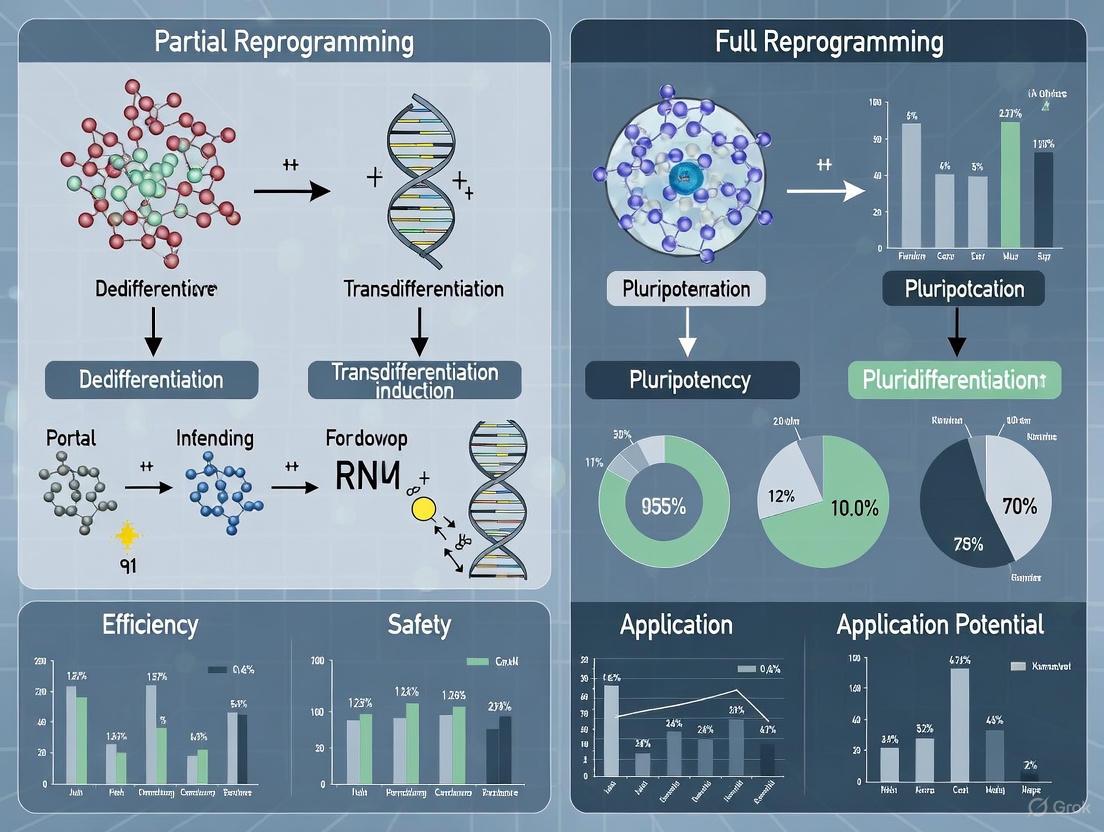
This article provides a comprehensive comparative analysis of partial and full cellular reprogramming, two pivotal strategies in regenerative medicine and aging research.
Partial vs. Full Cellular Reprogramming: A Comparative Analysis of Mechanisms, Applications, and Clinical Translation
Abstract
This article provides a comprehensive comparative analysis of partial and full cellular reprogramming, two pivotal strategies in regenerative medicine and aging research. Aimed at researchers, scientists, and drug development professionals, it delineates the fundamental principles, contrasting the complete dedifferentiation to pluripotency achieved by full reprogramming with the identity-preserving, transient epigenetic reset of partial reprogramming. The scope encompasses methodological approaches, including factor delivery via viral vectors and emerging non-integrative techniques like tissue nanotransfection. It critically examines the significant challenges of each paradigm, notably the tumorigenic risks of full reprogramming and the precise dosing required for safe partial reprogramming. Finally, the article synthesizes validation data from in vivo models, comparing efficacy in lifespan extension, functional rejuvenation, and therapeutic potential, thereby offering a roadmap for future biomedical and clinical applications.
Core Concepts and Evolutionary Pathways of Cellular Reprogramming
The ability to reprogram a mature, differentiated cell into a more primitive state represents one of the most transformative breakthroughs in modern biology. This field is dominated by two distinct yet interconnected paradigms: full reprogramming, which aims to achieve complete pluripotency, and partial reprogramming, which seeks to reverse age-related markers while maintaining cellular identity. Full reprogramming resets the epigenetic clock to zero, creating induced pluripotent stem cells (iPSCs) with unlimited self-renewal capacity and the potential to generate any cell type in the body [1] [2]. In contrast, partial reprogramming applies reprogramming factors transiently, enough to rejuvenate cells but not enough to erase their identity—a process that effectively turns back the epigenetic clock without returning it to the embryonic starting point [3] [2].
The distinction between these approaches has profound implications for both basic research and therapeutic development. While full reprogramming provides a powerful platform for disease modeling and regenerative medicine, partial reprogramming has emerged as a promising strategy for combating age-related degeneration and disease without the tumorigenic risks associated with pluripotency [4] [2]. This comparative analysis examines the mechanisms, efficiency, applications, and safety profiles of these complementary technologies, providing researchers with a framework for selecting the appropriate paradigm for specific experimental or therapeutic goals.
Conceptual Frameworks and Molecular Mechanisms
The Pluripotency Network and Full Reprogramming
Full cellular reprogramming to pluripotency involves profound epigenetic remodeling that reverses the developmental clock, effectively returning somatic cells to an embryonic-like state. The process is primarily driven by the Yamanaka factors (OCT4, SOX2, KLF4, and c-MYC, collectively known as OSKM), which collaboratively reactivate the endogenous pluripotency network while suppressing somatic cell programs [1] [5]. At the molecular level, this transition involves global changes in chromatin architecture, DNA methylation patterns, and histone modifications that establish a self-reinforcing pluripotent state.
The reprogramming process follows a hierarchical trajectory with distinct molecular landmarks. Initially, c-MYC induces global histone acetylation, facilitating the binding of OCT4 and SOX2 to their target loci [1]. KLF4 subsequently suppresses somatic gene expression while activating pluripotency factors. The late stages of reprogramming are marked by the activation of endogenous pluripotency factors such as NANOG, which create a stable, self-sustaining regulatory network that maintains the pluripotent state independent of the initial exogenous factors [1]. This complete epigenetic reset results in cells with essentially zero biological age, as reflected by the reversal of DNA methylation clocks to an embryonic ground state [2].
Rejuvenation Without Loss of Identity
Partial reprogramming operates on a fundamentally different principle—applying reprogramming factors just long enough to reverse age-related epigenetic changes but not long enough to erase cellular identity. This approach capitalizes on the discovery that the rejuvenating benefits of reprogramming can be separated from the loss of cell fate [2]. The molecular signature of successful partial reprogramming includes reduction in senescence-associated β-galactosidase, decreased double-strand DNA breaks, restoration of youthful morphology, and reversal of epigenetic aging clocks without pluripotency activation [4].
The timing and dosage of reprogramming factor expression are critical determinants between partial and full reprogramming outcomes. Studies have demonstrated a dose-dependent relationship between reprogramming duration and epigenetic age reversal, with shorter exposures sufficient for rejuvenation while longer exposures drive cells toward pluripotency [2]. This temporal sensitivity enables researchers to titrate the reprogramming process to achieve specific outcomes, making partial reprogramming a more controllable approach for therapeutic applications where maintaining original cell identity is essential.
Table 1: Core Conceptual Differences Between Full and Partial Reprogramming
| Parameter | Full Reprogramming | Partial Reprogramming |
|---|---|---|
| Primary Objective | Achieve pluripotent state | Reverse aging markers |
| Cell Identity | Completely erased | Maintained |
| Epigenetic State | Reset to embryonic ground state | Reverted to younger somatic state |
| Key Factors | OSKM or OSNL | OSKM (transient exposure) |
| Therapeutic Risks | Teratoma formation, genomic instability | Incomplete rejuvenation, potential viral vector issues |
| Primary Applications | Disease modeling, cell therapy, drug screening | Age-related disease treatment, cell rejuvenation |
Signaling Pathways in Reprogramming and Rejuvenation
The molecular pathways that govern reprogramming outcomes provide critical insights into the mechanistic differences between full and partial reprogramming. The diagram below illustrates the key signaling pathways and their roles in these processes:
Signaling Pathways in Reprogramming
The PI3K-AKT signaling pathway has been identified as a critical mediator of reprogramming efficiency, particularly in the context of stabilizing the pluripotency network during full reprogramming [6]. Conversely, the p53 pathway serves as a major barrier to reprogramming, with its inhibition significantly increasing efficiency and accelerating the transition to pluripotency [3]. Metabolic reprogramming from oxidative phosphorylation to glycolysis represents another essential step in full reprogramming, providing the necessary energy and biosynthetic precursors for rapid cell proliferation [1].
In partial reprogramming, these pathways are modulated differently. While OSKM-mediated partial reprogramming typically downregulates p53 signaling, chemical partial reprogramming using the 7c cocktail has been shown to upregulate p53, suggesting alternative pathways to rejuvenation that may offer enhanced safety profiles [3]. The differential activation of these core signaling pathways between full and partial reprogramming underscores their distinct biological mechanisms and therapeutic risk-benefit considerations.
Experimental Approaches and Methodologies
Reprogramming Workflows: From Somatic Cell to Target State
The experimental pathways for achieving full versus partial reprogramming share initial steps but diverge significantly in their execution and endpoints. The following diagram illustrates the key decision points in these experimental workflows:
Reprogramming Experimental Workflow
Factor Delivery Systems and Their Applications
The method of delivering reprogramming factors significantly influences both the efficiency and safety of reprogramming experiments. Researchers have developed multiple delivery systems with distinct characteristics suited for different applications:
Table 2: Comparison of Reprogramming Factor Delivery Systems
| Delivery Method | Genetic Material | Genomic Integration | Best Application Context | Key Advantages | Key Limitations |
|---|---|---|---|---|---|
| Sendai Virus | RNA | Non-integrating | Partial reprogramming studies | High efficiency, non-integrating | Viral clearance required |
| Episomal Vectors | DNA | Non-integrating | Clinical applications | Non-integrating, non-viral | Lower efficiency |
| Retrovirus/Lentivirus | DNA | Integrating | Basic research, iPSC generation | High efficiency, stable expression | Insertional mutagenesis risk |
| Chemical Reprogramming | Small molecules | Non-integrating | Therapeutic applications | Non-genetic, controllable | Complex multi-stage process |
Sendai virus vectors have demonstrated superior reprogramming success rates compared to episomal methods, making them particularly valuable for partial reprogramming experiments where transient, high-efficiency expression is desired [7]. The CytoTune-iPS Sendai Reprogramming Kit has been successfully employed in multiple partial reprogramming studies, including the rejuvenation of senescent mesenchymal stem cells, where it achieved significant reversal of age-related markers after just 5 days of transduction [4].
For clinical applications where safety concerns preclude viral vectors, non-integrating methods such as episomal vectors or chemical reprogramming offer preferable alternatives. Chemical reprogramming represents a particularly promising approach, utilizing small molecule combinations to induce pluripotency or rejuvenation without genetic manipulation [3] [5]. This method activates a highly plastic intermediate cell state with enhanced chromatin accessibility, enabling epigenetic remodeling without permanent genetic alterations.
The Scientist's Toolkit: Essential Research Reagents
Successful reprogramming experiments require careful selection of reagents and culture conditions. The following table details essential research reagents used in both full and partial reprogramming protocols:
Table 3: Essential Research Reagents for Reprogramming Studies
| Reagent Category | Specific Examples | Function in Reprogramming | Application Context |
|---|---|---|---|
| Reprogramming Factors | OCT4, SOX2, KLF4, c-MYC/L-MYC | Initiate epigenetic remodeling | Both full and partial |
| Small Molecule Enhancers | CHIR99021 (GSK3 inhibitor), PD0325901 (MEK inhibitor), Valproic acid | Enhance efficiency, replace transcription factors | Primarily full reprogramming |
| Senescence Assays | SA-β-galactosidase stain, p16/p21 expression analysis | Quantify rejuvenation effects | Primarily partial reprogramming |
| Pluripotency Verification | Alkaline phosphatase staining, NANOG/OCT4 immunostaining | Confirm pluripotent state | Primarily full reprogramming |
| Culture Supplements | Y-27632 (ROCK inhibitor), LIF, Activin A | Enhance cell survival, maintain pluripotency | Both full and partial |
The composition of culture media represents another critical variable in reprogramming experiments. For full reprogramming, specialized maintenance media such as mTeSR1 are essential for preserving pluripotency [7]. In partial reprogramming studies, standard growth media like DMEM/F12 are typically used, as the goal is to maintain rather than erase the original cell identity [4]. The inclusion of ROCK inhibitor (Y-27632) significantly improves cell survival during the critical early phases of both reprogramming paradigms [7].
Quantitative Comparison of Efficiency and Outcomes
Reprogramming Efficiency Metrics
The efficiency of cellular reprogramming varies dramatically between approaches and is influenced by multiple factors including cell type, delivery method, and culture conditions. The following table summarizes key efficiency metrics for full and partial reprogramming:
Table 4: Efficiency Comparison Between Reprogramming Approaches
| Efficiency Parameter | Full Reprogramming (iPSC Generation) | Cell Fusion Reprogramming | Partial Reprogramming |
|---|---|---|---|
| Time to Completion | 4+ weeks [8] | Less than 10 days [8] | 5-10 days [4] [2] |
| Reprogramming Efficiency | Less than 0.001% [8] | More than 0.005% [8] | Varies by protocol |
| Partially Reprogrammed Colonies | Common intermediate [8] | Almost none [8] | Target outcome |
| Key Advantages | True pluripotency, self-renewal | Much faster and more efficient [8] | Maintains cell identity, lower tumorigenic risk |
| Major Limitations | Low efficiency, tumorigenic risk | Tetraploid/aneuploid cells [8] | Incomplete rejuvenation |
Cell fusion reprogramming, while not the focus of this review, provides interesting comparative data—demonstrating that direct introduction of a somatic nucleus into a pluripotent environment can achieve more efficient and rapid reprogramming than standard iPSC generation, though it produces tetraploid or aneuploid cells of limited therapeutic value [8].
For partial reprogramming, success is measured not by pluripotency acquisition but by specific rejuvenation markers. In studies with senescent human mesenchymal stem cells, partial reprogramming for 5 days resulted in an 85% restoration of youthful morphology, significant reduction in senescence-associated β-galactosidase, decreased double-strand DNA breaks, and renewed proliferation capacity [4].
Functional Outcomes in Disease Modeling and Therapeutic Applications
The functional capabilities of cells produced through full versus partial reprogramming differ substantially, making each approach suitable for distinct research and therapeutic applications:
Table 5: Functional Outcomes and Applications of Reprogramming Technologies
| Application Domain | Full Reprogramming Outcomes | Partial Reprogramming Outcomes |
|---|---|---|
| Disease Modeling | Patient-specific iPSCs for neurodegenerative diseases, cardiac disorders [1] [5] | Limited application (maintains original cell identity) |
| Cell Therapy | iPSC-derived cells for retinal, neural, cardiac applications [9] | Rejuvenated autologous cells for age-related conditions |
| Aging Research | Complete epigenetic reset [2] | Epigenetic age reversal without identity loss [3] [4] |
| Drug Screening | iPSC-derived differentiated cells for toxicity testing [1] | Pharmacological rejuvenation screening |
| Therapeutic Safety | Teratoma risk, genomic instability [10] | Maintenance of cellular function, reduced tumorigenic risk |
Clinical translation of these technologies has progressed further for full reprogramming approaches, with 115 clinical trials using human pluripotent stem cell products registered as of December 2024, targeting primarily eye, central nervous system, and cancer indications [9]. These trials have dosed more than 1,200 patients with over 100 billion cells, demonstrating no generalizable safety concerns to date.
Partial reprogramming approaches are primarily in preclinical development but show remarkable promise for treating age-related conditions. In vivo studies using cyclic induction of OSKM factors in mouse models have demonstrated extended lifespan (up to 109% increase in remaining lifespan in 124-week-old mice), improved tissue function, and reversal of age-related transcriptomic and metabolomic changes without teratoma formation [3] [2].
Technical Challenges and Safety Considerations
Addressing Technical Hurdles in Reprogramming
Both full and partial reprogramming face significant technical challenges that must be addressed for successful experimental outcomes. For full reprogramming, the exceptionally low efficiency (typically <0.001%) represents a major barrier, requiring sophisticated screening and selection strategies to isolate successfully reprogrammed cells [8] [1]. The prolonged duration of the process (4+ weeks) creates additional challenges in maintaining culture stability and preventing spontaneous differentiation.
Partial reprogramming faces its own unique technical challenges, primarily related to the precise titration of reprogramming factor expression. The narrow window between insufficient exposure (failed rejuvenation) and excessive exposure (loss of cellular identity) requires careful optimization for each cell type and experimental context [4] [2]. Additionally, the persistence of viral vectors in some systems poses both technical and safety concerns, as demonstrated by studies showing viral components in conditioned medium from Sendai virus-reprogrammed cells [4].
The source somatic cells also significantly impact reprogramming outcomes. Research comparing different starting cell types has shown that while success rates vary across cell types, the reprogramming method itself (Sendai virus vs. episomal vectors) has a more profound impact on outcomes than the source material [7]. This underscores the importance of selecting appropriate delivery systems based on experimental goals rather than defaulting to convenience in source cell selection.
Safety Profiles and Risk Mitigation
The safety considerations for full and partial reprogramming differ substantially, reflecting their distinct biological endpoints and applications:
Full Reprogramming Risks:
- Tumorigenicity: The use of oncogenic factors like c-MYC and the inherent tumorigenic potential of pluripotent cells creates significant safety concerns for clinical applications [5] [10].
- Genomic instability: The extensive epigenetic remodeling and prolonged culture periods increase risks of chromosomal abnormalities and mutational load [1].
- Risk mitigation strategies: Approaches include using L-MYC instead of c-MYC, non-integrating delivery systems, chemical reprogramming, and stringent genomic screening of resulting iPSC lines [5] [7].
Partial Reprogramming Risks:
- Incomplete rejuvenation: Partial reprogramming may reverse some but not all age-related defects, potentially limiting therapeutic efficacy [4].
- Vector persistence: Viral vectors used in some partial reprogramming protocols may persist and cause unintended effects, as evidenced by hemagglutination activity in conditioned medium from reprogrammed cells [4].
- Risk mitigation strategies: Chemical reprogramming approaches, optimized exposure protocols, and thorough characterization of rejuvenation markers help address these concerns [3] [2].
For both approaches, the field is increasingly moving toward non-integrating, non-viral methods to enhance safety profiles. Chemical reprogramming represents a particularly promising direction, utilizing small molecule combinations to achieve either full pluripotency or partial rejuvenation without genetic manipulation [3] [5].
The choice between full and partial reprogramming paradigms should be guided by specific research objectives and therapeutic goals. Full reprogramming remains the gold standard for applications requiring true pluripotency, such as disease modeling, drug screening platforms, and generating cells for regenerative medicine. The ability to create patient-specific iPSCs with unlimited expansion potential provides unprecedented opportunities for studying human development and disease mechanisms.
Partial reprogramming offers a complementary approach focused specifically on reversing age-related deterioration while maintaining cellular identity. This paradigm shows exceptional promise for treating age-related diseases, rejuvenating senescent cells, and potentially extending healthspan. The more controlled nature of partial reprogramming and its reduced risk of tumorigenicity make it particularly attractive for in vivo therapeutic applications.
Future developments in both fields will likely focus on enhancing precision and safety—through improved factor delivery systems, more refined temporal control, and chemical approaches that eliminate the need for genetic manipulation. As both technologies mature, they may increasingly be used in complementary fashion, with full reprogramming providing foundational insights into pluripotency mechanisms that inform the optimization of partial reprogramming protocols for specific therapeutic applications.
The field of cellular reprogramming has undergone a revolutionary transformation, fundamentally altering our understanding of cellular identity and differentiation. This journey began with somatic cell nuclear transfer (SCNT) experiments and culminated in the groundbreaking discovery of induced pluripotent stem cells (iPSCs) using the Yamanaka factors. Today, the field has advanced beyond full reprogramming to pluripotency toward more refined partial reprogramming approaches that promise to reverse age-related deterioration without losing cellular identity. This comparative analysis examines the historical evolution of reprogramming technologies, their methodological frameworks, and their transformative potential in regenerative medicine and aging research.
Part I: The Foundation - Establishing Reprogramming Technologies
Somatic Cell Nuclear Transfer (SCNT): The Initial Breakthrough
The conceptual foundation for cellular reprogramming was established through pioneering SCNT experiments beginning in the 1950s. These studies demonstrated that the epigenetic state of differentiated cells remains pliable when exposed to appropriate cytoplasmic factors [11] [10].
Seminal Experiments:
- 1950s: Briggs and King showed that enucleated frog oocytes could incorporate blastula cell nuclei and develop into hatched tadpoles [11].
- 1960s: John Gurdon demonstrated that differentiated frog intestinal cells could serve as donor cells for nuclear transfer, giving rise to adult animals at approximately 1% efficiency [11] [10].
- 1990s: SCNT extended to mammalian species, most famously resulting in the cloning of Dolly the sheep [11].
- Recent advances: SCNT has been demonstrated in non-human primates, though human SCNT remains elusive [11].
The critical insight from these experiments was that oocytes and embryonic stem cells contain trans-acting factors capable of resetting the epigenetic landscape of differentiated cells back to an embryonic state [11].
The Yamanaka Factors: A Molecular Revolution
In 2006, Shinya Yamanaka's team achieved a landmark breakthrough by identifying a minimal set of transcription factors sufficient to reprogram somatic cells to pluripotency [5] [12]. This discovery provided the molecular mechanism underlying nuclear reprogramming and earned Yamanaka the 2012 Nobel Prize.
Key Development Timeline:
| Year | Milestone Achievement | Researchers |
|---|---|---|
| 2006 | First mouse iPSCs using Oct4, Sox2, Klf4, c-Myc (OSKM) with Fbx15 selection | Takahashi and Yamanaka [12] |
| 2007 | Improved mouse iPSCs using Nanog selection; viable chimeric mice | Multiple groups [12] |
| 2007 | Human iPSCs from fibroblasts using OSKM (Yamanaka) or OCT4, SOX2, NANOG, LIN28 (Thomson) | Takahashi et al.; Yu et al. [12] |
The original iPSC derivation process was slow and inefficient (0.01-0.1%), taking 1-2 weeks for mouse cells and 3-4 weeks for human cells [12]. Subsequent research identified that Oct4 and Sox2 represented the core essential factors, while Klf4 and c-Myc served as efficiency boosters [10] [12].
Part II: Technical Evolution - Refining Reprogramming Methods
Optimization of Reprogramming Factors
Following the initial discovery, extensive research focused on improving the safety and efficiency of reprogramming factors:
Factor Optimization Strategies:
- Oncogene reduction: c-Myc was identified as dispensable, though with reduced efficiency (approximately 0.001%) [11] [12].
- Alternative factors: L-Myc substitution reduced tumorigenic risk while maintaining efficiency [5].
- Family member substitution: KLF2/KLF5 could replace KLF4; SOX1/SOX3 could replace SOX2 [5].
- Non-transcription factor approaches: Small molecules like RepSox could replace SOX2; miRNAs (miR-302/367, miR-372) improved reprogramming efficiency [5].
Delivery System Innovations
The development of safer delivery methods has been crucial for clinical translation prospects:
Table: Comparison of Reprogramming Delivery Systems
| System Type | Genetic Material | Genomic Integration | Key Advantages | Key Limitations |
|---|---|---|---|---|
| Retrovirus | DNA | Yes | Established protocol | Multiple integrations; insertional mutagenesis [11] |
| Lentivirus | DNA | Yes | Higher efficiency; can infect non-dividing cells | Integration near transcription start sites [11] |
| Sendai Virus | RNA | No | High efficiency; non-integrating | Viral clearance required; immunogenic [13] |
| mRNA | RNA | No | Non-integrating; controllable | Requires repeated transfection; immunogenic [14] |
| Episomal Plasmid | DNA | No | Non-integrating; simple | Low efficiency; potential random integration [5] |
Chemical Reprogramming: A Non-Genetic Approach
The most recent advancement involves fully chemical reprogramming using small molecule cocktails, eliminating the need for genetic manipulation entirely [15] [16]. This approach utilizes compounds across three categories: epigenetic modulators, cell signaling regulators, and metabolic modulators [16].
Key Chemical Cocktails:
- Full reprogramming: Sequential treatment with multiple small molecules over 40+ days can generate chemical iPSCs (ciPSCs) [16].
- Partial reprogramming: Short-term treatment (6 days) with 7-compound cocktail (7c: CHIR99021, DZNep, Forskolin, TTNPB, VPA, Repsox, TCP) reverses aging hallmarks [16].
- Optimized partial reprogramming: Reduced 2-compound cocktail (2c) maintains rejuvenation effects with simplified application [16].
Part III: Paradigm Shift - From Full to Partial Reprogramming
Conceptual Framework and Definitions
The recognition that complete reprogramming to pluripotency poses significant clinical risks, particularly teratoma formation, prompted the development of partial reprogramming approaches:
Table: Comparison of Full vs. Partial Reprogramming Strategies
| Characteristic | Full Reprogramming | Partial Reprogramming |
|---|---|---|
| Endpoint | Pluripotent stem cells | Rejuvenated somatic cells |
| Cellular Identity | Erased | Maintained |
| Duration | Extended (weeks) | Short-term (days) |
| Tumor Risk | High (teratoma formation) | Lower |
| Epigenetic Reset | Complete | Targeted/Partial |
| Therapeutic Application | Limited by safety concerns | Higher translational potential |
Molecular Mechanisms of Partial Reprogramming
Recent research has illuminated the mechanistic basis for partial reprogramming:
Epigenetic Reconfiguration:
- Transient expression of reprogramming factors promotes resetting of the epigenetic clock without eliminating cellular identity [14].
- In human cells, a 4-day mRNA-based OSKMLN (OCT4, SOX2, KLF4, c-MYC, LIN28, NANOG) protocol reversed DNA methylation age by approximately 3.4 years according to Horvath's epigenetic clock [14].
- The transient naive treatment (TNT) strategy emulates the embryonic epigenetic reset, correcting epigenetic memory and aberrations seen in conventional hiPS cells [13].
Cellular Hallmark Reversal: Partial reprogramming has demonstrated efficacy in reversing multiple aging hallmarks:
- Reduction of DNA damage markers (γH2AX) [16]
- Restoration of heterochromatin marks (H3K9me3, HP1γ) [14]
- Improvement in mitochondrial function and reduction of ROS [15] [14]
- Enhancement of autophagy and proteasomal activity [14]
- Reduction of cellular senescence [16]
Figure 1: Aging Hallmarks Targeted by Partial Reprogramming. Partial reprogramming interventions simultaneously address multiple cellular hallmarks of aging, providing a comprehensive rejuvenation approach.
Part IV: Experimental Applications and Validation
In Vitro Disease Modeling
iPSC technology has become invaluable for investigating human diseases, particularly those with genetic components:
Neurodegenerative Disease Modeling:
- ALS patient-specific iPSCs differentiated into motor neurons (iPSC-MNs) provide robust platforms to recapitulate disease-specific pathology [5].
- These models enable investigation of molecular mechanisms and accelerate discovery of novel therapeutic strategies [5].
Progeroid Syndrome Research:
- iPSCs generated from Hutchinson-Gilford progeria syndrome (HGPS) donors facilitate study of accelerated aging mechanisms [10].
- HGPS iPSCs show characteristic nuclear blebs, chromatin organization defects, increased DNA damage susceptibility, and accelerated telomere shortening [10].
In Vivo Therapeutic Efficacy
Multiple studies have demonstrated the functional benefits of partial reprogramming approaches in whole organisms:
Mammalian Models:
- Short-term cyclic induction of OSKM in progeroid mice ameliorated aging hallmarks and extended lifespan [10] [16].
- Improved regenerative capacity demonstrated in multiple tissues including intervertebral disc, heart, skin, skeletal muscle, liver, optic nerve, and dentate gyrus [16].
C. elegans Lifespan Extension:
- Treatment with a 2-compound chemical reprogramming cocktail extended median lifespan by over 42% [16].
- Improved stress resistance, thermotolerance, and healthspan markers were observed [16].
Part V: The Scientist's Toolkit - Essential Research Reagents
Table: Key Reagents for Reprogramming Research
| Reagent Category | Specific Examples | Function in Reprogramming |
|---|---|---|
| Core Transcription Factors | OCT4, SOX2, KLF4, c-MYC/L-MYC | Master regulators of pluripotency network [5] [12] |
| Alternative Reprogramming Factors | NANOG, LIN28, SALL4, Esrrb, Glis1 | Enhance efficiency or replace core factors [5] |
| Epigenetic Modulators | VPA, Sodium butyrate, Trichostatin A, 5-aza-cytidine | Histone deacetylase/DNA methyltransferase inhibitors [5] |
| Signaling Pathway Modulators | CHIR99021 (GSK3 inhibitor), RepSox (TGF-β inhibitor) | Enhance reprogramming efficiency [5] [16] |
| Metabolic Regulators | Forskolin, 8-Br-cAMP | Activate cAMP signaling pathway [5] [16] |
| Additional Small Molecules | TTNPB, Tranylcypromine, DZNep | Support chemical reprogramming approaches [16] |
Part VI: Current Challenges and Future Directions
Technical Limitations and Safety Concerns
Despite significant advances, several challenges remain for clinical translation:
Tumorigenicity Risk:
- Both administered iPSCs and in vivo reprogramming have generated teratomas in mouse models [10].
- The proto-oncogenes c-Myc and Klf4 present particular safety concerns [11] [16].
Delivery Efficiency:
- Methods allowing efficient in vivo delivery of reprogramming factors require further development [10].
- Fine-tuning of factor expression levels and duration remains challenging [10].
Mechanistic Understanding:
- Complete understanding of how partial reprogramming achieves rejuvenation without loss of cellular identity is still evolving [15].
Emerging Frontiers and Methodological Innovations
Figure 2: Evolution of Reprogramming Technologies. Current research focuses on refining partial reprogramming approaches, while future directions aim toward clinical translation and personalized applications.
Advanced Reprogramming Strategies:
- Transient Naive Treatment (TNT): Reprogramming that emulates the embryonic epigenetic reset, correcting both epigenetic memory and aberrations [13].
- Chemical Reprogramming: Small molecule-only approaches that eliminate genetic manipulation entirely [15] [16].
- Tissue-Specific Optimization: Recognition that different cell types require distinct reprogramming conditions and efficiencies [6].
- Mesenchymal Drift Reversal: Targeting the pervasive upregulation of mesenchymal genes across multiple cell types during aging [17].
The journey from SCNT to Yamanaka factors and beyond represents one of the most transformative trajectories in modern biology. The paradigm has evolved from complete cellular reprogramming to pluripotency toward targeted partial reprogramming that rejuvenates cells while maintaining their identity. Current evidence demonstrates that partial reprogramming approaches can reverse multiple hallmarks of aging, restore youthful gene expression patterns, reset epigenetic clocks, and extend healthspan in model organisms.
The comparative analysis presented here reveals that each reprogramming methodology offers distinct advantages and limitations. While full reprogramming to pluripotency remains invaluable for disease modeling and developmental studies, partial reprogramming approaches show greater promise for therapeutic applications in age-related diseases. The recent development of non-integrative delivery methods and chemical reprogramming cocktails further enhances the translational potential of these technologies.
As the field advances, key challenges remain in optimizing delivery efficiency, ensuring safety, and fully elucidating the mechanisms underlying epigenetic rejuvenation. However, the rapid progress in reprogramming technologies suggests a future where targeted epigenetic resetting could potentially address fundamental drivers of aging and age-related diseases, representing a paradigm shift in regenerative medicine and therapeutic intervention.
The metaphor of an epigenetic landscape, first conceived by Conrad Waddington, provides a powerful framework for understanding cellular aging and rejuvenation [18]. In this analogy, a cell's developmental path is likened to a marble rolling down a landscape with branching valleys, each representing a different cellular fate. As organisms age, this landscape deteriorates: epigenetic information is progressively lost, chromatin structure is disrupted, and nucleocytoplasmic compartmentalization breaks down [18] [19]. This erosion of epigenetic control represents a fundamental driver of aging, contributing to mitochondrial dysfunction, inflammation, and cellular senescence [19].
Cellular reprogramming has emerged as a revolutionary approach to reverse this age-related epigenetic deterioration. By transiently exposing cells to reprogramming factors, researchers can potentially restore youthful epigenetic patterns without erasing cellular identity [20] [18]. This comparative guide examines the two primary strategies—partial and full reprogramming—evaluating their mechanisms, efficacy, and translational potential for research and therapeutic applications.
Comparative Analysis of Reprogramming Modalities
The field has developed distinct approaches to reprogramming, each with characteristic methodologies, outcomes, and risk profiles. The table below provides a systematic comparison of partial and full reprogramming strategies based on current research findings.
Table 1: Comparative Analysis of Partial vs. Full Cellular Reprogramming
| Feature | Partial Reprogramming | Full Reprogramming |
|---|---|---|
| Definition | Transient exposure to reprogramming factors, insufficient to erase cellular identity [20] | Sustained factor expression until cells reach pluripotent state [18] |
| Key Factors | OSK (Oct4, Sox2, Klf4) or OSKM (with c-Myc) [3] [21] | OSKM (Oct4, Sox2, Klf4, c-Myc) [18] |
| Primary Goal | Epigenetic rejuvenation while maintaining cell identity [20] [3] | Complete reset to pluripotent stem cell state [18] |
| Epigenetic Impact | Reversal of age-related DNA methylation patterns [3] | Global epigenetic reset to embryonic state [18] |
| Telomere Dynamics | Telomeres not significantly elongated [20] | Telomere elongation to embryonic lengths (~70kb) [20] |
| Tumorigenic Risk | Moderate (teratomas reported with prolonged OSKM) [20] [21] | High (frequent teratoma formation) [3] |
| In Vivo Efficacy | Improved tissue function, extended lifespan in mice [3] | Not applicable (incompatible with organismal survival) [20] |
| Therapeutic Viability | Higher potential for in vivo applications [3] | Limited to in vitro research and cell therapy generation [20] |
Quantitative Outcomes in Model Systems
Rigorous preclinical studies across species have demonstrated the rejuvenating potential of partial reprogramming, with significant extensions in both healthspan and lifespan. The following table summarizes key quantitative findings from seminal in vivo studies.
Table 2: Quantitative Outcomes of Partial Reprogramming in Model Organisms
| Organism/Model | Intervention | Lifespan Effect | Healthspan & Functional Outcomes |
|---|---|---|---|
| Progeric Mice (LAKI) | Cyclic OSKM induction (2-day pulse, 5-day chase) [3] | 33% median lifespan increase [3] [21] | Reduced mitochondrial ROS, restored H3K9me levels [3] |
| Wild-type Mice (124 weeks old) | AAV9-OSK gene therapy (1-day pulse, 6-day chase) [3] | 109% remaining lifespan extension [3] [21] | Frailty index improved from 7.5 to 6.0 [3] |
| C. elegans | Two-chemical cocktail (2c) [16] | 42.1% median lifespan increase [21] [16] | Improved stress resistance, thermotolerance, reproductive function [16] |
| Wild-type Mice | Long-term cyclic OSKM (7-10 months) [3] | No lifespan data reported [3] | Transcriptome, lipidome, metabolome rejuvenation in multiple tissues [3] |
Experimental Protocols & Methodologies
Genetic Reprogramming Protocols
In Vivo Partial Reprogramming in Mice
- Transgenic Model: LAKI mice with doxycycline-inducible polycistronic OSKM cassette [3]
- Induction Protocol: Cyclic doxycycline administration (2-day pulse, 5-day chase) for up to 35 cycles [3]
- Controls: Littermates without doxycycline treatment [3]
- Outcome Measures: Lifespan, DNA methylation clocks, transcriptomics, histopathology for teratoma formation [3]
AAV9-Mediated Gene Therapy
- Vector: Adeno-associated virus serotype 9 with broad tissue tropism [3] [21]
- Construct: Tetracycline-responsive element (TRE) controlling OSK expression (c-Myc excluded) [3]
- Administration: Single injection followed by cyclic doxycycline (1-day pulse, 6-day chase) [3]
- Safety Measure: Exclusion of c-Myc to reduce tumorigenic risk [3] [21]
Chemical Reprogramming Protocols
Seven-Compound (7c) Cocktail Treatment
- Compounds: CHIR99021, DZNep, Forskolin, TTNPB, Valproic acid (VPA), Repsox, Tranylcypromine (TCP) [16]
- Cell Culture: Primary human dermal fibroblasts from aged donors [16]
- Treatment Duration: 6 days continuous exposure [16]
- Assessment: γH2AX quantification (DNA damage), heterochromatin markers, senescence assays, ROS measurement [16]
Optimized Two-Compound (2c) Cocktail
- Compounds: CHIR99021 and VPA (based on efficacy screening) [16]
- In Vivo Testing: C. elegans lifespan assays [16]
- Endpoint Analysis: Stress resistance, thermotolerance, reproductive capacity, molecular aging markers [16]
Signaling Pathways in Reprogramming
The molecular pathways governing reprogramming-induced rejuvenation involve complex interactions between epigenetic regulators, signaling networks, and metabolic processes. The diagram below illustrates the key pathways and their interactions in partial reprogramming.
Pathway Interactions and Regulatory Dynamics The diagram illustrates two primary entry points to epigenetic reset: OSK transcription factors (genetic approach) and chemical cocktails (non-genetic approach). While both converge on epigenetic rejuvenation, they differentially regulate the p53 pathway—a critical barrier and safety mechanism [3]. OSK-mediated reprogramming typically downregulates p53 to enhance efficiency, whereas chemical reprogramming often upregulates this tumor suppressor pathway, potentially offering a superior safety profile [3]. The interplay between mTOR and AMPK/SIRT pathways integrates nutrient-sensing with epigenetic remodeling, influencing mitochondrial function and stress resistance [21]. These coordinated changes ultimately reduce cellular senescence, improve genomic stability, and restore youthful functionality across multiple tissue types.
The Scientist's Toolkit: Essential Research Reagents
Table 3: Key Research Reagents for Reprogramming Studies
| Reagent/Category | Specific Examples | Research Function & Application |
|---|---|---|
| Reprogramming Factors | OSK (Oct4, Sox2, Klf4), OSKM (+ c-Myc) [3] | Gold standard for inducing epigenetic reprogramming; OSK preferred for safety [3] [21] |
| Chemical Cocktails | 7c (CHIR99021, DZNep, Forskolin, TTNPB, VPA, Repsox, TCP), optimized 2c [16] | Non-genetic alternative for rejuvenation; modulates epigenetic enzymes and signaling pathways [16] |
| Delivery Vectors | AAV9, lentiviral vectors, modified mRNAs [3] | In vivo delivery of genetic reprogramming factors; AAV9 offers broad tissue tropism [3] |
| Age Reporters | Epigenetic clocks, NCC reporters (NLS-mCherry, NES-eGFP) [19] | Quantification of rejuvenation effects; NCC reporters visualize nucleocytoplasmic compartmentalization [19] |
| Senescence Assays | β-galactosidase, SASP factor measurement, γH2AX foci [16] | Detection and quantification of cellular senescence before/after intervention [16] |
| Animal Models | Progeric mice (LAKI), inducible transgenic mice, C. elegans [3] [16] | In vivo testing of safety and efficacy; progeric models enable accelerated lifespan studies [3] [16] |
The comparative analysis of partial versus full reprogramming reveals a dynamic field moving toward clinical translation. Partial reprogramming offers a viable path to epigenetic rejuvenation with manageable risks, while chemical reprogramming represents a promising non-genetic alternative that may overcome safety barriers [3] [16]. Current evidence demonstrates that multiple aging hallmarks—including epigenetic drift, mitochondrial dysfunction, and cellular senescence—can be simultaneously addressed through these approaches [16].
Future research priorities include optimizing tissue-specific delivery systems, developing more precise temporal control over reprogramming, and establishing comprehensive safety profiles for long-term interventions [20] [3]. The ongoing development of causality-enriched epigenetic clocks and single-cell multi-omics approaches will further enhance our ability to quantify rejuvenation while monitoring for potential oncogenic transformations [21]. As these technologies mature, partial reprogramming may ultimately transition from laboratory research to clinical applications for age-related diseases, representing a paradigm shift in regenerative medicine.
Cellular reprogramming represents a paradigm shift in regenerative medicine, fundamentally challenging the long-held notion that cell differentiation is a unidirectional and irreversible process. This field, catalyzed by the seminal discovery of induced pluripotent stem cells (iPSCs) by Yamanaka and Takahashi, has demonstrated that somatic cells can be reprogrammed to a pluripotent state through the forced expression of specific transcription factors—primarily OCT4, SOX2, KLF4, and c-MYC (collectively known as OSKM) [10] [5]. The potential applications of this technology are vast, ranging from disease modeling and drug discovery to the emerging frontier of rejuvenation therapies that target the fundamental mechanisms of aging [10] [3] [16].
The process of reprogramming can be conceptually understood through the lens of Waddington's epigenetic landscape metaphor, where cells are represented as balls rolling downhill through progressively narrowing valleys, each representing a specific differentiated cell fate [10]. Reprogramming effectively pushes these balls back uphill, reversing their developmental trajectory. More recently, the field has bifurcated into two complementary approaches: full reprogramming, which completely resets cellular identity to generate iPSCs, and partial reprogramming, which applies reprogramming factors transiently to reverse age-related characteristics without erasing cellular identity [10] [3] [20]. This comparative analysis will dissect the molecular drivers, mechanisms, and applications of both OSKM-based and alternative reprogramming strategies, providing researchers with a structured framework for selecting appropriate methodologies for specific experimental or therapeutic goals.
The OSKM Factors: Mechanisms and Molecular Roles
The OSKM transcription factors constitute the foundational machinery of cellular reprogramming, each playing distinct yet interconnected roles in dismantling the somatic cell program and establishing pluripotency. Understanding their individual functions is crucial for optimizing reprogramming protocols and developing safer alternatives.
OCT4 (Octamer-binding transcription factor 4): As a member of the POU transcription factor family, OCT4 serves as a master regulator of pluripotency. It is expressed in every cell during the early stages of murine and human development, where it upregulates genes associated with pluripotency, self-renewal, and stem cell maintenance [10] [5]. OCT4 activates its own expression through a positive feedback loop while simultaneously repressing genes associated with differentiation, thereby maintaining the embryonic stem cell state. Its presence is absolutely essential for reprogramming, as no other factor can compensate for its loss in the OSKM combination.
SOX2 (SRY-box 2): Functioning as a high-mobility group (HMG) box transcription factor, SOX2 collaborates with OCT4 to regulate the expression of key pluripotency genes, including themselves through interconnected autoregulatory loops [10] [5]. SOX2 plays a critical role in early development and maintains the self-renewal capacity of pluripotent stem cells. Like OCT4, SOX2 is indispensable for reprogramming, and its absence cannot be overcome by other factors in the standard OSKM cocktail.
KLF4 (Krüppel-like factor 4): This transcription factor exhibits context-dependent functionality, acting as either a transcriptional activator or repressor depending on the cellular environment [10]. During reprogramming, KLF4 promotes the activation of pluripotency genes, including NANOG, which is critical for maintaining pluripotency [10]. Additionally, KLF4 helps overcome reprogramming barriers by interacting with epigenetic modifiers. While considered less essential than OCT4 and SOX2, KLF4 significantly enhances reprogramming efficiency.
c-MYC (cellular Myelocytomatosis): As a proto-oncogene and global regulator of transcription, c-MYC influences up to 15% of the genes in the human genome through chromatin structure modification [10] [5]. It promotes reprogramming primarily by enhancing cellular proliferation and metabolic reprogramming, effectively priming the chromatin for the action of other reprogramming factors. However, its oncogenic potential poses significant safety concerns for therapeutic applications [5].
The following table summarizes the key characteristics, functions, and safety considerations for each OSKM factor:
Table 1: Molecular Profiles of OSKM Reprogramming Factors
| Factor | Type | Key Functions in Reprogramming | Essentiality | Safety Concerns |
|---|---|---|---|---|
| OCT4 | POU transcription factor | Master regulator of pluripotency; activates self-renewal genes | Essential | High expression in various cancers |
| SOX2 | HMG-box transcription factor | Partners with OCT4; regulates pluripotency network | Essential | High expression in various cancers |
| KLF4 | Zinc-finger transcription factor | Activates NANOG; context-dependent activator/repressor | Enhances efficiency | Proto-oncogene |
| c-MYC | Basic helix-loop-helix transcription factor | Global chromatin modifier; enhances proliferation | Not essential | Proto-oncogene; tumorigenic risk |
The collaborative action of these factors initiates a complex rewiring of the cellular transcriptome and epigenome, ultimately leading to the acquisition of pluripotency. However, the tumorigenic potential of particularly c-MYC and KLF4 has prompted the search for safer alternatives and refinement of the original OSKM combination [5] [3].
Alternative Reprogramming Strategies
The safety concerns associated with the canonical OSKM factors, particularly the oncogenic potential of c-MYC and KLF4, have driven the development of alternative reprogramming strategies. These approaches aim to maintain high reprogramming efficiency while mitigating the risks of tumorigenesis and other adverse effects.
Factor Substitution and Optimization
Research has demonstrated that the OSKM combination can be modified through factor substitution while maintaining reprogramming capability. The OSNL combination (OCT4, SOX2, NANOG, and LIN28) has proven sufficient to reprogram human somatic cells to pluripotency, effectively addressing the tumorigenic risks associated with c-MYC [5]. Furthermore, studies have identified that specific family members can substitute for their OSKM counterparts: KLF2 and KLF5 can replace KLF4; SOX1 and SOX3 can substitute for SOX2; and L-MYC and N-MYC can replace c-MYC, with L-MYC showing particularly promising reduction in tumorigenic risk [5]. Beyond direct family members, other genes and proteins can perform analogous functions; for instance, NR5A2 can substitute for OCT4 when combined with SOX2 and KLF4 [5].
Chemical Reprogramming with Small Molecules
A groundbreaking advancement in the field has been the development of fully chemical reprogramming approaches that eliminate the need for genetic manipulation entirely. These methods utilize cocktails of small molecules that modulate key signaling pathways and epigenetic barriers to induce pluripotency [5] [16] [22]. Two prominent cocktail formulations have emerged:
The 7c Cocktail: This combination consists of seven small molecules: CHIR99021 (a GSK-3 inhibitor), DZNep (a histone methylation inhibitor), Forskolin (a cAMP activator), TTNPB (a retinoic acid receptor agonist), Valproic acid (a histone deacetylase inhibitor), Repsox (a TGF-β inhibitor), and Tranylcypromine (a lysine-specific demethylase 1 inhibitor) [16]. This cocktail has demonstrated efficacy in ameliorating multiple aging hallmarks in human dermal fibroblasts, including reducing DNA damage markers and improving epigenetic profiles [16].
The 2c Cocktail: Researchers have identified an optimized combination containing only Repsox and Tranylcypromine that retains significant rejuvenation capabilities [23] [16]. This simplified cocktail has been shown to restore multiple aging phenotypes, including genomic instability, epigenetic dysregulation, cellular senescence, and elevated reactive oxygen species. Importantly, in vivo application of the 2c cocktail extends both lifespan and healthspan in C. elegans models [16].
Table 2: Comparison of Small Molecule Reprogramming Cocktails
| Cocktail | Components | Key Mechanisms | Efficiency | Toxicity Concerns | Documented Effects |
|---|---|---|---|---|---|
| 7c Cocktail | CHIR99021, DZNep, Forskolin, TTNPB, Valproic acid, Repsox, Tranylcypromine | Epigenetic modulation, signaling pathway inhibition | High | Moderate toxicity in mice [23] | Reverses multiple aging hallmarks in human fibroblasts [16] |
| 2c Cocktail | Repsox, Tranylcypromine | TGF-β inhibition, LSD1 inhibition | Moderate | Higher toxicity than 7c in mice with fewer benefits [23] | Extends C. elegans lifespan by 42.1%; improves healthspan [16] |
The following diagram illustrates the continuum of reprogramming approaches, from full to partial reprogramming, and their associated cellular outcomes:
Reprogramming Modalities and Outcomes: The diagram illustrates the divergent cellular fates resulting from full versus partial reprogramming protocols.
Chemical reprogramming follows a distinct trajectory compared to OSKM-based approaches, often involving an intermediate plastic state with enhanced chromatin accessibility and activation of early embryonic developmental genes [5]. This pathway shares similarities with cellular dedifferentiation processes observed in lower organisms, such as the initial limb regeneration in axolotls [5]. Importantly, chemical reprogramming demonstrates that increased cell proliferation is not strictly essential for cellular rejuvenation, as 7c-mediated partial reprogramming achieves epigenetic clock reversal despite decreasing cell proliferation rates [3].
Comparative Analysis: Full vs. Partial Reprogramming
The distinction between full and partial reprogramming represents a critical conceptual and practical divide in reprogramming research, with each approach offering distinct advantages and challenges for basic research and therapeutic applications.
Full Reprogramming to Pluripotency
Full reprogramming aims to completely reset somatic cells to a pluripotent state, generating induced pluripotent stem cells (iPSCs) that closely resemble embryonic stem cells in their differentiation potential, morphology, proliferation rate, gene expression, surface markers, and telomerase activity [10] [5]. This approach typically requires sustained expression of reprogramming factors over an extended period (several weeks) until cells complete the transition to a stable pluripotent state. The primary applications of full reprogramming include:
- Disease modeling: Generating patient-specific iPSCs for studying disease mechanisms [10] [5]
- Drug discovery and screening: Creating platforms for compound testing [5]
- Developmental biology: Studying early human development and differentiation [5]
- Cell therapy development: Producing differentiated cell types for transplantation [22]
However, full reprogramming faces significant challenges for direct therapeutic applications, particularly the risk of teratoma formation if any undifferentiated iPSCs remain after differentiation [10] [5]. Additionally, the use of integrating vectors for factor delivery raises concerns about insertional mutagenesis and oncogenic transformation [5] [22].
Partial Reprogramming for Rejuvenation
Partial reprogramming involves the transient application of reprogramming factors—just long enough to reverse age-associated epigenetic changes but not long enough to erase cellular identity [3] [20]. This approach capitalizes on the observation that reprogramming factors can ameliorate aging hallmarks before completing the transition to pluripotency. Key applications and findings include:
- Rejuvenation of aged cells: Restoration of youthful gene expression patterns, mitochondrial function, and metabolic profiles [3] [16] [20]
- Lifespan extension: Cyclic induction of OSKM extended lifespan by 33% in progeroid mice and by 109% in old wild-type mice [3]
- Tissue regeneration: Improved function in multiple tissues including retina, skeletal muscle, heart, liver, and brain [3] [24]
- Epigenetic reset: Reversal of age-related epigenetic marks without changing cellular identity [3] [20]
The critical challenge in partial reprogramming is fine-tuning the protocol to achieve optimal rejuvenation without risking teratoma formation or loss of cellular function [10] [3]. The following table compares the key characteristics of these two approaches:
Table 3: Full vs. Partial Reprogramming Comparison
| Parameter | Full Reprogramming | Partial Reprogramming |
|---|---|---|
| Factor Exposure | Sustained (weeks) | Transient/Cyclic (days) |
| Cellular Outcome | Pluripotent stem cells | Differentiated cells with youthful characteristics |
| Epigenetic State | Complete reset | Partial reset towards younger pattern |
| Cell Identity | Lost | Retained |
| Primary Applications | Disease modeling, drug screening, cell therapy | Rejuvenation, healthspan extension, tissue regeneration |
| Major Risks | Teratoma formation, genetic abnormalities | Incomplete rejuvenation, potential teratoma with improper dosing |
| Delivery Methods | Viral vectors, mRNAs, proteins | Viral vectors, small molecules, mRNAs |
Experimental Protocols and Workflows
Implementing reprogramming protocols requires careful consideration of multiple experimental parameters. Below are detailed methodologies for key approaches cited in the literature.
OSKM-Mediated Partial Reprogramming In Vivo
The landmark study by Ocampo et al. established a cyclic induction protocol for partial reprogramming in progeroid mice that has been widely adapted [3] [24]:
- Animal Model: LAKI mice carrying a Tet-inducible polycistronic OSKM cassette
- Induction Protocol:
- Administration of doxycycline (dox) in drinking water or food
- Cyclic regimen: 2-day induction pulse followed by 5-day chase (no dox)
- Repeated weekly for multiple cycles (e.g., 35 cycles in progeria study)
- Controls: Littermates receiving no dox treatment
- Outcome Measures:
- Lifespan extension (33% increase in progeroid mice)
- Histological analysis of tissues for teratoma formation
- Molecular analyses: mitochondrial ROS, H3K9me levels, transcriptomics, epigenomics
- Functional assessments: spine curvature, skin integrity, cardiovascular function
This protocol has been successfully adapted for wild-type mice, with one study utilizing a 1-day pulse/6-day chase regimen in 124-week-old mice, resulting in a 109% extension of remaining lifespan [3].
Chemical Partial Reprogramming of Human Fibroblasts
A detailed protocol for chemical partial reprogramming of aged human dermal fibroblasts has been described [16]:
- Cell Source: Primary human fibroblasts isolated from aged dermal tissue samples
- Culture Conditions: Standard fibroblast culture conditions
- Treatment Cocktail: 7c combination (CHIR99021, DZNep, Forskolin, TTNPB, Valproic acid, Repsox, Tranylcypromine)
- Treatment Duration: Continuous exposure for 6 days
- Control Groups: Untreated aged fibroblasts, young fibroblasts
- Assessment Methods:
- Immunofluorescence for DNA damage marker γH2AX
- Senescence-associated β-galactosidase staining
- Reactive oxygen species (ROS) detection
- Heterochromatin markers (H3K9me3)
- Transcriptomic and epigenomic analyses
The following workflow diagram illustrates the key decision points in designing a reprogramming experiment:
Reprogramming Experimental Workflow: Key decision points in designing reprogramming experiments.
Direct Chemical Reprogramming to Cardiomyocytes
A recent innovative protocol demonstrates direct reprogramming of human urine cells into cardiomyocytes using small molecules [22]:
- Cell Source: Human urine-derived cells (hUCs) isolated from fresh urine samples
- Reprogramming Cocktail: 15 small molecules under xeno-free conditions
- Culture Conditions: DMEM/F12 and keratinocyte serum-free medium mixture
- Timeline:
- Reprogramming efficiency of 15.08% achieved by day 30
- Purity reaches 96.67% by day 60
- Characterization Methods:
- Immunofluorescence for cardiomyocyte markers
- Transmission electron microscopy for sarcomeric structures
- Patch-clamp recordings for action potentials
- Intracellular Ca²⁺ measurements
- Single-cell RNA sequencing
- Functional Validation:
- Transplantation in mouse and porcine myocardial infarction models
- Assessment of cardiac function (ejection fraction, fractional shortening)
- Histological analysis of fibrosis and engraftment
The Scientist's Toolkit: Essential Research Reagents
Successful implementation of reprogramming protocols requires access to specific reagents and tools. The following table catalogs essential research reagents mentioned in the cited literature:
Table 4: Essential Research Reagents for Reprogramming Studies
| Reagent Category | Specific Examples | Key Functions | Applications |
|---|---|---|---|
| Core Reprogramming Factors | OCT4, SOX2, KLF4, c-MYC (OSKM) | Master regulators of pluripotency | Full and partial reprogramming |
| Alternative Genetic Factors | NANOG, LIN28, L-MYC, NR5A2, Esrrb, Glis1 | Enhance efficiency or replace oncogenic factors | Safer reprogramming protocols |
| Small Molecule Cocktails | 7c (CHIR99021, DZNep, Forskolin, TTNPB, VPA, Repsox, TCP); 2c (Repsox, TCP) | Epigenetic modulators, signaling pathway inhibitors | Chemical reprogramming and rejuvenation |
| Epigenetic Modulators | Valproic acid (HDAC inhibitor), Tranylcypromine (LSD1 inhibitor), DZNep (histone methylation inhibitor) | Modify chromatin accessibility, overcome epigenetic barriers | Enhance reprogramming efficiency |
| Signaling Pathway Modulators | CHIR99021 (GSK-3 inhibitor/Wnt activator), Repsox (TGF-β inhibitor) | Regulate key developmental pathways | Promote metabolic reprogramming |
| Delivery Systems | Retrovirus, lentivirus, Sendai virus, AAV, episomal plasmids, mRNAs | Introduce reprogramming factors into cells | Variable integration, efficiency, and safety profiles |
| Reprogramming Models | Progeroid mouse models (LAKI), C. elegans, human aged fibroblasts | Test rejuvenation effects in vitro and in vivo | Lifespan and healthspan studies |
The field of cellular reprogramming has evolved dramatically from the initial discovery of OSKM-mediated iPSC generation to the current exploration of partial reprogramming for rejuvenation. The molecular drivers of reprogramming—whether the canonical OSKM factors or emerging small molecule alternatives—offer powerful tools for manipulating cellular identity and age. The comparative analysis presented herein reveals that the choice between full and partial reprogramming, and between genetic and chemical approaches, depends fundamentally on the research or therapeutic objectives.
For therapeutic applications targeting aging, partial reprogramming approaches—particularly those using transient OSKM expression or small molecule cocktails—show remarkable promise in reversing age-related molecular hallmarks and extending healthspan in model organisms [3] [16]. However, significant challenges remain in translating these approaches to human therapies, including optimizing delivery methods, ensuring precise spatiotemporal control, and mitigating potential risks such as teratoma formation [10] [3] [24]. The development of chemical reprogramming strategies offers a particularly promising path forward, as small molecules can potentially be administered systemically with finer temporal control and reduced risk of genomic integration compared to genetic approaches [23] [16] [22].
Future research directions should focus on elucidating the precise molecular mechanisms through which both OSKM factors and small molecule cocktails reverse epigenetic aging, developing tissue-specific reprogramming protocols, and establishing safety profiles for long-term therapeutic applications. As the field advances, the optimal approach may involve combining multiple strategies—for instance, using small molecules to enhance the efficiency and safety of factor-based reprogramming—to achieve robust and controlled cellular rejuvenation for both research and clinical applications.
Technical Execution and Therapeutic Targeting in Reprogramming
The field of cellular reprogramming, which enables the conversion of one cell type into another, is revolutionizing regenerative medicine, disease modeling, and drug development [25]. The efficacy and safety of reprogramming are profoundly influenced by the delivery system used to introduce reprogramming factors into target cells. This guide provides a comparative analysis of the three primary delivery modalities: viral vectors, messenger RNA (mRNA) packaged in lipid nanoparticles (LNPs), and chemical reprogramming. Framed within the broader thesis of comparing partial versus full reprogramming research, this article objectively evaluates the performance, experimental data, and practical applications of each system for a scientific audience. Full reprogramming, typically achieved with viral vectors, aims to create induced pluripotent stem cells (iPSCs) by permanently introducing factors like OCT4, SOX2, KLF4, and c-MYC (OSKM) [5] [25]. In contrast, partial reprogramming seeks to reverse age-related changes without altering cell identity, a goal for which transient delivery methods like mRNA or chemicals are increasingly relevant [10] [26].
Comparative Analysis of Delivery Systems
The table below provides a quantitative and qualitative comparison of the core delivery systems, summarizing key performance metrics, advantages, and limitations.
Table 1: Comprehensive Comparison of Reprogramming Delivery Systems
| Feature | Viral Vectors (Lentivirus/LV) | mRNA/LNP Systems | Chemical Reprogramming |
|---|---|---|---|
| Key Components | Lentivirus, Adenovirus, Adeno-associated virus (AAV) [27] | Synthetic mRNA, Ionizable lipid, Cholesterol, Helper phospholipid, PEG-lipid [28] [29] | Small molecule cocktails (e.g., VPA, CHIR99021, 616452, DZNep) [25] |
| Reprogramming Efficiency | High (e.g., up to 31% with optimized viral factors) [25] | Highly efficient in protein expression; dependent on LNP design [29] | Low to Moderate (e.g., 0.04% - 31%, highly variable with cocktail) [25] |
| Cargo Capacity | Medium (~9 kb for LV) to Large [30] [27] | Limited only by mRNA length; suitable for multiple genes [28] | Not applicable (acts on endogenous pathways) |
| Genomic Integration | Yes (risks insertional mutagenesis) [30] [27] | No (transient expression in cytoplasm) [28] [26] | No (epigenetic/modulatory effect) [25] |
| Stability of Expression | Stable, long-term (due to integration) [27] | Transient (hours to days) [28] | Transient, requires sustained application [25] |
| Ideal for Full Reprogramming | Excellent (requires permanent factor expression) [5] [25] | Challenging (requires repeated dosing for sustained effect) | Possible but often low efficiency [25] |
| Ideal for Partial Reprogramming | Risky (difficult to control duration, high risk of tumorigenesis) [10] | Excellent (inherently transient, controllable) [26] | Excellent (non-genetic, controllable exposure) [10] [31] |
| Tumorigenicity Risk | High (especially with c-Myc; insertional mutagenesis) [5] [10] | Low (non-integrating, degradable) [28] [29] | Very Low (non-genetic) [25] |
| Major Challenge | Immunogenicity, insertional mutagenesis, cost [30] [27] | Optimizing endosomal escape, liver tropism, cost per dose [29] [27] | Low efficiency, complex optimization, unclear mechanisms [25] |
| Key Applications | Ex vivo cell therapy (e.g., CAR-T), iPSC generation [30] [27] | Vaccines, in vivo protein replacement therapy, transient reprogramming [28] [29] | In vivo rejuvenation, direct transdifferentiation, disease modeling [25] [31] |
Experimental Data and Performance
Direct Performance Comparisons
Experimental data highlights the significant performance differences between these systems. In mRNA delivery, a novel LNP named AMG1541 demonstrated a hundredfold increase in delivery efficiency compared to the FDA-approved SM-102 lipid. A flu vaccine delivered with AMG1541 in mice generated the same antibody response as the SM-102 particle but at 1/100 of the dose [29]. This was attributed to more effective endosomal escape and a greater tendency to accumulate in lymph nodes, enhancing interaction with immune cells [29].
For viral vectors, the choice of reprogramming factors directly impacts efficiency and safety. The standard OSKM combination can achieve reprogramming, but substituting the oncogenic c-Myc with other factors like SALL4, L-Myc, or Glis1 reduces tumorigenic risk while maintaining functionality [5] [25]. One study using a fusion protein strategy (Oct4-VP16, Sox2-VP16, Klf4, Nanog-VP16) reported a reprogramming efficiency of ~1.12% for mouse cells and ~0.24% for human cells [25].
Chemical reprogramming efficiencies are highly variable. Early protocols using small molecule cocktails like VPA, CHIR99021, and 616452 showed low efficiency (~0.04%) [25]. However, recent optimized cocktails have dramatically improved outcomes, with some reports achieving efficiencies as high as 1% to 31% for generating human iPSCs, demonstrating the rapid evolution of this field [25].
Table 2: Experimental Reprogramming Efficiencies by Method
| Delivery Method / Reprogramming Factor | Starting Cell Type | Ending Cell Type | Efficiency | Reference |
|---|---|---|---|---|
| Viral: OSKM | Human Dermal Fibroblasts | iPSCs | ~0.02% | [25] |
| Viral: OSKM + Valproic Acid (VPA) | Human Foreskin Fibroblasts | iPSCs | 0.73% - 1.1% | [25] |
| Viral: Sall4, Jdp2, Glis1, Esrrb | Mouse Embryonic Fibroblasts (MEFs) | iPSCs | ~8% | [25] |
| Chemical Cocktail (7-10 components) | MEFs | iPSCs | ~0.8% | [25] |
| Chemical Cocktail (21 components) | Human Embryonic Fibroblasts | iPSCs | ~1% - 31% | [25] |
| Direct Reprogramming: Ascl1, Brn2, Myt1l | MEFs | Neurons | ~19.5% | [25] |
Application in Partial vs. Full Reprogramming
The choice of delivery system is critical when distinguishing between full and partial reprogramming.
Full Reprogramming requires sustained expression of reprogramming factors to achieve a pluripotent state. Viral vectors are the traditional workhorses for this due to their stable integration and persistent expression [5] [25]. The experimental workflow is well-established, though it carries the highest safety risks.
Partial Reprogramming aims to rejuvenate cells without changing their identity. This requires a transient, precise pulse of reprogramming factors. Here, non-integrating methods shine. mRNA/LNPs offer a controllable way to deliver OSKM factors briefly, resetting epigenetic age without inducing pluripotency [26]. Similarly, chemical cocktails can modulate signaling pathways and epigenetics to promote rejuvenation, as evidenced by the restoration of youthful DNA methylation patterns and improved mitochondrial function in aged cells [10] [31]. The inherent safety of these non-genetic methods makes them superior candidates for in vivo partial reprogramming therapies.
The diagram below illustrates the core workflows for achieving full and partial reprogramming with these different systems.
Detailed Experimental Protocols
Viral Vector Protocol: Lentiviral Transduction for iPSC Generation
This is a standard protocol for generating iPSCs from human dermal fibroblasts using lentiviral vectors encoding the OSKM factors [5] [25].
- Vector Production: Produce lentiviral particles carrying individual OCT4, SOX2, KLF4, and c-MYC genes using a packaging cell line like HEK293T. Concentrate and titer the viral supernatants.
- Cell Preparation: Plate human dermal fibroblasts in appropriate media. The density should be optimized for infection (e.g., 50-70% confluency at time of transduction).
- Transduction: Replace the cell culture medium with a fresh medium containing polybrene (4-8 µg/mL) to enhance infection efficiency. Add the calculated volume of each lentivirus to the cells. Multiplicity of Infection (MOI) for each virus should be determined empirically but often ranges from 5 to 20.
- Factor Expression: After 24 hours, replace the virus-containing medium with standard fibroblast growth medium. Allow transgene expression to continue for 48-72 hours.
- Reprogramming Initiation: Trypsinize the transduced cells and re-plate them onto a feeder layer of mitotically inactivated mouse embryonic fibroblasts (MEFs) or on a Matrigel-coated plate in iPSC medium.
- iPSC Colony Selection: Change the medium every day. Embryonic stem cell-like colonies will typically appear in 2-4 weeks. These colonies can be picked mechanically or enzymatically and expanded for further characterization (e.g., pluripotency marker staining, teratoma formation) [25].
mRNA/LNP Protocol: In Vivo Delivery for Partial Reprogramming
This protocol outlines the use of mRNA/LNPs for transient, in vivo expression of reprogramming factors, suitable for partial reprogramming studies [29] [26].
- mRNA Preparation: Synthesize mRNA encoding the desired factors (e.g., OSKM) via in vitro transcription (IVT). Include a 5' cap structure (e.g., CleanCap) and a poly(A) tail to enhance stability and translation. Nucleotide modifications (e.g., pseudouridine) can reduce innate immune recognition [28].
- LNP Formulation: Prepare the LNP by rapid mixing of an ethanol phase containing the ionizable lipid (e.g., AMG1541 [29]), phospholipid, cholesterol, and PEG-lipid with an aqueous phase containing the mRNA in a citrate buffer, typically using a microfluidic device. The particles are then dialyzed to remove ethanol and adjust the buffer.
- In Vivo Administration: The formulated mRNA-LNPs are administered systemically (e.g., via intravenous injection) or locally (e.g., intramuscularly) into the animal model. Dosing must be optimized based on the target tissue and the specific LNP. The study on AMG1541 demonstrated efficacy at a dose 100-fold lower than standard LNPs [29].
- Cyclic Induction for Partial Reprogramming: To avoid full dedifferentiation, apply the mRNA-LNP treatment in short, controlled cycles (e.g., 2 days on, 5 days off). This transient pulse is sufficient to reverse epigenetic aging markers without changing cell identity [26].
- Validation: Analyze outcomes by assessing rejuvenation markers, including DNA methylation clocks, transcriptomic profiles, and functional tissue repair (e.g., wound healing assays) [10] [31].
Chemical Reprogramming Protocol: iPSC Generation from Fibroblasts
This protocol describes a method to generate iPSCs using only small molecules, eliminating the need for genetic material [25].
- Cell Preparation: Plate human fibroblasts (e.g., HEFs, hADSCs) at an appropriate density in fibroblast medium.
- Chemical Cocktail Application: Replace the medium with a reprogramming medium containing a specific cocktail of small molecules. An example cocktail includes: VPA (a histone deacetylase inhibitor), CHIR99021 (a GSK3 inhibitor), 616452 (a TGF-β inhibitor, also known as RepSox), DZNep (a histone methylation inhibitor), PD0325901 (a MEK inhibitor), Tranylcypromine, TTNPB, SAG, Y-27632, and others [25]. The exact composition and concentration are critical and have been refined over time.
- Medium Refreshment: Change the chemical-containing medium every few days, carefully monitoring cell morphology.
- Colony Emergence and Picking: Over 4-8 weeks, ES-like colonies will emerge. These colonies are then manually picked and transferred to new plates pre-coated with Matrigel.
- Expansion and Characterization: The picked colonies are expanded in a defined iPSC medium and characterized for pluripotency markers and differentiation potential. Modern chemical protocols have achieved efficiencies exceeding 30% for human cells [25].
The Scientist's Toolkit: Key Research Reagents
Table 3: Essential Reagents for Reprogramming Research
| Reagent | Function in Reprogramming | Example Use Case |
|---|---|---|
| OSKM Factors | Core transcription factors for inducing pluripotency. OCT4 and SOX2 are essential [5]. | Delivered via virus, mRNA, or DNA to initiate reprogramming in somatic cells. |
| Lipid Nanoparticles (LNPs) | Non-viral delivery system for protecting and delivering nucleic acids (mRNA, siRNA) into cells [28] [29]. | Used in mRNA vaccines and in vivo delivery of reprogramming mRNAs. |
| Valproic Acid (VPA) | Histone deacetylase inhibitor; loosens chromatin structure to improve access to reprogramming factors [25]. | Component of chemical reprogramming cocktails to enhance efficiency. |
| CHIR99021 | GSK-3 inhibitor that activates the Wnt signaling pathway, promoting self-renewal [25]. | Key molecule in chemical reprogramming and stem cell maintenance media. |
| 616452 (RepSox) | TGF-β receptor inhibitor; replaces Sox2 by modulating mesenchymal-epithelial transition (MET) [5] [25]. | Used in chemical reprogramming cocktails to mimic viral factor action. |
| Tissue Nanotransfection (TNT) | A physical, non-viral nanoelectroporation platform for in vivo gene delivery [26]. | Used for direct in vivo reprogramming of tissues for regenerative purposes. |
| Stable Packaging Cell Lines | Engineered cells (e.g., HEK293) that consistently produce high-titer viral vectors [30]. | Critical for scalable and efficient manufacturing of lentiviral or AAV vectors. |
| Sendai Virus (SeV) | An RNA virus-based vector for transgene delivery; non-integrating and eventually cleared from cells [5]. | A safer viral alternative for transient expression of reprogramming factors. |
Signaling Pathways and Workflows
The following diagram maps the core signaling pathways and molecular mechanisms targeted by different reprogramming delivery systems, leading to distinct cellular outcomes.
The field of regenerative medicine is increasingly focused on gene-based approaches to repair and replace damaged tissues. However, conventional gene delivery systems, particularly viral vectors, face substantial translational barriers including immunogenicity, off-target effects, and limited in vivo applicability [26]. Within this context, Tissue Nanotransfection (TNT) has emerged as a novel non-viral nanotechnology platform that enables in vivo gene delivery and direct cellular reprogramming through localized nanoelectroporation [26]. This technology represents a significant advancement in the comparative landscape of reprogramming strategies, particularly when evaluated against the backdrop of the ongoing scientific debate regarding partial versus full cellular reprogramming.
TNT occupies a unique position at the intersection of physical delivery systems and reprogramming methodologies. As researchers increasingly recognize the therapeutic potential of partial reprogramming approaches—which aim to reverse aging-associated changes without altering core cell identity—the need for precise, transient delivery systems has become paramount [3]. TNT addresses this need through its non-integrative gene delivery mechanism, offering a technological platform that can support the translational application of partial reprogramming research while mitigating the risks associated with viral vectors or permanent genetic modifications [26] [32].
Structural Components and Mechanism
The Tissue Nanotransfection device consists of a hollow-needle silicon chip mounted beneath a cargo reservoir containing genetic material [26]. This postage stamp-sized device is placed directly on the skin or target tissue, with the cargo reservoir connected to the negative terminal of an external pulse generator and a dermal electrode serving as the positive terminal [26] [32]. When electrical pulses are applied, the hollow needles concentrate the electric field at their tips, temporarily porating nearby cell membranes and enabling the targeted delivery of charged genetic material into the tissue [26].
The fabrication of TNT chips employs cleanroom techniques and photolithography followed by deep reactive ion etching (DRIE) of silicon wafers to create nanochannels, with backside etching of a reservoir for loading genetic factors [33] [32]. This configuration allows for precise, localized, non-viral, and efficient in vivo gene delivery, with optimization of electrical pulse parameters—including voltage amplitude, pulse duration, and inter-pulse intervals—being critical for maximizing delivery efficiency while preserving cellular viability [26].
Electroporation-Based Delivery System
TNT employs a highly localized and transient electroporation stimulus through nanochannel interfaces designed to create reversible nanopores in the plasma membrane [26]. These nanopores typically reseal within milliseconds or a few seconds, depending on cell type and membrane characteristics, with the short duration of pore opening limiting opportunities for cell damage and cytotoxicity [26]. This physical delivery mechanism offers distinct advantages over biological delivery systems (which rely on viral vectors and face challenges with immunotoxicity and off-target effects) and chemical delivery systems (which struggle with low transfection efficiency in vivo and cytotoxicity concerns) [26].
Table 1: Comparison of Gene Delivery Systems for Cellular Reprogramming
| Delivery System | Mechanism | Advantages | Limitations |
|---|---|---|---|
| TNT (Physical) | Nanoelectroporation via silicon hollow needles | High specificity, non-integrative, minimal cytotoxicity, transient expression | Limited to accessible tissues, potential scalability challenges |
| Viral Vectors (Biological) | Genetically engineered viruses | High transduction efficiency, stable gene expression | Immunotoxicity, unintended gene expression, insertional mutagenesis risk |
| Chemical Nanoparticles | Membrane disruption via polymers/lipids | Reduced immunogenicity, large genetic payload capacity | Low transfection efficiency, poor targeting specificity, cytotoxicity |
| Bulk Electroporation | Electrical field-induced membrane pores | High throughput, minimal setup time | Low cell viability, uneven electric field distribution |
Comparative Analysis: TNT Versus Alternative Reprogramming Platforms
Performance Metrics and Experimental Outcomes
When evaluated against alternative reprogramming technologies, TNT demonstrates distinctive performance characteristics across multiple metrics. In direct comparison to viral vector systems, TNT offers the advantage of transient gene expression without genomic integration, significantly reducing the risk of permanent alterations to the genome or insertional mutagenesis [26]. This non-integrative approach is particularly valuable for partial reprogramming applications where sustained expression of reprogramming factors is neither necessary nor desirable.
Recent research has prioritized plasmid DNA and mRNA for TNT applications due to their transient expression profiles [26]. Plasmid DNA transfection requires nuclear entry before gene expression, with highly supercoiled circular plasmids demonstrating greater efficiency than linear DNA plasmids [26]. Alternatively, mRNA transfection allows for direct protein translation in the cytoplasm without requiring nuclear entry, making it simpler, faster, and more efficient than DNA plasmid transfection [26]. The emergence of CRISPR/Cas9-based technologies, particularly catalytically inactive dCas9 fused to transcriptional or epigenetic effector domains, has further expanded TNT's capabilities by offering a more programmable, modular, and multiplexable platform for endogenous gene regulation [26].
Table 2: Comparative Analysis of Reprogramming Approaches Using Different Delivery Platforms
| Reprogramming Approach | Delivery Platform | Key Factors | Therapeutic Outcomes | Risks/Limitations |
|---|---|---|---|---|
| Partial Reprogramming | TNT Nanoelectroporation | OSKM factors (transient) | Reversal of aging markers, restored function without identity loss | Phenotypic stability, optimization of pulse parameters |
| Partial Reprogramming | AAV9 Vectors | OSK factors (c-Myc excluded) | Extended lifespan (109%), reduced frailty in aged mice | Limited payload capacity, immunogenicity concerns |
| Chemical Reprogramming | Small Molecule Cocktails | 7c or 2c chemical cocktails | Lifespan extension (42.1% in C. elegans), multi-omics rejuvenation | Off-target effects, undefined mechanisms for some compounds |
| Full Reprogramming | Viral Vectors | OSKM factors (sustained) | Pluripotency induction, complete cell fate conversion | Teratoma formation, ethical concerns, genomic integration |
Applications in Regenerative Medicine
TNT demonstrates transformative therapeutic potential across diverse biomedical applications, with documented success in tissue regeneration, ischemia repair, wound healing, immunomodulation, and antimicrobial therapy [26]. In one notable application, researchers used TNT to deliver a patented cocktail of plasmids (Etv2, Fli1, Foxc2) to ischemic mouse limb tissue, observing restored perfusion and establishment of new vasculature within 7 days post-treatment [32]. This demonstrates TNT's capacity for in vivo reprogramming of endogenous cells to rescue damaged tissues without cell transplantation.
Similarly, TNT has been employed to reprogram fibroblasts into neuron-like cells through delivery of a defined cocktail of reprogramming factors (ABM), with successful reprogramming observed both in the epidermis and dermis skin layers [32]. The functionality of these induced neurons was confirmed through histological and electrophysiological tests, validating TNT's capacity for creating functional cell types in situ [32]. These applications highlight TNT's versatility in addressing diverse regenerative challenges through targeted cellular reprogramming.
Experimental Protocols: Methodologies for TNT Implementation
TNT Chip Fabrication and Sterilization
The fabrication of silicon hollow-needle arrays for TNT applications follows a standardized and reproducible protocol typically requiring 5-6 days [33]. The process begins with silicon wafers that undergo photolithography to define the needle patterns, followed by deep reactive ion etching (DRIE) to create the nanochannels [33] [32]. Backside etching creates a reservoir for loading genetic cargo, completing the chip structure [33]. The sterilization of TNT devices is essential for biological applications, with ethylene oxide gas sterilization and gamma irradiation being the most frequently applied methods [26]. Ethylene oxide sterilization is particularly advantageous as it preserves the interior architecture of the nanodevices [26].
In Vivo TNT Procedure
The in vivo TNT protocol can be completed in approximately 30 minutes [33]. The procedure involves placing the fabricated TNT chip directly on the target tissue (typically skin) and loading the reservoir with the desired genetic solution [26]. An electrode (cathode) is placed into the reservoir well while a counter electrode (anode) is positioned intradermally beneath the chip [32]. The application of brief electrical pulses (lasting milliseconds) facilitates the delivery of genetic cargo to a predetermined specific depth in the tissue [33]. This rapid process enables efficient in vivo transfection without the need for viral vectors, minimizing the risk of genomic integration or cell transformation [33].
Comparative Experimental Models in Reprogramming Research
Research on partial versus full reprogramming employs diverse experimental models, each with distinctive protocols and readouts. In one notable study of partial reprogramming, researchers administered doxycycline cyclically (2-day pulse, 5-day chase) to progeric mice carrying a Tet-inducible polycistronic OSKM cassette, resulting in a 33% median lifespan increase compared to untreated controls [3]. This approach demonstrated rejuvenation of cellular phenotypes including reduced mitochondrial ROS and restoration of H3K9me levels, without observed teratoma formation [3].
Alternative approaches have explored chemical reprogramming using small molecule cocktails. In a 2025 study, researchers treated aged human dermal fibroblasts with a seven-compound (7c) cocktail or an optimized two-compound (2c) cocktail for 6 days, observing significant improvement in multiple aging hallmarks including reduced DNA damage, decreased cellular senescence, and lower oxidative stress [16]. When applied to C. elegans, the 2c cocktail extended median lifespan by over 42%, demonstrating the translational potential of chemical reprogramming approaches [16].
Signaling Pathways and Molecular Mechanisms
Reprogramming-Induced Rejuvenation Pathways
At the molecular level, partial reprogramming approaches function through complex signaling networks that modulate key aging hallmarks. The Yamanaka factors (OSKM) activate pathways that lead to epigenetic remodeling, resetting DNA methylation clocks and reversing age-associated transcriptional changes [26] [3]. This reprogramming-induced rejuvenation (RIR) is characterized by telomerase activation and telomere lengthening through epigenetic modifications that create a more open chromatin state at telomeres [26]. Additionally, mitochondrial rejuvenation enhances oxidative phosphorylation and restores mitochondrial function in aged cells [26].
Chemical reprogramming approaches operate through partially distinct mechanisms. While OSKM-mediated reprogramming typically downregulates the p53 pathway, chemical reprogramming using the 7c cocktail has been shown to upregulate p53, suggesting alternative pathways for achieving rejuvenation [3]. Furthermore, unlike OSKM-mediated approaches that typically increase cell proliferation, 7c-mediated partial reprogramming decreases proliferation while still achieving epigenetic clock reversal, indicating that increased proliferation is not strictly essential for cellular rejuvenation [3].
TNT-Specific Mechanistic Actions
TNT-mediated reprogramming operates through highly localized mechanisms at the cellular and tissue levels. The technology employs nanochannel interfaces that create reversible nanopores in the plasma membrane, enabling direct entry of genetic material into the cytoplasm [26]. For DNA-based approaches, the genetic material must subsequently reach the nucleus for transcription, while mRNA-based strategies directly engage with the translational machinery in the cytoplasm [26]. The spatial precision of TNT delivery limits the reprogramming effects to targeted areas, reducing off-target impacts and enabling localized tissue regeneration without systemic exposure.
Emerging evidence suggests that TNT may initiate bystander effects mediated by extracellular vesicles and other paracrine factors [32]. These mechanisms potentially explain the observation that reprogramming signals can propagate from the epidermis to deeper dermis layers following TNT application, indicating intercellular communication that amplifies the initial reprogramming stimulus [32]. This phenomenon represents an active area of investigation with significant implications for understanding the full therapeutic potential of TNT technology.
The Scientist's Toolkit: Essential Research Reagents and Materials
Core TNT Components and Reagents
Successful implementation of TNT technology requires specific materials and reagents that enable precise fabrication and operation. The core components include silicon wafers for chip fabrication, photoresists for lithography patterning, and etching chemicals for creating nanochannels [33]. Genetic cargo options include plasmid DNA formulations, modified mRNAs, and CRISPR/Cas9 components (including guide RNAs and Cas proteins) [26]. For in vivo applications, sterilization materials including ethylene oxide gas systems are essential for ensuring device safety [26].
Table 3: Essential Research Reagents for TNT and Reprogramming Studies
| Category | Specific Reagents/Materials | Function/Purpose | Examples/Formulations |
|---|---|---|---|
| TNT Hardware | Silicon wafers, photoresists, etching chemicals | Device fabrication with nanochannels | Standard silicon wafers, SU-8 photoresist, DRIE processes |
| Genetic Cargo | Plasmid DNA, mRNA, CRISPR components | Reprogramming factor delivery | OSKM plasmids, modified mRNAs, dCas9-effector fusions |
| Electroporation System | Pulse generator, electrodes | Application of electrical fields for nanoelectroporation | Customizable voltage/waveform generators |
| Reprogramming Factors | Yamanaka factors, lineage-specific TFs | Cell fate conversion | OSKM for pluripotency, ABM for neurons, EFF for endothelium |
| Small Molecules | Chemical reprogramming cocktails | Epigenetic and metabolic modulation | 7c cocktail: CHIR99021, VPA, Repsox, etc.; 2c optimized cocktails |
| Analysis Tools | Epigenetic clocks, senescence assays | Assessment of rejuvenation outcomes | DNA methylation arrays, β-galactosidase staining, omics profiling |
Specialized Reagents for Comparative Approaches
Research comparing TNT to alternative reprogramming platforms requires additional specialized reagents. For viral vector approaches, lentiviral or adenoviral vectors encoding reprogramming factors are necessary, along with appropriate packaging systems and titration kits [3]. For chemical reprogramming studies, small molecule cocktails such as the 7c formulation (CHIR99021, DZNep, Forskolin, TTNPB, Valproic acid, Repsox, and Tranylcypromine) or optimized 2c combinations serve as non-genetic alternatives [16]. Assessment reagents including epigenetic clocks, senescence-associated β-galactosidase staining kits, and oxidative stress detection dyes are essential for evaluating rejuvenation outcomes across all platforms [3] [16].
The selection of appropriate delivery vectors and reprogramming factors significantly influences experimental outcomes and therapeutic potential. Viral vectors offer high transduction efficiency but raise safety concerns, while chemical approaches provide non-integrative alternatives but may have undefined mechanisms for some compounds [3]. TNT occupies a middle ground with its physical delivery mechanism, offering precise spatial and temporal control without genetic integration, making it particularly suitable for partial reprogramming applications where transient expression is desirable [26].
Tissue Nanotransfection represents a significant advancement in the field of in vivo reprogramming, offering a unique combination of precision, efficiency, and safety that positions it favorably against viral and chemical alternatives. As research increasingly focuses on partial reprogramming strategies for rejuvenation and tissue regeneration, TNT's capacity for transient, localized delivery addresses critical safety concerns associated with permanent genetic modifications or teratoma formation [26] [3]. The technology's non-viral nature and minimal cytotoxicity further enhance its translational potential for therapeutic applications.
Looking forward, the trajectory of TNT development will likely focus on addressing current limitations related to phenotypic stability and scalability [26]. Additionally, integration with emerging CRISPR-based technologies, particularly epigenetic editors and synthetic transcription factors, may expand TNT's capabilities for precise gene regulation without DNA cleavage [26] [34]. As the field continues to refine partial versus full reprogramming paradigms, TNT stands as a versatile platform capable of supporting both approaches through tailored delivery strategies, offering researchers a powerful tool for advancing regenerative medicine and targeted gene therapy.
The development of induced pluripotent stem cell (iPSC) technology represents a pivotal breakthrough in regenerative medicine, disease modeling, and drug discovery. Since the landmark discovery by Shinya Yamanaka in 2006, iPSC technology has enabled researchers to reprogram adult somatic cells into a pluripotent state by introducing specific transcription factors [35]. These induced pluripotent stem cells possess the capacity for unlimited self-renewal and can differentiate into virtually any cell type of the human body, providing an unprecedented platform for studying human development, disease mechanisms, and therapeutic applications [36] [1]. The full reprogramming workflow encompasses somatic cell reprogramming, expansion of pluripotent cells, and subsequent differentiation into specific lineages, offering researchers a powerful tool to generate patient-specific cell types for investigative and clinical purposes [37].
The fundamental principle underlying iPSC generation involves the epigenetic reprogramming of a differentiated cell back to an embryonic-like state through the forced expression of key pluripotency factors [1]. This process effectively reverses the developmental clock, erasing somatic cell identity and restoring the broad differentiation potential characteristic of early embryonic cells. The resulting iPSCs have transformed biomedical research by providing unlimited access to human cell types that were previously difficult to obtain, enabling new approaches to disease modeling, drug screening, and cell-based therapies [36] [35]. This comparative guide examines the core methodologies, efficiency metrics, and experimental protocols that define the current state of full reprogramming workflows, providing researchers with practical frameworks for implementing these techniques in their investigative work.
Key Reprogramming Methodologies: A Comparative Analysis
Multiple reprogramming methods have been developed since the initial discovery of iPSCs, each with distinct advantages and limitations. The evolution from integrating to non-integrating delivery systems has significantly enhanced the safety profile of generated iPSCs by minimizing the risk of genomic alterations [7] [37]. The table below summarizes the primary reprogramming methods used in iPSC generation:
Table 1: Comparison of Primary iPSC Reprogramming Methods
| Method | Key Features | Reprogramming Efficiency | Genomic Integration | Safety Considerations | Best Applications |
|---|---|---|---|---|---|
| Sendai Virus (SeV) | Non-integrating RNA virus, delivers OSKM factors [7] | High efficiency, significantly higher than episomal methods [7] | No integration, eventually diluted out [7] [37] | Biosafety Level 1, low toxicity [37] | Clinical-grade iPSCs, high-efficiency research applications |
| Episomal Vectors | OriP/EBNA1 plasmid-based system, expresses reprogramming factors [7] | Moderate efficiency, lower than Sendai virus [7] | Non-integrating, but requires careful monitoring [7] | Minimal safety concerns after vector loss [7] | Basic research, therapeutic applications requiring non-viral approach |
| mRNA Transfection | Synthetic modified mRNAs encoding reprogramming factors [37] | High efficiency, faster kinetics [37] | No integration, purely cytoplasmic [37] | Requires multiple transfections, potential immune response [37] | Clinical applications, precision reprogramming |
| Small Molecules | Chemical compounds that modulate reprogramming pathways [37] | Variable efficiency, improving with new compounds [37] | No genetic material introduced [37] | Off-target effects require characterization [37] | Research applications, enhancing other methods |
The Sendai virus (SeV) method has demonstrated significantly higher success rates compared to episomal reprogramming methods according to comparative studies, while the source material (fibroblasts, LCLs, or PBMCs) does not significantly impact success rates [7]. Modern approaches increasingly favor non-integrating methods like Sendai virus and mRNA transfection due to their enhanced safety profiles, making them suitable for generating clinical-grade iPSCs [7] [37]. The choice of reprogramming method ultimately depends on the specific application, with Sendai virus offering the highest efficiency for critical applications, while episomal vectors provide a non-viral alternative with moderate efficiency suitable for basic research settings.
Quantitative Comparison of Reprogramming Success Rates
Recent comparative studies have provided quantitative data on the performance of different reprogramming methods across various cell sources. The table below summarizes key efficiency metrics:
Table 2: Quantitative Success Rates of Non-Integrating Reprogramming Methods
| Reprogramming Method | Starting Cell Type | Success Rate (%) | Time to Colony Emergence (Days) | Key Quality Metrics |
|---|---|---|---|---|
| Sendai Virus | Fibroblasts | High (>70% based on comparative analysis) [7] | 21-28 days [7] | Lower CNVs, SNPs, chromosomal mosaicism [7] |
| Sendai Virus | PBMCs | High (>70% based on comparative analysis) [7] | 21-28 days [7] | Lower CNVs, SNPs, chromosomal mosaicism [7] |
| Episomal Vectors | Fibroblasts | Moderate (significantly lower than SeV) [7] | 28-35 days [7] | Lower CNVs than integrating methods [7] |
| Episomal Vectors | LCLs | Moderate (significantly lower than SeV) [7] | 28-35 days [7] | Lower CNVs than integrating methods [7] |
| mRNA Transfection | Various | High, with optimized protocols [37] | 14-21 days [37] | No integration, controlled expression [37] |
These quantitative comparisons highlight the superior performance of Sendai virus-based reprogramming across different cell sources. The higher efficiency of the Sendai virus method translates to more reliable iPSC generation with reduced experimental variability, making it particularly valuable for applications requiring consistent outcomes, such as clinical development and large-scale biobanking initiatives [7]. The episomal method, while less efficient, offers a completely non-viral approach that may be preferred for certain regulatory applications despite its lower success rates.
Core Reprogramming Factors and Mechanisms
The molecular foundation of somatic cell reprogramming centers on a core set of transcription factors that orchestrate the transition from a differentiated to pluripotent state. The original Yamanaka factors (OSKM) - OCT4, SOX2, KLF4, and c-MYC - remain the most widely used combination for inducing pluripotency [35] [1]. Each factor plays distinct yet complementary roles in the reprogramming process: OCT4 and SOX2 function as primary regulators of the pluripotency network, KLF4 facilitates chromatin remodeling, and c-MYC promotes global chromatin accessibility and proliferation [1]. An alternative combination (OSNL) utilizing OCT4, SOX2, NANOG, and LIN28 has also demonstrated efficacy, particularly in human cell reprogramming [35] [1].
The reprogramming process occurs through a series of molecular events that progressively erase somatic cell identity and establish pluripotency. The early phase is characterized by the silencing of somatic genes and initiation of metabolic reprogramming, while the late phase involves activation of the endogenous pluripotency network and stabilization of the epigenetic landscape [35] [1]. This transition involves comprehensive remodeling of chromatin structure, DNA methylation patterns, histone modifications, and overall nuclear architecture [35]. The process is inherently inefficient, with only a small fraction of transfected cells achieving full pluripotency, reflecting the significant epigenetic barriers that must be overcome during reprogramming.
The molecular dynamics of reprogramming follow a biphasic trajectory, with initial stochastic events giving way to more deterministic processes as cells approach pluripotency. During the early phase, exogenous transcription factors must access closed chromatin regions to initiate widespread epigenetic changes, making this stage particularly inefficient [1]. The late phase becomes more hierarchical as cells activate endogenous pluripotency circuits that reinforce the reprogrammed state. Complete reprogramming results in iPSCs that closely resemble embryonic stem cells in their gene expression profiles, epigenetic signatures, and functional capabilities, including the ability to differentiate into all three germ layers [35] [1].
Experimental Protocols for iPSC Generation and Differentiation
Sendai Virus Reprogramming Protocol
The Sendai virus protocol represents one of the most efficient methods for iPSC generation, particularly suitable for difficult-to-reprogram cell types. The following detailed methodology is adapted from established protocols using the CytoTune Sendai Reprogramming Kit [7]:
Starting Material Preparation: Plate appropriate numbers of fibroblasts or PBMCs in optimized growth media 24 hours before transduction. Ensure cells are in log-phase growth and approximately 70-80% confluent at the time of transduction.
Virus Transduction: Thaw CytoTune Sendai virus vectors expressing hOCT4, hSOX2, hKLF4, and hC-MYC on ice. Add viral particles to cells at optimized MOI (Multiplicity of Infection) in serum-free medium containing polybrene (6-8 μg/mL). Centrifuge plates at 1000 × g for 45-60 minutes at 32°C to enhance infection efficiency (spinoculation).
Post-Transduction Culture: After 24 hours, replace transduction medium with fresh growth medium. Continue culture for approximately 6 additional days with medium exchanged every other day. Monitor transduction efficiency via EmGFP-positive cells if using reporter constructs.
Cell Harvest and Replating: Approximately 7 days post-transduction for fibroblasts (3 days for PBMCs), harvest transduced cells using gentle dissociation reagents. Replate cells onto Matrigel-coated plates at varying densities in essential 8 medium or mTeSR1 supplemented with 10 μM Y-27632 ROCK inhibitor.
Colony Selection and Expansion: After 2-3 weeks, identify and manually pick emerging iPSC colonies based on characteristic morphology (compact cells with defined edges, high nucleus-to-cytoplasm ratio). Transfer selected colonies to Matrigel-coated plates for expansion. Continue culture with daily medium changes until passage 10, establishing master and distribution banks.
This protocol typically yields iPSC colonies within 21-28 days, with Sendai virus demonstrating significantly higher success rates compared to episomal methods [7]. The complete clearance of viral vectors should be verified around passage 10-12 using RT-PCR detection methods.
Episomal Reprogramming Protocol
The episomal reprogramming method provides a non-viral approach suitable for clinical applications, though with moderately lower efficiency compared to Sendai virus [7]:
Vector Preparation: Prepare OriP/EBNA1 episomal vectors expressing hOCT3/4 with sh-p53, hSOX2, hKLF4, hL-MYC, LIN28, and EGFP using endotoxin-free purification methods.
Cell Nucleofection: Harvest and count source cells (LCLs or fibroblasts). Resuspend cells in appropriate nucleofection solution (Solution V for LCLs, Solution L for fibroblasts). Add 1-2 μg of episomal vector DNA per sample. Transfer cell-DNA mixture to certified cuvettes and nucleofect using Amaxa Nucleofector II device (program U-015 for LCLs, U-023 for fibroblasts).
Post-Nucleofection Culture: Immediately transfer nucleofected cells to pre-warmed culture medium containing 10 μM Y-27632 ROCK inhibitor. Maintain cells in 5% O2 conditions to enhance reprogramming efficiency. Assess nucleofection efficiency by monitoring GFP-positive cells.
Colony Development and Picking: On days 6-7 post-nucleofection, replate transfected cells onto feeder layers or Matrigel-coated plates. After 1-2 additional weeks, manually pick at least 24 clones based on embryonic stem cell-like morphology for further expansion.
Characterization and Banking: Expand selected clones through enzymatic passaging using Versene or ReLeSR. Establish master banks when cells expand to a minimum of nine wells of a six-well plate, with distribution banks prepared from five six-well plates.
Quality Control Assessment
Rigorous quality control is essential for validating iPSC lines regardless of reprogramming method. The following characterization should be performed:
Table 3: Essential Quality Control Measures for iPSC Lines
| Test Category | Specific Assays | Acceptance Criteria | Timing |
|---|---|---|---|
| Pluripotency Validation | Immunofluorescence for OCT4, SOX2, NANOG [7] | >90% positive cells | Pre-banking |
| Pluripotency Validation | Alkaline Phosphatase Staining [7] | Strong positive staining | Pre-banking |
| Pluripotency Validation | Teratoma Formation Assay [1] | Three germ layer differentiation | Post-banking |
| Genetic Integrity | Karyotype Analysis [7] | Normal karyotype | Master banking |
| Genetic Integrity | STR Profiling [7] | Match with donor cells | Master banking |
| Genetic Integrity | CNV/SNP Analysis [7] | Low variant load | Master banking |
| Functional Potential | Embryoid Body Formation [1] | Three germ layer markers | Characterization |
| Microbiological Safety | Mycoplasma Testing [7] | Negative | Each bank |
| Microbiological Safety | Sterility Testing [7] | No contamination | Each bank |
The Scientist's Toolkit: Essential Research Reagents
Successful implementation of iPSC generation and differentiation workflows requires access to specialized reagents and materials. The following table outlines essential components of the iPSC researcher's toolkit:
Table 4: Essential Research Reagents for iPSC Generation and Differentiation
| Reagent Category | Specific Products | Function | Application Notes |
|---|---|---|---|
| Reprogramming Kits | CytoTune Sendai Reprogramming Kit [7] | Delivers OSKM factors via non-integrating virus | High efficiency, requires BSL-1 containment |
| Reprogramming Kits | Episomal Reprogramming Vectors [7] | Non-integrating plasmid-based reprogramming | Moderate efficiency, no viral components |
| Culture Media | mTeSR1, Essential 8 [7] | Maintains pluripotency, supports iPSC expansion | Feeder-free culture, defined formulations |
| Culture Supplements | Y-27632 ROCK Inhibitor [7] | Enhances single-cell survival | Critical during passaging and thawing |
| Culture Matrices | Matrigel, Geltrex [7] | Provides extracellular matrix support | Feeder-free culture systems |
| Dissociation Reagents | Versene, ReLeSR [7] | Gentle cell dissociation | Maintains colony integrity during passaging |
| Characterization Tools | Pluripotency Antibodies (OCT4, SOX2, NANOG) [7] | Confirms pluripotent state | Immunofluorescence, flow cytometry |
| Characterization Tools | Mycoplasma Detection Kits [7] | Ensures culture purity | Regular monitoring essential |
| Banking Reagents | DMSO, Cryopreservation Media [7] | Long-term storage | Controlled-rate freezing recommended |
Differentiation of iPSCs to Specific Lineages
The utility of iPSCs fundamentally depends on their capacity to differentiate into functionally specialized cell types. The differentiation process typically involves sequential manipulation of key developmental signaling pathways to recapitulate embryonic development in vitro [37]. The flowchart below illustrates the general workflow for directed differentiation of iPSCs:
The differentiation process leverages key developmental signaling pathways including BMP, Wnt, and TGF-β, which can be precisely manipulated to direct cells toward specific fates [37]. For neural differentiation, dual SMAD inhibition using small molecule inhibitors of BMP and TGF-β signaling efficiently promotes ectodermal specification [37]. Mesodermal differentiation typically employs BMP4 and Activin A activation, while definitive endoderm formation requires precise temporal activation of WNT and Nodal signaling pathways [37]. These differentiation protocols have been refined to enhance efficiency and reproducibility, accelerating the potential clinical applications of iPSC-derived cells.
Advanced differentiation approaches now enable generation of complex tissue-like structures known as organoids, which recapitulate key aspects of native tissue architecture and cellular complexity [37]. Cerebral organoids containing multiple neuronal subtypes, liver organoids with functional hepatocytes, and intestinal organoids with crypt-villus structures have been successfully generated from iPSCs, providing valuable models for studying human development and disease mechanisms [37]. These 3D culture systems represent the cutting edge of iPSC differentiation technology, offering unprecedented opportunities to model human biology in vitro.
Applications and Future Perspectives
Fully reprogrammed iPSCs have enabled diverse applications across biomedical research and therapeutic development. In disease modeling, patient-specific iPSCs allow researchers to recapitulate human pathologies in vitro, facilitating investigation of disease mechanisms and identification of novel therapeutic targets [36] [35]. For drug discovery and toxicology testing, iPSC-derived cells provide human-relevant systems for compound screening and safety assessment, potentially reducing reliance on animal models [36]. The FDA Modernization Act 2.0 has further supported this application by permitting cell-based assays as alternatives to animal testing for drug applications [36].
In the clinical realm, iPSC-based cell therapies have progressed to clinical trials for conditions including age-related macular degeneration, graft-versus-host disease, and Parkinson's disease [36] [1]. The development of HLA-matched iPSC banks aims to enable allogeneic iPSC therapies that can be broadly distributed without immune rejection [1]. Meanwhile, ongoing research continues to enhance the safety and efficiency of reprogramming methods, with non-integrating approaches now representing the gold standard for clinical applications [7] [37].
The full reprogramming workflow for generating and differentiating iPSCs has thus established itself as a cornerstone technology in modern regenerative medicine, providing researchers with powerful tools to investigate human biology and develop novel therapeutic approaches. As methods continue to refine and applications expand, this technology promises to further transform both basic research and clinical practice in the coming years.
Partial cellular reprogramming represents a groundbreaking strategy in regenerative medicine and aging research, aiming to restore a more youthful cellular state without completely erasing cell identity. This comparative guide objectively analyzes the performance of the dominant protocols in this field: cyclic induction of Yamanaka factors and chemical reprogramming using small molecules. The core challenge these protocols address is balancing rejuvenation efficacy with safety, particularly avoiding the risks of teratoma formation and loss of cellular identity that accompany full reprogramming to pluripotency [2] [3]. The precision of dosage control and induction timing emerges as the critical differentiator between successful rejuvenation and adverse outcomes, forming the basis for this comparative analysis. This examination is situated within the broader thesis that partial reprogramming offers a more clinically viable path for treating age-related diseases than full reprogramming, as it maintains tissue function while reversing hallmark aging phenotypes.
Core Protocol Comparison: Mechanisms and Experimental Designs
The two leading approaches for partial reprogramming—transgene-based Yamanaka factor expression and chemical cocktail treatment—operate through distinct mechanisms and require unique experimental setups. The table below provides a systematic comparison of their core methodologies based on current research.
Table 1: Comparison of Core Partial Reprogramming Protocols
| Feature | OSKM-Based Cyclic Induction | Chemical Reprogramming |
|---|---|---|
| Primary Agents | Oct4, Sox2, Klf4, c-Myc (OSKM) [2] | Cocktails such as 7c (Repsox, CHIR99021, Forskolin, etc.) or 2c (Repsox, trans-2-PCPA) [38] |
| Delivery Method | Doxycycline-inducible transgenes (transgenic mice) or AAV9 viral vectors [3] | Direct application of small molecules to cell culture media [38] |
| Typical Cycle | Short pulses (e.g., 2 days ON, 5 days OFF [2] or 1-day ON, 6-day OFF [3]) | Sustained treatment (e.g., 4-6 days of continuous exposure) [38] |
| Key Mechanism | Epigenetic remodeling via transcription factor binding; potential activation of pluripotency network [2] [39] | Upregulation of mitochondrial oxidative phosphorylation (OXPHOS); modulation of signaling pathways without strong pluripotency induction [38] |
| Major Safety Concern | Teratoma formation, dysplasia, loss of cellular identity in some tissues [20] [3] | Off-target effects of chemicals; the role of p53 pathway upregulation is not fully understood [3] [38] |
Yamanaka Factor (OSKM) Cyclic Induction
The most established protocol involves the cyclic, short-term expression of the Yamanaka factors (OSKM). The foundational methodology, as demonstrated in progeric and wild-type mice, uses a doxycycline (dox)-inducible system to control OSKM expression with precise on/off cycles [2] [3]. A common regimen is a "2-day pulse" of doxycycline followed by a "5-day chase" without doxycycline, repeated cyclically [2]. This pulsatile rhythm is critical; it provides sufficient exposure to initiate epigenetic rejuvenation but is terminated before the cells commit to a pluripotent state, thereby preserving tissue identity and preventing teratomas [2]. An alternative gene therapy approach in aged wild-type mice utilized AAV9 to deliver OSK factors (excluding c-Myc for safety) and employed a 1-day-on, 6-day-off cycle, which successfully extended lifespan [3].
Chemical Reprogramming with Small Molecules
As a non-genetic alternative, chemical reprogramming employs cocktails of small molecules to induce a rejuvenated state. The experimental protocol involves treating cells, such as mouse dermal fibroblasts, with cocktails like 7c or 2c for a defined period, typically 4 to 6 days [38]. Unlike the cyclic OSKM protocol, this often involves continuous exposure. A key finding is that this method appears to operate through a different mechanistic pathway; it upregulates mitochondrial oxidative phosphorylation (OXPHOS) and does not strongly induce classic pluripotency markers like alkaline phosphatase, suggesting a potentially safer profile regarding identity loss [38]. However, it induces widespread multi-omic changes and has been shown to reverse both transcriptomic and epigenetic aging clocks [38].
Quantitative Outcomes and Performance Data
The efficacy of these protocols is quantified through their impact on molecular aging clocks, physiological function, and lifespan. The following table synthesizes key experimental results from pivotal studies, providing a basis for direct comparison of their performance.
Table 2: Comparative Experimental Outcomes of Partial Reprogramming Protocols
| Protocol & Study Model | Lifespan Extension | Epigenetic Age Reversal | Key Functional Improvements | Reported Safety Observations |
|---|---|---|---|---|
| OSKM (Cyclic, Progeria Mice) [2] [3] | +33% median lifespan | Multi-omic rejuvenation (transcriptome, lipidome) | Improved skin regeneration, reduced fibrosis | No teratomas reported after 35 cycles; some tissue dysplasia risk |
| OSK (AAV9, Old Wild-Type Mice) [3] | +109% remaining lifespan (at 124 weeks) | Not specified | Reduced frailty index (from 7.5 to 6.0) | Exclusion of c-Myc reduced tumor risk; no teratomas |
| Chemical (7c, Aged Mouse Fibroblasts) [38] | Not applicable (in vitro) | Yes (Epigenetic & transcriptomic clocks) | Increased spare respiratory capacity, restored mitochondrial membrane potential | No loss of cell identity; p53 pathway upregulated |
| Chemical (C. elegans) [3] | +42.1% lifespan | Amelioration of H3K9me3/H3K27me3 marks | Reduced DNA damage, decreased oxidative stress | Non-genetic approach, lower tumor risk postulated |
The data reveals that both approaches can achieve significant rejuvenation. OSKM-based protocols have proven efficacy in whole organisms, improving healthspan and extending lifespan in both accelerated and normal aging models [2] [3]. The exclusion of the oncogene c-Myc in the AAV9-OSK protocol appears to be a key factor in enhancing its safety profile while maintaining remarkable effectiveness [3]. Chemical reprogramming, while primarily demonstrated in vitro so far, shows a strong and distinct functional signature, particularly in revitalizing mitochondrial function—a hallmark of aging [38]. The consistent upregulation of OXPHOS and the increase in spare respiratory capacity suggest it targets a fundamental node in the aging network.
Signaling Pathways and Workflows
The following diagrams illustrate the core signaling pathways and experimental workflows for the two primary partial reprogramming strategies, highlighting the key molecular players and procedural steps.
OSKM Factor Signaling and Rejuvenation Pathway
The diagram below outlines the proposed mechanism through which the cyclic induction of OSKM factors leads to cellular rejuvenation, while also highlighting the critical safety challenges that necessitate precise dosage control.
OSKM Signaling and Rejuvenation Pathway
Partial Chemical Reprogramming Workflow
This flowchart depicts the standard experimental workflow for implementing partial chemical reprogramming in a research setting, from cell isolation to multi-omics validation of rejuvenation.
Chemical Reprogramming Workflow
The Scientist's Toolkit: Essential Research Reagents
Successful implementation of partial reprogramming protocols requires a specific set of research reagents and tools. The following table details the essential components for conducting experiments in this field.
Table 3: Key Research Reagent Solutions for Partial Reprogramming
| Reagent/Tool | Function/Description | Example Use Case |
|---|---|---|
| Doxycycline (Dox)-Inducible OSKM Cassette | Enables precise temporal control of OSKM expression in transgenic mouse models [2] [3]. | Foundational for in vivo cyclic induction studies (e.g., 2-day ON/5-day OFF pulses). |
| AAV9 Viral Vectors | Efficient in vivo delivery system for OSK(M) genes, achieving broad tissue distribution [3]. | Enables gene therapy approach in wild-type aged mice, often with c-Myc excluded. |
| 7c Chemical Cocktail | A combination of 7 small molecules (Repsox, VPA, etc.) that can reprogram somatic cells [38]. | Induces multi-omic rejuvenation in vitro; upregulates mitochondrial OXPHOS. |
| 2c Chemical Cocktail | A subset of 7c (Repsox, trans-2-PCPA) that induces some rejuvenation markers with minimal proliferation impact [38]. | Used to dissect mechanisms; increases mitochondrial membrane potential without strong pluripotency induction. |
| Alkaline Phosphatase (AP) Staining Kit | Standard assay for detecting pluripotency; used to confirm that partial reprogramming avoids full dedifferentiation [38]. | Validation step in chemical reprogramming to ensure cell identity is maintained. |
| Seahorse XF Analyzer | Instrument for measuring cellular metabolism in real-time, specifically Mitochondrial Oxygen Consumption Rate (OCR) [38]. | Key for demonstrating functional improvement in oxidative phosphorylation after treatment. |
| TMRM Fluorescent Dye | Cell-permeant dye for assessing mitochondrial membrane potential, a marker of mitochondrial health [38]. | Used to show that chemical reprogramming restores a youthful mitochondrial bioenergetic profile. |
| Mito Stress Test Kit | A standardized kit for use with the Seahorse analyzer to probe key parameters of mitochondrial function [38]. | Quantifies spare respiratory capacity, a key metric improved by 7c treatment. |
The comparative analysis of partial reprogramming protocols reveals a field defined by a trade-off between potency and control. OSKM-based cyclic induction currently has the strongest in vivo validation, demonstrating unprecedented lifespan extension in normal aged mice, but its safety is critically dependent on exquisitely precise dosing cycles and delivery systems [3]. In contrast, chemical reprogramming offers a potentially safer, more controllable, and scalable alternative, with a distinct mechanism of action centered on mitochondrial revitalization, though its efficacy in whole organisms remains less established [38]. The choice between these protocols is not merely technical but conceptual: it hinges on whether the primary goal is maximal rejuvenation (favoring refined OSK/OSKM approaches) or maximal safety and translational feasibility (favoring chemical cocktails). Future progress will likely involve hybrid strategies, leveraging insights from both genetic and chemical approaches to develop precise, safe, and effective rejuvenation therapies for human application.
Cellular reprogramming has emerged as a revolutionary force in regenerative medicine, presenting two distinct therapeutic paradigms: full reprogramming to pluripotency for disease modeling and partial reprogramming for in vivo rejuvenation. Full reprogramming, pioneered by Yamanaka and Takahashi, involves the complete resetting of somatic cells to an embryonic-like state, generating induced pluripotent stem cells (iPSCs) with vast differentiation potential. In contrast, partial reprogramming applies the same reprogramming factors—typically OCT4, SOX2, KLF4, and c-MYC (OSKM)—but only transiently, aiming to reverse age-associated epigenetic marks while maintaining cellular identity. This comparative analysis examines how these related yet distinct approaches are advancing both disease modeling for rare conditions and therapeutic rejuvenation for age-related decline, highlighting their respective protocols, applications, and translational challenges.
The fundamental distinction lies in their temporal application and therapeutic goals. Full reprogramming creates patient-specific iPSCs that can be differentiated into various cell types for modeling human diseases, particularly valuable for rare conditions where patient tissues are scarce. Meanwhile, partial reprogramming seeks to achieve epigenetic rejuvenation in living organisms without altering cell identity, potentially addressing multiple age-related pathologies simultaneously. As one perspective notes, "The clinical potential of partial cell reprogramming is undeniable," yet significant hurdles remain in achieving precise spatiotemporal control to minimize risks while preserving therapeutic benefits [20].
Full Reprogramming: Foundation for Disease Modeling
Core Methodology and Workflow
Full reprogramming typically utilizes integrative or non-integrating viral vectors to deliver the Yamanaka factors (OSKM) to somatic cells, driving them through a defined series of molecular transitions toward pluripotency. The process involves global epigenetic remodeling, including DNA demethylation at pluripotency gene promoters and restructuring of histone modifications, ultimately establishing a self-renewing pluripotent state [10]. The standard workflow begins with somatic cell isolation from patient tissues, followed by factor delivery and extended culture (typically 3-4 weeks) until iPSC colonies emerge, which are then isolated, expanded, and rigorously characterized for pluripotency markers and functional capacity.
Table 1: Full Reprogramming Applications in Progeroid Syndrome Research
| Application | Reprogramming Factors | Key Outcomes | References |
|---|---|---|---|
| HGPS iPSC Generation | OSKM | Successful derivation of iPSCs from HGPS donors; cells show disease phenotypes including progerin accumulation and nuclear abnormalities | [10] |
| Disease Modeling | OSKM | Generation of smooth muscle and endothelial cells from HGPS iPSCs; recapitulation of disease-specific pathologies in vitro | [10] |
| Drug Screening | OSKM | iPSC-derived cells enable high-throughput screening of therapeutic compounds for progeria and aging-related pathways | [10] |
Signaling Pathways in Full Reprogramming
The molecular journey during full reprogramming involves coordinated activation and suppression of multiple signaling cascades. The process initiates with the mesenchymal-to-epithelial transition (MET), driven by suppression of the TGF-β pathway and activation of epithelial genes. Subsequently, epigenetic modifiers facilitate the demethylation of pluripotency gene promoters, while cell cycle regulators including p53 and p21 present significant barriers that must be overcome for successful reprogramming. The following diagram illustrates the core signaling pathways and their interactions during the full reprogramming process:
Partial Reprogramming: Toward In Vivo Rejuvenation
Methodological Approaches and Experimental Protocols
Partial reprogramming employs carefully controlled, transient expression of reprogramming factors to achieve epigenetic rejuvenation without complete dedifferentiation. Two primary platforms have emerged: genetic delivery systems using inducible vectors and chemical reprogramming using small molecule cocktails. The genetic approach typically utilizes doxycycline-inducible lentiviral vectors or adeno-associated viruses (AAV9) to deliver OSKM or the safer OSK (excluding c-MYC) combination, with expression controlled through precise dosing regimens. For example, studies in progeria models use cyclic induction (2-day OSKM pulse followed by 5-day chase) repeated over multiple cycles, while wild-type mouse studies may employ single or multiple cycles of shorter duration [3].
Chemical reprogramming represents a promising non-genetic alternative, using defined small molecule cocktails to mimic the effects of transcription factors. Recent advances include a seven-compound (7c) cocktail—containing CHIR99021, DZNep, Forskolin, TTNPB, Valproic acid, Repsox, and Tranylcypromine—applied continuously for 6 days to aged human fibroblasts, which significantly reduced DNA damage markers and improved multiple aging hallmarks [16]. An optimized two-compound (2c) cocktail further demonstrated efficacy in extending C. elegans lifespan by over 42% while improving healthspan markers [16].
Table 2: Comparative Outcomes of Partial Reprogramming In Vivo
| Intervention | Model System | Key Rejuvenation Outcomes | Lifespan Impact | References |
|---|---|---|---|---|
| Cyclic OSKM | Progeric Mice (LAKI) | Reduced mitochondrial ROS, restored H3K9me levels, improved tissue regeneration | 33% median lifespan increase | [3] |
| AAV9-OSK Gene Therapy | Wild-type Aged Mice (124-week-old) | Improved frailty index, multi-tissue rejuvenation | 109% remaining lifespan extension | [40] [3] |
| Chemical Reprogramming (2c) | C. elegans | Improved stress resistance, thermotolerance, healthspan markers | 42.1% median lifespan extension | [16] |
| Long-term Cyclic OSKM | Wild-type Mice | Rejuvenated transcriptome, lipidome, metabolome; enhanced skin regeneration | No lifespan data reported | [3] |
Molecular Mechanisms of Partial Reprogramming
Partial reprogramming operates through complex molecular mechanisms that reset age-associated epigenetic marks while preserving cellular identity. The process primarily targets epigenetic dysregulation, a hallmark of aging, by reversing DNA methylation patterns and restoring youthful histone modification profiles. Research demonstrates that partial reprogramming ameliorates multiple aging hallmarks simultaneously, including genomic instability, epigenetic alterations, cellular senescence, and mitochondrial dysfunction [16]. The following diagram illustrates the core signaling network and molecular outcomes activated during partial reprogramming:
Comparative Analysis: Technical and Translational Considerations
Safety Profiles and Technical Limitations
The therapeutic application of reprogramming approaches necessitates careful consideration of their distinct risk profiles. Full reprogramming carries significant tumorigenic risks, as the pluripotent stem cells generated can form teratomas if transplanted in vivo [10]. Additionally, iPSCs may retain epigenetic memory of their tissue of origin or acquire genetic abnormalities during reprogramming, potentially limiting their therapeutic utility. In contrast, partial reprogramming faces different safety challenges, primarily the risk of incomplete reprogramming leading to epigenetic aberrations or the opposite danger of overshooting toward pluripotency, which can cause loss of cellular identity and teratoma formation [20].
Different tissues also show varying susceptibility to reprogramming, with some cell types demonstrating resistance while others undergo excessive dedifferentiation. Notably, organ-specific toxicity has been observed in liver and intestinal tissues during partial reprogramming experiments, and the process may favor clonal expansion of pre-existing mutated cells [40]. The choice of reprogramming factors also significantly impacts safety—including the oncogene c-MYC substantially increases tumorigenicity risk, leading many researchers to adopt the safer OSK combination [3].
Translational Potential and Clinical Applications
Full and partial reprogramming target fundamentally different clinical applications, reflected in their distinct developmental timelines. Full reprogramming has established itself as a powerful tool for disease modeling and drug screening, particularly for rare conditions like Hutchinson-Gilford Progeria Syndrome (HGPS), where patient-specific iPSCs enable detailed mechanistic studies and therapeutic screening [10]. The technology is also advancing toward cell replacement therapies, though this application remains largely in preclinical development.
Partial reprogramming represents a more radical approach—targeting the aging process itself as a therapeutic objective. By addressing multiple aging hallmarks simultaneously, it offers potential for treating age-related functional decline across multiple tissues. Recent breakthroughs demonstrating lifespan extension in wild-type animals have generated significant excitement, though the technology remains at an earlier stage of therapeutic development [3]. The emergence of chemical reprogramming approaches may accelerate clinical translation by avoiding the risks associated with genetic manipulation.
Table 3: Technical Comparison of Reprogramming Approaches
| Parameter | Full Reprogramming | Partial Reprogramming |
|---|---|---|
| Primary Applications | Disease modeling, drug screening, cell replacement therapies | In vivo rejuvenation, age-related functional decline |
| Key Safety Concerns | Teratoma formation, genetic instability, epigenetic memory | Incomplete reprogramming, teratoma formation, tissue-specific toxicity |
| Delivery Methods | Integrating/lentiviral vectors, Sendai virus, episomal plasmids | Inducible vectors, AAV9, small molecule cocktails |
| Reprogramming Duration | 3-4 weeks continuous factor expression | Transient pulses (1-2 days) with recovery periods |
| Current Status | Established disease modeling, advancing toward clinical trials | Preclinical development with promising in vivo results |
| Major Technical Hurdles | Controlling differentiation, ensuring safety for transplantation | Tissue-specific optimization, precise dosing control, safety monitoring |
The Scientist's Toolkit: Essential Research Reagents
Successful reprogramming research requires carefully selected reagents and systematic approaches. The following table details essential research tools and their applications in both full and partial reprogramming studies:
Table 4: Essential Research Reagents for Reprogramming Studies
| Reagent Category | Specific Examples | Function & Application | Considerations |
|---|---|---|---|
| Reprogramming Factors | OCT4, SOX2, KLF4, c-MYC (OSKM) | Core transcription factors for inducing pluripotency; c-MYC often excluded for safety | [3] [10] |
| Delivery Systems | Lentiviral vectors, AAV9, Sendai virus, mRNA transfection | Vehicle for introducing reprogramming factors; AAV9 shows broad tissue tropism | [3] |
| Small Molecule Cocktails | 7c cocktail (CHIR99021, DZNep, Forskolin, TTNPB, VPA, Repsox, TCP); optimized 2c cocktail | Non-genetic alternative for chemical reprogramming; enables precise temporal control | [16] |
| Induction Systems | Doxycycline-inducible promoters (Tet-On/Off) | Enables precise temporal control of reprogramming factor expression | [3] |
| Epigenetic Clocks | DNA methylation-based aging clocks (e.g., DamAge) | Quantitative biomarkers for assessing epigenetic age reversal | [40] |
| Senescence Assays | β-galactosidase staining, SASP factor measurement | Detection and quantification of cellular senescence before/after intervention | [16] |
| Lineage Tracing Systems | Cre-lox, fluorescent reporter constructs | Monitoring cell fate and identity maintenance during partial reprogramming | [20] |
The parallel development of full and partial reprogramming technologies represents a transformative frontier in regenerative medicine. While full reprogramming has established robust platforms for disease modeling and drug development, partial reprogramming offers a revolutionary approach to addressing age-related functional decline at its root. Both approaches face significant technical hurdles—particularly regarding safety controls, delivery optimization, and tissue-specific responses—but the remarkable pace of advancement suggests these barriers may be overcome in the coming years.
Future progress will likely focus on several key areas: developing more precise spatiotemporal control systems to enhance safety; optimizing tissue-specific reprogramming protocols; advancing non-genetic delivery methods; and establishing more comprehensive biomarkers to assess functional rejuvenation beyond epigenetic clocks. The emergence of computational approaches, including AI-powered cell fate mapping and single-cell transcriptomic atlases, promises to accelerate this progress by enabling more predictive modeling of reprogramming outcomes [40]. As these technologies mature, they hold potential to fundamentally reshape our approach to treating age-related diseases and potentially the aging process itself.
Navigating Technical Hurdles and Safety Concerns
The advent of cellular reprogramming, enabling the conversion of somatic cells into induced pluripotent stem cells (iPSCs), has heralded a new era in regenerative medicine and disease modeling [41] [2]. However, a significant barrier to clinical translation is the inherent oncogenic risk, particularly the formation of teratomas—benign tumors containing tissues from all three germ layers [41] [42]. The reprogramming process, whether achieved through the forced expression of transcription factors like the Yamanaka factors (OSKM: Oct4, Sox2, Klf4, c-Myc) or via chemical means, can inadvertently lead to incomplete reprogramming or the formation of pluripotent cells in vivo, posing a substantial tumorigenic threat [43] [2] [44]. Among the reprogramming factors, the proto-oncogene c-Myc has been identified as a particularly potent driver of oncogenic transformation, influencing not only cell proliferation but also critical processes like angiogenesis that support tumor growth [45] [46]. This analysis objectively compares the tumorigenic risks, specifically teratoma formation, associated with full versus partial reprogramming protocols, with a focused examination on the role of c-Myc. We summarize experimental data on teratoma incidence, detail the methodologies used to quantify this risk, and provide a comparative overview of the reagents and tools essential for researchers in this field.
Comparative Analysis of Teratoma Risk in Reprogramming Modalities
The risk of teratoma formation is intrinsically linked to the degree and duration of reprogramming factor expression. The following table synthesizes key experimental findings from the literature, highlighting the differential outcomes between full and partial reprogramming, as well as the specific impact of c-Myc.
Table 1: Comparative Experimental Data on Teratoma Formation and c-Myc's Role
| Reprogramming Modality / Factor | Experimental Model | Key Findings on Teratoma Risk & c-Myc Function | Reference |
|---|---|---|---|
| Full Reprogramming (OSKM) | Doxycycline-inducible OSKM mice | Uncontrolled induction leads to teratoma formation across multiple organs. | [3] [2] |
| Partial Reprogramming (Cyclic OSKM) | Doxycycline-inducible OSKM mice (progeric & wild-type) | Cyclic induction (e.g., 2-day ON, 5-day OFF) showed no teratoma formation, extended lifespan, and ameliorated age-related phenotypes. | [3] [2] |
| Partial Reprogramming (OSK only) | Wild-type mice via AAV9 delivery | Exclusion of c-Myc from the cocktail (using only OSK) to reduce teratoma risk; extended remaining lifespan by 109% in old mice without reported teratomas. | [3] |
| c-Myc in Angiogenesis | c-myc-/- Embryonic Stem (ES) Cells | c-Myc is essential for vasculogenesis and angiogenesis; c-myc-/- ES cells form small, poorly vascularized tumors in vivo. c-Myc regulates VEGF, angiopoietin-2, and thrombospondin-1. | [45] |
| c-Myc in Human MSC Tumorigenicity | Human Mesenchymal Stromal Cells (MSCs) | c-MYC overexpression promoted proliferation and reduced differentiation but did not immediately lead to tumor formation in a mouse model. It induced senescence markers P19ARF/P16INK4A. | [46] |
| Spontaneous In Vivo Reprogramming | Reprogrammable rOG2 Mice (without doxycycline) | Mice spontaneously developed aggressive teratomas containing Oct4-GFP+ pluripotent cells, demonstrating the inherent tumorigenic risk of accidental reprogramming in vivo. | [43] |
| iPSC vs. ESC Aggressiveness | Immune-compromised (NOD/SCID IL2Rγ-/-) mice | iPSCs formed teratomas with 100% efficiency and showed a 52% shorter latency (31 vs. 59 days) compared to hESCs after subcutaneous injection. | [42] |
The data indicates a clear trade-off: full reprogramming generates high-quality pluripotent cells but carries a significant and well-documented teratoma risk [42]. In contrast, partial reprogramming strategies appear to mitigate this risk effectively while still conferring rejuvenative benefits, as evidenced by the absence of teratoma reports in multiple in vivo studies [3] [2]. The exclusion of c-Myc from reprogramming cocktails is a specific strategy employed to enhance safety, though it may come at the cost of reduced reprogramming efficiency [3].
Detailed Experimental Protocols for Assessing Oncogenic Risk
To ensure reproducibility and provide a clear "Scientist's Toolkit," this section outlines the standard methodologies used in the cited literature to quantify teratoma risk and c-Myc function.
Teratoma Formation Assay
The teratoma assay is the gold-standard in vivo test for pluripotency and tumorigenic risk [42].
- Cell Preparation: A minimum of 1 x 10⁶ undifferentiated human iPSCs or ESCs are harvested. Cells are resuspended in a mixture of Phosphate Buffered Saline (PBS) supplemented with 30% Matrigel to enhance cell survival and engraftment [42].
- Animal Model & Injection: Immunodeficient mice, typically NOD/SCID IL2Rγ-/- (NSG) strains that lack adaptive immunity and show superior engraftment, are used. Animals aged 6-8 weeks are anesthetized. Cells are implanted either subcutaneously into the hind limb (200 µL volume) or via intratesticular injection (60 µL volume) [42].
- Monitoring & Analysis: Mice are monitored weekly for tumor formation. Latency is recorded as the time from injection to the appearance of a palpable tumor. Upon reaching a predetermined tumor size (e.g., ~1.5 cm diameter), mice are sacrificed, and tumors are excised. Tissues are fixed in 4% Paraformaldehyde (PFA), embedded in paraffin, sectioned, and stained with Hematoxylin and Eosin (H&E). Histological analysis confirms teratoma formation by identifying disorganized tissues derived from all three germ layers: ectoderm (e.g., neural tissue), mesoderm (e.g., cartilage, muscle), and endoderm (e.g., epithelial cysts) [43] [42].
In Vivo Partial Reprogramming Protocol
This protocol is designed to achieve rejuvenation without teratoma formation.
- Genetic Model: Use of transgenic mice harboring a doxycycline (dox)-inducible polycistronic cassette for OSKM or OSK factors [3] [2].
- Induction Regimen: Dox is administered cyclically to achieve transient, rather than continuous, expression of the reprogramming factors. A common regimen is a "2-day pulse" of dox in the drinking water, followed by a "5-day chase" without dox. This cycle is repeated multiple times (e.g., 35 cycles) [3] [2].
- Outcome Measures: Successful partial reprogramming is assessed by:
Assessing c-Myc-Specific Contributions
- Angiogenesis Analysis: Following the implantation of c-Myc proficient and deficient cells (e.g., ES cells), tumors are sectioned and stained with antibodies against the endothelial cell marker PECAM-1 (CD31). The density and morphology of blood vessels within the tumors are quantified to assess the role of c-Myc in supporting tumor vasculature [45].
- Senescence & Apoptosis Markers: To understand why c-MYC overexpression does not always lead to immediate transformation in human MSCs, researchers analyze the expression of tumor suppressors and senescence markers like P16INK4A and P19ARF via qRT-PCR or western blot, and assess apoptosis rates via TUNEL assays [46].
Signaling Pathways and Molecular Mechanisms
The oncogenic risk of reprogramming is governed by a network of signaling pathways and transcription factors. The following diagram synthesizes the core relationships and risks associated with key factors like c-Myc.
Diagram 1: Signaling network of reprogramming and teratoma risk. The diagram illustrates how sustained OSKM expression, particularly c-Myc, drives processes leading to teratoma formation, while partial reprogramming aims to uncouple rejuvenation from this risk.
Key Mechanistic Insights from the Diagram:
- The Central Role of c-Myc: c-Myc acts as a powerful amplifier of the reprogramming process, directly driving cell proliferation and angiogenesis by regulating key factors like VEGF and angiopoietin-2 [45]. This dual function makes it a critical determinant of tumor growth and vascularization.
- The Balance with Tumor Suppressors: The p53 pathway is a major inhibitor of OSKM-mediated reprogramming. Its inactivation can significantly increase reprogramming efficiency and tumorigenic potential, creating a delicate balance between successful reprogramming and cancer risk [3].
- The Partial Reprogramming Advantage: The pathway demonstrates the conceptual basis of partial reprogramming. By using transient or cyclic expression of the factors (often excluding c-Myc), the protocol aims to activate beneficial epigenetic rejuvenation while avoiding the terminal node of full dedifferentiation and teratoma formation [3] [2] [44].
The Scientist's Toolkit: Essential Research Reagents
The following table catalogs critical reagents and models used in the featured experiments for studying teratoma formation and c-Myc biology.
Table 2: Key Research Reagent Solutions for Oncogenic Risk Studies
| Reagent / Model | Function & Application in Research | Experimental Context |
|---|---|---|
| Doxycycline (Dox)-Inducible OSKM Mice | Allows precise temporal control over reprogramming factor expression in vivo for both full and partial reprogramming studies. | Central model for testing teratoma risk and rejuvenation protocols [3] [43] [2]. |
| NOD/SCID IL2Rγ-/- (NSG) Mice | Immunodeficient host for teratoma formation assays from human iPSCs/ESCs; enables high engraftment efficiency and lacks thymic lymphoma. | Gold-standard model for validating pluripotency and assessing tumorigenicity of human cell lines [42]. |
| Anti-PECAM-1 (CD31) Antibody | Marker for immunohistochemical staining of endothelial cells; used to quantify tumor vasculature and angiogenesis. | Essential for demonstrating c-Myc's role in tumor vascularization [45]. |
| Matrigel | Extracellular matrix supplement used in cell transplantation; improves cell viability and engraftment in teratoma assays. | Used in subcutaneous and intratesticular injections of pluripotent stem cells [42]. |
| AAV9 Delivery System | Viral vector for in vivo gene delivery; provides broad tissue tropism for delivering reprogramming factors like OSK. | Used for partial reprogramming in wild-type mice without the need for transgenic models [3]. |
| c-Myc-/- ES Cells | Tool to study the specific functional contributions of c-Myc to pluripotency, differentiation, and tumorigenesis. | Key model for elucidating c-Myc's role in angiogenesis and tumor support [45]. |
The comparative analysis clearly demonstrates that the oncogenic risk of teratoma formation is a manageable variable in reprogramming biology, not an inevitable outcome. Full reprogramming protocols, while powerful for generating iPSCs, carry a high and documented risk of teratoma formation, a risk that is exacerbated by the inclusion of the potent oncogene c-Myc [41] [42]. In contrast, partial reprogramming strategies—characterized by transient factor expression, cyclic induction, and often the exclusion of c-Myc—present a significantly safer profile, successfully uncoupling epigenetic rejuvenation from tumorigenic dedifferentiation in multiple in vivo models [3] [2] [44]. The role of c-Myc is particularly nuanced; while it is a formidable driver of proliferation and angiogenesis that contributes to tumor growth and vascularization [45], its overexpression in certain somatic contexts like MSCs can also trigger protective senescence pathways, delaying immediate transformation [46]. For researchers and drug developers, the choice of reprogramming modality must be guided by the application: full reprogramming remains essential for in vitro disease modeling, whereas partial reprogramming emerges as the leading candidate for safe in vivo therapeutic applications. Future work must focus on standardizing and optimizing these safer protocols for eventual clinical translation.
The discovery that adult somatic cells can be reprogrammed to a pluripotent state marked a revolutionary advance in regenerative medicine. However, this breakthrough revealed a fundamental paradox: the same process that resets epigenetic aging also threatens cellular identity, creating a significant barrier to therapeutic applications [3]. This comparative analysis examines the critical distinction between partial and full reprogramming methodologies, focusing on their differential effects on rejuvenation and dedifferentiation. As the field progresses, researchers are developing increasingly sophisticated approaches to separate the beneficial rejuvenating effects of reprogramming from the potentially dangerous loss of cellular identity that characterizes full dedifferentiation [47].
The conceptual framework for understanding this balance originates from the classic "epigenetic landscape" metaphor, where cells progressively lose differentiation potential as they descend into specialized valleys. Reprogramming reverses this descent, but the challenge lies in controlling how far back cells travel up the differentiation landscape [10]. Full reprogramming returns cells completely to the pluripotent plateau, erasing both age-related changes and cellular identity, while partial reprogramming aims to reverse aging signatures while maintaining functional specialization—a delicate balancing act with profound implications for therapeutic development [3].
Molecular Mechanisms: Divergent Pathways to Rejuvenation
Understanding Mesenchymal Drift and Its Reversal
Aging and many age-related diseases are characterized by a phenomenon termed mesenchymal drift (MD), a transcriptomic shift toward a mesenchymal state across diverse cell types including epithelial, endothelial, glial, and immune cells [48]. This drift involves widespread upregulation of mesenchymal genes and increased stromal cell populations, representing a loss of cellular identity at the molecular level [48].
Partial reprogramming with Yamanaka factors has demonstrated the ability to significantly reverse this mesenchymal drift, restoring more youthful transcriptional patterns while maintaining core cellular identity [48]. This reversal appears to be a fundamental mechanism through which partial reprogramming achieves its rejuvenating effects, re-establishing tissue-specific gene expression patterns that are lost during aging.
Table 1: Key Differences Between Partial and Full Reprogramming
| Feature | Partial Reprogramming | Full Reprogramming |
|---|---|---|
| Cellular Identity | Maintained or rapidly regained [3] | Completely erased, yielding pluripotency [10] |
| Epigenetic State | Resets aging signatures while preserving differentiation markers [3] | Complete epigenetic reset to embryonic state [49] |
| Risk of Teratoma | Low when properly controlled [3] [10] | High without careful management [10] |
| Therapeutic Viability | High potential for in vivo applications [16] | Limited to in vitro research and cell generation [10] |
| Key Applications | Age-related disease treatment, tissue regeneration [3] [16] | Disease modeling, patient-specific cell generation [10] |
Signaling Pathways in Reprogramming and Rejuvenation
The molecular pathways governing reprogramming and rejuvenation involve complex interactions between epigenetic regulators, metabolic processes, and signaling networks. Partial and full reprogramming appear to engage both overlapping and distinct pathways, with differential effects on critical processes such as the p53 pathway, which is downregulated during OSKM-mediated reprogramming but upregulated during chemical reprogramming [3].
Diagram 1: Molecular Pathways in Aging and Reprogramming. This diagram illustrates how partial and full reprogramming interventions differentially affect aging processes, leading to distinct cellular outcomes.
Comparative Methodologies: Experimental Approaches to Controlled Rejuvenation
Genetic Reprogramming Protocols
The original approach to cellular reprogramming utilized genetic factors, primarily the Yamanaka factors (OCT4, SOX2, KLF4, and c-MYC, collectively known as OSKM) [10]. These factors can be delivered via multiple methods, each with distinct implications for controlling the balance between rejuvenation and dedifferentiation:
Inducible Transgene Systems: Transgenic mice with doxycycline-inducible OSKM expression allow precise temporal control. The cyclic administration protocol (e.g., 2-day ON, 5-day OFF) enables partial reprogramming that ameliorates aging phenotypes without teratoma formation [3]. This approach demonstrated a 33% lifespan extension in progeroid mice and rejuvenation of transcriptomic, lipidomic, and metabolomic profiles in wild-type mice [3].
Viral Delivery Systems: Adeno-associated viruses (AAVs), particularly AAV9 with broad tissue tropism, can deliver OSK factors (often excluding c-MYC to reduce oncogenic risk). This approach extended the remaining lifespan of 124-week-old wild-type mice by 109% and improved frailty indices [3].
Non-integrating Methods: Modified mRNAs and episomal vectors provide transient expression of reprogramming factors, reducing the risk of genomic integration and permanent transgene expression [16].
Chemical Reprogramming Protocols
Chemical reprogramming represents a promising non-genetic alternative that may offer superior controllability [16]. These approaches utilize small molecules that target specific epigenetic and signaling pathways:
Seven-Compound (7c) Cocktail: Consists of repsox, trans-2-phenylcyclopropylamine, DZNep, TTNPB, CHIR99021, forskolin, and valproic acid [38]. This comprehensive cocktail can reprogram somatic cells to pluripotency but when applied short-term (typically 4-6 days) induces partial reprogramming with rejuvenation effects.
Two-Compound (2c) Cocktail: A reduced combination of repsox and trans-2-phenylcyclopropylamine that maintains rejuvenation capacity while minimizing dedifferentiation risk [16]. This simplified approach has demonstrated efficacy in improving aging hallmarks without adversely affecting cell proliferation.
Table 2: Quantitative Outcomes of Reprogramming Approaches in Model Organisms
| Reprogramming Method | Model System | Lifespan Extension | Key Functional Improvements | Safety Profile |
|---|---|---|---|---|
| Cyclic OSKM Expression | Progeroid mice | 33% median lifespan increase [3] | Improved transcriptomic profiles, skin regeneration [3] | No teratomas reported with controlled cycles [3] |
| AAV-delivered OSK | Wild-type mice (124-week-old) | 109% remaining lifespan extension [3] | Reduced frailty index scores [3] | Excluded c-MYC to reduce oncogenic risk [3] |
| Chemical Cocktail (2c) | C. elegans | 42% median lifespan extension [16] | Enhanced stress resistance, thermotolerance, healthspan [16] | Non-genetic approach with reduced tumorigenesis risk [16] |
| Chemical Cocktail (7c) | Human fibroblasts | Not applicable (in vitro) | Improved genomic instability, epigenetic alterations, oxidative stress [16] | Preserved cellular identity with short-term treatment [38] |
The Scientist's Toolkit: Essential Research Reagents
Table 3: Key Research Reagents for Reprogramming and Rejuvenation Studies
| Reagent/Category | Specific Examples | Function in Reprogramming |
|---|---|---|
| Genetic Factors | OCT4, SOX2, KLF4, c-MYC (OSKM) [10] | Core transcription factors that initiate reprogramming to pluripotency |
| Chemical Reprogramming Cocktails | 7c cocktail, 2c cocktail [16] [38] | Small molecule alternatives to genetic reprogramming factors |
| Epigenetic Modulators | VPA (HDAC inhibitor), DZNep (EZH2 inhibitor), TCP (LSD1 inhibitor) [16] [38] | Modify chromatin state to facilitate epigenetic reprogramming |
| Signaling Pathway Modulators | CHIR99021 (GSK-3 inhibitor), Repsox (TGF-β inhibitor) [16] [38] | Regulate key signaling pathways that maintain cellular identity |
| Metabolic Modulators | Forskolin (cAMP activator) [38] | Alter cellular metabolism to support reprogramming process |
| Differentiation Status Markers | Alkaline phosphatase, surface markers [38] | Assess pluripotency induction and differentiation status |
| Aging Biomarkers | Epigenetic clocks, senescence markers (γH2AX, p53) [3] [16] | Quantify rejuvenation effects and biological age reversal |
Quantitative Assessment: Measuring Rejuvenation Versus Dedifferentiation
Epigenetic and Functional Hallmarks
The efficacy of partial reprogramming approaches is quantified through multiple molecular and functional metrics:
Epigenetic Clocks: Both OSKM-based and chemical partial reprogramming have demonstrated significant reversal of epigenetic aging signatures in human dermal fibroblasts [3] [38]. The 7c chemical cocktail reduced biological age in both young and old mouse fibroblasts according to transcriptomic and epigenetic clock analyses [38].
Mitochondrial Function: Partial chemical reprogramming with both 2c and 7c cocktails significantly enhanced mitochondrial function, increasing basal mitochondrial membrane potential and spare respiratory capacity—both of which typically decline with age [38]. Specifically, 7c treatment dramatically increased proton leak and spare respiratory capacity in cellular respiration assays [38].
Genomic Stability: Chemical-induced partial reprogramming reduced markers of DNA damage (γH2AX foci) in aged human fibroblasts and decreased cellular senescence [16].
Transcriptomic Rejuvenation: Cyclic OSKM expression in wild-type mice reversed age-associated transcriptomic changes across multiple tissues, shifting gene expression patterns toward more youthful states [3].
Safety and Identity Metrics
The critical balance between rejuvenation and dedifferentiation is assessed through several safety-focused metrics:
Teratoma Formation: The gold-standard assay for pluripotency that must be avoided in partial reprogramming. Controlled cyclic induction of OSKM in mice demonstrated no teratoma formation even after 35 cycles [3].
Cellular Identity Markers: Preservation of cell-type-specific gene expression and function during and after reprogramming treatments. Partial reprogramming protocols aim to maintain or enable rapid reacquisition of cellular function following treatment [3].
Oncogene Activation: Monitoring of proto-oncogenes like c-MYC and KLF4 that present significant safety concerns in reprogramming applications [16]. Some approaches exclude c-MYC or use chemical alternatives to mitigate this risk [3].
Diagram 2: Chemical Reprogramming Mechanism. This diagram illustrates how chemical cocktails simultaneously target multiple cellular processes to achieve rejuvenation while preserving cellular identity.
Emerging Frontiers and Future Prospects
Novel Approaches to Decouple Rejuvenation from Dedifferentiation
Recent advances focus on specifically targeting the rejuvenation aspects of reprogramming while completely avoiding dedifferentiation:
Single-Gene Interventions: Early-stage research has identified specific genes that may mediate rejuvenation independently of pluripotency pathways. One study designated "SB000" as the first single-gene intervention capable of rejuvenating cells from multiple germ layers with efficacy rivaling the Yamanaka factors but without evidence of pluripotency or loss of function [47].
Pathway-Specific Chemical Cocktails: Optimization of chemical combinations that specifically target aging-related pathways while avoiding core pluripotency networks. The progression from 7c to 2c cocktails represents a step in this direction, maintaining rejuvenation capacity with fewer components [16].
Tissue-Specific Reprogramming: Approaches that tailor reprogramming factors and delivery methods to specific tissues, recognizing that different cell types may have varying susceptibility to dedifferentiation and require customized rejuvenation strategies [3].
Technical Challenges and Translational Barriers
Despite promising advances, significant challenges remain in translating partial reprogramming therapies to clinical applications:
Delivery Efficiency: Current delivery systems, particularly for genetic factors, show limited efficiency in certain tissues and insufficient organ specificity [3].
Dosage Precision: Fine-tuning the dose and duration of reprogramming factors is critical to maintain the delicate balance between rejuvenation and dedifferentiation [10].
Combination Therapies: For genetic progeroid syndromes, reprogramming approaches may need to be combined with treatments targeting the underlying genetic cause to achieve long-term benefits [10].
Biomarker Development: More precise biomarkers of aging and rejuvenation at both cellular and organismal levels are needed to accurately assess the efficacy and safety of partial reprogramming interventions [3].
The field continues to evolve rapidly, with ongoing efforts to develop increasingly precise methods for reversing age-related decline without compromising cellular identity—bringing us closer to safe, effective rejuvenation therapies for age-related diseases.
The therapeutic translation of cellular reprogramming, whether for full reversion to pluripotency or partial rejuvenation, is critically dependent on overcoming two significant technical hurdles: achieving spatiotemporal specificity and managing immunogenicity. Full reprogramming aims to completely reset a somatic cell to an induced pluripotent stem cell (iPSC) state, which carries risks like teratoma formation and uncontrolled cell proliferation. In contrast, partial reprogramming seeks to rejuvenate cells—reversing age-related epigenetic and functional declines—without altering their fundamental identity, thereby presenting a potentially safer profile for in vivo applications [50] [51]. However, both approaches share the fundamental challenge of precisely controlling the delivery, dosage, and duration of reprogramming factor activity within a complex organism. The chosen delivery system must navigate the competing demands of efficiency, specificity, and safety, with the inherent immunogenicity of delivery vectors and the reprogramming factors themselves posing additional significant barriers to clinical development [52] [7]. This guide provides a comparative analysis of the current methodologies addressing these challenges, presenting structured experimental data and protocols to inform research and therapeutic development.
Comparative Analysis of Delivery Systems and Their Properties
The efficacy and safety of reprogramming are largely dictated by the delivery vector. The table below provides a systematic comparison of the primary delivery systems used for both full and partial reprogramming, highlighting their key characteristics concerning immunogenicity and control.
Table 1: Comparison of Reprogramming Factor Delivery Systems
| Delivery System | Reprogramming Type | Immunogenicity Profile | Spatiotemporal Control | Key Advantages | Key Limitations |
|---|---|---|---|---|---|
| Integrating Viral (Retro/Lentivirus) | Full [52] | High (persistent immune activation) [52] | Low (random genomic integration, persistent expression) [52] | High efficiency; stable expression [52] | Insertional mutagenesis; tumorigenesis risk; residual transgene expression [52] [7] |
| Non-Integrating Viral (Adeno-associated Virus - AAV, Sendai Virus) | Full & Partial [7] [3] | Moderate to High (host immune response to viral particles) [7] | Moderate (episomal persistence; transient for SeV) [7] | Reduced integration risk; high efficiency (SeV) [7] | Potential for immune clearance; limited payload capacity [7] |
| mRNA/ModRNA | Full & Partial [53] [51] | Moderate (can trigger innate antiviral responses) [53] | High (precise dosing via repeated transfections) [53] | Non-integrating; high efficiency; precise control over stoichiometry [53] | Requires optimized delivery to minimize cytotoxicity; multiple transfections needed [53] |
| Doxycycline-Inducible Systems (in transgenic models) | Primarily Partial [50] [2] | Low (absence of foreign delivery vector) | High (temporal control via dox administration) [2] [51] | Excellent for in vivo proof-of-concept studies [2] | Not translatable to humans; requires genetically modified models [51] |
| Small Molecule Cocktails | Partial [3] [2] | Low (non-genetic integration) [3] | Moderate (control via dosage and treatment duration) [3] | Non-genetic; easy delivery; potentially reversible [3] | Lower efficiency; complex optimization; unclear long-term safety [3] |
Quantitative Comparison of Immunogenicity and Efficiency
The choice of delivery system directly impacts key experimental outcomes, particularly reprogramming efficiency and the burden of safety concerns like teratoma formation. The following table synthesizes quantitative data from key studies to illustrate these trade-offs.
Table 2: Experimental Outcomes and Safety Profiles Across Delivery Methods
| Delivery Method | Reprogramming Efficiency | Teratoma Formation Risk | Evidence and Notes |
|---|---|---|---|
| Lentiviral (Integrating) | Low efficiency in early studies [52] | High [52] | p53 knockout increases efficiency but elevates cancer risk [52]. |
| Sendai Virus (Non-integrating) | "Significantly higher success rates" relative to episomal methods [7] | Low (non-integrating, transgene-free) [7] | Success rates not significantly impacted by source material (fibroblasts, PBMCs) [7]. |
| Modified mRNA (ModRNA) | Up to 90.7% of individually plated cells reprogrammed [53] | Low (non-integrating, transient) [53] | Synergy with miRNA-367/302s mimics; requires optimized pH (~8.2) transfection buffer [53]. |
| In Vivo Partial (Cyclic Dox Induction) | Not quantified as colonies; measured by lifespan/healthspan | Effectively mitigated with cyclic pulses [2] [50] | No teratomas reported in progeria mice after 35 cycles; extended median lifespan by 33% [2] [51]. |
| Chemical Reprogramming | Lower efficiency relative to OSKM [3] | Not reported, but theoretically low | Increased C. elegans lifespan by 42.1%; rejuvenated mouse fibroblasts [3]. |
Detailed Experimental Protocols for Key Studies
High-Efficiency RNA-Based Reprogramming of Human Fibroblasts
This protocol [53] demonstrates a highly efficient, integration-free method for full reprogramming, with relevance for achieving controlled partial reprogramming through adjusted duration.
- Objective: To achieve high-efficiency, integration-free generation of iPSCs from human primary fibroblasts using a combination of modified mRNAs (mod-mRNAs) and mature miRNA mimics (m-miRNAs).
- Key Reagents: 5fM3O mod-mRNA cocktail (M3O-OCT4, SOX2, KLF4, cMYC, LIN28A, NANOG), miRNA-367/302s mimics, Lipofectamine RNAiMAX, Opti-MEM adjusted to pH 8.2, KOSR-based reprogramming medium.
- Workflow:
- Cell Seeding: Plate 500 human primary neonatal fibroblasts per well of a 6-well plate.
- Transfection Regimen: Perform transfections every 48 hours for a total of 7 cycles.
- RNA Complex Formation: For each well, combine 600 ng of the 5fM3O mod-mRNA cocktail and 20 pmol of m-miRNAs in Opti-MEM-8.2. Mix with RNAiMAX in Opti-MEM-8.2 and incubate.
- Cell Treatment: Add RNA-lipid complexes to cells in KOSR medium.
- Culture Maintenance: Culture cells between transfections in KOSR medium. Monitor for colony formation.
- Critical Parameters: The pH of the Opti-MEM transfection buffer is crucial. Efficiency drops significantly at pH 7.3 and is cytotoxic at pH 8.6. A low seeding density is essential to allow for sufficient cell cycling.
In Vivo Partial Reprogramming in a Progeria Mouse Model
This foundational protocol [2] [50] [51] established that transient expression of Yamanaka factors can rejuvenate cells and extend healthspan in vivo without teratoma formation.
- Objective: To reverse age-related phenotypes in a progeria mouse model through cyclic, short-term induction of OSKM factors.
- Key Reagents: Reprogrammable mice (genetically engineered with a doxycycline-inducible OSKM transgene), doxycycline (dox) in drinking water.
- Workflow:
- Animal Model: Use progeric LAKI mice homozygous for the inducible OSKM transgene.
- Induction Cycles: Administer dox cyclically. A common regimen is a 2-day pulse of dox followed by a 5-day chase without dox.
- Treatment Duration: Repeat this cycle multiple times (e.g., 35 cycles).
- Monitoring: Assess for teratoma formation, measure lifespan, and evaluate age-related physiological and molecular biomarkers (e.g., epigenetic clocks, mitochondrial function).
- Critical Parameters: The duration of the dox pulse is critical to avoid full dedifferentiation and teratoma formation. The use of a heterozygous progeria model or wild-type mice provides a more physiologically relevant assessment of rejuvenation effects.
The Scientist's Toolkit: Key Research Reagent Solutions
Success in reprogramming research hinges on the selection and proper use of specific reagents. The following table details essential tools and their functions for navigating delivery and control hurdles.
Table 3: Essential Research Reagents for Reprogramming Delivery and Control
| Research Reagent | Function in Reprogramming | Key Considerations |
|---|---|---|
| Doxycycline (Dox) | Inducer of OSKM expression in Tet-On systems [2] [51] | Dose and pulse duration are critical for partial vs. full reprogramming outcomes. |
| Sendai Virus (SeV) Vectors | Non-integrating viral delivery of OSKM factors [7] | Cytopathic effect indicates successful infection; requires clearance confirmation. |
| Lipofectamine RNAiMAX | Transfection reagent for mRNA/miRNA delivery [53] | Efficiency is highly dependent on transfection buffer pH and cell health. |
| miRNA-367/302s Mimics | Enhances reprogramming efficiency and kinetics [53] | Acts synergistically with mod-mRNAs to push cells toward pluripotency. |
| OSKM Polycistronic Cassette | Ensures coordinated expression of all four factors from a single vector [2] | Reduces variability in factor stoichiometry; common in inducible systems. |
| p53 Inhibitor (sh-p53) | Temporary suppression to enhance reprogramming efficiency [52] [7] | Improves yield but raises safety concerns; often used episomally. |
| ROCK Inhibitor (Y-27632) | Enhances survival of single pluripotent cells [7] | Used during passaging and thawing to minimize anoikis. |
| Epigenetic Clock Assays | Quantitative biomarker of biological age and rejuvenation [50] | Critical for validating the success of partial reprogramming protocols. |
Visualization of Immunogenicity and Safety Considerations
The path from delivery to a therapeutic outcome is fraught with potential immune-related setbacks. The following diagram maps the key decision points and associated risks related to immunogenicity.
The pursuit of controlled cellular rejuvenation has positioned partial reprogramming as a central strategy, aiming to reverse age-related decline without erasing cellular identity. This field is primarily advanced through two methodologies: the use of small molecule chemical cocktails and the strategic trimming of reprogramming factors. Chemical cocktails offer a transient, non-genetic intervention, potentially simplifying therapeutic delivery and safety profiles. In parallel, factor trimming refines the original Yamanaka factor (OSKM) approach by omitting potent oncogenes like c-Myc, or using only a subset of factors (OSK), to reduce tumorigenic risk while maintaining rejuvenating potential. This guide provides a comparative analysis of these strategies, detailing their performance, experimental data, and protocols to inform research and development.
Head-to-Head Comparison of Reprogramming Strategies
The following tables summarize the core characteristics, performance data, and functional outcomes of chemical cocktail and factor trimming strategies, based on recent preclinical evidence.
Table 1: Strategy and Molecular Profile Comparison
| Feature | Chemical Cocktail (7c/2c) Approach | Factor Trimming (OSK) Approach |
|---|---|---|
| Core Components | 7c: Repsox, Tranylcypromine, DZNep, TTNPB, CHIR99021, Forskolin, VPA [16] [38].2c: Repsox, Tranylcypromine [16]. | Doxycycline-inducible AAV9 delivery of Oct4, Sox2, Klf4 (OSK); c-Myc excluded [19] [54]. |
| Key Mechanism of Action | Non-genetic; modulates signaling pathways (TGF-β, HDAC, GSK-3β) and epigenetic state [55] [16] [38]. | Genetic; forced expression of transcription factors to reset epigenetic landscape [19] [54]. |
| Impact on Hallmarks of Aging | Reverses DNA damage, heterochromatin loss, cellular senescence, and oxidative stress; upregulates mitochondrial OXPHOS [16] [38]. | Resets epigenetic clocks, improves transcriptomic and metabolomic profiles, enhances tissue function [19] [54]. |
| Impact on Cellular Identity | Preserves cell identity under partial reprogramming conditions [16] [38]. | Preserves cell identity with cyclic, short-term induction; continuous expression leads to dedifferentiation [19] [54]. |
Table 2: Performance and Functional Outcome Data
| Parameter | Chemical Cocktail Approach | Factor Trimming Approach |
|---|---|---|
| Reprogramming Efficiency (In Vitro) | Robustly promotes Yamanaka factor-induced reprogramming; 2c increases alkaline phosphatase-positive cells [55] [38]. | High efficiency in generating iPSCs; partial reprogramming efficiency is protocol-dependent [56] [54]. |
| Rejuvenation Evidence (Molecular) | Reduces transcriptomic and epigenetic age; reverses age-associated metabolites [38]. | Reverses DNA methylation patterns and transcriptomic profiles toward a younger state [19] [54]. |
| Rejuvenation Evidence (Functional) | Improves liver regeneration and function after acute injury (VPA/Li2CO3/Tranilast cocktail) [55]. | Restores visual function in aged mice; improves skin regeneration [19] [54]. |
| Lifespan/Healthspan Impact | Extends median lifespan in C. elegans by over 42% (2c cocktail) [16]. | Extends remaining lifespan in 124-week-old wild-type mice by 109% (OSK) [54]. |
| Tumorigenic Risk (In Vivo) | No teratoma formation reported in studies; non-genetic nature may offer a superior safety profile [16]. | No teratoma formation reported with OSK cyclic induction; exclusion of c-Myc is critical for safety [19] [54]. |
Detailed Experimental Protocols
To ensure reproducibility and provide a clear technical foundation, below are the detailed methodologies for key in vivo and in vitro experiments cited in this comparison.
Table 3: Key In Vivo and In Vitro Experimental Protocols
| Experiment | Model System | Treatment Protocol | Key Readouts & Measurements |
|---|---|---|---|
| Chemical Cocktail for Liver Regeneration [55] | In Vivo: Mice with acute liver injury (partial hepatectomy or CCl4). | - Cocktail: VPA (0.5 mmol/L) + Li2CO3 (0.3 mmol/L) + Tranilast (30 μmol/L) or LY2157299 (1 μmol/L).- Administration: Single intraperitoneal injection 6 hours post-injury. | - Liver/Body Weight Ratio: Measured 48h post-PHx.- Liver Function: Serum ALT/AST levels 24h post-CCl4.- Proliferation: Immunofluorescence for Ki-67.- Gene Expression: qPCR for pluripotency genes. |
| Chemical Partial Reprogramming in Human Fibroblasts [16] | In Vitro: Aged human dermal fibroblasts. | - Cocktails: 7c or 2c cocktail.- Treatment: Continuous treatment for 6 days. | - DNA Damage: Immunostaining for γH2AX.- Senescence: SA-β-gal staining.- Heterochromatin Marks: Immunostaining for H3K9me3.- ROS: Levels measured by fluorescent probes. |
| Factor Trimming (OSK) for Lifespan Extension [54] | In Vivo: 124-week-old wild-type mice. | - Delivery: AAV9 vectors for OSK and rtTA.- Induction: Cyclic doxycycline (1-day pulse, 6-day chase). | - Lifespan: Survival monitoring.- Frailty Index: Comprehensive physiological assessment.- Healthspan: Functional tests for strength and activity. |
| Multi-omics Analysis of Chemical Reprogramming [38] | In Vitro: Young and aged mouse fibroblasts. | - Cocktails: 2c or 7c.- Treatment: 6-day treatment.- Analysis: Multi-omics post-treatment. | - Metabolomics: LC-MS for aging-related metabolites.- Transcriptomics/Epigenomics: RNA-seq & DNA methylation for clock analysis.- Mitochondrial Function: Seahorse Analyzer (OCR). |
Molecular Mechanisms and Signaling Pathways
The efficacy of both chemical and factor-based strategies hinges on their ability to modulate core signaling pathways that govern cell identity and aging. The diagram below synthesizes the key pathways targeted by these interventions and their functional outcomes.
The diagram illustrates how chemical cocktails and trimmed factors converge on rejuvenation. Chemical cocktails simultaneously inhibit multiple aging-related pathways: TGF-β inhibition reduces DNA damage and senescence [55] [16], GSK-3β inhibition activates Wnt signaling and promotes mitochondrial function [38], and HDAC inhibition facilitates epigenetic resetting [55]. In parallel, the OSK factors directly activate the pluripotency network, driving widespread epigenetic and transcriptomic rejuvenation [19] [54]. These changes collectively lead to improved tissue regeneration and extended healthspan and lifespan.
The Scientist's Toolkit: Essential Research Reagents
For researchers aiming to implement these protocols, the following table catalogs key reagents and their functions as featured in the cited studies.
Table 4: Research Reagent Solutions for Reprogramming and Rejuvenation Studies
| Reagent / Solution | Function / Mechanism of Action | Example Application Context |
|---|---|---|
| VPA (Valproic Acid) | Histone Deacetylase (HDAC) inhibitor; modifies chromatin accessibility for reprogramming [55]. | Component of liver regeneration and full chemical reprogramming cocktails [55] [16]. |
| Repsox / A83-01 | Inhibitor of TGF-β receptor kinase; reduces barriers to reprogramming and senescence [55] [57] [16]. | Core component of 2c and 7c chemical cocktails for in vitro rejuvenation [16]. |
| CHIR99021 | GSK-3β inhibitor; activates Wnt signaling pathway to enhance self-renewal [16] [38]. | Component of the 7c full chemical reprogramming cocktail [16] [38]. |
| Tranilast / LY2157299 | Clinical TGF-β inhibitors; anti-fibrotic and anti-inflammatory agents [55]. | Used in vivo in drug cocktails to promote liver regeneration [55]. |
| Y-27632 | ROCK inhibitor; suppresses apoptosis in dissociated cells, enhancing survival of stem/progenitor cells [57]. | Used in salivary gland epithelial progenitor cell culture [57]. |
| Doxycycline (dox) | Tetracycline analogue; induces expression of transgenes in Tet-On systems [54]. | Used for cyclic induction of OSK factors in transgenic mouse models [54]. |
| AAV9 Vectors | Adeno-associated virus serotype 9; efficient gene delivery vehicle for in vivo applications with broad tissue tropism [54]. | Used for systemic delivery of OSK and rtTA constructs in wild-type mice for lifespan studies [54]. |
The comparative analysis reveals that both chemical cocktails and factor trimming are potent strategies for achieving partial reprogramming and cellular rejuvenation. The chemical approach offers a promising, non-genetic path with a favorable safety profile, demonstrated efficacy in reversing multiple aging hallmarks, and the potential for systemic administration. The factor trimming strategy, particularly using OSK, provides robust, genetically-encoded rejuvenation with proven capabilities in extending lifespan and restoring function in complex mammalian models. The choice between strategies involves a trade-off between the delivery and safety advantages of small molecules and the potent, direct action of transcription factors. Future work will focus on optimizing cocktail compositions, refining delivery systems for clinical translation, and further elucidating the precise mechanisms that decouple rejuvenation from dedifferentiation.
Cellular reprogramming, the process of reversing the biological age and developmental commitment of cells, has emerged as a transformative approach in regenerative medicine and aging research. The field is primarily dominated by three key strategies: full reprogramming to a pluripotent state, partial reprogramming for rejuvenation without loss of identity, and direct reprogramming (or transdifferentiation) for conversion between somatic cell types [3]. Each approach presents unique advantages and limitations, particularly regarding how different cell types and tissues respond to reprogramming stimuli. Understanding this cellular heterogeneity—the variable responses across different tissues—is crucial for developing safe and effective therapeutic applications.
The fundamental challenge lies in the fact that cells from various tissues possess distinct epigenetic landscapes, metabolic profiles, and gene expression networks that influence their receptiveness to reprogramming factors [2]. This variability manifests in differential reprogramming efficiencies, kinetics, and potential safety outcomes across tissues. As the field advances toward clinical applications, a comprehensive comparative analysis of how partial and full reprogramming navigate this cellular heterogeneity becomes essential for optimizing protocols and predicting tissue-specific responses.
Comparative Analysis of Reprogramming Approaches
Technical Specifications and Methodological Variations
Table 1: Comparison of Major Reprogramming Modalities
| Parameter | Full Reprogramming | Partial Reprogramming | Direct Reprogramming |
|---|---|---|---|
| Reprogramming Factors | OSKM (Oct4, Sox2, Klf4, c-Myc) [10] | OSKM (cyclic/transient) or chemical cocktails (7c/2c) [3] [16] | Tissue-specific factors (e.g., Nkx2-1, Foxa1, Foxa2, Gata6 for lung cells) [58] |
| Final Cell State | Pluripotent stem cells (iPSCs) [10] | Rejuvenated somatic cells (same lineage) [3] | Different somatic cell type [58] |
| Epigenetic Reset | Complete [2] | Partial/Measured [2] | Targeted |
| Teratoma/Tumor Risk | High [2] [10] | Lower (with careful dosing) [3] | Context-dependent |
| Therapeutic Applications | Disease modeling, drug screening [7] | Age-related dysfunction, tissue regeneration [3] [2] | Tissue-specific regeneration [58] |
| Key Challenges | Genomic instability, ethical concerns [7] | Fine-tuning to avoid identity loss [3] | Low efficiency, functional maturation [58] |
Experimental Models and Delivery Systems
Table 2: Experimental Models and Delivery Methods in Reprogramming Research
| Model System | Reprogramming Approach | Delivery Method | Key Findings |
|---|---|---|---|
| Mouse fibroblasts | Direct reprogramming to alveolar cells [58] | Retroviral vectors (4TFs: Nkx2-1, Foxa1, Foxa2, Gata6) | Generated induced pulmonary alveolar epithelial-like cells (iPULs) with 0.002% efficiency in 2D, improved to 2-3% with 3D organoid culture [58] |
| Human dermal fibroblasts | Partial chemical reprogramming [16] | Small molecule cocktails (7c or 2c) | Reversed multiple aging hallmarks including DNA damage (γH2AX reduction), heterochromatin loss, and cellular senescence [16] |
| Progeric mouse models | In vivo partial reprogramming [3] | Doxycycline-inducible OSKM; AAV9 delivery | Cyclic expression extended lifespan by 33% in progeric mice and by 109% in wild-type mice (124-week-old) [3] |
| C. elegans | Chemical partial reprogramming [16] | Small molecule treatment in culture | Extended median lifespan by 42.1% and improved healthspan markers [16] |
| Human cell biobanking | Full reprogramming [7] | Sendai virus (SeV) vs. episomal vectors | Sendai virus method showed higher reprogramming success rates compared to episomal method across multiple cell sources [7] |
Tissue-Specific Heterogeneity in Reprogramming Outcomes
Mechanisms Underlying Variable Tissue Responses
The differential responses to reprogramming factors across tissues can be attributed to several biological factors. Baseline epigenetic states vary significantly between cell types, creating different barriers to reprogramming [2]. For instance, tissues with naturally higher plasticity (e.g., liver, skin) often demonstrate greater reprogramming efficiency compared to more stable tissues (e.g., neurons, muscle). Cell proliferation rates also influence reprogramming outcomes, as the epigenetic remodeling required for identity change often occurs during DNA replication [3]. Additionally, tissue-specific metabolic profiles can either facilitate or impede the reprogramming process, with oxidative phosphorylation and glycolysis playing modulatory roles [59].
The microenvironment and niche signals present in different tissues create another layer of variability. Studies implementing in vivo reprogramming have demonstrated that the same OSKM factors produce markedly different outcomes depending on tissue context [3]. For example, partial reprogramming protocols successfully rejuvenated skin and kidney tissues in mouse models without teratoma formation, whereas other tissues showed varied susceptibility to oncogenic transformation [3]. This suggests that intrinsic tissue properties interact with reprogramming factors to determine safety and efficacy profiles.
Experimental Evidence of Tissue-Specific Responses
Recent investigations have provided compelling evidence for tissue-specific reprogramming responses. In a landmark study, cyclic induction of OSKM in wild-type mice through a doxycycline-inducible system resulted in differential rejuvenation effects across tissues [3]. The transcriptome, lipidome, and metabolome reverted to younger states in multiple—but not all—tissues, with particularly strong effects observed in skin and kidney [3]. The skin regeneration capacity was significantly enhanced, demonstrating the functional implications of this tissue-specific variability.
Similar heterogeneity has been observed in direct reprogramming approaches. When attempting to generate induced pulmonary alveolar epithelial-like cells (iPULs) from different fibroblast sources, researchers noted substantially different efficiencies [58]. Mouse embryonic fibroblasts (MEFs) and mouse dermal fibroblasts (MDFs) successfully generated iPULs, while adult lung fibroblasts (ALFs) showed markedly lower reprogramming efficiency despite expressing AT2 cell markers [58]. This suggests that even within the same broad cell type (fibroblasts), the tissue of origin creates significant variability in reprogramming capacity.
Methodological Approaches for Heterogeneity Challenges
Experimental Protocols for Assessing Tissue-Specific Responses
Protocol 1: In Vivo Partial Reprogramming in Mouse Models
- Genetic Engineering: Generate transgenic mice with doxycycline-inducible OSKM or OSK cassette (excluding c-Myc to reduce tumor risk) [3].
- Induction Protocol: Administer doxycycline cyclically (e.g., 2-day pulse, 5-day chase for OSKM; 1-day pulse, 6-day chase for OSK) [3].
- Tissue Analysis: Collect multiple tissues (skin, liver, kidney, muscle, brain) after predetermined cycles for multi-omics analysis (transcriptomics, epigenomics, metabolomics) [3].
- Functional Assessment: Perform tissue-specific functional tests (e.g., skin wound healing, muscle regeneration, cognitive tests) alongside molecular analyses [3].
- Safety Monitoring: Monitor for teratoma formation histologically and track survival rates compared to control animals [3].
Protocol 2: Chemical Partial Reprogramming of Human Cells
- Cell Sourcing: Obtain primary human dermal fibroblasts from aged donors (e.g., >60 years) [16].
- Chemical Cocktail Preparation: Prepare 7c cocktail containing CHIR99021, DZNep, Forskolin, TTNPB, Valproic acid (VPA), Repsox, and Tranylcypromine (TCP) or optimized 2c cocktail [16].
- Treatment Regimen: Treat cells for 6 days with continuous exposure to chemical cocktails [16].
- Aging Hallmark Assessment:
- Identity Verification: RNA sequencing for cell lineage markers to ensure maintained cellular identity [16].
The Scientist's Toolkit: Essential Research Reagents
Table 3: Key Research Reagents for Reprogramming Studies
| Reagent/Category | Specific Examples | Function in Reprogramming |
|---|---|---|
| Reprogramming Factors | OCT4, SOX2, KLF4, C-MYC (OSKM) [10] | Core transcription factors for inducing pluripotency |
| Chemical Cocktails | 7c (CHIR99021, DZNep, Forskolin, TTNPB, VPA, Repsox, TCP) [16] | Small molecules that modulate signaling pathways to enable reprogramming |
| Delivery Vectors | Sendai virus (non-integrating) [7], Episomal vectors [7], AAV9 [3] | Vehicles for introducing reprogramming factors into target cells |
| Culture Systems | 3D organoid cultures [58], Matrigel, defined media formulations | Mimic tissue microenvironment and support reprogrammed cell growth |
| Cell Sorting Markers | Thy1.2 (fibroblast marker) [58], EpCAM (epithelial marker) [58], Sftpc-GFP (AT2 cell marker) [58] | Isolation and purification of successfully reprogrammed cells |
| Aging Biomarkers | γH2AX (DNA damage) [16], SA-β-gal (senescence) [16], epigenetic clocks [3] | Assessment of rejuvenation effects and aging hallmark reversal |
Visualization of Reprogramming Concepts and Workflows
The comparative analysis of partial versus full reprogramming approaches reveals a critical tension between efficacy and safety, with cellular heterogeneity serving as a central determinant of both. While full reprogramming offers complete epigenetic reset, its practical applications are limited by significant tumorigenic risks and the loss of cellular identity [2] [10]. Partial reprogramming strikes a promising balance, demonstrating measurable rejuvenation effects across multiple tissues while largely preserving cellular function [3] [2]. However, the variable responses observed across different tissues highlight the need for tissue-optimized protocols rather than one-size-fits-all approaches.
Future research directions should prioritize the development of more precise delivery systems that can target specific tissues, along with refined dosing regimens that account for tissue-specific sensitivity to reprogramming factors [3] [10]. The emergence of chemical reprogramming offers particularly promising alternatives to genetic approaches, potentially mitigating some safety concerns while enabling more controllable and reversible interventions [16]. As the field progresses, understanding the molecular basis of tissue-specific heterogeneity will be essential for developing the next generation of reprogramming-based therapies that can selectively rejuvenate dysfunctional tissues without compromising overall organismal homeostasis.
Efficacy, Biomarkers, and Strategic Trade-offs
The quest to combat aging has pivoted from a theoretical possibility to a tangible scientific pursuit, largely driven by breakthroughs in cellular reprogramming. This field, which allows for the resetting of cellular identity and age, presents two dominant paradigms: full reprogramming to a pluripotent state and the more recently developed partial reprogramming. A comparative analysis of these approaches is crucial for researchers and drug development professionals aiming to translate rejuvenation strategies into safe, effective therapies. Full reprogramming, exemplified by the generation of induced pluripotent stem cells (iPSCs), demonstrates the profound ability to reset biological age to a "ground zero" state but is clinically hampered by the risk of teratoma formation and loss of cellular identity [44]. In contrast, partial reprogramming, which involves the transient expression of reprogramming factors, has emerged as a promising strategy to uncouple the rejuvenative benefits of reprogramming from complete dedifferentiation [2] [3]. This guide provides a detailed, evidence-based comparison of these two strategies, focusing on their efficacy in reversing the hallmarks of aging and epigenetic clocks, the experimental protocols that define them, and their potential for therapeutic application.
Hallmarks of Aging: A Framework for Evaluating Rejuvenation
Aging is characterized by a progressive decline in physiological function, driven by interconnected cellular and molecular hallmarks. The widely accepted hallmarks of aging include genomic instability, telomere attrition, epigenetic alterations, loss of proteostasis, deregulated nutrient-sensing, mitochondrial dysfunction, cellular senescence, stem cell exhaustion, and altered intercellular communication [60]. More recently, chronic inflammation (inflammaging) and dysbiosis have been added to this list [60]. These hallmarks are not only manifestations of the aging process but also active contributors to it; experimentally accentuating them accelerates aging, while therapeutic interventions that ameliorate them can decelerate or even reverse the aging process [60].
Rejuvenation strategies aim to restore a more youthful physiological state by targeting these hallmarks. The following table compares the impact of full and partial reprogramming on key aging hallmarks based on current experimental evidence.
Table 1: Impact of Full vs. Partial Reprogramming on Hallmarks of Aging
| Hallmark of Aging | Impact of Full Reprogramming | Impact of Partial Reprogramming |
|---|---|---|
| Epigenetic Alterations | Complete reset of epigenetic age to "ground zero" in iPSCs; restoration of youthful DNA methylation patterns and histone modifications [44]. | Reversal of epigenetic age measured by DNA methylation clocks; restoration of H3K9me3 levels; amelioration of age-related transcriptomic and epigenomic profiles without full dedifferentiation [61] [3]. |
| Telomere Attrition | Elongation of telomeres to lengths comparable to embryonic stem cells, even in cells from progeria patients and supercentenarians [44]. | Restoration of telomere length and mobility of heterochromatin protein 1 (HP1) to youthful levels in senescent human fibroblasts [2] [44]. |
| Mitochondrial Dysfunction | Improvement in mitochondrial morphology, function, and number; restoration of nuclear envelope integrity [44]. | Amelioration of mitochondrial metabolism and oxidative phosphorylation; reduction in mitochondrial ROS in vivo [61] [3]. |
| Cellular Senescence | Reversal of senescent phenotypes in reprogrammed cells [44]. | Reduction of senescence-associated markers; potential upregulation of the p53 pathway in chemical partial reprogramming, which may induce senescence [62] [3]. |
| Stem Cell Exhaustion | N/A (Creates pluripotent stem cells) | Improvement in stem cell function and tissue regeneration; enhanced physiological function of human muscle stem cells [2] [3]. |
| Altered Intercellular Communication | N/A (Resets cell identity) | Rejuvenation of the aging mouse transcriptome, lipidome, and metabolome in vivo; restoration of visual function and skin regeneration capacity [3]. |
Epigenetic Clocks: Quantifying Rejuvenation Efficacy
Epigenetic clocks are DNA methylation-based biomarkers that can accurately predict biological age [61]. They are powerful tools for quantifying the efficacy of rejuvenation interventions, as they provide an objective measure of a cell's or tissue's biological state relative to its chronological age.
Full Reprogramming and Epigenetic Age: The process of generating iPSCs completely resets the epigenetic clock. Both embryonic stem cells (ESCs) and iPSCs have an epigenetic age of approximately zero, mirroring the "ground zero" state observed in early embryogenesis (between E4.5–E10.5 in mice) [44]. This confirms that full reprogramming is capable of erasing the accumulated epigenetic marks of aging.
Partial Reprogramming and Epigenetic Age: A key advancement has been demonstrating that epigenetic age reversal is possible without full dedifferentiation. Studies have shown that partial reprogramming of aged human cells can revert their epigenetic age based on DNA methylation clocks to zero in a dose-dependent manner [2] [3]. For instance, cyclic induction of OSKM factors in vivo has been shown to return the transcriptome, lipidome, and metabolome of multiple mouse tissues to a younger state, which is reflected in the reversal of epigenetic and transcriptomic aging signatures [3].
The following diagram illustrates the fundamental difference in how full and partial reprogramming interact with the epigenetic landscape and cell identity over time.
Diagram 1: Reprogramming pathways and cell identity. This flowchart contrasts the full reprogramming pathway, which passes through a pluripotent state with associated teratoma risk, with the partial reprogramming pathway, which aims to rejuvenate cells while maintaining their original identity.
Comparative Analysis of Rejuvenation Efficacy
To objectively compare the therapeutic potential of these approaches, it is essential to examine key efficacy metrics from foundational studies. The table below summarizes quantitative data from pivotal in vivo studies.
Table 2: Efficacy Metrics of Reprogramming in Key In Vivo Studies
| Reprogramming Type | Model System | Intervention | Key Efficacy Metrics | Impact on Lifespan/Healthspan |
|---|---|---|---|---|
| Partial Reprogramming | Progeric LAKI mice [3] | Cyclic Dox-induced OSKM (2-day pulse, 5-day chase) | - 33% increase in median lifespan- Reduction of mitochondrial ROS- Restoration of H3K9me levels- No teratomas after 35 cycles | Significant lifespan extension |
| Partial Reprogramming | Wild-type mice (124 weeks old) [3] | AAV9-delivered OSK + cyclic Dox | - 109% extension of remaining lifespan- Improved frailty index score (6 vs. 7.5 in controls) | Significant lifespan and healthspan extension |
| Partial Reprogramming | Wild-type mice [3] | Long-term cyclic OSKM | - Rejuvenation of transcriptome, lipidome, metabolome- Increased skin regeneration capacity- No teratoma formation | Improved healthspan metrics |
| Full Reprogramming | SCNT-derived animals [44] | Somatic Cell Nuclear Transfer (SCNT) | - Restoration of telomere length- Live a full lifespan- Can be serially cloned | Viable offspring, full lifespan (with exceptions like Dolly) |
| Chemical Partial Reprogramming | C. elegans [3] | Two-chemical cocktail | - 42.1% increase in lifespan- Reduced DNA damage and oxidative stress- Ameliorated H3K9me3/H3K27me3 | Significant lifespan extension |
Experimental Protocols: A Detailed Methodological Comparison
The divergent outcomes of full and partial reprogramming are direct consequences of their distinct experimental protocols. Below is a detailed breakdown of the methodologies used in each approach.
Protocol for In Vivo Partial Reprogramming
This protocol is adapted from studies that demonstrated rejuvenation without teratoma formation in mice [2] [3].
Genetic Engineering of Model System:
- Use transgenic mice harboring a doxycycline (dox)-inducible polycistronic cassette encoding the OSKM (Oct4, Sox2, Klf4, c-Myc) transcription factors.
- Alternative Approach: For a non-transgenic model, use adeno-associated virus (AAV9 capsid) to deliver the OSK factors (often excluding c-Myc to reduce oncogenic risk) and a reverse tetracycline-controlled transactivator (rtTA) to various tissues.
Induction of Reprogramming:
- Administer doxycycline to the animals to induce factor expression. The cyclical, short-term nature of induction is critical for partial, not full, reprogramming.
- A standard cycle is a "2-day pulse" of doxycycline followed by a "5-day chase" without doxycycline [3]. This cycle is repeated multiple times (e.g., 35 cycles).
Monitoring and Analysis:
- Safety Monitoring: Regularly monitor for teratoma formation via histological analysis of major organs.
- Efficacy Assessment:
- Molecular: Analyze DNA methylation clocks (e.g., Horvath clock) from tissue samples, transcriptomic (RNA-seq), and metabolomic profiles.
- Cellular: Assess mitochondrial function, ROS levels, and histone modification marks (e.g., H3K9me3).
- Physiological: Measure tissue regeneration capacity (e.g., skin wound healing), organ function, and overall healthspan metrics like frailty index.
Protocol for Full Reprogramming to Pluripotency
This protocol, based on the original Yamanaka method, is used to generate iPSCs in vitro [44].
Source Cell Isolation and Culture:
- Isolate somatic cells (e.g., dermal fibroblasts from a skin biopsy) and culture them in standard fibroblast medium.
Ectopic Factor Expression:
- Introduce the OSKM factors into the somatic cells. Multiple delivery methods exist, each with pros and cons:
- Integrating Viruses (Retrovirus/Lentivirus): High efficiency but risks insertional mutagenesis.
- Non-Integrating Methods: Preferred for clinical applications. Options include:
- Sendai Virus: An RNA virus that does not integrate into the genome but requires time and dilution to become "vector-free" [63].
- Episomal Vectors: DNA plasmids that replicate independently of the genome but may have lower efficiency and a higher incidence of karyotypic instability [63].
- Synthetic mRNA: High efficiency but requires repeated transfections and has a lower overall success rate [63].
- Introduce the OSKM factors into the somatic cells. Multiple delivery methods exist, each with pros and cons:
Culture and Identification of iPSCs:
- Transfer transduced cells to plates coated with Matrigel or feeder layers and culture in pluripotent stem cell medium.
- Monitor for the emergence of colonies with embryonic stem cell-like morphology.
- Isolate and expand these candidate iPSC lines.
- Characterization: Confirm pluripotency through:
- Immunostaining for pluripotency markers (e.g., Oct4, Nanog, SSEA-4).
- In vitro differentiation into cells of the three germ layers.
- Teratoma formation assay in immunodeficient mice.
- Epigenetic clock analysis to confirm reset to "zero" age [44].
The following diagram visualizes the key decision points and steps in these two core experimental workflows.
Diagram 2: Experimental workflow decision tree. This decision tree outlines the fundamental methodological choices between full and partial reprogramming, highlighting their distinct protocols, outcomes, and associated risks or advantages.
The Scientist's Toolkit: Key Research Reagents and Solutions
The experimental protocols for reprogramming research rely on a specific set of reagents and tools. The following table details essential materials and their functions in rejuvenation studies.
Table 3: Essential Research Reagents for Reprogramming and Rejuvenation Studies
| Reagent / Tool Category | Specific Examples | Function in Research |
|---|---|---|
| Reprogramming Factors | OSKM (Oct4, Sox2, Klf4, c-Myc); OSK (c-Myc excluded); LIN28 | Ectopic expression to initiate the reprogramming process. c-Myc is often omitted to reduce oncogenic risk [3] [44]. |
| Factor Delivery Systems | Doxycycline-inducible systems; Adeno-Associated Virus (AAV, e.g., AAV9); Retrovirus/Lentivirus; Sendai Virus; Episomal Vectors; Synthetic mRNA | To deliver the genes encoding reprogramming factors into the target cells. Choice depends on efficiency, integration, and safety needs [3] [63]. |
| Epigenetic Age Assessment | DNA Methylation Clocks (e.g., Horvath clock, GrimAge); Illumina MethylationEPIC BeadChip arrays | To quantify biological age before and after intervention. GrimAge has been shown to effectively predict mortality risk [61] [44]. |
| Cell Culture Supplements | bFGF, PDGF-AA, Sonic Hedgehog (SHH); Small Molecule Cocktails (e.g., 7c) | To create a culture environment that supports the reprogramming process or the maintenance of specific cell types like OPCs [64] [3]. |
| Senescence & Aging Markers | Antibodies for p16, p21, SA-β-Galactosidase assay; SASP cytokine panels (e.g., IL-6) | To detect and quantify cellular senescence, a key hallmark of aging that is targeted by rejuvenation strategies [61] [62]. |
| Metabolic & Functional Probes | Mitochondrial ROS dyes (e.g., MitoSOX); OCR/ECAR assays (Seahorse); Metabolomics/Lipidomics platforms | To assess mitochondrial function and metabolic health, which are often restored during rejuvenation [61] [3]. |
The comparative analysis of full and partial reprogramming reveals a field in a critical transition. Full reprogramming remains an indispensable research tool, providing definitive proof that aging is reversible and allowing for the complete reset of epigenetic age. However, its therapeutic application is severely limited by the inextricable link between rejuvenation and dedifferentiation, leading to teratoma risk. Partial reprogramming represents a sophisticated evolution of this technology, strategically sacrificing the completeness of age reset for the crucial benefit of maintained cellular identity and a dramatically improved safety profile. Evidence from in vivo models demonstrates that transient, cyclical expression of Yamanaka factors can extend both healthspan and lifespan, reverse epigenetic aging signatures, and ameliorate multiple hallmarks of aging without causing widespread teratomas. The ongoing development of non-integrating delivery methods and chemical reprogramming cocktails further enhances the translational potential of partial reprogramming. For researchers and drug developers, the current evidence strongly suggests that partial reprogramming is the more viable and promising pathway for pioneering safe and effective human rejuvenation therapies.
The pursuit of interventions that delay the onset of age-related decline has positioned mouse models as a central pillar in geroscience research. Within this field, a critical distinction is made between lifespan (the total duration of life) and healthspan (the period of life spent in good health, free from chronic disease and disability) [65]. The ultimate goal of many anti-aging interventions is not merely to extend survival but to prolong the healthy, functional period of life. Cellular reprogramming strategies, encompassing both full and partial approaches, have emerged as powerful tools with the potential to achieve this. This guide provides a comparative analysis of the functional outcomes—specifically lifespan and healthspan extension—elicited by these distinct reprogramming paradigms in mouse models, offering a objective overview for researchers and drug development professionals.
Quantitative Outcomes: Lifespan vs. Healthspan
The following tables summarize the key quantitative findings from studies on major reprogramming and other interventional approaches in mice, highlighting their differential impacts on lifespan and healthspan.
Table 1: Lifespan and Healthspan Outcomes of Reprogramming Interventions
| Intervention | Mouse Model | Lifespan Outcome | Healthspan Outcome | Key Metrics |
|---|---|---|---|---|
| Partial Reprogramming (OSK) | 124-week-old wild-type mice [3] | Remaining lifespan increased by 109% [3] | Improved; Frailty Index score of 6 vs. 7.5 in controls [3] | Frailty Index [3] |
| Partial Reprogramming (OSKM) | Progeric LAKI mice [3] | Median lifespan increased by 33% [3] | Ameliorated age-related phenotypes [3] | Mitochondrial ROS, H3K9me levels [3] |
| Full Reprogramming to iPSCs | Various models | Not a direct outcome | Not a direct outcome | Resets epigenetic age, telomere length [44] |
| Early-Life Exercise | C57BL/6J mice [66] | No significant extension of median or overall lifespan [66] | Significantly extended; improved metabolism, cardiovascular function, muscle strength, reduced frailty [66] | Frailty, systemic metabolism, cardiovascular function [66] |
| Rapamycin + Trametinib | Mice (unspecified strain) [67] | Increased lifespan by over 30% [67] | Not specified | Survival rate [67] |
| Protein/Isoleucine Restriction | Female HET3 mice [65] | No increase in lifespan [65] | Robustly promoted healthspan [65] | FAMY, GRAIL metrics [65] |
Table 2: Healthspan Assessment Metrics in Mouse Models
| Metric Name | Measured Parameters | Intervention Examples | Key Findings |
|---|---|---|---|
| FAMY (Frailty-Adjusted Mouse Years) [65] | Integrates lifespan with longitudinal clinical frailty index (FI) data [65] | Calorie Restriction [65] | Robustly improves healthspan; quantifies "years lived in perfect health" [65] |
| GRAIL (Gauging Robust Aging when Increasing Lifespan) [65] | Incorporates lifespan, frailty, healthspan assays, and hallmarks of aging [65] | Protein Restriction [65] | Identified healthspan promotion without longevity increase [65] |
| Frailty Index [3] | Accumulation of deficits across multiple physiological domains [65] | Partial Reprogramming (OSK) [3] | Score of 6 (treated) vs. 7.5 (control) in aged wild-type mice [3] |
| Healthspan Assay Toolbox [65] | Cardiac function, muscle strength, neuromuscular function, metabolic health, cognition [65] | Consensus standardized protocols [65] | Assesses clinically relevant, reproducible parameters [65] |
Experimental Protocols and Workflows
In Vivo Partial Reprogramming
The efficacy and safety of partial reprogramming are highly dependent on the specific experimental protocol. Below is a generalized workflow for a common transgenic approach.
Key Protocol Details:
- Transgenic System: Many studies use mice engineered with a doxycycline (dox)-inducible polycistronic cassette encoding the OSKM factors [3]. This allows for precise temporal control.
- Cyclic Induction: A common protocol involves short pulses of dox administration (e.g., 2 days) followed by extended recovery periods without dox (e.g., 5 days) to prevent teratoma formation and allow cells to retain their identity [3].
- Dosage and Timing: The length of the pulse and chase, the number of cycles, and the age at which treatment is initiated are critical variables. For example, one study in progeric mice used 35 cycles of a 2-day-on/5-day-off regimen without observing teratomas [3].
- Alternative Delivery: Non-transgenic approaches have successfully used Adeno-Associated Virus 9 (AAV9) to deliver OSK factors (excluding c-Myc to reduce oncogenic risk) to wild-type mice, with induction still controlled by cyclic dox administration [3].
Full Reprogramming to Pluripotency
Full reprogramming is typically an in vitro process used for generating induced Pluripotent Stem Cells (iPSCs). While not directly applied for in vivo lifespan extension due to high cancer risk, its principles are foundational.
Key Protocol Details:
- Factor Delivery: Somatic cells (e.g., fibroblasts) are isolated and transduced with retroviruses or lentiviruses constitutively expressing high levels of OSKM factors [10] [44].
- Sustained Expression: Unlike the transient induction in partial reprogramming, factor expression is maintained until colonies with embryonic stem cell morphology emerge, which can take 2-3 weeks [44].
- Endpoint Validation: The resulting iPSCs are validated through measures of pluripotency, including teratoma formation in immunocompromised mice, which demonstrates the ability to differentiate into all three germ layers [10]. This teratoma-forming potential is precisely the reason full reprogramming is unsuitable as an in vivo therapy.
Signaling Pathways and Molecular Mechanisms
The divergent functional outcomes of partial versus full reprogramming stem from their differential engagement of core biological pathways. The diagram below illustrates the proposed mechanistic differences.
Mechanistic Insights:
- Partial Reprogramming: Transient OSKM expression is insufficient to complete the reprogramming process but is enough to initiate epigenetic remodeling, reversing age-associated DNA methylation patterns and restoring a more youthful transcriptome and metabolome [3] [44]. This is associated with improved mitochondrial function and reduced inflammation [3]. The p53 pathway, a key barrier to reprogramming, is often downregulated, facilitating these changes without forcing dedifferentiation [3].
- Full Reprogramming: Sustained factor expression drives a complete epigenetic reset, erasing the somatic cell's epigenetic memory and returning it to a ground-zero biological age, as confirmed by epigenetic clocks [44]. This process involves the full activation of the pluripotency network (including genes like NANOG) and inevitable dedifferentiation, resulting in a loss of original cell identity and function [10] [44].
The Scientist's Toolkit: Essential Research Reagents
The following table catalogs key reagents and tools essential for conducting research in mouse lifespan/healthspan extension, particularly in the context of reprogramming studies.
Table 3: Essential Research Reagents for Reprogramming and Aging Studies
| Reagent / Solution | Function in Research | Example Application |
|---|---|---|
| Doxycycline (Dox)-Inducible OSKM Cassette | Enables precise, temporal control of Yamanaka factor expression in transgenic mice [3]. | Cyclic induction of partial reprogramming in vivo without permanent genetic alteration [3]. |
| Adeno-Associated Virus (AAV9) | A gene delivery vector providing widespread tissue tropism for factor delivery in wild-type mice [3]. | Delivery of OSK factors to aged wild-type mice for late-life intervention studies [3]. |
| Clinical Frailty Index (FI) Assessment | A quantitative, non-invasive tool for measuring overall health status and deficit accumulation in aging mice [65]. | Longitudinal tracking of healthspan in intervention studies; a key input for FAMY calculation [65] [3]. |
| Senolytic Compounds (e.g., Dasatinib + Quercetin) | Selectively induce apoptosis in senescent cells, which contribute to aging and inflammation [67] [68]. | Testing the role of cellular senescence in aging; improving healthspan in aged mouse models [67]. |
| Rapamycin | An mTOR inhibitor that mimics aspects of caloric restriction, extending lifespan in mice [69] [68]. | Used as a positive control in longevity studies; investigating nutrient-sensing pathways in aging [67] [69]. |
| DNA Methylation Clock | A multi-tissue epigenetic age predictor based on DNA methylation patterns at specific CpG sites [44]. | Quantifying biological age reversal in reprogramming interventions [44] [70]. |
The comparative analysis of partial versus full cellular reprogramming represents a frontier in regenerative medicine and aging research. Within this context, molecular biomarkers serve as essential tools for quantifying the extent, efficiency, and functional outcomes of reprogramming interventions [71] [2]. Epigenetic, transcriptomic, and metabolic biomarkers provide distinct yet complementary windows into the cellular resetting processes, each capturing different layers of the profound biological reorganization that occurs during reprogramming [71]. Full reprogramming to pluripotency, typically induced by the Yamanaka factors (OSKM: Oct4, Sox2, Klf4, c-Myc), involves a comprehensive reset of cellular identity accompanied by reversal of age-associated molecular signatures [72]. In contrast, partial reprogramming applies transient or reduced exposure to reprogramming factors, aiming to reverse age-related deterioration while maintaining cellular identity [2]. This comparative guide examines the distinct biomarker profiles associated with these approaches, providing researchers with objective performance data and methodological frameworks for their application in drug development and therapeutic discovery.
Comparative Biomarker Profiles Across Reprogramming Modalities
Biomarker Characteristics and Detection Methodologies
Table 1: Technical Specifications and Detection Methods for Reprogramming Biomarkers
| Biomarker Category | Key Molecular Targets | Primary Detection Technologies | Sample Types | Temporal Resolution |
|---|---|---|---|---|
| Epigenetic | DNA methylation patterns, Histone modifications (PTMs), Chromatin accessibility | Bisulfite sequencing, ChIP-seq, ATAC-seq, Methylation arrays | FFPE tissue, Fresh/frozen tissue, Blood, Plasma, Serum | Stable, long-term changes |
| Transcriptomic | mRNA expression, Non-coding RNAs (miRNA, lncRNA), Alternative splicing variants | RNA-seq, Microarrays, qRT-PCR, Single-cell RNA-seq | Blood-derived RNA, Primary tissues, Plasma (for miRNAs) | Dynamic, rapid response |
| Metabolic | Metabolites (<1,500 Da): Amino acids, Lipids, Organic acids, Carbohydrates | LC-MS/MS, GC-MS, NMR, CE-MS, MS imaging | Serum, Plasma, Urine, Cerebrospinal fluid, Feces | Immediate, real-time changes |
Performance Metrics in Reprogramming Contexts
Table 2: Biomarker Performance in Full vs. Partial Reprogramming Applications
| Performance Metric | Epigenetic Biomarkers | Transcriptomic Biomarkers | Metabolic Biomarkers |
|---|---|---|---|
| Sensitivity to Full Reprogramming | High (Complete reset of epigenetic age clocks) [2] [72] | High (Comprehensive pluripotency network activation) [72] | Moderate (Shift to glycolytic metabolism) [73] |
| Sensitivity to Partial Reprogramming | Moderate-High (Dose-dependent reduction in epigenetic age) [2] | Moderate (Transient expression changes without full pluripotency) [2] | High (Rapid normalization of age-related metabolic shifts) [74] |
| Predictive Value for Rejuvenation | High (Correlation with functional aging parameters) [2] | Moderate (Some discordance between molecular and functional aging) [75] | High (Close proximity to phenotypic outcomes) [74] |
| Stability in Clinical Samples | High (Stable in FFPE, blood spots) [76] | Variable (RNA degradation concerns) [77] | Moderate (Requires immediate processing) [73] |
| Technical Reproducibility | Moderate-High (Standardized protocols emerging) [76] | High (Established RNA-seq protocols) [75] | Moderate (Platform variability challenges) [74] |
| Clinical Translation Potential | High (Epigenetic clocks for age-related diseases) [78] | Moderate (Tissue-specific signatures) [77] | High (Non-invasive monitoring) [74] |
Experimental Protocols for Biomarker Assessment in Reprogramming
DNA Methylation Analysis for Epigenetic Reprogramming Assessment
Purpose: To quantify resetting of epigenetic age and methylation patterns during partial and full reprogramming protocols.
Methodology Details:
- Sample Preparation: Extract genomic DNA from treated cells or tissues using magnetic bead-based protocols (e.g., AxyMag FFPE for fixed samples). For blood samples, use EDTA-containing tubes with storage at -80°C to preserve methylation patterns [76].
- Bisulfite Conversion: Treat 500ng-1μg DNA using commercial bisulfite conversion kits (e.g., EZ DNA Methylation Kit). Validate conversion efficiency with control DNA containing known methylation status [76].
- Methylation Profiling: Utilize genome-wide platforms such as Illumina Infinium MethylationEPIC BeadChip or targeted bisulfite sequencing. For longitudinal studies, employ consistent processing batches to minimize technical variation [78].
- Data Analysis: Calculate epigenetic age using established clocks (e.g., Horvath clock). For reprogramming-specific assessment, analyze differentially methylated regions near pluripotency and developmental genes (ARID3A, GATA5, HDAC4) [78]. Generate methylation risk scores for age-related pathologies using validated algorithms [78].
Applications in Reprogramming Research:
- Quantify dose-dependent epigenetic rejuvenation during partial reprogramming [2]
- Validate complete epigenetic reset in fully reprogrammed iPS cells [72]
- Monitor epigenetic instability and aberrant methylation during reprogramming [76]
Multi-Layer Transcriptomic Profiling for Cell Identity Assessment
Purpose: To comprehensively evaluate gene expression changes and identity transitions during reprogramming protocols.
Methodology Details:
- Sample Collection and RNA Extraction: Isolate total RNA using column-based purification methods with DNase treatment. For single-cell analysis, utilize immediate cell fixation or sorting into preservation buffer. For blood samples, employ PAXgene RNA tubes to stabilize transcriptomes [77].
- Library Preparation and Sequencing: Deplete ribosomal RNA or enrich poly-A transcripts. Use strand-specific protocols to accurately quantify antisense transcripts and non-coding RNAs. For single-cell applications, employ droplet-based platforms (10X Genomics) or plate-based smart-seq2 protocols [75].
- Sequencing and Data Acquisition: Sequence to minimum depth of 20-30 million reads per sample for bulk RNA-seq, using Illumina platforms. Include spike-in controls for normalization across samples [75].
- Bioinformatic Analysis: Apply weighted gene co-expression network analysis (WGCNA) to entire datasets before differential expression filtering to preserve network topology [75]. Identify pluripotency modules, somatic identity genes, and senescence-associated transcripts. Utilize pseudotime algorithms to reconstruct reprogramming trajectories.
Applications in Reprogramming Research:
- Distinguish partial versus complete reprogramming states [2] [72]
- Identify aberrant transcriptional programs and incomplete transitions
- Monitor senescence-associated secretory phenotype (SASP) downregulation during rejuvenation [2]
Metabolomic Profiling for Functional Reprogramming Assessment
Purpose: To characterize metabolic resetting during reprogramming interventions and identify functional rejuvenation biomarkers.
Methodology Details:
- Sample Collection and Quenching: Rapidly collect culture media or body fluids (plasma, urine) and snap-freeze in liquid nitrogen. For intracellular metabolites, use cold methanol extraction. Maintain samples at -80°C until analysis [73] [74].
- Metabolite Extraction and Preparation: Implement dual-phase extraction for comprehensive coverage of hydrophilic and lipophilic metabolites. Use 80% methanol/water for polar metabolites and methyl-tert-butyl ether for lipids. Include internal standards for quantification [74].
- Instrumental Analysis: Employ complementary platforms: LC-MS for broad metabolite coverage, GC-MS for volatile compounds and central carbon metabolites, and NMR for absolute quantification and unknown identification. Use HILIC chromatography for polar metabolites and reversed-phase C18 for lipids [73] [74].
- Data Processing and Integration: Use platform-specific software (XCMS, Progenesis QI) for peak alignment, and normalize to protein content or cell numbers. Conduct pathway enrichment analysis (KEGG, HMDB) and integrate with transcriptomic data to identify regulatory nodes [74].
Applications in Reprogramming Research:
- Monitor shift from oxidative phosphorylation to glycolysis during full reprogramming [73]
- Assess restoration of youthful metabolic patterns during partial reprogramming [2]
- Identify metabolic bottlenecks that limit reprogramming efficiency
Visualization of Biomarker Relationships and Workflows
The Scientist's Toolkit: Essential Research Reagents and Solutions
Table 3: Key Research Reagent Solutions for Reprogramming Biomarker Studies
| Reagent Category | Specific Products/Platforms | Primary Applications | Technical Considerations |
|---|---|---|---|
| Epigenetic Analysis | Illumina Infinium MethylationEPIC, EZ DNA Methylation Kit (Zymo Research), MagPrep FFPE DNA Recovery Kit | Genome-wide methylation profiling, Bisulfite conversion, FFPE sample processing | Batch effect correction essential, Control for cell type composition [76] [78] |
| Transcriptomic Profiling | SMART-seq2 reagents, 10X Genomics Single Cell RNA-seq, PAXgene Blood RNA System, RNeasy Mini Kit | Single-cell transcriptomics, Blood RNA stabilization, High-quality RNA extraction | Implement WGCNA before DEG filtering, Ribosomal RNA depletion for total RNA-seq [77] [75] |
| Metabolomic Analysis | Q Exactive HF Hybrid Quadrupole-Orbitrap (Thermo), Biocrates AbsoluteIDQ p400 HR Kit, Methanol/MTBE extraction solvents | High-resolution mass spectrometry, Targeted metabolite quantification, Comprehensive metabolite extraction | Standardize quenching protocols, Use multiple analytical platforms for coverage [73] [74] |
| Reprogramming Induction | CytoTune-iPS Sendai Reprogramming Kit, episomal plasmids, Doxycycline-inducible OSKM systems | Non-integrating reprogramming, Transient factor expression, Controlled induction timing | Titrate factor expression for partial reprogramming, Monitor teratoma formation risk [2] [72] |
| Cell Senescence Detection | SA-β-Galactosidase Kit (Cell Signaling), Luminex SASP Assay, C12FDG substrate | Senescence-associated beta-galactosidase, Secretory phenotype quantification, Flow cytometry detection | Distinguish quiescence from senescence, Correlate with epigenetic clocks [2] |
The comparative analysis of epigenetic, transcriptomic, and metabolic biomarkers reveals distinct yet complementary insights into the processes of full and partial cellular reprogramming. Epigenetic biomarkers, particularly DNA methylation clocks, provide robust quantitative measures of age reversal but may not fully capture functional rejuvenation [2] [78]. Transcriptomic biomarkers offer comprehensive views of identity transitions but require sophisticated network analyses to avoid misinterpretation [75]. Metabolic biomarkers deliver immediate functional readouts but exhibit greater technical variability [74]. For research applications, the optimal approach involves multi-modal biomarker integration, with specific combinations selected based on the reprogramming context and research objectives. As partial reprogramming emerges as a promising therapeutic strategy for age-related diseases [2], these biomarker frameworks will be essential for validating efficacy, monitoring safety, and translating rejuvenation technologies into clinical applications. Future directions should focus on establishing standardized biomarker panels, improving spatial profiling technologies, and developing integrated computational models that can predict functional outcomes from multi-omic signatures.
Cellular reprogramming, a cornerstone of modern regenerative medicine, primarily manifests in two distinct forms: full reprogramming and partial reprogramming. Full reprogramming involves the complete conversion of differentiated somatic cells into induced pluripotent stem cells (iPSCs), a state of embryonic-like pluripotency achieved through the forced expression of specific transcription factors [10]. This process, pioneered by Shinya Yamanaka, typically uses the OSKM factors (OCT4, SOX2, KLF4, and c-MYC) and results in cells with unlimited self-renewal and differentiation capacity [79]. In contrast, partial reprogramming represents a more recent innovation wherein cells are exposed to reprogramming factors for a shorter, controlled duration. This transient exposure aims to reverse age-associated changes and restore youthful functionality without erasing cellular identity or pushing cells through a full pluripotency conversion [20] [3].
The strategic distinction lies in their ultimate objectives. Full reprogramming seeks to reset cellular identity entirely, creating blank-slate progenitor cells for tissue engineering and cell replacement therapies. Partial reprogramming aims for cellular rejuvenation, refreshing the function of existing cells without altering their type or disrupting tissue architecture. This fundamental difference in purpose translates to unique benefits, limitations, and application landscapes for each approach, which this analysis will explore in detail.
Comparative Analysis: Benefits and Limitations at a Glance
The following table provides a consolidated, data-driven overview of the core characteristics of full and partial reprogramming, summarizing their key applications, advantages, and challenges.
Table 1: Strategic Comparison of Full and Partial Reprogramming
| Feature | Full Reprogramming | Partial Reprogramming |
|---|---|---|
| Primary Objective | Generate induced pluripotent stem cells (iPSCs) for differentiation into any cell type [10] [36]. | Rejuvenate aged or senescent cells without changing their identity [20] [3]. |
| Key Applications | Disease modeling, cell therapy, drug screening, personalized medicine [56] [36] [79]. | Reversal of aging phenotypes, treatment of age-related diseases, extension of healthspan [20] [3] [4]. |
| Major Advantage | Unlimited expansion potential and broad differentiation capacity [10] [36]. | Avoids complex differentiation protocols and preserves tissue architecture in vivo [20] [3]. |
| Critical Limitation | High tumorigenic risk (teratomas/teratocarcinomas) from residual undifferentiated cells [10] [56]. | Precisely controlling the "partial" state is difficult; risks include incomplete rejuvenation or identity loss [20] [3]. |
| Genomic & Epigenetic Safety | Risk of genomic instability from integrating vectors; epigenetic abnormalities common [56] [7] [79]. | Lower theoretical risk, but potential for aberrant epigenetic changes leading to dysfunction [3]. |
| Therapeutic Readiness | Multiple clinical trials ongoing (e.g., Parkinson's, macular degeneration) [36] [79]. | Largely in preclinical research; significant safety hurdles remain for in vivo use [20] [3]. |
| Scalability & Manufacturing | Challenging due to need for complex differentiation and stringent quality control [56] [79]. | Simpler in vivo delivery envisioned; but dosing and tissue-specific responses are major hurdles [20]. |
Experimental Data and Evidence
Efficacy and Functional Outcomes
Full Reprogramming has demonstrated its therapeutic potential in pioneering clinical applications. Notably, a Phase I/II trial reported in 2025 showed that allogeneic iPSC-derived dopaminergic progenitors survived transplantation in Parkinson's patients, produced dopamine, and showed no tumor formation [79]. In another landmark case, the first iPSC-derived cell transplant for macular degeneration was conducted in 2013, establishing the feasibility of this approach for regenerative medicine [36]. The efficacy of full reprogramming is further quantified by its ability to generate cells that express pluripotency markers, form teratomas in immunodeficient mice (a standard functional test), and demonstrate differentiation potential into all three germ layers in vitro [10] [56].
Partial Reprogramming has shown remarkable efficacy in preclinical models of aging. In progeria mice, cyclic induction of OSKM factors extended median lifespan by 33% and ameliorated aging-related phenotypes [3]. In wild-type aged mice, a similar regimen restored youthful transcriptomic and epigenomic profiles across multiple tissues and improved wound healing capacity [20] [3]. At the cellular level, a 2024 study on senescent human mesenchymal stem cells (MSCs) demonstrated that partial reprogramming reduced senescence-associated β-galactosidase (from 95% to 31% positive cells) and significantly decreased DNA double-strand breaks, indicating potent rejuvenation effects [4].
Safety and Tumorigenicity Profiles
The safety profiles of these two strategies diverge significantly, primarily concerning tumorigenic risk.
Table 2: Comparative Safety and Risk Analysis
| Risk Factor | Full Reprogramming | Partial Reprogramming |
|---|---|---|
| Tumorigenicity | High risk from teratoma formation by pluripotent cells; potential from insertional mutagenesis [10] [56]. | Lower risk, but potential exists if reprogramming progresses too far; c-MYC is a known oncogene [20] [3]. |
| Genetic Safety | Integrating viral vectors (e.g., retroviruses) pose a risk of insertional mutagenesis [7] [79]. | Non-integrating methods (e.g., Sendai virus, mRNA) are preferred, reducing this risk [3] [4]. |
| Tissue Dysfunction | Not applicable post-differentiation. | A critical risk; improper reprogramming can lead to liver failure, intestinal dysfunction, and loss of cellular identity [20]. |
| Oncogene Activation | c-MYC is a potent oncogene often used in reprogramming cocktails [10]. | Studies often exclude c-MYC to improve safety, using only OSK factors [3]. |
Methodologies and Experimental Protocols
Protocol for Full Reprogramming to Generate iPSCs
The following workflow outlines a standard protocol using non-integrating Sendai virus vectors, a common method for clinical-grade iPSC generation [7] [79].
Detailed Procedure:
- Source Cell Culture: Expand human dermal fibroblasts or peripheral blood mononuclear cells (PBMCs) in appropriate media [7].
- Transduction: On day 1, transduce cells with Sendai virus (SeV) vectors containing OCT4, SOX2, KLF4, and c-MYC (CytoTune-iPS 2.0 Sendai Reprogramming Kit is commonly used). A multiplicity of infection (MOI) of 3-5 is typical [7] [4].
- Post-Transduction Culture: Refresh medium 24 hours post-transduction. Continue culturing for approximately 6 days, changing medium every other day. Monitor transduction efficiency via GFP expression if using reporter vectors [7].
- Re-plating: Around day 7, harvest transduced cells and re-plate them onto irradiated mouse embryonic fibroblast (MEF) feeders or Matrigel-coated plates in iPSC culture medium (e.g., mTeSR1).
- Colony Picking: Between days 21-28, manually pick individual colonies exhibiting classic iPSC morphology (small cells, large nucleus-to-cytoplasm ratio, distinct borders) for further expansion.
- Quality Control: Rigorously characterize established lines through:
- Pluripotency Marker Analysis: Immunofluorescence for OCT4, SOX2, NANOG; flow cytometry for TRA-1-60 [7].
- Trilineage Differentiation: Form embryoid bodies in vitro and confirm differentiation into ectoderm, mesoderm, and endoderm derivatives.
- Karyotyping: Ensure genomic stability [7].
- Virus Clearance: Test for the loss of SeV vectors via RT-PCR after ~10 passages [7].
Protocol for Partial Reprogramming
Partial reprogramming protocols vary significantly based on the target cell type and desired outcome. The following describes a general protocol for in vitro rejuvenation of senescent cells [3] [4].
Detailed Procedure:
- Senescent Cell Preparation: Establish a culture of senescent cells, confirmed by markers like senescence-associated β-galactosidase (SA-β-Gal) activity, enlarged/flat morphology, and elevated p21/p16 expression [4].
- Factor Induction: Deliver reprogramming factors. For in vitro work, Sendai virus vectors (OSKM) are effective. The key is the duration of exposure—typically between 2 to 7 days—which must be optimized for each cell type to avoid dedifferentiation [4].
- Factor Withdrawal: Remove the reprogramming stimulus. For inducible systems, doxycycline is removed from the culture medium. For Sendai virus, the natural dilution of the virus through cell passaging eventually clears it [3].
- Recovery and Expansion: Culture cells in their standard growth medium for several days to weeks, allowing them to recover and stabilize.
- Assessment of Rejuvenation:
- Senescence Markers: Quantify reduction in SA-β-Gal activity, γH2AX foci (DNA damage), and lipofuscin autofluorescence [4].
- Functional Assays: Test restored proliferative capacity (cell cycle analysis, growth curves), improved migration (wound-healing assay), and enhanced secretory profile [4].
- Epigenetic Clocks: Analyze DNA methylation patterns using established epigenetic aging clocks (e.g., Horvath clock) to confirm molecular age reversal [3].
- Identity Verification: Confirm retention of original cell lineage markers via flow cytometry or RT-PCR (e.g., CD90, CD105, CD73 for MSCs) [4].
Molecular Mechanisms and Signaling Pathways
The divergent outcomes of full and partial reprogramming are governed by distinct molecular pathways and epigenetic dynamics, as illustrated below.
Full Reprogramming entails a profound epigenetic landscape remodeling, where the somatic cell's epigenetic marks are erased and replaced by a pluripotent state signature. This involves global DNA demethylation, activation of the core pluripotency network (OCT4, SOX2, NANOG), and histone modification changes [10] [79]. The process is often inefficient and slow because it must overcome multiple epigenetic and metabolic barriers. A key checkpoint is the downregulation of the p53 pathway, which acts as a safeguard against dedifferentiation; its inhibition significantly increases reprogramming efficiency [20] [3].
Partial Reprogramming, by its transient nature, appears to trigger a more limited and reversible epigenetic reset. It primarily reverses age-associated epigenetic changes, such as the accumulation of repressive histone marks (H3K9me3, H3K27me3) and alterations in DNA methylation patterns that constitute the "epigenetic clock" [3]. Notably, during partial reprogramming, the p53 pathway may be upregulated, in stark contrast to full reprogramming, suggesting a different mechanistic route that may prevent full dedifferentiation [3]. The process also improves mitochondrial function and reduces oxidative stress, contributing to the observed rejuvenation phenotype [20] [3].
The Scientist's Toolkit: Essential Research Reagents
Successful reprogramming research requires a suite of specialized reagents and tools. The following table catalogs essential solutions for both full and partial reprogramming workflows.
Table 3: Key Research Reagent Solutions for Reprogramming Studies
| Reagent / Solution | Function | Example Use Case |
|---|---|---|
| Sendai Virus Vectors (CytoTune Kit) | Non-integrating viral particles for efficient delivery of OSKM factors [7] [4]. | Primary method for both full and partial reprogramming of fibroblasts and PBMCs. |
| Episomal Plasmids | Non-viral, non-integrating DNA vectors for factor expression; good for clinical applications [7]. | Alternative to viral methods for generating clinical-grade iPSCs. |
| mTeSR1 Medium | Defined, feeder-free culture medium for maintaining human iPSCs and ESCs [7]. | Standard culture medium for established iPSC lines and during reprogramming colony expansion. |
| Y-27632 (ROCK Inhibitor) | Small molecule that inhibits Rho-associated kinase; significantly enhances survival of dissociated iPSCs [7]. | Added to medium during passaging or thawing of iPSCs to prevent apoptosis. |
| Antibodies for Pluripotency Markers | Specific antibodies for detecting OCT4, SOX2, NANOG, TRA-1-60, SSEA4 via immunofluorescence/flow cytometry [7]. | Essential for quality control and confirmation of full reprogramming to pluripotency. |
| Senescence-Associated β-Galactosidase Kit | Chemical staining kit to detect β-galactosidase activity at pH 6.0, a marker of senescent cells [4]. | Critical for quantifying the burden of senescence before and after partial reprogramming. |
| Anti-γH2AX Antibody | Antibody for detecting phosphorylated histone H2AX, a sensitive marker of DNA double-strand breaks [4]. | Used to assess DNA damage, a key aging marker, reversed by partial reprogramming. |
This strategic comparison reveals that full and partial reprogramming are not competing technologies but complementary tools addressing different biomedical challenges. Full reprogramming remains the unrivaled method for generating patient-specific cells for disease modeling, drug screening, and cell replacement therapies where the goal is to replace lost or damaged tissues [36] [79]. Its path to the clinic is more advanced but is tempered by persistent concerns regarding tumorigenicity and the complexity of manufacturing.
Partial reprogramming represents a paradigm shift, targeting the underlying mechanisms of aging and cellular senescence with the goal of rejuvenating existing tissues. Its potential impact on age-related diseases is profound, but its translational path is at an earlier stage, with critical safety hurdles concerning precise spatiotemporal control in vivo to prevent tumor formation or loss of tissue function [20] [3].
Future progress in both fields will be driven by several key innovations. The development of non-genetic reprogramming methods, such as chemical cocktails, promises to enhance safety profiles for both approaches [3]. Furthermore, advanced delivery systems including tissue-specific vectors and improved in vivo gene editing tools will be crucial for translating partial reprogramming into viable therapies [20]. Finally, the integration of AI and machine learning for predicting differentiation outcomes and optimizing reprogramming protocols will enhance the reproducibility and scalability of both full and partial reprogramming, accelerating their journey from the laboratory to the clinic [80] [79].
The quest to combat age-related and degenerative diseases has ushered in a new era in regenerative medicine centered on cellular reprogramming technologies. At the core of this paradigm lies the fundamental distinction between full reprogramming, which completely resets cell identity to pluripotency, and partial reprogramming, which aims to rejuvenate aged cells without erasing their specialized functions [3] [50]. This comparative analysis examines the clinical translation potential of these approaches for treating age-related pathologies, assessing their respective mechanisms, efficacy, and safety profiles based on current experimental evidence.
The pioneering work of Yamanaka demonstrated that somatic cells could be reprogrammed into induced pluripotent stem cells (iPSCs) through forced expression of four transcription factors: OCT4, SOX2, KLF4, and c-MYC (collectively termed OSKM) [2] [10]. This process of full reprogramming effectively winds back the developmental clock, yielding cells with embryonic-like characteristics. Subsequently, researchers discovered that transient application of the same factors could rejuvenate aged cells without pushing them into pluripotency—a phenomenon termed partial reprogramming [50]. The clinical appeal of this approach lies in its potential to reverse age-associated functional decline while maintaining tissue identity, thereby addressing a fundamental limitation of full reprogramming strategies.
Comparative Analysis of Reprogramming Modalities
Table 1: Fundamental Characteristics of Full vs. Partial Reprogramming
| Feature | Full Reprogramming | Partial Reprogramming |
|---|---|---|
| Reprogramming Factors | OSKM (OCT4, SOX2, KLF4, c-MYC) | OSKM or subsets (OSK), chemical cocktails |
| Duration | Sustained expression (weeks) | Transient, cyclic expression (days) |
| Endpoint | Induced pluripotent stem cells (iPSCs) | Rejuvenated somatic cells with original identity |
| Epigenetic Age | Completely reset to ground zero | Reversed toward younger state without full reset |
| Telomere Status | Elongated to embryonic lengths | Modest restoration without full elongation |
| Tumorigenic Risk | High (teratoma formation) | Lower, but requires careful dosing |
| Therapeutic Window | Narrow (must differentiate before transplantation) | Defined "critical window" (approximately 3-13 days) |
Table 2: Therapeutic Outcomes in Model Systems
| Disease Context | Full Reprogramming Approach | Partial Reprogramming Approach | Key Findings |
|---|---|---|---|
| Progeria Models | HGPS iPSC generation for disease modeling [10] | Cyclic OSKM in progeric mice [3] | Lifespan extension: 33% in partial vs. modeling only in full |
| Wild-type Aging | Not directly applicable | Cyclic OSK in wild-type mice [3] | Remaining lifespan extension: 109% in old mice; improved frailty indices |
| Tissue Regeneration | iPSC-derived cells for transplantation | In vivo partial reprogramming after injury [2] | Safety profile: Partial avoids teratomas; full requires extensive safety controls |
| Neurological Applications | Limited due to integration issues | Chemical reprogramming in C. elegans [3] | Lifespan extension: 42.1% with chemical approach; neurological benefits noted |
Molecular Mechanisms and Signaling Pathways
The molecular events distinguishing full from partial reprogramming trajectories center on the dynamics of epigenetic remodeling and the preservation of cellular identity. During full reprogramming, cells undergo complete epigenetic reorganization, erasing somatic gene expression patterns while activating the pluripotency network [10]. This process involves widespread demethylation, histone modification changes, and chromatin restructuring that collectively redefine cellular identity.
In contrast, partial reprogramming operates within a defined "critical window" where rejuvenation benefits can be achieved before identity loss occurs [50]. Research indicates that this window typically falls between days 3-13 of reprogramming factor expression, with optimal rejuvenation observed around day 13 in human dermal fibroblasts [50]. Beyond this point, the emergence of senescence-associated gene expression and progressive loss of somatic identity diminish therapeutic benefits.
The diagram below illustrates the key signaling pathways involved in OSKM-mediated reprogramming and how their modulation differs between full and partial approaches:
The diagram above illustrates how the p53 pathway acts as a critical safety mechanism that inhibits full progression to pluripotency during partial reprogramming [3]. Chemical reprogramming approaches appear to modulate this pathway differently, with some cocktails actually upregulating p53 activity rather than suppressing it [3].
Experimental Models and Methodologies
In Vivo Reprogramming Protocols
Significant advances in reprogramming research have emerged from well-established in vivo models, particularly transgenic mice with doxycycline-inducible OSKM cassettes. The seminal work by Ocampo et al. established a cyclic induction protocol (2-day OSKM induction followed by 5-day withdrawal) that successfully ameliorated age-associated phenotypes in progeroid mice without reported teratoma formation [3] [2]. This protocol demonstrated that partial reprogramming could reverse epigenetic aging markers while maintaining tissue integrity.
Further refinement of this approach in wild-type mice employed gene therapy delivery using adeno-associated virus (AAV9) capsids to distribute OSK factors (excluding c-MYC to reduce oncogenic risk) throughout aged animals [3]. The treatment regimen consisted of 1-day induction pulses followed by 6-day withdrawal periods, resulting in significant extension of remaining lifespan (109% increase) and improved frailty index scores in 124-week-old mice [3].
Chemical Reprogramming Approaches
Non-genetic alternatives to factor-based reprogramming have emerged as promising clinical candidates. A two-chemical reprogramming procedure in C. elegans extended lifespan by 42.1% while reducing DNA damage, oxidative stress, and age-related epigenetic marks [3]. In mammalian cells, a 7c chemical cocktail has demonstrated capacity to rejuvenate mouse fibroblasts at multi-omics levels, Interestingly, this chemical approach upregulates the p53 pathway—contrasting with OSKM-mediated reprogramming which typically suppresses this tumor suppressor pathway [3].
The workflow below outlines a typical experimental protocol for assessing partial reprogramming efficacy:
The Scientist's Toolkit: Essential Research Reagents
Table 3: Key Research Reagents for Reprogramming Studies
| Reagent/Cell Line | Function in Research | Application Context |
|---|---|---|
| Doxycycline-inducible OSKM mice | Enables temporal control of reprogramming factor expression | In vivo partial reprogramming studies [3] [2] |
| AAV9-OSK vectors | Gene therapy delivery of reprogramming factors | In vivo studies in wild-type aged animals [3] |
| 7c chemical cocktail | Non-genetic alternative for reprogramming | Chemical reprogramming studies [3] |
| HGPS patient fibroblasts | Cellular model of accelerated aging | Progeria research and drug screening [10] |
| SA-β-Gal assay kit | Detection of senescent cells | Evaluation of rejuvenation efficacy [81] |
| Methylation clock algorithms | Quantification of epigenetic age | Assessment of rejuvenation at epigenetic level [3] [50] |
| Anti-uPAR CAR-T cells | Selective clearance of senescent cells | Senolysis approach for age-related conditions [82] |
Clinical Translation Challenges and Safety Considerations
The path to clinical application of reprogramming technologies faces several significant hurdles. For full reprogramming approaches, the primary challenge remains teratoma formation after transplantation of iPSC-derived cells [10]. Additionally, the necessity to differentiate iPSCs into specific lineages before transplantation introduces variability and potential functional immaturity in the resulting cells.
Partial reprogramming strategies present their own unique challenges, particularly regarding delivery optimization and tissue-specific responses. Different cell types exhibit varying susceptibilities to reprogramming, with some tissues responding favorably while others experience dysfunction or cell death [20]. The optimal reprogramming "dose" must be carefully titrated for each tissue type to achieve rejuvenation without identity loss or tumorigenesis.
Recent innovations aim to address these safety concerns. Heterochronic parabiosis studies suggesting that circulating factors can modulate aging have inspired less invasive approaches. The development of senolytic therapies (e.g., uPAR-targeting CAR-T cells) that selectively清除衰老细胞 represents an alternative strategy for addressing age-related dysfunction [82]. Additionally, engineered cell therapies such as senescence-resistant mesenchymal progenitor cells (SRC) have demonstrated efficacy in primate models, delaying multi-organ aging and reducing aging-related gene expression patterns [83] [82].
The comparative analysis of full and partial reprogramming approaches reveals a dynamic landscape of therapeutic development for age-related and degenerative diseases. While full reprogramming offers the potential for complete cell replacement, its clinical application remains constrained by safety concerns and complex manufacturing requirements. In contrast, partial reprogramming presents a promising avenue for in vivo rejuvenation, though it requires precise control to avoid oncogenic transformation and maintain tissue identity.
Future research directions will likely focus on several key areas: First, refining tissue-specific reprogramming protocols that account for the unique epigenetic and functional characteristics of different cell types. Second, developing novel delivery systems that enable spatially and temporally controlled expression of reprogramming factors. Third, establishing comprehensive safety profiles through long-term studies in relevant animal models, particularly non-human primates.
The rapid progression of reprogramming technologies from bench to bedside will depend on collaborative efforts between basic scientists, clinical researchers, and regulatory bodies. As the field matures, the strategic integration of partial reprogramming with complementary approaches like senolytics and metabolic interventions may offer synergistic benefits for addressing the multifaceted challenge of age-related degenerative diseases.
Conclusion
The comparative analysis reveals that partial and full reprogramming are complementary yet distinct strategies with transformative potential for regenerative medicine. Full reprogramming, through the generation of iPSCs, remains an unparalleled tool for disease modeling and cell replacement therapies but is hampered by significant safety concerns. Partial reprogramming emerges as a groundbreaking approach for in vivo rejuvenation, capable of reversing age-related phenotypes without altering cell identity, though it requires exquisite control to avoid detrimental effects. The future of this field hinges on overcoming key challenges: developing safer, more precise delivery systems like tissue nanotransfection; fine-tuning reprogramming protocols for tissue-specific applications; and establishing robust biomarkers to monitor efficacy and safety in clinical settings. The convergence of these technologies promises a new frontier in treating age-associated diseases and degenerative conditions, moving from symptomatic care to targeting underlying aging processes.
References
- 1. A comprehensive analysis of induced pluripotent stem cell ... [https://www.frontiersin.org/journals/cell-and-developmental-biology/articles/10.3389/fcell.2025.1593207/full]
- 2. Partial cellular reprogramming: A deep dive into an emerging ... [https://pmc.ncbi.nlm.nih.gov/articles/PMC10861195/]
- 3. The long and winding road of reprogramming-induced ... [https://www.nature.com/articles/s41467-024-46020-5]
- 4. Partial Reprogramming Exerts a Rejuvenating Effect on ... [https://www.mdpi.com/1422-0067/25/23/12533]
- 5. Advances in Induced Pluripotent Stem Cell Reprogramming ... [https://pmc.ncbi.nlm.nih.gov/articles/PMC12577567/]
- 6. and Fibroblast-Derived Induced Pluripotent Stem Cells (iPSCs ... [https://pmc.ncbi.nlm.nih.gov/articles/PMC12384536/]
- 7. Human iPSC Reprogramming Success: The Impact of ... [https://pmc.ncbi.nlm.nih.gov/articles/PMC11756937/]
- 8. Comparison of reprogramming efficiency between ... [https://pubmed.ncbi.nlm.nih.gov/20572011/]
- 9. Review Pluripotent stem-cell-derived therapies in clinical trial [https://www.sciencedirect.com/science/article/pii/S1934590924004454]
- 10. Current advances and future prospects of cell ... [https://www.frontiersin.org/journals/cell-and-developmental-biology/articles/10.3389/fcell.2025.1546423/full]
- 11. Upping the Ante: Recent Advances in Direct Reprogramming [https://pmc.ncbi.nlm.nih.gov/articles/PMC2835184/]
- 12. Induced pluripotent stem cell [https://en.wikipedia.org/wiki/Induced_pluripotent_stem_cell]
- 13. Transient naive reprogramming corrects hiPS cells ... [https://www.nature.com/articles/s41586-023-06424-7]
- 14. Transient non-integrative expression of nuclear ... [https://www.nature.com/articles/s41467-020-15174-3]
- 15. Multi-omics characterization of partial chemical ... - PubMed [https://pubmed.ncbi.nlm.nih.gov/38517750/]
- 16. Chemical reprogramming ameliorates cellular hallmarks of ... [https://pmc.ncbi.nlm.nih.gov/articles/PMC12340157/]
- 17. 衰老和疾病中普遍存在的间充质漂移可通过部分重编程逆转 - 论文 [https://paper.sciencenet.cn/htmlpaper/2025/8/2025815161419904138155.shtm]
- 18. A ride through the epigenetic landscape: aging reversal by ... [https://pmc.ncbi.nlm.nih.gov/articles/PMC8110674/]
- 19. Chemically induced reprogramming to reverse cellular aging [https://www.aging-us.com/article/204896/text]
- 20. A Review of the Present State of Epigenetic ... [https://www.fightaging.org/archives/2025/10/a-review-of-the-present-state-of-epigenetic-reprogramming-to-treat-aging/]
- 21. Longevity science 2025: decoding partial reprogramming ... [https://thezenportal.com/longevity-science-2025-decoding-partial-reprogramming-gains/3/]
- 22. Reprogramming of human urine cells into cardiomyocytes ... [https://www.nature.com/articles/s43856-025-00963-y]
- 23. Exploring 7c versus 2c Small Molecule Reprogramming ... [https://www.fightaging.org/archives/2025/07/exploring-7c-versus-2c-small-molecule-reprogramming-combinations-for-rejuvenation/]
- 24. Organ‐Specific Dedifferentiation and Epigenetic Remodeling ... [https://pmc.ncbi.nlm.nih.gov/articles/PMC12610414/]
- 25. Cell reprogramming: methods, mechanisms and applications [https://pmc.ncbi.nlm.nih.gov/articles/PMC11947411/]
- 26. Tissue nanotransfection and cellular reprogramming in ... [https://www.frontiersin.org/journals/bioengineering-and-biotechnology/articles/10.3389/fbioe.2025.1558735/full]
- 27. The State and Future of Viral, Nonviral Vectors for Gene ... [https://www.ajmc.com/view/the-state-and-future-of-viral-non-viral-vectors-for-gene-therapy]
- 28. mRNA Vaccines: Current Applications and Future Directions [https://pmc.ncbi.nlm.nih.gov/articles/PMC12572956/]
- 29. Particles that enhance mRNA delivery could reduce ... [https://news.mit.edu/2025/particles-enhance-mrna-delivery-could-reduce-vaccine-dosage-costs-1107]
- 30. Reducing Risk in Lentiviral-Based Gene Therapy with ... [https://www.isctglobal.org/telegrafthub/blogs/isct-head-office1/2025/08/11/reducing-risk-in-lentiviral-based-gene-therapy-wit]
- 31. Conserved biological processes in partial cellular ... [https://www.sciencedirect.com/science/article/pii/S1568163725000832]
- 32. - Wikipedia Tissue nanotransfection [https://en.wikipedia.org/wiki/Tissue_nanotransfection]
- 33. Fabrication and use of silicon hollow-needle arrays to achieve tissue ... [https://www.nature.com/articles/s41596-021-00631-0?error=cookies_not_supported]
- 34. The CRISPR therapeutics landscape in 2025 [https://www.kilburnstrode.com/knowledge/european-ip/the-crispr-therapeutics-landscape-in-2025]
- 35. Induced pluripotent stem cells (iPSCs) [https://www.nature.com/articles/s41392-024-01809-0]
- 36. Induced Pluripotent Stem Cell (iPSC) Industry Trends for ... [https://bioinformant.com/ipsc-industry-trends/]
- 37. Pluripotent Stem Cells: Recent Advances and Emerging ... [https://pmc.ncbi.nlm.nih.gov/articles/PMC12025069/]
- 38. Multi-omics characterization of partial chemical ... [https://elifesciences.org/articles/90579]
- 39. Diverse partial reprogramming strategies restore youthful ... [https://www.sciencedirect.com/science/article/pii/S240547122200223X]
- 40. Longevity science 2025: decoding partial reprogramming ... [https://thezenportal.com/longevity-science-2025-decoding-partial-reprogramming-gains/15/]
- 41. Prevention of tumor risk associated with the ... [https://pmc.ncbi.nlm.nih.gov/articles/PMC7268627/]
- 42. Human Induced Pluripotent Stem Cells Develop Teratoma ... [https://pmc.ncbi.nlm.nih.gov/articles/PMC2996086/]
- 43. In vivo reprogrammed pluripotent stem cells from teratomas ... [https://www.nature.com/articles/srep13559]
- 44. Cellular reprogramming and epigenetic rejuvenation [https://clinicalepigeneticsjournal.biomedcentral.com/articles/10.1186/s13148-021-01158-7]
- 45. c-Myc is essential for vasculogenesis and angiogenesis ... [https://pmc.ncbi.nlm.nih.gov/articles/PMC187450/]
- 46. Impact of c-MYC expression on proliferation, differentiation ... [https://stemcellres.biomedcentral.com/articles/10.1186/s13287-019-1187-z]
- 47. Progress in Separating Rejuvenation from Pluripotency in ... [https://www.fightaging.org/archives/2025/06/progress-in-separating-rejuvenation-from-pluripotency-in-cell-reprogramming/]
- 48. Prevalent mesenchymal drift in aging and disease is ... [https://www.sciencedirect.com/science/article/abs/pii/S0092867425008530]
- 49. PROGRAMMING AND REPROGRAMMING CELLULAR AGE ... [https://pmc.ncbi.nlm.nih.gov/articles/PMC4508309/]
- 50. Age reprogramming: cell rejuvenation by partial ... [https://pmc.ncbi.nlm.nih.gov/articles/PMC9845736/]
- 51. Partial reprogramming deep dive: the good, bad, and ... [https://www.adanguyenx.com/blog/partial-reprogramming]
- 52. Cell Reprogramming, IPS Limitations, and Overcoming ... [https://pmc.ncbi.nlm.nih.gov/articles/PMC3368489/]
- 53. High-efficiency RNA-based reprogramming of human ... [https://www.nature.com/articles/s41467-018-03190-3]
- 54. The long and winding road of reprogramming-induced ... [https://pmc.ncbi.nlm.nih.gov/articles/PMC10908844/]
- 55. Cocktail of chemical compounds robustly promoting cell ... [https://pmc.ncbi.nlm.nih.gov/articles/PMC5359186/]
- 56. A comprehensive analysis of induced pluripotent stem cell ... [https://pubmed.ncbi.nlm.nih.gov/40406420/]
- 57. Chemical reprogramming culture for the expansion of salivary ... [https://stemcellres.biomedcentral.com/articles/10.1186/s13287-025-04295-5]
- 58. Direct reprogramming of mouse fibroblasts into self ... [https://www.nature.com/articles/s41536-025-00411-4]
- 59. Highly efficient and rapid generation of human pluripotent ... [https://www.sciencedirect.com/science/article/pii/S1934590923000693]
- 60. Hallmarks of aging: An expanding universe [https://www.sciencedirect.com/science/article/pii/S0092867422013770]
- 61. Epigenetic Regulation of Aging and its Rejuvenation - PMC [https://pmc.ncbi.nlm.nih.gov/articles/PMC12402629/]
- 62. Rejuvenation Roundup September 2025 [https://www.lifespan.io/news/rejuvenation-roundup-september-2025/]
- 63. Reprogramming methods compared [https://www.nature.com/articles/nmeth.3265]
- 64. Comparison of Reprogramming Methods for Generation ... [https://pmc.ncbi.nlm.nih.gov/articles/PMC5499613/]
- 65. Quantification of healthspan in aging mice [https://pmc.ncbi.nlm.nih.gov/articles/PMC10659332/]
- 66. Early-life exercise extends healthspan but not lifespan in ... [https://www.nature.com/articles/s41467-025-61443-4]
- 67. Rejuvenation Roundup May 2025 [https://www.lifespan.io/news/rejuvenation-roundup-may-2025/]
- 68. Life Extension Treatments: A New Era in Anti-Aging (2025) [https://www.dvcstem.com/post/life-extension-treatments]
- 69. Anti-aging interventions in geriatric mice [https://pmc.ncbi.nlm.nih.gov/articles/PMC11872812/]
- 70. Reviewing What is Known of the Effects of Partial ... [https://www.fightaging.org/archives/2025/04/reviewing-what-is-known-of-the-effects-of-partial-reprogramming/]
- 71. Applications and challenges of biomarker-based predictive ... [https://pmc.ncbi.nlm.nih.gov/articles/PMC12399543/]
- 72. Reprogramming to pluripotency: stepwise resetting of the ... [https://pmc.ncbi.nlm.nih.gov/articles/PMC3193418/]
- 73. Functional metabolomics: from biomarker discovery to ... [https://pmc.ncbi.nlm.nih.gov/articles/PMC4537470/]
- 74. Small molecule metabolites: discovery of biomarkers and ... [https://www.nature.com/articles/s41392-023-01399-3]
- 75. Improved biomarker discovery through a plot twist in ... [https://bmcbiol.biomedcentral.com/articles/10.1186/s12915-022-01398-w]
- 76. Epigenetic biomarkers: Current strategies and future ... [https://pmc.ncbi.nlm.nih.gov/articles/PMC6733278/]
- 77. Transcriptomic Biomarkers of Cardiovascular Disease - PMC [https://pmc.ncbi.nlm.nih.gov/articles/PMC4131429/]
- 78. Epigenetic biomarkers predict macrovascular events in ... [https://www.sciencedirect.com/science/article/pii/S2666379125003635]
- 79. Clinical translation of human iPSC technologies: advances ... [https://www.frontiersin.org/journals/cell-and-developmental-biology/articles/10.3389/fcell.2025.1627149/full]
- 80. Early and non-destructive prediction of the differentiation ... [https://www.nature.com/articles/s41598-025-11108-5]
- 81. 微胶质细胞衰老与神经退行性疾病 [https://biospective.com/zh/resources/microglial-senescence-and-neurodegenerative-disease]
- 82. 抗衰万亿市场!CAR-T、干细胞、基因疗法进军蓝海,进展频频 [https://www.phirda.com/artilce_39645.html?module=trackingCodeGenerator]
- 83. 【央视新闻网等】刘光慧团队研发灵长类通用抗衰祖细胞疗法 [http://www.ioz.cas.cn/gb2018/xwdt/mtsm/202507/t20250702_7878326.html]